
23 Wonderful Small Bedroom Decor Ideas for a Room That Feels Twice the Size
In a small bedroom, the bed takes a third of the floor before a single decorative decision is made — a queen mattress alone covers about 33 square feet. So the room is never really decorated or undecorated; it is either measured or guessed at. Most small bedrooms feel cramped for three fixable reasons: the bed is too big or wrongly placed, the storage spreads across the floor, and the light and colour chop the walls into pieces.
Decorating a small bedroom, then, is not a talent for buying small things. It is three decisions made in order — where the bed goes and what stays clear around it, where the storage climbs, and how the light and the palette are softened. Make those three decisions and most rooms need very little shopping; the highest-yield moves in this guide are free.
What follows is that three-step measured method, then 23 small bedroom decor ideas in five zones, with budget levels, the seven mistakes that quietly shrink a small bedroom, a short safety note on fixings, tall furniture and cords, and answers to the questions people actually ask about these rooms. One boundary before we start: this is the adult, all-year bedroom — its fall layer, its Christmas layer and the kids’ version are the site’s own articles, linked where they belong.
Measure It, Store It Upward, Then Soften It: The Small Bedroom Method
Every good list of small bedroom decor ideas is secretly the same three moves. Here they are as one method, in the order the work actually has to happen.
Step 1 — Measure the Room and Place the Bed
Before anything is bought or moved, measure wall to wall and mark the door’s swing, the windows, the closet and any vent or radiator on a rough sketch. Then tape the bed’s outline and the walkways onto the floor with painter’s tape, and live with the tape for a day. The clearances that make a small bedroom work are these: at least 24 inches (60 cm) at the foot and along each open side of the bed, about 30 inches (75 cm) on the side people actually walk and dress on, and 24–30 inches of clear approach in front of the closet and dresser drawers. The bed itself goes on the longest unbroken wall, out of the door’s direct path and clear of its swing. If the taped clearances fail, the bed size is wrong, not the room: a queen needs roughly a 9 ft × 8 ft 8 in room to keep them. This measure-first discipline is the same one behind our narrow living room ideas guide, and if you want the numbers argued in full, AweDeco’s small bedroom guide works through the same clearances and the code minimum room size.
Step 2 — Send the Storage Up and Under
A small bedroom cannot afford storage that spreads, so storage takes the room’s wasted directions instead. Under the bed: drawers or lidded boxes — measure the actual gap first, because rails and legs vary more than mattress sizes do. Up the walls: shelves and one tall, narrow dresser on a single wall, so the other walls keep the blank space the room’s sense of size is read from. Behind and above the door: hooks and a high shelf for the rarely reached. And inside furniture that does two jobs. Two rules govern all of it: storage that holds everyday life stays closed, because visible daily stuff reads as clutter at exactly this scale — and nothing new comes in on the floor until the up-and-under directions are full.
Step 3 — Soften It and Stretch the Light
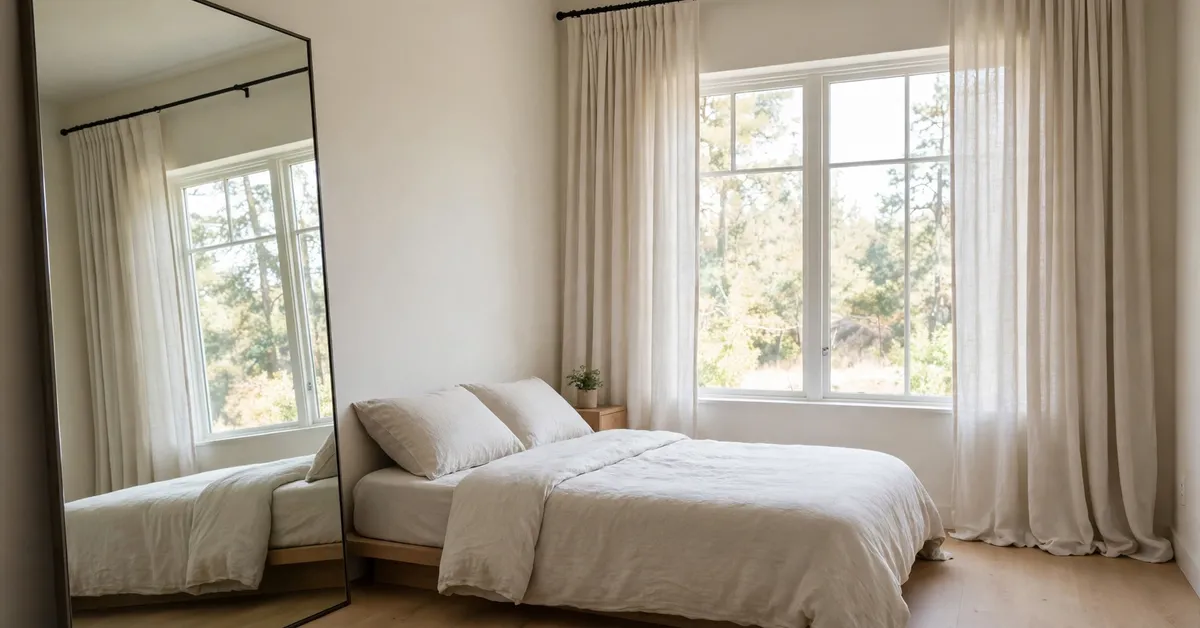
The finish makes the measured room feel bigger than it measures. Carry one light colour family across walls, trim and ceiling, the ceiling the same shade or one lighter, so the box’s edges blur. Hang curtains high and wide: the rod 4–6 inches above the frame as standard, 6–12 inches toward the ceiling when height is the goal, and panels 6–12 inches wider than the frame on each side, so they stack on the wall and the whole pane of glass shows. Add one large mirror opposite or beside the window, light at three heights with every bulb around 2700K — the warm-light rule our cozy living room ideas guide is built on — and bedding layered in one tonal palette, so the bed reads as one calm field instead of a dark block.
Zone 1 — Layout First: The Bed and Its Clearances
1. Measure the Room Before You Move Anything

The tape-measure hour decides everything else: the room’s dimensions, the door’s swing, the window and closet positions, then the bed’s outline and the walkways taped on the floor. Keep at least 24 inches clear at the foot and open sides and about 30 inches on the walked side. If the tape says the clearances fail, change the plan on the floor — not after the furniture is in and the room has started arguing back.
2. Put the Bed on the Longest Wall
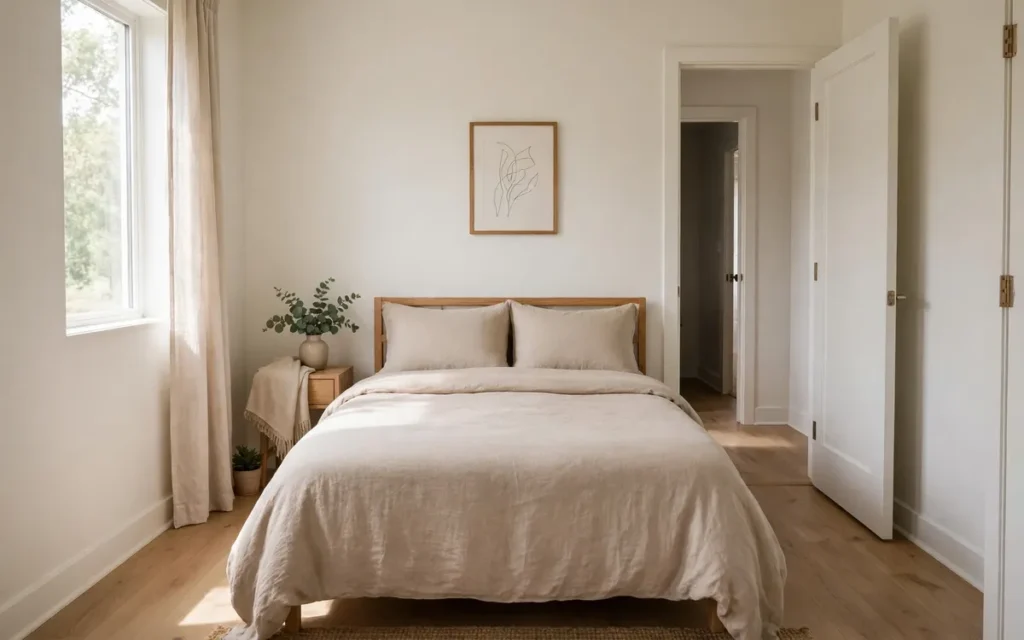
The bed is the room’s largest object, so its wall decides the room: the longest unbroken stretch, out of the door’s direct path and clear of its swing. Never block a closet approach (that 24–30 inches), a vent or a radiator with the frame. A bed that fights the room’s fixed points loses every single day, not just on moving day — the fixed points always win, so plan around them from the start.
3. Right-Size the Bed to the Room

The largest bed that keeps the clearances is the right bed. A queen mattress is 60 × 80 inches — about 33 square feet, nearer 38 with its frame — which eats close to half of a 70 square foot minimum-size bedroom. Stepping down to a full (54 × 75 inches) hands back about 5 square feet of mattress and several inches of walkway on every side. And a Murphy bed, where one is considered, is a decision about the room’s longer dimension, not a shortcut around the measuring.
4. Keep the Bed Low and Drop the Footboard
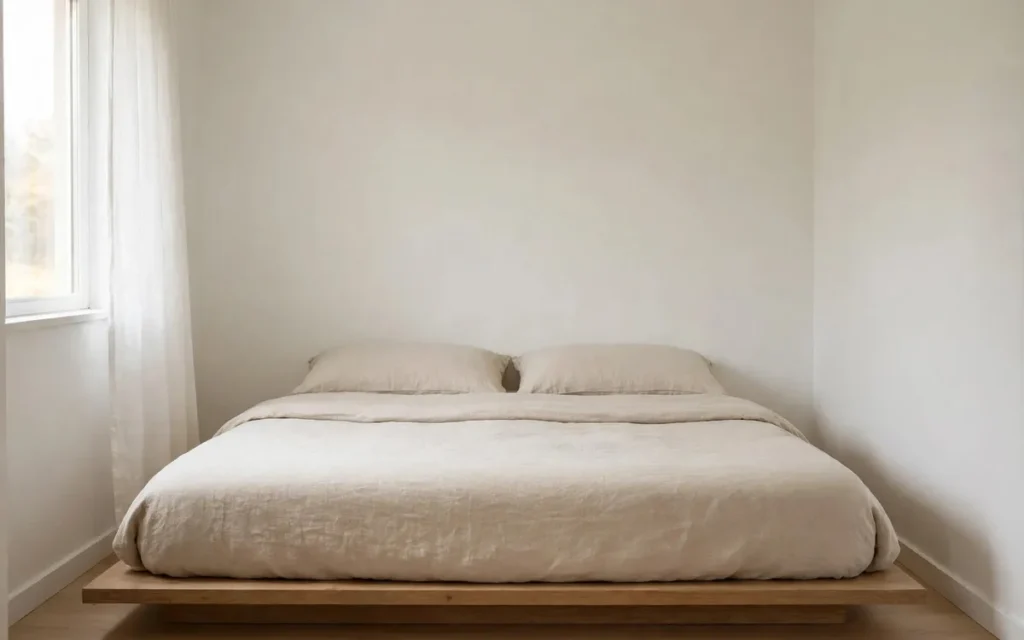
A low or platform frame leaves more wall visible above the mattress, so the ceiling reads higher and the room’s centre reads lighter. A footboard does the opposite: it closes the foot view and shortens the room’s longest sightline. Advice genuinely splits on legs versus legless frames — either beats a bulky skirted base. What matters is low, slim and uncluttered at the foot, where the walkway passes.
5. Push the Bed Into the Corner Only for One Sleeper

The corner frees more floor than any other layout, and for a single sleeper in a truly tiny room it can be the right call — with its trade-off stated plainly. The wall side becomes hard to make and awkward to climb into, so couples keep both sides reachable, with 24 inches on the main side at the very least. The corner is a one-sleeper’s tool, not a default for every small room.
Zone 2 — Storage That Climbs
6. Store Under the Bed
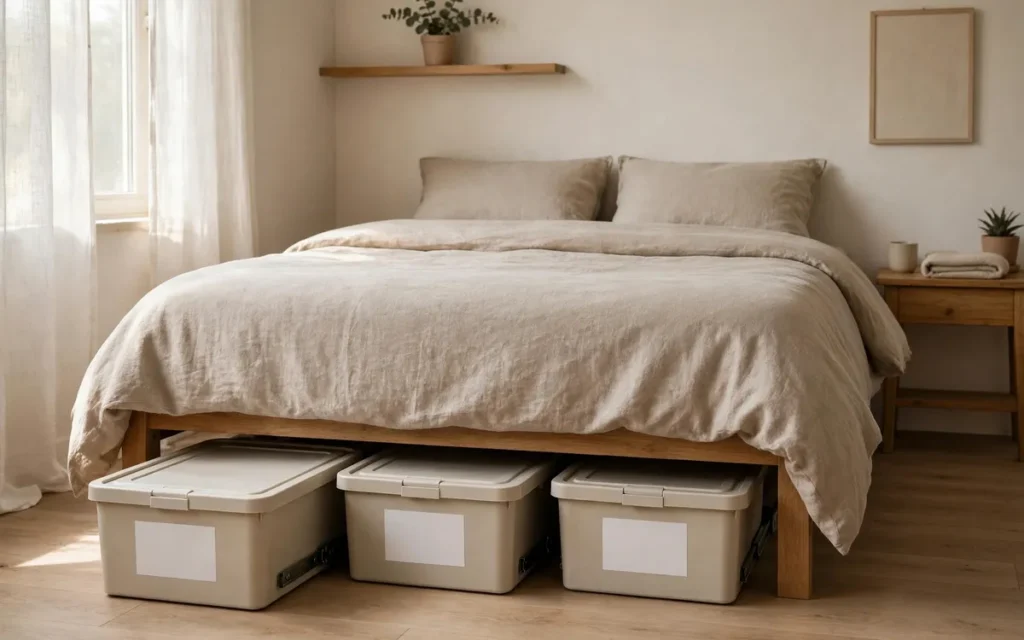
The room’s largest patch of floor is already occupied — it should store, too. Drawers or lidded roll-out boxes under the bed take spare bedding, clothes and the off-season layer at zero extra footprint. Measure the gap under the frame before buying boxes: 6–9 inches is typical, but rails, legs and slats vary. Label the boxes, keep them closed, and put the opening side on the walkway, not against the wall.
7. Float the Nightstand, Free the Floor
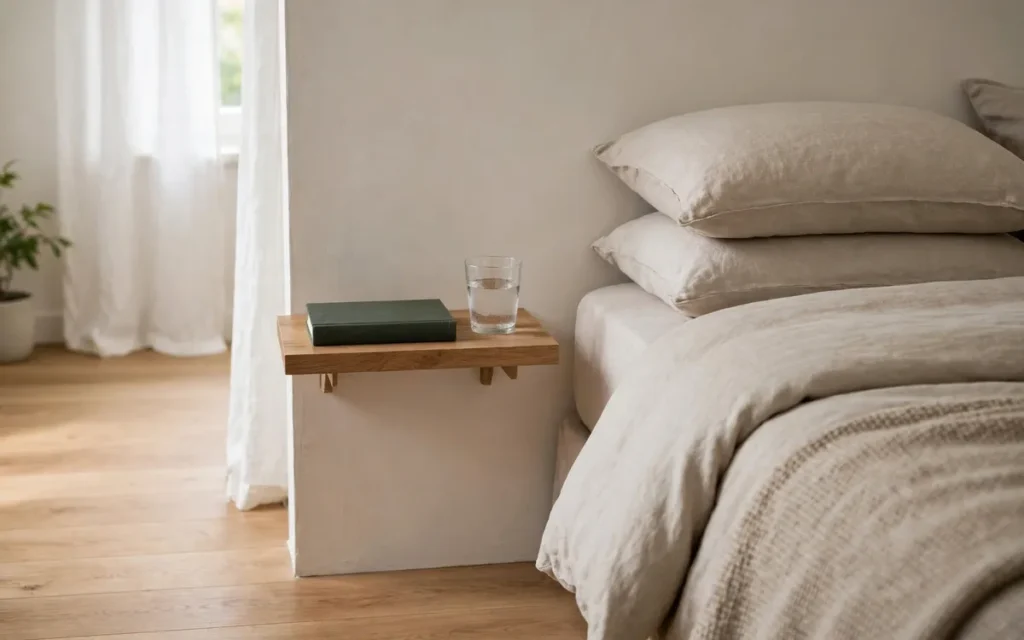
A wall-mounted shelf or slim floating nightstand holds what a nightstand actually holds — a light, a book, a glass of water — without eating roughly 2 × 2 feet of floor or breaking the floor’s clean line. Keep the top to three things only. The light moves to the wall (Idea 13), chargers live in the shelf’s little drawer or a basket below, and the visible floor does half the work of making the room read bigger.
8. Run One Shelf Above the Bed — Lightly

One shallow shelf above the headboard gives a small bedroom display and storage where no floor exists: small baskets, one plant, a piece of art. Keep it about 8–10 inches deep, fix it into studs or with fixings rated for the load — the maker’s instructions govern, always — and let only light things ever sit on it. Nothing heavy goes above pillows, ever. A picture ledge is the shallower, calmer alternative.
9. Use the Door: Its Back and the Band Above It

The door is two storage surfaces nobody prices. On its back: hooks or a slim organiser for bags, scarves and tomorrow’s clothes. Above its frame: a shelf on the forgotten band, holding closed boxes of rarely reached things. Check the load the door and its hinges can carry, and make sure the door still closes fully. And keep the high shelf for the seldom-used — anything reached for weekly becomes a daily annoyance up there.
10. Swap the Wide Dresser for a Tall, Narrow One
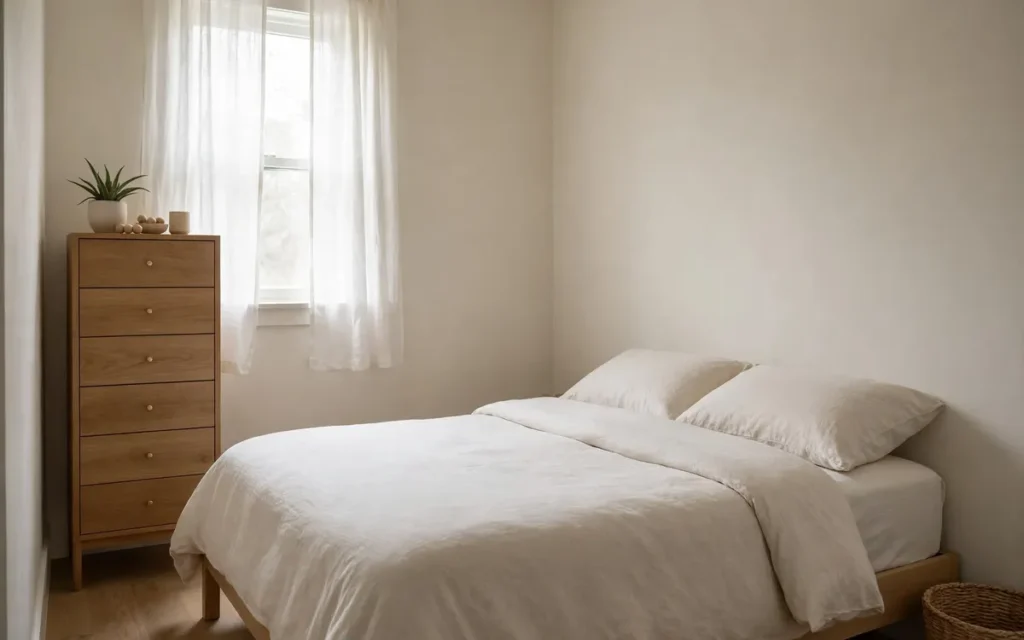
Fewer, taller pieces beat many small ones. A tall, narrow dresser holds a similar volume on about half the footprint, and height is the one direction a small room has spare. Tall storage goes on one wall only — a second tall wall closes the room in. And the dresser gets anchored to the wall with anti-tip straps as part of the same job, not as an afterthought; the safety section below explains why that is non-negotiable.
Zone 3 — Light and the Look of Space
11. Hang Curtains High and Wide
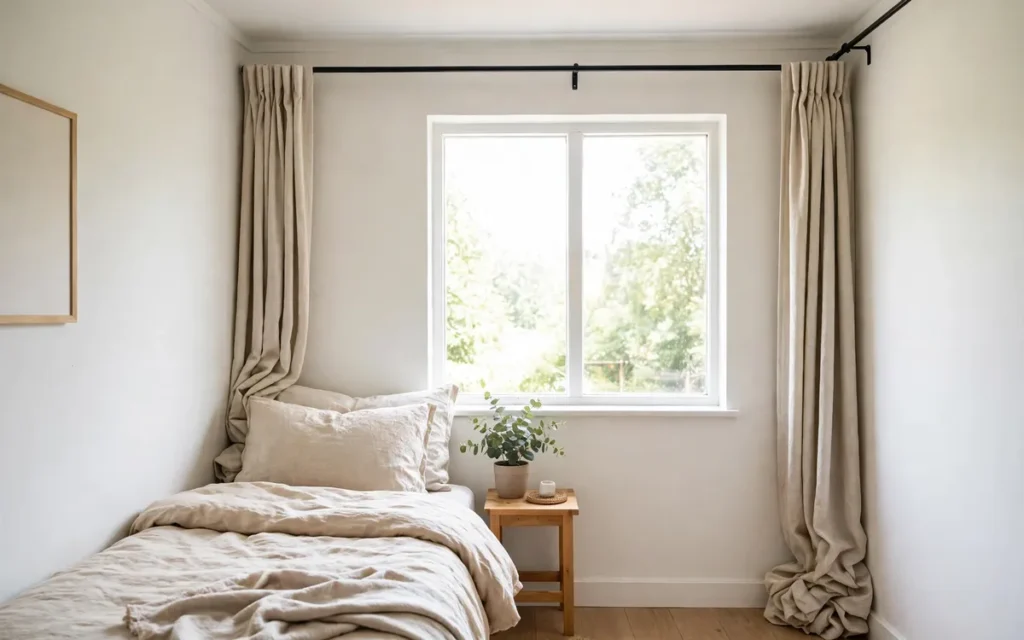
The right window treatment changes the room’s proportions: the rod goes up and out, the panels stack back onto the wall, and the whole pane of glass — and its daylight — stays in the room. Hang the rod 4–6 inches above the frame as standard, or 6–12 inches toward the ceiling when height is the goal; extend it 6–12 inches beyond the frame on each side; and let the hem just kiss the floor. A sheer behind a blackout panel gives daylight and sleep both.
12. Give the Room One Large Mirror

The most-repeated move in every small-room guide, done once and done large: a mirror opposite or beside the window doubles the daylight and the view, and one large mirror reads as depth where several small ones read as decoration. Check the reflection from the pillow before fixing anything — the mirror doubles whatever it faces, so aim it at the window or a calm view, never at the closet or the laundry pile. A full-length leaner by the door is the no-drill version.
13. Layer Light at Three Heights
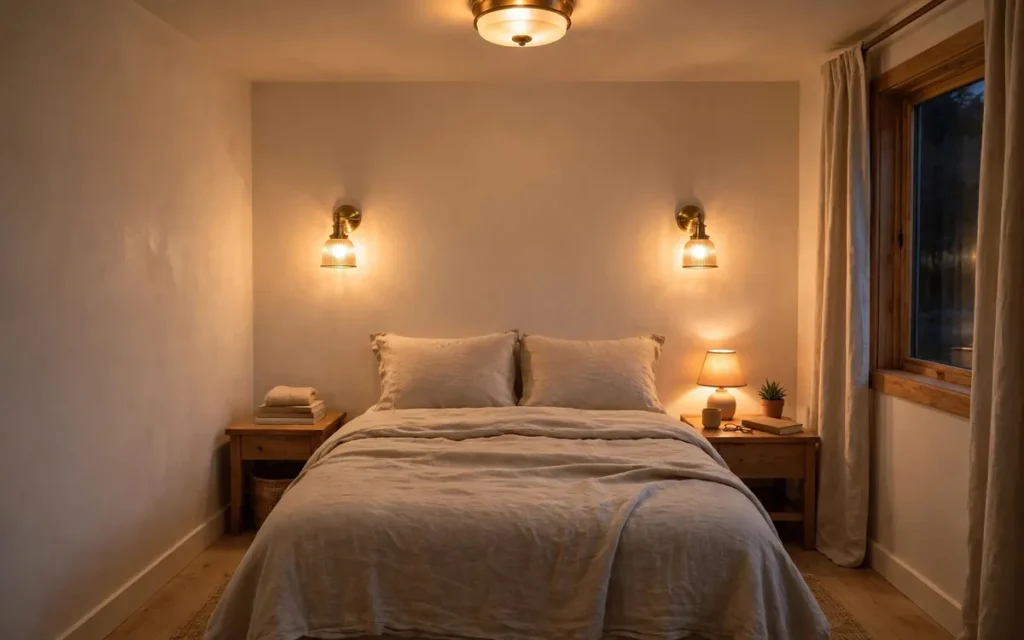
One harsh overhead bulb flattens a small room and shadows its corners shut. Three soft layers open it: ambient light overhead or washed up a wall, a bedside task light, and one low accent. Wall sconces or swing-arm lights free the nightstand entirely (Idea 7). Keep every bulb around 2700K so the layers agree with each other, and put them on dimmers or smart bulbs where you can, so one small room runs from bright morning to low evening.
14. Paint Walls, Trim and Ceiling as One Light Colour
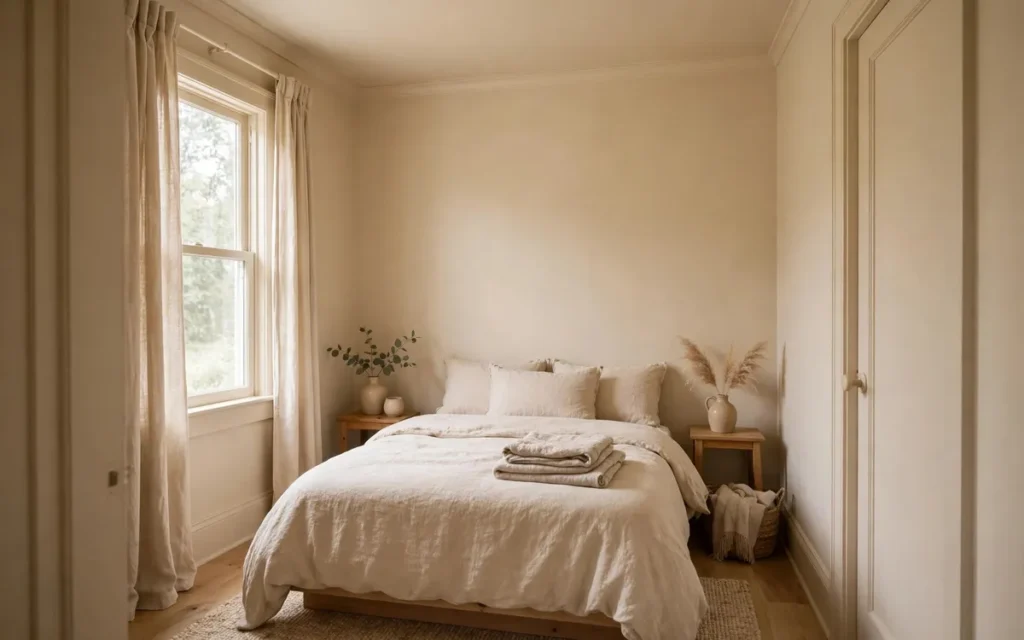
Colour carried across every surface blurs the lines where the box’s faces meet, and the room reads as one continuous space instead of a box with a lid. Choose light, warm neutrals with a high light-reflectance value — the number is printed on paint chips and listed by makers online — in a matte or eggshell finish, with the ceiling the same shade or one lighter. The honest exception: a fully drenched dark room can blur its corners in strong daylight, but in a small, low-light room, light is the reliable route.
15. Draw the Eye Up With a Tall Headboard

Height is the small bedroom’s cheapest illusion. A tall, slim headboard pulls the eye upward and gives the bed wall a vertical accent that costs no floor at all. Keep it within the bed’s width and slim in profile — tall, not bulky. Vertical lines elsewhere reinforce the same direction: panelling, or stripes running along the room’s longest side rather than across it, quietly stretch the room the way the headboard lifts it.
Zone 4 — The Bed as the Room’s Soft Centre
16. Layer Bedding in One Tonal Palette
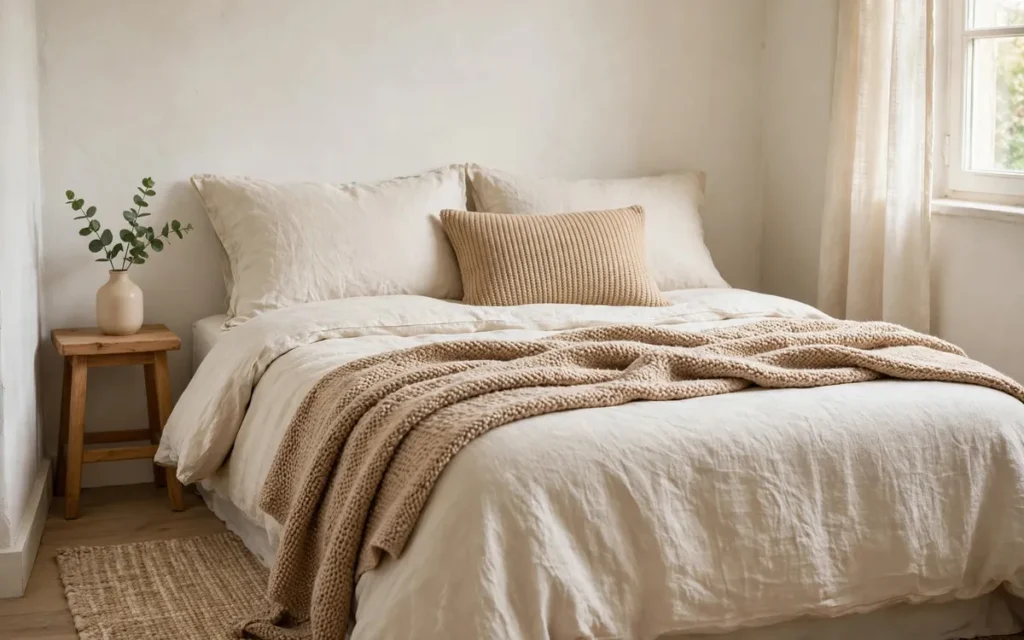
The bed is the room’s largest surface, so its layering sets the room’s calm: sheets, a duvet or quilt and one throw in a single tonal family, with texture — linen, a knit, a woven throw — doing the work patterns would otherwise shout about. Repeat one accent colour at least three times (cushion, throw, art) so it reads as a decision. Light bedding against light walls stops the bed reading as a dark block; the seasonal version of this layering is our cozy fall bedroom ideas guide.
17. Size the Rug to the Bed
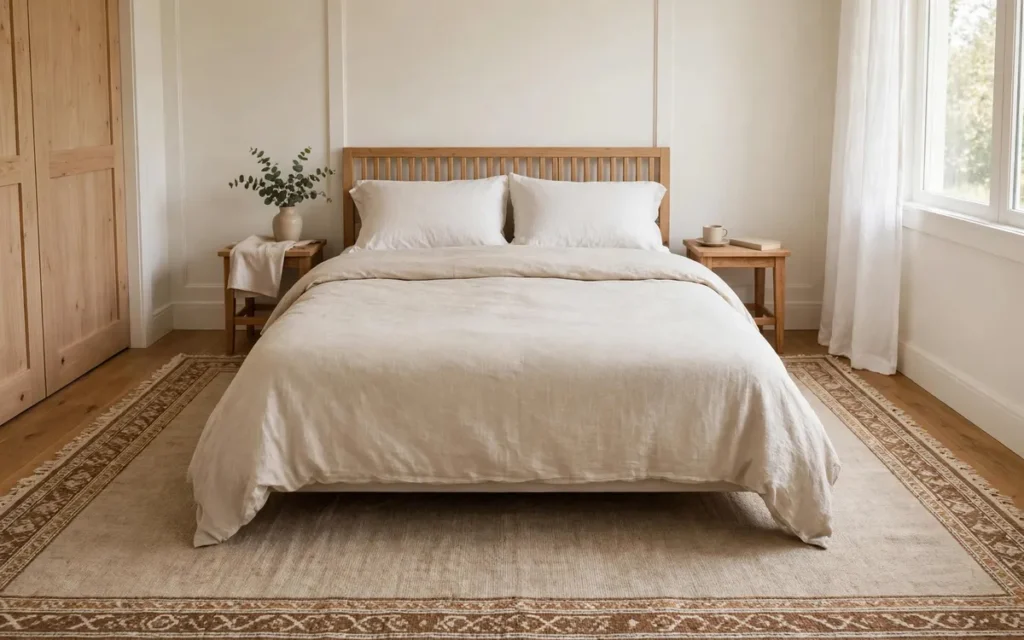
A rug is sized to the bed it frames, not to the leftover floor: it runs under the bed and out past its sides, so bed and rug read as one continuous surface and bare feet land soft on both sides. The rug should extend at least 18 inches beyond the bed’s sides — an 8 × 10 ft rug under a queen does exactly that. A 5 × 7 under a queen shows no border and floats as an island; in a room barely wider than bed plus walkways, honest bare floor beats a sliver-bordered rug.
18. Keep Prints Small-Scale

From across a small room, a small-scale print reads as texture while a large one reads as noise — pattern discipline is what lets a patterned room stay calm. Put small prints on the soft things (bedding, curtains, a cushion), keep solids everywhere else, and allow only one large-pattern or statement element in the whole room: the focal point of Idea 23. Everything else stays quiet so that one piece can speak.
19. Trail One Plant Where It Uses No Floor

Greenery softens a small bedroom’s hard edges, and the trailing kind does it from above: one plant spilling from the high shelf or the top of the wardrobe adds life at zero floor cost. One plant is a room accent; three is a shelf garden competing with the storage. And where the light will not keep one alive, a good faux plant is the honest choice — the room does not need a dying plant to prove a point.
Zone 5 — Double-Duty Pieces and the Finish
20. Choose Furniture That Does Two Jobs

In a small bedroom every piece is interviewed. A storage ottoman or trunk at the foot holds bedding inside and works as a seat and a surface outside; a rolling cart serves as nightstand, desk caddy or dressing table and moves where the day needs it. The rule is simple: a second job, or it leaves — a piece that only decorates is spending floor the room does not have. Give the cart’s lower tiers baskets, so the double duty stays tidy, not just possible.
21. Tuck a Slim Desk Into One Corner

Where the bedroom must also work, a slim desk earns its corner instead of apologising for it: about 16–20 inches of depth is enough for a laptop and a notebook, with storage built upward — cubbies, a shelf above — rather than drawers spreading sideways. Keep the surface clear enough to use daily, because a desk that becomes a shelf has failed both jobs. Let it double as a dressing table with the room’s mirror from Idea 12, and the corner works twice as hard.
22. Wallpaper the Bed Wall Only

One patterned wall gives a small bedroom its feature without shrink-wrapping it: the bed wall in a small-scale print, the other three walls left in the room’s calm colour. Peel-and-stick paper makes the idea renter-honest, because it comes down clean when the lease ends. One wall is a feature; four walls is a smaller room. And the pattern stays small-scale, per Idea 18 — texture from across the room, not noise.
23. Land the Eye Once: One Focal Point
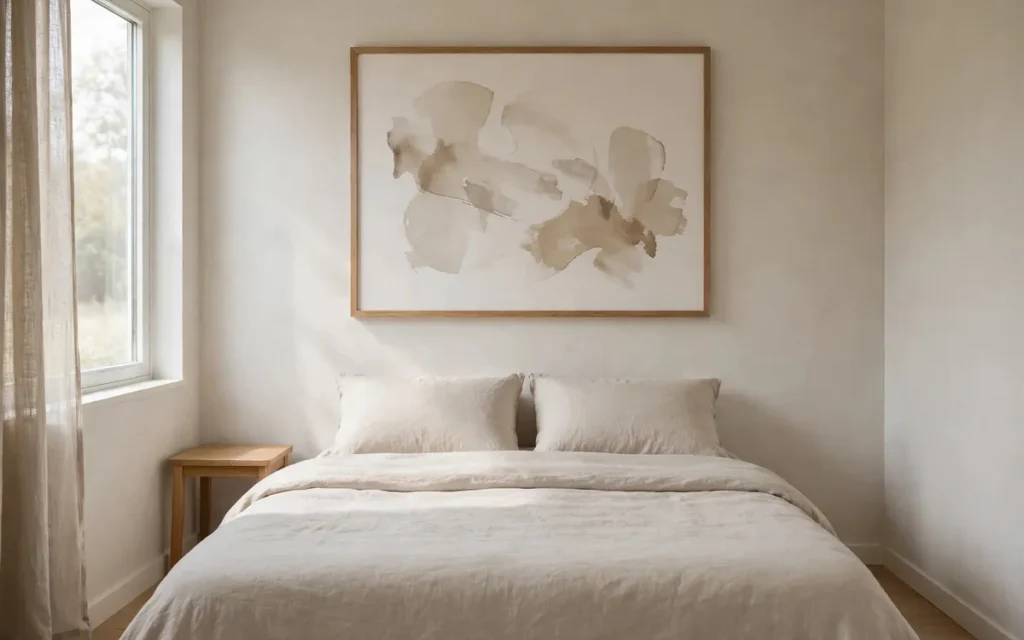
The finished room gives the eye one place to land: one large piece above the bed, or a few large-framed pieces — not a wall of small frames, which makes the room feel busy at exactly the scale it can least afford. The focal point is the room’s only loud element; everything else stays quiet around it. And every surface keeps its short list — the nightstand’s three things, the dresser’s clear top — because calm surfaces are the finish, not an extra.
What Small Bedroom Decorating Costs: Three Budget Levels
$0 — The Measured Reset
Tape the layout, move the bed to the longest wall, clear every surface and the floor, restyle the bedding from the linen cupboard, swap in warm bulbs already owned elsewhere in the house, and borrow the hallway’s mirror for a week to test the wall. Most small bedrooms were never unstylish — only unmeasured and unedited — and this level proves it before a single purchase.
Under $75 — The Climbing Kit
Lidded under-bed boxes, over-door hooks, one floating shelf, and a longer curtain rod so the existing curtains can be rehung high and wide. This level buys the two things anyone sitting on the bed actually feels: storage that has left the floor, and a window finally showing at its full size.
A Few Hundred and Up — The Structural Pieces
Paint for the whole room (a 10 × 10 ft room’s walls take roughly two gallons for two coats), the right 8 × 10 ft rug, plug-in sconces, a storage ottoman, and the tall narrow dresser. One honest note about this level’s order: the bed frame is the last thing to buy, not the first. A storage bed is a furniture decision priced like furniture — and no new frame fixes clearances that a tape measure and a stepped-down size would have fixed for free.
7 Mistakes That Shrink a Small Bedroom
- A bed the room can’t carry. A king, or a queen forced into a room that then has no walkways: the mattress is chosen by desire and the room pays for it daily. Measure first — the largest bed that keeps 24 inches of clearance is the right bed (Step 1, Idea 3).
- Many small pieces instead of fewer tall ones. Five small items of furniture, each apologising, where two taller pieces would hold more and read calmer. Small rooms need fewer, taller, harder-working pieces (Step 2, Idea 10).
- A small rug floating in the middle. A rug sized to the leftover floor chops the room into pieces, and the half-size rug is the worst option of all. Size the rug to the bed — at least 18 inches beyond its sides — or go honestly bare (Idea 17).
- A patchwork of colour and pattern. Competing contrasts chop the walls into small pieces, and dark colours under heavy curtains close a low-light room like a lid. One light family across walls, trim and ceiling; prints small-scale; one loud element at most (Ideas 14, 18, 23).
- Open storage everywhere. Visible everyday stuff is visual clutter, and a small room shows all of it. Storage that holds daily life stays closed; open shelves are for the few calm things (Step 2).
- Blocking the paths and the light. The bed across the door’s swing or the closet’s approach, the wardrobe over the window wall, a door that cannot open fully. The fixed points win every argument — plan around them, not against them (Step 1, Idea 2).
- One harsh overhead light. A single bright bulb flattens the room and shadows its corners, and shadowed corners pull the walls inward. Layer the light at three heights and keep it warm (Idea 13).
A Small Bedroom, Safely: Fixings, Tip-Overs, Flame and Cords
This guide sends storage upward, so its fixings are part of the advice. Shelves, mirrors and art above or beside the bed belong on fixings rated for their weight — into studs or with proper wall anchors, following the maker’s instructions — and only light items ever sit on a shelf above pillows. Tall, narrow furniture, including this guide’s own dresser advice, gets anchored to the wall with anti-tip straps as part of the same job: tip-over is a documented risk with tall furniture, especially where children climb or pull, and a strap costs a tiny fraction of the dresser. Over-door organisers stay within the load the door and its hinges can carry, and never where they stop the door closing fully — a bedroom door that cannot close is a safety feature removed, not storage gained.
Bedding is the most flammable surface in the home, and the nightstand sits against it — so real candles do not live beside the bed; the flameless candle is the default there, and any real flame in the room sits on a stable, heat-safe surface away from curtains and bedding, never left burning in an empty room. Lamps keep shades and bulbs clear of draped fabric and stay at or below their rated maximum wattage, and their cords run behind furniture where they can be seen and checked — never trapped under a mattress or a rug, where they wear unseen. The bed never blocks a vent or a radiator, and the path beside the bed stays clear at night for the simplest of reasons: it is also the dark-hours route to the door.
Frequently Asked Questions
How do I make a small bedroom look bigger?
In this guide’s order: layout, storage, then light and palette. Place the bed on the longest wall with at least 24 inches clear around it; send storage under the bed and up the walls, closed; then carry one light colour across walls, trim and ceiling, hang the curtains high and wide, add one large mirror opposite the window, and layer warm light at three heights. No single trick does it — the order does, because each step hands the next one a clear room to work in.
What colours make a small bedroom look bigger?
Light, warm neutrals with a high light-reflectance value (the number is printed on paint chips and listed by makers online), in a matte or eggshell finish, carried across walls, trim and ceiling so the box’s edges blur. Designers disagree about dark colours: a fully drenched dark room can blur its corners in strong daylight, but in a small room with one modest window, light colours are the reliable answer — and a paint can only reflect the light it receives.
How much space should I leave around a bed?
At least 24 inches (60 cm) at the foot and along each open side, about 30 inches (75 cm) on the side you actually walk and dress on, and 24–30 inches of clear approach in front of the closet and dresser drawers. Guides vary between 24 and 36 inches for the comfort figure; the working rule is 24 inches as the floor and 30 where life happens — and if every edge cannot have it, the honest fix is usually a smaller bed, not a tighter squeeze.
What size bed is best for a small bedroom?
The largest that keeps the clearances above. A queen mattress is 60 × 80 inches — about 33 square feet, close to half of the 70 square feet that building codes allow as the smallest bedroom — and needs roughly a 9 ft × 8 ft 8 in room to keep 24 inches around it. A full, at 54 × 75 inches, hands back about 5 square feet of mattress and several inches of walkway on every side. In a room near 100 square feet, a full often restores the paths a queen eats: measure the room, tape the outline, and let the tape decide.
How do I add storage to a small bedroom without more furniture?
Use the space the room already wastes: under the bed (drawers or lidded boxes — measure the gap first, 6–9 inches is typical), above the door (closed boxes of rarely used things), on the walls (one floating nightstand, shelves), and behind the door (hooks and a slim organiser). Keep it closed wherever everyday things live, put tall storage on one wall only, and let double-duty pieces — a storage ottoman, a rolling cart — replace single-purpose ones.
What size rug should go in a small bedroom?
One sized to the bed, not to the leftover floor: the rug should run under the bed and extend at least 18 inches (45 cm) beyond its sides, which an 8 × 10 ft rug does under a queen. A 5 × 7 ft rug under a queen shows no border and floats as an island — the half-size rug is the worst option of all. In a room barely wider than the bed plus its walkways, honest bare floor beats a rug that leaves only slivers showing.
The same measured discipline, applied to the wettest room in the house: small bathroom ideas — protect the clearances, store up the walls and light it warm.
Your nightstand is the smallest surface in the room, and it has its own rules — the right lamp height, one tray for the nightly group, and a third of the surface left empty. See the full bedside guide: 21 Pretty Nightstand Decor Ideas for a Bedside That Feels Finished.
Once the right dresser is standing in a small bedroom, its top is the next job: anchor the wall above it, zone the surface, and keep a third of it clear for folding clothes. Our guide to 22
Effortless Top of Dresser Decor Ideas for a Tidy, Working Bedroom has the measurements and the full idea list.
Every idea above makes a small bedroom feel bigger with light, bright tricks, but a small room has a second direction worth knowing: go deliberately dark. Deep colour blurs the corners the eye measures the room by, and with three low light sources and a pale bed the room reads cocooned rather than cramped; that whole measured system is in our moody bedroom ideas.
One last lever for a small room is colour discipline: a warm neutral scheme, built by undertone and a counted number of textures rather than by adding more things, makes a tight bedroom feel deeper without any visual noise. The measured version of that system — named warm whites with their LRV numbers, three textures on the bed and the 2700K light rule — is set out in our cozy neutral bedroom ideas.
This guide is written for a sleeper whose size holds still — but if the small bedroom belongs to a child, three rules change everything: no raised bed before age six, storage placed at the child’s reach instead of the adult’s, and a desk fitted by the 90-90-90 test. The measured kids’ version of this room is our small bedroom decor ideas for kids.
When the small room in question is also the guest room, the layout arithmetic in this article is only the first half of the job — once the bed fits, hosting becomes a second, shorter system laid over it: a bed that has actually been slept in, a landing zone for the suitcase and the right number of pillows and lights at each side. Our guest bedroom ideas set out that tested system, so a small room can host properly without growing any bigger.
Small rooms also reward a single strong idea, and for a child that idea is often a theme. Our space themed bedroom ideas use the same measure-first discipline — glow stars, planet decals and bedding that can change as the child grows — so a small bedroom feels like an adventure without needing more floor space.
Conclusion
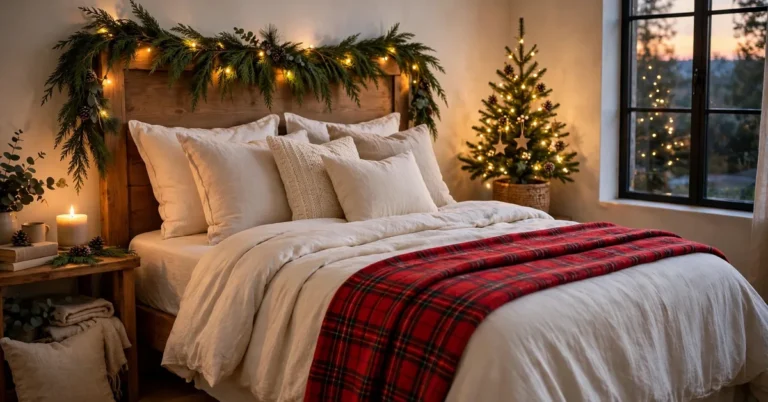
Measure it, store it upward, then soften it. A small bedroom is decided by the bed’s clearances, the storage’s direction and one calm palette — the decor is just how those decisions show. This room’s seasonal layers live in our fall bedroom guide and our Christmas bedroom ideas, and the same measure-first discipline runs the narrow living room.
The best small bedroom decor ideas are rarely new purchases. They are the same room you already have — measured once, its storage sent up and under, its light softened — finally given the space to feel twice its size.


8 Comments