

18 Thoughtful Guest Bedroom Ideas That Feel Like a Hotel, Not a Spare Room
A guest room is the only bedroom in the house judged by someone with no reason to be kind about it — and too polite to be honest either. It is not judged in the doorway at noon, among the cushions; it is judged at 2 a.m., by a guest lying awake in a bed that was never tested, in a room with nowhere to put a suitcase. These guest bedroom ideas begin where a stay actually begins: with one night slept in the room by the host, a bed sized by arithmetic instead of habit, and a room set as a system rather than dressed as a picture. (Our cozy neutral bedroom ideas dressed the owner’s room the opposite way — for the person who sleeps in it every night: their palette, their layers, their habits. The guest room inverts the brief: it is decorated for someone the host may barely know, which is why it runs on counts and tests instead of taste.)
The Method: Sleep It, Size It, Set It
Three decisions, in order, before a single cushion is bought — because a guest room fails at night, in private, on three things no photograph prints: whether anyone ever tested the bed, whether the bed fits the people sent to it, and whether the room was set as a system or arranged as a picture.
Step 1 — Sleep It: The Room Is Tested by Sleeping in It
The first audit is a night, not a look: sleep in the room yourself, once, before anyone else does. Only a sleeper meets the room’s real faults — the dip the back finds at 3 a.m., the streetlight that comes through the blind, the corner that never warms up, the board that squeaks. Run the test honestly: a straightedge laid across the mattress (a dip under 1 inch is a topper’s job; past 1½ inches, no topper rescues it), and the room held at the setting a guest will actually get — 65–68°F, the band the Sleep Foundation publishes as ideal in its best temperature for sleep guide. It is the standard our moody bedroom ideas designed for: a bedroom’s night performance engineered, not decorated; here the auditor is simply the host, and one night in the room is worth a page of styling.
Step 2 — Size It: The Bed Is Chosen by the Guests’ Arithmetic
Width is a per-person figure, and it is unforgiving: a queen at 60 × 80 inches gives two sleepers 30 inches each; a full at 54 × 75 gives 27 each — less than the 38 inches a twin gives one person; and two twin XLs (38 × 80 each) pushed together build a true 76 × 80 king that splits back into singles, a trick two standard twins miss by 5 inches of length. Around the bed, hold the clearance floor — 24 inches on every side a sleeper uses, 36 inches at the foot where the luggage lands — and on top of it, a 2–3 inch topper and two pillows per sleeper. More than any styling, guest bedroom ideas stand on that arithmetic, because a guest forgives a plain room and never forgives a narrow bed. Where the guest room is the home’s box room, its floor-planning is our small bedroom decor ideas‘ own system, cited here for the tight case; this article spends its length on the hosting.
Step 3 — Set It: The Room Is Staged in Zones, Then Stored as One Kit
A guest room fails at its edges, not its center: nothing to land on, nothing in reach of the bed, nothing prepared. So the room is set station by station — a landing surface for the suitcase (Zone C), a working bedside for each sleeper (Zone D), a welcome laid out where it cannot be missed (Zone E) — and between visits, everything the reset needs (the spare sheet set, the tray’s contents, the spare charger) is stored as one labeled kit in the room itself. Set once, in zones, the room returns to ready in minutes; set as a picture, it is re-invented before every arrival.
Zone A — Prove the Sleep
Three proofs before the room is believed: the night the host sleeps in it, the mattress rescued or condemned by a straightedge, and the temperature set to the published band — because a guest room’s comfort is a claim until it has been slept in.
1. Sleep One Night in It Yourself
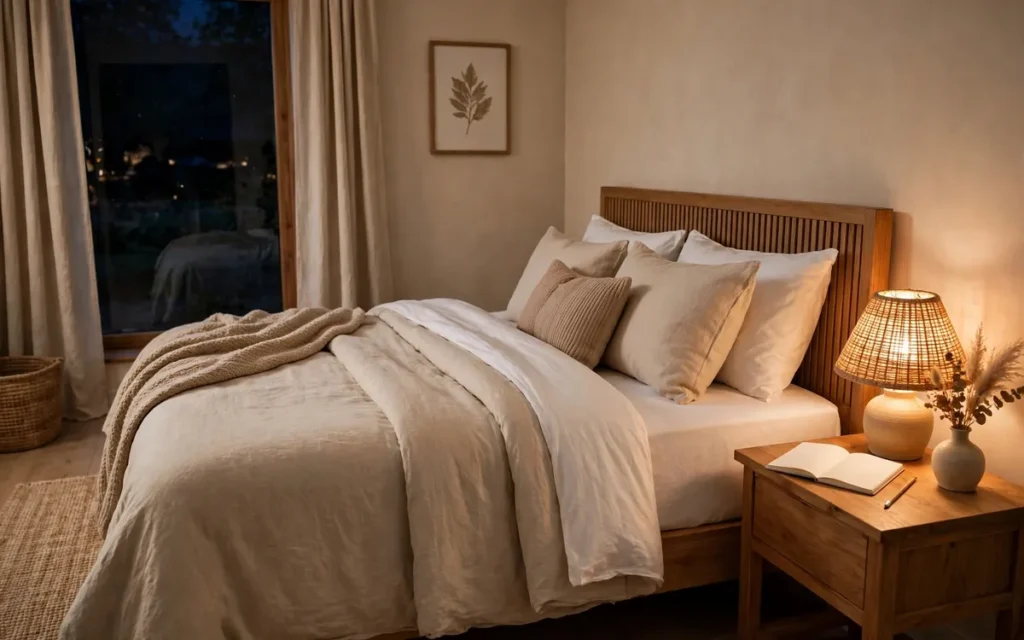
The audit no photograph survives: one night in the room before the first guest, notebook on the stand. Note the four things only a sleeper meets — the dip your back finds at 3 a.m., the light that gets in, the corner that stays cold, the board that squeaks. Whatever bugs you in one night would bug a guest for a week; fix the list, not the look.
2. Rescue the Mattress With a 2–3 Inch Topper

The guest mattress is usually the household’s retired one, and its rescue is bought by thickness: a 2-inch topper softens a sound mattress that is merely firm; 3 inches is the working depth for pressure relief at shoulder and hip. The straightedge decides first — a dip under 1 inch is topper territory; past 1½ inches the foam only follows the sag, and the honest purchase is a mattress.
3. Set the Room to 65–68 Degrees

The room is held in the published band — 65–68°F, with 65°F as the single setting — because no guest reprograms a host’s thermostat out of politeness. Control is handed over in objects instead: a fan for the warm sleeper, idea 7’s blanket in reach for the cold one. The setting is the host’s; the adjustment is the guest’s.
Zone B — Size the Bed
Four sizings settle the bed itself: the default width, the split that makes the room flexible, the pillow count, and the peelable layers.
4. Default to a Queen at 60 by 80
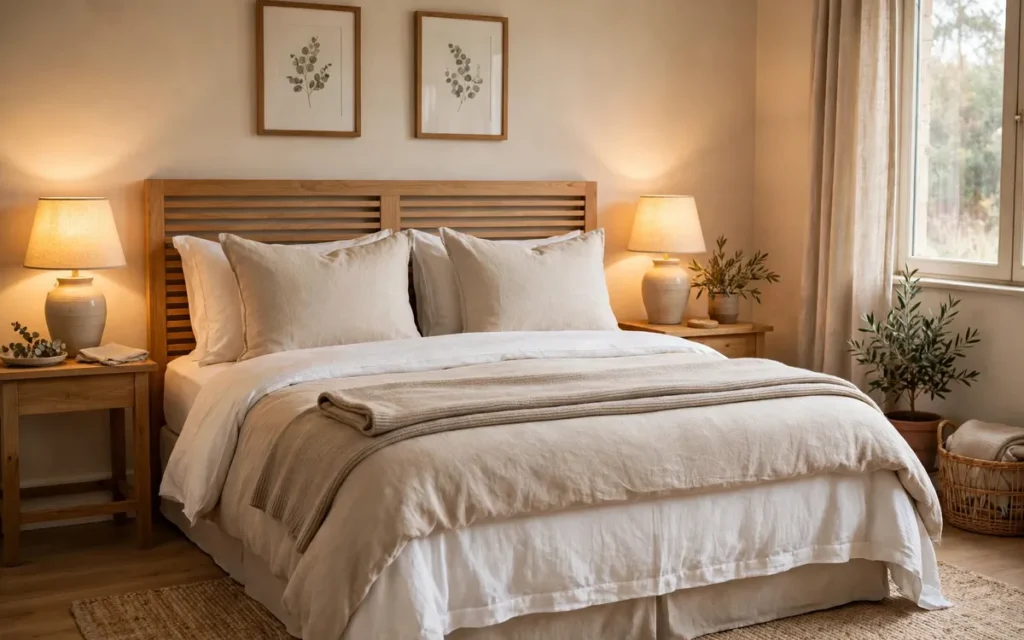
The default is arithmetic, not fashion: 60 inches is 30 inches per sleeper, the narrowest width at which two adults sleep without negotiating. The full (54 × 75) is admitted only when the clearance floor fails around a queen — at an honest 27 inches each. A twin (38 × 75) is a one-guest room stated plainly, not a couple’s bed in disguise.
5. Split It Into Two Twin XLs
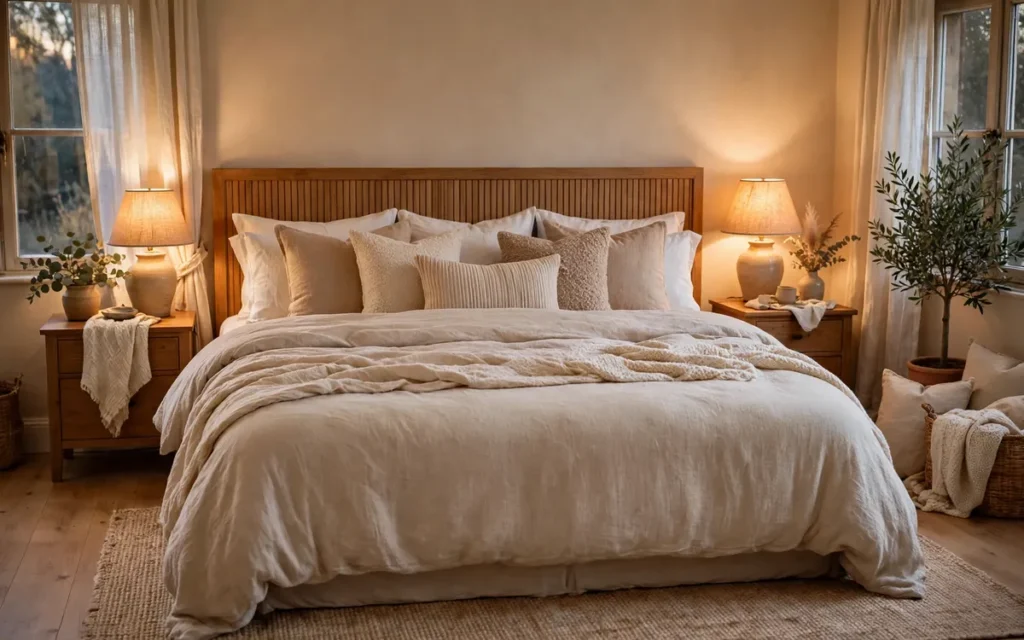
The flexible room’s foundation: two twin XL mattresses, 38 × 80 inches each, pushed together make a 76 × 80 king for a couple, and split into two singles for everyone — siblings, friends, a grandparent and a child. The XL is the whole point: two standard twins (38 × 75) come up 5 inches short of a king’s length, and no shared sheet hides the step.
6. Give Every Sleeper Two Pillows

The count is two per sleeper — one firm, one soft — because pillow preference is the one comfort a host cannot guess and the cheapest one to cover both ways. The firm one props reading; the soft one sleeps. A guest who needs neither loses nothing; a guest who needs the other kind is never reduced to folding a towel under their head at midnight.
7. Layer the Bed in Peelable Layers
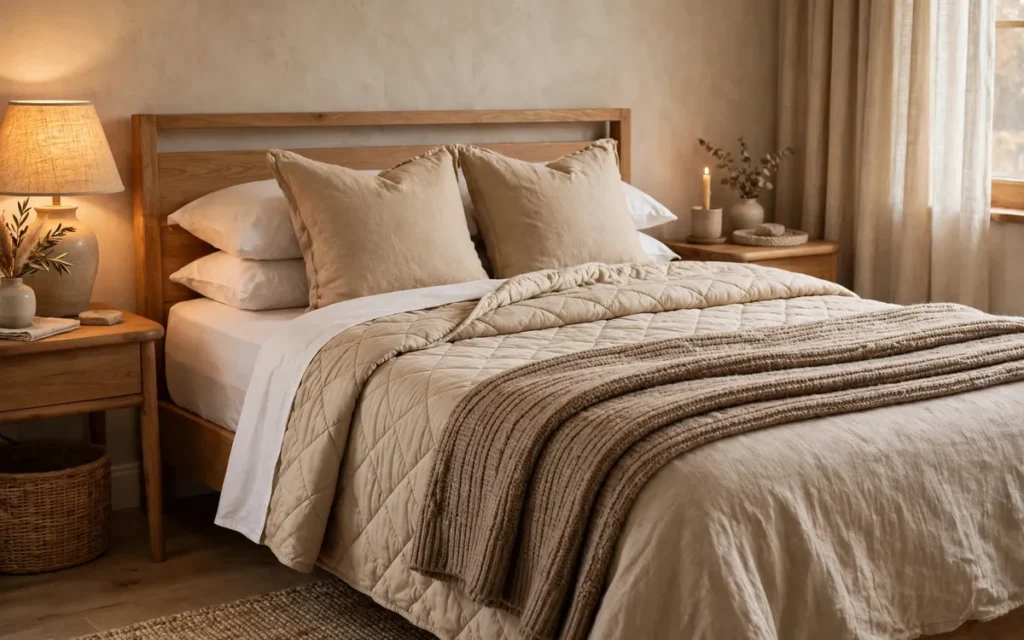
The bed is made in layers a guest can subtract: the fitted sheet, a light quilt or coverlet as the sleeping layer, and one heavier blanket folded at the foot — three depths of warmth against idea 3’s setting, so guests set their temperature from the bed. At turnover the same layers pay again: the wash is a reset, not a rebuild.
Zone C — Leave Room to Land
Everything a guest carries in needs a landing, in the order it arrives. (The home already runs this discipline at its other end: our drop zone ideas give what comes through the front door a station of its own. This zone is the same rule at the visit’s far end — the suitcase, the coat and the keys land here, on surfaces sized for them.)
8. Fold Out a Luggage Rack

The suitcase gets a station, not the bed and not the floor: a folding rack, 24–30 inches wide and about 20–26 inches high in its standard hotel size, opened where the guest can work out of it. Between visits it folds to 4–5 inches thick and lives behind the wardrobe door or under the bed — the cheapest square footage in this article, returning the whole bed for thirty inches.
9. Size the Foot Bench to the Bed
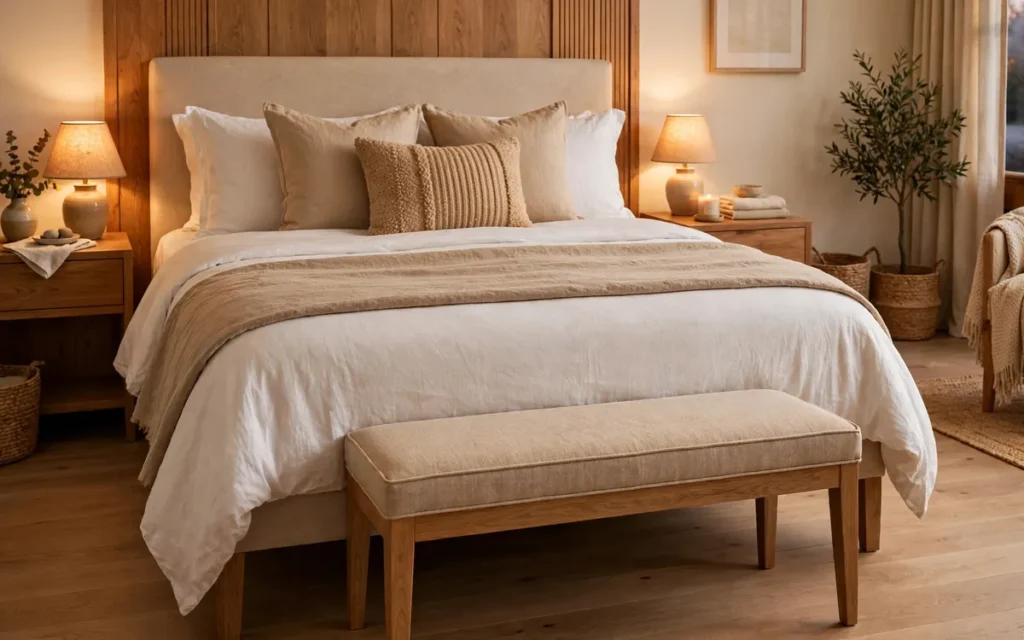
The permanent landing: a bench narrower than the bed by roughly 6–8 inches a side — a 45–52-inch bench under a 60-inch queen — with its top at or just below the mattress top, and 30 inches of walkway kept beyond it. If the foot cannot spare bench plus 30, skip the bench and let idea 8’s rack carry the zone alone; a blocked route helps no one.
10. Clear One Drawer, Free Six Hangers

Storage a guest can use is counted, not gestured at: one dresser drawer emptied completely — not half of one, which reads as the host’s overflow with a guest’s things laid on top — and six empty hangers waiting on the rail beside a cleared run of wardrobe. The guest who can unpack stops living out of the suitcase idea 8 is holding, and the room stops reading as storage.
11. Add Hooks Behind the Door

The vertical landing for what no drawer takes: a row of hooks on the back of the door, or the wall beside it — the robe, the coat, the outfit hung ready for tomorrow — placed where the door’s swing keeps them clear of the wall. In the small guest room this is the wardrobe’s second shift, and it is bought for the price of the hooks.
Zone D — Work the Bedside
The bedside is where a guest meets the room half-asleep, so it is set by reach, not by eye. (This zone fixes the stand’s height and its job list — light, charging, water, each within a stranger’s reach; styling the stand’s top for the room’s own sleeper is our nightstand decor ideas‘ system — useful here, beautiful there.)
12. Set the Guest Nightstand at Mattress Height

The stand’s top lands within 2 inches of the mattress top — the same rule this site sets for the owner’s bedroom, re-run here because guests meet the stand half-asleep, reaching blindly. Lamp switch, glass and phone all land where a hand expects them. Where two sleepers share, each side gets a surface — a stand, a small table, a stool; symmetry is optional, reach is not.
13. Bring Charging Up to the Bed

The outlet is presented, not hunted for: a power strip or charging point on or at the nightstand, at mattress height, with a spare cable waiting in the drawer — never a socket behind the bed that a guest must move furniture to reach. It is the room’s least photogenic idea and one of its most used: a dead phone is the one souvenir no guest should take home.
14. Give Each Side Its Own Light

One lamp per sleeper, switched from the bed: two bedside lamps, or sconces that free the stand’s surface — with warm bulbs in the 2700–3000K band this site standardizes on, and the light at reading height beside each pillow. The rule is symmetry of service, not of objects: no sleeper reads by phone torch because the room’s only light was placed on the other side of the bed.
15. Blackout the Window, Light the Route

Darkness is fitted, not hoped for: blackout curtains or a shade covering the whole glass — the streetlight and the early sunrise are the two complaints guests never make. Where curtains cannot be hung, the fallback is a sleep mask on the nightstand. A low night-light on the bathroom route lights the 2 a.m. walk without waking the room.
Zone E — Finish Like a Host
Three finishes turn a correct room into a hosted one: the welcome assembled as one tray, the towels placed where they cannot be missed, and the whole reset stored as a single kit for the next arrival.
16. Tray the Welcome on the Bed
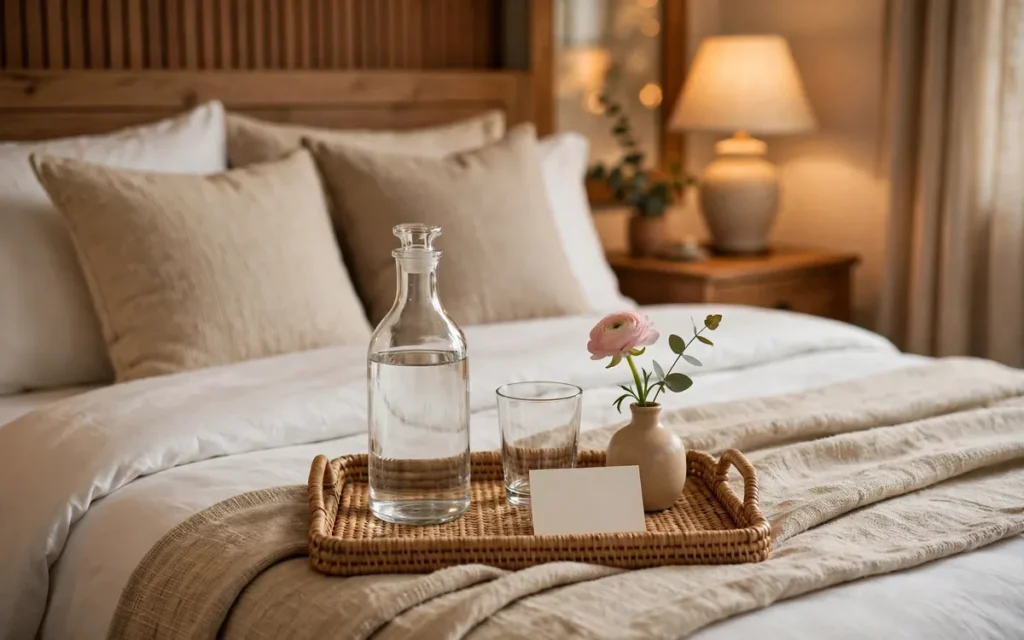
The welcome is assembled on one tray, so it can be set in minutes and stored in one piece: a carafe and glass, the Wi-Fi password on a card, idea 13’s spare charger, and one small living thing — a stem in a bud vase — that says the room was prepared today. The tray is the system: what is not on it is not promised.
17. Leave the Towels on the Bed

Towels are placed where the guest cannot miss them — folded on the bed, or over the rack: one bath towel, one hand towel and a washcloth per guest, so nobody has to ask which bathroom towel is theirs. The bathroom they will be used in is another room’s system; the count and the placement are this one’s, because the welcome happens in the bedroom.
18. Store the Reset as One Kit

Between visits, the room’s readiness is stored, not remembered: the spare sheet set, the folded blanket, the tray’s card and charger, a spare bulb for idea 14’s lamps — one labeled box or basket, kept in the room’s own wardrobe. Turnover becomes a kit emptied onto the room in order, and the room can be ready the same day the phone call comes.
What It Costs: Three Ways In
The audit tier (under roughly $75). The self-test costs nothing; a blackout liner or shade for one window, a folding luggage rack, six spare hangers, a carafe-and-glass set, a plug-in night-light and a power strip for the stand. This tier proves most guest-room failures are a preparation problem — an untested mattress, nowhere to land, nothing in reach — not a shopping problem.
The comfort tier (roughly $75–$400). The 2–3 inch topper (a queen runs roughly $100–$300), the second pillow pair in firm and soft, a foot bench sized to the bed, the second bedside lamp, and a full spare sheet set for the turnover kit. The tier that changes the night itself, bought in method order: sleep rescued, bed sized, room set.
The bed tier (roughly $400 and up). A new queen mattress where the straightedge condemned the old one, a pair of twin XLs and the frame that splits them, fitted blackout curtains, a dresser whose drawer can be honestly emptied. The tier that changes the room’s furniture — worth it only after the audit tier has proven what the room actually fails at.
7 Mistakes That Leave a Guest Room Feeling Like a Spare Room
- Decorating for the doorway instead of sleeping in it. The room is styled at noon and never tested at night, so the first audit is performed by a guest too polite to report it. One night of the host’s own sleep (idea 1) finds the dip, the light leak and the cold corner that seventeen photographs never show.
- Counting a full bed as a two-person bed. A full is 54 inches wide — 27 inches per sleeper, less than the 38 a twin gives one person. Two adults sleep as guests and wake as evidence. The width is divided before the bed is bought (idea 4), not discovered at midnight.
- Piling a thicker topper on a sagging mattress. Foam follows the shape beneath it: over a dip past 1½ inches, a 4-inch topper makes a softer dip, not a flatter bed. The straightedge test (idea 2) comes before the topper is ordered — a topper for firm, a replacement for sagging.
- Leaving the suitcase nowhere to go. With no rack and no bench, the case lives on the bed by day and the floor by night, and the room reads as the household’s storage with a guest stored in it. Thirty inches of folding rack (idea 8) is the difference between a landing and a spill.
- One lamp, one outlet, two guests. The far sleeper reads by phone light and charges a phone in the hallway. A light per side (idea 14) and charging at the stand (idea 13) are bought once; the asymmetry is noticed every night of every stay.
- Half-clearing the drawer. A drawer with the host’s wrapping paper pushed to the back offers a guest storage and insults them with it. The drawer is emptied completely or not offered at all (idea 10) — and the turnover kit (idea 18) is what keeps it empty between guests without a fresh excavation each time.
- Setting the temperature for the host. The host sleeps warm at 72 and sets the house so; the guest lies awake politely in a room held above the published 65–68°F band. The room is set to the band, and the adjustment is handed over in objects — a fan, layers that peel, the extra blanket in reach (ideas 3 and 7).
FAQs
What should every guest bedroom have?
The essentials compress to counts: a tested bed with two pillows per sleeper — one firm, one soft; one drawer emptied completely and six hangers free; a luggage rack or a bench; a light and a charging point within reach of each side of the bed; water on a tray with the Wi-Fi password; blackout at the window; and towels on the bed. Everything else in this article is those nine things done properly.
What size bed is best for a guest room?
A queen — 60 × 80 inches, 30 inches per sleeper — wherever the clearance floor survives: 24 inches on the sides a sleeper uses, 36 inches at the foot. A full only where a queen breaks that floor, knowing it pays 27 inches each; and two twin XLs, 38 × 80 each, where the room must change its mind between a couple and singles.
How can I make a guest room comfortable on a small budget?
In audit order, not shopping order: sleep in it yourself (free), blackout the window, fold out a luggage rack, free the drawer and the hangers, and tray the water and the Wi-Fi card — the under-$75 tier does all of it. The first purchase that changes the night is the 2–3 inch topper, and only on a mattress that passed the straightedge test.
How do I make a small guest room work?
Protect the clearances before the furniture: 24 inches on the side the sleeper uses — one side can go to the wall only in a genuinely one-guest room — and keep the foot’s walkway honest. Then choose the fold-away version of everything: the rack that folds to 4–5 inches, hooks instead of a wardrobe’s second half, sconces instead of lamps crowding the stands.
What temperature should a guest room be?
65–68°F — the band published as ideal for sleep — with about 65°F as the single setting if the thermostat takes one number. Because guests rarely touch a host’s thermostat, the adjustment is given in objects rather than instructions: a fan, layers that peel, an extra blanket in reach. The guest tunes the bed, not the house.
How many pillows should a guest bed have?
Two per sleeper — one firm, one soft — because the preference cannot be guessed and covering both kinds costs one extra pillow per side. The firm props reading, the soft sleeps, and guests who stack both are covered too. Spares live inside the room — on the bench or the wardrobe’s top shelf — never in another room down the hall.
Conclusion
A guest room is not a spare room with better linen; it is a small act of hospitality that either was tested or was not. Work through these guest bedroom ideas in order — sleep it, size it, set it — and the room stops storing a guest and starts hosting one: a bed that fits its sleepers, a landing for everything they carry, and nothing left for a polite stranger to silently forgive.


One Comment