
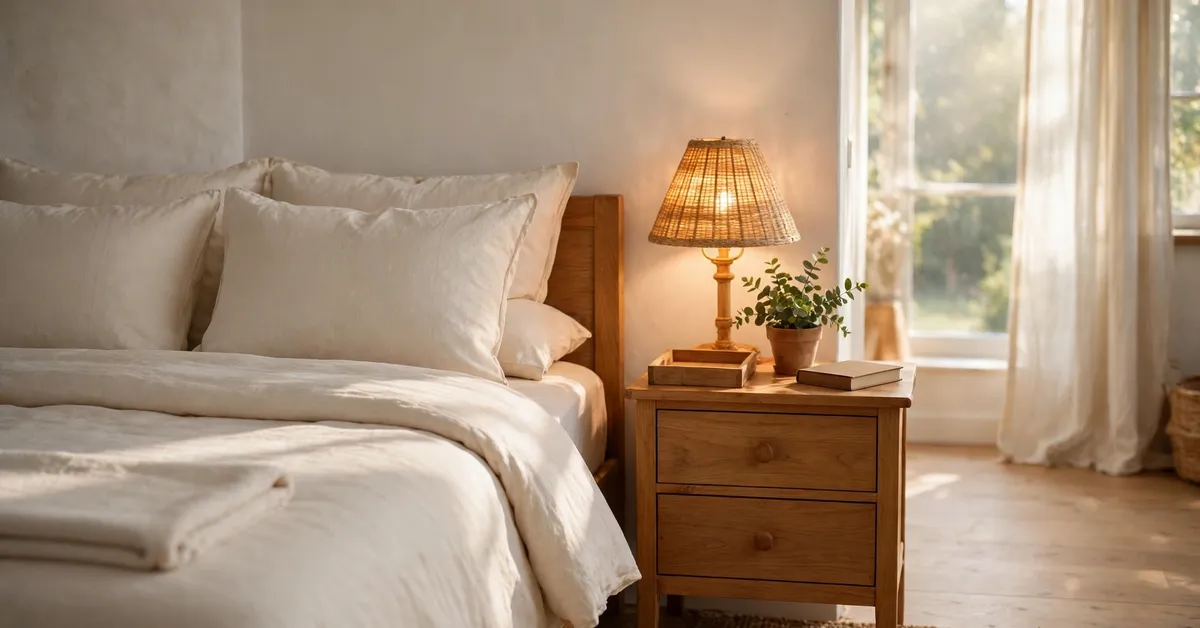
21 Pretty Nightstand Decor Ideas for a Bedside That Feels Finished
Your nightstand is the smallest surface in the bedroom, and somehow it collects the most: a phone, a wandering charger, two water glasses, a book you finished months ago, receipts, hair ties. Then we wonder why the bedroom never feels calm. Good nightstand decor ideas are not really about decorating at all. They are about deciding what earns a place on those few square inches, and giving everything else a home somewhere else.
This guide keeps the list honest: 21 ideas, each one a different move, with the measurements that make a bedside actually work at 1 a.m. — how tall the lamp should be, how much of the surface should stay empty, and where the phone should charge. If the whole room needs attention first, start with our small bedroom decor ideas, then come back here for the one surface you touch first every morning and last every night.
First, the Method: Light It, Tray It, Leave a Third Empty
Every calm bedside you have ever saved follows the same order of work, whether its owner knew it or not. The most useful nightstand decor ideas are just these three moves, done in this order: light first, then a tray for the things the night actually needs, then one living or personal piece — and stop. The order matters, because the lamp decides the layout, the tray decides the clutter, and the empty third is what lets the nightstand still do its night job.
Step 1: Light It First
The lamp is the tallest thing on the nightstand, so it goes on first, in the back corner farthest from the bed. Before you choose one, check two heights. Your nightstand top should sit within about 2 inches of the top of your mattress, so reaching across is level rather than a climb or a drop. And when you sit up against your pillows, the bottom of the lamp shade should land near your chin. Guides quote overall lamp heights from 24 to 32 inches and disagree with each other, because the right number depends on your table and your mattress; the chin test settles it for your bed. One more guardrail: the lamp base should take no more than about a third of the top. The Decor Holic’s step-by-step nightstand styling guide works through the same heights, and they are worth measuring once before you buy anything.
Step 2: Tray the Nightly Essentials
Next, gather the things your night genuinely uses — phone, glasses, rings, lip balm, water — and give them one tray in the front corner nearest the bed. The tray is a corral, not a display: it should be sized to the group, not to the table. Everything that is not used at night moves into the drawer or off the top entirely. This single move is what separates a styled nightstand from a cluttered one, because clutter is rarely too many things; it is things with no agreed place to land.
Step 3: Add One Living Thing, Then Stop
Last, add exactly one living or personal piece — a small plant, a single stem, a framed photo, the book you are reading. One, not three. Then protect the empty third of the surface on purpose. That bare patch is not unfinished styling; it is working space for a water glass, a book and a hand reaching in the dark. A nightstand that cannot accept a glass of water at midnight is a photo, not furniture.
Light First: Four Ways to Get the Glow Right
Light is the whole job of a bedside, and it is where most nightstands quietly fail: a lamp too short to read by, or a bulb so harsh the room feels like a waiting room. Fix the light and half the styling is done.
1. Start With a Lamp at Chin Height
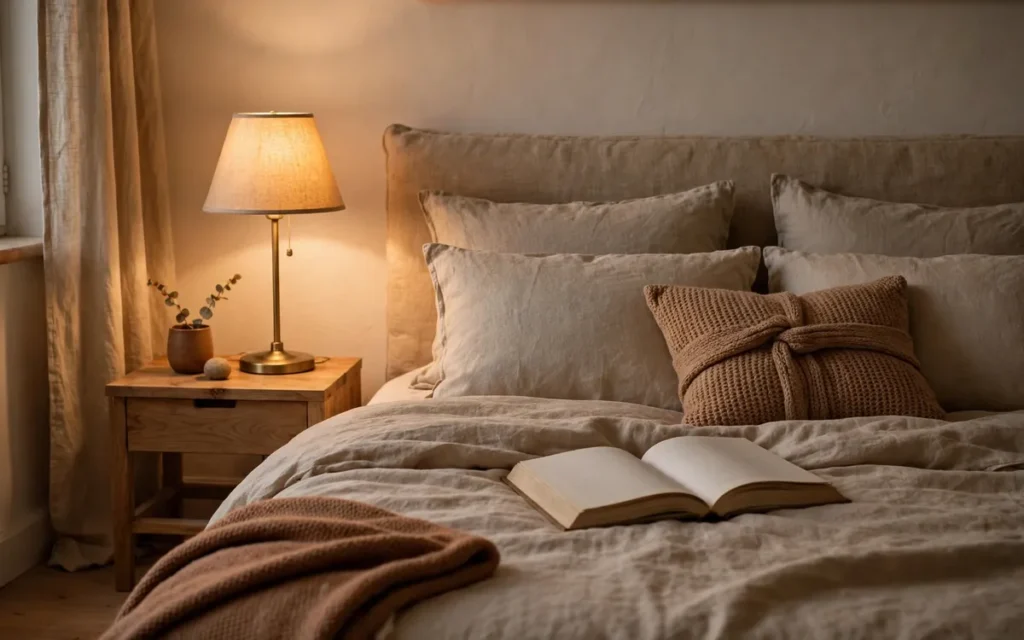
This is the rule the whole article hangs on, so it gets the first idea. Sit up in bed the way you actually read, and have someone check where your chin falls against the wall. The bottom of the shade should sit about there: lower, and the bare bulb glares in your eyes; higher, and the light pools on the ceiling instead of the page. Start your search in the 24 to 32 inch overall range, then let the chin test, not the label, make the final call.
2. Swap the Lamp for a Wall Sconce

If your nightstand top is small, move the light onto the wall and take the whole surface back. A plug-in sconce needs no electrician — it mounts with screws and plugs in like a lamp — and it puts the glow at reading height while the top stays free for the tray and a book. Centre it over the nightstand or just inside its edge, roughly above where a lamp would stand, and choose a shade that throws light down onto the page, not out into the room.
3. Use a Dimmable Bulb at 2700K

The bulb matters as much as the lamp. Choose a warm 2700K bulb — the colour of evening light, and the same warmth that makes cozy fall bedroom ideas feel so settled — and make it dimmable if you can. Full brightness for reading, low for the last ten minutes of the day, and no harsh white glare when you switch it on at 1 a.m. A three-way bulb or a lamp with a built-in dimmer does the same job without smart-home fuss.
4. Add a Clip-On Reading Light for a Shared Bed

Two readers with different bedtimes do not need a brighter lamp; they need a smaller one. A clip or swing-arm reading light attached to the headboard throws a narrow pool of light on one side of the bed only, so one person can finish a chapter while the other sleeps in the dark. Keep the main lamp low and warm for the room’s glow, and let the little light do the work. It also travels well — the same clip light earns its keep in a guest room.
Corral the Nightly Things: Four Moves That End the Clutter
With the light placed, the next job is containment. Everything in this zone answers one question: where does this land at night, every night, without thinking?
5. Give the Nightly Group One Tray

One tray — wood, marble, rattan or ceramic — holding the phone, glasses, lip balm and dish, in the corner your hand reaches first. The sizing rule is the trick most people miss: measure the group, not the table. A tray that fits the nightly things exactly looks composed; a tray twice their size invites refugees, and within a week it holds coins, cables and a screwdriver. If an item is not used at night, it does not live on the tray, however pretty it is.
6. Park Rings and Earrings in a Small Dish

Rings come off at the bedside and vanish by morning into sheets, drawers and once, memorably, a water glass. A small dish — ceramic, brass, a shell, anything with a lip — gives them one landing spot beside the tray. It takes up two inches of surface and ends the morning hunt entirely. This is also the one decorative extra a tiny nightstand can always afford, because it works for its footprint every single night.
7. Move the Charger Into the Drawer
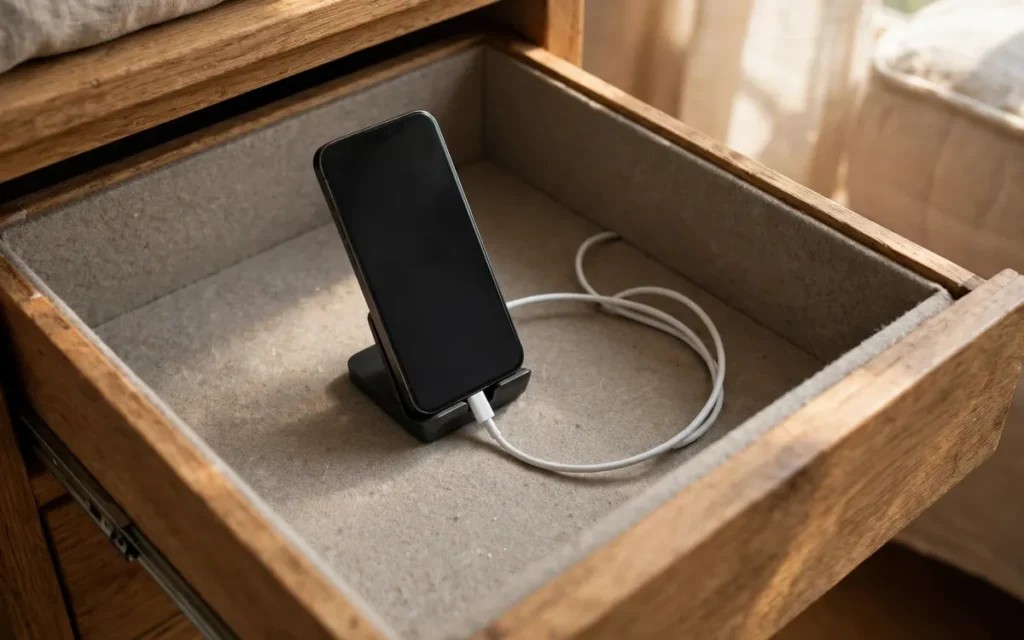
The phone needs charging; it does not need to sprawl across the styled top with its cable. Run one cable into the top drawer — clipped behind the nightstand so it cannot slither to the floor — and let the phone charge inside or resting on the tray only while you are awake. A small charging dock inside the drawer keeps it upright and findable. The top stays clear, the cable stops collecting dust bunnies in plain sight, and the bedroom’s last glowing screen is out of view at lights-out.
8. Pour Water From a Carafe, Not a Bottle

Most bedsides grow a small graveyard of half-finished water bottles. A carafe and glass — the glass doubling as the carafe’s lid — replaces all of them with one handsome pour, and it looks intentional in a way a plastic bottle never will. Keep it on a coaster, always: water rings are the nightstand’s most common injury. Refill it in the morning when you make the bed, and the nightly water sorts itself without a collection of empties marching to the kitchen.
One Living or Personal Piece: Four Finishing Touches
The tray keeps the nightstand useful; this zone keeps it yours. One piece only — the surface is too small for a collection, and a single chosen thing always reads stronger than three competing ones.
9. Pick a Plant That Forgives Forgetting

A small plant is the classic third piece because it brings the triangle of heights together and softens all the rectangles. Choose one that tolerates a bedroom’s lower light and an occasional missed watering: a pothos, a snake plant or a ZZ plant in a pot no wider than about 4 to 5 inches. Set the pot beside the lamp base, where its leaves catch the warm light in the evening. If your bedroom is truly dark all day, a good faux stem beats a struggling real one, honestly.
10. Stand One Stem in a Bud Vase

Not a bouquet — one stem. A single rose, a sprig of eucalyptus, one dried bloom in a narrow bud vase gives the nightstand a living line without eating the surface a bunch of flowers would demand. The narrow neck holds the stem upright and the small footprint leaves the empty third intact. Swap the stem when it fades and the whole bedside feels refreshed for pennies; in winter, a bare twig or a stem of dried grasses does the same job and asks for no water at all.
11. Lean a 5×7 Photo Instead of Hanging It

A framed photo is the personal piece that makes a nightstand yours rather than a showroom’s, and 5×7 inches is the size that fits: big enough to see from the pillow, small enough to share the top. Lean it against the wall instead of hanging it — leaning keeps it movable for seasons and cleaning, and the slight angle catches the lamplight kindly. Choose a frame that echoes one finish already in the room, and one photo you actually love, not a placeholder print.
12. Keep Only the Book You Are Reading
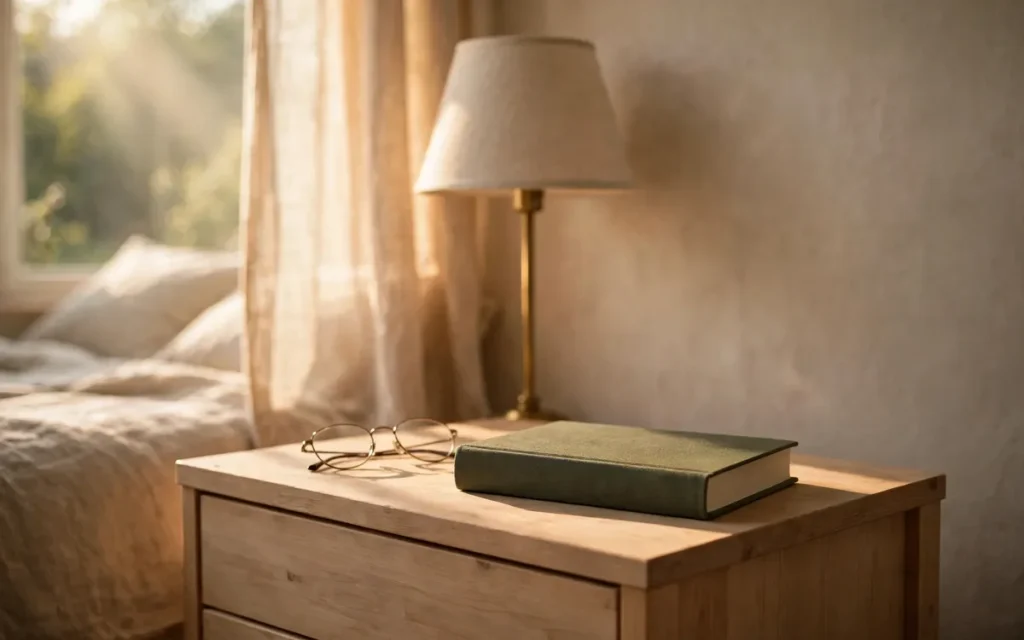
One book: the one in progress. A leaning tower of unread books is not a reading habit, it is a shelf that lost its way — and it crowds out the glass, the tray and the empty third. When you finish the book, it leaves, and the next one takes its single place. If you read on a tablet or e-reader instead, it lives in the drawer with the charger (Idea 7) and comes out at night; the top keeps its calm either way.
Height and the Wall Above: Three Ways to Go Up, Not Out
When the top is full, the wall is still empty. Styling a nightstand is half surface, half wall — and the wall half costs no footprint at all.
13. Hang Small Art Above the Nightstand

A small framed print, a piece of textile art or a little mirror hung above the nightstand finishes the picture the lamp starts. Keep the frame modest — roughly the width of the nightstand or a little less — and hang it low, with its bottom edge about 6 to 10 inches above the tabletop, so it reads as part of the bedside rather than a separate event happening higher up. On a pair of nightstands, matching frames at matching heights tie the whole wall together.
14. Use a Book Stack as a Riser
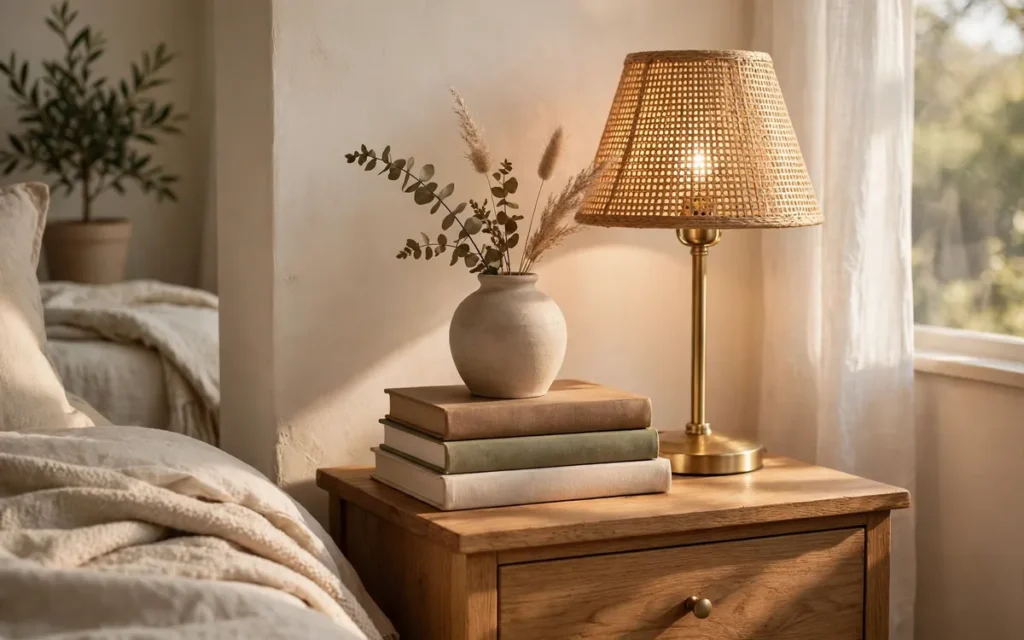
Stylists use this constantly because it works: two or three hardcover books stacked flat become a small platform that lifts a vase, the plant or a candle into the middle height of the triangle, between the low tray and the tall lamp. Choose books with calm covers in the room’s colours, spines turned whichever way reads quieter. It is the one idea here that adds height with things you already own — just keep the stack honest at two or three, or it becomes the tower from Idea 12 in disguise.
15. Add Height With One Tall Branch

For height without weight, stand one tall branch — pussy willow, dried eucalyptus, a bare sculptural twig — in a narrow, heavy-based vase at the back corner. It draws the eye up like the lamp does, costs almost no surface, and casts lovely shadows in lamplight. The vase choice is the safety detail: narrow and bottom-heavy, placed where a hand reaching for the alarm in the dark will not sweep it. Fresh branches last a week or two; dried ones last a season.
Tiny Nightstands and Shared Bedsides: Four Fixes for Real Life
Not every bedroom gets two generous nightstands. Small rooms, shared surfaces and odd furniture are the normal case, not the exception — so here is the method adapted to them.
16. Float a Shelf as the Nightstand
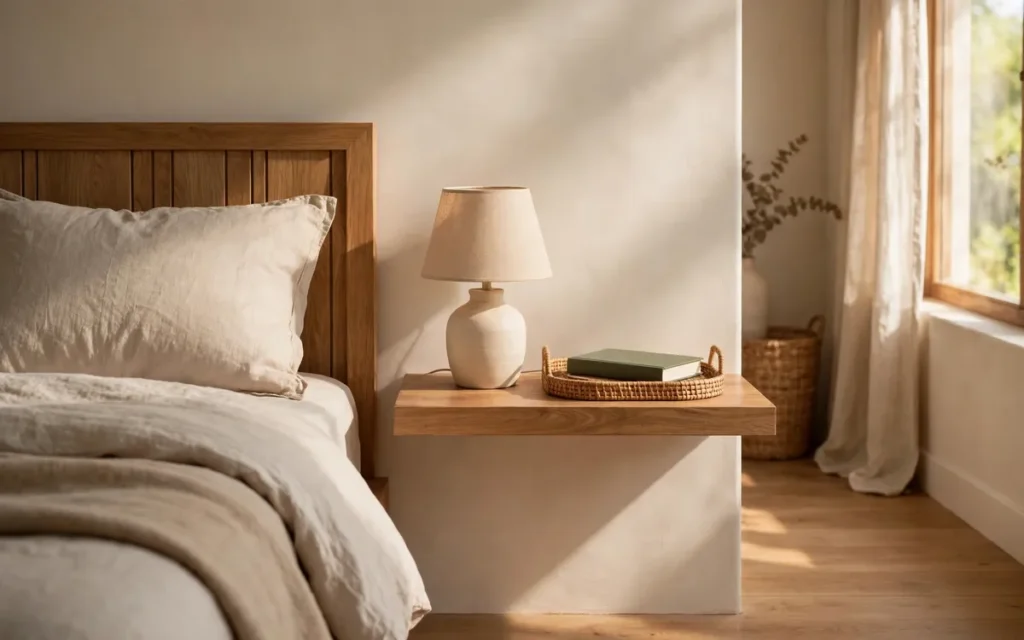
When floor space is gone, a wall-mounted floating shelf at bedside does the nightstand’s whole job — lamp or sconce above it, tray on it, drawer clutter simply banished. Mount it so its top lands at mattress height, within the same 2 inch guide as a table, and choose a shelf at least about 10 inches deep so a glass and a book sit safely. Fix it into studs or with proper wall anchors; a shelf holding a lamp and a carafe is not the place for guesswork fixings.
17. Let a Dresser Do Nightstand Duty
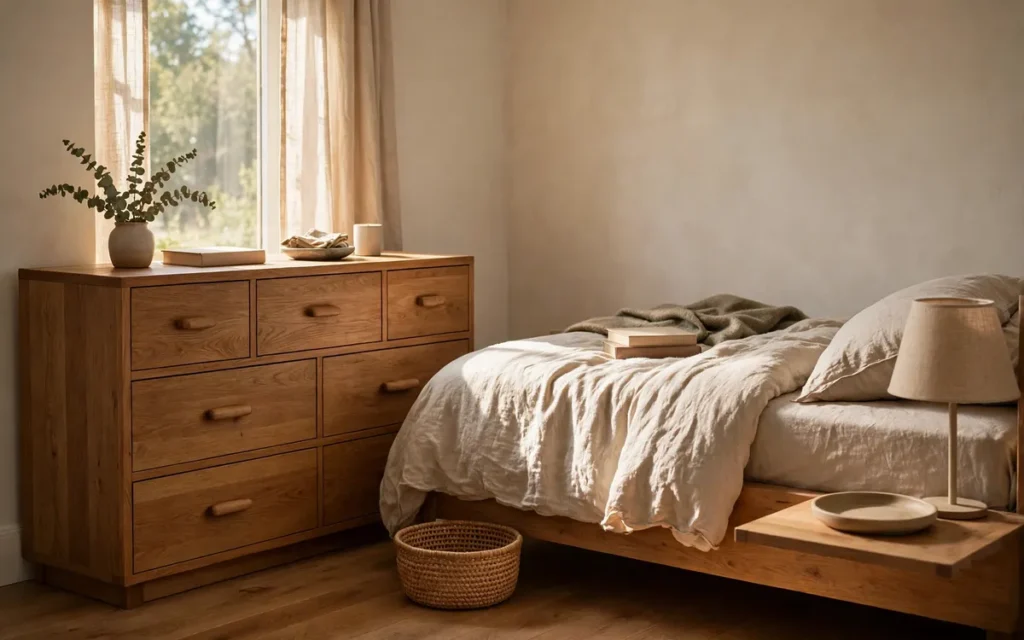
In a small room, the dresser often stands beside the bed anyway — so let it be the nightstand too. Claim only the bed end of its top: lamp at the back, one tray for the nightly group, and the dresser’s far end stays free for its own work. The extra width is a luxury a table cannot offer, so resist spreading; the discipline is the same one tray, one light, one living piece, just on a longer surface. A runner under the bedside end quietly marks the territory.
18. Split One Nightstand Between Two Sleepers
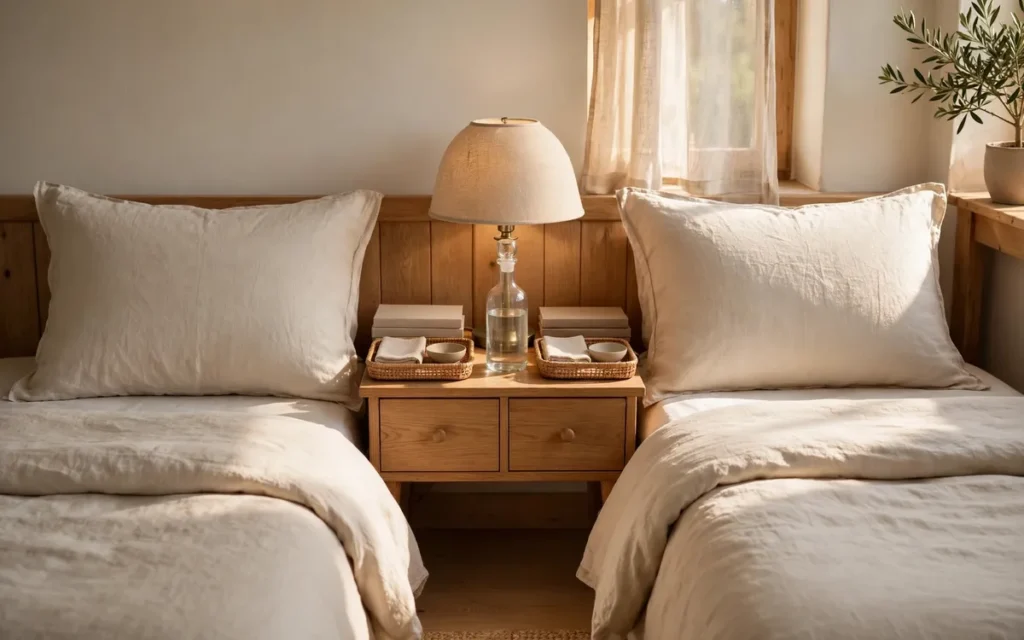
One nightstand, two people: divide it by side, not by item. Each sleeper gets the half nearest them, with a small tray of their own — glasses, watch, lip balm — while the lamp moves to the middle of the back edge and serves both. Water is the shared item that causes the spills, so give it one carafe on one coaster in the centre, or a glass each on the two front corners. It is a small treaty, but bedsides run on treaties.
19. Match a Mismatched Pair by Lamp and Height

Two different nightstands look like a mistake only when everything about them differs. Give both sides the same lamp — same height, same shade — and the pair suddenly reads as a set, because the eye compares the lit shapes first. Then bring the tops roughly level: a riser stack (Idea 14) under the shorter side’s tray, or thicker books, closes a small height gap. Different woods, different drawers, same light: that is not a compromise, it is how collected rooms actually look.
Finish and Keep It That Way: The Last Two Ideas
Styling is an afternoon; keeping it is a habit. These two ideas are the difference between a nightstand that photographs well once and one that stays calm all year.
20. Make One Seasonal Swap, Not a Whole Redo

When the season turns, change exactly one thing: the stem in the bud vase becomes a sprig of pine, the candle’s scent turns warmer, a small ribbon ties around the vase. The lamp, tray and layout stay untouched — they are the working system, not the decoration. It takes five minutes and the bedside feels new. For December, our Christmas bedroom ideas build the full festive layer on top of this same calm base.
21. End the Night With a Two-Minute Reset

The final idea is the one that keeps all the others true. Before lights-out: glass back on its coaster, book in its single place, the day’s extras — coins, receipts, a mug — evicted from the tray. Two minutes, no more. And once a week, do the fuller version: everything off, wipe the top, put back only what the method allows. Nightstands do not become cluttered in a day; they drift, one small exception at a time. The reset is simply the drift, reversed nightly.
What It Costs: Three Budget Levels
Free: Clear, Move, Rearrange
The highest-yield nightstand makeover costs nothing: everything off, the lamp moved to the back corner and checked against your chin, the charger rerouted into the drawer, and only the nightly group allowed back, on a plate or tray you already own. Most cluttered bedsides are one honest clear-off away from looking styled.
Low Cost: One Tray, One Vase, One Bulb
With a small spend, buy the three things that do the visible work: one tray sized to your nightly group, one narrow bud vase, and one warm dimmable 2700K bulb for the lamp you have. Add a small dish for rings if yours wander. That is the whole shopping list; everything else in this article is arrangement.
Worth Considering: The Right Lamp or a Sconce
If money goes anywhere, it goes to light: a lamp that finally passes the chin test, or a plug-in wall sconce that hands a small nightstand its whole surface back. Buy it once, at the measured height, and every idea above it works better. Save this step for last — after the free clear-off, many people find the lamp they own was only ever in the wrong corner.
7 Nightstand Mistakes That Undo the Styling
- A lamp too short to read by. If the shade’s bottom sits well below your chin when you sit up, you get glare and shadow instead of light on the page — raise the lamp or swap it, no accessory fixes this.
- The charger snaking across the top. A cable draped over the styled surface undoes it visually and ends up under glasses of water; clip it behind and charge in the drawer.
- More than five things on the surface. Lamp, tray, one living piece, a glass, a book — past five residents, the empty third is gone and clutter math wins.
- Water with no coaster, beside a charging phone. Rings on the wood are permanent, and water plus charging cables is a pairing the safety section below exists to separate.
- A candle beside the bed with no rule. Pretty in photos, careless in a room built for sleep; if it burns, it burns attended only — or choose flameless.
- Forcing a matching pair. Two identical cheap nightstands read worse than two different good ones unified by lamps; match the light, not the furniture.
- Styling the top and ignoring the wall. A bare wall above a styled surface looks unfinished from the door; one small piece of art at the right height completes it.
A Short Word on Bedside Safety
Flame first, because the bedside is where candles do their riskiest work. If you burn a real candle on the nightstand, it burns only while you are awake and in the room — never as a sleep aid — set on a stable, heat-proof base, clear of bedding, curtains, books and the plant. Deep sleeper, restless house, pets on the bed? A good flameless candle gives the same glow with none of the negotiation, and there is no styling points lost for choosing it.
Electricity and water share this small surface, so give them separate territories: one charging cable, clipped and routed behind the furniture, never under a pillow, never across the walkway where a bare foot finds it at night, and never sharing the tray with the water glass. Tall vases and branches need bottom-heavy bases set back from the edge — a hand reaching for the alarm in the dark sweeps wider than you think. And one boundary worth stating plainly: plug-in sconces are a simple DIY, but anything hardwired belongs to an electrician, not a weekend experiment.
FAQs
What should I put on my nightstand?
Three groups, in order: light (a lamp or sconce that passes the chin test), the nightly essentials corralled in one tray — phone, glasses, rings, lip balm, water — and one living or personal piece, such as a small plant, a single stem or a framed photo. That is the whole list. Everything else belongs in the drawer or another room, and about a third of the surface should stay empty on purpose.
How tall should my nightstand lamp be?
Let your chin decide. Sit up in bed as you would to read: the bottom of the shade should sit roughly at chin height. For most beds and tables that means an overall lamp height somewhere between 24 and 32 inches, which is why published guides disagree — they assume different furniture. Also check that your nightstand top is within about 2 inches of your mattress top, and that the lamp’s base takes no more than a third of the surface.
How do I style a really tiny nightstand?
Go up, not out. Move the light to the wall with a plug-in sconce, hang one small piece of art above, and let a single small tray hold the nightly group on the little top that remains. Skip the plant and the carafe; keep the dish for rings. A floating shelf mounted at mattress height can even replace a too-small table entirely, and it frees the floor underneath.
How many things is too many on a nightstand?
Count residents, not wishes: lamp, tray, one living or personal piece, water glass, current book — five is a comfortable ceiling for a standard nightstand, fewer for a small one. The test is the empty third: if a third of the surface is not clear, something is living there that should not be. When in doubt, the drawer is the nightstand’s second surface, and it is allowed to hold things.
Where should my phone charge at night?
In or on the nightstand, but not sprawled across it. Route one cable behind the furniture, clipped so it cannot slip to the floor, and charge the phone inside the top drawer or in a small dock within it. The screen leaves your eyeline at lights-out, the cable leaves the styled surface, and the phone is still arm’s reach away in the morning. Keep it out of the water glass’s neighbourhood while you are at it.
What if my nightstands don’t match?
Then match what the eye compares first: the lamps. Identical lamps at identical shade heights make two different tables read as an intentional pair. Level the tops as closely as you can — a book stack under the shorter side’s tray closes a small gap — and repeat one small thing on both sides, like the same style of tray or dish. Collected and coordinated beats identical and apologetic, every time.
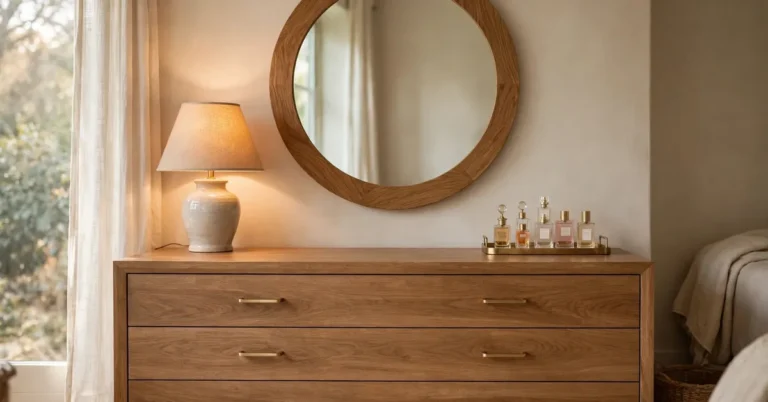
And when a dresser takes over a surface job in the bedroom, its top deserves the same treatment: a mirror at two-thirds width, one tray for the morning bottles, and a clear third left bare for folding. The full system is in our guide to 22 Effortless Top of Dresser Decor Ideas for a Tidy, Working Bedroom.
The lamp you have just placed is doing more than lighting this one surface; it is one layer of the whole room’s evening light. When the walls, the bed and every bulb join that same warm system, the bedroom turns properly moody, and the full measured version is in our moody bedroom ideas.
Conclusion
A nightstand is two square feet with an outsized job: it is the last thing you touch at night and the first thing you see in the morning. These nightstand decor ideas ask for very little — the right lamp height, one honest tray, one living piece, and the discipline to leave a third of the surface empty. Do the free clear-off tonight, measure the lamp before you replace anything, and let the two-minute reset keep it that way. Small surface, calm room.


5 Comments