

28 Joyful Christmas Bedroom Ideas for Kids That Keep Bedtime Calm
Every child in a decorated house will remember one room’s December best: their own. And every parent standing in that room’s doorway with a box of decorations feels the same tug in two directions — the room has to feel like Christmas, and it still has to work as the place a small, very excited person falls asleep, in the darkest month of the year. Those two jobs pull against each other, which is why so many kids’ Christmas rooms end up either boring or wired.
This article refuses the choice. It starts with a bedroom-first system — protect the sleep, decorate by age band, zone the room, size everything for a child — and only then runs through 28 christmas bedroom ideas for kids, from the duvet to the door, including the shared, bunk, nursery, tiny-room and teen versions. A child’s Christmas bedroom runs on rituals, not purchases; here is how to build both halves of that sentence.
Decorate It Like a Bedroom First: The Sleep-First System
Protect the Sleep First
The rule everything else hangs on: the bed is a sleep zone, not a display zone. Nothing is decorated in the bed beyond bedding and one beloved plush. All glow in the room is warm white, low, and on a timer — off at bedtime or within half an hour after; a timer with a six-hour setting does this without a nightly negotiation. Nothing flashing or colour-changing sits in the line of sight from the pillow, and lights near the bed are battery or low-voltage LED: cool to the touch, with no mains lead within a young child’s reach. A room can be magical at story time and properly dark at sleep time — the timer is what makes those the same room. For a like-minded practical reference on doing this safely, this kids’ room guide builds its ideas on the same safety-and-sleep-first premise.
Decorate by Age Band, Not by Theme
Four bands, and the rules change at each step. Nursery and toddler (0–3): decor is looked at, not touched — everything high, outside the cot’s reach and pull range, no small or detachable parts anywhere in the room, the cot itself kept bare. Ages 4–7: the reachable years — decor at their eye level (roughly 90–110 cm), touchable and unbreakable, and the countdown rituals begin. Ages 8–12: choosing rights — their own small tree, their colours, a desk and shelf to style; the parent’s job shrinks to safety and budget. Teens: hand it over — palette-led and subtle, closer to the grown-up bedroom article than to this one. Decorating “for a kid” without a band is how a nursery ends up with a toddler-height string of glass baubles.
The Three-Zone Rule: Theirs, Shared, Off-Limits
Zone the room before anything is hung. A “theirs” zone — a shelf, the inside of the door, one corner — is decorated by the child entirely themselves, and it is not edited: this is where the lopsided tree and the paper chains live. A “shared” zone — bedding, window, the tree if it is a family effort — is done together, in the house palette if there is one. And an off-limits zone is kept calm and clear: the sleep surface, the cot, and the walking route from bed to door. Most parent-child decorating arguments are really one missing zone boundary, discovered at 8 pm.
Sizes and Heights That Fit a Child’s Room
The numbers listicles never give. A child’s own tree is 2–3 ft (60–90 cm): tall enough to feel real, short enough to decorate standing on the floor. Displays sit at child eye level, not adult. Above the bed, only paper and felt, on short drops that cannot be reached from the mattress. Door decor must clear the swing and the latch. And there is a floor-space budget: in a small room, decor gets one corner, about 1 m², and everything else goes on walls, the door and the bedding. A child’s room already contains a life; Christmas is a guest in it, not a tenant.
The Countdown Is the Decor
The ritual layer outlasts tinsel. An advent calendar at child height. A basket of Christmas books that appears on 1 December. And one new piece added each December weekend rather than the whole room transformed in a day. Decor that does something — counts down, gets read, gets chosen — holds a child’s attention for 24 days; decor that only glows is furniture by the second week. The countdown is also a sleep tool: a room that grows gradually never delivers the single overwhelming transformation that keeps a small child buzzing until midnight.
1. Swap In a Festive Duvet Set

The single highest-impact move in the room. One Christmas duvet set — trees, reindeer, snowflakes — turns the biggest surface in the room festive in five minutes, and comes off in one wash in January. In a child’s room the bed is the landscape; decorate the landscape and half the room is done.
One set is enough: washed and rotated, it survives the season’s hot chocolates and December colds. Choose it with the child where possible — the duvet they picked is the duvet they will show every visitor, including visitors who have seen it four times.
2. Layer Flannel Sheets and One Christmas Cushion

Warmth first, theme second. Brushed flannel sheets for cold nights do more for a child’s December sleep than any decoration in this article, and exactly one festive cushion joins the pillows — so the bed stays sleepable instead of becoming a cushion display that has to be excavated every night.
The one-cushion rule is the sleep-first system in miniature: a bed a child can get into, in the dark, half asleep, without moving furniture. The cushion lives on the bed by day and on the chair by night, and everybody’s December is simpler for it.
3. Dress Up a Favourite Plush Friend

Their existing teddy or favourite toy, in a festive scarf, a small hat, or a ribbon tied like a bow tie. The zero-cost idea — and often the one the child cares about most, because it is not decor done to their room; it is their friend, joining in.
It is also the gentlest first Christmas touch for the youngest children: nothing new enters the room, nothing about the bed changes, and yet December has visibly arrived. Change the scarf’s colour on Christmas Eve if a small ceremony is wanted; some families hide a tiny bell in the ribbon on the last night.
4. Swap the Night Light for a Christmas One

A warm-toned star, moon or tree night light, at its usual low brightness, in its usual place. Festive at bedtime — and unchanged as a sleep cue, which is the entire point: the light a child falls asleep to is a routine, and December is not the month to retrain it.
Keep the brightness genuinely low and the colour warm; a bright white novelty light is a toy, not a night light, and belongs in the daytime zones. Battery or low-voltage, with the compartment screwed shut — the safety section’s button-battery rule applies to night lights first of all.
5. Hang an Empty Stocking on the Footboard
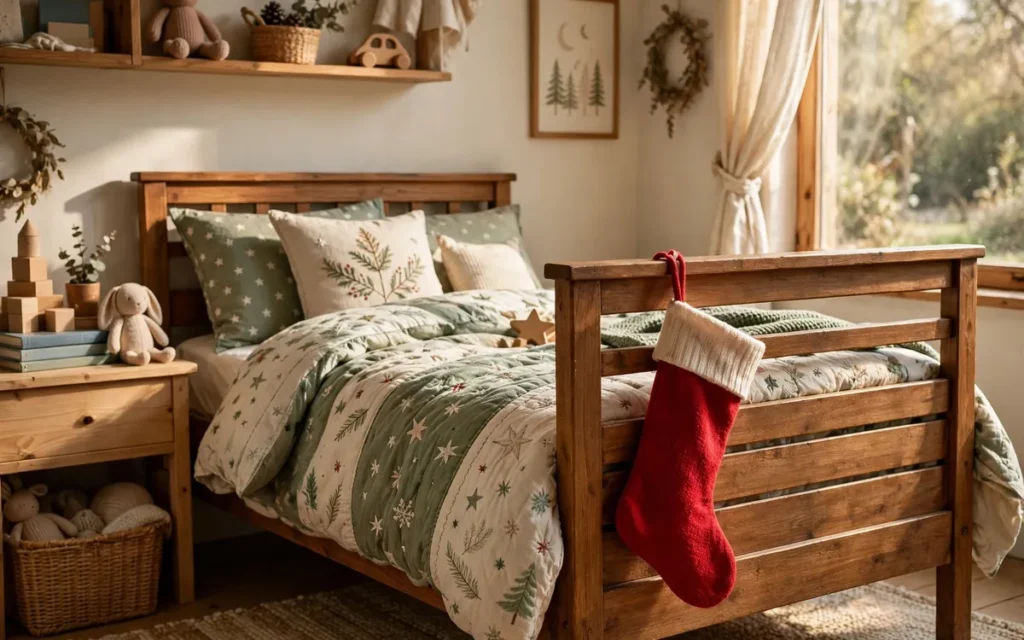
One stocking, on the bedpost or footboard, from early December — empty until Christmas Eve. Anticipation built into the furniture: the child watches it hang there, night after night, doing nothing, which is precisely what makes Christmas Eve enormous.
Hang it where small hands can touch it (it will be touched, nightly, hopefully) but where it cannot be pulled down onto a sleeping child — a ribbon loop over the footboard’s end, not a hook over the pillow. For under-threes, the stocking is a daytime decoration that comes down at bedtime.
6. String Paper Stars Across the Canopy or Bed Frame
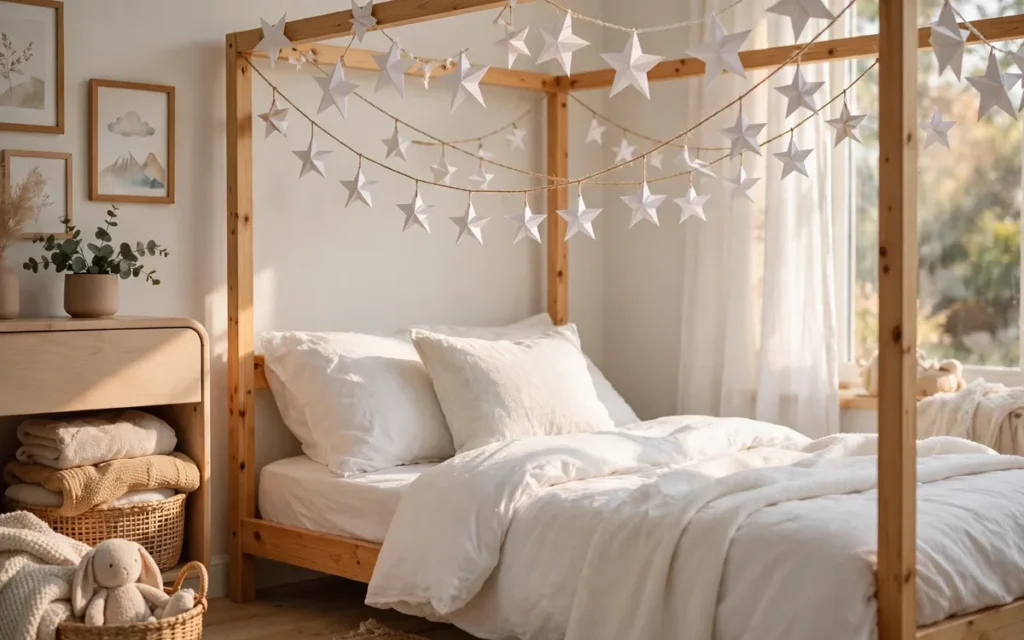
Lightweight paper or felt stars strung across a canopy frame or between headboard posts: height and magic in the room’s top half, in the only materials allowed above a bed. Nothing heavy, nothing hard, and drops kept short, well out of reach from the mattress.
White and silver paper keeps this calm; coloured stars belong to the 8–12 band, who will want to make them. Either way the garland is secured at both ends so a tug brings nothing down — a star garland that falls is only a mess, but the rule protects the heavier things hung elsewhere by habit.
7. Give Them a Mini Tree of Their Own

The centrepiece idea of the whole article: a 2–3 ft tree in the room’s one decor corner, and it is theirs. Not a miniature of the family tree — their tree, decorated by them, in their order, with their ornaments, lopsided in exactly the places they chose.
Everything in the system points here: the size fits their height, the corner fits the floor budget, and the choosing rights fit their age band. Parents who can resist straightening this tree will be repaid in a child who asks, every November, when their tree is coming.
8. Choose Unbreakable Ornaments for Little Hands

For under-sevens, the tree they decorate must be a tree they can grab: felt, wood, fabric and shatterproof ornaments, with nothing small enough to swallow and nothing with detachable parts. Decorating becomes something the child does — not something done carefully around them while they watch.
Keep a basket of the unbreakables beside the tree, not on it: half the pleasure at this age is re-decorating, and a tree that can be re-dressed daily needs its wardrobe within reach. Glass stays downstairs on the family tree, where the audience is taller.
9. Theme the Mini Tree to Their Favourite Things

Woodland animals. Their favourite colours. Dinosaurs and stars. A theme a child picks beats a palette a parent picks, every time, at this scale — this is the “theirs” zone’s flagship, and its job is to be loved, not to match the landing.
The compromise that keeps households sane: the tree’s theme is the child’s, but its lights and base follow the room’s rules (warm white, timer, weighted basket). Inside those rails, total freedom. A tree wearing twelve felt dinosaurs and one astronaut is not a styling failure; it is a portrait.
10. Stand the Tree in a Basket or Crate

A weighted basket or a wooden crate as the mini tree’s base: steadier than a small plastic stand, no sharp metal feet at ankle height, and weighed down with a stone or a bag of gravel it shrugs off the bumps a child’s room delivers daily.
The crate version earns its keep twice — in January it turns around and becomes the blanket box or the book box. Whatever holds the tree, check the wobble with a push before the ornaments go on; a tree that falls in week one teaches a child the wrong lesson about December.
11. Use a Wall Tree When There Is No Floor Space
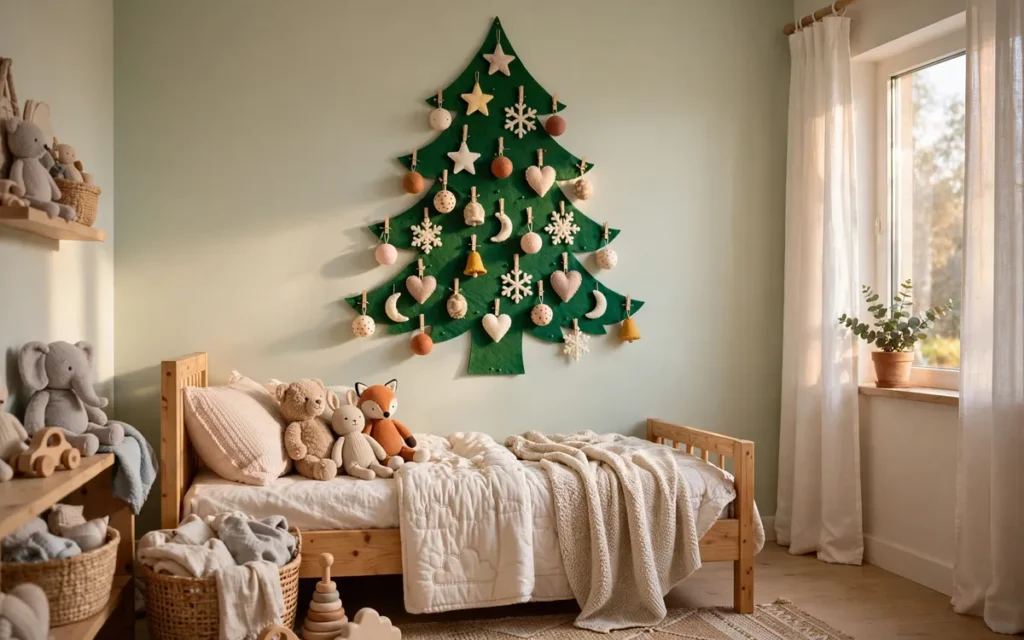
No corner to spare? The tree goes flat: a felt tree on the wall with felt ornaments that stick and re-stick, a decal tree, or a light-strung outline in the tree’s shape. The full tree ritual — decorating, re-decorating, showing visitors — in rooms where the floor-space budget is genuinely zero.
The felt version is the toddler champion of this article: soft, silent, unbreakable, and designed to be touched. Keep light-strung versions battery-powered and the cord out of reach, and place the wall tree in the “theirs” zone where daily re-dressing is a feature, not a disturbance.
12. Turn the Bedroom Door Into a Snowman

Paper or card circles, a carrot nose and a scarf, on the inside face of the bedroom door: big, flat, nearly free, and the door still opens, closes and latches exactly as before. Of all the wall ideas, children vote for this one with their feet — it is the first thing they show anyone.
Keep every piece flat against the door and clear of the latch and hinges, and use removable adhesive that will not take the paint in January. Building the snowman together is a December-weekend activity in itself; let imperfect circles stand — a snowman a child cut out beats a snowman a parent perfected.
13. Hang a Mini Wreath on the Bedroom Door
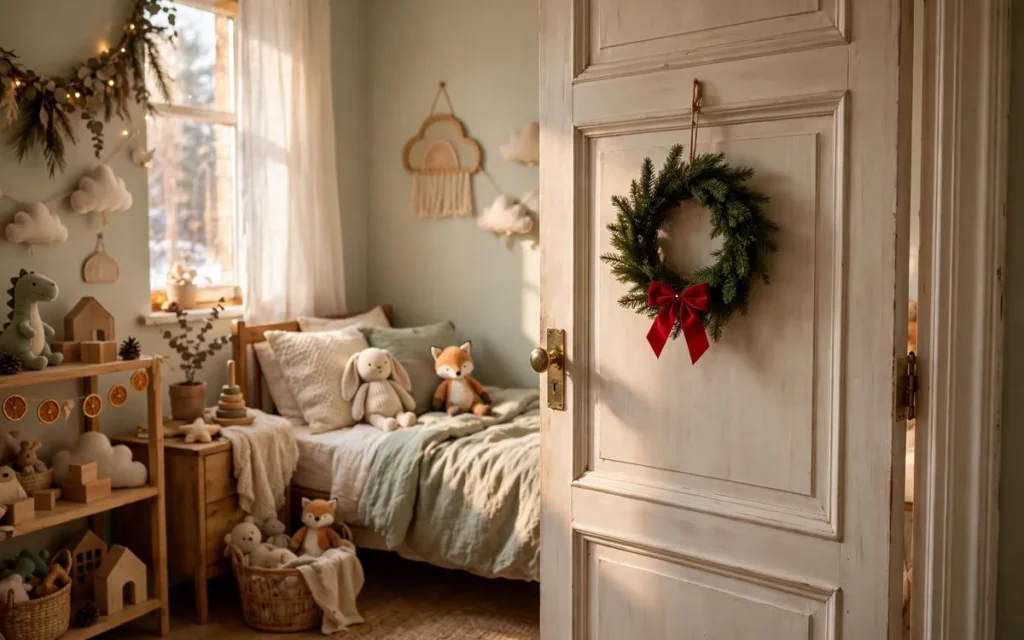
A small, light wreath on a door hook or a ribbon looped over the top of the door: the grown-up front-door ritual at child scale. It pairs with the snowman (wreath outside the door, snowman inside) or stands alone on a door that stays decorated all month.
Scale and hanging follow the same rules as our christmas wreath ideas, miniaturised: light enough for an interior door, hung so it cannot swing against the paintwork, and low enough — on the inside face, at their height — for the child to straighten it each morning, which they will.
14. Cover the Window With Removable Snowflakes

Gel or static-cling snowflakes scattered across the glass: the view itself becomes the decoration, nothing is hung, nothing can fall, and January removal takes minutes. From the street the room glows frosty; from the pillow it is a sky that changed for December.
A generous scatter beats a careful pattern — children apply these best, armfuls at a time. Keep flakes off the window’s opening section if it is used for air, and for under-threes use the large cling shapes only: small gel pieces are a mouth-sized temptation.
15. Hang Paper Stars in the Window
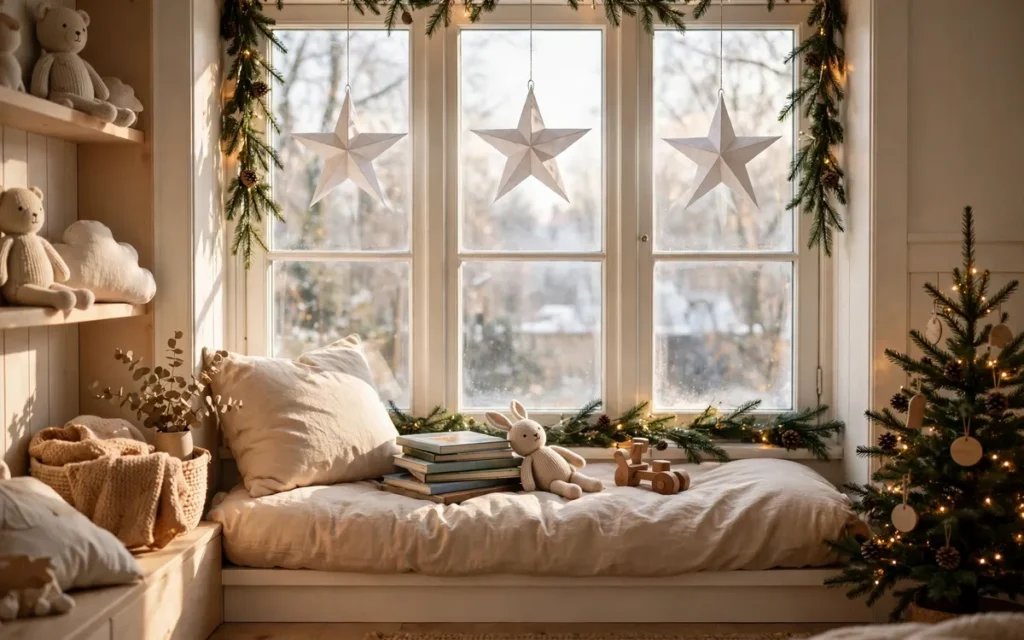
One or three paper stars on clear line in the window, where they catch the morning light for the child and the evening light for the street. Lit versions exist, but unlit paper has its own virtue in a sleep room: it decorates the day and disappears at night.
Hang them high in the pane, out of the reach arc from any nearby furniture a child can climb. Three stars at uneven heights read as a small sky; a single large star over the reading corner ties two zones of the room together with one thread.
16. Make a Felt Wall Scene They Can Rearrange
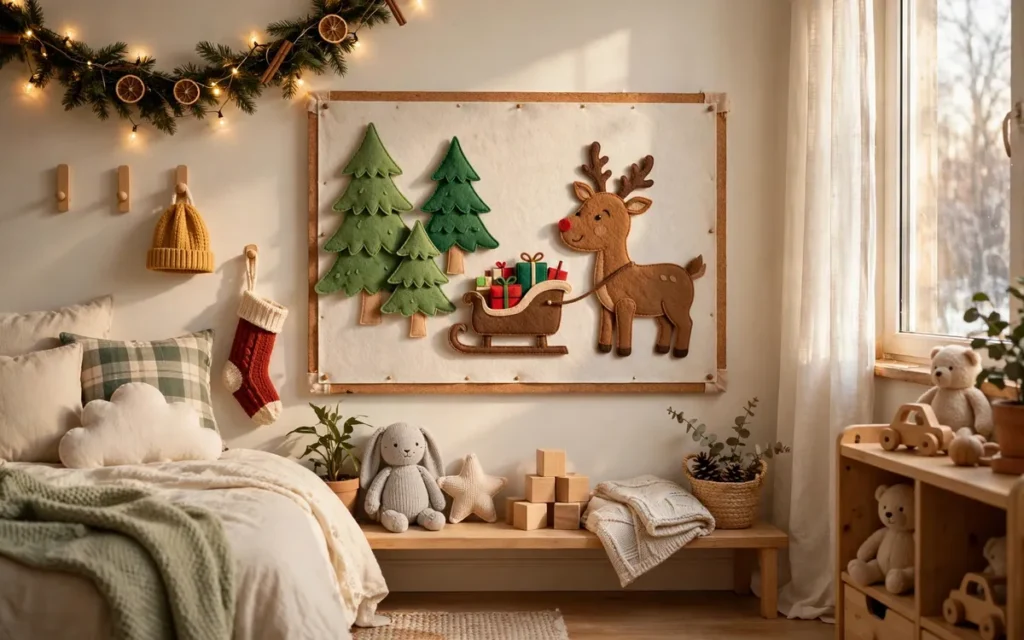
A felt reindeer-and-sleigh, or a village street, on a felt board or wall panel at child height — decor designed to be touched, moved and re-storied daily. This is the “theirs” zone in its purest form: a picture the child finishes every morning, differently.
Mount the board firmly (a scene that slides is a scene on the floor by Tuesday) and keep a small basket under it for the pieces not currently in the story. For siblings, a scene each or one shared scene with figures assigned — the fairness rule from the countdown system applies to felt reindeer too.
17. Drape a Garland Over the Wardrobe or Bookshelf
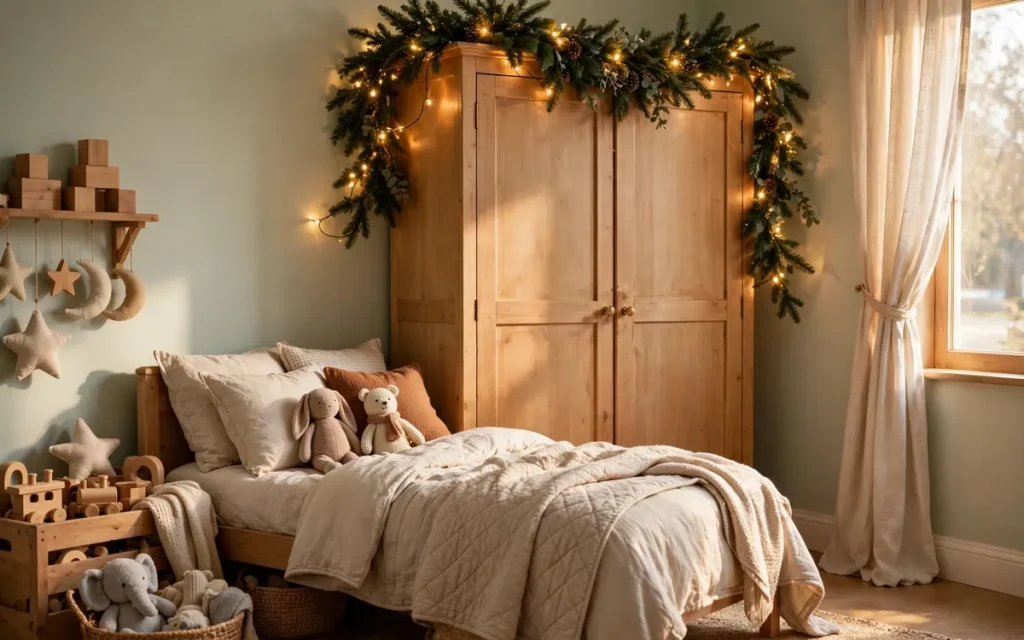
Greenery, or a paper chain made on a wet Sunday, across the top of the tall furniture: festive height in the room, achieved with nothing placed above the bed. The wardrobe top is the room’s free display shelf — visible from the pillow, reachable by no one under five feet tall.
Secure the garland at both ends and keep it off the radiator side of the room; dried greenery and paper both dislike heat. Battery lights can join it if the pack sits on top with the furniture, out of the room’s reach economy entirely.
18. Add a Name Banner and a Personal Stocking

Their name in a fabric or card banner, and a personalised stocking on the wall beneath it: the room announces whose Christmas this is. The banner goes up on 1 December as part of the countdown, and the stocking waits there beside it, companionably empty.
In shared rooms this idea is load-bearing — it is each child’s signature on their half (idea 24 builds on it). Keep the banner light and its fixings kind to paint, and hang the pair in the shared zone: this is identity decor, and identity is a family project, not a solo one.
19. Hang a Fabric Advent Calendar at Child Height

Pockets at their reach, filled with notes, small treats, and tiny decorations destined for their tree: the room’s organising ritual, hung in the “theirs” zone. A fabric calendar survives years of December mornings in a way no cardboard version does, and it refills — which matters, because younger siblings inherit it.
Fill thoughtfully for the age band: pictures and activities for the youngest, small responsibilities-with-rewards for the middle band (choose Friday’s film, pick the tree’s new ornament). The calendar is the countdown made touchable, and on the mornings it is emptied, bedtime’s approach is measured in pockets.
20. Build a Christmas Book Nook
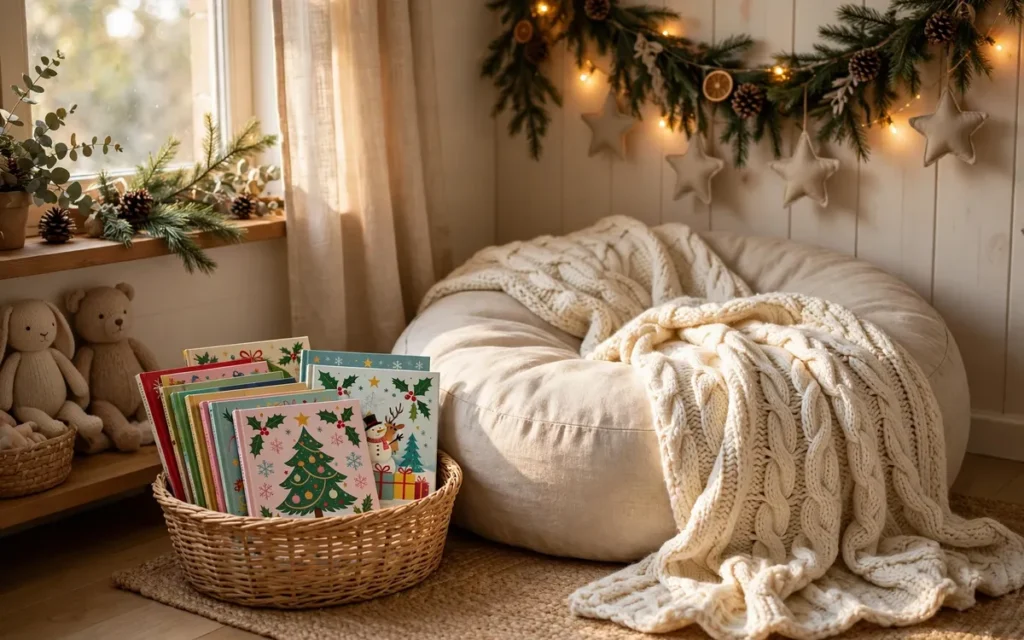
A basket or a low shelf of Christmas picture books, one cushion and a throw, in the room’s calmest corner: a bedtime routine wearing a costume. The nook does double duty all month — it is decoration, and it is also the twenty minutes of winding down that December bedtimes desperately need.
The books appear on 1 December with the calendar and vanish in January, which keeps them electric with novelty year after year. Library books rotate through the basket for free; a household’s own few, re-read annually, become the ones the family can recite.
21. Set a Mini Village on a High Shelf
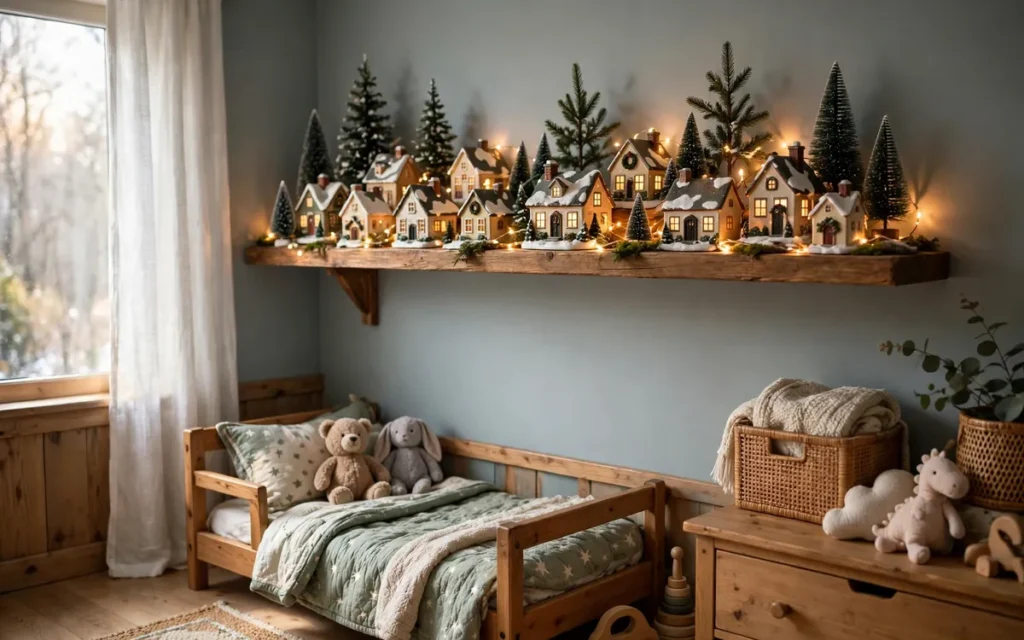
A small village — a few tiny houses, warm lights — on a shelf above reach. For younger children it is the room’s look-don’t-touch piece, a lit skyline to fall asleep watching from a safe distance; for older ones it graduates down to the desk and becomes a display they arrange.
Its layout follows the same riser and one-theme method as our christmas village display ideas, at shelf scale: a back row raised, one theme, one warm light colour. On a shelf above a bed’s headboard it stays unlit-after-bedtime like everything else; the timer rule has no favourite children.
22. Make a Letter-to-Santa Desk Corner

Paper, pencils, an envelope and a stamp drawn in crayon, laid out on the desk or a small table: a decoration that is also December’s most important correspondence. For the 8–12 band, swap in a proper writing set and a list they curate all month.
Give the corner a deadline ritual — the letter is posted (however your household posts such letters) on a fixed December date, and the corner then becomes a thank-you-note station in the new year. A workspace that changes jobs teaches a child what desks are for better than any lecture.
23. Add One New Piece Each December Weekend

The countdown system as a decorating idea in its own right: the room begins December nearly bare — bedding, calendar, books — and gains one small piece each weekend, chosen together. A shelf that grows, a garland that lengthens, a tree that gains its star on the last weekend before Christmas.
By the 20th the room is still getting more Christmassy, which no single-day transformation can claim; and the child’s anticipation is spread across the month instead of spent by the 3rd. Photograph the shelf each weekend — the growth is the story, and children love a before-and-after.
24. Decorate a Shared Sibling Room in Two Halves

One palette, one system, one set of rules for the room — then one unmistakably personal element each: a named stocking, a banner, a side of the tree, a chosen cushion. Fairness in a shared room is designed, not negotiated nightly at lights-out.
Identical bedding with different cushions is the classic settlement: the room looks whole, and each bed is still somebody’s. Let each child decorate within their own half freely (the “theirs” zone doubles), and keep the shared zones genuinely shared — one tree, decorated in turns, stars included.
25. Dress Bunk Beds Without Touching the Sleep Zone

Garland belongs on the bunk frame’s outer posts and ends only — secured so a pull brings nothing down — and nowhere else: nothing in the ladder path, nothing draped over a sleeper, nothing within a top-bunk arm’s reach of the ceiling fittings. The frame dresses; the bunks themselves stay sleep zones.
Paper chains suit bunks better than greenery (lighter, and a fallen chain is laundry, not debris), and the under-bunk cave, if there is one, can take a battery light on the timer like any other glow. The child on the top bunk gets the paper stars of idea 6 at their height — bunks are two rooms stacked, and both deserve a view.
26. Keep a Nursery Soft, Brief and Out of Reach

The nursery version is three touches, no more: a festive cushion on the nursing chair, a small tree or vignette on a dresser outside the cot’s reach, and soft colours throughout. And the cot itself is left exactly as it is every other night of the year — that restraint is the decoration’s whole point.
A nursery’s Christmas is for the parents in the chair at 3 am, and it should be gentle: warm low light, nothing that glitters in a feeding baby’s eyeline, nothing new that rustles, chimes or glows within the sleep space. The baby’s second Christmas will be a different article’s worth of fun; this one is a lullaby with a tree in the corner.
27. Decorate a Tiny Room With Three Touches Only
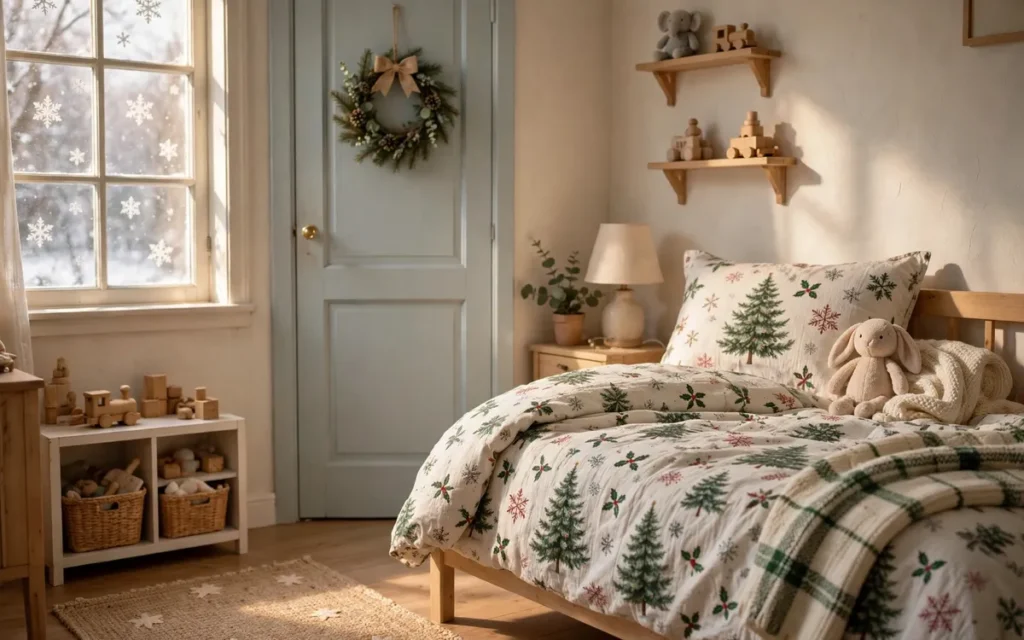
Bedding, door, window — and stop. The small-space discipline of our christmas ideas for a small living room applies doubled in the smallest bedroom in the house: a few high-impact touches, everything off the floor, nothing competing for the room’s one square metre of free space.
The wall tree of idea 11 is the tiny room’s fourth touch, if a fourth is wanted — it costs no floor at all. What a tiny room must never get is the full programme at small scale: twenty small things in a small room read as clutter where three confident things read as Christmas.
28. Give a Teen the Quiet, Grown-Up Version

Fairy lights on a timer, one cushion, a mini tree in their colours, nothing they did not choose. The teen room is decorated by negotiation or not at all, and a parent’s role shrinks to offering the kit — lights, a tree, a budget — and accepting the result, including the result where the answer is “just the lights, thanks”.
From here the road runs to the adult method: the calm palettes and textile layering of our christmas bedroom ideas are where this band graduates. A teen whose childhood Christmases were sleep-first and partly self-chosen tends to arrive there with taste already formed — which was, quietly, the point of the whole system.
A Magical Room Without a Big Spend
- Bedding is the one real buy: a single festive duvet set does more than a box of novelties, washes, and returns every year.
- The dressed-up plush friend is free — the child’s own toy in a scarf or ribbon is the idea they will remember, and it costs nothing.
- Paper does the walls: one pack of card makes the snowman door, the chains, the stars and the banner; removable decals do the window for the price of a coffee.
- The mini tree is the only furniture-scale purchase — buy it once, add unbreakable ornaments once, and both serve every December (and every younger sibling) for years.
- Spend on the countdown, not on more ornaments: a fabric advent calendar and a few Christmas books work for 24 days; another bauble works for an afternoon.
- Let the child choose one small thing themselves — a single ornament or cushion of their pick: the cheapest item in the room will be the one they show visitors.
Kids’ Christmas Bedroom Mistakes That Cost Sleep (or Worse)
- Decorating the bed instead of the room — cushions, garlands and glow piled onto the sleep surface, then wondering why bedtime falls apart.
- Mains-powered fairy lights within a young child’s reach, or any lights left on all night — heat, cords and a lit room are three separate problems.
- Glass ornaments and detachable small parts at toddler height: the tree a three-year-old decorates must be a tree a three-year-old can grab.
- Hanging anything heavy, hard or framed directly over the pillow — above the bed is paper-and-felt territory only.
- Doing the whole room on 1 December: no countdown left, novelty gone by the 10th, and a child too wound up to sleep in it.
- Copying the adult palette without asking: a beautiful neutral room the child never chose loses to one garish ornament they did.
- Blocking the practical paths — the mini tree in the door swing, decor across the radiator, or the night-time route to the door lit, cluttered and trip-ready.
- Button-battery novelties with loose compartments anywhere in the room — if the compartment does not screw shut, the light-up tealight or singing decoration does not come in.
Kids’ Christmas Bedroom Safety Notes
Sleep and safety are the same subject in christmas bedroom ideas for kids, so the rules are stated once and plainly. Lights: near a child’s bed use battery or low-voltage LED sets only — cool to the touch, no mains lead within reach, battery packs tucked where small fingers cannot open them — and put every light in the room on a timer, or a switch the child cannot reset, so everything is off at bedtime. Button batteries are the hidden hazard of the season: light-up novelties, LED tealights and singing decorations must have screw-closed battery compartments, and any with loose covers stay out of the room entirely. Nothing heavy, hard or glass-fronted hangs above a bed — paper, felt and fabric only, on short drops that cannot be reached from the mattress — and shelves above beds hold soft things or nothing. Ornaments follow the age band: under-threes get nothing small, detachable or breakable anywhere in the room; under-sevens decorate with felt, wood and shatterproof pieces; glass lives on the family tree downstairs. Garlands are secured so a pull brings nothing down, and they never cross a bunk ladder, a sleep surface or a doorway at child height.
Candles do not belong in a child’s bedroom at all — flameless only, and those on a stable surface away from bedding. The cot follows safe-sleep rules without a Christmas exception: bare, flat and clear, with all decor outside reach and pull range, and festive bedding for babies means a fitted sheet only. The mini tree stands weighted in its corner, out of the door swing, away from the radiator’s heat and off the dark walking route from bed to door. Stored and second-hand soft decor is washed or aired before it goes near a bed, and everything comes down together in January — small parts have a way of migrating into toy boxes if the takedown is casual.
Frequently Asked Questions
How can I decorate my child’s bedroom for Christmas without ruining their sleep?
Decorate the room, not the bed. Keep the sleep surface to bedding and one plush, keep all glow warm, dim and outside the pillow’s direct sightline, and put the lights on a timer so the room is festive at story time and properly dark at sleep time. It is the same room at two settings — and the timer, not willpower, is what switches between them.
What Christmas decorations are safe in a toddler’s bedroom?
Treat the room as a look-don’t-touch space at that age: decor high or on the walls, nothing small, loose, detachable or breakable within reach, battery lights with the pack out of reach, and the cot kept completely bare. A festive fitted sheet is the nursery’s whole bedding change; the rest of the room carries the theme where small hands cannot follow.
How big should a Christmas tree be in a kid’s bedroom?
Around 2–3 ft (60–90 cm). That is tall enough to feel like a real tree and short enough for the child to decorate most of it standing on the floor — no climbing, no chair. Stand it weighted, in a basket or crate, in one corner of the room and out of the door swing, and it is also the right scale for the room itself.
How do I decorate a shared kids’ bedroom so both children feel it is theirs?
One system, two signatures: the same bedding palette and the same tree for the room, then one unmistakably personal piece each — a named stocking, a name banner, a side of the tree, a chosen cushion. Fairness in a shared room is designed in advance, not negotiated nightly at lights-out, and identical-bedding-different-cushion is the settlement that has ended more arguments than any other.
What is the cheapest way to make a child’s bedroom feel like Christmas?
One festive duvet set, paper decorations the child helps make, and their own toy dressed in a ribbon will carry most rooms. If the budget stretches to one purchase beyond the bedding, make it the small tree: it is the piece that returns every year, and the unbreakable ornaments bought with it will outlast several childhoods.
When should I put up Christmas decorations in a child’s bedroom?
Early December, and gradually: the calendar, the books and the bedding on the 1st, then one new piece each weekend. Building the room across the month protects sleep — no single overwhelming transformation the night before a school day — and it gives the countdown something real to count, week by week, all the way to Christmas Eve.
This guide dresses a child’s bedroom for one season — but the room underneath the tinsel still has to work for the other eleven months: a bed sized to the room at 38 by 75 inches, storage at child height, and zones for sleep, study and play. That year-round system is our small bedroom decor ideas for kids.
Conclusion
The best christmas bedroom ideas for kids fit in three lines: protect the sleep, decorate by age, zone the room. Everything after that is ritual — the countdown pockets emptied one by one, the book basket at story time, the tree decorated lopsidedly by its owner — and ritual, not purchasing, is what a child remembers a room by. Photograph the finished room each December: it is next year’s decorating plan, one band up, and in a few years it will be the picture the family actually keeps. Then take everything down together in January and store the unbreakable box whole — next year, the room decorates itself in an afternoon.




3 Comments