
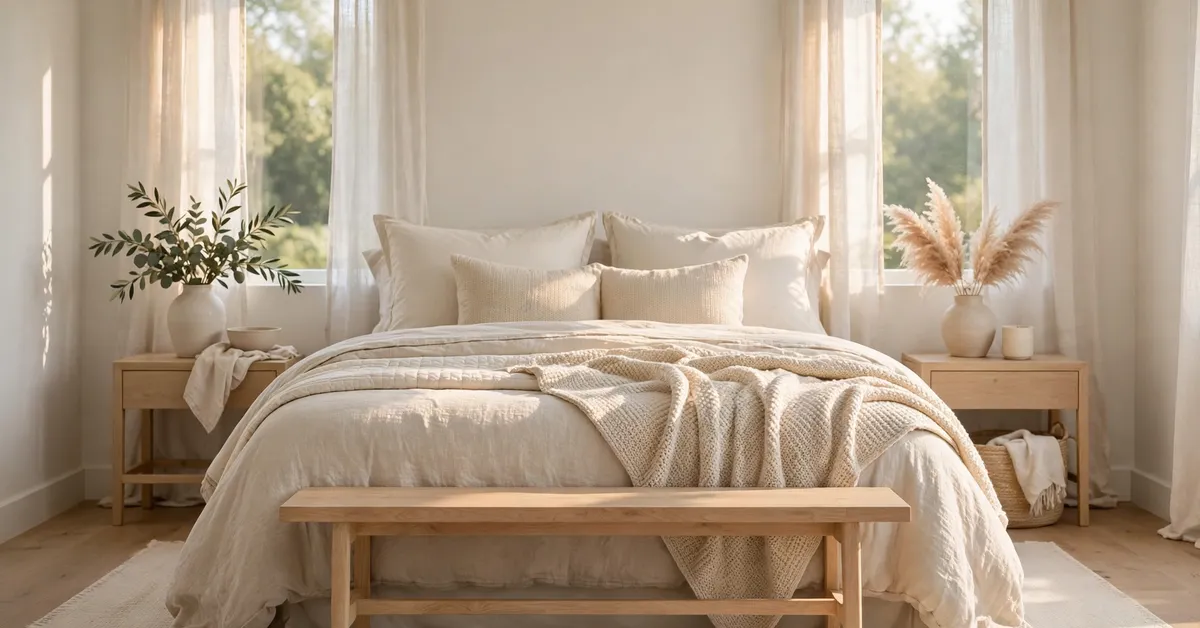
23 Blissful Cozy Neutral Bedroom Ideas for a Calm, Layered Room
A neutral bedroom should be the calmest room in the house. Get one thing wrong, though, and the same gentle palette turns cold, flat and faintly like a waiting room. The difference is rarely the colour itself. It is the undertone hiding inside the paint, the number of textures you can actually count, and whether something warm and weighty grounds all those pale layers. These cozy neutral bedroom ideas are built as a system rather than a shopping list: choose the warm white by the light your room actually gets, layer the bed by a counted recipe, size the rug by the bed instead of the room, and set every bulb to the same warm temperature. The 23 ideas below are grouped the way a room really comes together — walls first, then the bed, the floor and windows, the furniture, and finally the light — and each one carries the measurement or rule that makes it work.
The Method: Warm It, Layer It, Ground It
Every calm neutral room that works is doing three jobs at once. The paint is warm enough for the light it lives in, the layers are counted rather than guessed, and something with weight stops the pale colours floating away. Do the three steps in order and most of the 23 ideas that follow become simple shopping decisions.
Step 1 — Warm It: Let the Paint’s Undertone Decide
Choose the wall colour by undertone, not by name. Stay inside the warm-white band, roughly LRV 74 to 83 (LRV is how much light a paint reflects — higher is paler). Benjamin Moore Swiss Coffee OC-45 sits at 81.91 with a creamy yellow undertone, Sherwin-Williams Alabaster SW 7008 at 82 is softly warm, Benjamin Moore White Dove OC-17 at 83.16 leans gentle greige, and Sherwin-Williams Shoji White SW 7042 at 74 gives a deeper warm wall when a room wants more body. Anything built on blue or grey undertones — and any true white up at LRV 90+ — reads cold and clinical in a bedroom. North-facing rooms get blue-grey light all day, so go one step warmer than you think you need. More than in any other scheme, cozy neutral bedroom ideas are decided at exactly this step, because every fabric you add later has to agree with the walls. Test properly before you commit: paint a swatch about 60 × 60 cm on two walls and look at it in morning light and again under the bedside lamps at night — a neutral that behaves at noon can turn on you by 9 p.m. Jen Woodhouse’s guide to choosing the perfect white paint walks through the same warm whites room-direction by room-direction, and it is worth a read before a single tin is bought. If you are drawn to the deep end of the same ladder instead, our moody bedroom ideas use the identical tonal logic in reverse — drench dark, but still warm the undertone first.
Step 2 — Layer It: Count the Tones and Textures
Work in three tonal levels: a light foundation (the walls and the main bedding), a medium neutral (curtains, rug, headboard) and a darker grounding shade (the wood, a throw, one anchor) — roughly the classic 60-30-10 split, played entirely inside the neutral family. Then count textures, because warmth lives in texture more than in colour: at least three distinct textures on the bed itself, and about five texture families across the room — smooth cotton or linen, a chunky knit or wool, woven jute or rattan, warm wood grain, and one soft pile like bouclé or velvet. The bedding recipe, in order, is: cotton or linen sheets, the duvet, a coverlet or second blanket folded at the foot, sleeping pillows with two Euro shams in front and one accent pillow, and one chunky throw last of all.
Step 3 — Ground It: Warm Wood, One Dark Anchor, Warm Light
Pale rooms drift without weight at the bottom. Bring in warm wood — white oak, ash, maple, pine or a warm mid-tone stain — and match its undertone to the walls: never grey-washed wood against warm paint, because the two undertones fight all day. Add one darker anchor from the grounding tone — a deep taupe throw, bronze or soft-black lamp bases, dark picture frames — and repeat it at least twice, so it reads as a decision rather than an accident. Size the rug by the bed (the numbers are in idea 11 below), and set every bulb in the room to 2700K. The warmest layer in a neutral bedroom is not a fabric at all — it is the light itself.
Zone A — Warm Walls First
Everything in a neutral room sits on the walls, so the four decisions in this zone carry the other nineteen. Get the paint family, the undertone match and the tonal steps right here, and the soft furnishings almost choose themselves.
1. Start With a Warm White, Not a Bright One
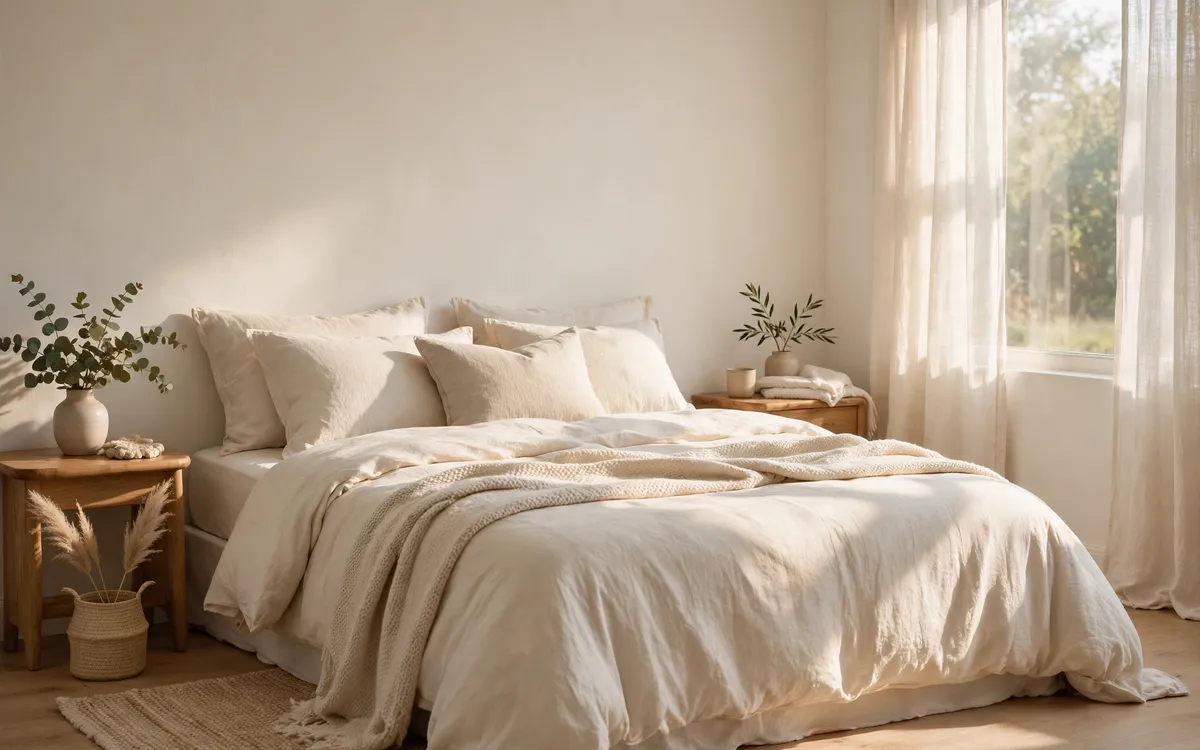
Paint the walls from the warm-white set in Step 1 — LRV 74 to 83, with a yellow, cream or faint greige undertone doing the warming. Bright true whites up at LRV 90+ are the classic cold-room mistake: they are made for galleries and kitchens, and in a bedroom they bounce blue light around all day and leave every fabric looking tired beside them.
2. Match the Undertone to Your Light

Window direction is the rule that overrides the paint chart. North-facing rooms live in cool, blue light from morning to night, so counter it with the warmest candidates — Swiss Coffee or Alabaster. South-facing rooms get golden light for free and can take the softer White Dove. Whichever way your windows face, run the two-wall swatch test and check it morning and evening before a full tin is opened.
3. Give the Bed Wall Quiet Panelling
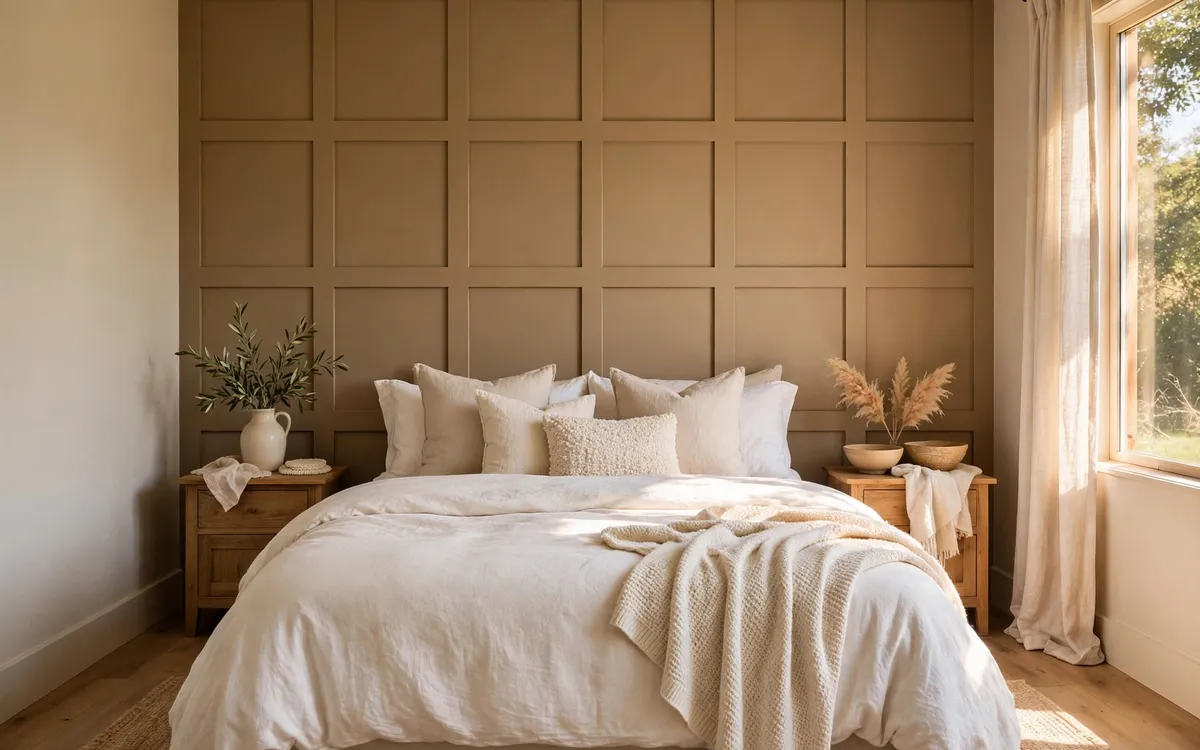
Panel moulding or simple board-and-batten on the wall behind the bed gives a pale room architecture without adding a single new colour. Paint the panelling one step deeper than the walls — Sherwin-Williams Accessible Beige (LRV 58) behind a bed, against an LRV-82 wall, is the classic pairing. The bed gains a backdrop, the wall gains shadow lines, and the room still reads entirely neutral.
4. Build Three Tonal Levels, Not One Flat Shade
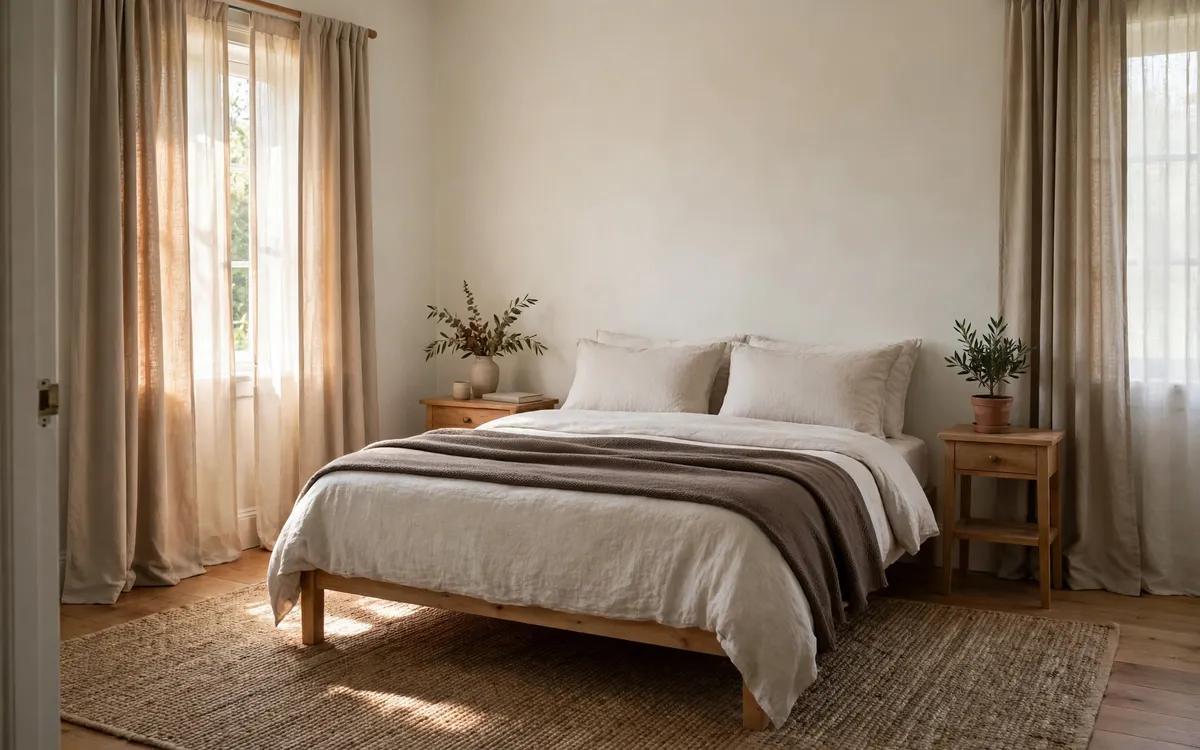
If the walls, bedding and curtains are all the same shade of beige, the eye has nowhere to land and the room feels unfinished rather than calm. Separate the three levels on purpose: the foundation pale, the middles a clear step deeper, the grounding pieces a step deeper again. Stand in the doorway and squint — if you can still see three bands of tone, the levels are working.
Zone B — The Bed, Layered by the Recipe
The bed is more than half of what you see in a bedroom, so it carries the texture count almost single-handed. Build it by the Step 2 recipe, layer by layer. This is also the layer that changes with the seasons — our cozy fall bedroom ideas dress this same bed for autumn; what follows is the calm, year-round base that sits underneath.
5. Lay the Base in Washed Linen or Soft Cotton

The foundation layer sets the room’s temperature more than any other fabric. Washed linen and matte cotton percale have a relaxed, slightly rumpled weave that reads warm on sight; shiny synthetics and sateen finishes read cool and hotel-corporate. Choose the base in the palest of your three tones — oatmeal, warm white or pale stone — and let everything above it deepen gradually toward the foot.
6. Fold the Duvet Back Over a Second Layer

Two sleeping layers, visibly separated, are what make a bed look deep from the doorway. Put a coverlet or light blanket over the sheet, then the duvet on top, folded back by about a third so both fabrics show. The fold line is a free tonal step: keep the under-layer a shade deeper than the duvet, or the other way round, but never let the two be identical.
7. Add One Chunky Throw at the Foot

The throw is the bed’s third texture and its grounding note in one move. Choose a genuinely chunky knit or a woven wool, in the deepest of your three tones, and lay it across the foot rather than folding it into a tight rectangle. One generous throw beats three thin ones — the weight is the point, both visually and on a cold night.
8. Stack the Pillows in a Counted Order

Pillow maths keeps a bed looking styled instead of stuffed: sleeping pillows upright against the headboard, two Euro shams (about 65 × 65 cm) in front of them, then one smaller accent pillow last. That is the whole arrangement. Every pillow beyond it is a nightly removal chore and a morning rebuilding job — and in a calm room, the sleepers in plain cases are a texture layer in their own right.
9. Choose a Soft Upholstered Headboard
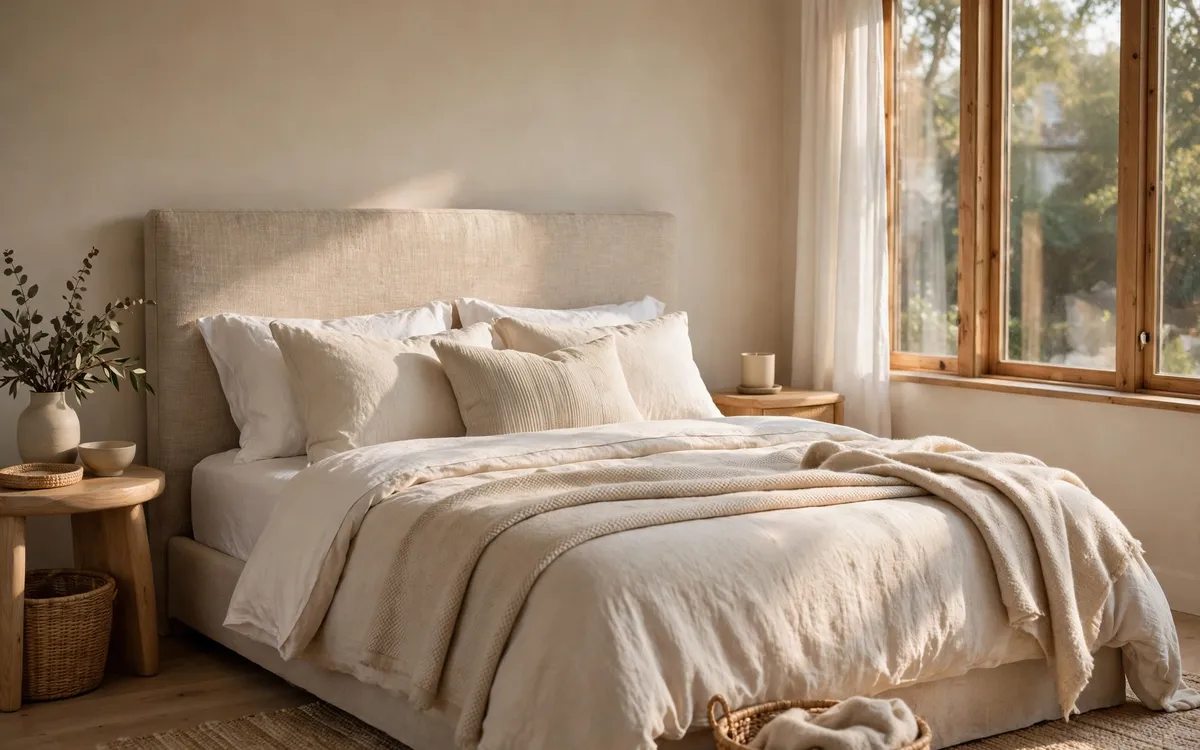
In a room built on softness, the bed’s backdrop should be fabric, not hard wood or metal. An upholstered headboard in oatmeal linen or cream bouclé adds one of your five texture families at the exact point the eye lands first, and it makes sitting up to read a comfort rather than a compromise. Keep the shape simple — a plain rectangle or gentle curve outlasts every trendier silhouette.
10. Spend Your One Pattern on the Front Pillow

A room with no pattern at all can feel printed rather than decorated, but pattern discipline is what keeps neutrals serene. Allow exactly one: the front accent pillow, in a ticking stripe, a small check or a quiet floral drawn in the same neutrals as everything else. One pattern per bed, everything else plain — the single patterned piece becomes the room’s signature instead of its noise.
Zone C — Floor and Windows
Warmth in a pale room lands from below and from the glass. This zone covers the two largest surfaces after the walls — the floor under the bed and the window wall — and both are sized by rules rather than taste.
11. Size the Rug by the Bed, Not the Room

The rug should extend 18 to 24 inches past the sides and foot of the bed, so your feet land on pile every single morning. In practice that means an 8 × 10 ft rug under a queen and a 9 × 12 ft under a king, run under the lower two-thirds of the bed and stopping just short of the nightstands, with roughly 12 inches of bare floor left at the walls. If the room is small, two runners down the sides do the same job — the layout rules for tight rooms are in our small bedroom decor ideas.
12. Pick a Pale Rug With a Warm Base
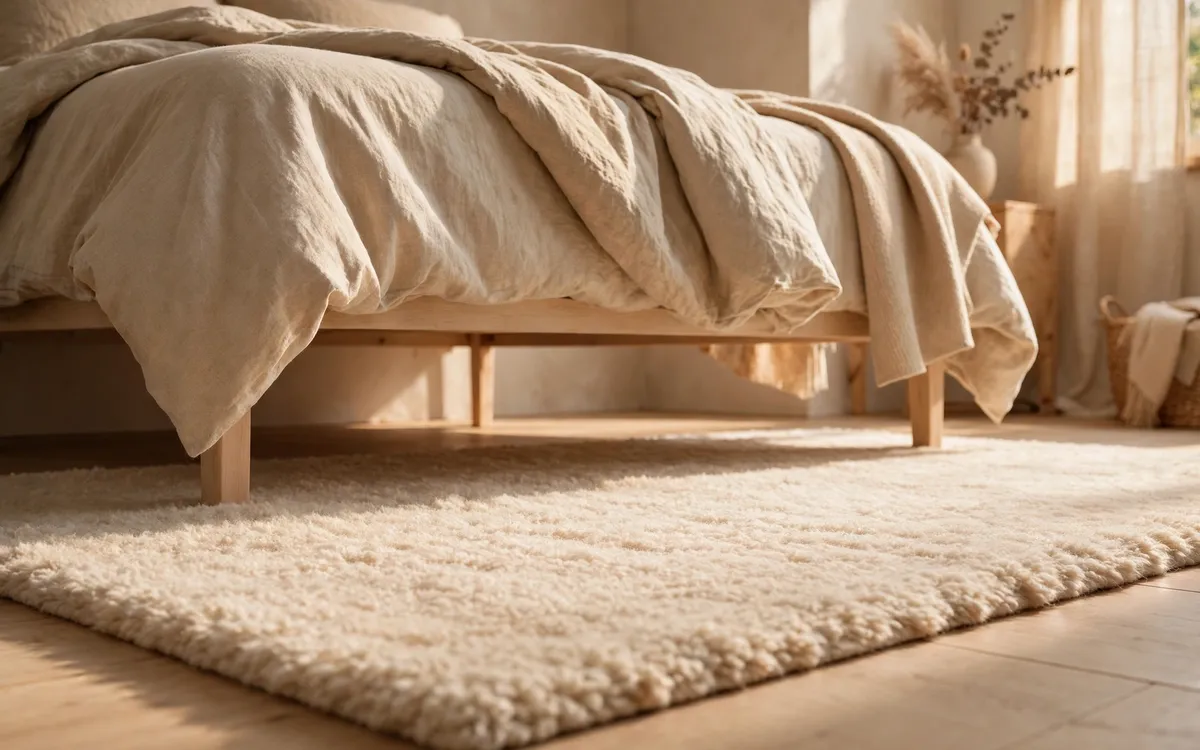
Hold the rug sample against your wall paint before you buy: a grey-based “neutral” rug laid over half the floor will cool the whole room faster than any wall colour can warm it. Choose cream, oat or wheat with a visibly warm undertone, in wool or a wool-look weave for softness. Where a door swings across it, drop to a flatweave or low pile so the door clears without dragging.
13. Hang Linen Curtains High, Wide and to the Floor

Fit the curtain rod close to the ceiling line and wide enough that the panels stack back off the glass, so the window keeps its full daylight. The hems should just kiss the floor — curtains that stop at the sill chop the wall in half visually. Natural linen is the fabric of the scheme: it is the medium tonal level, a texture family, and a softener of hard window light, all in one pair of panels.
14. Layer a Woven Shade Under the Curtains

A bamboo or woven-wood blind fitted inside the window, beneath the linen curtains, gives the glass its own texture layer and warms the daylight before it even enters the room. It also solves the practical half of layering: the shade does the privacy and glare work during the day, and the curtains do the softness and darkness work at night. Choose a natural mid-tone weave to sit in your middle tonal level.
Zone D — Wood, Furniture and the Dark Anchor
With the soft layers counted, the furniture has one job: to give the room its weight and its warm grain. Keep the pieces few, their undertones matched, and let one darker note repeat until it looks intentional.
15. Bring In One Warm Wood Piece

One substantial piece of warm wood — a dresser, or a matched nightstand pair — anchors a pale room more effectively than any accessory. White oak, ash, maple, pine and warm mid-tone stains all belong here; the only rule is undertone: hold a drawer front against the wall paint and check the two warmths agree. Let one wood family lead the room, with any second wood kept clearly subordinate.
16. Keep the Nightstand Pair Matching
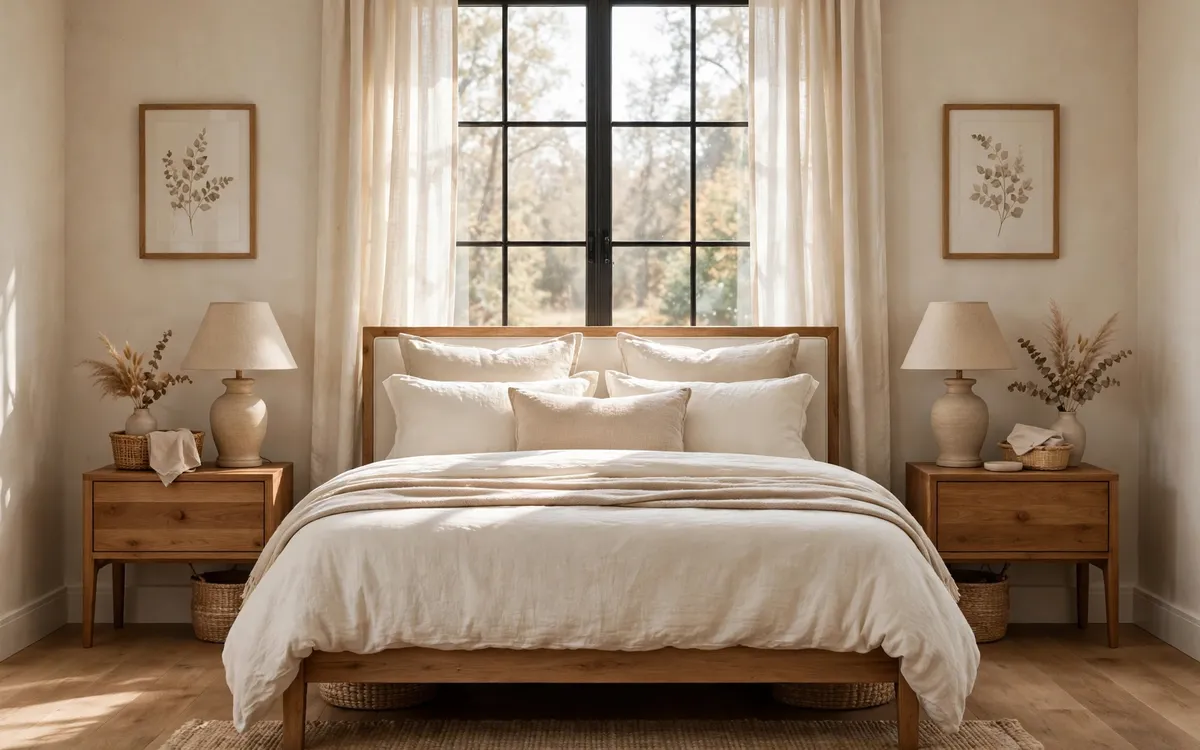
Same table, same lamp, both sides of the bed. Symmetry is the quiet engine of a calm pale room: it is what separates “serene” from “unfinished” when almost everything is the same colour. Mismatched nightstands can work in bolder schemes, but in a neutral bedroom they read as a room still being collected. Match the pair first; style their tops second.
17. Add One Dark Anchor, Repeated Twice
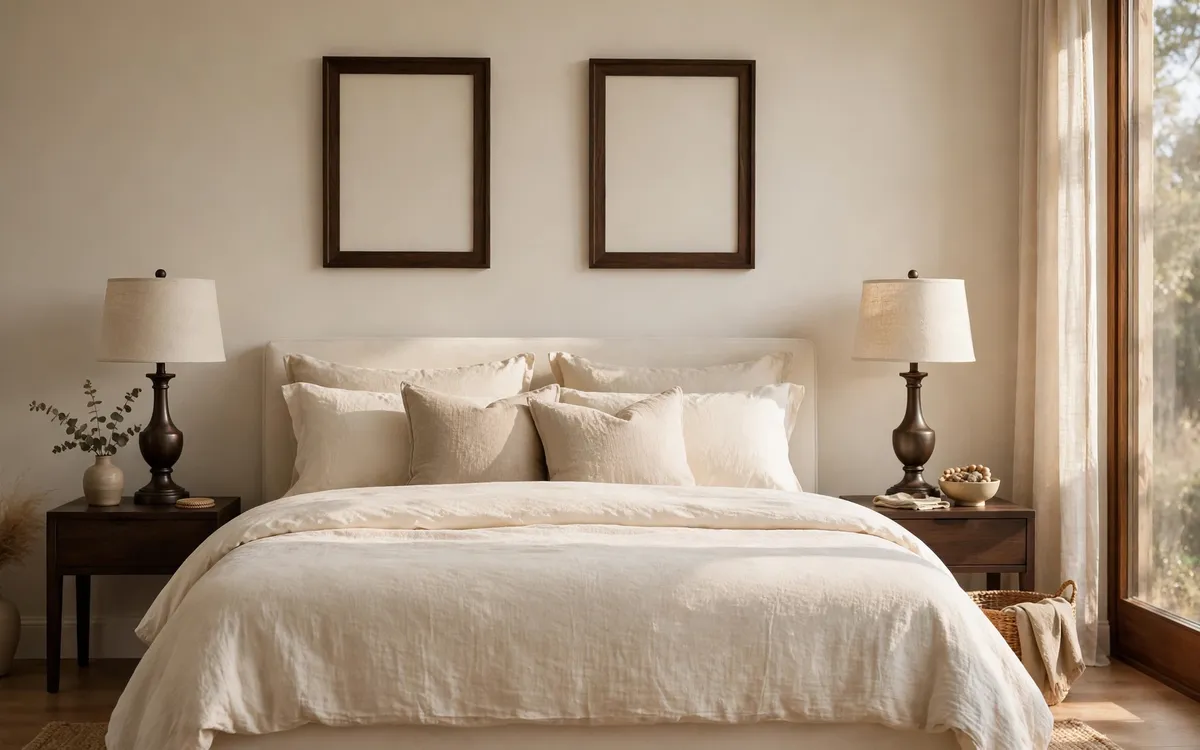
Every pale room needs one deeper note to rest the eye on: deep taupe, soft black or aged bronze, at roughly the 10 level of the 60-30-10 split. The discipline is repetition — lamp bases plus picture frames, or the chunky throw plus a bench cushion. An anchor that appears once looks like a mistake; the same note twice, in two different places, becomes the room’s punctuation.
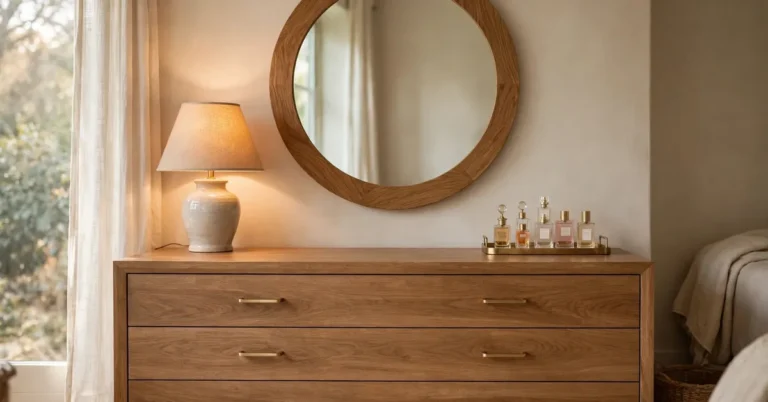
18. Keep the Dresser Top to a Tray, a Lamp and One Stem

The dresser top follows the same counted logic as the bed: one tray to gather the small things, one small lamp for a low pool of light, one stem or small vase for height — and then stop, leaving bare wood visible around all three. The full system for dressing that surface, zones and all, is in our top of dresser decor ideas.
19. Set a Bench at the Foot in a Deeper Neutral

An upholstered bench at the foot of the bed earns its place three ways: it catches the throw and tomorrow’s clothes, it gives the bed a finished edge, and upholstered in the grounding tone it carries the 10 level at floor height. Look for a seat about 14 to 16 inches deep and a few inches narrower than the bed — and measure the walkway past it before you buy, because a bench that blocks the route to the bathroom helps nobody at 3 a.m.
Zone E — Light and the Last Layer
The final zone is the one that decides how the room feels at the hour it is actually used. Warm light, placed low and in pools, is worth more to a neutral bedroom than any single piece of furniture in it.
20. Swap Every Bulb to 2700K

Check the Kelvin number on every bulb in the room — ceiling, bedside lamps, all of them — and standardise on 2700K, the warm end of household bulbs. This is the cheapest fix in the entire article and the one with the largest effect: a single 4000K bulb turns warm paint grey-blue after dark and quietly undoes a weekend of careful decorating. Add dimmers wherever the wiring allows, because warm light you can lower is cozier still.
21. Light Three Pools, Not One Ceiling Light

One bright ceiling light flattens everything it touches. Instead, build three low pools: the bedside lamp pair, plus one low lamp or a candle’s glow in a corner or on the dresser. Then run the 9 p.m. test: stand in the doorway after dark and check that the paint still reads warm, the textures still cast soft shadows, and no corner has gone grey. If the room passes at night, it passes at any hour.
22. Fill the Tall Corner With One Branch or Plant
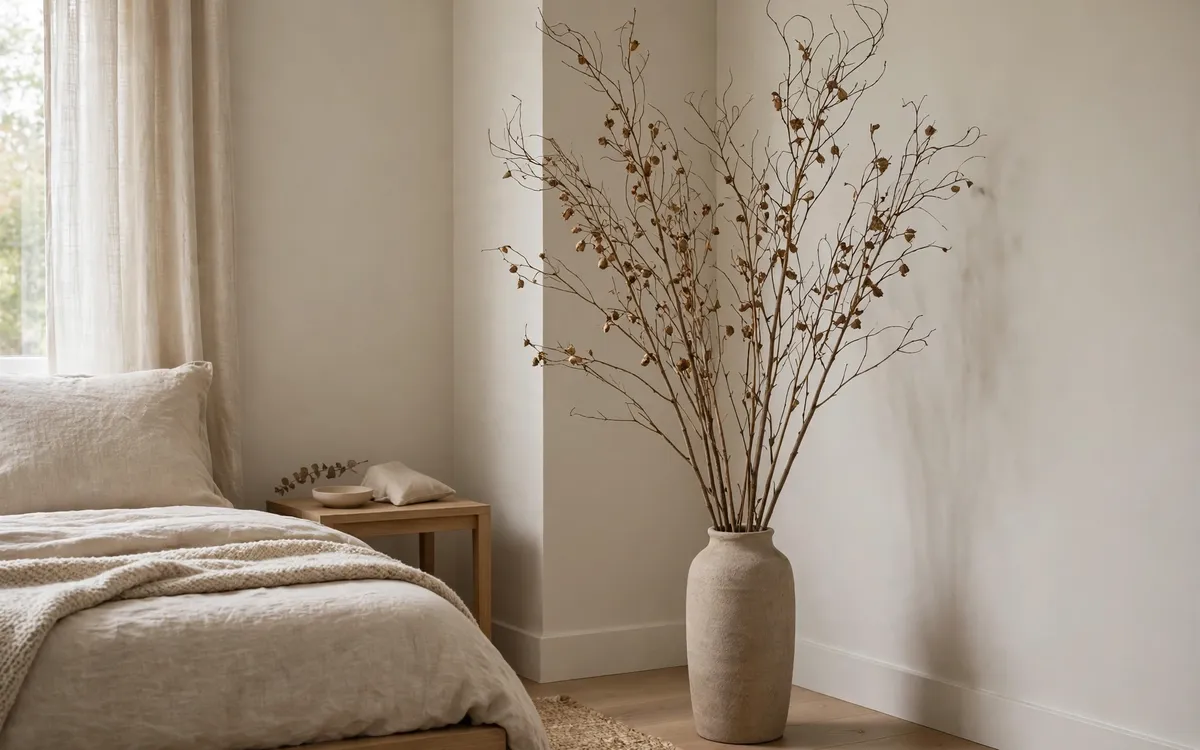
Most bedrooms have one tall empty corner that makes the ceiling line feel unfinished. A floor vase of dried branches — pampas, willow, dried eucalyptus — or a single tall plant fills that vertical space without adding furniture, and brings the room its one living, irregular note among all the straight lines. Keep it to one corner: height is the accent, and two competing stems cancel each other out.
23. Keep a Woven Basket for the Spare Throw

The last layer is storage that behaves like decor. A woven basket beside the bed or bench holds the spare throw and the cushion that rotates off the bed at night — texture family, tidiness system and extra warmth within arm’s reach, all in a single piece. Choose seagrass, rattan or woven cotton in the middle tonal level, big enough for the throw to fold into loosely rather than being stuffed.
What It Costs: Three Ways In
The textile-and-light tier (roughly under $150). Start where the effect is largest: the full bulb swap to 2700K, one chunky throw in the grounding tone, two linen pillow shams, a woven basket and dried stems — plus test pots of two warm whites, so the swatch test in Step 1 is run properly instead of guessed from a paint chip.
The middle tier (roughly $150–$500). The full bedding recipe: a duvet cover set, the coverlet for the folded layer and Euro shams. Add the linen curtain pair, the woven window shade and a matching pair of bedside lamps, and the room’s bones are done.
The furniture tier (roughly $500–$1,500). The long-term pieces: an upholstered headboard or bed, an 8 × 10 wool or wool-look rug sized by the bed, one warm-wood dresser or a matching nightstand pair, and the bed-wall panelling project. Bought in that order, each piece lands in a room that already works.
7 Mistakes That Make a Neutral Bedroom Feel Cold
- Choosing a blue- or grey-based white. It reads cold and clinical in a bedroom, and worst of all in north-facing light. The undertone, not the colour name, is the decision.
- Painting everything one flat shade. Walls, bedding and curtains at identical tones leave the eye nowhere to land. Neutral needs its three tonal steps.
- All-smooth surfaces. Cotton, cotton and more cotton stays flat no matter the colour. Without a chunky weave, a woven texture and a wood grain, there is nothing for light to play on.
- Cool bulbs over warm paint. One 4000K bulb turns the whole scheme grey-blue after dark. Standardise on 2700K everywhere, no exceptions.
- A rug that is too small. A 5 × 8 rug under a queen leaves the bed floating and your feet on cold floor. Size the rug by the bed: 18–24 inches showing on three sides.
- Grey-washed wood against warm walls. The undertones fight all day, and every grey-toned piece makes the warm ones beside it look yellow by comparison.
- Skipping the swatch test. Neutrals shift more between the paint chip, daylight and lamplight than any other colour family. The 60 × 60 cm test on two walls is not optional homework — it is the cheapest insurance in the whole project.
FAQs
How do I make a neutral bedroom feel cozy instead of boring or cold?
Warmth in a neutral room comes from three counted things, not from adding colour: a warm undertone in the paint, at least three textures on the bed (five across the room), and one darker grounding note repeated twice. If a room feels cold, check the bulbs first — swapping to 2700K fixes more “cold” neutral rooms than any repaint.
What is the best warm white paint for a bedroom?
Start with the three most forgiving: Benjamin Moore Swiss Coffee OC-45 (LRV 81.91) for a creamy wall, Sherwin-Williams Alabaster SW 7008 (LRV 82) for a softer warmth, and Benjamin Moore White Dove OC-17 (LRV 83.16) for the palest greige-white. For a deeper wall, Sherwin-Williams Shoji White (LRV 74) is the next step down. The best one is the one that passes the two-wall swatch test in your room’s light.
Should a north-facing bedroom use warm or cool neutrals?
Warm, always. A north-facing room receives cool, blue-grey light all day, which drags every colour colder than its chip. Counter it by choosing from the warm end of the white family — Swiss Coffee and Alabaster are the standard fixes — and by keeping wood tones warm rather than grey-washed, so the room’s largest surfaces are not fighting the light.
What accent colours go with a neutral bedroom without breaking the calm?
Stay close to the family first: deep taupe, warm caramel, clay and bronze all read as darker neutrals rather than colours. If you want one true colour, take it from nature and keep it muted and singular — a sage or olive cushion, dried stems with a rust tone — used in the 10 slot and repeated once. One quiet accent, twice placed, never a rainbow of “pops”.
How many textures does a neutral bedroom actually need?
Count three on the bed itself — for example matte linen, a smooth cotton duvet and a chunky knit throw — and about five across the whole room, adding woven texture (a shade, a basket) and warm wood grain. The count matters more than the pieces: below three textures in total, even a perfectly chosen palette reads flat, because the light has nothing to describe.
Can a neutral colour palette work in a small bedroom?
Yes — it is one of the best palettes for a small room, because the tonal system adds depth without visual noise, and pale warm walls return more light than any other colour family. Keep all three tonal levels (small rooms go flat fastest), choose the lighter rug option with runners if a full rug crowds the floor, and borrow the layout and furniture-scale rules from our small bedroom decor ideas.
Neutral is a wonderful base, but it need not be the whole story. If you fancy one room with a little more drama, our Dark Boho Bedroom Ideas take the same warm undertones, layered textures and single dark anchor and turn them up a shade, so a calm neutral bedroom and a moody boho one sit happily side by side.
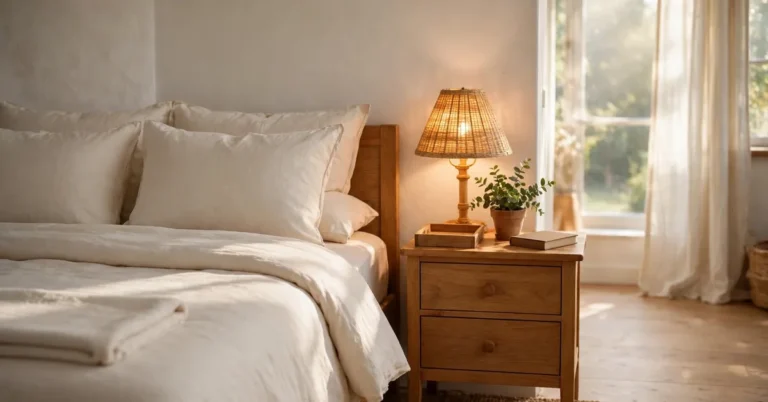
If the calm system in this room works, it is worth running in the spare room too — a second bedroom does not need a second personality, just the same measured hospitality: a bed that has been properly slept in, a place for a suitcase to land and a light within reach on each side. Our guest bedroom ideas carry that thinking through the whole room, so the spare feels like a hotel rather than a storage cupboard with a bed in it.
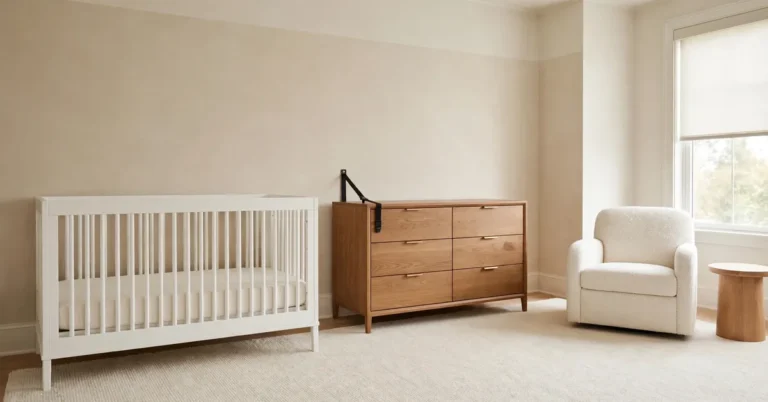
If there is one room where a calm neutral palette matters most, it is the nursery. Soft, warm neutrals soothe a baby and grow with them, and the storage and layout need to keep everything within reach during night feeds. Our neutral nursery ideas are the companion to this bedroom guide, carrying the same calm into a baby’s first room.
Conclusion
A neutral bedroom is not a room with the colour removed — it is a room where undertone, texture and tone do the work that colour does elsewhere. Warm the paint to your light, count the layers on the bed, ground the pale scheme with warm wood and one repeated dark note, and set the light to 2700K so the whole system still holds at 9 p.m. Keep these cozy neutral bedroom ideas in that order and the palette that so easily turns cold or flat becomes the calmest, warmest room in the house — in every season, at any size.



5 Comments