
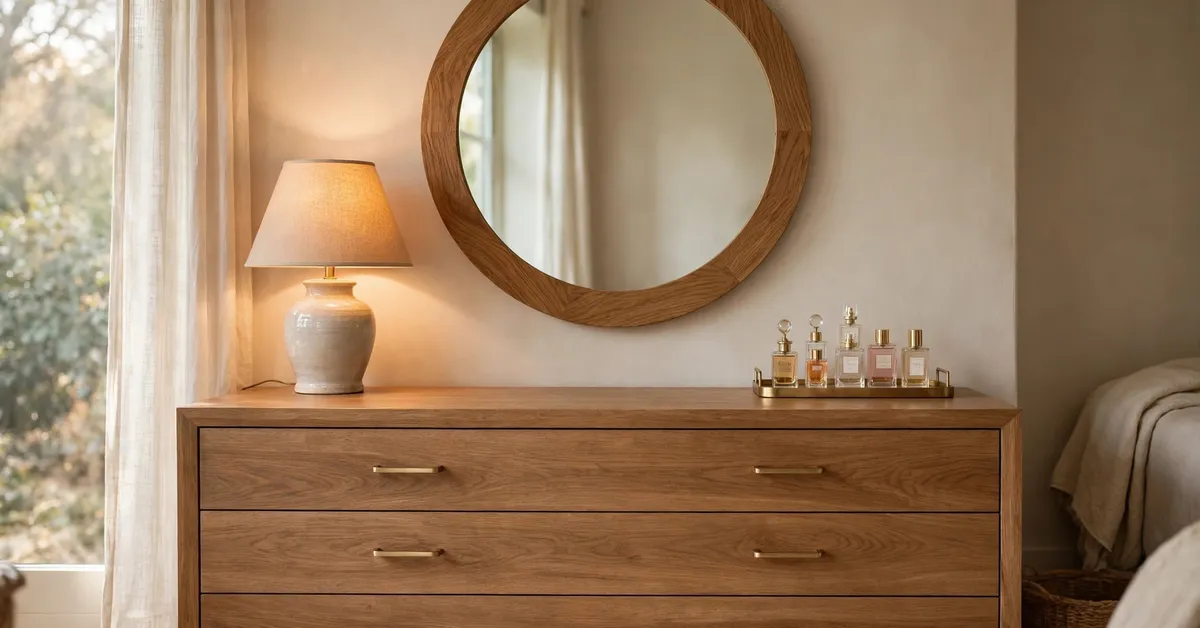
22 Effortless Top of Dresser Decor Ideas for a Tidy, Working Bedroom
The top of a dresser is the most-used styled surface in the bedroom, and the most betrayed. It is where perfume, watches, jewellery and tomorrow’s clothes all have to live, so styling that ignores the daily job gets quietly dismantled within the week, one drawer-pull at a time. These top of dresser decor ideas respect both jobs at once: a top that looks finished in the morning light and still works while you are getting ready in it. Everything below runs on one measured system, and most of it starts with pieces you already own.
Be honest about what this surface does. A dresser is a working top, not a mantel: clothes get folded on it, outfits get laid out on it, and the mirror above it is where the day actually begins. Decor that covers the whole top leaves nowhere for any of that, which is why so many styled dressers end up with the decor shoved to one end and a pile of laundry on the other. So this article sizes the anchor before it styles it, reserves a whole stretch of the top for real life, and saves the pretty layer for the space that is genuinely spare.
The dresser is also half of a pair. Its smaller bedside sibling, the nightstand, has its own system in our guide to nightstand decor ideas, built around sleep: the reading lamp, the nightly group, the two-minute reset before bed. The dresser works the other end of the day. It is the morning surface, and it deserves a system of its own, with its own numbers.
The Method: Anchor It, Zone It, Step It
Every good list of top of dresser decor ideas is secretly the same three moves, done in the same order. Anchor the wall first so the surface stays free, zone the top so real life has a reserved place on it, and step the heights so the styling reads as layers instead of a row. The stylists at ShineSheets’ dresser styling formula build on the same six pieces; here is the measured version, move by move.
Step 1: Anchor It — Hang the Wall Piece First
Start with the wall, not the top. A standard dresser stands about 30 to 34 inches tall, and the piece above it, a mirror or one large print, should span about two-thirds of the dresser’s width: 36 to 42 inches on the standard 60 inch dresser. Hang it with its bottom edge 4 to 6 inches above the top, close enough to read as one piece of furniture with the dresser below it. A mirror earns the spot when it faces or catches a window; a print earns it when the mirror would only reflect a closet door. Either way, the wall carries the styling, and that is what leaves the surface underneath free to work.
Step 2: Zone It — Display, Daily, and a Clear Third
Before anything is placed, divide the top into three stretches. One end is the display zone, where the vase, the books and the personal piece live. One stretch is the daily zone: a single tray, 12 to 16 inches long and never more than about a third of the whole surface, holding the perfume, the watch and the jewellery you actually use. And one full third of the top stays deliberately, permanently clear, because that is where clothes get folded and tomorrow’s outfit gets laid out. The clear third is not leftover space. It is the hardest-working zone on the dresser, and it is the one that keeps the other two alive.
Step 3: Step It — Tall, Middle, Low
Last, build the heights as a stepped triangle instead of a flat row. One lamp, 24 to 30 inches tall and set 3 to 6 inches in from one end, is the tall point; on a standard dresser its shade top lands around 58 to 64 inches from the floor, high enough to light the top without glaring across the room, and its shade should stay narrower than the top is deep. The middle height comes from stacked books or a vase of branches, the low line from the tray at the other end. Keep everything else on the top under about 18 inches tall, so nothing competes with the anchor on the wall. The lamp is the one deliberate tall exception.
Use the ideas below by zone, not all at once. Hang the anchor first and live with the clear top for a few days; the zoning does more work than anything you can buy. Add the lamp second, the tray third, and only then choose from the zones that follow: the wall above, light and height, the daily getting-ready stretch, wide and narrow tops, and the finishing touches. If your dresser carries a TV, start at idea 17. If the top already works and still feels unfinished, the personal piece at idea 19 is usually what is missing.
The Wall Above the Dresser
1. Hang the Mirror at Two-Thirds Width
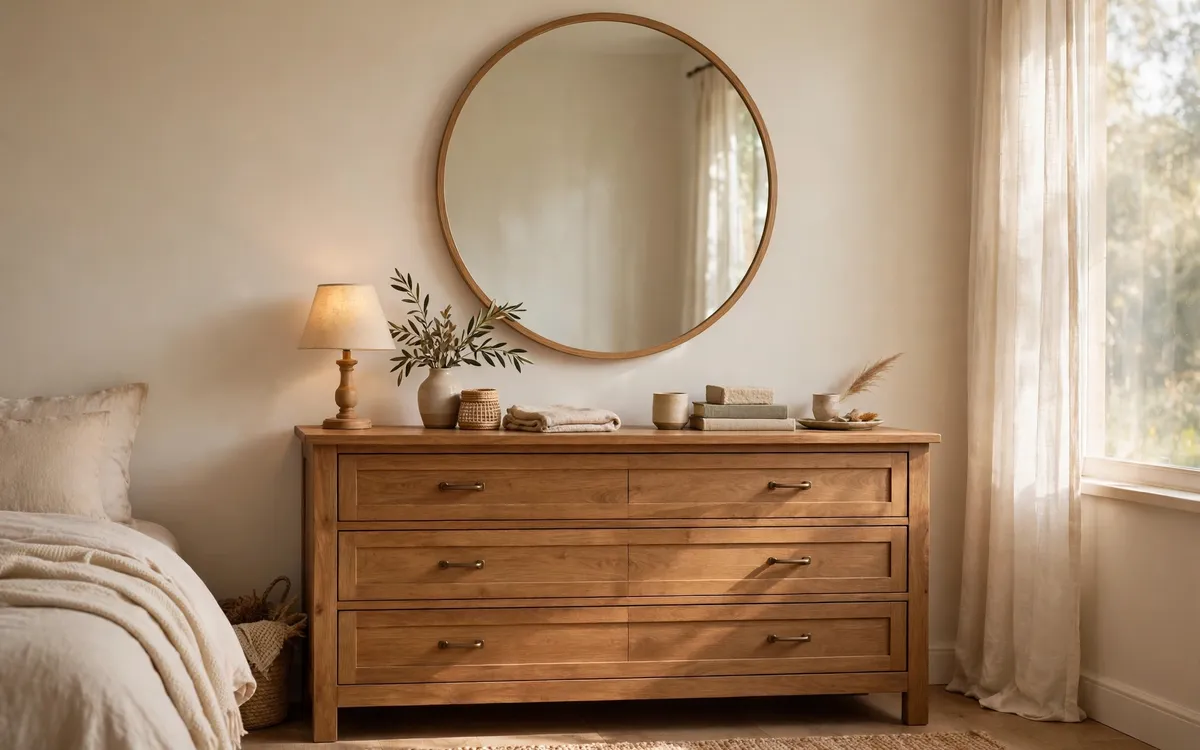
A mirror about two-thirds as wide as the dresser is the anchor that does the most work: 36 to 42 inches across on a standard 60 inch dresser, hung with its bottom edge 4 to 6 inches above the top. It is the last check before you leave the room, it doubles the light the lamp gives in the evening, and against a window it pulls daylight deep into the bedroom all morning.
2. Pick One Large Print Over a Mirror
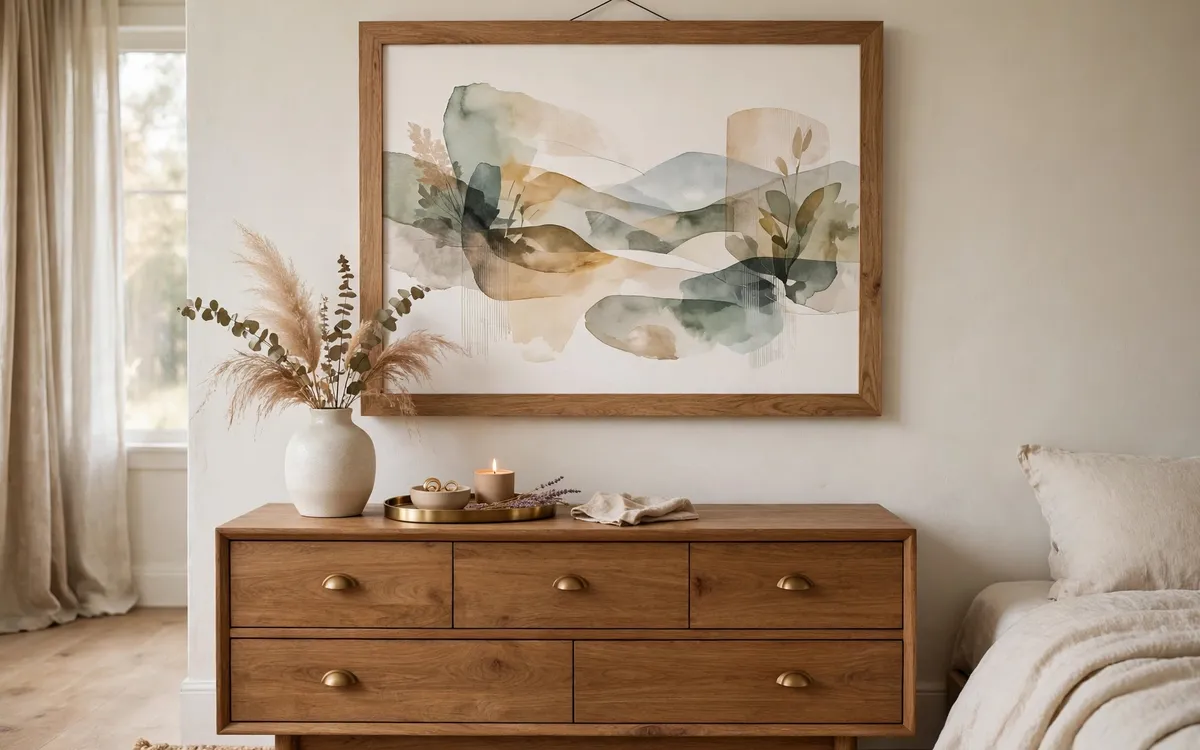
A mirror is only as good as what it reflects. When the dresser faces a closet door, a blank hallway or the side of a wardrobe, hang one large framed print instead, on the same two-thirds rule and the same 4 to 6 inch gap. One strong image calms the wall in a way a mirror showing a door never can, and the top below it can stay exactly as simple.
3. Lean a Mirror When You Can’t Drill
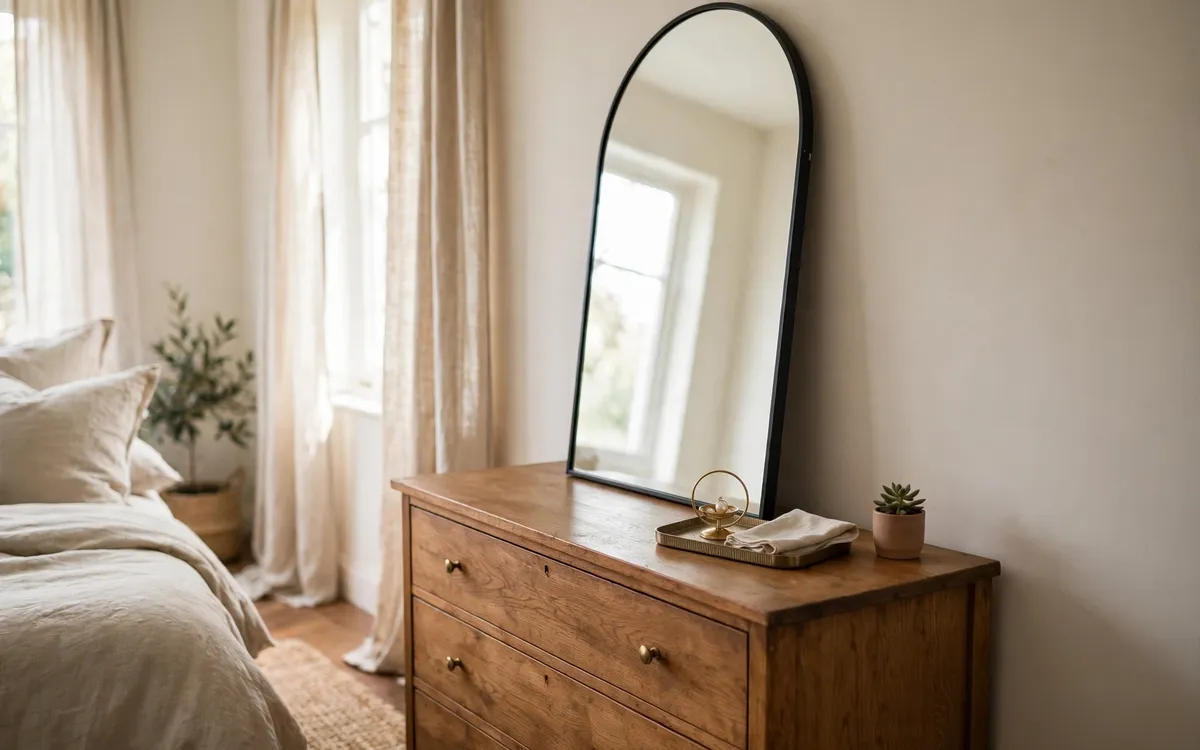
For renters, and for anyone whose walls defeat a drill, a tall mirror leaned on the top against the wall is the anchor without the holes. Set its base a few inches out from the wall, on an anti-slip pad, and strap it to the wall for safety, as the note at the end of this article explains. It splits the difference between mirror and art, and it moves when you do.
4. Build a Small Gallery Within the Width
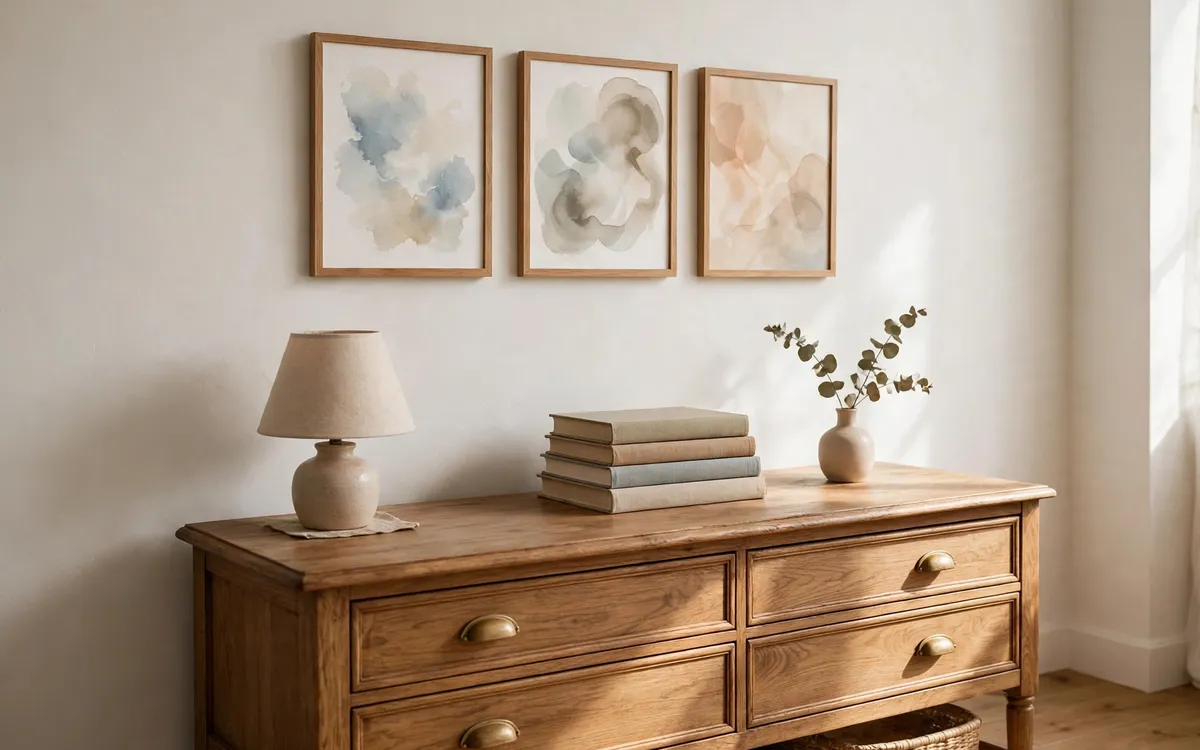
Three or four small frames, grouped inside the dresser’s footprint, make the wall personal where a mirror makes it bright. Keep the lowest frame 4 to 6 inches above the top, the spacing between frames even at about 2 inches, and the whole group narrower than the dresser itself. Photos and small prints belong here: the dresser is where you stand still every morning, which makes it the best-read wall in the room.
Light and Height
5. Set One Lamp In From the End
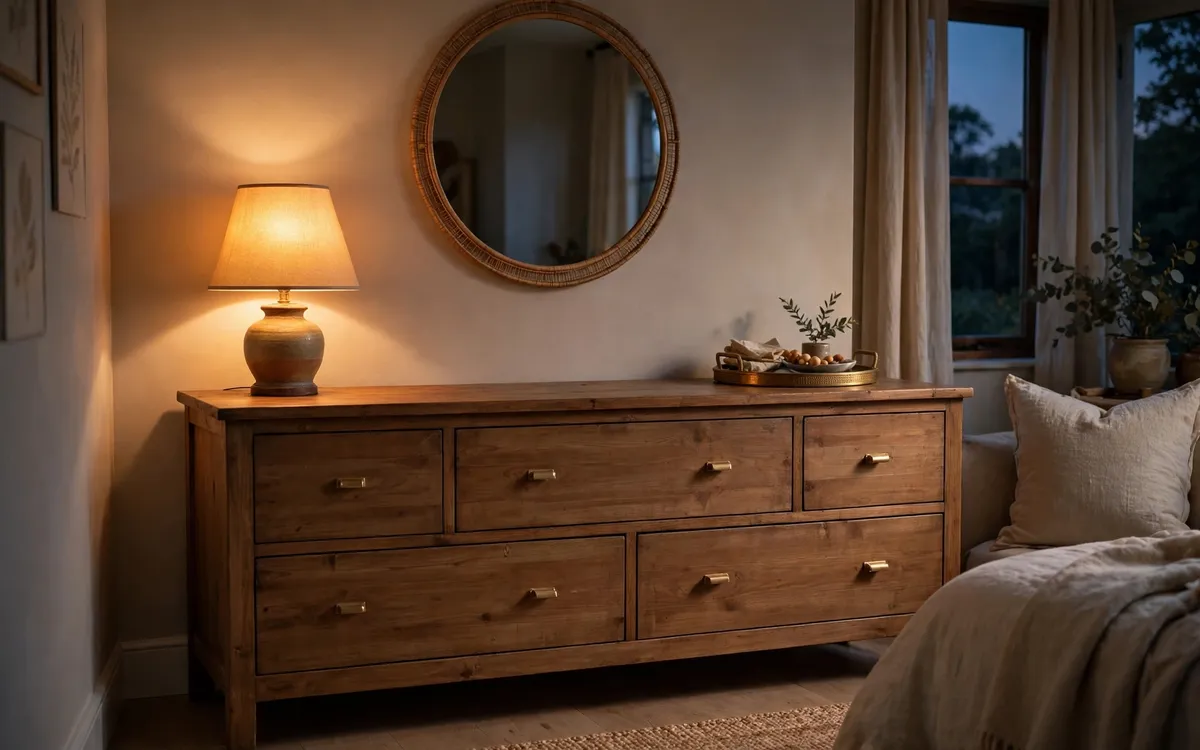
Place one lamp toward one end of the top, but not on the edge: set it 3 to 6 inches in, so it reads as part of the composition instead of a piece about to fall. On a dresser of 30 to 34 inches, a lamp of 24 to 30 inches puts its shade top around 58 to 64 inches from the floor, and a warm bulb makes the morning mirror kinder and the evening room softer in one move.
6. Balance It With Branches Under Eighteen Inches
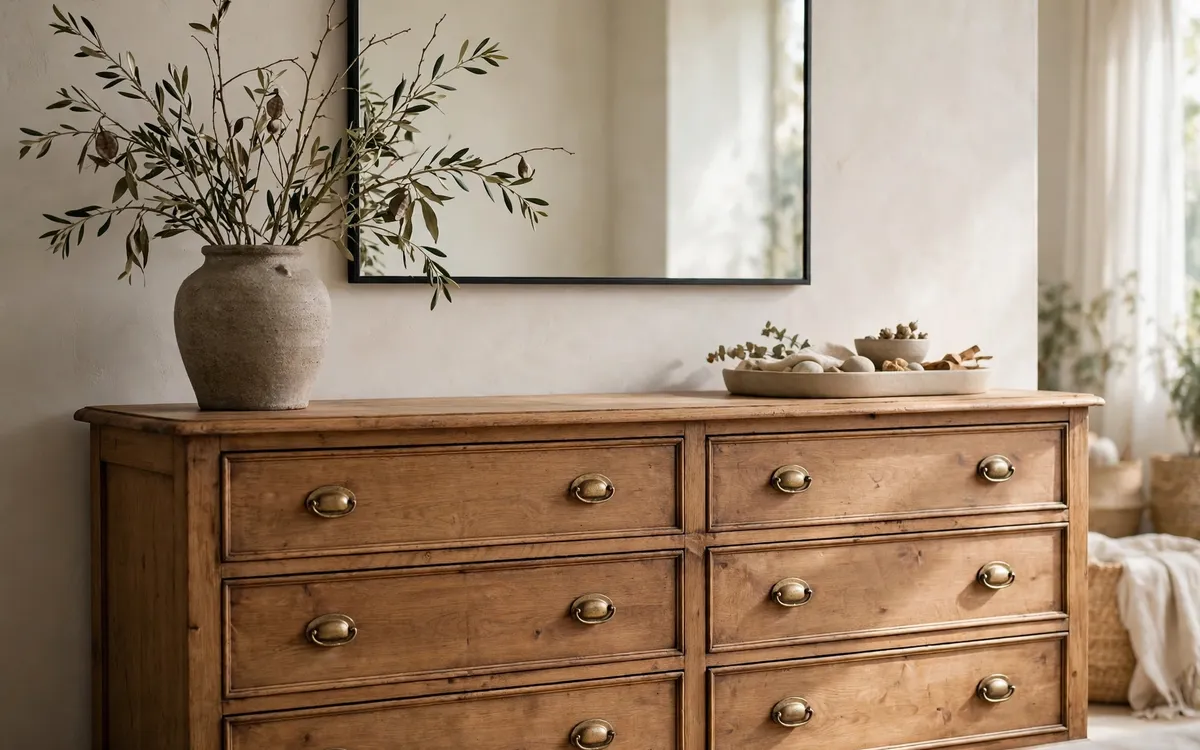
Opposite the lamp, a vase of stems or branches gives the second height without a second lamp. Keep the arrangement under about 18 inches tall, so it stays a middle height and never argues with the anchor above. Choose a vase with a genuinely heavy base, stoneware or thick glass, because a dresser top gets bumped by elbows and drawer-pulls, and a light vase will not survive the season.
7. Stack Books for the Middle Height
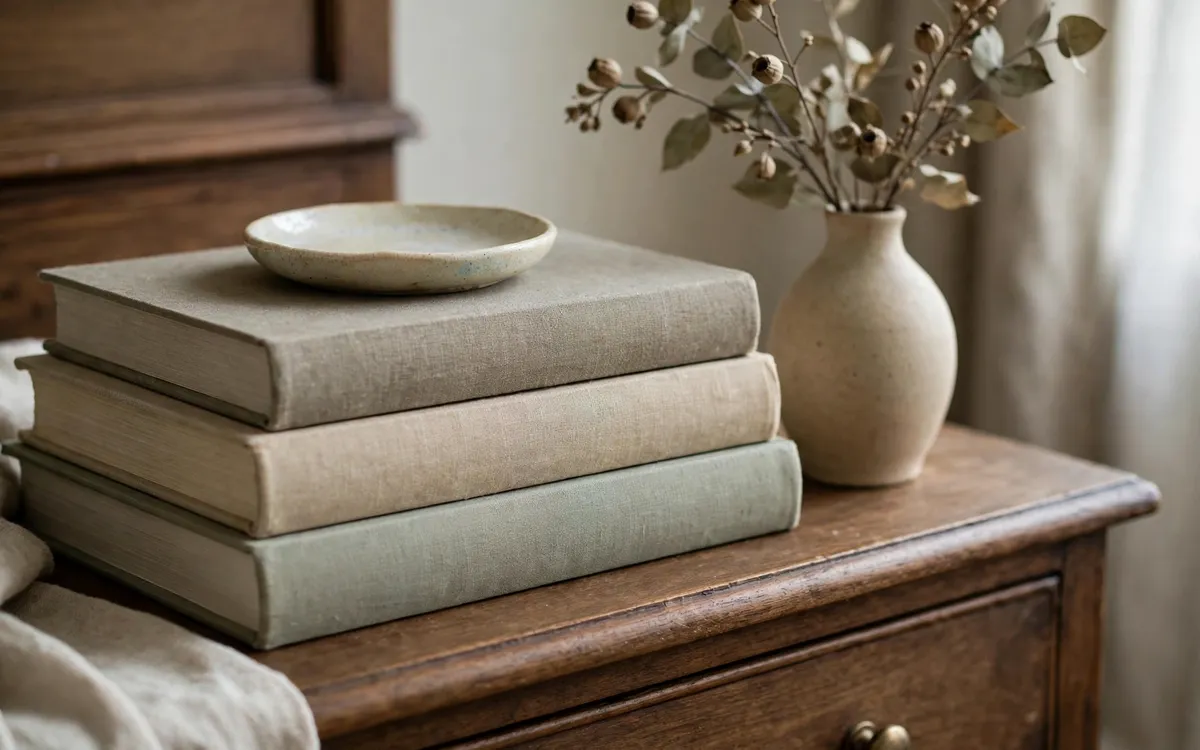
Two to four hardcover books, laid flat with their spines facing out, are the middle step of the triangle and the cheapest riser in the bedroom. Rest a small dish, a flameless candle or the plant on top and it rises out of the tray’s shadow. Keep the stack to one spot, line the spines up neatly, and pick books whose colours you are glad to see half-asleep.
8. Step the Heights: Tall, Middle, Low
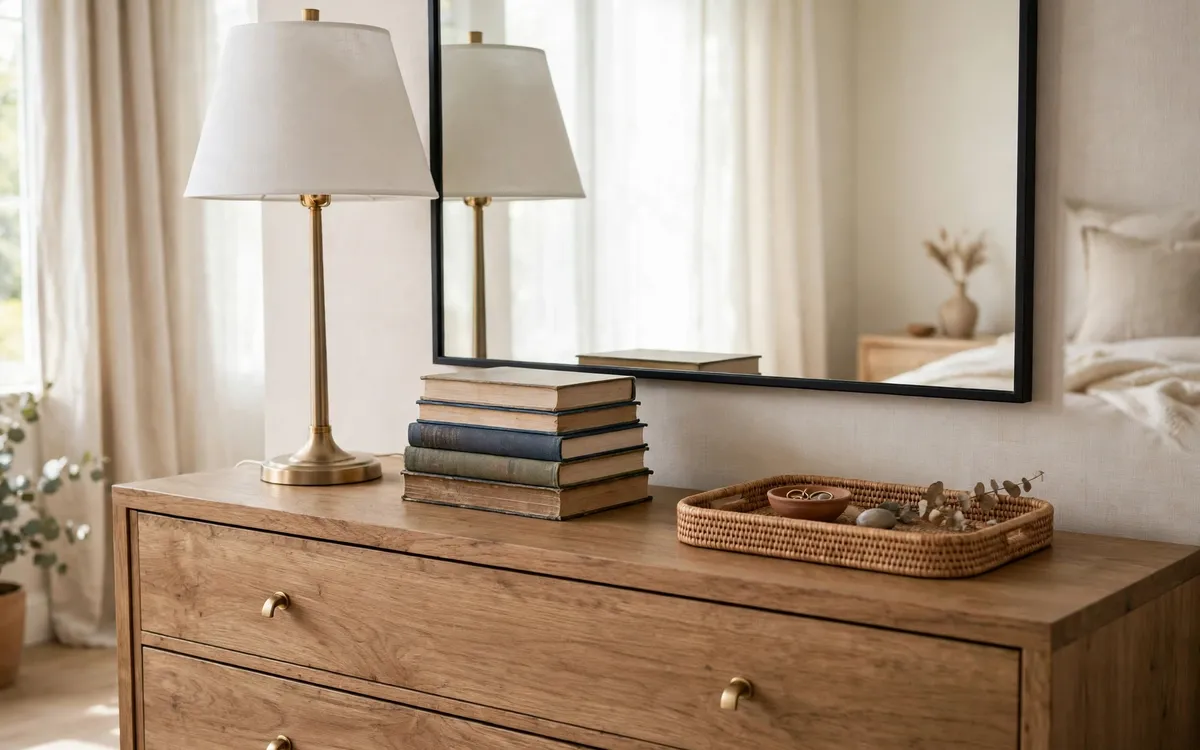
This is the composition rule the whole list leans on. Lamp tall, books or vase in the middle, tray low, stepped across the top, reads as styled from the doorway. A flat row of same-height objects reads as a shelf of storage, however pretty each piece is. When a dresser top feels dull and you cannot name why, check the skyline first: it is almost always four objects politely standing at the same level.
The Daily Zone: Getting Ready
9. Give Perfumes One Tray
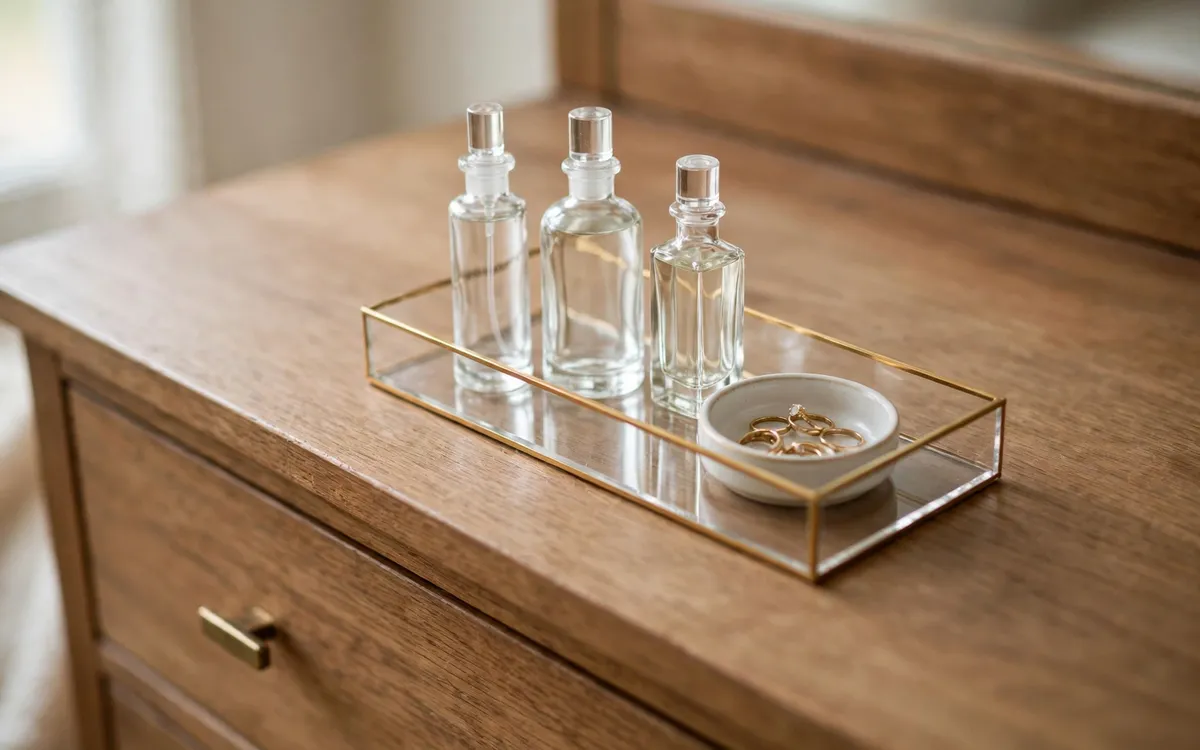
One tray, 12 to 16 inches long, holds the bottles you actually use, and grouping them changes everything: on a tray they read as a vanity display, loose on the wood they read as clutter and leave rings. The tray also lifts off in one move for dusting, which is why the daily zone stays clean when the rest of the room does not. Never let it grow past about a third of the top.
10. Keep Jewellery in a Lidded Box
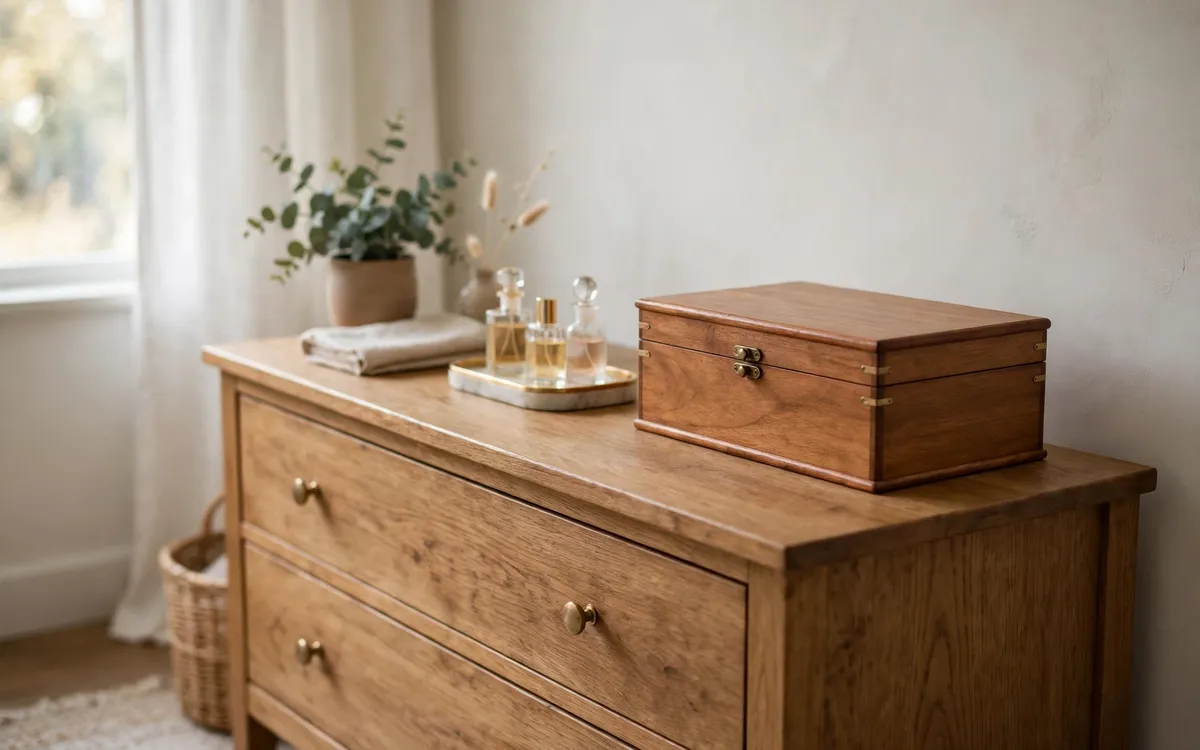
Necklaces tangle, earrings migrate, and watches gather dust in the open. One lidded box in the daily zone, beside the perfume tray, swallows all three problems: the lid keeps dust off, the inside stops the spreading, and closed, it reads as a calm piece of decor. Size it to the real collection, and when it overflows, the answer is a clear-out, not a second box creeping across the top.
11. Turn One End Into a Mini Vanity
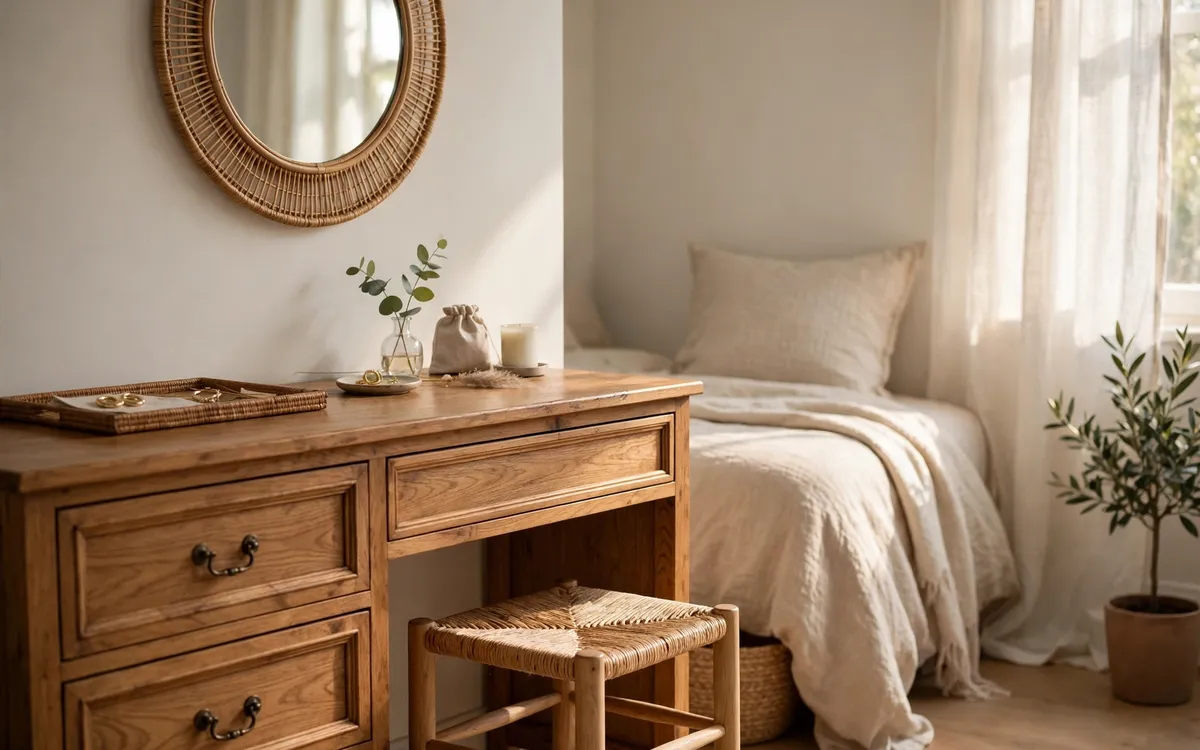
Where the mirror hangs, the end of the dresser beneath it can work as a small vanity: the perfume tray, the jewellery box, and one small stool tucked in front of the top. It is five minutes of morning order instead of a queue for the bathroom mirror, and it costs one end of a surface you already own. Keep the stool low and light enough to move with one hand.
12. Leave the Middle Third Bare for Folding
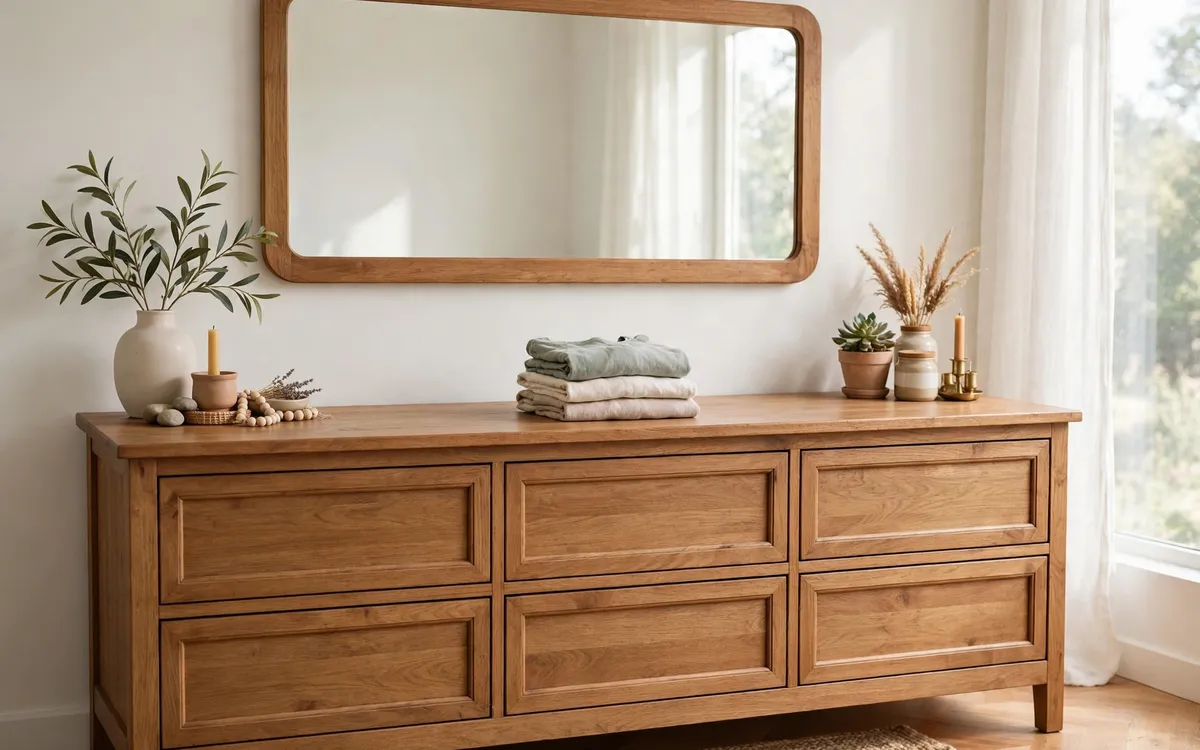
This is the idea the whole method protects. Roughly a third of the top, ideally the middle stretch, stays completely clear: it is where laundry gets folded, where tomorrow’s clothes get laid out, and where a bag gets set down without a crisis. Decor that colonises the folding stretch gets moved by real life within the week, usually into a resentful pile. Defend the empty third and the styled ends survive on their own.
13. Protect the Top With a Runner
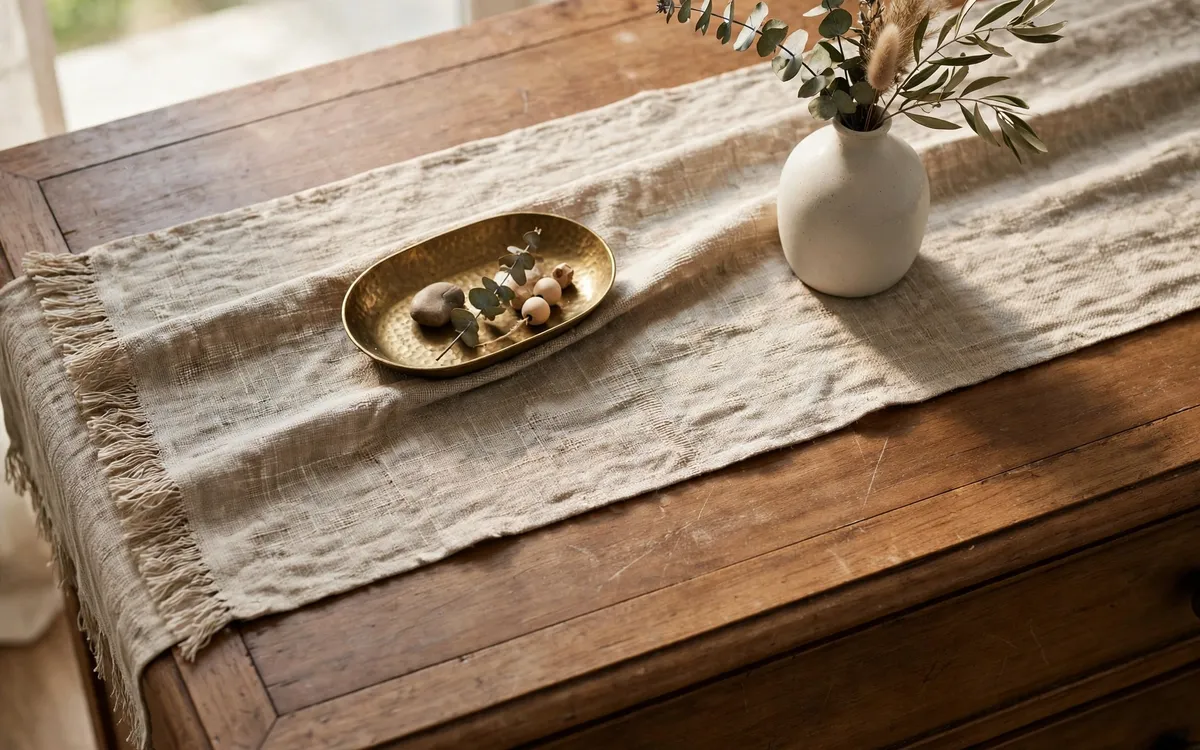
A washable runner or mat under the daily zone catches what the tray misses: perfume rings, water marks from a stem vase, and the slow scratches of jewellery and keys. Cut or choose it a little narrower than the top, so a border of wood still shows and the dresser reads as furniture, not as a covered table. When it dulls, it washes; the wood underneath never has to learn the lesson.
Wide, Narrow and Shared Dressers
14. Split a Wide Dresser Into Two Zones
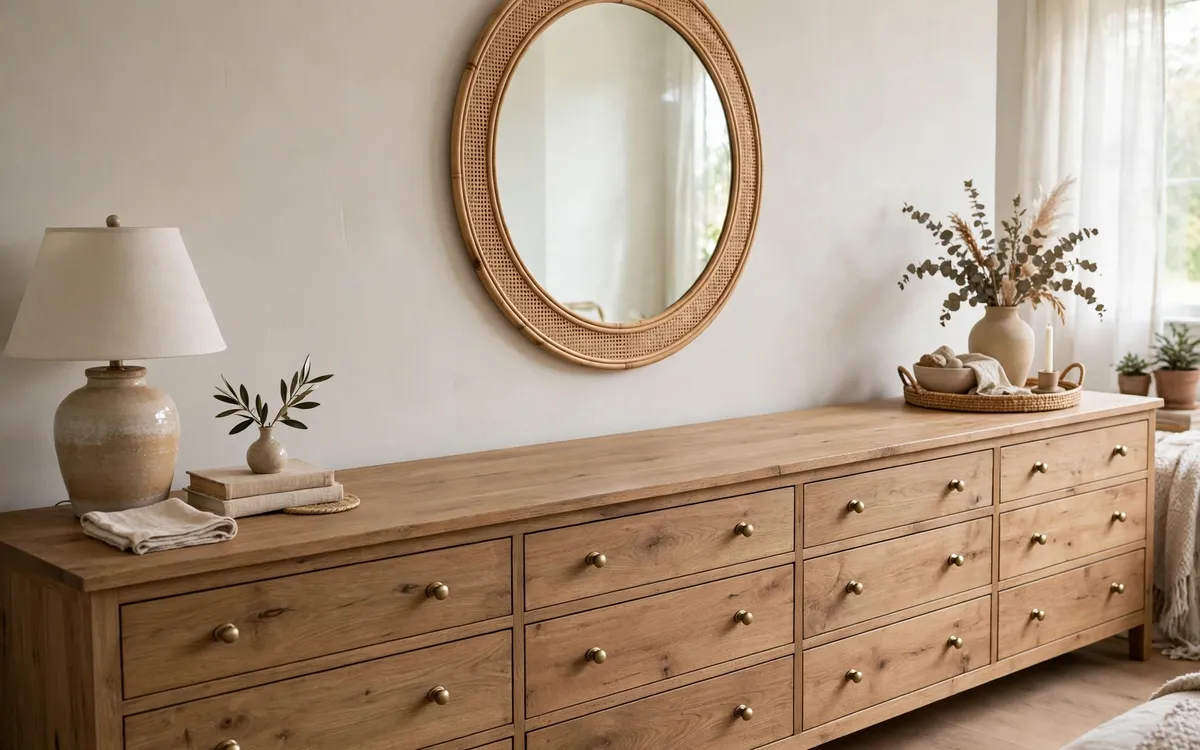
On a dresser of 60 inches or more, styling spread in a thin line reads as bare in the middle. Build two honest clusters instead: the lamp side and the tray side, with three to six small items in total across the whole top, and let the centre stay calm under the anchor. Two finished ends and an empty middle look richer than six lonely objects spread along six feet of wood.
15. On a Narrow Dresser, Style One End Only

A small top gets one cluster, not a scheme: the tray plus one vase or book stack at one end, and the rest completely clear for the daily work of a small room. Fewer, slightly bigger pieces beat many small ones, which just read as clutter at this scale. If you are choosing or keeping a smaller dresser for a tight room, the layout rules in our small bedroom decor ideas are the place to start; the styling then takes one end only.
16. Share the Top With One Tray Each
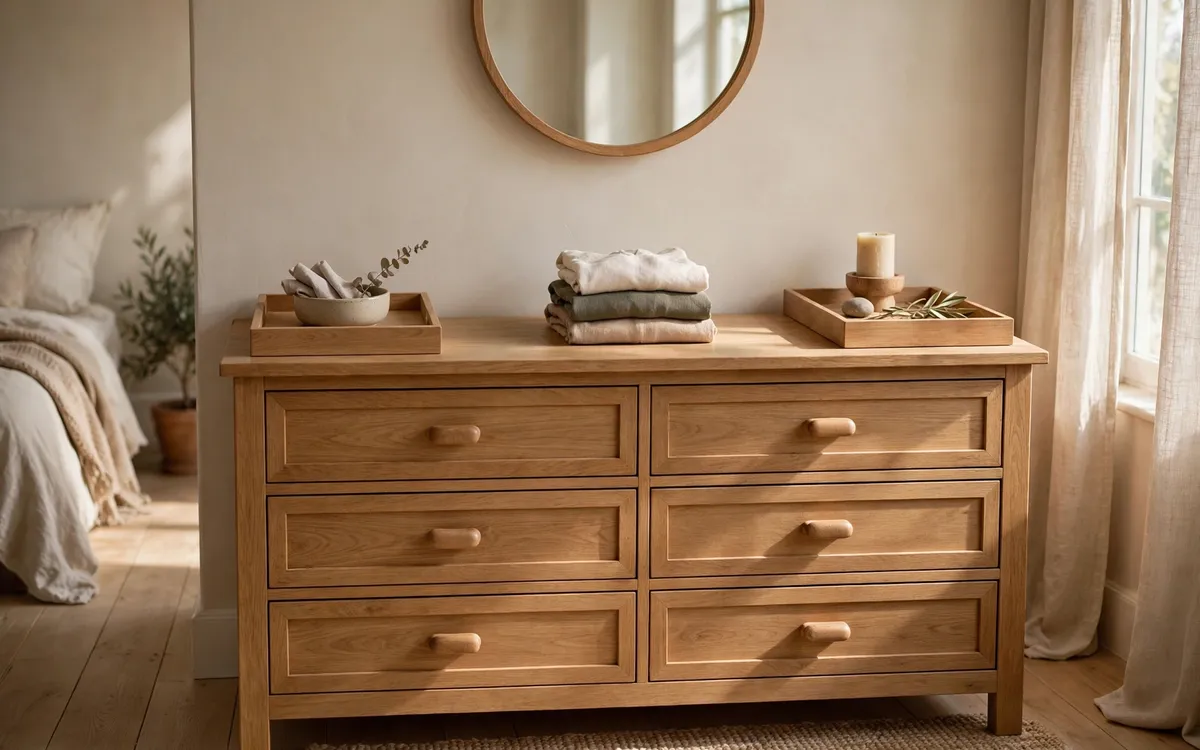
Two people and one dresser stops being an argument when the top is zoned by person: a tray at each end, in the same palette, the mirror centred above, and the middle stretch shared and kept clear. The two ends do not need matching objects; they meet because the materials match, wood with wood, metal with metal. Each person’s morning mess stays on their own tray, which is the whole peace treaty.
17. Keep It Low Under a TV
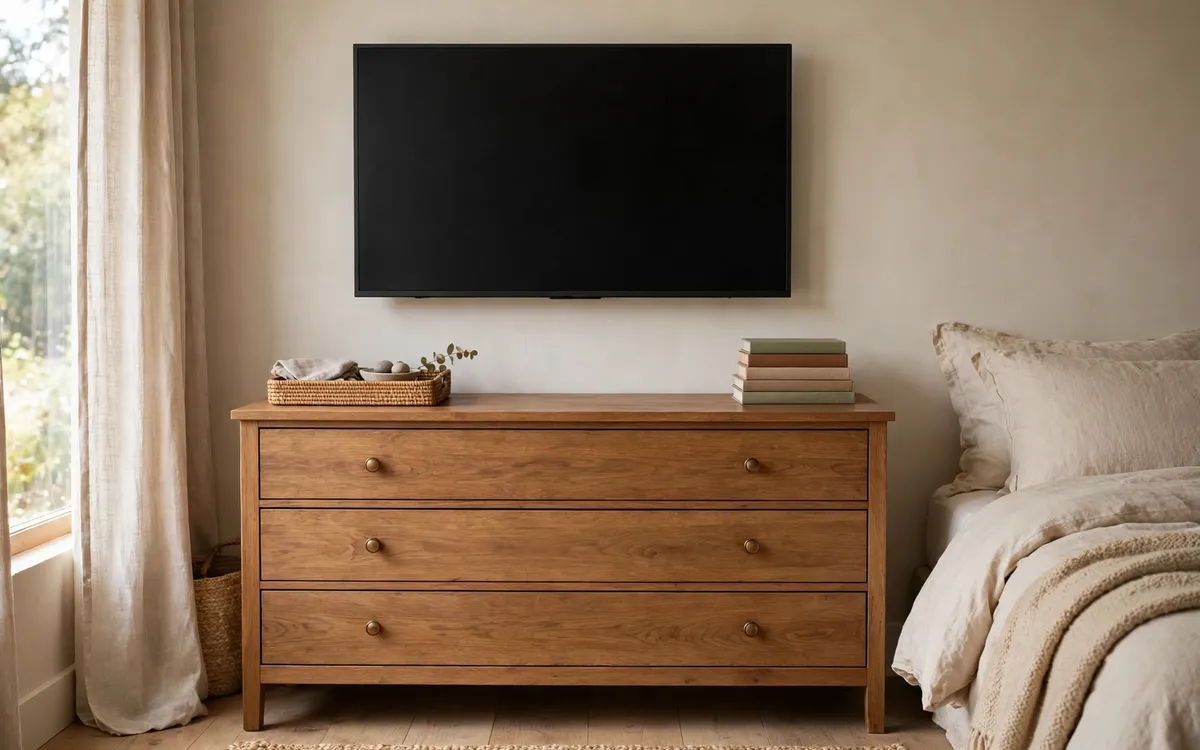
If a television sits on the dresser or hangs above it, the middle stretch changes jobs: keep everything in front of the screen low, nothing taller than its bottom edge, and move the tray and the book stack out to the ends. Tall branches drifting across a screen undo the whole room. And the set itself is a safety job, not a styling one; the note at the end of this article covers anchoring it properly.
Personality and Life
18. Add One Living Thing
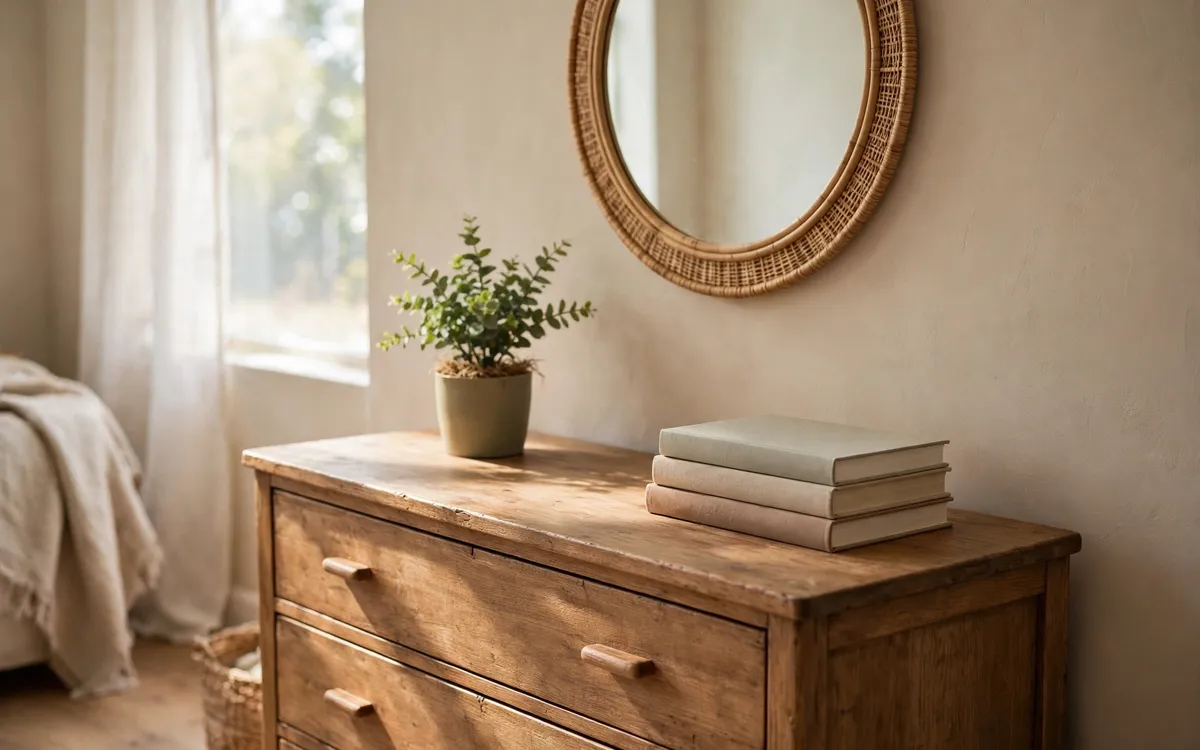
One small plant, or a single stem in a bud vase, is the difference between a styled top and a showroom top. Living texture softens all the hard edges of bottles, books and boxes. Keep it in the display zone, out of the folding stretch, where an elbow will not find it, and let a good-quality faux stem stand in honestly where the room’s light is too poor for the real thing.
19. Show One Personal Object
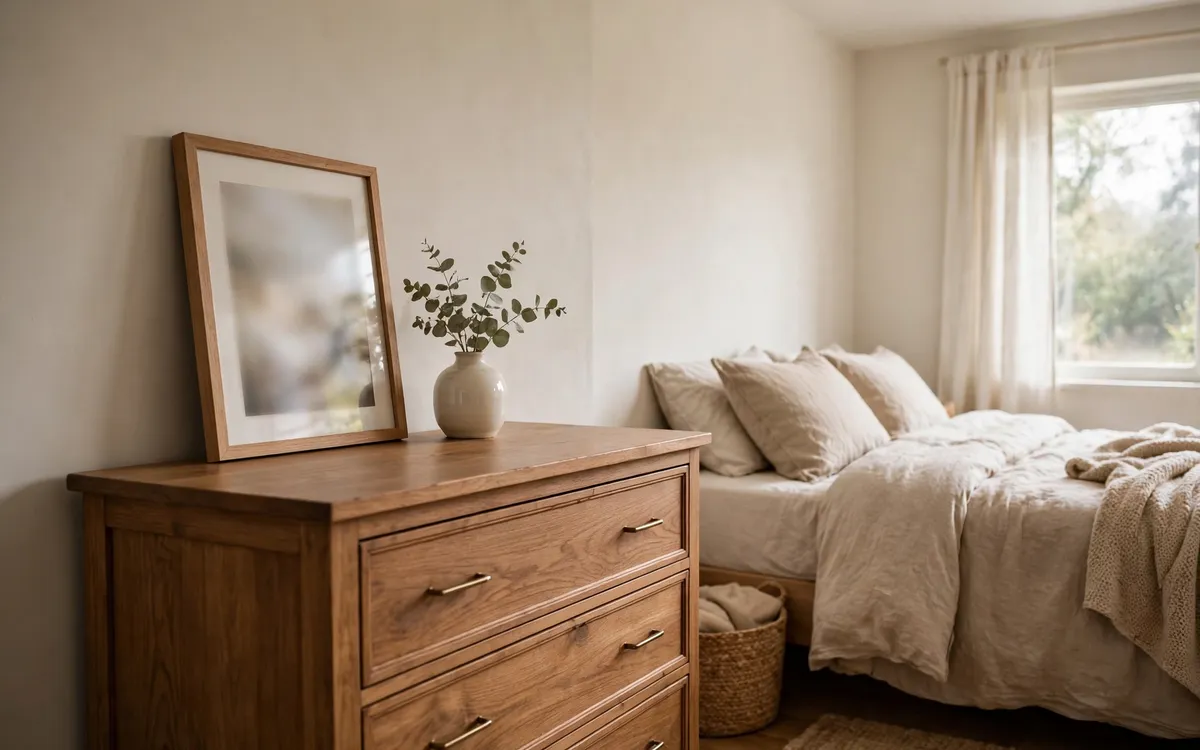
One framed photograph, one kept shell in a dish, one small object with a story: a single personal piece reads as personality. Ten of them read as clutter, and none at all reads as a hotel. Choose the one that earns the most glances, and let the rest rotate in from a drawer when the season changes. The dresser is where you start the day; it should say whose day it is.
20. Swap One Layer With the Season

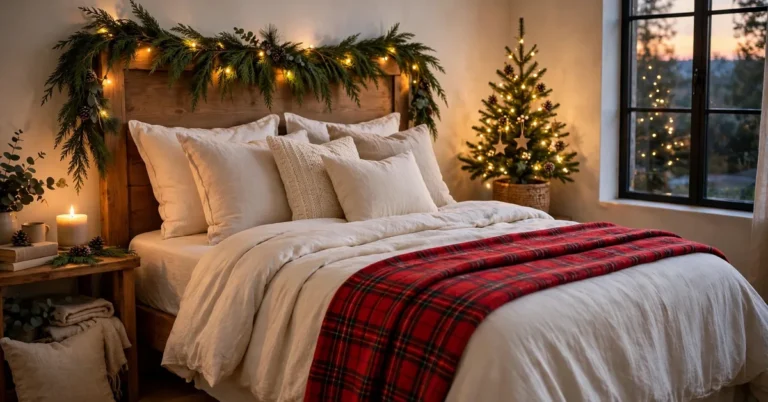
The anchor, the lamp and the tray never move. Only the stems in the vase, one small accent on the tray, and perhaps the runner change with the season: autumn stems and warmer colours in fall, when the same room gets its full seasonal dress in our cozy fall bedroom ideas, and in December the festive layer, the mini tree and the garland around this same dresser mirror, which lives in our christmas bedroom ideas. Five minutes a season, and the top feels new without ever being redone.
The Finish
21. Group in Threes, Then Remove One Piece
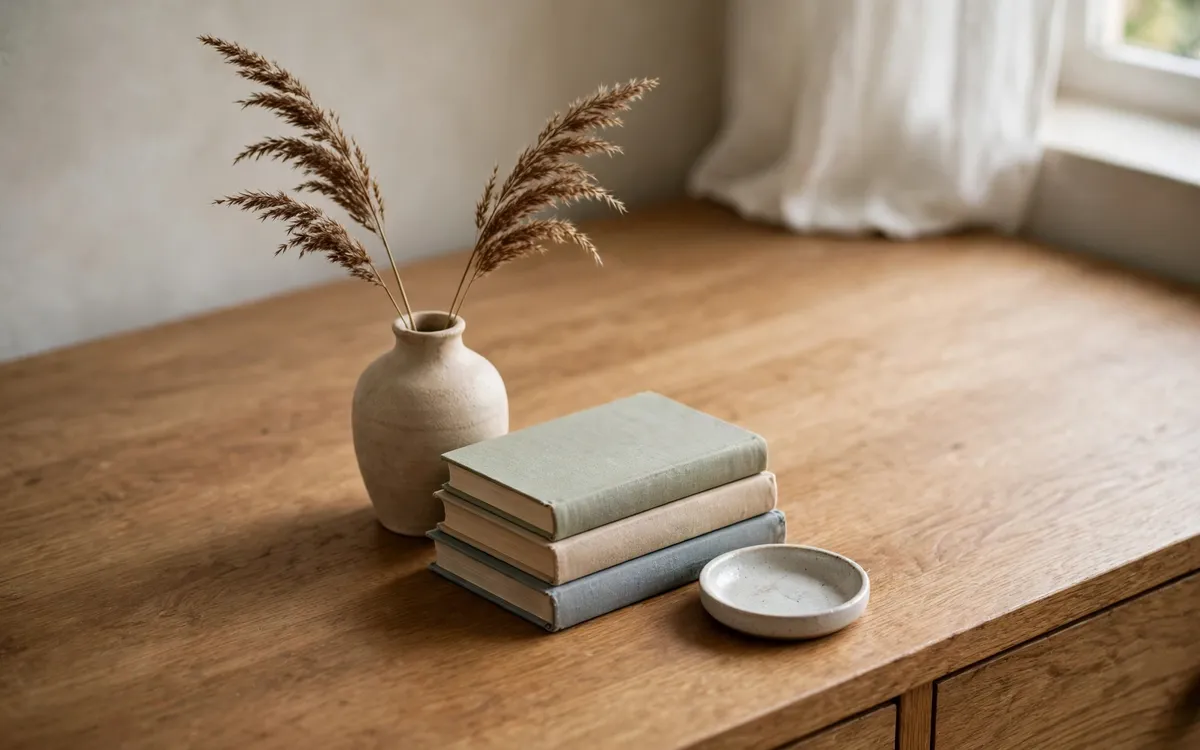
The editing rule that separates styled from stuffed: arrange each cluster in an odd-numbered group, three or five, then step back to the doorway and take one piece away. The minus-one edit is the whole secret, and it is free. The removed piece goes into a drawer, not onto another surface, or the clutter just changes rooms. Run the edit again whenever a new object arrives on the top.
22. Run the Two-Minute Morning Reset
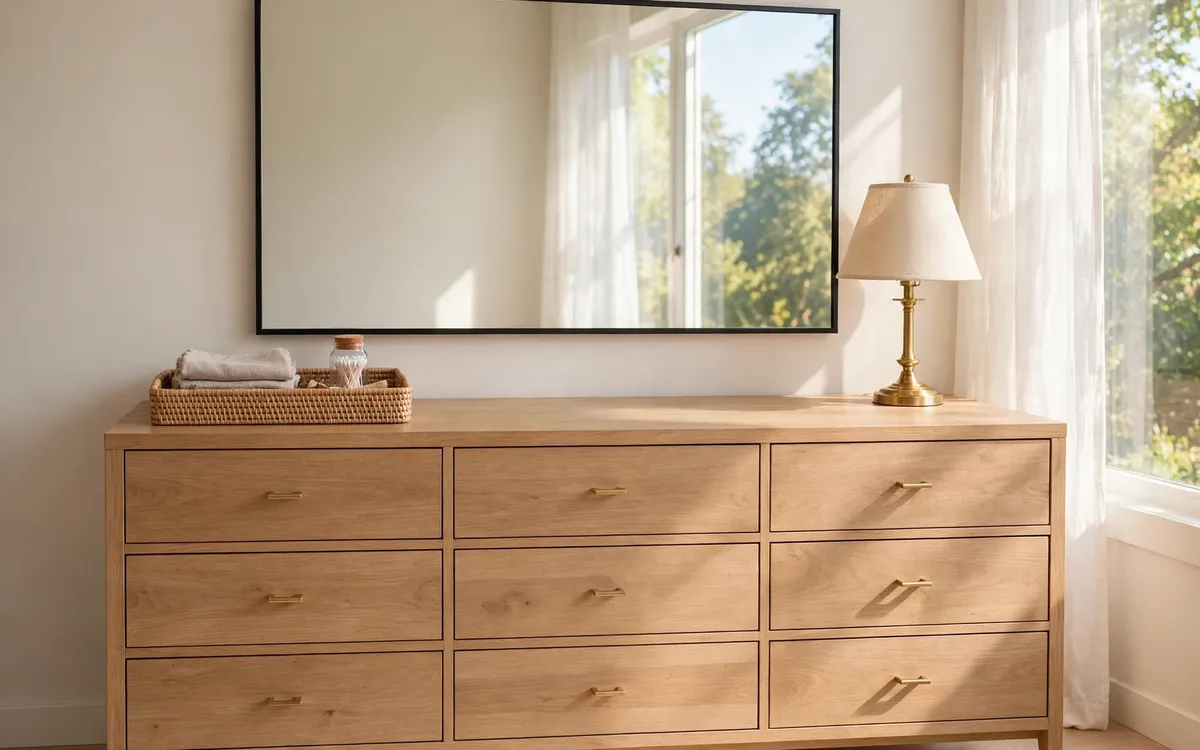
After getting dressed, give the top two minutes: bottles back on the tray, jewellery into the box, the folding stretch cleared, and one migrated thing back into its drawer. That is the entire maintenance the system needs, because the zones do the rest. It is the dresser’s version of the bedside reset, set by the morning job instead of the night one, and two minutes is what keeps a styled top alive past the first laundry day.
What It Costs: Three Honest Levels
A dresser top is one of the cheapest surfaces in the house to fix, because the moves that change it most, re-hanging the anchor at the right gap and clearing a third of the top, are free. Spend only where a wrong size is the actual problem.
Free: Use What You Already Own
Clear the top completely and put back only what the zones allow. Re-hang the mirror or print you own at the two-thirds width and the 4 to 6 inch gap. Borrow a tray from another room, stack books you already have, and move a lamp in from a room that has two. Most dumping-ground dressers are finished at this level.
Low Cost: Three Small Buys
One tray of 12 to 16 inches, one lidded box for the jewellery, and a washable runner to protect the wood under the daily zone. These three are the entire daily system; nothing else needs buying until they are in place, in use, and have survived a full laundry cycle.
Worth Spending On: The Mirror or the Lamp
If money goes anywhere, it goes to the two pieces that change the whole wall: a mirror at the full two-thirds width, or a lamp in the 24 to 30 inch range with the shade at the right height. Buy one, live with it for a month, and only then decide whether the other is still needed. Half the time, it is not.
7 Dresser Top Mistakes to Skip
- A mirror too small, or hung too high. A 24 inch mirror over a 60 inch dresser reads as a porthole, and one floating near the ceiling helps nobody. Fix: two-thirds of the dresser’s width, bottom edge 4 to 6 inches above the top.
- Covering the whole top. A dresser with nowhere to fold a shirt or set down a bag gets dismantled by real life within the week. Fix: zone it, display at one end, daily tray in its stretch, and a clear third that stays empty on purpose.
- Everything at the same height. A flat row of objects reads as storage on a shelf, not styling. Fix: tall, middle and low in a stepped triangle, on-top decor under about 18 inches, the lamp the one tall piece.
- Too many tiny things, all loose. A dozen small ornaments scattered separately look like the contents of a drawer emptied out. Fix: group them on the tray or in the lidded box, in threes, then remove one.
- A lamp the wrong size. Dinky on a wide dresser it disappears; oversized, its shade hangs past the top’s edge and glares. Fix: 24 to 30 inches tall, shade top around 58 to 64 inches from the floor, shade narrower than the top is deep.
- Perfume and candles loose on bare wood. Rings, wax and scent stains are how good dressers get ruined slowly. Fix: everything daily stands on the tray, a runner runs under the daily zone, and candles near clothes are flameless.
- Styling in front of a TV. Tall pieces crossing the screen’s bottom edge, or a set perched unsecured and treated as decor. Fix: keep the middle stretch low, move the clusters to the ends, and treat the TV as the safety job described below.
A Quick Safety Note
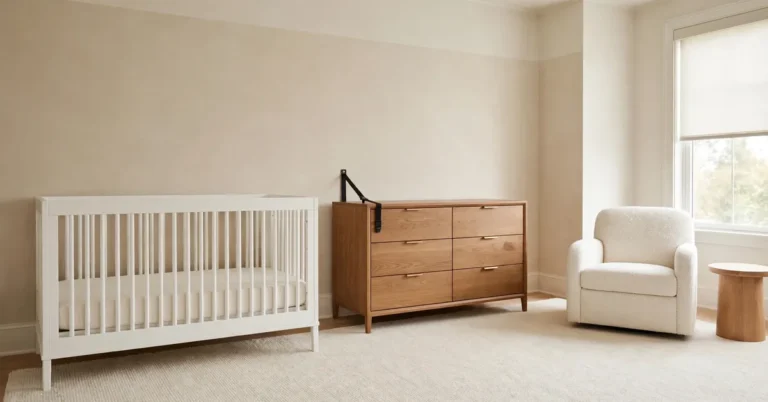
A dresser is tall furniture with drawers that pull out into steps, so anchor the dresser itself to the wall with an anti-tip kit, above all in a child’s room. Hang the mirror or artwork on proper fixings rated for its weight, into studs or the correct wall anchors: a mirror of 36 to 42 inches is genuinely heavy, and a single nail and hope is not a fixing. A leaning mirror gets an anti-slip base and a safety strap to the wall, so a bumped dresser cannot walk it off the top. And a TV on a dresser is a safety decision, not a styling one: only on a sturdy dresser that is itself anchored, with the set secured by its own strap and its cords run out of reach.
Daily-use hazards are the quieter half. Keep lit candles off the dresser top entirely, where sleeves, scarves, bedding and curtains all move within reach of a flame; a flameless candle gives the same evening glow with none of the risk. Perfume is alcohol-based and flammable, so the bottles live on the tray, away from any flame and out of harsh direct sun. Run lamp and charger cords behind the dresser, never dangling down the front where they invite a pull, set heavy pieces like stone trays and thick vases back from the front edge, and put a coaster or the runner under a vase of fresh stems before a drip teaches the wood the hard way.
Dresser Top Questions, Answered
What should I actually put on top of a dresser?
Less than you think, in a set order: one anchor on the wall above it, one lamp toward one end, one tray of 12 to 16 inches for the daily bottles and jewellery, a middle height of books or branches, and one personal piece. Then stop, because about a third of the top stays empty for the dresser’s real job of folding and getting ready.
How big should the mirror above my dresser be?
About two-thirds as wide as the dresser is the reliable rule: a standard 60 inch dresser takes a mirror of roughly 36 to 42 inches. Much smaller and it reads as a porthole floating on the wall; much larger and it overwhelms the furniture below it. Round and arched mirrors soften a wide dresser well, and a mirror that catches a window will also brighten the whole room.
How high above the dresser should I hang the mirror?
Leave a gap of 4 to 6 inches between the top of the dresser and the mirror’s bottom edge. That is close enough that the mirror and the dresser read as one piece of furniture, and high enough that the tray, the lamp base and daily life on the top never crowd it. On a standard dresser that usually puts the mirror’s centre somewhere near standing eye level, which is where a getting-ready mirror wants to be anyway.
How tall should a lamp on a dresser be?
For a standard dresser of 30 to 34 inches, a lamp of 24 to 30 inches tall is the working range. That puts the top of the shade around 58 to 64 inches from the floor: high enough to light the top and your face at the mirror, low enough that the bulb never glares across the room. Keep the shade narrower than the dresser top is deep, and set the lamp 3 to 6 inches in from the end.
How much of the dresser top should I leave empty?
About a third, kept clear on purpose and defended daily. That stretch is not wasted styling space; it is where clothes get folded, outfits get laid out, and bags land without a crisis. A top that is one hundred percent styled has nowhere for real life to happen, and real life will take its space back within the week, usually by shoving the decor into a pile at one end.
Can I put a TV on my dresser?
You can, with conditions. The dresser must be sturdy and anchored to the wall, the television itself secured with a strap, and its cords run out of reach, because a set on furniture is a tip-over risk in a way a wall-mounted screen is not. Styling-wise, keep the stretch in front of the screen low, nothing taller than its bottom edge, and move the tray and book stacks to the ends. If any of the safety conditions cannot be met, wall-mount the screen instead.
Conclusion
A dresser top does not need more decor; it needs zones small enough to survive a busy morning. Anchor the wall at two-thirds width, give the daily bottles one tray, defend the clear third, and step the heights so the eye reads layers instead of a row. Do those four things and the top of dresser decor ideas above stop being a weekend project and become simply the way the dresser stays, tidy on the days nobody is even trying.
6 Comments