

17 Serene Neutral Nursery Ideas That Fit the Standards, Not Just the Photograph
A nursery is the most photographed room in the house and the least measured — styled in pictures with dressed cribs, draped canopies and unanchored dressers by people who never mention the standards. These neutral nursery ideas begin with the room measured and cleared, because a nursery does not fail on its palette; it fails on the crib nobody checked, the bumper nobody removed, and the dresser nobody anchored.
The palette itself is the easy half. Our cozy neutral bedroom ideas build the same calm — warm whites, layered neutrals, one deep note — for a grown-up’s room, where nothing is regulated and a mistake costs a repaint. This room runs that discipline under rules a grown-up’s bedroom never meets: the crib’s size is fixed by federal law, the AAP decides what may be inside it, and the dresser is anchored before it is styled.
The Method: Measure It, Clear It, Anchor It
Three decisions, in order, before a single cushion is bought — because a nursery is not styled, it is fitted, and every fitting is decided by something checkable: the furniture’s real footprints against the room’s real walls, the standards that disqualify half of what the photographs put in the crib, and the anchoring that keeps the room’s storage standing when a toddler treats its drawers as a ladder.
Step 1 — Measure It: Plan the Room by Exterior Footprints
Three footprints draw the whole map. The crib: every full-size crib sold in the US has the same interior by law — 28 inches wide by 52⅜ inches long (16 CFR 1219) — but the frame around it takes roughly 54–57 inches long by 30–31 inches wide of floor, and it is the exterior that meets the wall. A mini crib’s interior runs about 24 by 38 inches and its exterior about 40 by 26, saving roughly 14 inches of length where a wall is short. The glider: bought by a showroom footprint of roughly 30 by 36 inches, a reclining glider in use runs to 64 inches deep and more — plan the corner by the reclined depth, or the chair goes back. The dresser: nursery dressers run 18–20 inches deep, and the changing surface they carry belongs between roughly 36 and 42 inches high. Leave working room where the work happens — roughly 3 feet in front of the crib for lifting in and out, as this site’s planning rule — and keep the door’s swing clear of every footprint. Then measure your own room and your own shortlisted models: the classes are ranges, and the tape is the authority.
Step 2 — Clear It: Strike the Photograph’s Kit Against the Standards
The AAP’s safe-sleep policy is the clearing rule, and it is not negotiable: the crib is bare — a firm, flat mattress, a fitted sheet, and nothing else. No bumpers (the Safe Sleep for Babies Act banned crib bumpers for sale in the US in 2022), and the same rule strikes blankets, pillows, quilts, soft toys and mattress toppers from the sleep space, with a wearable blanket as the warmth answer. No canopy draped over the sleep surface, and no inclined sleeper of any kind. The crib itself is checked, not assumed: fixed sides only, made after the June 2011 federal standard took effect, and checked against the CPSC recall list — a hand-me-down that fails any of those is not a saving; it is the one purchase this room makes new or verified.
The clearing runs around the room as well: window coverings cordless, the crib placed away from windows, and every cord in the room — monitor, lamp, sound machine — routed at least 3 feet from the crib. The clearing is the whole article in miniature — more than any palette, neutral nursery ideas stand on the bare-crib rule and the standards behind it, because those decide whether the room is safe to sleep in long before they decide whether it is calm to look at. The American Academy of Pediatrics’ own parent guide, How to Keep Your Sleeping Baby Safe, states the whole clearing in one page, in the paediatricians’ own words. This article’s job is the room: what follows is general information about fitting it, not medical advice.
Step 3 — Anchor It: Fix Everything Tall, Then Assign the Room to Convert
Anchoring is the step the photographs skip, because it cannot be seen. The CPSC’s Anchor It! campaign exists because dresser drawers are a ladder: a clothing storage unit made after 1 September 2023 must meet the federal stability standard and ship with an anti-tip device — and the instruction is unchanged either way: anchor it to the wall anyway, with a kit that costs under $20, the heaviest contents in the lowest drawers, and nothing tempting stored on top. Bookcases and wardrobes get the same treatment; the crib is the one piece that is never anchored — it is checked, not fixed. Only once the room measures, clears and holds does the neutral assignment happen, and it is made to be outgrown gracefully: the convertible crib whose toddler rail and conversion kit were priced at purchase, the palette built from three neutrals a child’s room keeps, storage that swallows the next size up. The rule that runs the whole article: if it goes in the crib it must pass the bare rule, if it stands tall it must be anchored, and if it cannot convert, it is bought knowing it leaves within the year.
Zone A — Fit the Sleep Zone to the Standard
The sleep zone is fitted first, because it is the only zone in the house whose furniture is specified by law. Five decisions — the crib, its mattress, its emptiness, its small-room variant and its second life — and every one of them is a number before it is a look.
1. Choose a Full-Size Crib by Its Interior, Not Its Photograph
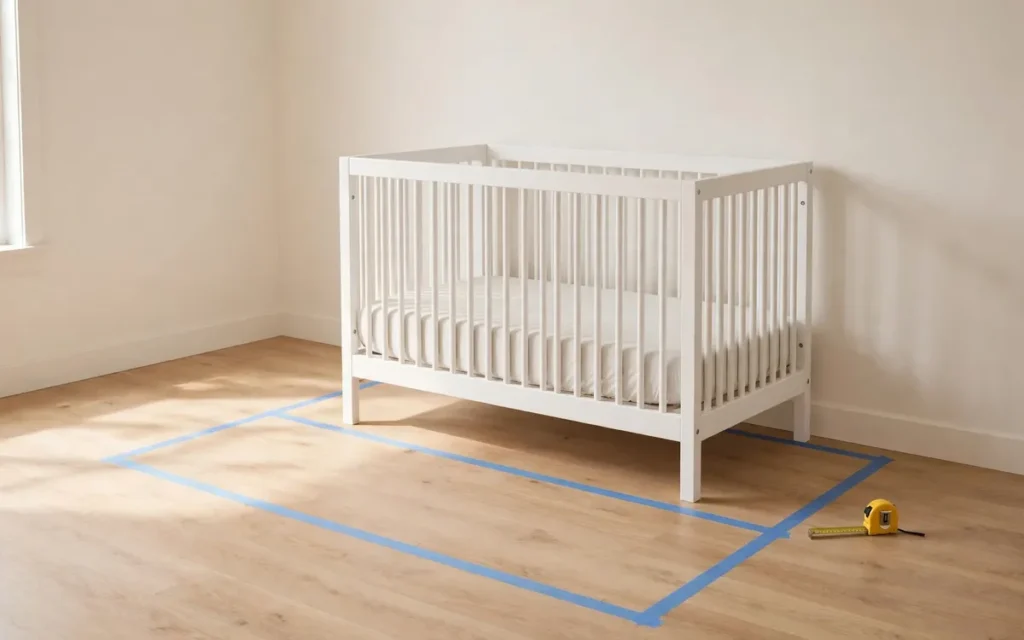
Every full-size crib sold in the US has the same interior by law — 28 inches wide by 52⅜ inches long — with slats no more than 2⅜ inches apart and corner posts no more than 1/16 inch proud of the end panels. So shop by what varies: the frame’s exterior (roughly 54–57 inches long by 30–31 wide), fixed sides, and a manufacture date after the June 2011 standard. The colour is the only free choice.
2. Fit the Mattress by the Two-Finger Rule

The federal mattress standard (16 CFR 1241) sets the floor: a full-size crib mattress measures at least 27¼ inches wide by 51⅝ inches long and no more than 6 inches thick. The fit is then proven by hand, not by the listing — run two fingers between the mattress and the frame at every side, and if more than two fit, the mattress is the wrong one, whatever it was called.
3. Keep the Crib Bare — the Photograph Is the Hazard
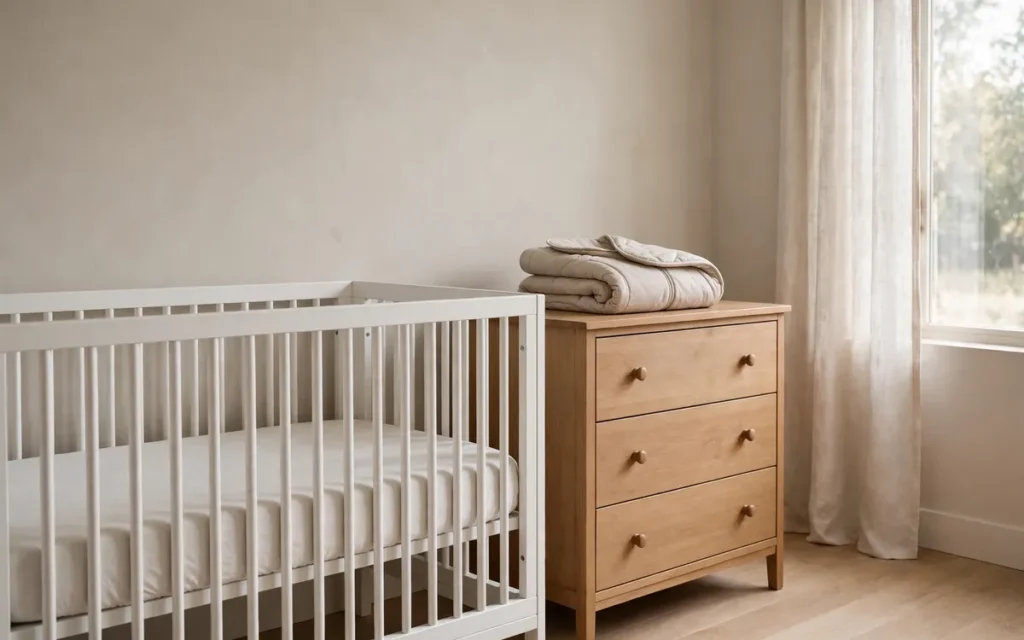
Everything the photographs pile into the crib — bumpers, blankets, pillows, plush, the draped canopy — is the AAP’s struck list. The sleeping crib carries a firm, flat mattress and a fitted sheet, and nothing else; warmth comes from a wearable blanket, and crib bumpers have been banned for sale in the US since 2022. Every soft, pretty thing in the room lives outside the rails until the first birthday has passed.
4. Take the Mini Crib When the Wall Is Short
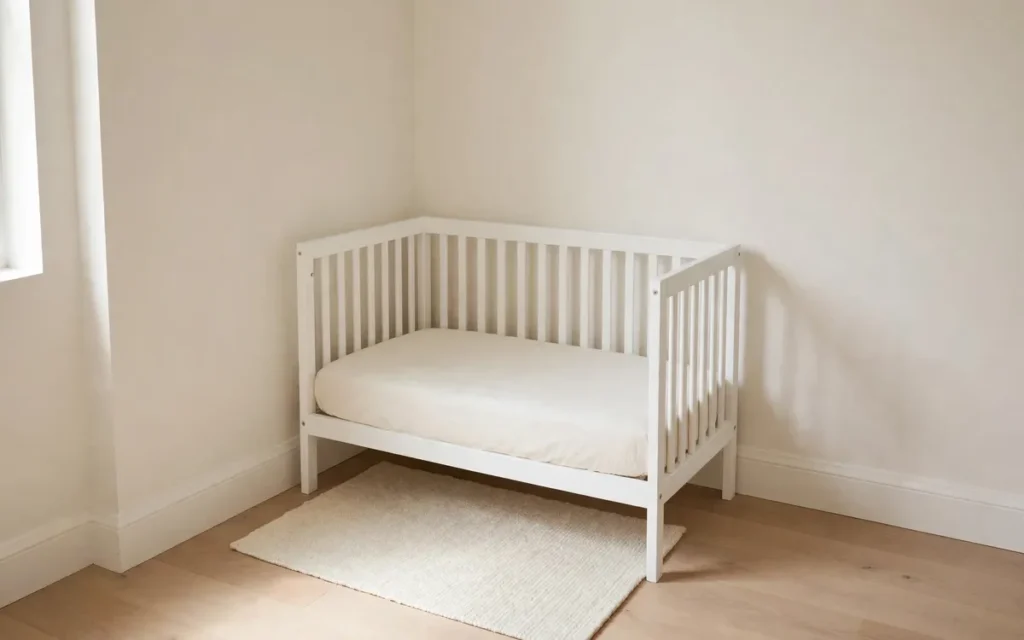
Where the long wall is short, the mini crib is the honest answer: an interior of about 24 by 38 inches inside an exterior of about 40 by 26, returning roughly 14 inches of wall to a small room or a parents’-room corner — the same small-room fitting our small bedroom decor ideas work through for a grown-up’s room, at its smallest scale. The trade is time, not safety: the same standards apply, and the same outgrowing rules end the mini sooner.
5. Buy the Crib That Converts — and Price the Kit at Purchase

A 4-in-1 convertible is this room’s whole furniture strategy: crib, toddler bed, daybed and full-size headboard from one footprint and one purchase. The catch is priced on day one, not on conversion day — the toddler rail and the full-size rails are usually sold separately, and both belong in the first basket. A conversion kit discontinued by the year it is needed turns the saving into a second bed bought at full price.
Zone B — Anchor the Changing and Storage Wall
The wall opposite the crib does the room’s heavy work: changing, dressing and storing. Four decisions fit it — and the first is made with a drill, before a single drawer is filled.
6. Anchor the Dresser Before Anything Goes in It
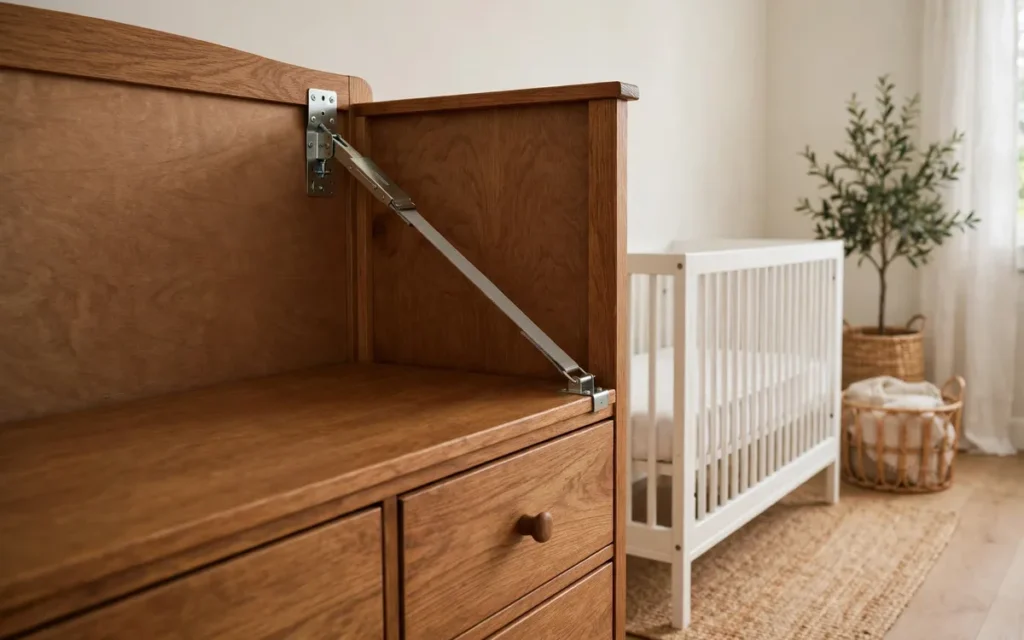
The dresser is the nursery’s hardest-working piece and its ladder, so it is anchored to the studs before the first drawer is filled — the kit costs under $20. Where you can, buy post-September-2023 manufacture: units made since then must meet the federal stability standard and ship with an anti-tip device. Anchor anyway, and load the heaviest contents into the lowest drawers either way.
7. Put the Changing Pad on the Dresser, at Waist Height

A dedicated changing table is a second footprint for a job the dresser already does. The standard contoured pad is 32 by 16 inches, with raised sides of 3–4 inches; set it on the dresser top and the changing surface lands at roughly 36 inches — waist height, where a parent’s back survives it. The pad leaves in two years; the dresser stays for a decade.
8. Keep the Daily Kit Within One Arm’s Reach of the Pad
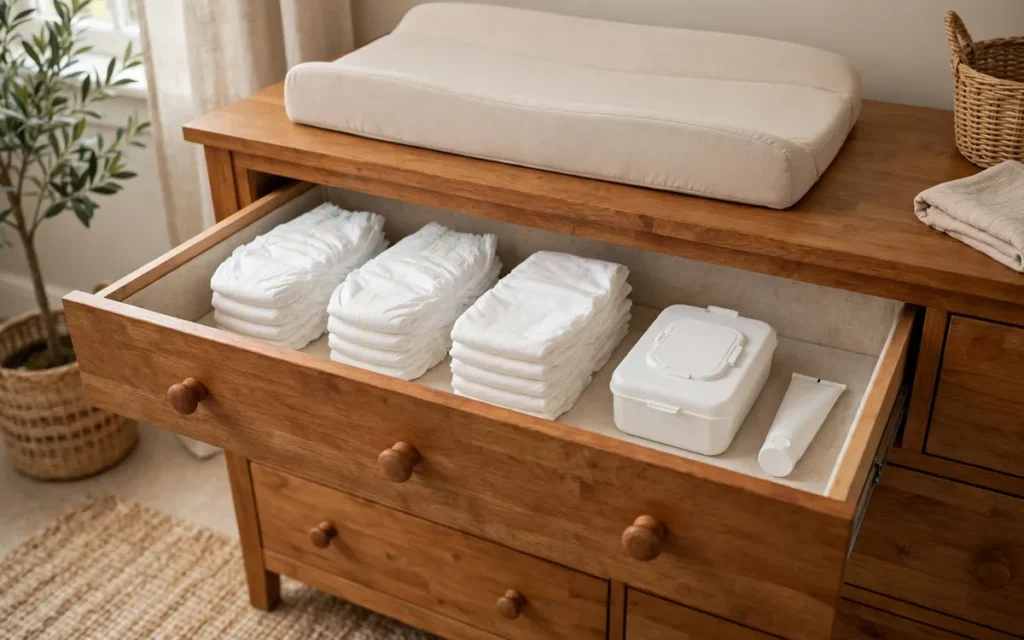
The changing station is stocked like a workstation, not displayed like a shelf: diapers, wipes and cream in the top drawer or a caddy at the pad’s side, reachable with the one hand that is not on the baby. That arm’s-reach rule is the whole layout — anything stored across the room gets fetched mid-change, one-handed, exactly once before it is moved.
9. Face the Books Out in a Low, Anchored Bookcase
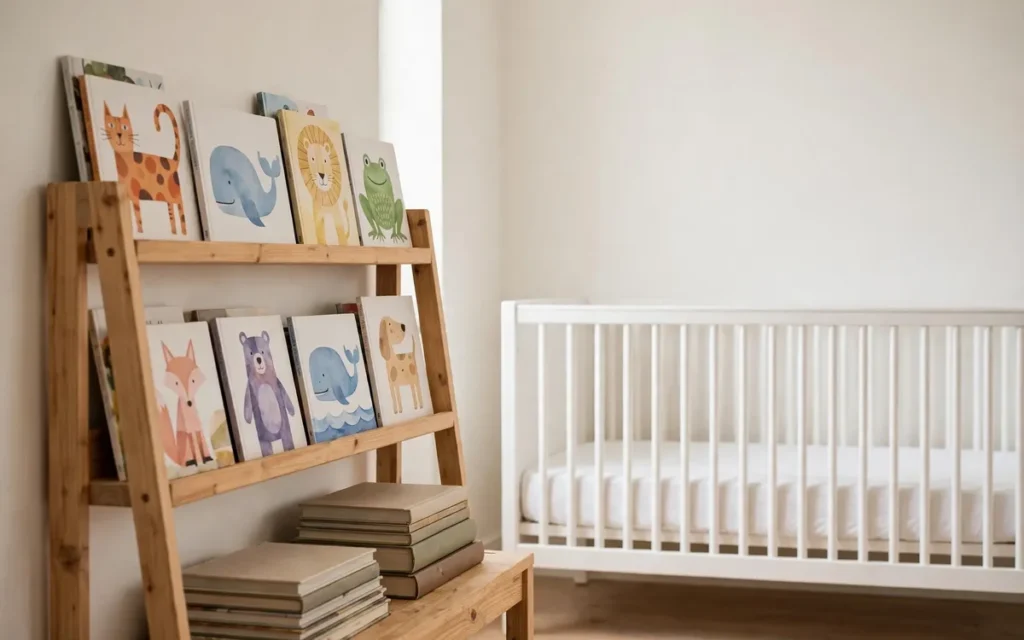
The first storage the child uses alone is a low bookcase in the toddler-scale class, around 30 inches high, its picture books facing out so the covers do the choosing. It is anchored to the wall exactly like the dresser, loaded heaviest at the bottom, and sized to the picture-book years the nursery actually serves — not to the chapter-book library that comes later.
Zone C — Claim the Feeding Corner
The feeding corner is the room’s night shift: a chair, a table, a light and a web of cords, all used one-handed and half-asleep. Four decisions size it by how it is actually used, not by how it photographs at noon.
10. Size the Glider by Its Reclined Depth, Not Its Footprint
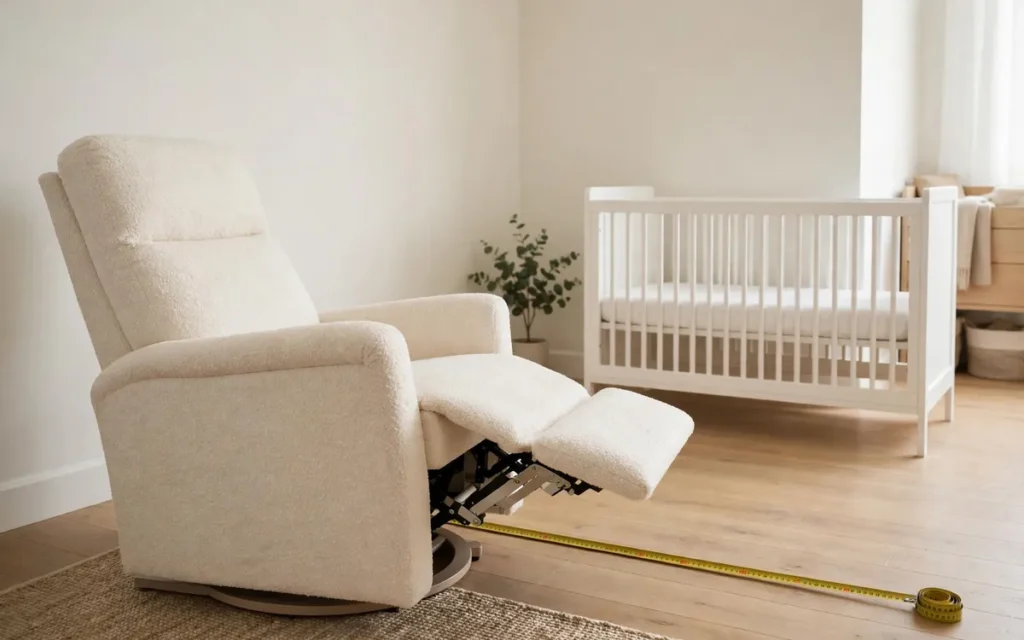
A glider is bought by its showroom footprint and lived in at its working size: roughly 28–34 inches wide and 30–40 deep sitting up, but up to 64 inches deep and more reclined with the footrest out. Measure the corner for the recline, and leave the rocker’s path clear of the crib’s side — the corner has to fit on the worst night, not the showroom day.
11. Give the Chair a Side Table at Arm Height
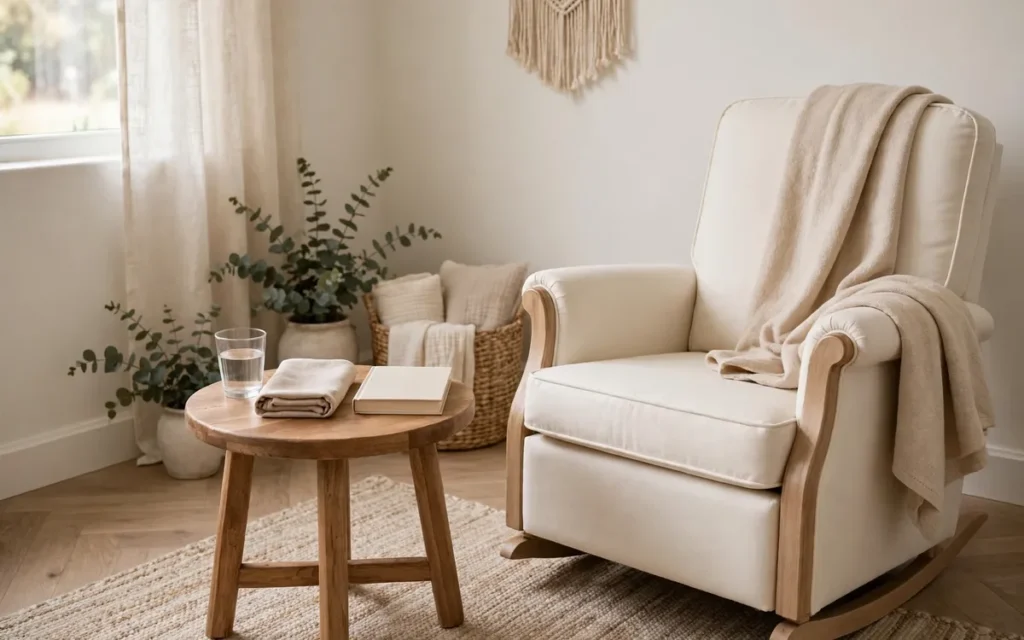
The feeding chair needs a nightstand in miniature: a small table roughly 24 inches high, at the chair’s arm, holding water, the phone, a cloth and the book — everything a feeding parent reaches for one-handed, in reach and off the floor. It is the worked-surface discipline of our nightstand decor ideas in a smaller key, and it is fitted with the chair, not after it.
12. Run the Corner’s Light at Two Levels

One light cannot do both jobs. Fit two levels: a bright, shaded light for changes and checks, and a low, warm light for night feeds that never wakes the room up — a dimmer or two lamps, decided at fitting, not improvised at 3 a.m. Place the low light so its glow falls across the chair and the pad, never into the crib.
13. Route Every Cord at Least Three Feet From the Crib
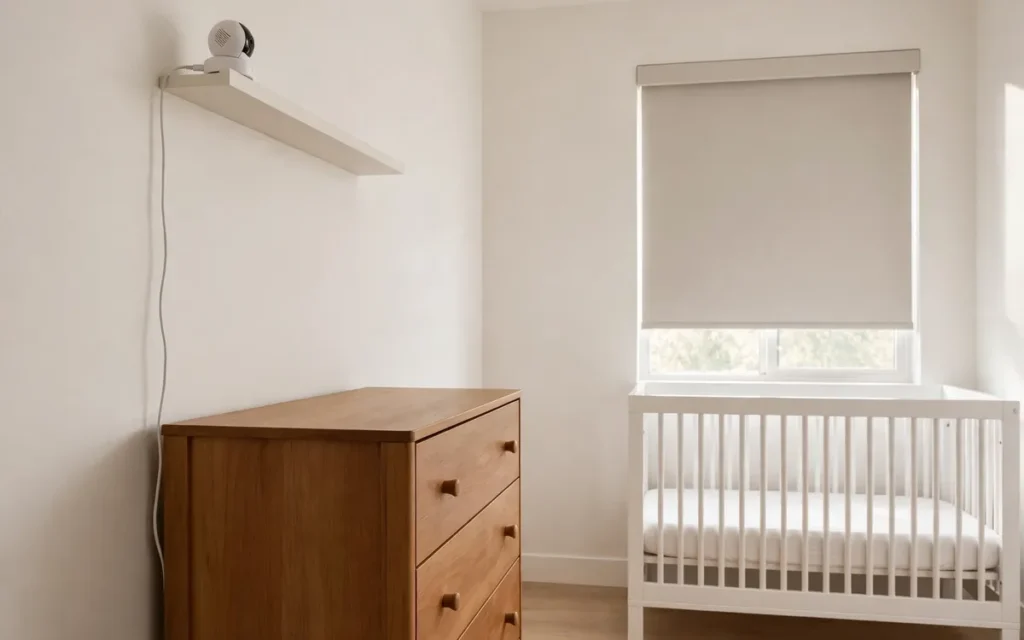
The monitor, the lamp and the sound machine all arrive with cords, and every cord in the room is routed at least 3 feet from the crib — the Window Covering Safety Council’s line — run behind anchored furniture, where small hands cannot work them loose. The window coverings themselves are cordless, and the crib is never parked under them: the window wall is the one wall the sleep zone does not use.
Zone D — Finish It Neutral, and Make It Last
Last, the layer the photographs think is the whole job — colour, floor, walls and the calendar. Four finishing rules keep the room neutral, washable and audited as the baby grows; and when the crib finally converts, the room it becomes is the one our small bedroom decor ideas for kids fits next, on the neutral base laid here.
14. Build the Palette in Three Neutrals, Not One
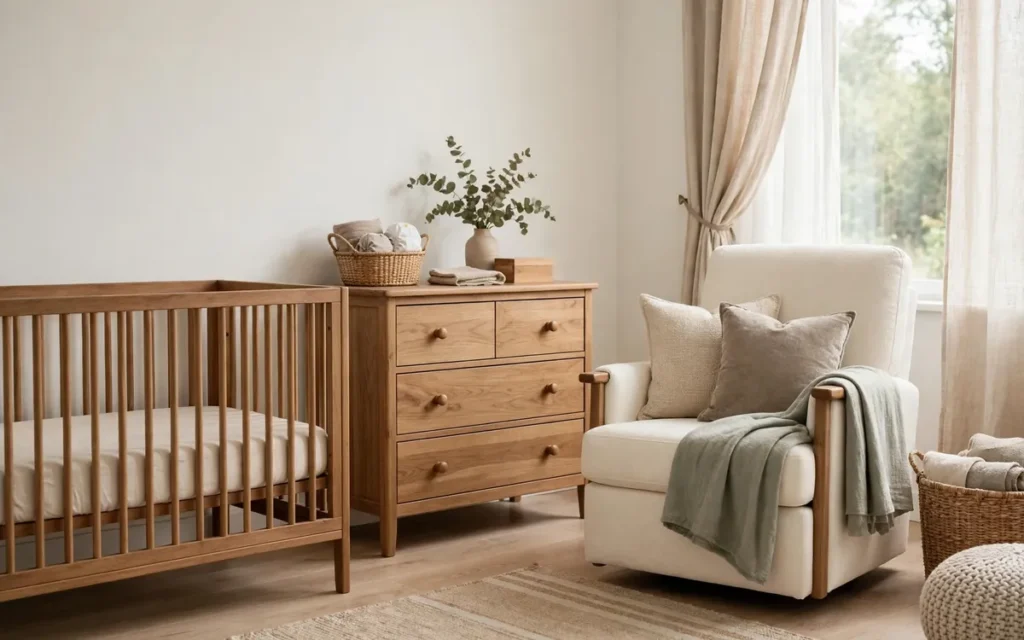
The rooms that photograph flat use one neutral; the ones that last use three. Lay a warm white as the field, a mid neutral — greige, taupe, soft sage — as the furniture tone, and one deep note, natural wood or a black accent, as the anchor, repeated at least twice. Paint goes on in a low- or zero-VOC formula, finished before the baby arrives: a palette is a system, not a swatch.
15. Lay One Washable Rug Under the Crib and Chair

One washable rug, the standard 5×8, laid under the crib’s front half and the glider’s feet covers the room’s two working zones in a single field. Keep it low-pile, so the chair still rocks and glides over it, and washable, because this is the one rug in the house guaranteed to be fed on — a rug that cannot be washed in this room is a rug on a countdown.
16. Hang the Art Over the Dresser — Anchored, Never Over the Crib

The wall dressing goes where the standards leave wall: over the dresser and the chair, on fixings rated for the frame’s weight and anchored into the wall, hung at the standing parent’s eye level. Nothing hangs over the sleep surface at any weight. The photograph of a mirror over a dresser is right about the wall — it is simply silent about the fixing, and the fixing is the idea.
17. Audit the Room at Every Mattress Drop

The system is re-run on the growth calendar, not on memory. Lower the mattress as the baby learns to sit; set it at its lowest before the baby stands, where the standard leaves at least 26 inches of rail above it. Re-check cords and anchors as reach grows — and when the climbing starts, or the child reaches about 3 feet tall, the crib’s job ends and the conversion begins.
What It Costs: Three Ways In
The standards tier (under roughly $75). Anti-tip kits for the dresser and bookcase, cord management for the monitor and lamps, fitted sheets and a wearable blanket, drawer dividers for the changing kit. This tier proves a nursery does not fail for lack of a theme; it fails because nothing was measured, the crib was dressed, and the dresser was never anchored — and all three failures are fixed here, before any furniture is bought.
The furniture tier (roughly $75–$400). A standard or mini crib bought to the standard, the changing pad that turns the dresser into the changing station, the washable 5×8 rug, cordless blackout coverings for the nursery window. The tier that does the visible work, bought in method order: the room measured first, the photograph’s kit cleared second, the furniture fitted last.
The conversion tier (roughly $400 and up). The 4-in-1 convertible crib with its toddler rail and full-size conversion kit bought while both are still in production, a reclining glider sized to its corner, and a closet fitted with a low second rod. Worth it only where the room will serve the same child through the toddler years — and only after the cheaper tiers have proved the layout, because furniture forgives nothing.
6 Mistakes That Make a Nursery Fail
- Dressing the crib for the photograph. Bumpers, blankets, pillows, plush toys and a canopy draped over the rails are the styling kit in half the photographs of this room — and the AAP’s struck list at the same time. Bumpers have been banned for sale in the US since 2022, and the safe crib is bare: fitted sheet, wearable blanket, nothing else (Method Step 2, idea 3).
- Taking the free crib without checking it. A hand-me-down or second-hand crib that is a drop-side, was made before the June 2011 federal standard, or sits on the CPSC recall list is not a saving. Fixed sides, a manufacture date, and two minutes on the recall list are the whole check (Method Step 2).
- Leaving the dresser unanchored “until the baby can climb.” By the time a child can climb, the drawers are already the ladder and the lesson is overdue. Anchor before the first use — the kit costs under $20, the heaviest contents go lowest — and read a post-September-2023 manufacture date as the floor, not the finish (Method Step 3, idea 6).
- Parking the crib under the window. The prettiest light in the room comes with its worst pairing: covering cords within reach, and a climb-and-fall path as the child grows. Cordless coverings, the crib on another wall, and windows that open no more than 4 inches where guards are fitted (Method Step 2, idea 13).
- Laying out the room by showroom footprints. A glider measured sitting up needs up to 64 inches reclined; a crib measured by its interior is 54–57 inches of frame. Rooms laid out by catalogue numbers get rebuilt at midnight; rooms laid out by exteriors and working depths do not (Method Step 1, idea 10).
- Letting the monitor cord live at the crib. The camera gets posed on the rail or the nearest shelf, and its cord dangles inside the one radius that matters. Every cord in the room — monitor, lamp, sound machine — is routed at least 3 feet from the crib and behind anchored furniture (idea 13).
FAQs
What colours count as neutral in a nursery?
Warm whites and creams as the field; greige, taupe and mushroom as the mid tones; soft sage as the neutral that behaves like a colour; natural wood and a black accent as the deep note. Built in three layers — field, furniture tone, anchor — the palette stays calm without going flat, and it survives the conversion to a child’s room unchanged.
How big is a standard crib — and will it fit a small nursery?
The interior is fixed by federal standard at 28 by 52⅜ inches, so every standard mattress fits every standard crib — the mattress standard starts at 27¼ by 51⅝ inches, and the fit is proven by the two-finger test. Plan the room by the exterior: roughly 54–57 inches long by 30–31 wide. Where the wall is short, a mini crib’s roughly 40-by-26-inch exterior returns about 14 inches; the same standards apply, and it is simply outgrown sooner.
Are crib bumpers and bedding sets safe?
No. The AAP’s rule is a bare crib — firm, flat mattress, fitted sheet, nothing else — and crib bumpers have been banned for sale in the US since 2022 under the Safe Sleep for Babies Act. The bedding set’s quilt and pillows wait outside the crib until after the first birthday; warmth comes from a wearable blanket.
When does a baby outgrow the crib?
When the child climbs out, or reaches about 3 feet (35 inches) tall — whichever comes first. On the way there, lower the mattress as the baby learns to sit, and set it at its lowest before the baby stands, where the standard leaves at least 26 inches of rail above the mattress.
Does a heavy dresser really need anchoring?
Yes — weight is not stability once drawers open and a child climbs them. Clothing storage units made after 1 September 2023 must meet the federal stability standard and include an anti-tip device, and the CPSC’s Anchor It! instruction is to anchor regardless; the kit costs under $20, and the heaviest contents belong in the bottom drawers.
Can a nursery work in a corner of the parents’ room?
Yes. The AAP recommends room-sharing on a separate sleep surface for at least the first 6 months, and a corner counts as a room for these purposes if it passes the same tests: the crib’s exterior footprint plus working room in front of it, a bare crib, every cord at least 3 feet away, and no window cords in reach. A mini crib is the corner’s usual fit.
How do you keep a neutral nursery from looking boring?
By layering, not by adding colour: three neutrals instead of one, texture doing the work colour usually does — boucle, rattan, washed linen, warm wood — one pattern at rug scale, and the deep note, wood or black, repeated at least twice. The answer is a palette system, not a shopping list.
When the child outgrows the crib, the same neutral base carries the next room. Our space themed bedroom ideas keep the palette calm and the furniture convertible, while stars, planets and a soft glow give a post-crib child a theme that can change as they grow.
Conclusion
Work through these neutral nursery ideas in order — measure it, clear it, anchor it — and the baby’s first room stops being a photograph that expires and becomes a fitted system: measured against the standards its furniture is sold under, cleared of everything its sleep rules disqualify, and anchored and layered to convert as the child grows. Fitted that way, the room the baby outgrows is a conversion, not a clearance.






One Comment