
16 Proven Over the Refrigerator Storage Ideas That Pass the Heat, Reach and Weight Tests
The space above the refrigerator is the kitchen’s most wasted storage and its most lied-about — styled in photographs with lamps, candles and trailing plants by people who never mention the heat. These over the refrigerator storage ideas begin with the zone measured and cleared, because the top of a fridge does not fail on looks; it fails on the clearance nobody kept, the wine nobody should have stored, and the daily things nobody can reach.
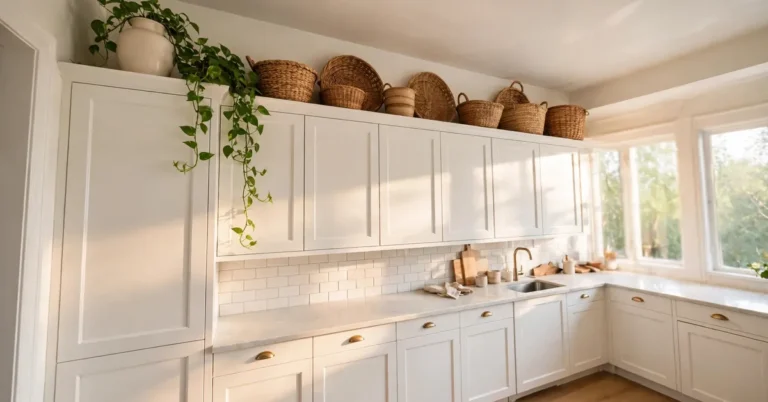
The kitchen has one other high zone, and it is this one’s opposite: the band above the wall cabinets, which our decorating above kitchen cabinets styles as a display you only ever look at. The fridge top is not a display band. It is a working surface that begins at about 66–70 inches, warm from the appliance below it and backed by the deepest cabinet in the room — so it is not styled, it is assigned, and every assignment has to pass three tests: nothing heat-sensitive, nothing heavy, nothing daily.
The Method: Size It, Clear It, Assign It
Three decisions, in order, before a single basket is bought — because the space above a refrigerator is not decorated, it is assigned, and every assignment is decided by something measurable: the zone’s actual dimensions and clearances, the heat that disqualifies half of what kitchens try to store there, and the frequency-and-weight rule that decides what remains.
Step 1 — Size It: Measure the Zone Before Assigning It
Four numbers draw the whole map. The fridge’s top: standard models stand about 66–70 inches tall — Whirlpool’s size guide puts side-by-sides at 66–70 inches and French doors up to about 70⅛ inches overall, with the case top near 68⅞ — so the storage surface itself begins above most people’s shoulders. Its depth class: a standard-depth case runs about 29–32 inches deep, 33–35 with handles, against a counter-depth case of about 24–25 — the deeper the fridge, the further its top’s back edge sits from anyone standing in front of it. The gap above: the maker’s own installation sheet governs — Whirlpool asks ½ inch at the sides and top with 1 inch behind on its bottom-mount line, and 3 inches to overhead cabinets in an older top-mount guide; LG specifies 2 inches at back, top and sides; and the trade consensus is about 1 inch minimum at the top and 1–2 inches behind. Whatever the sheet says is the air the fridge breathes, and no stored item may ever bridge it. The cabinet, where there is one: 24 inches deep against the 12-inch standard wall cabinet, typically 30–36 inches wide and 12–18 inches high — and its front half is the only half a person on a stool can honestly reach into. Whirlpool’s refrigerator sizes and dimensions guide publishes the size ranges by fridge type and how to measure the opening — size your own appliance there before you size its storage.
Step 2 — Clear It: Run the Heat Test and Strike the Never-Store List
A refrigerator is a heat engine running in reverse: its condenser sheds the room’s warmth off its back, sides or top, and the air above it is the warmest storage air in the kitchen — warm enough that the top of a hard-working fridge frequently exceeds 65°F — in a spot that also vibrates every time the compressor cycles and collects the kitchen’s grease. So the never-store list is struck first, and it is not negotiable: wine (it wants a steady ~55°F, and sommeliers name the fridge top the worst storage spot in the house for heat, swings and vibration together — the wine-rack insert sold for this cabinet is the prettiest trap in the search results); medicine (labels read “store in a cool, dry place” because heat and temperature swings degrade potency); bread and baked goods (the warm airflow stales them and, bagged, molds them); spices (heat spends their potency); anything flammable; and anything heavy — at 66–70 inches plus a step stool, the only safe lift is a light one, and the stand mixer lives in a base cabinet. Blocking the maker’s clearance is struck too: a fire captain’s warning carried by Reader’s Digest is that piled storage over the condensers makes the fridge work harder, shortens its life, and is at worst a fire hazard. What survives the clearing is a short, honest class: light, bulky, heat-proof, rarely used — and that class is the whole article.
Step 3 — Assign It: One Job, Assigned by Frequency
The survivors are assigned in one pass, by how often they are touched. Annual and seasonal things go highest and deepest — the holiday serving pieces, the turkey-roaster class. Monthly things take the cabinet’s front half and the open top’s basket row — party servingware, the rarely used light appliances, boxed with their parts. Weekly-or-less backstock that is light and bulky — paper towels, napkins, party paper — is the open top’s best citizen. And daily things are assigned nothing up here at all: they belong to the counter’s working system — our kitchen counter organization ideas are the assignment they get instead — because an assignment that sends anyone up a stool daily has failed by design. The assignment is the whole article in miniature: more than any basket, over the refrigerator storage ideas stand on the three tests, because those decide whether the zone works as storage for years or decays into a warm, dusty pile that is excavated twice a year and cursed weekly. Every assignment is then made reachable rather than merely placed: dividers file the flat things upright, a pull-out or baskets turn the 24-inch depth into drawers, labels are written for a reader standing on the floor, and the stool the system needs is parked inside the system’s own footprint. The rule that runs the whole article: if it is light, bulky and rarely used it may live above the fridge; if it is heavy, heat-sensitive or daily, the answer is not a better basket — it is a different shelf.
Zone A — Fit Out the Deep Cabinet
Four ways to fit out the one cabinet that is twice as deep as every other in the kitchen — 24 inches against the standard 12 — so its back half works instead of swallowing. The instinct is the same one that organizes the reachable cabinets in our small kitchen cabinet organization ideas, run one cabinet higher, with the reach rules its height adds.
1. File Trays and Platters Upright on Dividers

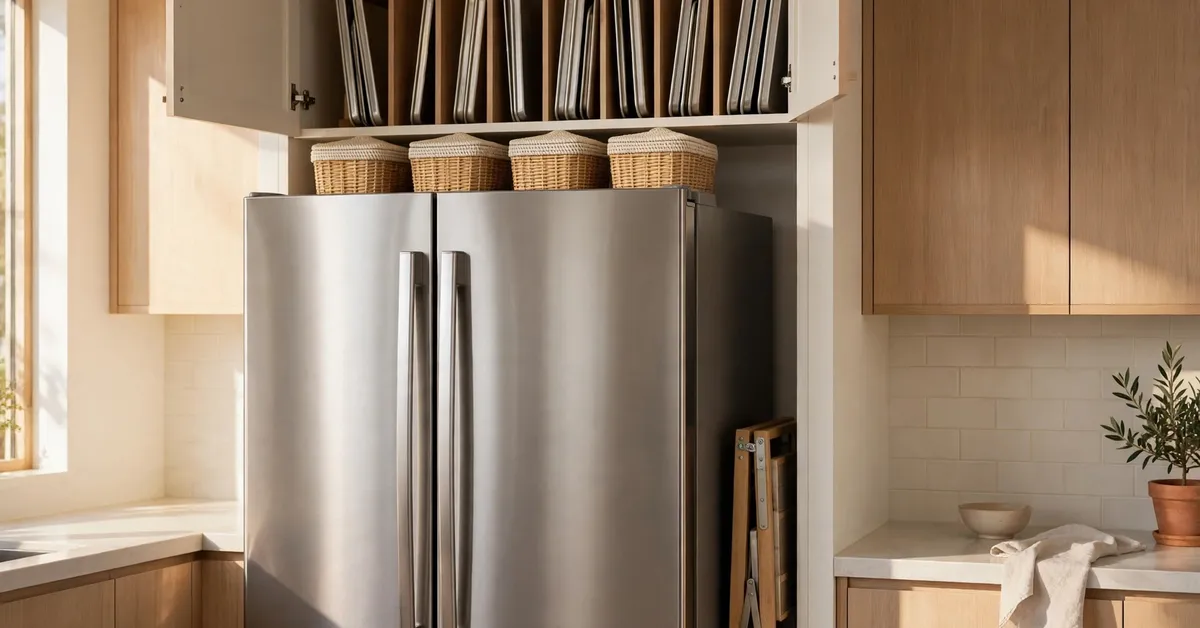
The cabinet’s 24 inches of depth is built for flat things filed, not stacked: vertical dividers stand baking sheets, cutting boards and serving trays on edge like books, each one visible from the stool. The piece you want slides straight out instead of sitting under four others over your head — the stack is what makes this cabinet awkward, and the divider is what ends it.
2. Bring the Back Half to You With a Pull-Out Shelf
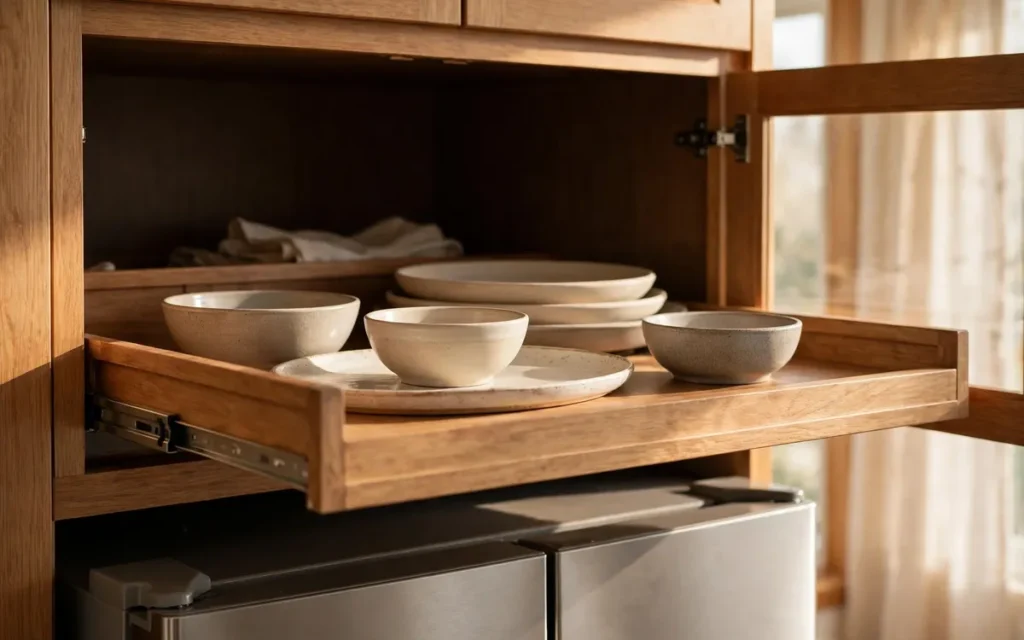
A deep cabinet swallows whatever is pushed behind the reach line, and the reach line in a 24-inch cabinet is about halfway in. A pull-out shelf or sliding tray fitted inside turns the back 12 inches into the front — the single fix that converts the black hole into a drawer, and the first purchase this cabinet honestly earns.
3. Use Labeled Baskets as the Cabinet’s Drawers

Small things go up only inside baskets sized to the cabinet’s width — one job per basket, labeled on the face the floor sees. A basket is lifted down whole, used, and lifted back, so nothing is ever fished for blind at 70 inches. Loose small things in this cabinet are not stored; they are misplaced in advance.
4. Spend the Cabinet’s Height on a Shelf Riser

The over-fridge cabinet runs 12–18 inches high, and one layer wastes half of it. A shelf riser splits the tall cabinet into two light layers — paper goods and linens above, serving pieces below — doubling the honest storage without deepening the reach by a single inch. Tall and shallow beats tall and stacked, every time.
Zone B — Run the Open Top Honestly
No cabinet — or a cabinet already assigned — leaves the open top itself, and the open top has its own discipline: everything filed or lidded, everything kept inside the maker’s clearance, and nothing up there that the heat or the grease can spoil.
5. File the Flat Things on the Open Top, Too

No cabinet is no excuse for a pile: the same divider rack stands trays and boards upright on the fridge top itself, biggest at the back, each piece sliding out on its own. One boundary is absolute — the rack and its contents stay inside the maker’s clearance from Step 1; nothing may rise into the gap the fridge breathes through.
6. Run One Row of Matching Lidded Baskets
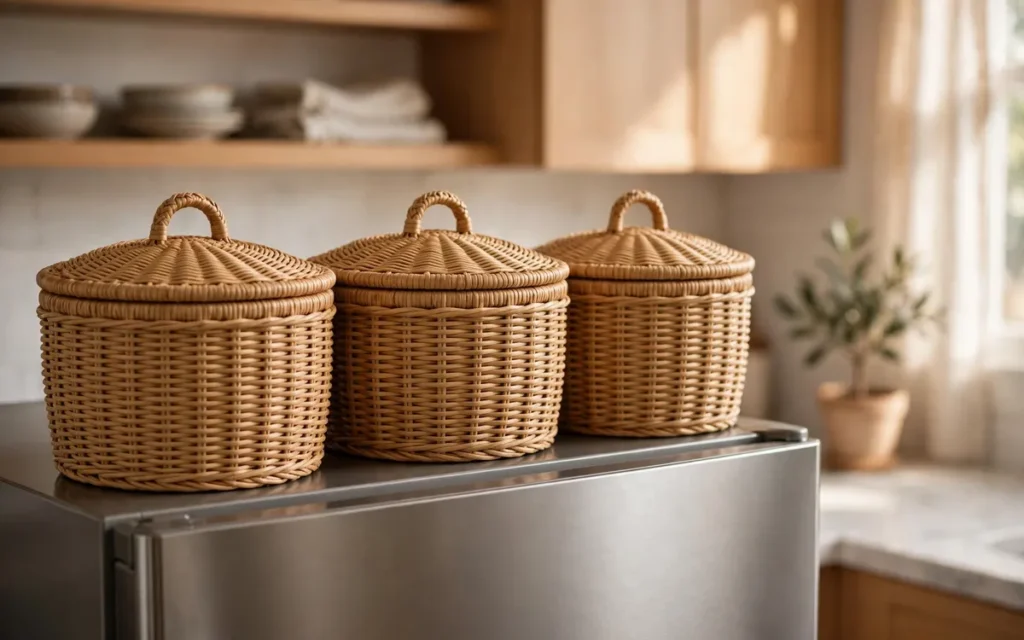
Where the top is the storage, one row of lidded baskets in the fridge’s width class is the whole system. Lids, because kitchen grease rises and settles on whatever sits up there; matching, because a row reads as storage and a jumble reads as a pile. Two or three baskets, one job each, is the entire discipline.
7. Keep the Cookbooks Up There — Standing, Not Stacked

The one daily-adjacent exception the top honestly holds: cookbooks stand in a row with a bookend, at the front edge’s reach, spines out. They are flat, light and heat-proof, indifferent to the warm air that ruins wine — and lifted down one at a time, by the spine, rather than dug out of a leaning stack.
8. Give Seasonal Serving Pieces One Lidded Box

The turkey platter, the holiday bowls, the once-a-year pieces: one lidded box, labeled on its floor-facing side, holds the season’s whole service. This is the assignment the height was made for — touched twice a year, in the way never — and the lid keeps fifty weeks of kitchen grease off pieces that meet food.
Zone C — Assign by Frequency
With the zone fitted, what remains is the assignment itself — the survivors of Step 2 placed by how often they are touched, from the once-a-year appliance box to the stool the whole system stands on.
9. Box the Light Once-a-Year Appliances — Parts Inside, Label Out
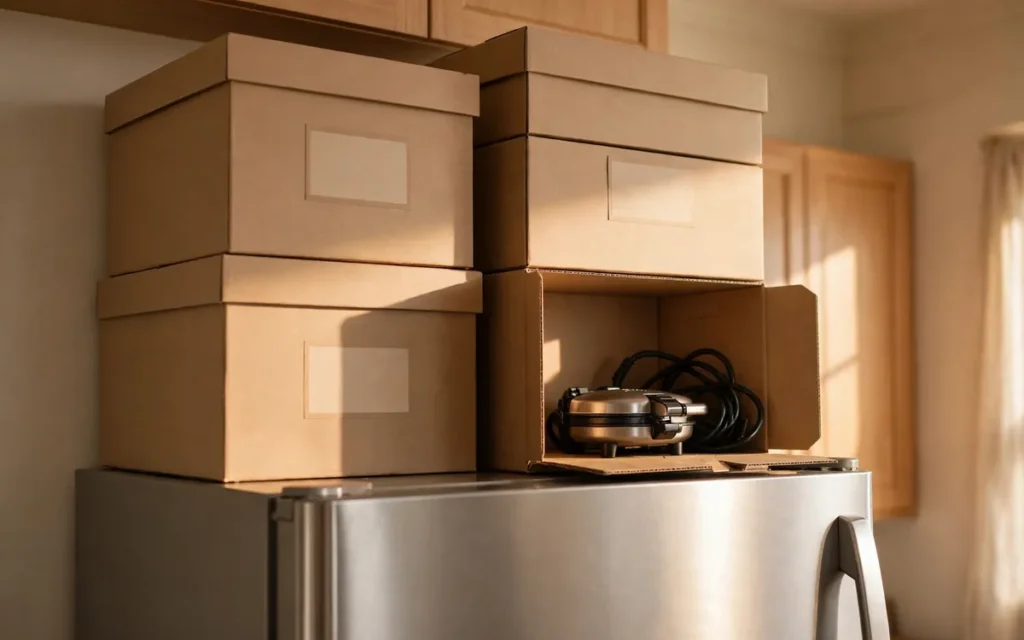
The waffle-iron class may live up here, boxed with its cord and parts inside and its name on the floor-facing side. The weight test draws the line exactly: if it cannot be lifted down safely in two hands from a stool, it is not a fridge-top appliance — and the stand mixer, heavy and wanted far more often than that, never is.
10. Send Party Servingware to the Front Half
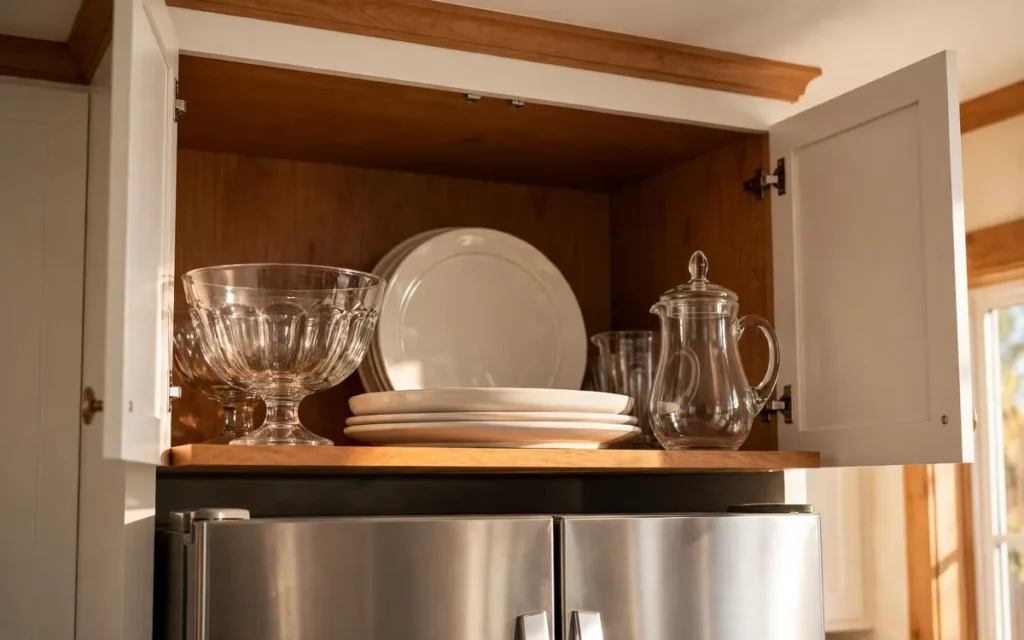
Punch bowls, big platters, the pitcher set: bulky, light, and monthly at most — so they take the cabinet’s reachable front half or the open top’s basket row, never the deep back. The front is the system’s prime shelf, and prime shelf is spent on the things touched oftenest among the rare, not on whatever was lifted up first.
11. Make Paper Goods the Top’s Backstock

Paper towels, napkins and party paper are the perfect citizens of this zone: the bulkiest light things in the kitchen, indifferent to warmth, and bought in packs too big for any honest cupboard. Food backstock belongs to the pantry’s own system — our small pantry organization ideas — but the paper backstock is the fridge top’s share, one pack at a time down.
12. Park the Step Stool Inside the System

A zone at 70 inches that needs a stool owns its stool: a slim folding stool stands in the gap beside the fridge or hangs on a hook within arm’s reach of it. A stool kept in another room is how a system decays — into tiptoe reaching, dragged chairs, and piles pulled down by their nearest corner.
Zone D — Keep It Safe, Clean and True
Four finishing rules keep the fitted zone fitted: labels written for the person standing below, the heat path defended, the grease capped, and the whole assignment re-passed on a calendar.
13. Write Every Label for a Reader on the Floor

Labels go on the front-bottom face of every basket and box, in letters large enough to read from the floor. The person choosing is standing below, not on the stool — deciding what to bring down before climbing for it. A label that can only be read at eye level, up at 70 inches, will simply never be read, and the box becomes a mystery with a lid.
14. Keep the Heat Path Open — Never Bridge the Gap

The clearance measured in Step 1 is a rule, not a suggestion: nothing stacks high enough to touch the cabinet or soffit above, nothing drapes over the back edge where the heat rises, and the gap stays air from the fridge’s top to whatever is over it. Storage that bridges the breathing gap is not storage — it is a load on the appliance.
15. Cap the Top Against Grease and Dust

Everything stored open gets a lid, and everything stored closed sits on a washable liner cut to the top. The fridge top collects the kitchen’s grease film faster than any shelf in the room; a liner that lifts off to wash is the difference between a five-minute wipe at audit time and a scour nobody ever gets to.
16. Audit the Top Twice a Year

The system is re-run on the seasonal swap, twice a year: everything down, the top wiped, the never-store list checked against whatever migrated up — a spice jar, a medicine bottle, a good bottle of wine — and each assignment re-passed against the three tests. A zone this easy to forget is audited on a calendar, not on memory.
What It Costs: Three Ways In
The container tier (under roughly $50). Two to four baskets with lids, a divider rack, labels and a washable liner. This tier proves over-fridge storage does not fail for lack of cabinetry; it fails because nothing was measured, the heat was never considered, and daily things were exiled to a shelf nobody can reach.
The fitted tier (roughly $50–$200). A pull-out shelf or sliding tray fitted to the cabinet, a shelf riser, matching lidded boxes for the seasonal service and the light appliances, and the slim folding stool the system parks beside the fridge. The tier that does the visible work, bought in method order: the zone sized first, the never-store list cleared second, the assignments fitted last.
The cabinet tier (roughly $200 and up). A proper 24-inch-deep replacement fridge cabinet where a shallow one is stranded at the back, lift-up door hardware for the high reach, or a finished enclosure panel at the fridge’s open side. Worth it only in a remodel conversation, or a kitchen that will keep this fridge’s footprint for years — and only after the cheaper tiers have proved the assignments, because cabinetry forgives nothing.
6 Mistakes That Fail the Heat, Reach and Weight Tests
- Fitting the wine rack above the fridge. The prettiest trap in the search results: wine wants a steady ~55°F, still and dark, and the fridge top gives it heat that frequently passes 65°F, a temperature swing at every compressor cycle, and constant vibration — sommeliers name it the worst wine-storage spot in the house. The rack goes in a cool cupboard; the cabinet takes the platters (Method Step 2).
- Storing the stand mixer over your head. Heavy appliances are the weight test’s whole point: lowering a stand mixer from above shoulder height while balanced on a step stool is the ranking cabinet guides’ named common mistake. Heavy lives in base cabinets; only the light, boxed, once-a-year class goes up (idea 9).
- Stacking until the storage bridges the breathing gap. Baskets piled until they touch the cabinet above choke the clearance the maker specified — about an inch at the top by trade consensus, 2 inches in LG’s manuals — and piled storage over the condensers makes the fridge work harder, shortens its life and is at worst a fire hazard (Method Steps 1–2, idea 14).
- Exiling daily things to the black hole. Cereal, the everyday pantry and the lunch boxes in a 24-inch-deep cabinet at 70 inches are not stored, they are lost — and the household climbs a stool daily for them. Daily things belong to the counter and the reachable cabinets; this zone takes the rare and the light (Method Step 3).
- Letting heat-sensitive things migrate up. Bread staling in the warm airflow, medicine losing potency against its own “cool, dry place” label, spices spending their flavor — the migration is always one tired evening at a time. The never-store list is checked at every audit (Method Step 2, idea 16).
- Loose stacking with no containers and no labels. Unboxed things collect the grease film, gather dust, walk toward the edge on the compressor’s vibration and come down as a pile the first time anyone reaches blind. Lids, a liner, and labels written for the floor are the system, not the styling (Zone D).
FAQs
What can you safely store on top of the refrigerator?
Only the class that passes all three tests: light, bulky, heat-proof and rarely used — paper-goods backstock, trays and platters filed upright, seasonal serving pieces in a lidded box, light once-a-year appliances boxed with their parts, cookbooks standing in a row. Keep it inside the maker’s clearance, in lidded containers, and light enough to lift down safely in two hands from a stool.
What should never be stored on top of the fridge?
Wine, medicine, bread and baked goods, spices, anything flammable, and anything heavy. The top of a fridge is warm — frequently over 65°F on a hard-working appliance — it vibrates as the compressor cycles, and it collects grease: heat-sensitive things degrade there, and heavy things are an unsafe lift at that height.
What is the cabinet above the refrigerator actually best for?
The least-used, lightest, bulkiest things you own: seasonal servingware, trays and baking sheets filed on dividers, party pieces, paper backstock — fitted with a pull-out or baskets so its 24 inches of depth work like drawers. It is the worst cabinet in the kitchen for daily food storage, precisely because it is deep, high and warm on one side.
How much space should be left above a refrigerator?
Whatever your model’s installation sheet says — the sheet governs, and there is no single universal figure. Common numbers: Whirlpool asks about ½ inch at the sides and top with 1 inch behind on its bottom-mount line, and 3 inches to overhead cabinets in an older guide; LG specifies 2 inches at back, top and sides; the trade consensus is roughly 1 inch minimum at the top and 1–2 inches behind. Storage must never bridge that gap.
Can I put a wine rack in the cabinet above the fridge?
No — it is the one insert this space should never get. Wine keeps at a steady ~55°F, still and dark; above the fridge it gets heat, a swing at every compressor cycle and constant vibration, which is why sommeliers call the fridge top the worst wine-storage spot in the house. A cool, dark cupboard away from appliances is the honest home for it.
How do I reach things in the deep cabinet above the fridge?
Make the cabinet come to you instead: vertical dividers for flat things, a pull-out shelf or sliding tray for the back half, baskets that lift down whole, labels readable from the floor — and a slim step stool parked beside the fridge, not in another room. Keep only light things up there: the reach rule and the weight rule are the same rule.
Can I decorate the top of the fridge with a plant or a lamp?
It is the photograph’s idea, not the system’s: a lamp cord and a watered plant sit badly on a warm, vibrating surface that collects grease, and the space works harder as storage than as a shelf for styling. If the top must carry something seen, let it be the working row itself — matching lidded baskets and standing cookbooks read as deliberate from the floor and still earn their height.
Conclusion
Work through these over the refrigerator storage ideas in order — size it, clear it, assign it — and the dead zone above the fridge stops being a shelf of good intentions and becomes storage: measured against the appliance it sits on, cleared of everything its heat and height disqualify, and assigned to the light, the bulky and the rare. The zone was never too high or too deep to use. It was only ever unmeasured.


One Comment