
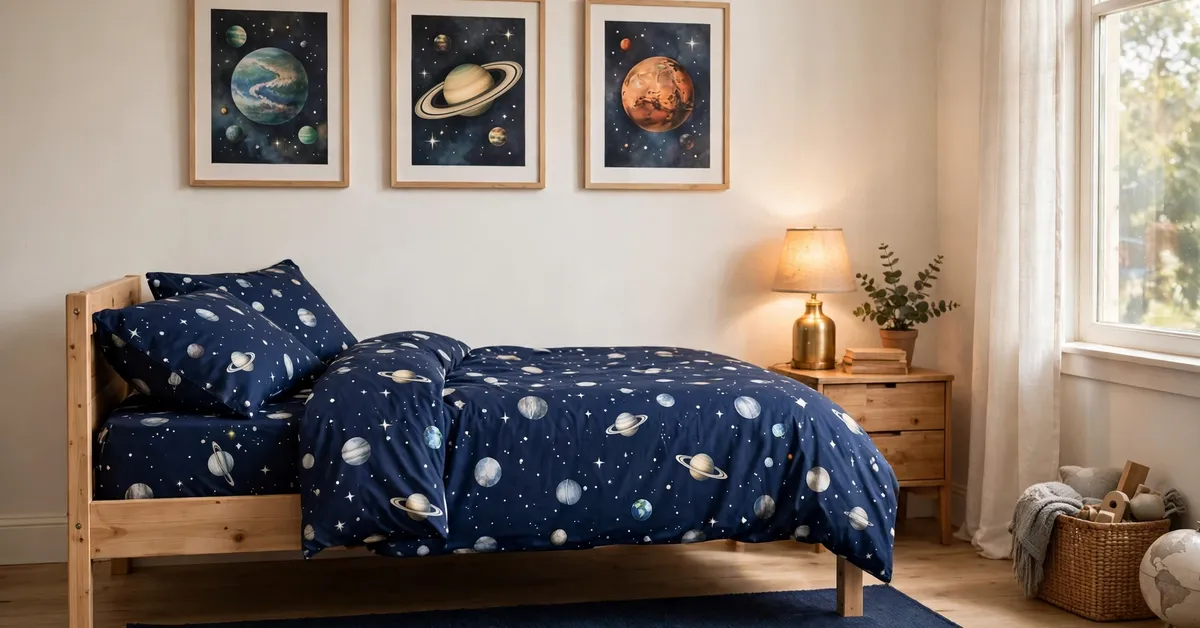
17 Playful Space Themed Bedroom Ideas That Fit the Child, Not Just the Theme
A child’s space room usually begins with a photograph: a galaxy wall, a rocket-shaped bed, planets on every surface — and the bed, the sleep and the safety rules are left to fit around whatever the photograph wanted. Fitted in the right order, a space themed bedroom works the other way round. The child’s age band is named first, because it sets both the sleep the room has to protect and how much theme the room can hold. The theme itself then goes on the layer that swaps in an afternoon — bedding, decals, prints, a rug — while the paint, the ceiling and the bed are bought plain, standard-sized and checked against the numbers that govern children’s beds. What is left is a room a five-year-old can sleep in properly and a twelve-year-old has not already outgrown.
If the room itself is small, that fitting comes first: our small bedroom decor ideas for kids fits a small child’s room by its measured size classes, whatever theme it ends up wearing. This article assumes the room is already fitted and spends its length on one theme — how much of it the room should carry, on which layer it belongs, and what the bed underneath it has to pass. Everything here is for the post-crib child, roughly four to twelve; the crib and toddler stage runs on different standards and has its own article.
The Method: Age It, Layer It, Guard It
Three decisions, in order, before a single decal is bought — because a theme room is almost always fitted backwards, theme first and facts later, and a child’s room is the one room where the facts are printed in federal standards and sleep guidelines rather than left to taste.
Step 1 — Age It: Name the Band Before Anything Is Bought
The age band sets both ends of the job. At one end is the sleep the room must protect: the American Academy of Sleep Medicine’s consensus, endorsed by the American Academy of Pediatrics, puts children aged 3 to 5 at 10 to 13 hours of sleep per 24 hours including naps, and children aged 6 to 12 at 9 to 12 hours. At the other end is how much theme the room can hold before it tips into a costume a child is embarrassed by two birthdays later. A five-year-old’s room and an eleven-year-old’s room are different fits of the same theme, so the band is named once — and every later decision, including whether a top bunk is even on the table, reads off it. The room is a sleep room first and a theme room second.
Step 2 — Layer It: Spend the Theme Where It Can Be Taken Back
Every piece in the room belongs to one of two layers. The swappable layer — bedding, peel-and-stick decals, framed prints, the rug, cushions, lamps — carries nearly all of the theme, because it retires in an afternoon. The fixed layer — paint, wallpaper, the ceiling, the bed frame — stays neutral and at most night-sky-adjacent, bought for the child’s next age band rather than this one: navy is a colour, not a costume, and it will still be right when the rockets are gone. One focal point only — the wall, the bed or the ceiling — and everything else supports it. More than any mural, a space themed bedroom is made by this split: the theme lives where it can be peeled, folded and boxed away, and underneath it sits a plain, well-fitted child’s room that the next theme, or no theme at all, can move straight into.
Step 3 — Guard It: Fit the Bed Against the Numbers
The bed and the tall furniture are fitted against the standards, not the photograph. Under federal rules a bed counts as a bunk when the underside of its mattress foundation sits more than 30 inches above the floor, and children’s bunk beds are regulated under 16 CFR Part 1513: guardrails on both sides, the wall-side rail running continuously (a gap to the end structure of no more than 0.22 inches), openings at the ends of the other rail of no more than 15 inches, and guardrail tops at least 5 inches above the top of the thickest mattress the manufacturer specifies. The bed’s own required warning label bars children under 6 from the top bunk. The full checklist is set out in the CPSC’s bunk bed business guidance, and idea 11 below turns it into a buying routine. Tall pieces — bookcases, dressers — are anchored to the wall, because a themed room is still climbed in.
Zone A — Sort the Room by Age and Sleep
Four sorting decisions come before any spending. The room’s basic fitting — bed placed, walkway kept clear, storage a child can reach — is covered in our small bedroom decor ideas; this zone takes that fitted room and sorts it by the child who actually sleeps in it.
1. Name the Age Band Before the Theme
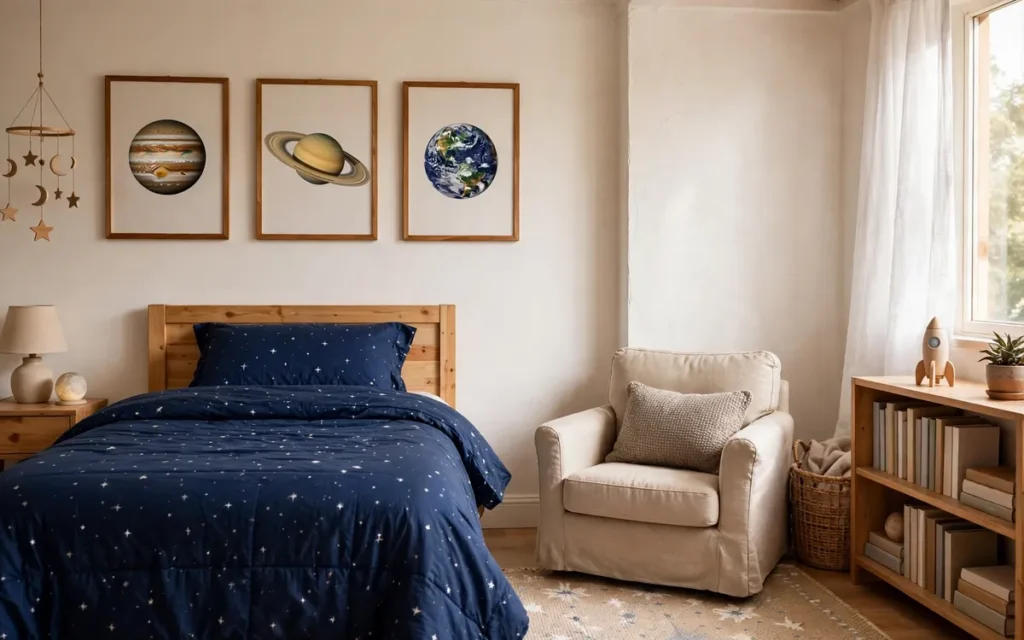
Fit the room to one of three bands — roughly 4 to 6, 7 to 9 or 10 to 12 — and let the band drive everything after it. The youngest band takes the boldest theme and the lowest furniture; the oldest takes the theme at print-and-bedding strength and a bed bought for length. The band also settles the bunk question before it is asked: under 6, the top bunk is not an option at any price.
2. Protect the Sleep Hours First
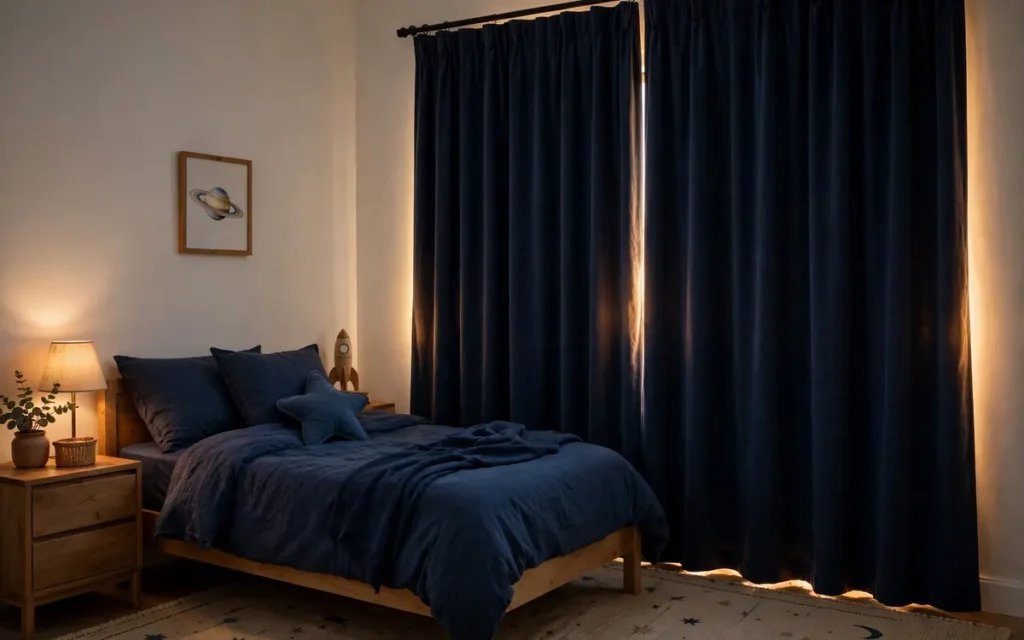
The sleep durations are the room’s real brief: 10 to 13 hours for the youngest children here, 9 to 12 hours for ages 6 to 12, every night. Judge every thematic piece against them. A lamp that stays bright, a light show with no off switch, a glow that never settles — anything that works against those hours fails the room’s first job, however good it looks in a photograph.
3. Pick One Focal Point and Stop
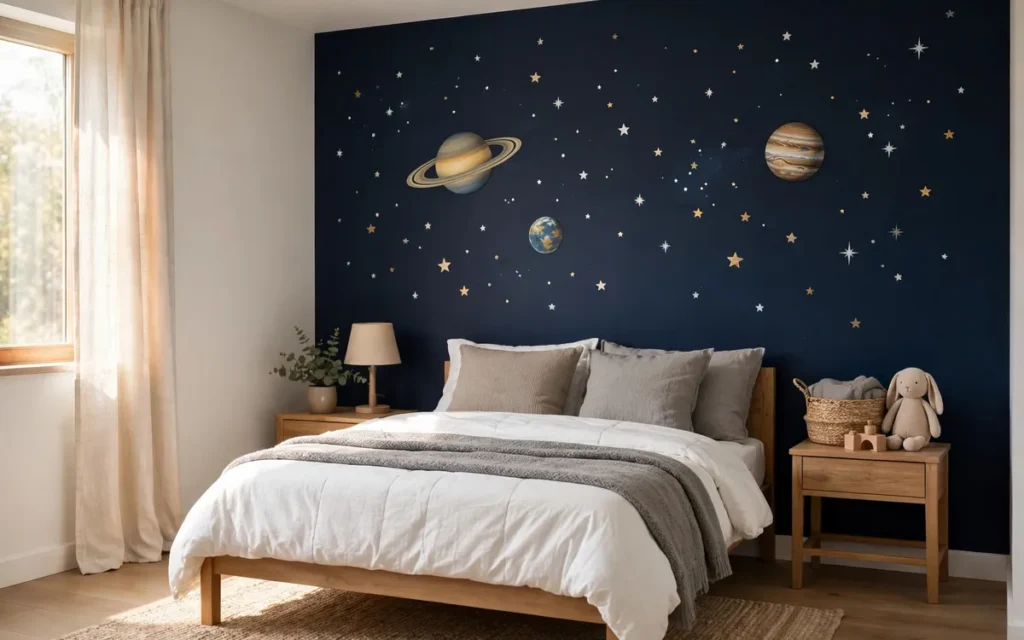
Choose the one surface that carries the galaxy — the wall, the bed or the ceiling — and let the other two stay quiet. A room themed on every surface reads as a costume, dates fastest and costs the most to retire. One strong surface does the opposite on all three counts, and it is the surface the swappable layer can reach: bedding, decals or the ceiling over the bed.
4. Build the Palette on Navy, Warm White and One Metallic

Navy does the night sky’s work as a plain colour, so it outlives the theme on walls, curtains and bedding bases. Warm white keeps the room calm and readable by day, when it is also a homework and play room. One metallic — brass or silver, not both — is the starlight, repeated on the lamp, the picture frames and a handle or two. The proportions follow the room, never the theme pack.
Zone B — Carry the Theme on the Swappable Layer
Five pieces carry almost the whole theme between them, and every one of them can be folded, peeled or rolled up on the afternoon the theme retires. Buy these first and the fixed layer last, and the room can change its mind as often as the child does.
5. Let the Bedding Carry the Theme
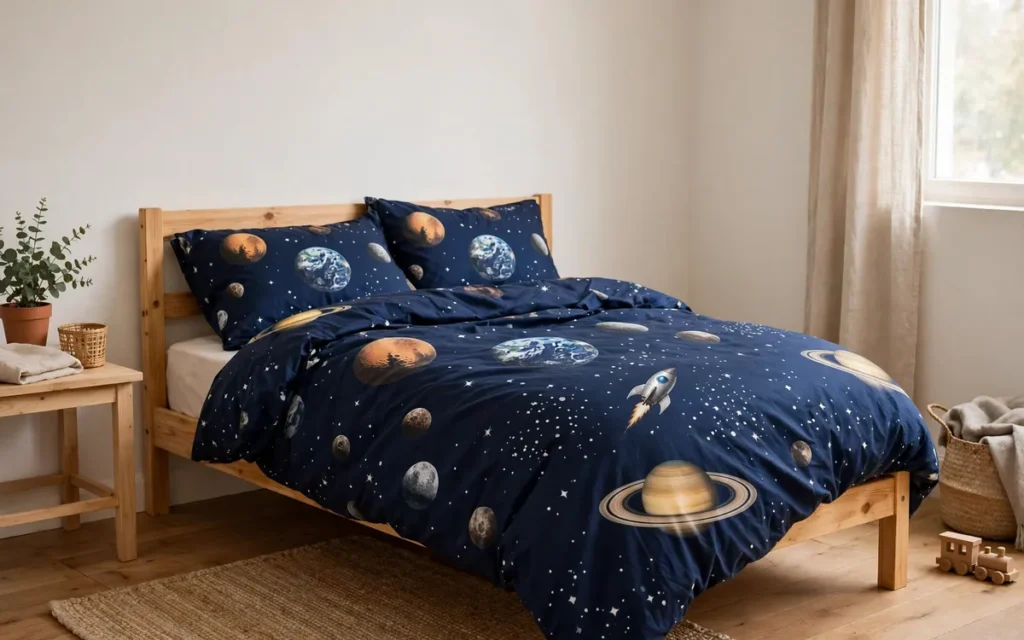
The bed is the largest surface in the room, so one themed duvet set delivers most of the theme in a single purchase — and swaps back out in minutes. Buy it in the bed’s standard size class (idea 10), so the next set, themed or plain, always fits the same bed. If one piece in the room is allowed to shout, it should be the one that goes in the wash.
6. Use Peel-and-Stick Decals, Not Wallpaper, on the Theme Wall

Decals do wallpaper’s job at a fraction of the commitment: planets, stars and a moon, arranged once and peeled off clean when the theme retires. Confine them to the one focal wall chosen in idea 3, or to the wall above the bed only — never carried round all four walls. Keep a few spares from the same pack; a torn planet replaced in kind keeps the wall looking deliberate.
7. Hang the Solar System as Prints at the Child’s Eye Height

Frame the planets as prints and hang them centred on the child’s standing eye height — measure the child rather than guessing, and mark the height with painter’s tape before any holes are made. Put the row on a wall the child faces from the bed, where it will actually be looked at. The wall directly over the pillows stays frameless; that wall gets flat decals instead (mistake 5).
8. Lay a Galaxy Rug Sized to the Bed, Not the Room
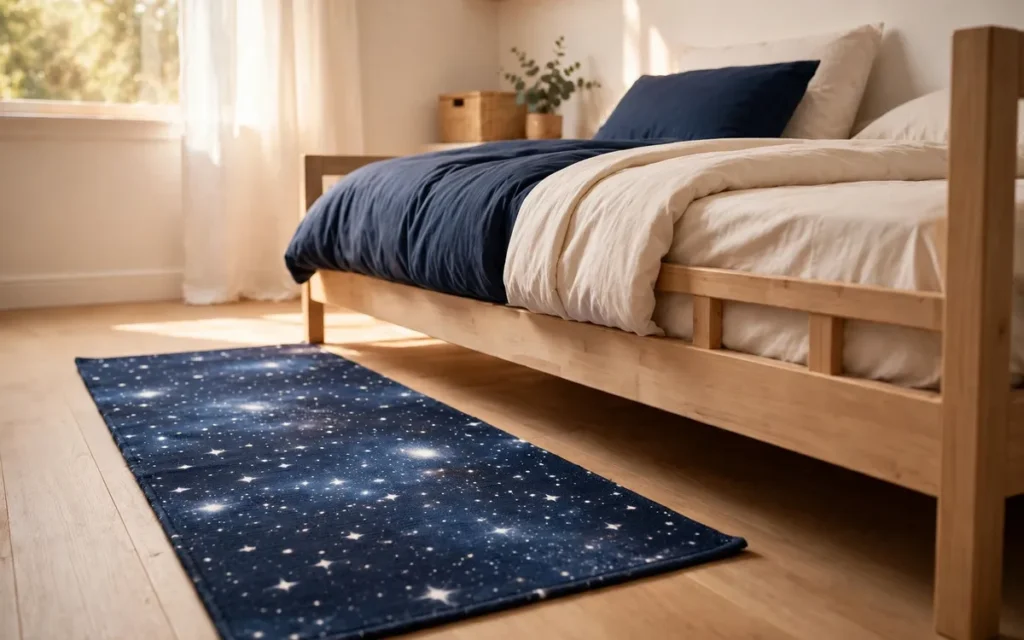
The rug’s job is the bedside landing, not wall-to-wall coverage: a runner or small rug in the standard bedside classes, laid along the bed’s open side where bare feet land first. Sized to the bed, it stays a swappable piece — rolled up and replaced when the theme turns over — instead of a fitted cost the room has to keep. A low, dense pile is the practical choice beside a bed.
9. Keep the Costume Pieces in the Toy Class
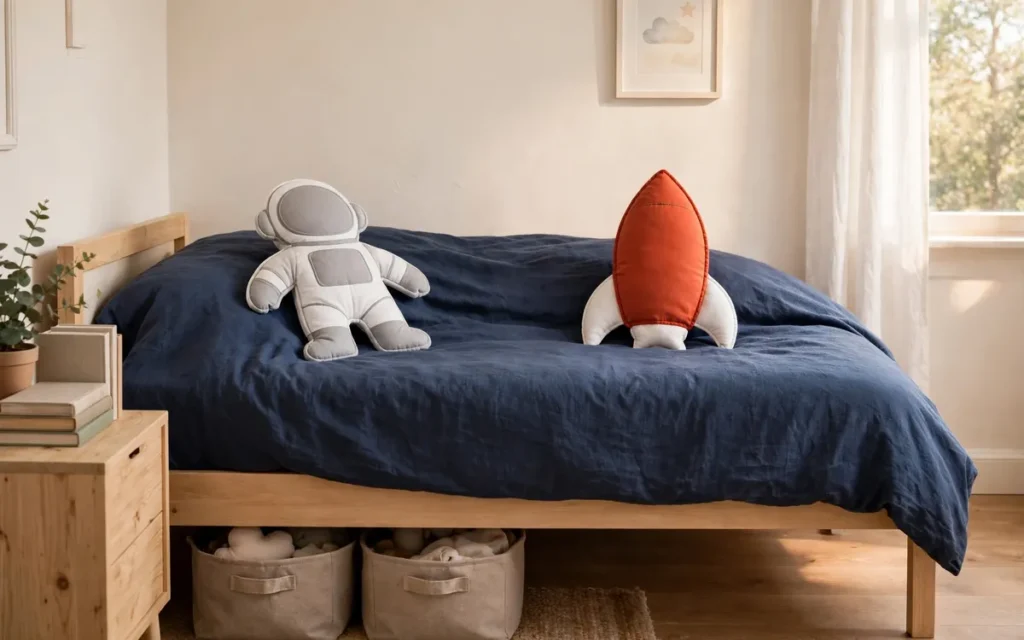
The literal, playful pieces — an astronaut-shaped cushion, a plush rocket, themed storage bins — belong in the class that is supposed to be outgrown: toys and soft furnishings. They are the cheapest pieces in the room and the easiest to hand down. What they must never become is furniture or paint: the day the child tires of astronauts, the cushions leave in a bag and nothing in the room’s structure notices.
Zone C — Fit the Bed and the Furniture by the Numbers
This is the zone the photographs skip. The bed is the one piece in the room regulated by federal standards and the one piece priced like furniture, so it is chosen by size class and checked against the rules before its colour is discussed.
10. Choose the Bed by Its Size Class

The standard child’s class is the twin, 38 by 75 inches; the twin XL, 38 by 80, buys five more inches of length for a child who is shooting up. A themed frame is fine on one condition: it takes the standard mattress and standard bedding for its class. A novelty frame built around a non-standard size fails every bedding purchase after it (mistake 6) — the theme belongs on the bedding, never in the mattress dimensions.
11. Run the Federal Checks on Any Bunk or Loft
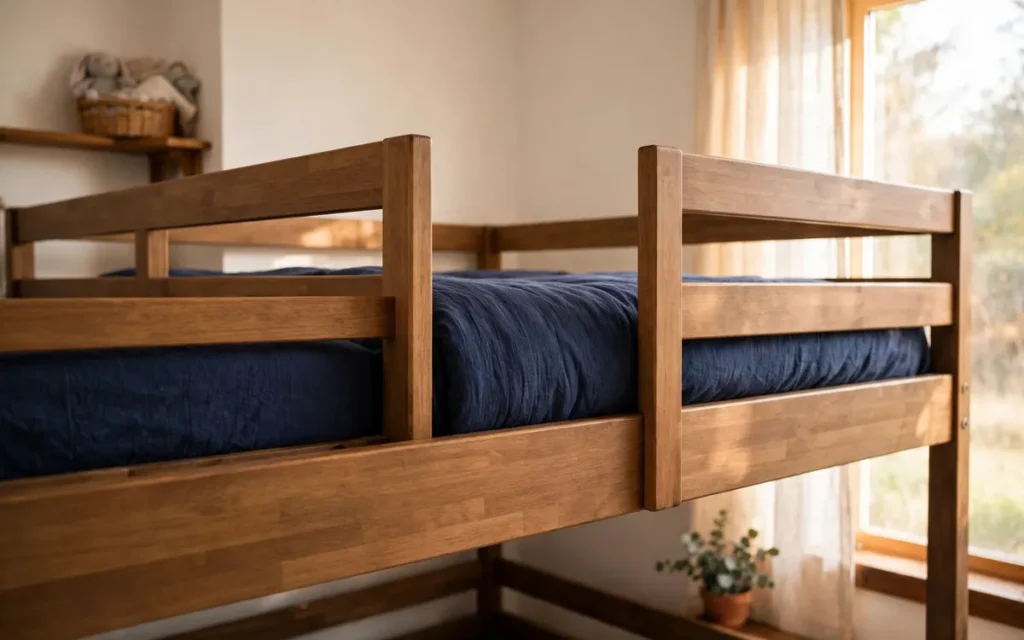
Work the checklist before a bunk or loft is paid for. A foundation more than 30 inches up means the bunk standard applies. Then: guardrails on both sides; the wall-side rail continuous, within 0.22 inches of the end structures; openings at the access rail’s ends no more than 15 inches; rail tops at least 5 inches above the mattress, measured against the thickest mattress the maker allows — which in practice caps most top-bunk mattresses in the 6-to-8-inch class. The thickness printed on the bed’s label is the maximum, full stop, and no child under 6 sleeps on top.
12. Measure the Sitting Room Above a Loft Before Buying It

The honest test needs no borrowed figure: ceiling height, minus the height of the mattress platform, minus the mattress thickness, must clear the child’s own seated height with room to spare — measure the child sitting up in bed and add a hand’s width. As a rough cross-check, fitting guides commonly work to about 30 inches or more of clear space above the mattress. A loft that fails the seated test means a bumped head every single morning.
13. Anchor the Tall Pieces and Clear the Bedside
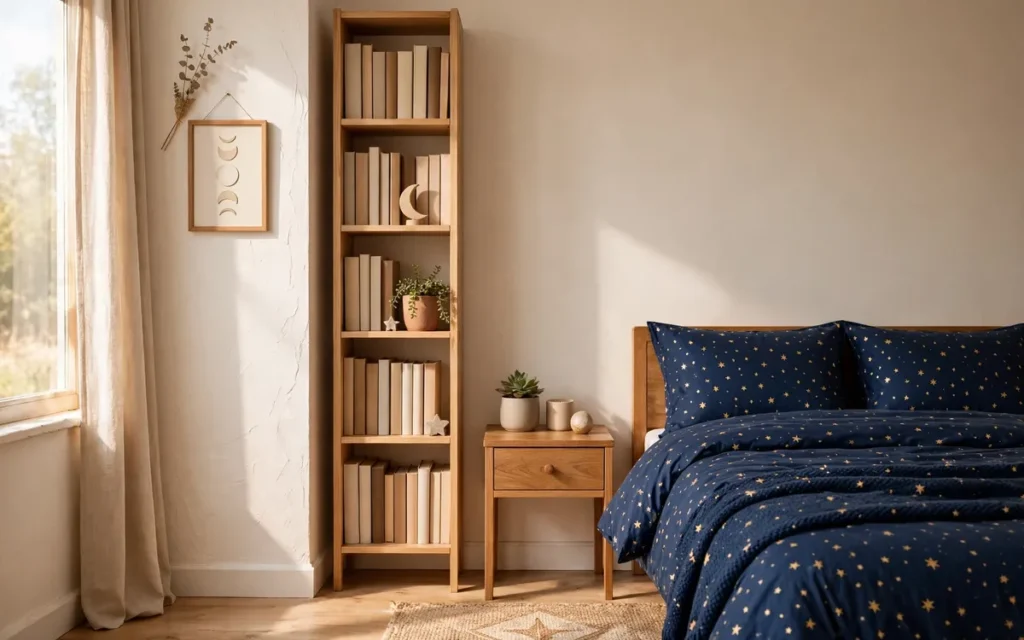
Strap the bookcase and the dresser to the wall — anti-tip hardware is a fitting, not an accessory, in a room that gets climbed in. The bedside then holds only what the night needs: a lamp, a book and water within the child’s reach, with cords routed off the bed and out of the walkway. The full fitting of that surface is our nightstand decor ideas‘ subject; here it earns one line and no clutter.
Zone D — Light the Night Sky, Then Let It Go Dark
The theme’s favourite trick is light, and light is where a theme room most easily breaks its first job. Four fittings give the room its night sky at story time — and a properly dark room by the time the sleep hours start counting.
14. Put the Stars on the Ceiling Above the Bed Only
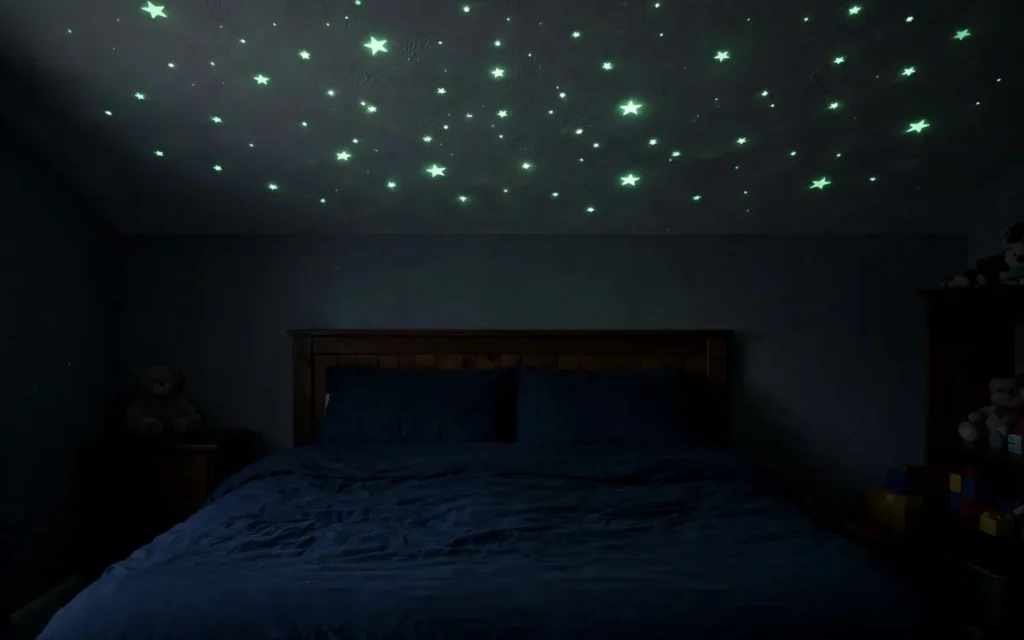
Glow stars earn their place as the lights-out reward: flat, light and silent — the one decoration that may live over a bed (mistake 5). Confine them to the ceiling above the sleeping surface rather than scattering them over every surface: one field of stars reads as a sky, five read as static. They fade as the child falls asleep, which is exactly the direction the room’s light should travel.
15. Use a Projector as a Wind-Down, Not a Night Light
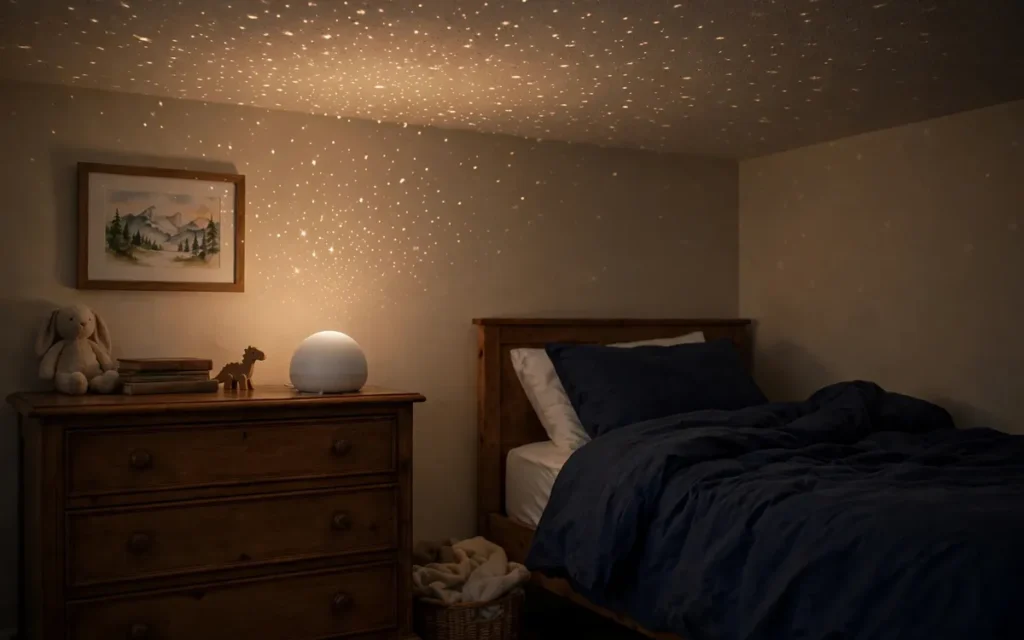
A star projector is a story-time fitting: switched on while the child settles, run on its timer, off for the night. A light show that turns all night works against idea 2’s brief, however gentle it looks. Stand it on the dresser or the nightstand, aimed up at the ceiling — never on the bed itself, where it becomes a toy, a warm object and a thing to roll onto, all three at once.
16. Give the Moon Lamp the Nightstand Job

For the child who still wants a light left on, one low, warm lamp at bedside height is the fitting — warm and dim, where a bright, blue-white light would keep the room in daytime mode. Sit it within the child’s own reach, so switching it off is theirs to do: control of the light is often the whole of what a nervous sleeper is asking for. The rest of the nightstand stays as idea 13 left it.
17. Plan the Exit Before You Start
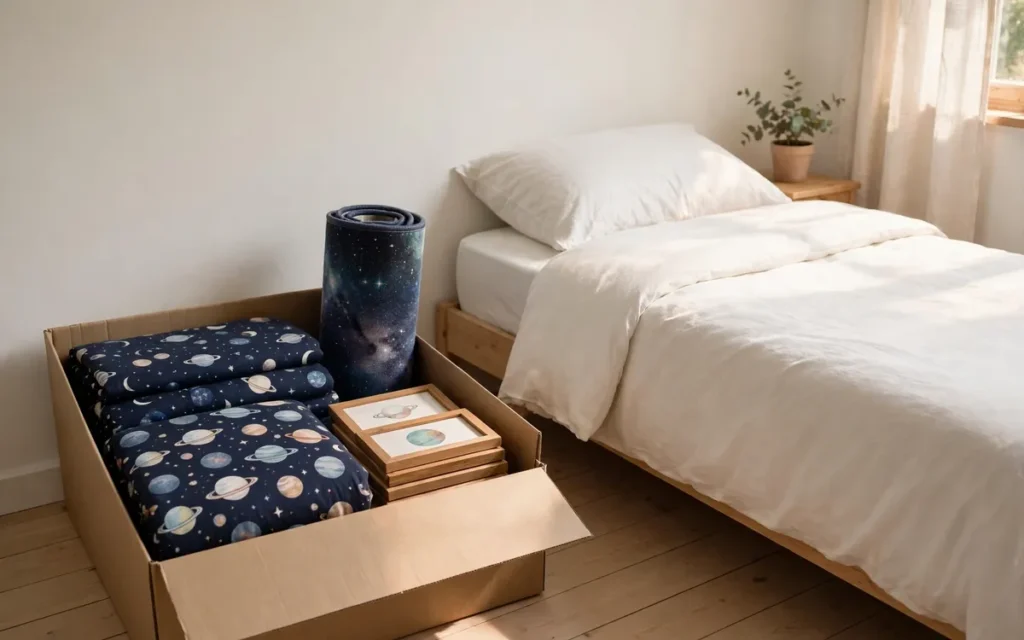
Fit the room so the theme can retire in an afternoon: decals peel, bedding and rug swap, prints come down to be re-framed for whatever comes next. Keep the packaging the decals came in, and a note of the wall paint colours tucked in with it. A room fitted by layers never needs a renovation when the child turns thirteen — it needs one box, one wash load and an hour.
What It Costs: Three Ways In
The swappable-layer refresh (roughly under $75). A themed duvet set, a peel-and-stick decal pack, a glow-star pack and one or two framed prints. This is the whole theme, bought the way this article teaches it — nothing fixed touched, nothing that cannot be undone in an afternoon. For most rooms it is also the honest place to stop and live with the theme for a while.
The room fit (roughly $75–$300). The refresh, plus the fittings that make the room work at night: a blackout curtain layer, the galaxy rug, a moon lamp or a projector with a timer, and proper frames for the prints. This is where most readers land — the theme complete, the sleep protected, the fixed layer still plain.
The fitted room (roughly $300 and up). A standard-size twin, or a bunk or loft that passes the Zone C checks, with a mattress inside the maker’s stated thickness and anchoring hardware fitted — and the swappable layer on top. The bed is the only piece in the room priced like furniture, because it is the only piece that is; everything thematic still comes from the two cheaper tiers. All three tiers are rough planning classes, not quotations.
6 Mistakes That Undo a Theme Room
Mistake 1 — Committing the Fixed Layer to the Theme
Galaxy wallpaper on all four walls, a mural ceiling, furniture shaped like rockets: the fixed layer is the expensive layer, and committing it means the theme’s retirement — which always comes — is a renovation with paint, paper and a skip, instead of an afternoon with a box. The theme belongs on the layer that swaps (Method, Step 2); the walls underneath stay a colour, not a scene.
Mistake 2 — Putting a Child Under 6 on the Top Bunk
The bed’s own required warning label bars it, and the American Academy of Pediatrics says the same: children under 6 should not sleep on a top bunk. The reason is coordination and fall risk at an age when both are still developing, and no guardrail, however tall, changes the rule. The lower bunk of a bed that passes the federal checks is the under-6 answer.
Mistake 3 — Swapping in a Thicker Mattress
Every inch added to a top-bunk mattress comes straight off the guardrail’s 5 inches above it. The standard is tested against the thickest mattress the manufacturer specifies, and the thickness printed on the bed’s label is the maximum, full stop — “more comfortable” is not an exemption. Measure any replacement against the label before it goes on the bed, not after.
Mistake 4 — Lighting the Room Like a Planetarium at Sleep Time
A projector running all night and bright, cool-white lamps left burning turn the room’s best trick into the thing that breaks its first job. The room owes the child the sleep hours — 9 to 12 of them at school age — and light is the fitting most likely to steal them. The light show is a wind-down with a timer (idea 15); the lamp left on is low and warm (idea 16).
Mistake 5 — Hanging Heavy or Framed Pieces Over the Bed
Anything that can fall should not hang where a child sleeps under it. The wall over the pillows gets flat, light decals and nothing heavier; framed prints, shelves and anything with glass live on walls the child does not sleep beneath (idea 7). It costs nothing to move a frame two walls along, and it is the cheapest safety decision in the room.
Mistake 6 — Buying a Novelty Bed in a Non-Standard Size
A rocket-shaped frame that takes no standard twin mattress turns every later purchase — mattress, bedding, protector — into a hunt for a size nobody stocks. The bed is the fixed layer, and it is bought in the standard classes (twin 38 by 75, twin XL 38 by 80) so that everything swappable keeps fitting it. The rocket belongs on the duvet cover, where it can be outgrown gracefully.
FAQs
What age is a space theme best for?
The post-crib years, roughly four to twelve, fitted by band: bold and literal at four to six, at print-and-bedding strength by ten to twelve. Under 6 changes the bed rules — no top bunk, whatever the bed — and the theme’s intensity should cool as the band rises, which the layer system does on its own: the fixed layer was never themed, so only the swappable pieces need to quieten down.
How do you start a space theme without redecorating?
With the swappable layer, in order: themed bedding first, because the bed is the room’s biggest surface; decals on one wall second; framed prints third. One focal point, chosen before anything is bought. Paint and paper enter the job only if they were due anyway — and then they go on as plain colours, navy included, never as a mural the next theme inherits.
Are bunk beds safe for a 5-year-old?
Not the top bunk. The federal warning label every bunk bed must carry, and the American Academy of Pediatrics with it, bar children under 6 from sleeping up top — coordination and fall risk are the reasons, and guardrails do not change it. The lower bunk of a bed that passes the federal checks in idea 11 is a different question, and a single standard twin is simpler still.
How dark should the room be at night?
Dark enough to protect the sleep hours the room owes: 9 to 12 hours a night at school age. Glow stars are fine — they fade as the child falls asleep. The projector is a timed wind-down, not an all-night show. And the one lamp left on, for the child who wants one, is low and warm at the bedside, within the child’s own reach.
What colours work best for a space theme?
Navy, warm white and one metallic. Navy reads as the night sky without committing the walls to a mural; warm white keeps the room calm and usable by day; brass or silver, chosen once as the accent and repeated sparingly, does the starlight. The palette is a plain room’s palette — which is the point: it survives the theme by years.
Can you do a space theme in a rental?
Yes — the layer rule is almost built for renting. Decals peel off, bedding, rug and prints are yours to take with you, and nothing fixed is touched: no wallpaper, no mural, no themed furniture to leave behind. Fit the theme entirely on pieces that pack, and check the bed against the federal numbers in idea 11 before it is bought, because renting changes what may be fixed to the walls, never the standards the bed itself must meet.
What happens when my child grows out of the space theme?
By design, an afternoon’s work. The swappable layer — bedding, decals, rug, prints — goes into one box or on to a younger cousin; the fixed layer was never themed, so there is nothing to strip or repaint; and the bed is a standard size that takes any bedding made for its class. A theme fitted by layers retires like a stage set, not a renovation.
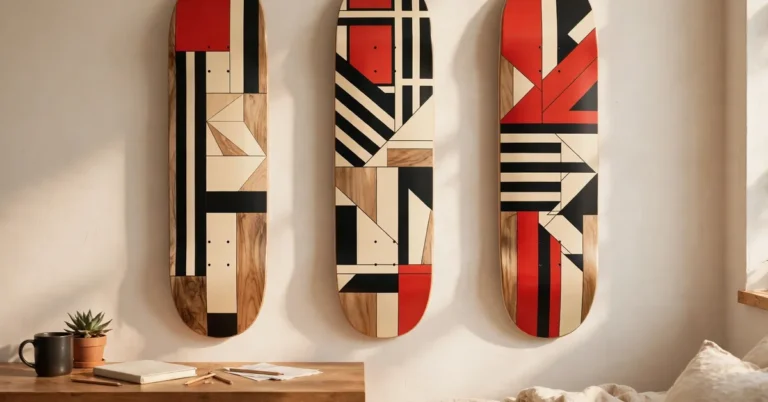
The same measured hanging that keeps prints at a child’s eye height works for a teenager’s wall, too: our skateboard wall decor ideas hang decks level on honest fixings, at a centreline a growing child can live with. The theme changes; the discipline of measuring first does not.
Conclusion
Work through these space themed bedroom ideas in the order they are given — age it, layer it, guard it — and the room stops being a photograph with a bed in it. The age band is named, so the theme is the right strength and the sleep is protected. The theme sits on the layer that swaps, so it can retire in an afternoon. The bed has passed the federal numbers — rails, gaps and the 5 inches, all of it. And at night the room does the last thing a theme room has to do: it goes properly dark, and lets the child sleep.

One Comment