
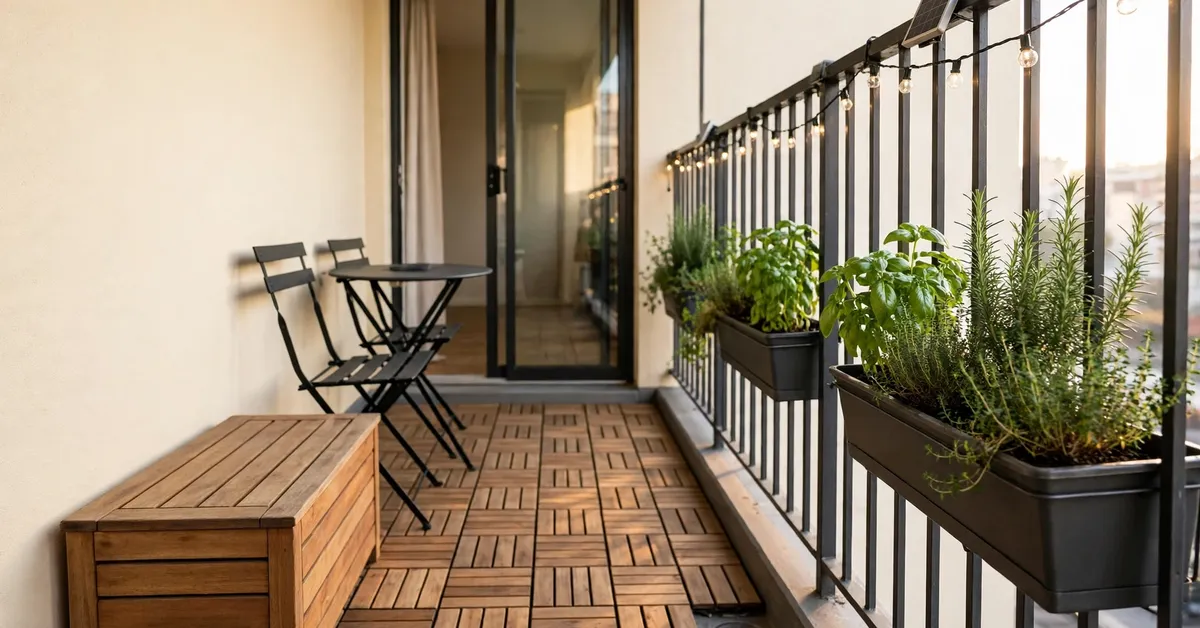
16 Radiant Small Balcony Decor Ideas That Turn a Ledge Into a Room
A small balcony is the most argued-over square footage in the apartment and the least measured — decorated in pictures with patio furniture standing on ledges and planters hung over the street. These small balcony decor ideas begin with the balcony measured and its railing read, because a small balcony does not fail on its colours; it fails on the set a class too big, the planters on the wrong face, and the drain nobody left open.
The same few square feet of outdoor floor exist at ground level, and they have their own fitting: our apartment patio privacy ideas fit the small floor you walk onto, where the problem is being overlooked. This article fits the floor one storey up — reached through the living-room door and bounded by a railing — where the problem is the railing itself, the drain hidden in the floor, the load that was carried up in a lift, and a building whose rules outrank every photograph. Everything here is decided by the balcony’s own measurements, because on a floor this small the tape measure is the stylist.
The Method: Sort It, Rail It, Fit It
Three decisions, in order, before a single planter is bought — because a small balcony is not decorated, it is fitted, and every fitting is decided by something checkable: the balcony’s own depth against the furniture’s real footprints, the railing and the walls that can be spent before the floor is touched, and the drain and the building rules that outrank every photograph.
Step 1 — Sort It: Measure the Depth and Name the Class
Two tape measurements draw the whole map. The depth, from the wall to the inside face of the railing, measured at its shallowest point: under about 3 feet the balcony is a standing ledge — it holds a person, a railing table and plants, and no furniture at all. From 3 to 4 feet it is a one-seat balcony: one folding chair or a slim bench against the wall, and the table on the railing. From 4 to 6 feet it is a bistro balcony, earning a folding set for two — and that is the class most apartment balconies actually are, the size guides putting the typical small balcony at 4 to 6 feet deep and 6 to 10 feet wide, as EngineerFix’s balcony size guide sets out. The width is the second number, and it is spent along the wall and the railing, never across the depth. Two fixtures are read before any idea is spent: the door — a clear path of about 24 inches is kept to it end to end, and a hinged door’s swing is drawn on the floor and left empty, where a sliding door spends nothing — and the drain: balconies slope to a drain or a scupper, and the floor layer, whatever it is, stops short of it, because a covered drain turns the first storm into a pond against the door. Then measure your own balcony and your own shortlisted furniture: the classes are the guides’ ranges, and the tape is the authority.
Step 2 — Rail It: Spend the Railing and the Walls Before the Floor
The vertical surfaces are spent first — on a balcony they are bigger than the floor. The railing is measured before anything hangs on it: guards stand at least 36 inches high under the residential code and 42 inches in many apartment buildings, and your own rail’s height is the number every planter depth, screen height and bar-table bracket is bought against. Three rules govern everything hung. Planters hang on the inside face — never on the outside, over the pavement and the neighbours below. Weight is counted wet — saturated soil runs roughly 1 to 1.5 kg per litre, so a single 50-litre planter can pass 60 kg once watered; the heaviest pots stand on the floor against the wall, and nothing heavy is suspended. And the building’s rules are read before the shopping list — screens, planters, fixings and flames are restricted in many buildings, and the lease or the manager, not the photograph, is the authority. What the railing cannot take, the wall takes: a pocket planter or a fold-down table on brackets into the wall, not the railing. The fitting is the whole article in miniature — more than any palette, small balcony decor ideas stand on the railing spent first and the floor spent last, because those decide whether the balcony can be sat on, watered and walked out onto at all, long before they decide whether it photographs well. The rule that runs the whole article: the depth class is the budget, the railing is spent before the floor, and every piece after that is bought with what is left.
Step 3 — Fit It: Admit Only the Furniture the Class Earns
Each class buys a short, definite list and nothing beyond it. The standing ledge buys the railing’s kit only — bar table, planters, light — and no seat. The one-seat balcony adds one folding chair or a slim bench, about 16 to 18 inches deep as sold, against the wall. The bistro balcony earns the folding set: a table about 24 inches across and chairs 16 to 18 inches wide, folding flat against the wall or onto a hook when the floor is wanted back — never the standard patio chair, whose roughly 36-inch depth is a class for a patio, not a balcony. Storage is a bench with a lid, bought once and doing two jobs. Only when the balcony is sorted and railed does the styling happen — one palette of two or three colours, light at seated height from solar or battery sources where there is no outlet, shade only where the sun’s hours demand it, and nothing on the floor the class did not pay for. One boundary, stated plainly: this article fits and decorates a balcony that already exists — it does not design structure or set loads, and it does not overrule a building; the weight figures are the guides’ cautions, the guard figures are floors that vary by building and jurisdiction, and your own balcony, your own building’s rules and your own municipality are the final authority.
Zone A — Sort the Balcony Before You Spend on It
Four decisions draw the balcony’s budget before a single purchase is made — the class, the lane to the door, the floor layer, and the railing and rules that govern everything hung. Get these right and the balcony is already fitted; every later zone is spent from the numbers named here.
1. Sort the Balcony Into Its Depth Class First
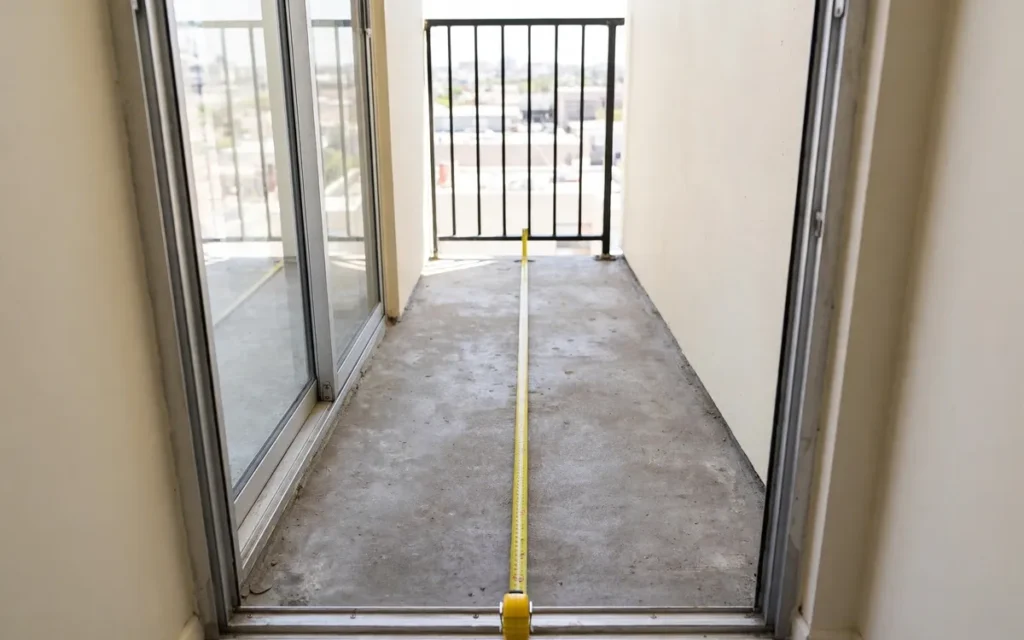
One measurement, wall to the railing’s inside face at the shallowest point, decides everything the balcony may hold: under about 3 feet is a standing ledge (the railing’s kit, no seat), 3 to 4 feet is one seat against the wall, and 4 to 6 feet — where most apartment balconies live — is a bistro balcony. Write the class at the top of the shopping list, before the list itself.
2. Keep 24 Inches Clear to the Door
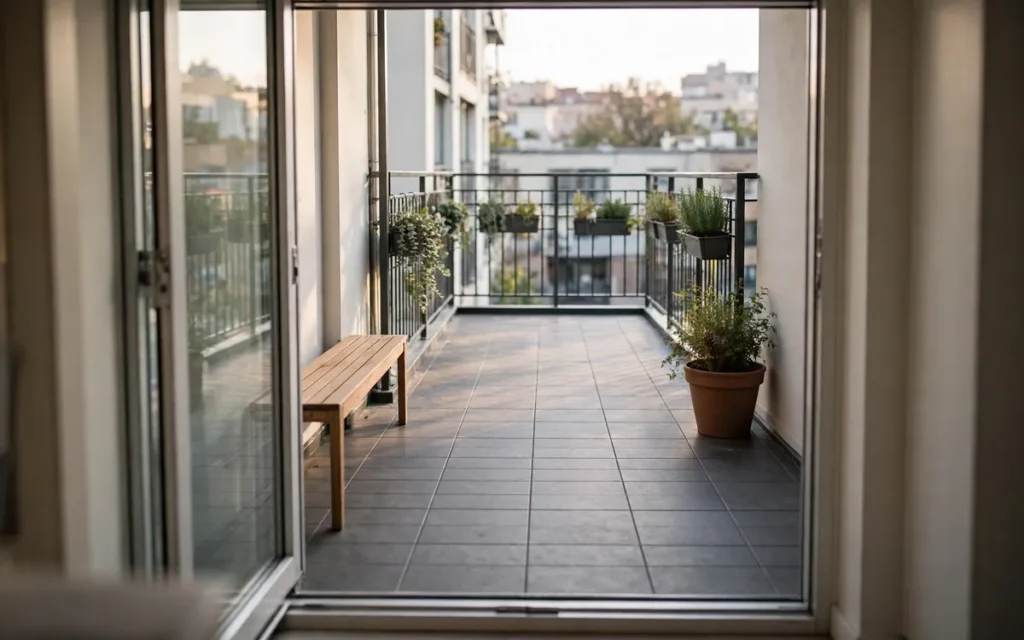
The balcony’s one non-negotiable is a clear lane about 24 inches wide from the door to the railing, empty end to end — and if the door is hinged rather than sliding, its swing is drawn on the floor and kept as empty as the lane. It is the width a person carrying a tray or a watering can actually moves in, and it is the first thing the styling photographs spend.
3. Lay the Floor, and Leave the Drain Open
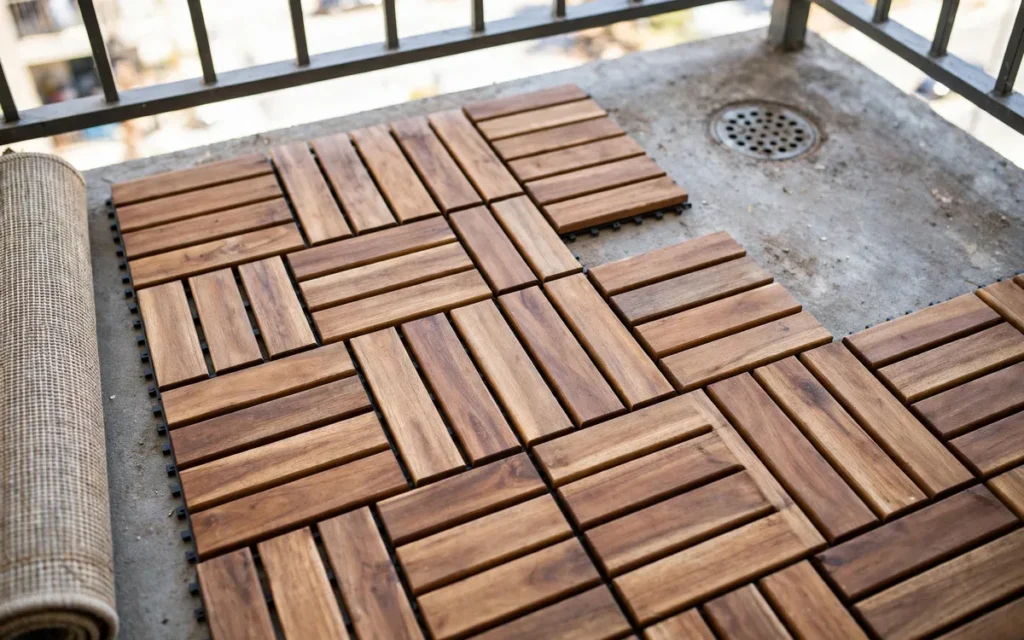
The floor layer is what turns concrete into a room: interlocking deck tiles in the standard 12-by-12-inch class, clicked over the slab, or one outdoor rug in the balcony classes, about 3 by 5 or 4 by 6 feet. Either way the layer stops short of the drain and respects the slope — a floor laid wall to wall over a covered drain is a pond waiting for its first storm, standing against your own door.
4. Read the Railing and the Rules Before You Buy
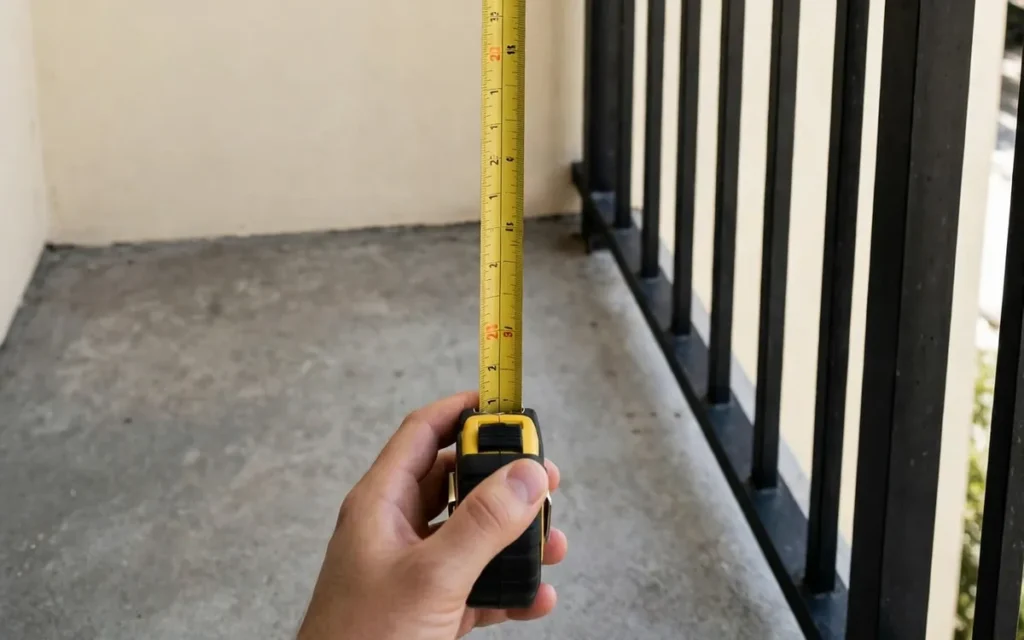
Two checks precede the shopping. The railing’s own height — at least 36 inches under the residential code, 42 inches in many apartment buildings; measure yours, because planter depths and screen heights key off it. And the building’s rules on screens, planters, fixings and flames, which vary building by building and outrank any photograph. Ten minutes of reading is the cheapest fitting on the balcony.
Zone B — Spend the Railing and the Walls First
Four ways to spend the surfaces that are bigger than the floor — the railing’s top, its inside face and the wall beside the door — before a single square foot of floor is touched. Everything in this zone costs no floor at all, which is why it is bought before the furniture.
5. Hang the Table on the Railing
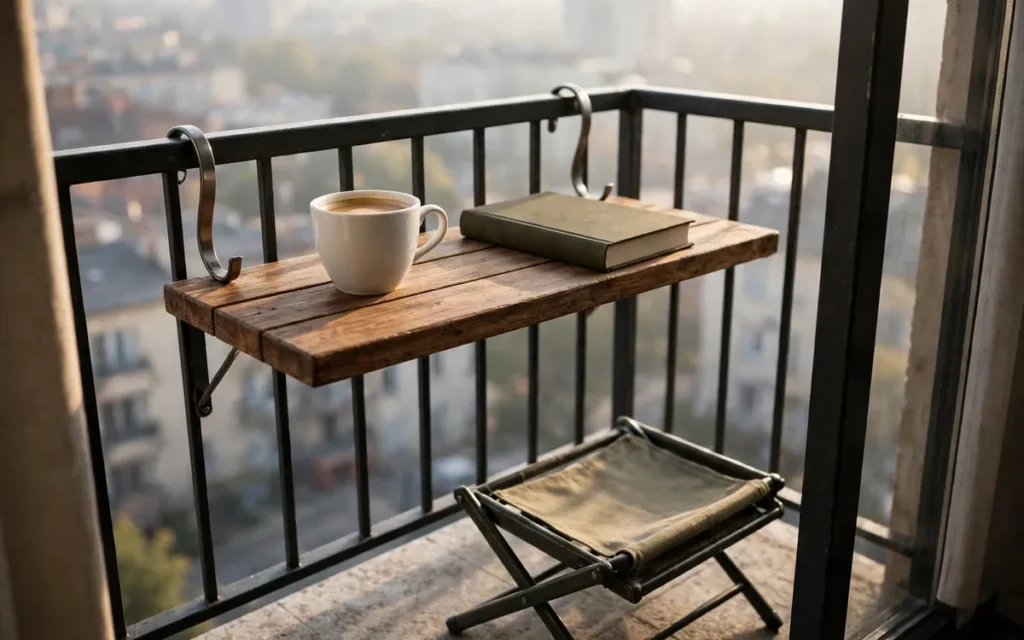
The small balcony’s best surface costs no floor: a railing bar table, a shelf about 8 to 12 inches deep hooked or clamped over the rail, its bracket matched to your rail’s width and profile before it is bought. It holds coffee, a laptop and a dinner plate on a standing ledge where no table could stand — and on a seated balcony it is the second surface that lets the bistro table stay small.
6. Plant the Railing’s Inside Face
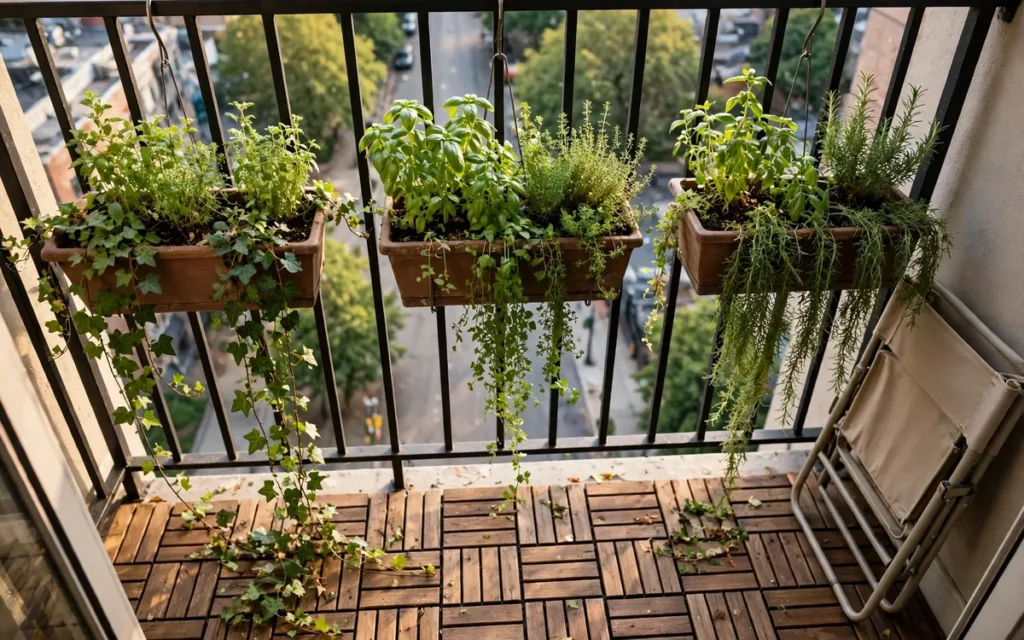
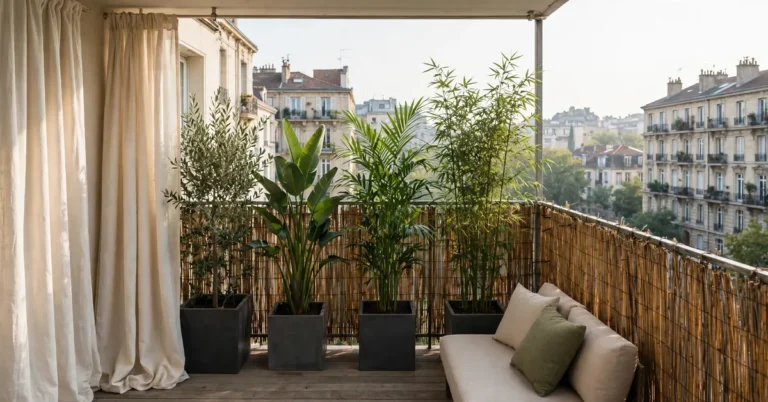
The planter row goes on the inside of the railing, in hook-over boxes sized to the rail, where the weight sits over the balcony and the drips fall on your own floor. The outside face — the one in half the photographs — hangs saturated soil over the pavement and the neighbours below, and is the first thing most buildings’ rules forbid. Inside, the row costs no floor and reads as a green edge from the chair.
7. Take the Garden Up the Wall
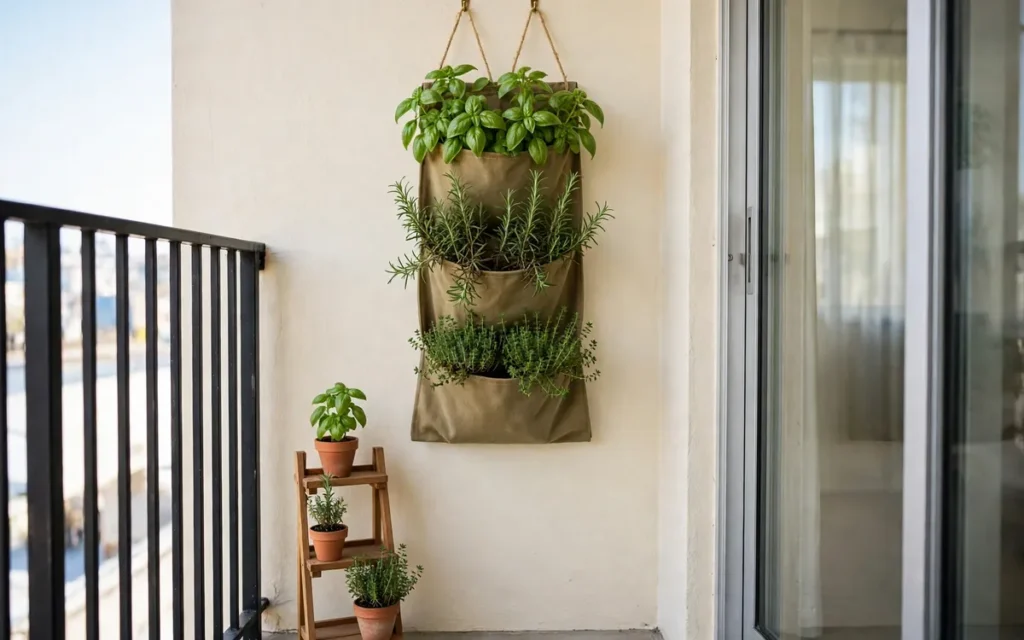
Where the floor is spent, the planting goes vertical: a pocket planter or a narrow tiered stand in the corner beside the door, stacking the pots the floor refused inside a single square of balcony. Herbs are the working version — a rail-width row of small pots at the kitchen door’s side. The check is the watering: every pocket is reachable, and nothing drips onto a neighbour’s balcony that a tray would not catch.
8. Screen Inside the Railing Line
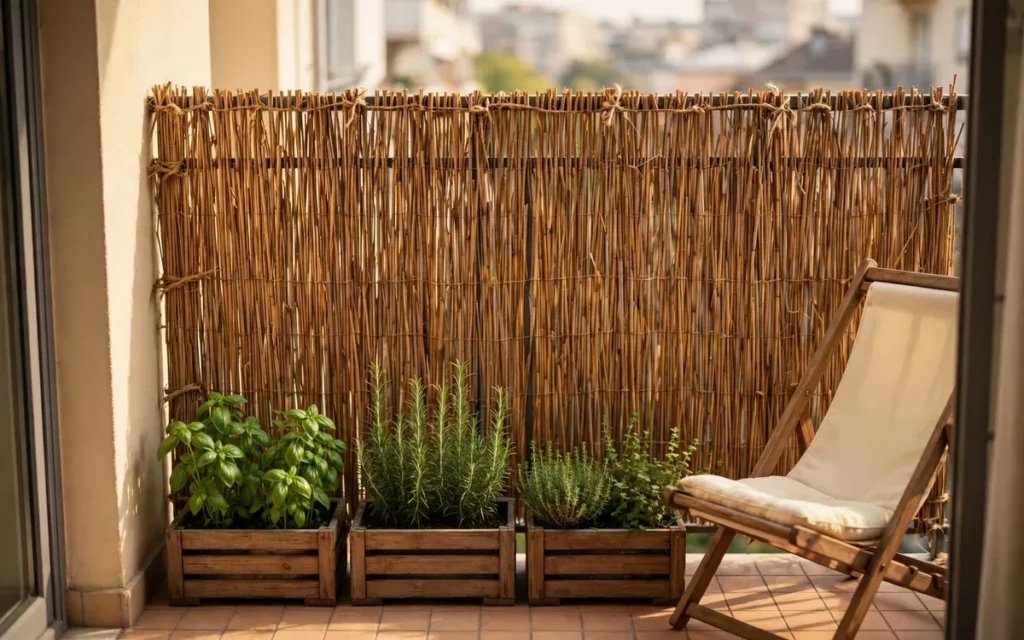
Privacy is fitted inside the balcony, not hung off it: a reed, bamboo or fabric screen fixed to the inside face of the railing, no higher than the sightline it needs to break, with fixings the building allows — checked in idea 4, before it is bought. The fitting stays all-season; the seasonal dressing of a small outdoor floor is a separate article, our fall porch decor ideas, and it hangs on a floor fitted like this one.
Zone C — Fit Only the Furniture the Depth Earns
Five pieces of furniture, graded by the depth that earns them — from the bistro set the 4-foot class buys to the floor lounge the narrow classes fall back on. The other small outdoor floor this site fits by measurement, our small front porch winter decor, is a floor you walk onto from the street; this one is reached through a living room, and every piece on it was carried up and must fold, stack or store.
At ground level the same fitting-by-measurement thinking applies. Our small front porch ideas show how to fit seating and planting onto a porch you walk onto from the street, rather than one reached through a living room.
9. Earn a Bistro Set at Four Feet
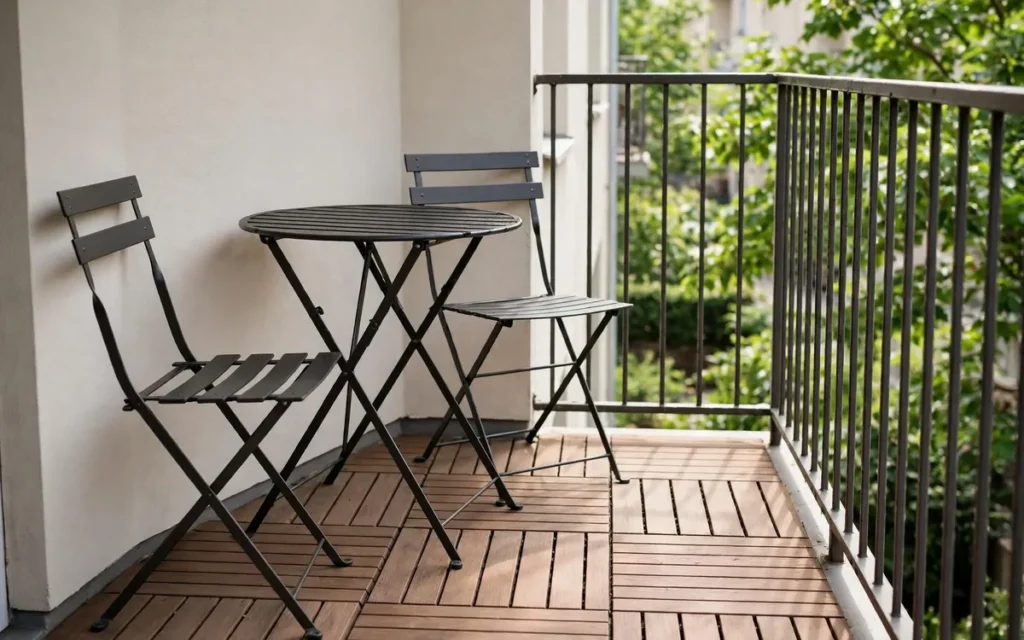
The set is bought by arithmetic, not by the photograph: a folding table about 24 inches across and two chairs 16 to 18 inches wide occupy about 4 feet of depth sat in — which is why 4 feet is the bistro class’s floor. Below it, the set is one chair and the honesty to stop there. At every depth, the set folds flat against the wall when the floor is wanted back.
10. Take One Chair, Not a Set, at Three to Four Feet

The one-seat class’s honest furniture is a single good chair — a folding reading chair or a slim lounge chair in the shallow classes — angled at the railing’s best view, with the railing table as its surface. One chair used daily beats a set that turns the balcony into storage for furniture; the class’s second seat is a cushion on the storage bench, not another footprint.
11. Bench the Wall, and Store Inside It
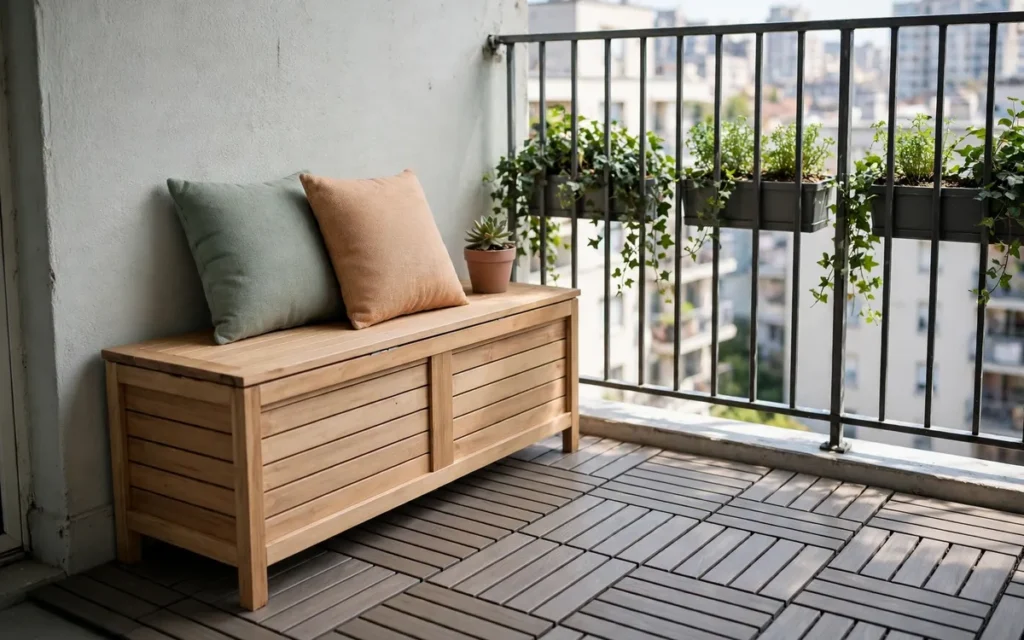
The balcony’s storage problem and its second seat are the same purchase: a bench against the house wall in the shallow class, about 16 to 18 inches deep as sold, its lid over the cushions, the watering can and the folded chairs’ covers. On a floor this small a piece with one job is a luxury — the bench seats two, stores the balcony’s whole kit, and its top is the plant stand the floor refused.
12. Fold a Table Down From the Wall

Where the railing is glass, curved or ruled out for brackets, the wall gives the table instead: a drop-leaf or fold-down table on wall brackets, its desktop in the 24-to-30-inch class, flat against the wall at zero depth when folded and a real surface when down. It is the balcony’s breakfast bar and desk in one fitting, and it spends wall the planting did not need.
13. Turn the Far End Into a Floor Lounge
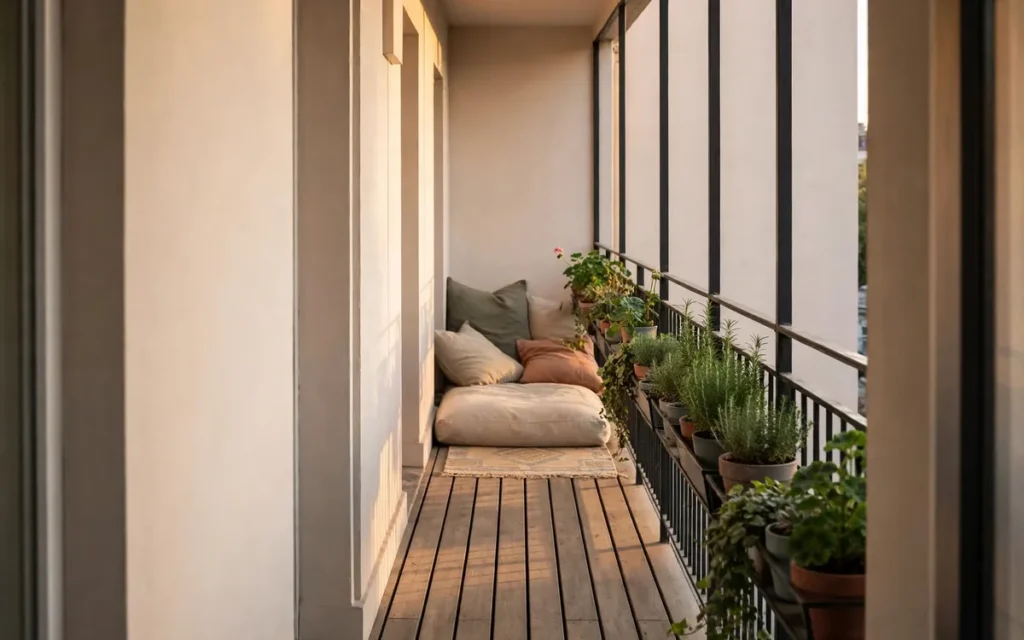
On a long, narrow balcony the far end is its own room: floor cushions or a low daybed pad run along the end wall, at the floor’s own level, where the depth class that forbids chair legs stops mattering. It is the one lounge the narrow classes honestly hold — bought as textiles, stored in the bench, and cleared in a minute when the floor is wanted for plants or drying.
Zone D — Finish It as a Room
Three finishes close the room — a palette of three, light that needs no socket, and shade bought only where the sun earns it. None of them adds a footprint; all of them are what makes the fitted floor read as a room rather than a storage ledge.
14. Run the Whole Balcony on One Palette of Three
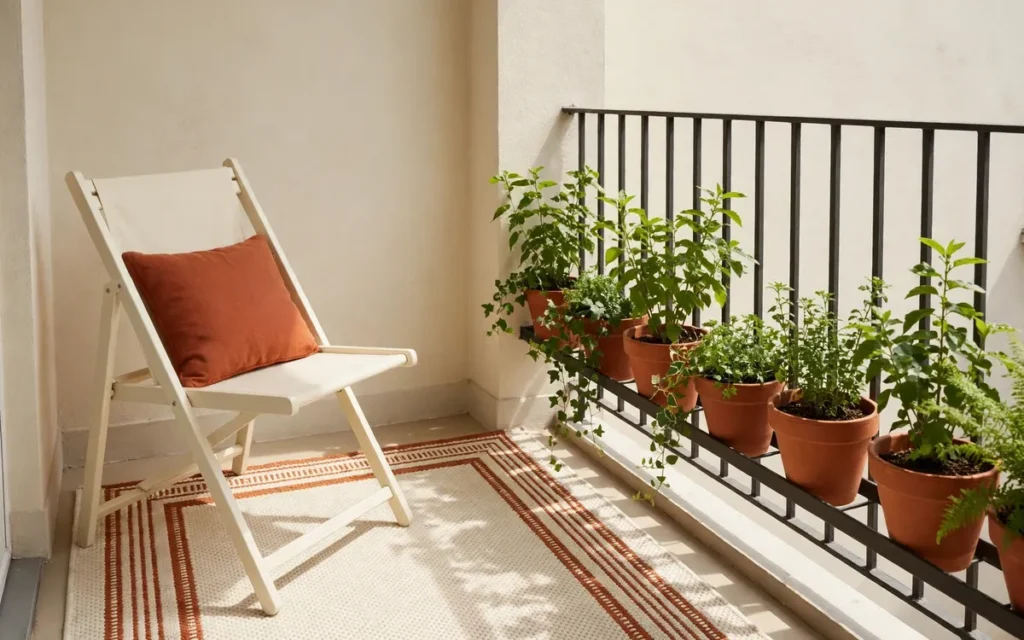
The finishing system is two or three colours in total — one neutral, one green, one accent repeated at least twice: a cushion, a pot, the rug’s border. On a floor this small the palette is what makes six fitted pieces read as one room instead of a queue of purchases. The textiles are outdoor-rated, the cushions live in the bench when the weather turns — and the palette is the cheapest idea in this article.
15. Light It Without an Outlet
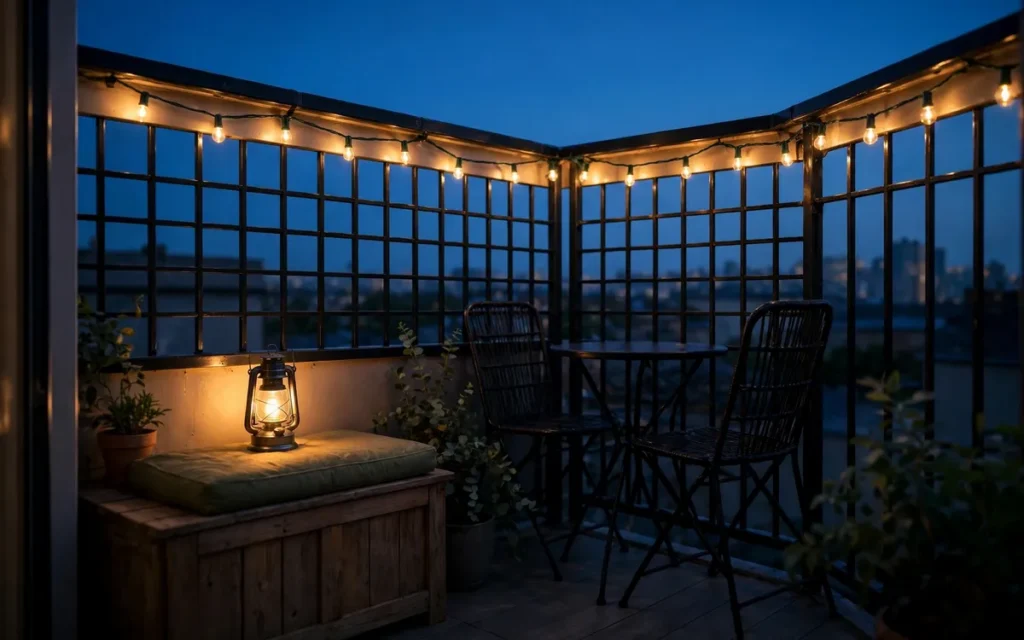
Most small balconies have no outdoor socket, so the lighting is planned for the balcony that exists: solar string lights along the railing’s inside top rail — a strand of about 25 feet covers most small balconies’ rails — and battery lanterns at seated height on the bench and the rail table. Nothing mains-powered trails through the door. Light at seated height, not overhead, is what makes the fitted floor read as a room after dark.
16. Shade Only the Corner the Sun Owns
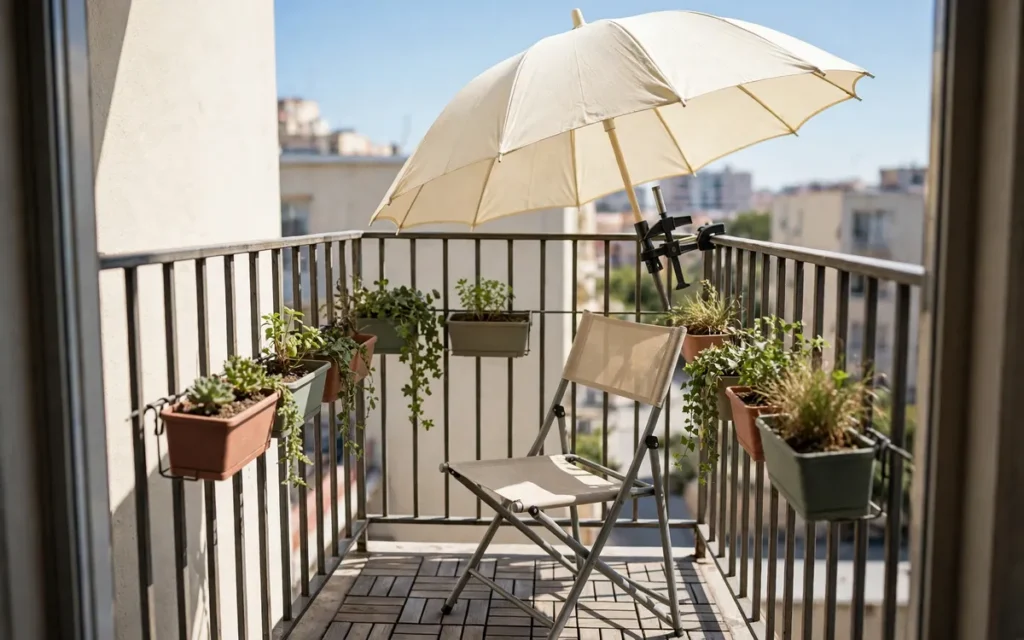
Shade is bought by the sun’s hours, not by the photograph: a compact or clamp-on parasol over the one seat that takes the midday sun, or a shade cloth corner where the building’s rules allow the fixings — checked in idea 4. On a balcony the sun never reaches, spend nothing here and put the money into idea 15’s light instead. And wherever the rail allows it, the clamp beats the base: a parasol’s base is floor the classes count.
What It Costs: Three Ways In
The railing tier (under roughly $75). The railing bar table or a pair of inside-face railing planters, solar string lights, one outdoor cushion, a herb row in small pots. This tier proves a small balcony does not fail for lack of furniture; it fails because nothing was measured — the set is a patio class too big, the planters hang on the wrong face, and the drain is under the tiles — and all three failures are fixed at this tier, before any furniture is bought.
The furniture tier (roughly $75–$300). The folding bistro set the depth class earned, the storage bench, the deck tiles or the correctly sized rug, the fold-down wall table. The tier that does the visible work, bought in method order: the balcony sorted first, the railing spent second, the furniture fitted last.
The fitted tier (roughly $300 and up). A made-to-measure bench along the wall, a quality folding set in teak or aluminium that will outlast the tenancy, a fitted shade solution where the sun demands it. Worth it only where the balcony is the home’s daily outdoor room — and only after the depth class has been lived with at a cheaper tier, because furniture carried up to the wrong depth forgives nothing.
6 Mistakes That Make a Small Balcony Fail
- Buying a patio set for a balcony. The standard patio chair runs about 36 inches deep; parked on a 4-foot balcony it leaves no lane to the door and no room to sit back. The classes write the list — folding chairs 16 to 18 inches wide, a table about 24 inches across — and the depth class, not the showroom set, decides (Method Step 1, idea 9).
- Hanging the planters on the outside of the railing. The photograph’s green edge hangs saturated soil — roughly 1 to 1.5 kg per litre, 60 kg and more in a big box once watered — over the pavement and the neighbours below, against most buildings’ rules. The row belongs on the inside face, over your own floor (Method Step 2, idea 6).
- Covering the drain. Deck tiles or a rug laid wall to wall over the balcony’s drain or scupper turn the first heavy rain into a pond against the door — and standing water is the floor’s enemy and the slab’s. The layer stops short of the drain and the slope is left to do its job (idea 3).
- Buying the egg chair. A standing egg chair’s footprint runs to roughly 40 inches across — on a bistro-class floor it is the whole seating budget spent on one seat that cannot fold, stack or move for the watering can. The one-seat class buys a chair that folds (idea 10).
- Screening above the line, or fixing without asking. A screen raised above the railing’s top, or brackets screwed into a facade the lease does not allow, is the fitting most likely to be ordered back down. Screens sit inside the line at the height the sightline needs, and the building’s rules are read before anything is fixed (ideas 4, 8).
- Parking one huge planter mid-balcony. A single 50-litre planter is 60 kg and more when watered, and it lands wherever it was first put down and never moves again. The weight is spread — the heaviest pots on the floor against the wall, the rest in railing boxes and wall pockets — and the building is asked before anything bigger is carried up (Method Step 2).
FAQs
What furniture actually fits a small balcony?
Whatever the depth class earns. Under about 3 feet, none — the table hangs on the railing. At 3 to 4 feet, one folding chair or a slim bench about 16 to 18 inches deep. At 4 feet and up, a folding bistro set — a table about 24 inches across, chairs 16 to 18 inches wide. The standard patio set is a bigger floor’s furniture.
How deep does a balcony need to be for a bistro set?
About 4 feet of working depth: the set sat in occupies roughly that once chair depth and legroom are counted, which is why the fitting guides put the bistro class at 3 to 5 feet with 4 as the comfortable floor. Most apartment balconies, at 4 to 6 feet deep, are in the class — measure at the shallowest point, because that number governs.
Can you put a rug or deck tiles on an apartment balcony?
Yes — both are the standard floor layers: interlocking tiles in the 12-by-12-inch class clicked over the slab, or an outdoor rug in the 3-by-5 or 4-by-6 class. Two conditions: the layer stops short of the drain and leaves the slope working, and the building’s rules allow it — some leases restrict floor coverings, so the check in idea 4 comes first.
How do you make a small balcony private without breaking the rules?
Screen the inside face of the railing, at no more height than the sightline needs, with fixings the building allows — reed, bamboo or outdoor fabric are the usual materials — and plant the inside rail row in front of it. The rules vary building by building, so they are read first; the fuller screening system for a small outdoor floor at ground level is covered in our apartment patio privacy ideas.
How do you light a balcony with no outdoor outlet?
Solar first: a string-light strand along the inside of the top rail charges by day and needs no socket, and battery lanterns at seated height — on the bench, on the rail table — do the close work. Nothing mains-powered trails through the door; where an outdoor-rated socket does exist, it is used with outdoor-rated fittings only.
Are railing planters safe?
On the inside face, yes — that is what hook-over railing boxes are made for, sized to the rail’s width and profile. The safety rules are the face (inside, never outside over the pavement below), the weight counted wet — saturated soil runs roughly 1 to 1.5 kg per litre — and the building’s rules read first. Nothing heavy is ever suspended.
What can you do with a balcony too small for any furniture?
Fit it as a standing ledge, which is a real class and not a failure: the table hangs on the railing, the planting goes in inside-face boxes and wall pockets, the light is solar, and the floor stays clear but for one person standing with coffee. A ledge fitted by its rules reads as a garden window; a ledge with a chair wedged on it reads as storage.
Evening light is the finish that makes a fitted balcony feel like a room. Our outdoor string light ideas show how to measure a single run, choose warm bulbs and hang lights safely, so a small balcony glows softly without dazzling the neighbours.
Conclusion
Work through these small balcony decor ideas in order — sort it, rail it, fit it — and the ledge outside the living-room door stops being a photograph that crowds and becomes a fitted room: sorted by the depth it actually has, furnished off its railing, and finished with only what its class honestly earned.


One Comment