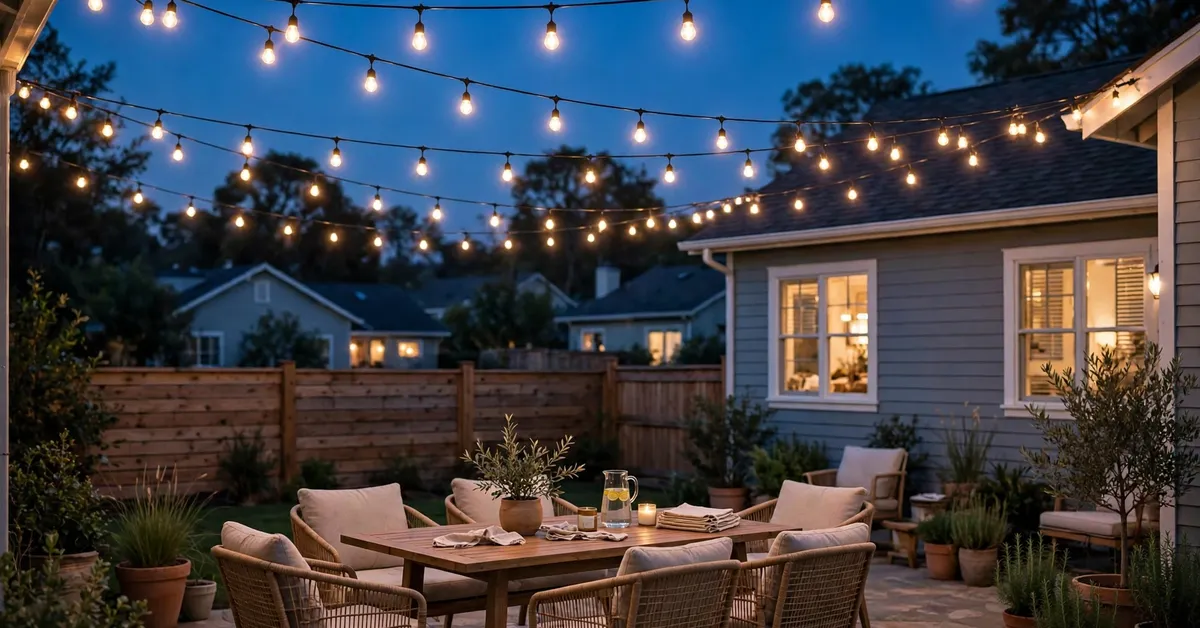
23 Remarkable Outdoor String Light Ideas That Start With a Tape Measure
A string of café lights looks like the simplest purchase in the garden — unbox it, drape it, plug it in. It is also the purchase that fails most predictably: the run arrives six feet short, the span that looked level on Saturday sags to forehead height by the next one, or a third strand chained onto the end quietly overloads the first. These outdoor string light ideas start where the photographs never do — with a tape measure — because a lighting run is a fitting before it is a decoration: the run is measured with its swag, the support is graded to the span so the cord never carries the load, and the power is counted against the limit printed on the strand itself.
The fitting hangs over rooms this library has already fitted at ground level: the patio floor itself, screened and arranged by day, is our apartment patio privacy ideas‘ subject, and the two articles share one discipline — renters and careful owners alike work inside what the house allows, drilling nothing that cannot be justified. This article takes the same outdoor rooms after dark, and it fits light the way the earlier articles fitted floors and screens: by measurement, by span and by load, not by the photograph.
The Method: Measure It, Support It, Power It
Three decisions, in order, before a single strand is bought — because a string-light run fails in predictable places: in the measuring that never happened, in the support that was never fitted to the span, and in the power that was never counted.
Step 1 — Measure It: Every Run, Anchor to Anchor
Every run is measured anchor to anchor before a strand is bought, because a strand is the one decor purchase that fails by arriving six feet short. The tape gives the straight line; the strand is bought longer than the line, with the swag allowance the installation guides work to — roughly 5 to 15 percent over the straight measurement, about 10 percent as the planning figure — plus the drop from the outlet up to the first anchor, which is part of the run and eats strand like any other part. Patterns multiply the tape before they multiply the effect: a zigzag canopy crosses the same patio four or five times, and the worked example the guides use — a 10-by-10-foot patio under a zigzag — lands at 75 to 100 feet of strand in total, where a perimeter run around the same slab is one long line and a radial fan is several short ones. Strands are bought in their length classes — commercial stringers run 25, 50 and 100 feet, retail café strands cluster around 25 and 48 feet — with sockets spaced by class: 12 inches is the standard spacing, and 6, 15, 18 and 24 inches are the commercial variants. Then measure your own runs and your own shortlisted strands: the classes are the guides’ and makers’ ranges, and the tape is the authority.
Step 2 — Support It: The Cord Never Carries the Load
Support is graded by span, on the classes the installation guides agree on — Garden2Review’s patio light installation guide sets them out as a table and works a diagonal example through them. Under about 12 feet, a strand may run anchor to anchor between two honest fixings. From about 12 to 20 feet, a support wire is the safer choice. Past about 20 feet, the wire goes up tight with a turnbuckle, and a mid post is added if the line still droops. The wire itself is 1/8-inch galvanized or stainless steel cable, and the strand is clipped or tied to it every 2 to 3 feet, so the wire takes the tension and the electrical cord takes none. The sag is set deliberately, at 3 to 5 percent of the span: drum-tight multiplies the inward pull on the anchors, and deeper drops the run into the room it was meant to light. The room underneath is measured too — the lowest point of any run keeps 7 feet clear over anywhere people walk, so with about a foot of sag expected, anchors are set at roughly 9 feet, inside the usual 8-to-10-foot mounting class. Anchors are eye hooks or eye bolts into structure — eaves, fascia, solid fence posts, a set post — never gutters, never siding skin, never a dead branch. That grading is the whole step: it is what turns outdoor string light ideas from draping into fitting.
Step 3 — Power It: Count It Before You Plug It In
The power is counted before it is plugged in. The plug goes into a GFCI-protected outdoor outlet — the requirement for outdoor receptacles, and the non-negotiable this step hangs on, with local code the final authority wherever it speaks. Strands connect end-to-end only up to the maximum printed on the strand’s own label: the labelling exists because the safety standard for decorative lighting (UL 588) requires the maker to state it, and the limit is thermal, not a suggestion — incandescent café classes commonly cap at about 3 sets, LED classes allow more, and the reader’s own label, not this article, is the figure that governs. Outdoor-rated extension cord only, connections kept off the ground, sockets facing down or out so rain sheds instead of pooling. One boundary, stated plainly: no span in this article crosses a pool or a hot tub — trade press summarises the electrical code as calling for lights over a pool, or within 5 feet of it, to sit at least 12 feet above the water, and rather than fit a DIY span to a code clearance, the layouts here route around pools entirely.
Zone A — Measure the Run Before You Buy a Strand
Five measuring decisions come before any spending. They take one session with a tape and a notebook, and every later choice — the strand class, the wire, the pole count — reads off the numbers they produce.
1. Measure Anchor to Anchor, Then Add the Swag
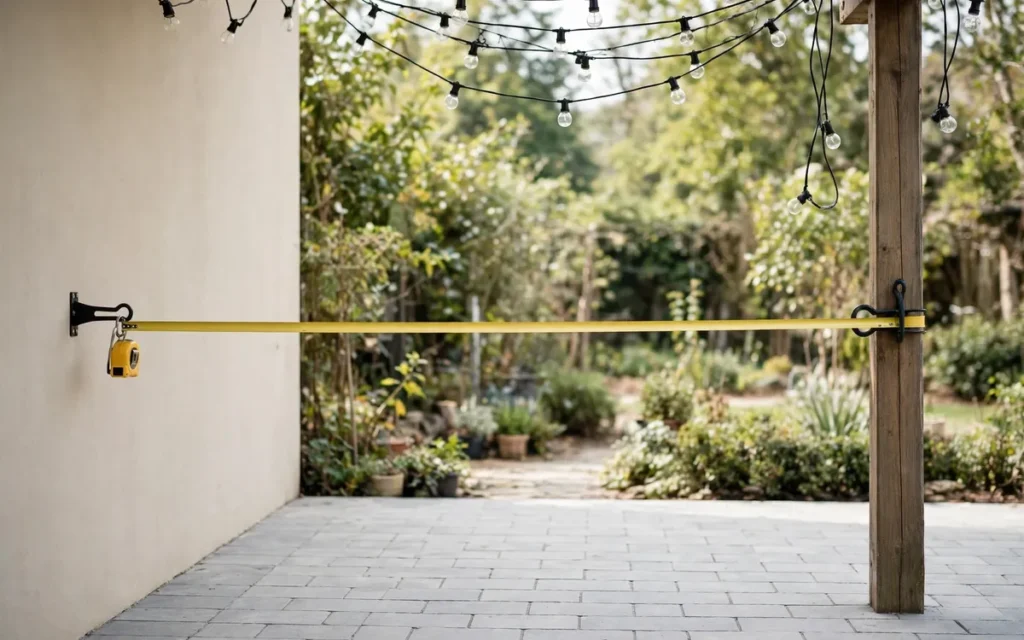
The tape gives the straight line, and the strand is bought at roughly 10 percent over it — inside the guides’ 5-to-15-percent band — plus the drop from the outlet to the first anchor. A strand bought to the exact tape measure is this topic’s most common failure: it arrives short, or it is pulled drum-tight to reach, which multiplies the anchor pull the Method warns about and still leaves the run sagging by the second weekend.
2. Count the Pattern Before the Strands

Layouts are bought by total feet, not by box count. A zigzag crosses the patio four or five times; a perimeter run is one long line; a radial fan is several short ones radiating from a single point. The worked class is worth memorising: a 10-by-10-foot patio under a zigzag canopy takes about 75 to 100 feet of strand all-in — far more than the same slab’s tape measure first suggests.
3. Set the Height by the Clearance Underneath
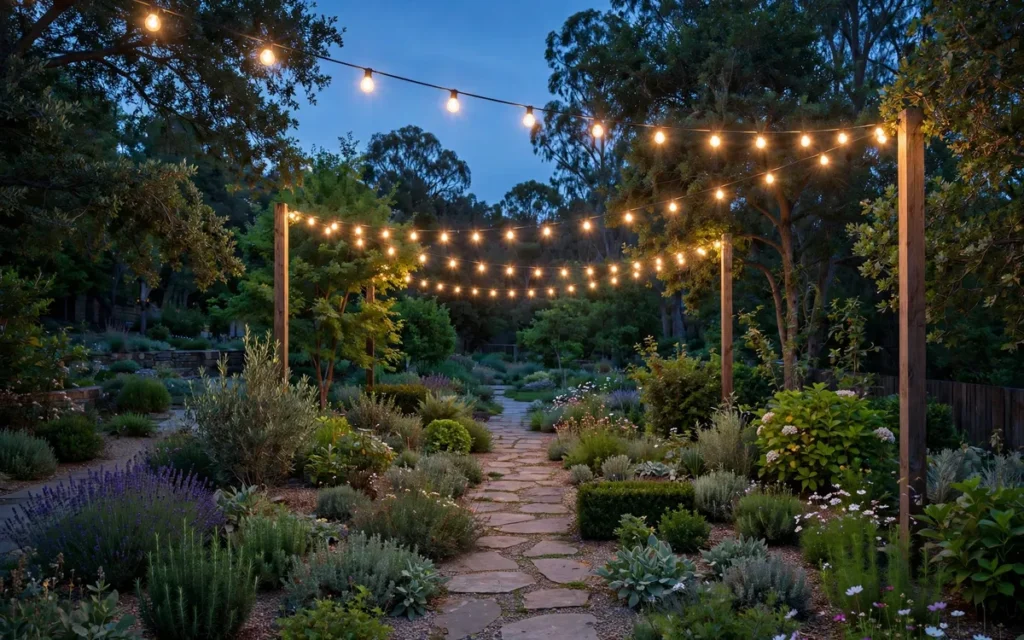
The lowest point of the swag keeps 7 feet clear over walkways and paths, and the anchor height is worked backwards from it — about 9 feet of anchor for 8 feet of clearance at a foot of sag. Over a dining table, where nobody walks, the canopy can sit lower and closer. The clearance is always measured to the use underneath it, never copied from a photograph of somebody else’s yard.
4. Choose the Strand Class Before the Pattern
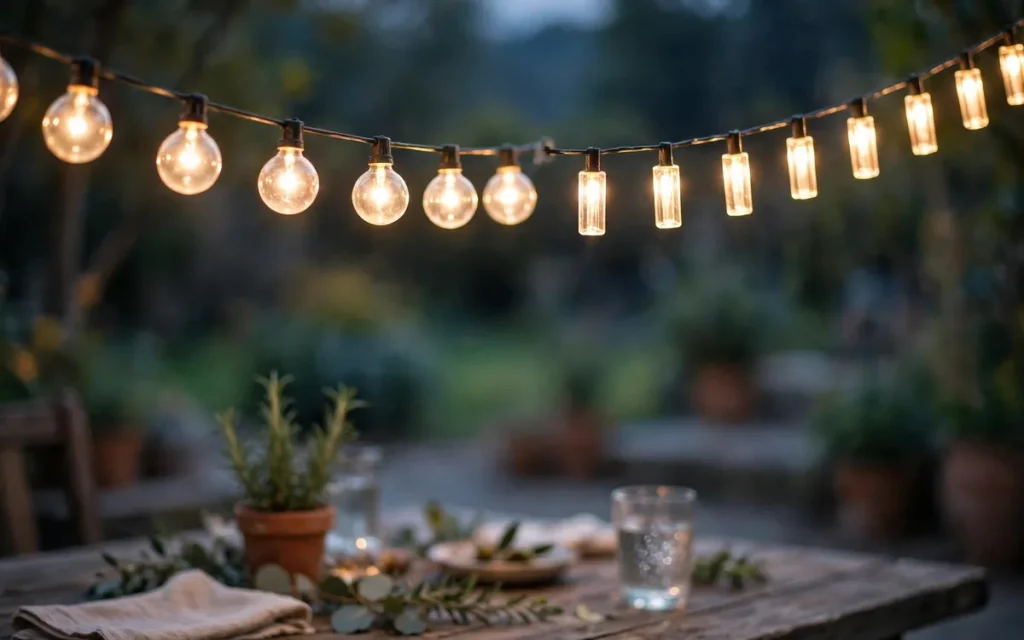
Socket spacing comes first — 12 inches is the standard class, with denser 6-inch and wider 15-to-24-inch variants — then the bulb shape class: the G40 globe, the S14 festoon, the Edison tube. Shatterproof LED bulbs anywhere over hard paving or seating, and the warm-white class, about 2700K, that every ranking rival’s photographs are actually showing. The class is chosen for the weather and the surface below it, not for the box art.
5. Keep Each Run on One Strand Where the Classes Allow

Every end-to-end joint is one more connection to keep off the ground and one more link the label’s count must cover, so fit each run to a single strand wherever the length classes allow. A 40-foot run, swag included, is one strand from the 48-foot retail class — not two shorter strands chained to reach. Reserve chaining for the patterns whose total no single class covers.
Zone B — Support It So the Cord Never Carries the Load
Five support decisions carry the system — literally. A run that is measured well and powered honestly still fails if its own cord is asked to work as structure, so this zone grades every span before a strand goes up.
6. Run a Guide Wire on Any Span Past About 20 Feet
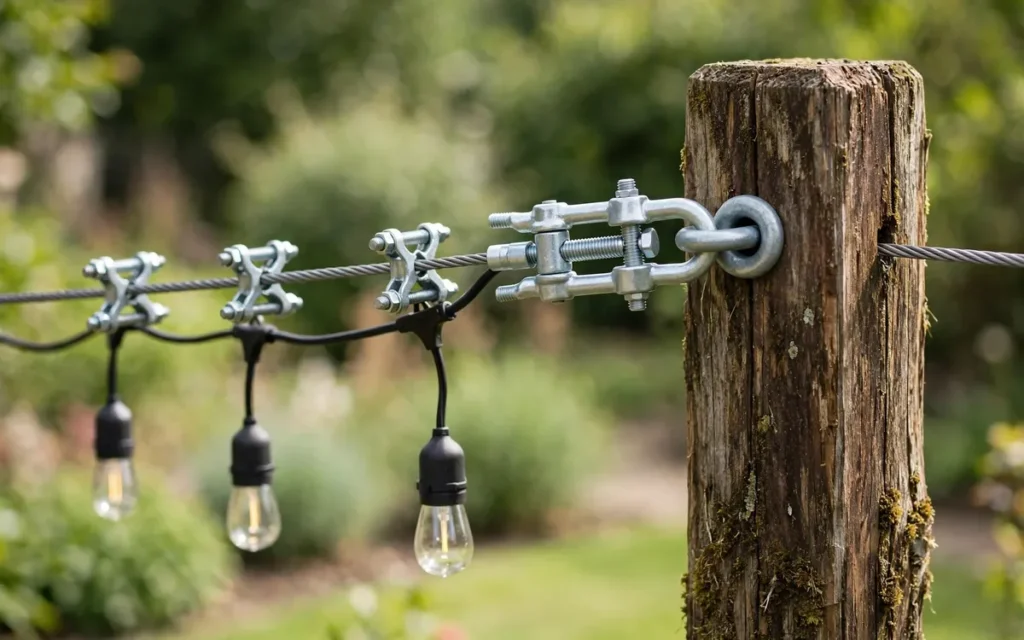
The long span’s structure is a 1/8-inch galvanized or stainless cable run between eye bolts and tensioned with a turnbuckle, with the strand clipped to it every 2 to 3 feet. The wire is the structure; the strand is a passenger. Between about 12 and 20 feet the wire is the safer choice; past about 20 feet it is the system itself, with a mid post added if the line still droops under its load.
7. Short Spans Still Get Two Honest Anchors
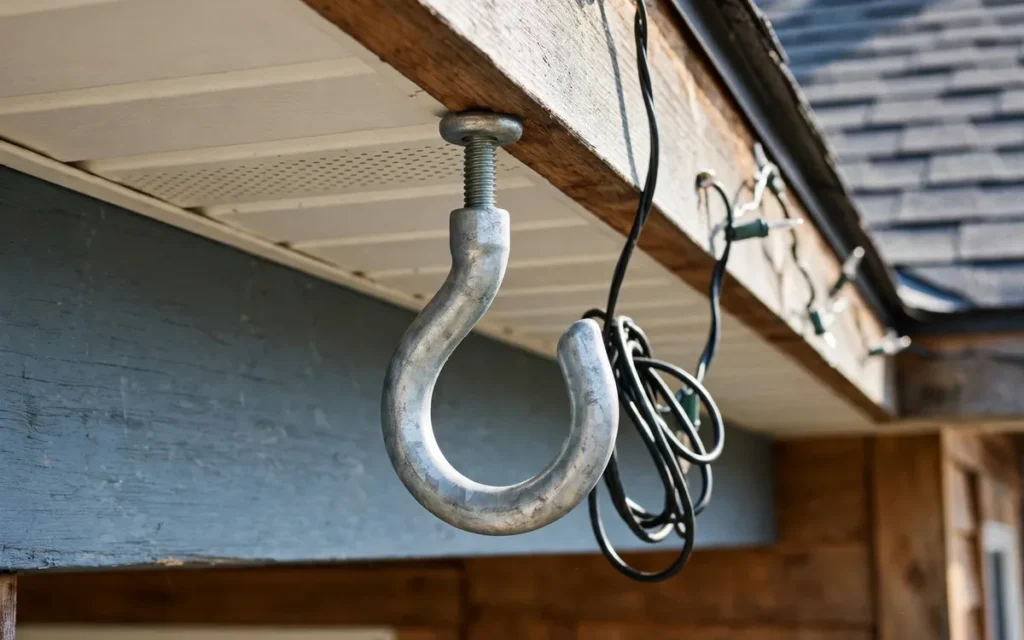
Under about 12 feet a strand can run anchor to anchor — but the anchors are eye hooks or eye bolts into eaves, fascia or solid posts: structure, as in every fitting in this library. Never a gutter, which bends under constant horizontal pull; never staples driven through a cord; never a branch that can die, drop or grow into the line. Short is not an excuse for dishonest fixings.
8. Stand Poles Where There Is Nothing to Hang From
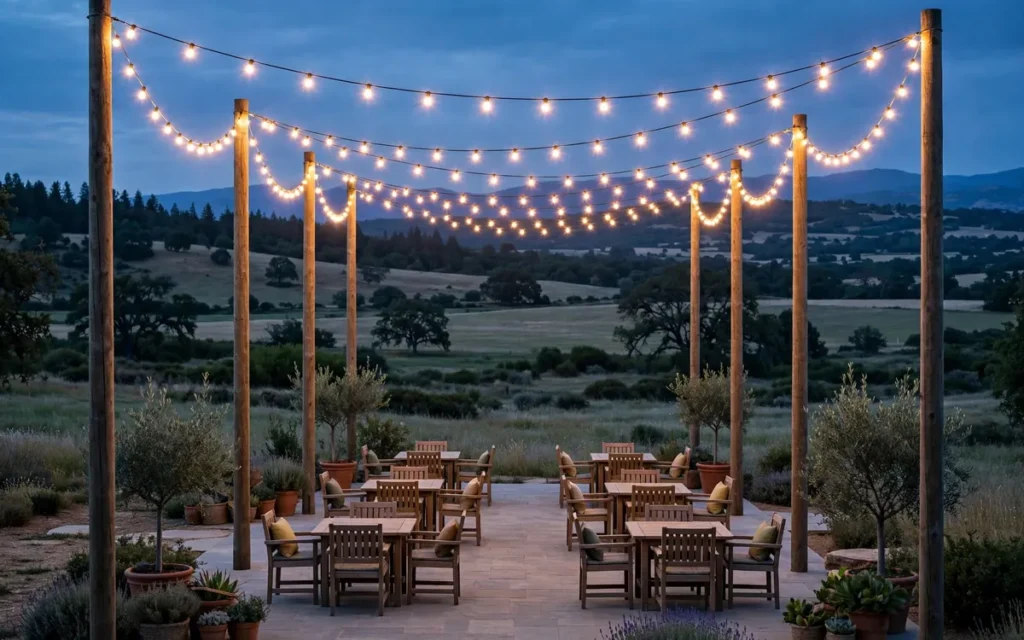
Poles carry the run at 8 to 10 feet, spaced 15 to 25 feet apart as a class and closed to about 10 feet for heavy commercial strands. Permanent posts are set in concrete and buried at least 18 inches — 2 to 3 feet in wind or soft soil. Planter poles are graded honestly: in one maker’s reported test, a wide barrel holding about 100 pounds of concrete still tipped under a heavy span past 20 feet. Planters serve short, light runs; long spans get set posts.
9. Keep the Sag Inside the 3-to-5-Percent Band
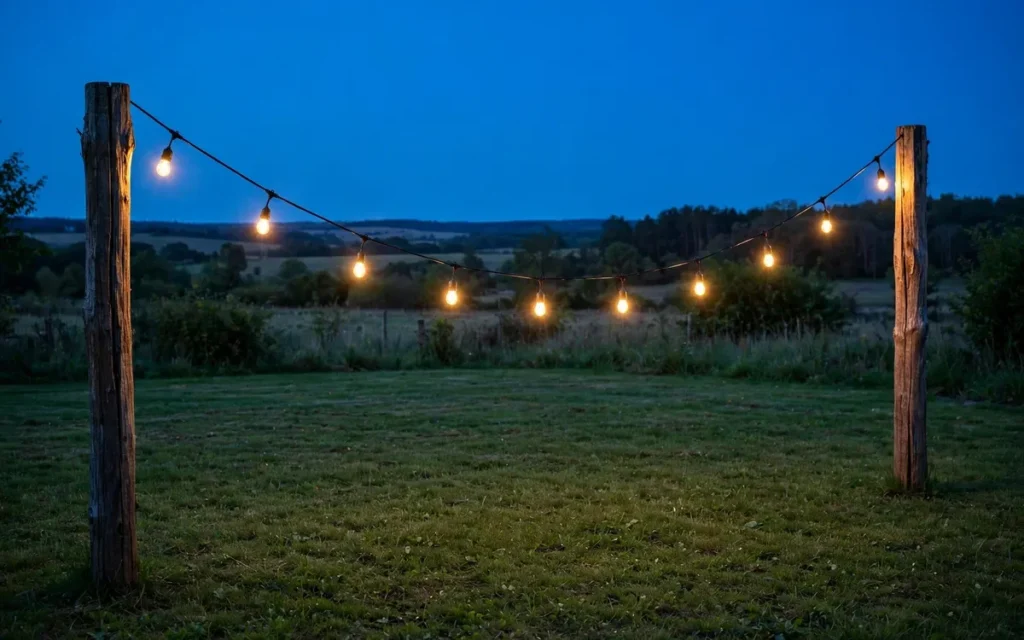
Sag is a percentage of span, not a mood: 3 to 5 percent reads as the gentle curve in the photographs and keeps the inward pull on the anchors sane. Adjustment happens at the turnbuckle and in the clip spacing — even swags of roughly 8 to 12 inches of drop at canopy scale — never by hauling on the strand itself, which only stretches the cord and works the sockets loose.
10. Grade Every Pass of a Pattern as Its Own Span
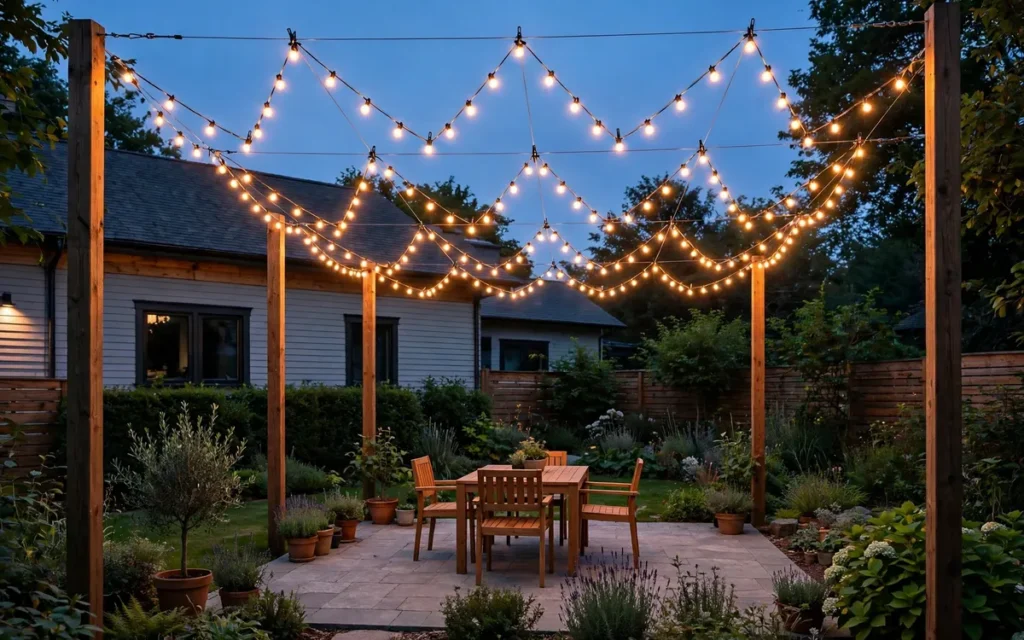
A zigzag or parallel canopy is not one long span but several short ones sharing anchors, and each pass is graded on its own length: a 14-foot pass takes the wire the 12-to-20-foot class calls for, even when the strand itself runs on into the next pass unbroken. The strand may run continuously; the support never does — wire, clips and sag are fitted pass by pass.
Zone C — Lay It Out by the Shape of the Space
Seven layouts cover most yards — the zigzag canopy, the pergola lines, the radial fan, the fence run, the dining rectangle, the driveway span and the corner turn — and all seven run on the same measured runs, the same span classes and the same counted power.
11. Zigzag a Canopy Over a Square Patio
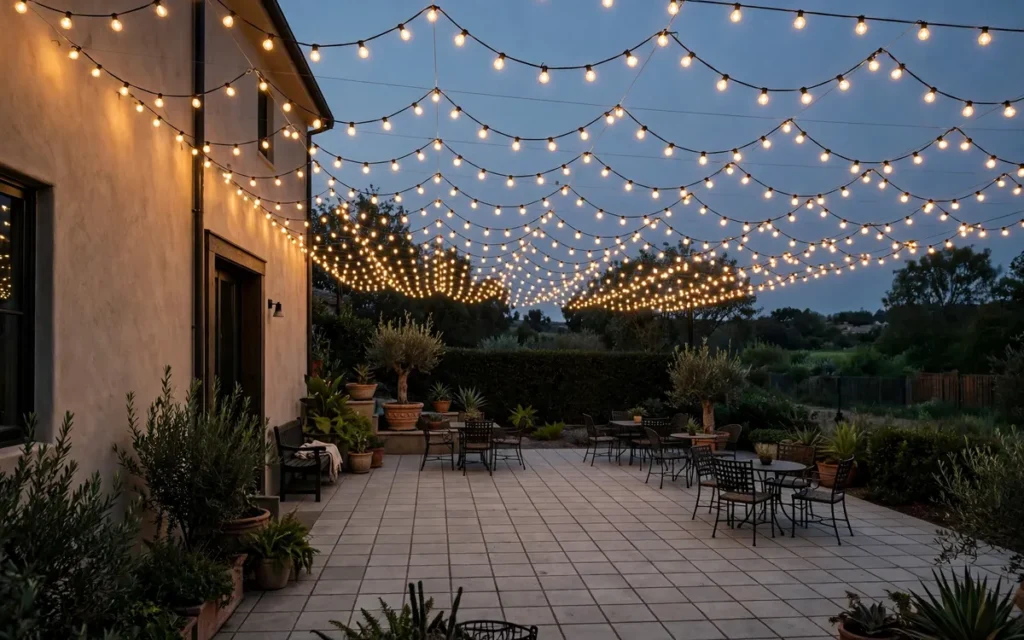
Anchor points are set along two opposite sides and the strand runs back and forth across them: the layout that turns a 10-by-10 slab into a room, at Idea 2’s worked count of 75 to 100 feet of strand. Runs stay evenly spaced so the swags match — an uneven zigzag reads as a mistake, while an even one reads as a ceiling the room was always meant to have.
12. Run Parallel Lines Along a Pergola’s Beams
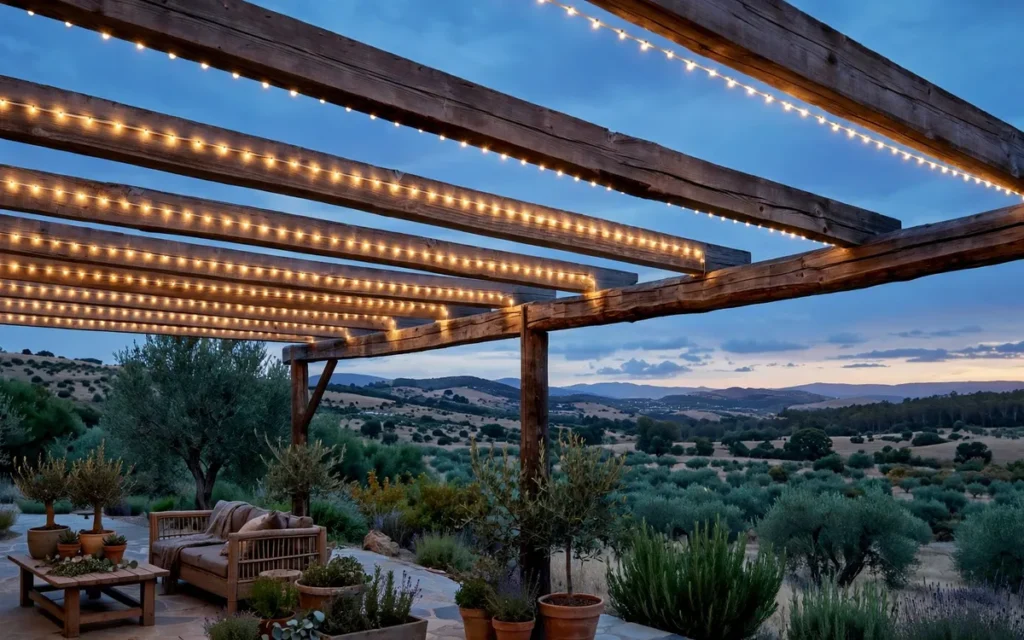
The structure is already there, so the lights follow it: one run per beam gap, each on its own fixings, the longest run wired exactly as Zone B grades it. The pergola’s shade pattern by day becomes its light pattern by night, nothing new has to be built, and the beams — structure, honestly rated for their own job — take the eye hooks the Method asks for.
13. Radiate From One High Point Over a Round Space

A fan or starburst runs from a single tall anchor — a centre pole, an eave hook, a strong tree — out to the perimeter: the layout for a fire-pit circle or a round lawn, with spoke lengths kept near-equal so every swag dips the same. The pit below is the ground-level glow the canopy is centred over; fitting the pit itself and its clearances is our outdoor fire pit ideas‘ subject.
14. Line the Fence for the Longest Honest Run in the Yard

A single strand clipped along the fence top or the fence line’s posts: the perimeter layout needs no poles and, on a standard fence length, no guide wire, and it gives the whole yard its edge after dark. It is also the renter’s layout — clips on a rail, nothing drilled into anything — the no-drill end of the discipline the introduction shares with the patio article.
15. Give the Dining Table Its Own Rectangle of Light

The canopy is drawn to the table, not to the yard: strands end at the table’s corners, the swag clears seated heads by the Zone A clearance worked to the table’s use, and the run stops short of the grill’s heat. A table under its own measured rectangle reads as a dining room; a yard-wide wash of light reads as a fairground, however even its swags are.
16. Carry One Span Across a Driveway or Garage Gap
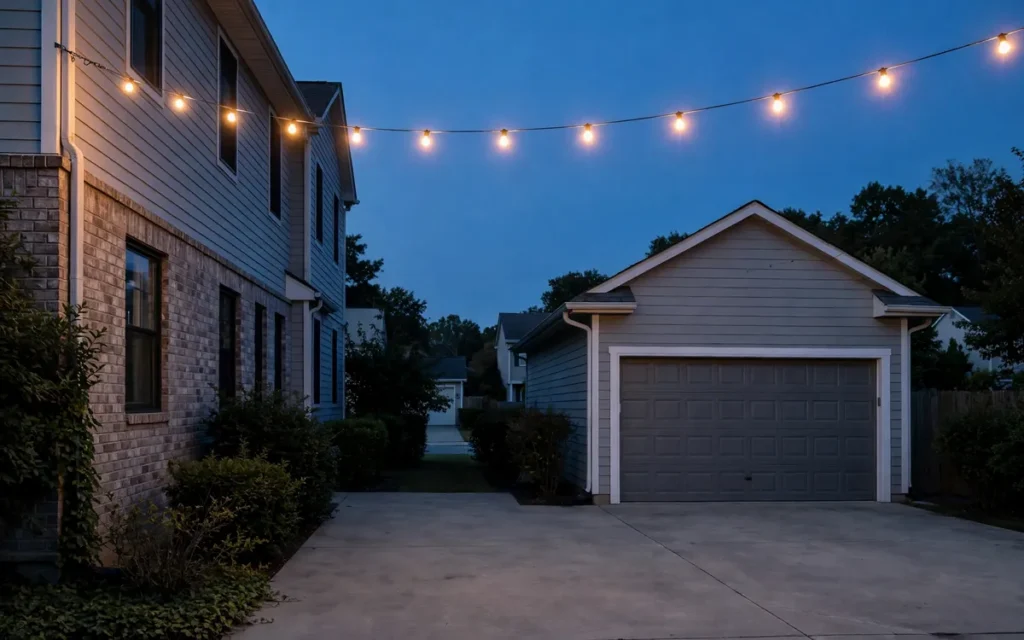
Where a run must cross from the house to a garage or detached structure, the span is measured like any other — and the clearance is measured to the tallest vehicle that uses the drive, not to a walking head. Add the sag to the vehicle’s height before the anchors are set, and grade the span by Zone B: a gap past about 20 feet takes the wire and turnbuckle.
17. Turn an L-Shaped Patio at a Corner Post
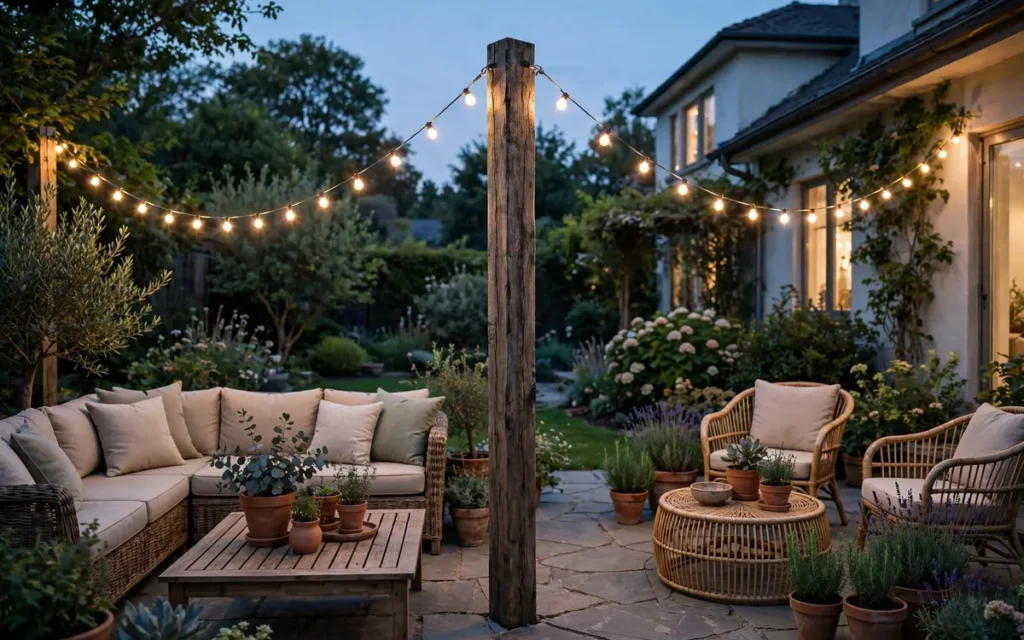
An L-shaped patio takes two runs meeting at a corner, and the corner is an anchor, not a bend: a post or corner fixing carries an eye bolt for each run, so neither strand turns the corner under tension. Each leg is measured and graded on its own length, and the swags are matched at the corner, so the turn reads as a joint in the ceiling, not a sag.
Zone D — Power It, Then Keep It Working
The last six ideas are the system’s life after hanging day: the connection counted at the outlet and split honestly where one chain is not enough, the solar class graded honestly, the timer that makes the fitting behave like house lighting, and the upkeep — the outlet tested at season turns, the strand stored like hardware — that keeps next year’s canopy out of a tangled box.
18. Plug Into GFCI and Count the Connections
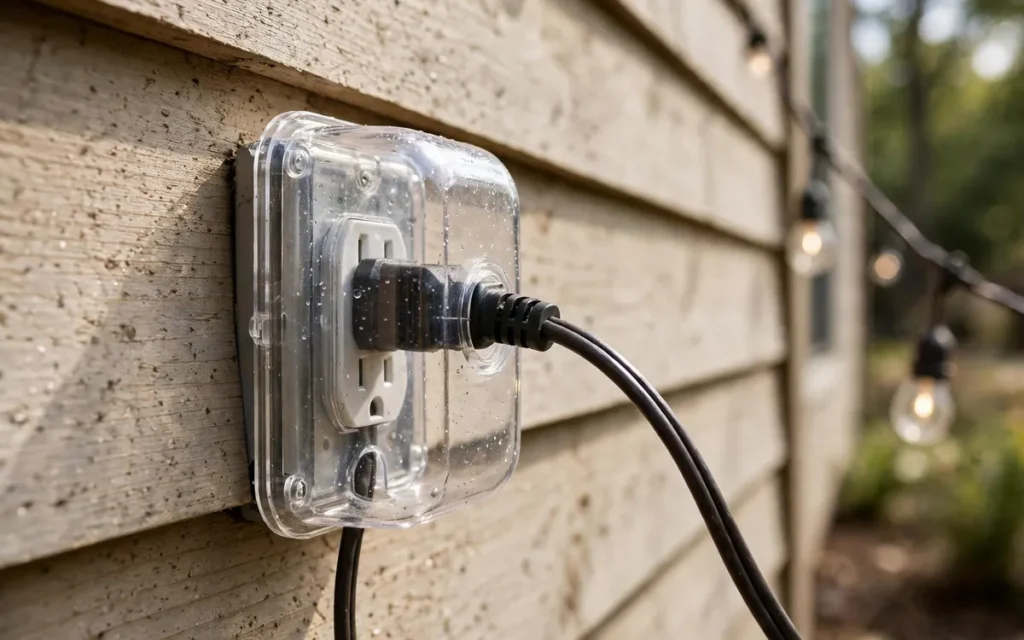
The outlet is GFCI-protected, the cord outdoor-rated, and the chain stops at the number printed on the strand’s label — incandescent café classes commonly about 3 sets, LED classes more, the label governing in both cases. Connections sit off the ground, inside the outlet cover where one is fitted, and sockets face down or out so rain runs off them instead of pooling inside.
19. Split a Long Layout Into Two Chains on Two Outlets
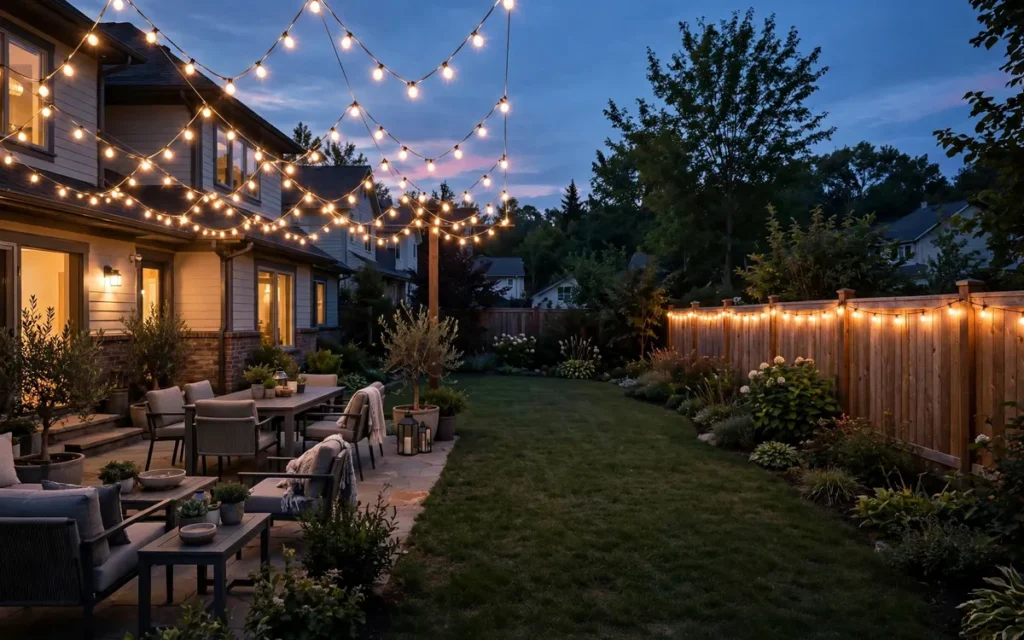
When a layout’s total passes one chain’s labelled limit, the answer is a second outlet, not a longer chain: the canopy runs on one protected outlet and the fence line on another, each chain counted against its own strand label. Two shorter chains also fail separately — a tripped outlet darkens one zone, not the whole yard — and each can sit on its own timer.
20. Use Solar Strands Where There Is No Outlet — as the Accent Class
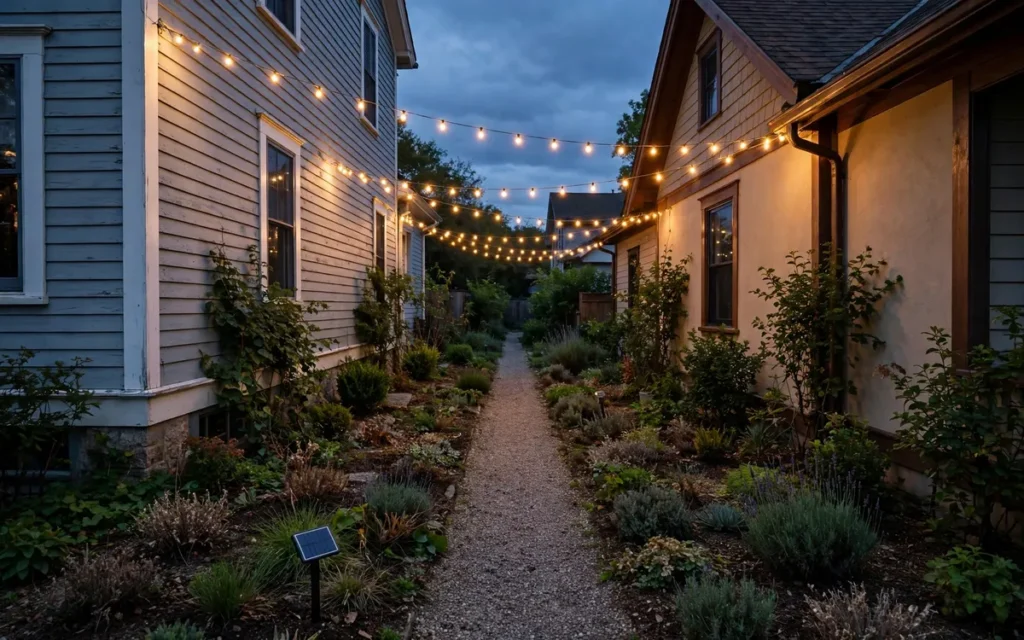
A solar strand’s panel stakes where the sun actually falls, and makers rate the bulb-style solar class at roughly 6 to 8 hours of light after a full day’s charge — a glow, not dining light. The main canopy over a table stays plug-in; solar takes the fence end, the side path and the tree, where its softer light is the point rather than a compromise.
21. Put the System on a Timer
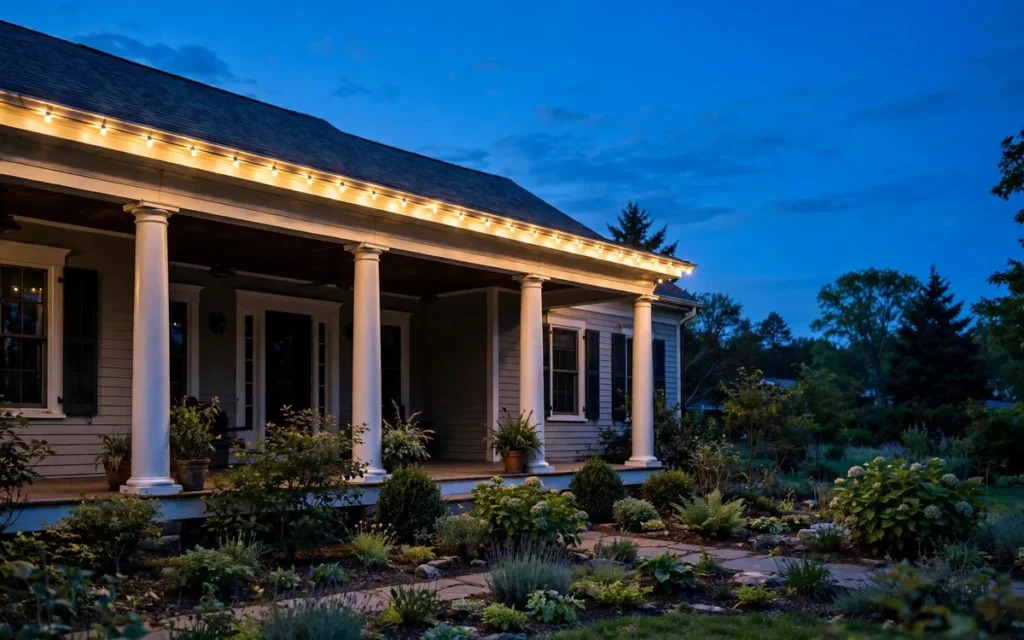
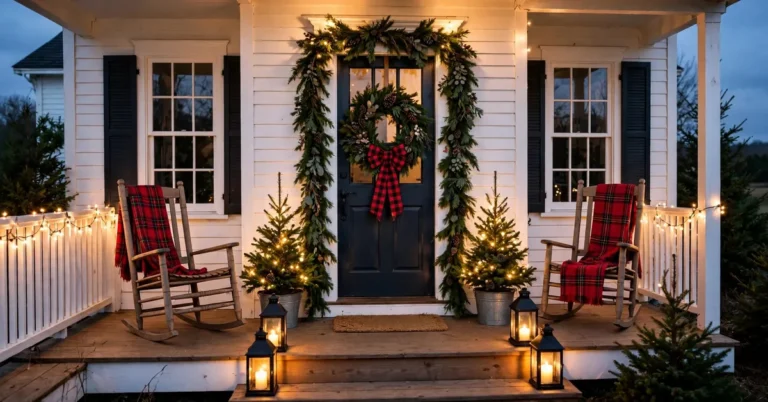
A dusk-to-dawn or set-hours timer at the outlet makes the fitting behave like the house’s other lighting: on at dark, off at bedtime, no nightly trip to the plug and no strand burning forgotten until morning. The timer is rated for outdoor use and lives inside the outlet’s weatherproof cover. A porch roofline run kept on a timer is the same fitting working through the cold season, alongside the porch dressing in our small front porch winter decor.
22. Inspect It, Repair It and Store It Like Hardware
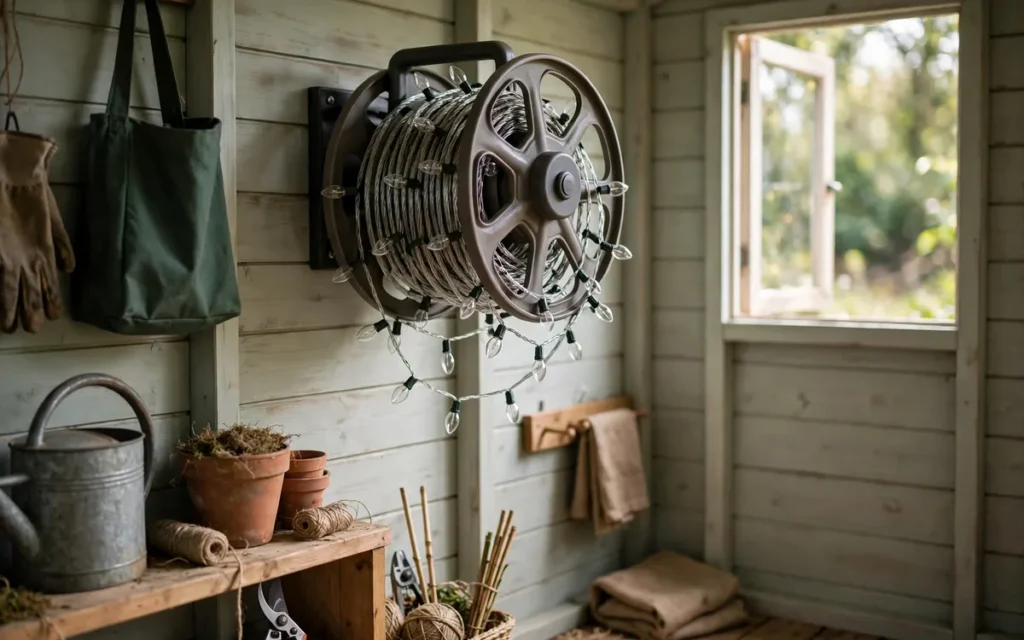
After storms and at season turns: sockets checked, a cracked bulb replaced with the strand’s own class — a wrong-class bulb is how a matched set goes patchy — and wire tension re-checked at the turnbuckle. A strand that comes down is coiled on a reel or a board, never wadded into a box, which is exactly how next year’s tangle and broken sockets are made.
23. Test the GFCI Outlet at Every Season Turn
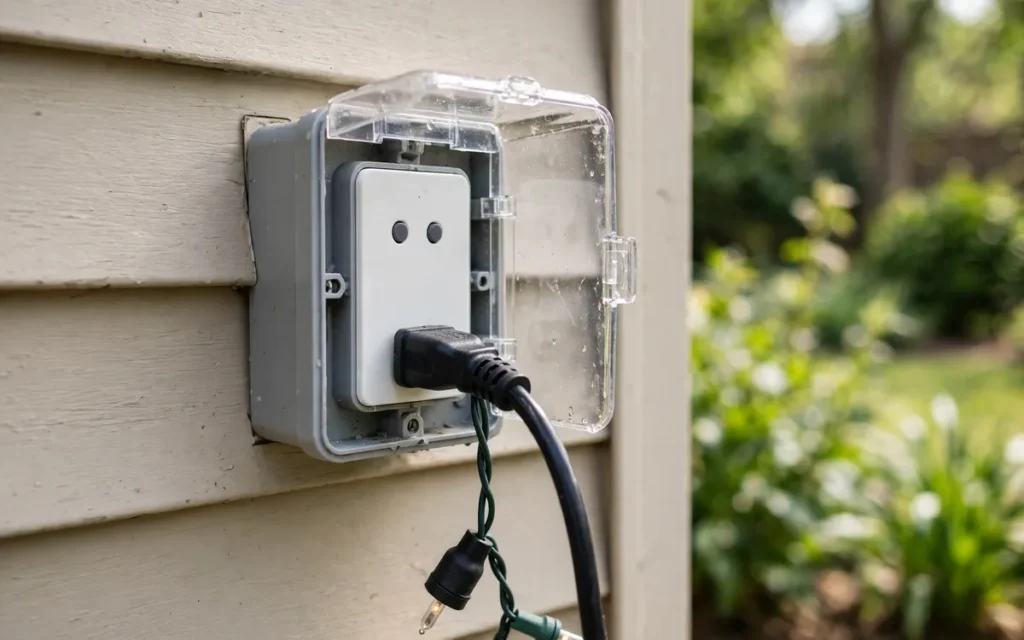
The protection the whole system hangs on is tested, not assumed: every GFCI outlet carries its test and reset buttons, and pressing test at each season turn — when the strands are inspected anyway — proves the trip still works before the canopy depends on it. An outlet that will not trip, or will not reset, is replaced before the strands go back up, not after the first wet night.
What It Costs: Three Ways In
The one-run tier (roughly under $50). One strand in the 25-to-48-foot class, rated hooks or fence clips, and a fence-line, porch or single pergola run. This is the tier that proves the system: measured with its swag, honestly anchored, plugged into a protected outlet — one run, fitted properly, before any decision about the rest of the yard.
A single run is often all a small balcony needs, too. Our small balcony decor ideas show how to layer seating, lighting and planting on a balcony, so one strand of lights finishes the space rather than overwhelming it.
The canopy tier (roughly $50–$200). The strands for a zigzag or parallel canopy over a patio — the 75-to-100-foot class of total strand — a guide-wire kit of cable, turnbuckles, eye bolts and clips, and poles where the yard offers nothing to hang from. This is where most readers land: a whole outdoor room, supported by span and powered against the printed limit.
The fitted-yard tier (roughly $200 and up). Commercial strands in the 100-foot class on wired spans, posts set in concrete, and several zones — canopy, fence line, dining rectangle — run on a timer. Worth it where the yard is the house’s summer living room, and only after the layout has been lived with at a cheaper tier, because set posts fitted to the wrong layout are expensive holes. All three tiers are rough planning classes, not quotations.
Buying Strands to the Tape Measure
No swag allowance means the run arrives short — or gets hauled drum-tight to reach, which multiplies the inward pull on its anchors and still sags by the second weekend as the cord settles. The tape measure gives a straight line; nothing in a real yard hangs in one. The roughly 10-percent planning figure (Idea 1) costs a few feet of strand and is the cheapest number in this article: it is the difference between a run fitted to the yard and a run stretched to it.
Hanging the Strand by Its Own Cord on a Long Span
The electrical cord is not a structure. Past about 20 feet unsupported, the strand’s own weight and the wind’s load work directly on its sockets, the line droops past fitting, and every gust worries the connections a little looser. The guide wire exists precisely so the cord never carries tension (Idea 6): the wire is tensioned, clipped and forgotten, and the strand hangs from it as a passenger. A cord asked to be a cable eventually fails at both jobs.
Anchoring to Gutters, Siding or Dead Wood
The pull on a string-light anchor is horizontal and constant, and it is applied to whatever the hook is screwed into. Gutters bend under it; siding is a skin with nothing behind the screw but air; a dead branch is a falling object with lights attached. The fitting rule never changes: eye hooks into structure — eaves, fascia, solid posts — or a post set for the purpose (Ideas 7 and 8). Whatever the anchor is screwed into is the anchor, and the yard finds out which one was chosen on the first windy night.
Chaining One Strand Past the Label
The connect limit printed on the strand is a thermal limit set under the safety standard, not a conservative suggestion with slack built in. The first strand in an over-long chain carries the current of every strand after it, and it heats accordingly. “One more won’t hurt” is how chains overheat — quietly, at the plug end, inside a fitting nobody is watching. The label’s number is the whole law of the chain (Idea 18), and where a run needs more length than one chain allows, it gets a second outlet, not a longer chain.
Letting the Swag Drop Into Head Clearance
The sag was never budgeted, so the lowest point of the canopy settles at forehead height over the path — and the yard’s best feature becomes the thing every guest ducks under. Clearance is not a styling outcome that happens at hanging time; it is measured first, and the anchor height is worked backwards from it (Idea 3): 7 feet clear at the lowest point, about a foot of sag expected, anchors at roughly 9 feet. A canopy you duck under is a fitting that failed at the tape measure, weeks before it was hung.
Putting Indoor Strands Outside
An unrated or indoor-only strand in real weather takes moisture into its sockets and degrades within a season, however similar it looks on the shelf to the outdoor product beside it. Outdoor-rated is a specific label, not marketing language: the strand class is chosen for the weather it will live in (Idea 4), its pack rating is the authority, and its sockets are built to shed the rain that an indoor fitting was never asked to meet. The saving is small; the replacement, and the risk carried in the meantime, are not.
FAQs
How many string lights do I need for my patio?
By the tape, not the box: measure each run anchor to anchor, add roughly 10 percent for swag and slack — the guides’ band is 5 to 15 percent — and total the runs. A zigzag multiplies the patio’s width by its passes, which is how the worked class lands where it does: 75 to 100 feet of strand for a 10-by-10 canopy. Buy to the total, in the strand classes the runs divide into.
How high should string lights hang?
The lowest point of the swag keeps 7 feet clear over anywhere people walk. Mounting heights run 8 to 10 feet as a class, and with about a foot of sag expected, anchors go at roughly 9 feet for 8 feet of clearance at the lowest point. Over a table, where nobody walks, the canopy may sit lower and closer — the clearance is measured to the use underneath, not to a rule copied from a taller yard.
Do string lights need a guide wire?
By span: under about 12 feet, no — two honest anchors carry the strand. From about 12 to 20 feet, a guide wire is the safer choice. Past about 20 feet, yes: a 1/8-inch steel cable tensioned with a turnbuckle, with the strand clipped to it every 2 to 3 feet, so the wire carries the load and the cord carries none. The wire is fitted once and then forgotten, which is the point of it.
How far apart should string light poles be?
Fifteen to 25 feet apart as a class for standard strands, closed to about 10 feet for heavy commercial strands. Past a 30-to-40-foot span, add a mid-span post rather than asking two anchors to hold the whole pull — the post is cheaper than the anchor failure it prevents, and it keeps every span it creates inside the classes the support system was graded for.
How many strands can I connect together?
Exactly as many as the label on your strand allows. The maker is required to print a maximum number of sets — and often a maximum wattage — for end-to-end connection. Incandescent café classes commonly cap at about 3 sets; LED classes allow more, and the figure varies by product. The printed limit governs in every case: it is a heat limit, not a guideline, and the first set in the chain is the one that pays for exceeding it.
Can string lights stay outside all year?
Outdoor-rated strands are built to live outside: check the pack’s weather rating, keep sockets facing down or out so rain sheds instead of pooling, run them from a GFCI-protected outlet, and inspect after storms and at season turns. Indoor-only strands are not the same product and do not become it by surviving a dry month — an unrated fitting in a wet season is a failure on a timer.
Can you hang string lights over a pool?
Not as a DIY span in this article’s system. Trade press summarises the electrical code as calling for lights over a pool, or within 5 feet of it, to be at least 12 feet above the water and on protected circuits — a clearance a homeowner’s span is not the tool to improvise. The layouts here route around pools entirely, and wherever a pool is involved, local code is the authority, not a decor article.
Conclusion
Work through these outdoor string light ideas in order — measure it, support it, power it — and the yard after dark stops being a photograph that sags. The run is measured with its swag, so the strand arrives long enough and hangs at the curve it was bought for. The support is graded by span, so the cord never worked as structure. And the power is counted against the printed limit, from a protected outlet. What is left is the thing the photographs were promising all along: a fitted canopy that holds its line through the season.