
24 Fresh Winter Wreath Ideas for a Front Door That Welcomes All Season
By the second week of January, the pattern is the same on almost every street: the Christmas wreath is boxed away, the lights are down, and the front door — the first thing every visitor, neighbour and delivery driver sees — stands bare and a little forgotten until spring. December gave the porch a full dressing-up; January gives it nothing.
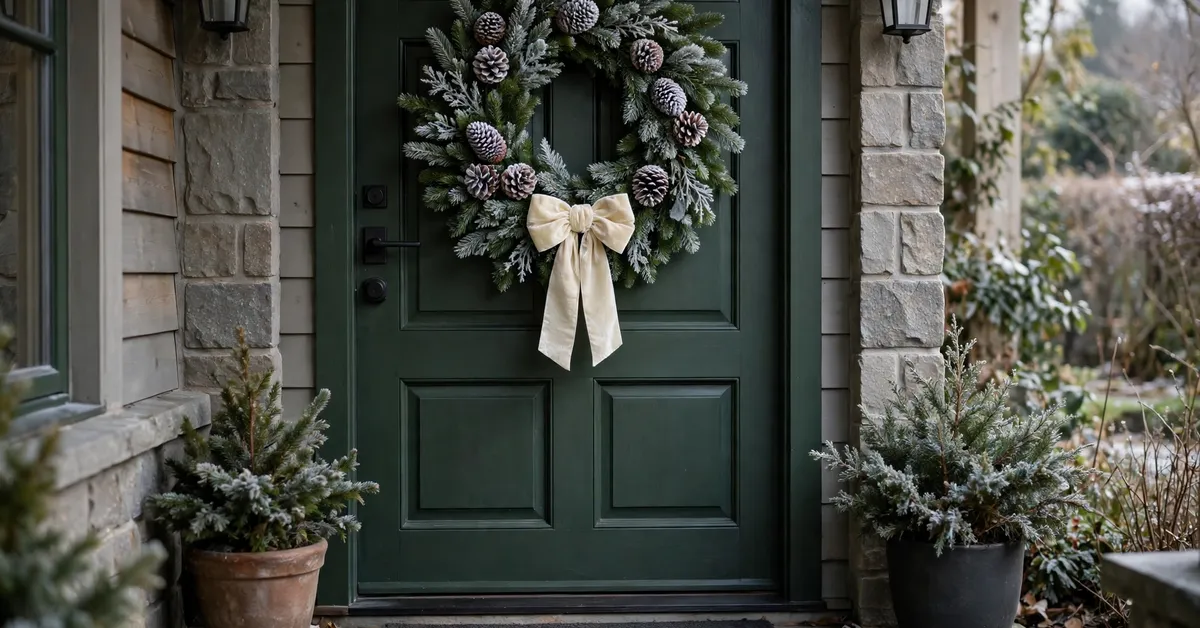
A winter wreath is not a smaller, sadder Christmas wreath. It has a harder job: a December wreath must survive four weeks of parties, but a January wreath must survive eight to ten weeks of weather — rain, wind, low sun and a door that slams a dozen times a day — and still look intentional at the end. That means fewer signals, tougher materials, and a wreath sized and hung properly, because it lives outdoors over a walkway. If you are resetting the whole house too, the whole-home January edit covers every room; this guide stays on the spot that greets people first, and adds the method most roundups — like Room of Inspo’s January wreath collection — skip.
So the order here is method first, ideas second: a five-step system for sizing a wreath to your door, stripping the Christmas out of one you already own, matching the material to your porch, and hanging the result safely. Then come 24 winter wreath ideas grouped by approach — conversions, quiet greenery, snowy whites, woodland texture and the non-ring forms — plus budget levels, the mistakes that keep a door looking like leftover Christmas, safety, and FAQs.
Size It, Strip It, Hang It Safe: The Winter Wreath Method
Work through these five steps before choosing from the winter wreath ideas below, and the wreath you hang in January will still look placed — not left over — in February.
Step 1: Size It to the Door First
Measure the finished wreath, not the frame size on its label — greenery fluffs two or three inches beyond the frame. The rule: the finished diameter should span roughly one-half to two-thirds of the door’s width. A standard door, about 36 inches (90 cm) wide, takes a 24–28 inch (60–70 cm) wreath; a narrow 30–32 inch door takes 20–24 inches; double doors take a matched pair at 20–24 inches each; and a wide door of 40 inches or more can carry 30–36 inches. Keep clear space around the edges, handle and peephole — jammed edge to edge reads as clutter.
Step 2: Strip the Christmas Out
The best January wreath in the house is usually the December one, converted. Work in order: everything red comes off first (berries, bows, picks); then ornaments, word signs and novelty pieces — a “Merry Christmas” plaque is what actually expires in January. Glitter and shiny finishes go, or get frosted over. The ribbon is swapped for a winter neutral — cream, charcoal, deep blue, natural linen — or removed entirely. Winter texture — pinecones, white berries, cotton, frost — fills the gaps the ornaments left. The green base, the shape and the hanger all stay, which is why the conversion costs almost nothing. If your starting point is the wreath from our Christmas wreath ideas, this is simply that wreath with its December signals removed.
Step 3: Match the Material to Your Porch
Decide honestly how much weather your door gets before choosing a look. A covered porch forgives almost anything; an exposed door is rained on, wind-buffeted and faded by low sun. Real evergreen gives the best colour and scent, but its good life outdoors in cold weather is roughly three to six weeks with occasional misting — fine under cover, but an exposed-door wreath may need a mid-February refresh. Good-quality faux is the full-season answer for exposed doors: buy once, hang ten weeks, store flat. Dried and preserved materials — baby’s breath, dried oranges, eucalyptus — are beautiful under cover and fragile in direct rain. Material for the exposure comes before style.
Step 4: Hang It at Eye Level, on a Rated Hook
Aim for the wreath’s centre at roughly eye level — about 57 inches (145 cm) from the ground — or, on a tall door, in the upper-middle of the panel, clear of the handle’s swing. Use an over-the-door hook rated for more than the wreath’s weight when wet, because a rain-soaked real wreath is far heavier than the dry one that went up; the same rated hook that carried your fall porch decor wreath will usually do. A wide ribbon looped over the door top and secured inside is the softest alternative. Never nail or screw into a steel, fibreglass or rented door. After hanging, swing the door fully: the wreath must not catch the frame, drag on the threshold or block the peephole.
Step 5: The Two-Minute Winter Check
Once a week, passing the door anyway, give the wreath two minutes. On real greenery, bend a needle — it should bend, not snap. Check the ribbon for fading and water spots, a lit wreath’s battery pack for damp, and the hook for movement after storms and a week of slams. Two minutes in January is what keeps a wreath looking deliberate in February — and how you catch a real wreath drying out before it reads as neglect.
1. Strip the Red and Keep the Green
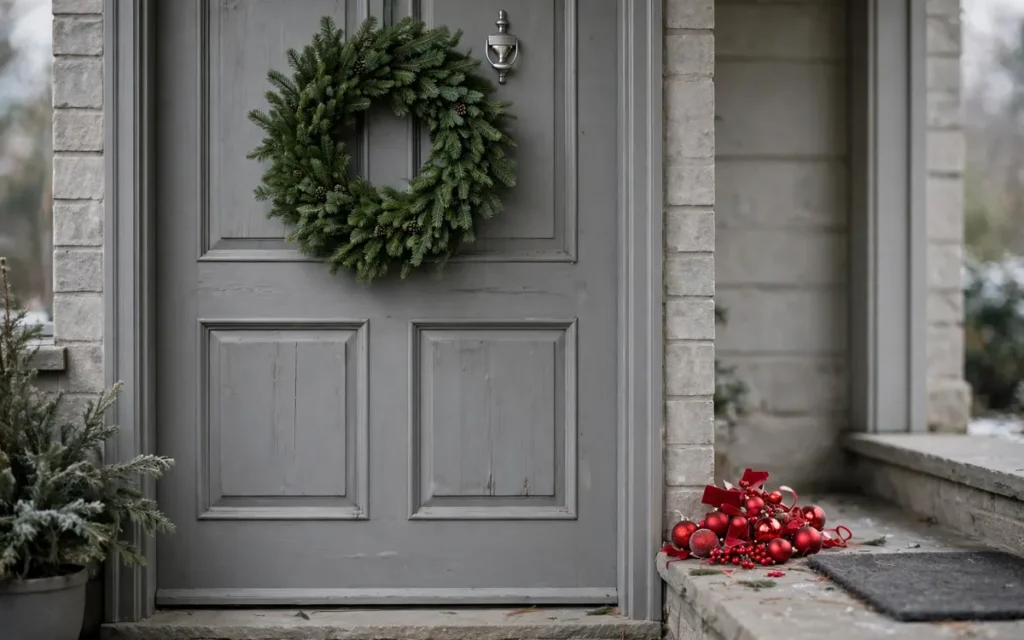
The highest-value January move costs nothing: take the Christmas wreath you already own and remove every December signal, following Step 2 above. Red berries, baubles, picks and the festive bow go back in the Christmas box. What remains — a plain, full green ring — is not a stripped-down compromise; it is the calmest wreath on this list. Tease greenery into any gaps the decorations hid, check it from across the street, and hang it — a good December base carries January and February free.
2. Swap the Bow for a Winter Neutral

If only one thing changes, change the ribbon. A red bow announces December louder than any other element; swapping it for cream, charcoal, deep blue or natural linen converts the wreath’s message in two minutes. Keep the new tails a little longer and looser than December’s tidy bow — relaxed reads as winter styling, not gift wrap. Choose wired, matte ribbon: it holds its loops outdoors and does not water-spot the way shiny satin does after one rainy week.
3. Frost the Christmas Wreath You Own
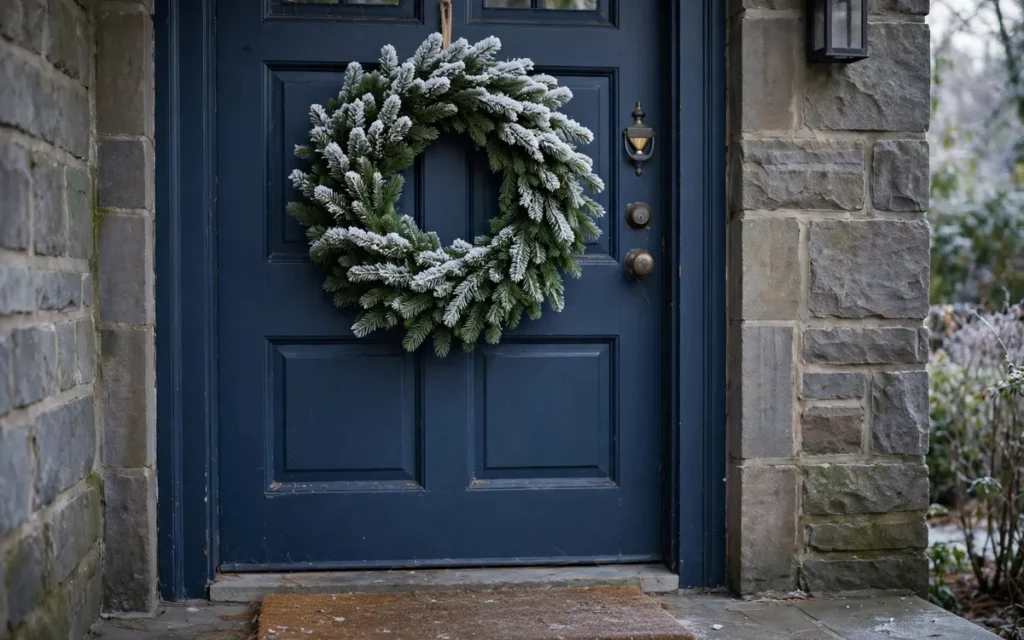
A light hand with flocking spray — or a few white-tipped picks pushed into the greenery — turns the same wreath snowy without rebuilding it. Frost the top edges more than the bottom, the way real snow settles, and let deep green show underneath; an even coating reads as sprayed, not snowed on. Work in a ventilated space and let it dry fully before hanging; flocking weathers fastest on exposed doors, so this conversion is happiest under cover.
4. Weave In Warm Lights and Set a Timer

The December light strand does not have to go back in the box. Re-weave it through the stripped wreath more loosely than it sat in December, so the glow is a soft wash rather than a dotted outline, and tuck the battery pack at the back where it stays dry and cannot swing against the door. Set the timer for the dusk hours only — late afternoon to bedtime — which stretches the batteries across weeks. Battery LED only, never a mains strand on a door; the safety section below explains why.
5. Start With a Plain Evergreen Wreath

Bought new or converted, the plain evergreen — one green, nothing added — is the calm baseline every other idea builds on. It suits almost every door colour and never dates. Its one demand is quality: with no decoration to hide behind, thin or patchy greenery shows, so choose a full wreath and check it from across the street, where flat spots show. On a brightly coloured door, the plain ring is often the finished answer, not a starting point.
6. Mix Three Greens for Depth

A single flat green can read as leftover; three greens in one ring read as winter woodland. Combine a long-needled pine, a softer cedar or fir, and one different texture — eucalyptus, boxwood or juniper — distributed around the whole circle rather than in sections. The variation in needle and shade is what gives the wreath depth in flat January light. Work the accent green in odd-numbered handfuls at slightly different depths, and keep the mix even from straight-on: a door wreath is viewed head-on, so balanced texture matters.
7. Go All-In on Eucalyptus

Silvery blue-green eucalyptus is winter’s easiest non-Christmas green: its colour already looks frost-touched, so it steps away from December with no conversion tricks, and it holds that colour for weeks, fresh or faux. It suits pale, modern and coastal-style doors, and needs no ribbon — the leaf shape is the decoration. Real eucalyptus dries in place and keeps its shape, though it turns brittle; faux versions shrug off exposed doors entirely. Keep the ring full and simple, and let one material do all the work.
8. Choose Silvery Lamb’s Ear for a Frosted Leaf Look

Lamb’s ear’s soft, silver-furred leaves look frost-touched without a drop of flocking — the gentlest route to a snowy look on a sheltered door. Keep accents few and pale: a small cluster of white berries, or nothing. Resist any red, which slides this wreath straight back into December. It is loveliest on white and light-grey doors, where the silver-on-white contrast stays subtle. Because the leaves crush easily, hang it where the door’s swing and passing coats will not brush it daily.
9. Add White Berries Instead of Red
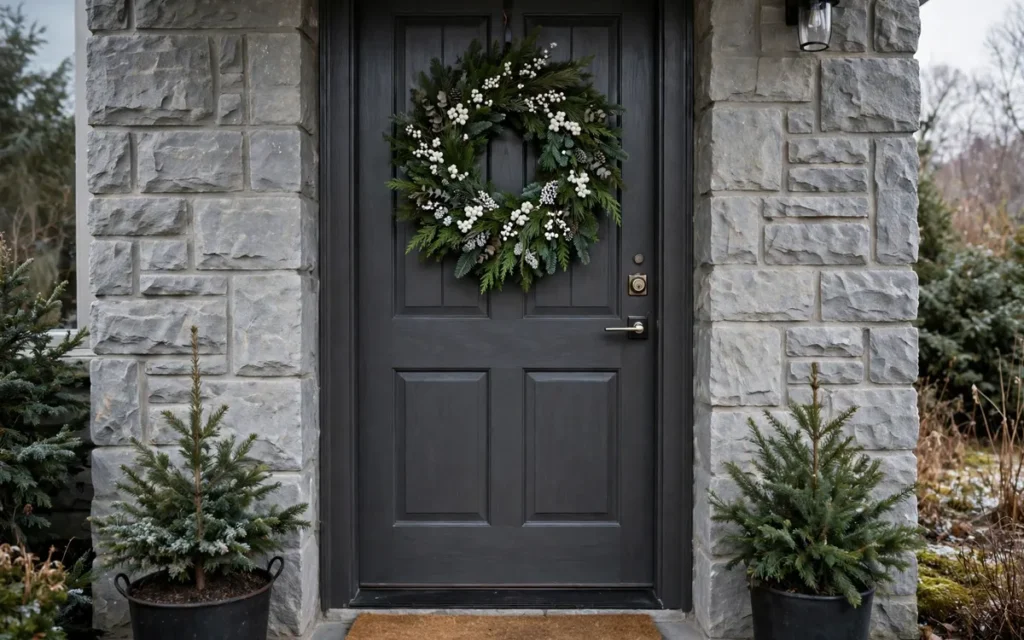
If you love a berry wreath’s structure but not its Christmas message, this is the one-swap fix: white or silvery-white berries keep the dotted, generous texture and lose the December signal completely. Cluster them unevenly, the way berries grow — heavier at two or three points around the ring, sparse elsewhere — instead of spacing them like decorations. White berries also bridge the seasons — snowberries now, early-spring freshness later — making this one of the longest-working looks here.
10. Flock It for a Snow-Dusted Finish

A fully flocked wreath, whitened all over until it looks snow-dusted, is the boldest of the snowy looks. It earns its place where real snow is rare, or against a dark door where the white ring glows even in flat light. Be honest about exposure, though: flocking is the first finish to weather, patch and shed, so a flocked wreath belongs under a covered porch — or should be a good faux bought ready-flocked rather than a home spray job. Pair it with nothing but its hanger; the snow is the whole decoration.
11. Build an All-White Winter Wreath

White berries, pale pinecones, cream ribbon and pale stems in one monochrome ring: the all-white wreath is the most composed look here, and it photographs beautifully against a black or very dark door. The discipline is in the shades — mix warm whites and creams rather than one flat bright white, so the wreath has depth instead of looking plastic. It also carries the calm, neutral palette of the January rooms indoors out to the street. Keep it under cover if it includes painted or dried elements.
12. Cover a Grapevine Base in Baby’s Breath
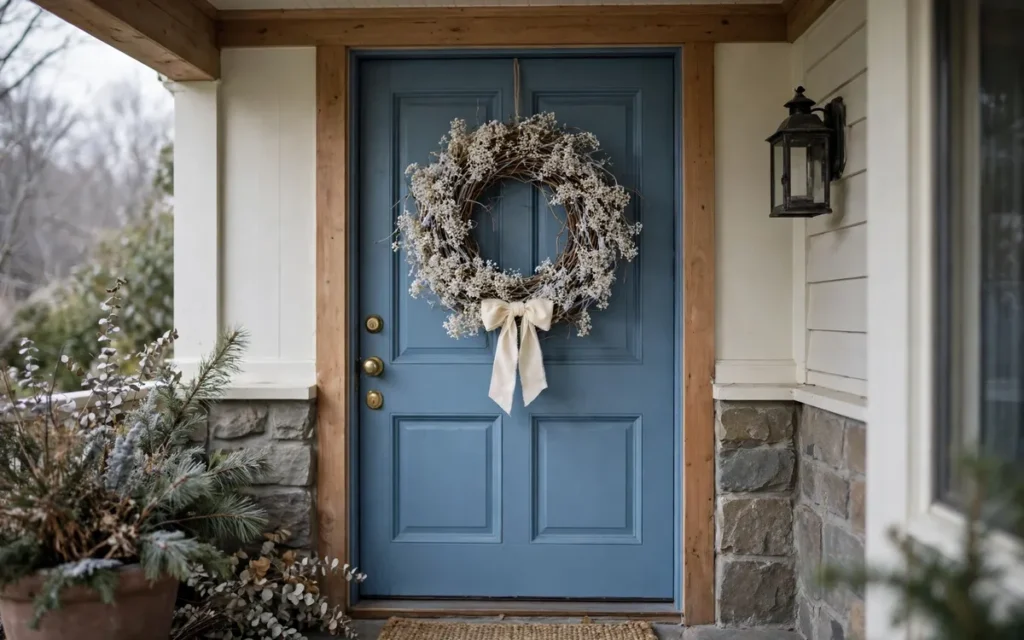
Dried baby’s breath worked densely over a grapevine base reads, from the street, as fresh snowfall caught on branches — and it is one of the cheapest wreath coverings there is. Finish with a soft cream bow, and hang it where the porch roof protects it: dried stems are fragile, and one storm on an exposed door will thin it and scatter it across the step. Handle it by the base, not the flowers, whenever it goes up or comes down.
13. Wrap It in Chunky Knit or Yarn
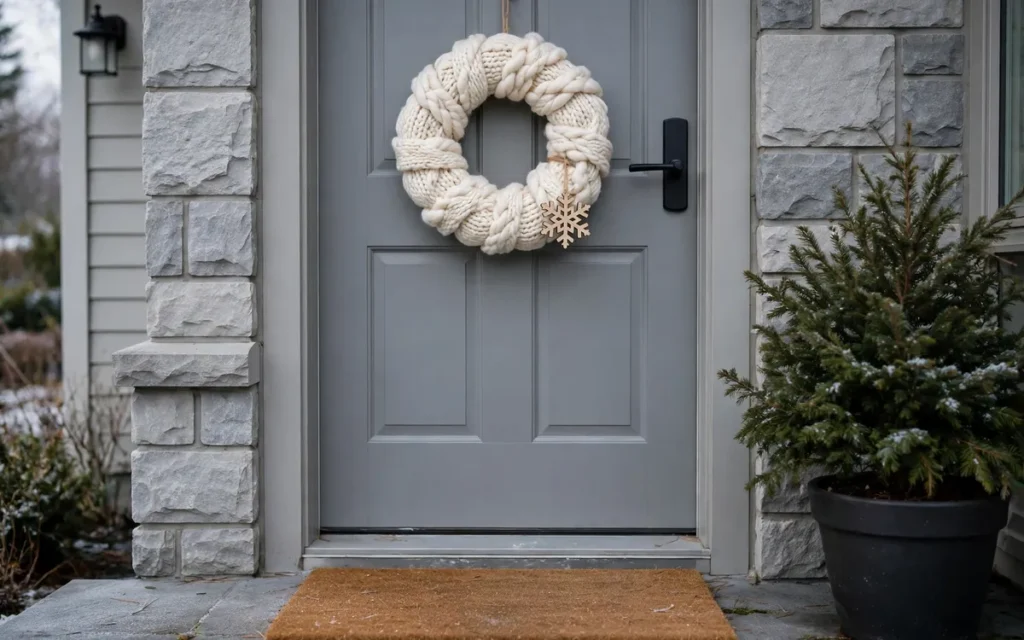
A wreath form wrapped in chunky ivory or oatmeal yarn is the wreath as a warm layer — the door wearing a jumper. It is the cosiest option here, and it connects the entrance to the knitted throws waiting inside the winter living room. Add one small wooden snowflake, or nothing; the texture is the decoration. Yarn drinks up rain and sags when soaked, so this is strictly a covered-porch wreath — but under shelter it stays soft and welcoming all season, and it is the lightest wreath on the list to hang.
14. Go Blue and White for an Icy Palette

Every calm winter scheme benefits from one cool accent, and blue is January’s. Frosted greenery, a few blue thistles or blue-grey stems, white berries and a deep blue velvet bow make an icy, composed wreath that pairs best with pale, white or weathered-wood doors. Keep the blue to three to five touches around the ring, so it reads as an accent in a white wreath, not a theme. Against a dark door, deepen the greenery and let the ribbon carry most of the blue.
15. Make Pinecones the Whole Wreath
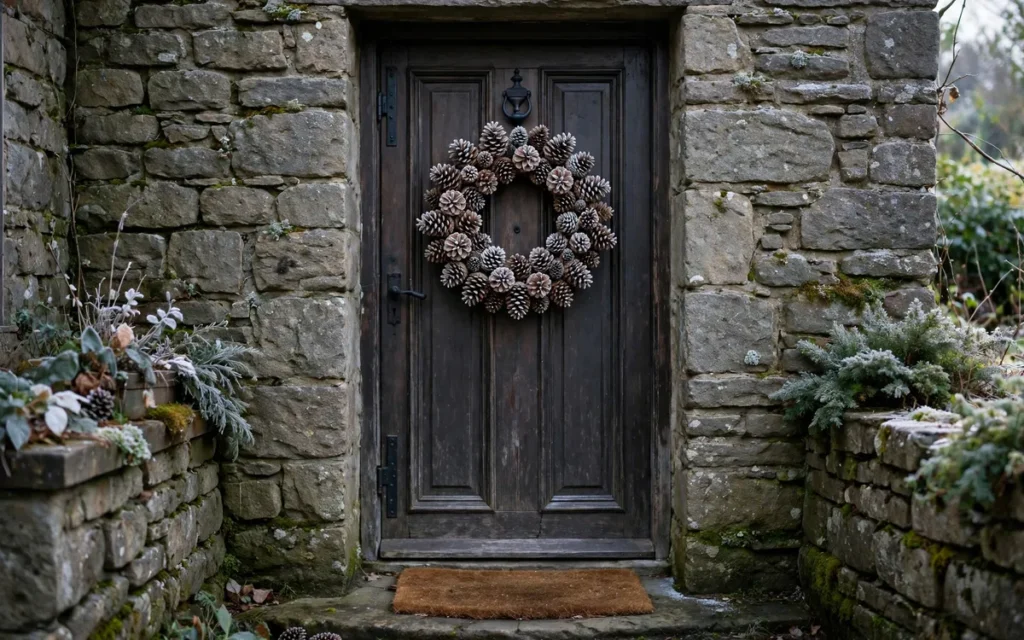
An all-pinecone wreath — cones in mixed sizes wired or fixed to a solid form, natural or lightly frosted at the tips — is the longest-lasting real-material wreath there is. Cones do not dry out, drop needles or fade like greenery, so one hung in January looks the same in March — and again next winter. Mix sizes and angles so the surface ripples instead of sitting flat. And weigh the finished wreath before choosing the hook: a solid cone wreath is heavier than it looks — exactly the case the rated-hook rule exists for.
16. Hang a Pinecone Door Swag Instead

Not every door wants a ring. A door swag — a vertical bundle of greenery with frosted pinecones on twine lengths and a burlap bow — suits narrow doors and doors with a centre window, where a wide circle fights the glass and frame. The vertical shape also leaves the peephole and handle completely clear. Hang it from the same rated hook, high enough that the lowest cone clears a swinging bag, and keep the bundle tight — a loosened swag sheds cones onto the step.
17. Tuck In Dried Oranges and Cinnamon

Dried orange slices and cinnamon sticks in a green base give natural colour and a faint, genuine scent when the door opens — done the winter way, with a natural linen or cream ribbon instead of red or plaid. Keep it under cover: dried fruit is a rain casualty, and soaked slices darken and sag within a couple of storms. One honest caveat — in some gardens, birds and squirrels treat a fruit wreath as a feeder. If that starts, enjoy the visitors or bring the wreath in.
18. Dress It Farmhouse Style With Plaid and Burlap

The farmhouse door keeps its character in January; it just changes palette. Swap December’s red tartan for black-and-white or neutral plaid, trade shiny accents for burlap and a galvanised piece or two, and the wreath that sat on the farmhouse Christmas porch settles into winter without losing its style. Keep the plaid to the bow alone so the door reads calm, not busy. Burlap forgives weather better than most fabrics, though a soaked bow should be allowed to dry back into shape.
19. Hang a Pair of Mittens Filled With Greenery
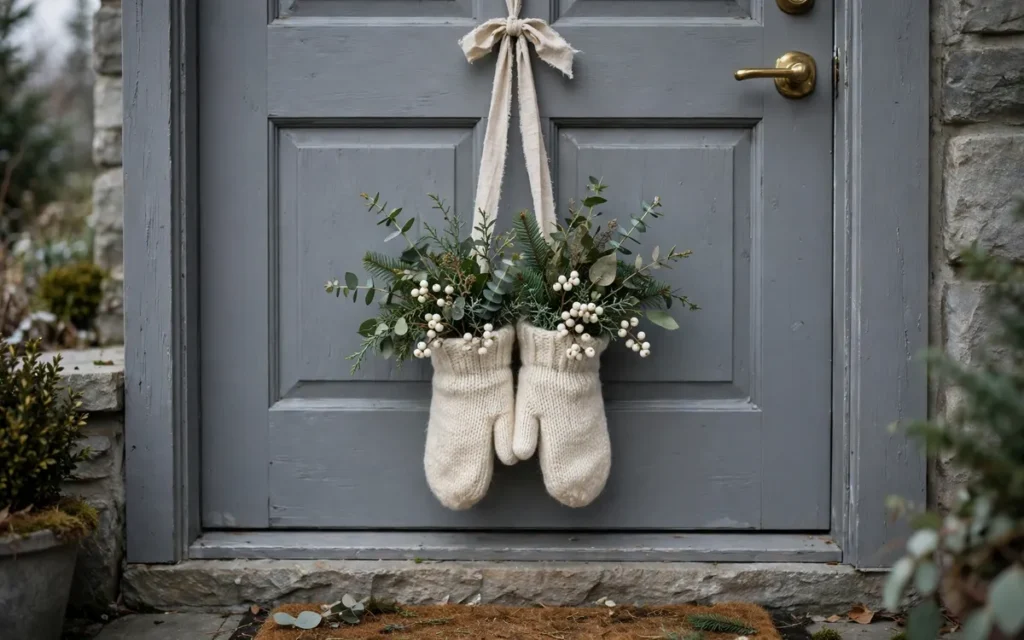
The playful non-ring: a pair of knit or plaid mittens stuffed with greenery and white berries so the arrangement holds its shape, hung side by side from a linen ribbon. It is the family-door favourite — children read it instantly — and it converts easily from December if the mittens are a neutral knit rather than a novelty pair. It is also the lightest thing here, which makes secure hanging matter more, not less: light objects twist and walk their hooks loose in wind, so seat the hook well and check it after storms.
20. Hang a Matching Pair on Double Doors
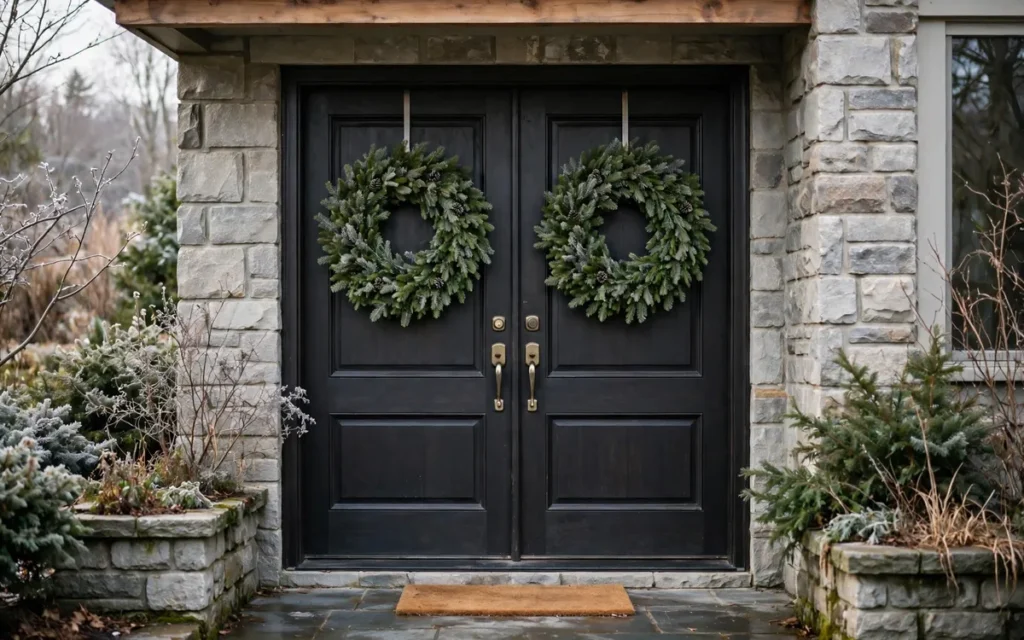
Double doors take a matched pair, one wreath centred on each door at exactly the same height. Symmetry is the whole effect, so measure both centres from the ground, not from each door’s top — door tops are not always level with each other. Use the Step 1 pair sizes (20–24 inches each) and identical wreaths — two different ones side by side always look like a mistake. Plain greenery or white-berry pairs carry the formality best.
21. Choose a Square Wreath for a Modern Door

On a contemporary door — flat panels, long bar handle, clean lines — a round wreath can look borrowed from another house. A square wreath, usually boxwood or a tight green frame, speaks the door’s own geometry and reads as designed rather than seasonal. Keep the styling almost empty: at most one ribbon tail or a small cluster of white berries in one corner. Square wreaths also sit flatter than deep round ones, a neat answer for doors that open against a wall or behind a tight storm door.
22. Centre a Lantern or Bells in the Ring

The empty middle of a wreath can hold one object — and one only. A small battery lantern on a timer gives the doorway real, useful light on dark evenings; a cluster of aged brass bells gives the door a soft voice and announces arrivals. Choose by the job you want done, never both, and include the object’s weight in the hook calculation. A lantern must be outdoor-rated and hung so it cannot swing against the door; bells need two fixing points so they hang straight.
23. Hang It on a Wide Ribbon, Not a Hook

Sometimes the hanger is part of the styling. A wide velvet or linen ribbon looped over the door top and secured inside lets the wreath ride lower and calmer than hook height, and its colour joins the composition — cream on a dark door is a classic for a reason. Fix the ribbon’s inside end firmly (a small hook or thumbtack on the inside top edge) so weeks of opening and slamming cannot slowly walk it loose, and check its position in the weekly two-minute check.
24. Add One Oversized Bow as the Only Decoration

The fastest composed look on the list: a plain green or bare grapevine wreath plus one large, well-made bow in a winter fabric — velvet, linen or neutral plaid — and nothing else. Because the bow is the whole idea, its quality is the whole idea: wired ribbon holding full loops, tails cut long and finished cleanly, sized generously enough to balance the ring. A small, floppy bow looks like an afterthought; a confident one looks like a decision. It is also the easiest look here to refresh mid-season — swap the bow, and the door changes.
What a Winter Wreath Costs: Four Budget Levels
Rough guidance levels, not product prices. Shop your home first at every level; most January wreaths are already in the house wearing December clothes.
$0 — the conversion. Strip and restyle the Christmas wreath (Ideas 1–4), forage pinecones, swap in a ribbon from the craft drawer, reuse last year’s hook. For most doors this is not the budget option; it is simply the best one.
Under $25 — the refresh. A winter-neutral ribbon, a bag of frosted cones or white berries, dried oranges made at home, and a new rated hook if the old one is bent. Small money, aimed at the parts that show.
$25–$75 — the composed wreath. A good faux evergreen or eucalyptus wreath bought once for many winters, or a fresh premium real wreath — plus the hook and ribbon to hang it properly. This is where cost-per-week starts to favour buying well.
$75+ — the heirloom door. A large, high-quality faux wreath sized properly for a double or oversized door, or a fresh florist-made wreath for a special entrance, with everything else at the lower levels. The season maths favours it: a winter wreath works eight to ten weeks, roughly twice a Christmas wreath’s run, so one good piece beats two cheap ones that fade by February.
8 Winter Wreath Mistakes That Keep the Door Looking Like Leftover Christmas
- Leaving one red piece on “because it’s small.” One red bow or berry cluster re-Christmases the whole door. The conversion only works when December’s colour is fully out.
- Buying by the label size, not the door. Frame-size wreaths arrive smaller than expected and look lost — or swallow a narrow door whole. Measure the finished diameter.
- Hanging it too high. A centre up near the door’s top edge reads as an afterthought and fights the frame. Eye level — about 57 inches to the centre — is the guide.
- Putting a delicate dried wreath on an exposed door. One storm turns baby’s breath and dried oranges into litter on the step. Match the material to the porch’s real exposure.
- Trusting a bent or under-rated hook. A rain-soaked real wreath weighs far more than the dry wreath hung in December. Hooks fail in February, onto the step where visitors walk.
- Letting the wreath block the door’s job. Covering the peephole, catching the frame on every swing, or hiding the house number turns decor into an obstacle.
- Keeping real greenery up until it is brown. A dried-out wreath in late February reads as neglect, not winter. The weekly check catches the turn; taking it down on time is part of the look.
- Matching the wreath to December’s porch instead of January’s door. Red plaid and the Christmas doormat underneath undo the conversion from below. The door is one composition, not a single object.
Door Wreath Safety: Weather, Weight, Lights and Real Greenery
A door wreath lives outdoors and over a walkway, so hanging it is a safety job before it is a styling one: use an over-the-door hook or outdoor adhesive hook rated for more than the wreath’s weight when wet — a rain-soaked real evergreen can weigh far more than the dry wreath that went up — and check the hook is fully seated after storms, high wind and the door slams of a busy week, because a wreath that lets go falls at head height onto the step where guests, children and delivery drivers stand. Keep the door working as a door: the wreath must clear the frame through the full swing, never block the peephole, the handle’s travel or the house number, and nothing should trail where it can catch a coat or a bag strap. Match the material to the exposure as you go — dried and delicate wreaths on covered doors, sturdy faux and cone wreaths on exposed ones — and care for real greenery like the outdoor plant it is: out of direct sun where possible, misted in dry spells, taken down when the needles snap instead of bending — expect roughly three to six weeks of good life outdoors in cold weather. Sweep dropped needles off the step before they build into a slippery layer, and compost or bin the wreath at the end rather than storing dried-out greenery indoors.
Any glow on a door wreath should be battery LED, never a mains-powered strand: cords must never be pinched in a closing door, where a crushed cord is a fire and shock risk, trailed across the step, or left where rain can reach a plug. Use a battery pack rated for outdoor use, tucked inside the wreath’s back where it stays dry, and put the lights on a timer so they are never forgotten on all night. Inspect the strand as it moves over from its Christmas position — no frayed wires, no cracked bulbs, no corroded battery contacts — and change button or coin batteries with the pack out of children’s reach, storing spares the same way, since swallowed button batteries are a serious emergency. Treat ribbons and fabric wraps as the flammable materials they are: keep any lit candle or oil lamp on the porch well away from the door’s swing and the wreath’s tails, and never hang a wreath where wind can blow it against a hot porch light fitting. Where any of this differs from your door or hook manufacturer’s own ratings and instructions, the manufacturer’s guidance wins.
Frequently Asked Questions
How do I turn my Christmas wreath into a winter wreath?
Take the December signals off and put winter texture in: red berries, bows and picks first, then ornaments and word signs, then swap the ribbon for a winter neutral or remove it. Pinecones, white berries or a touch of frost go where the ornaments were. The green base, shape and hanger all stay — which is why the conversions in Ideas 1–4 usually cost nothing.
What size wreath should I hang on my front door?
Go by the finished, fluffed diameter against the door’s width: roughly one-half to two-thirds of the width. That is about 24–28 inches on a standard 36-inch door, 20–24 inches on a narrow door, a matched 20–24 inch pair on double doors, and 30 inches or more only on genuinely wide doors. Measure the wreath itself, not its packaging.
How long can a winter wreath stay up?
It is made for early January to the end of February — or, in milder places, until the first spring flowers make it look out of season. It comes down when the season turns, not on a fixed date. Real greenery comes down sooner: once it dries out and sheds, its season is over whatever the calendar says.
How long does a real evergreen wreath last outside?
Roughly three to six weeks in cold outdoor weather is the common guidance. Hang it out of direct sun, mist it in dry spells, and expect a real wreath on an exposed door to need replacing or retiring by about mid-February. Under cover it lasts longer; for one wreath covering January and February untouched, good faux is the honest answer.
How do I hang a wreath without damaging my door?
Use an over-the-door hook rated for more than the wreath’s wet weight, an outdoor-rated adhesive hook, or a wide ribbon looped over the door top and secured inside. Never nail or screw into a steel, fibreglass or rented door. After hanging, swing the door fully to confirm the wreath clears the frame, and check the hook again after the first storm.
How do I keep a winter wreath looking good in bad weather?
Start with the material: sturdy faux and pinecone wreaths live happily on exposed doors, dried and delicate wreaths belong under cover, and a handmade wreath staying in the weather can be protected with an outdoor clear coat. After that, it is the two-minute weekly check — hook seated, ribbon sound, needles still bending, battery pack dry — that keeps a wreath lasting the season.
Bring the same calm greenery indoors: these winter mantel decor ideas compose the fireplace with the stripped-back palette this wreath uses.
The wreath is the porch’s anchor — these small front porch winter decor ideas compose the whole small entry around it, measured first so the door swing and walkway stay clear.
Conclusion
A winter wreath asks for less than a Christmas one and gives back more: fewer signals, tougher materials, a longer life. Size it to the door, strip the December out, hang it safe — the method really is that short, and every idea above is a variation on it. If you are carrying the same calm reset through the house, winter decor ideas for the home is the whole-home guide, and your door’s December look lives in our Christmas wreath ideas. Next in this January series, the wreath gets its setting: styling a small front porch in winter, once Christmas is down. Until then, the best winter wreath ideas are usually the simplest ones — sized right, stripped back, and hung to last the season.




2 Comments