
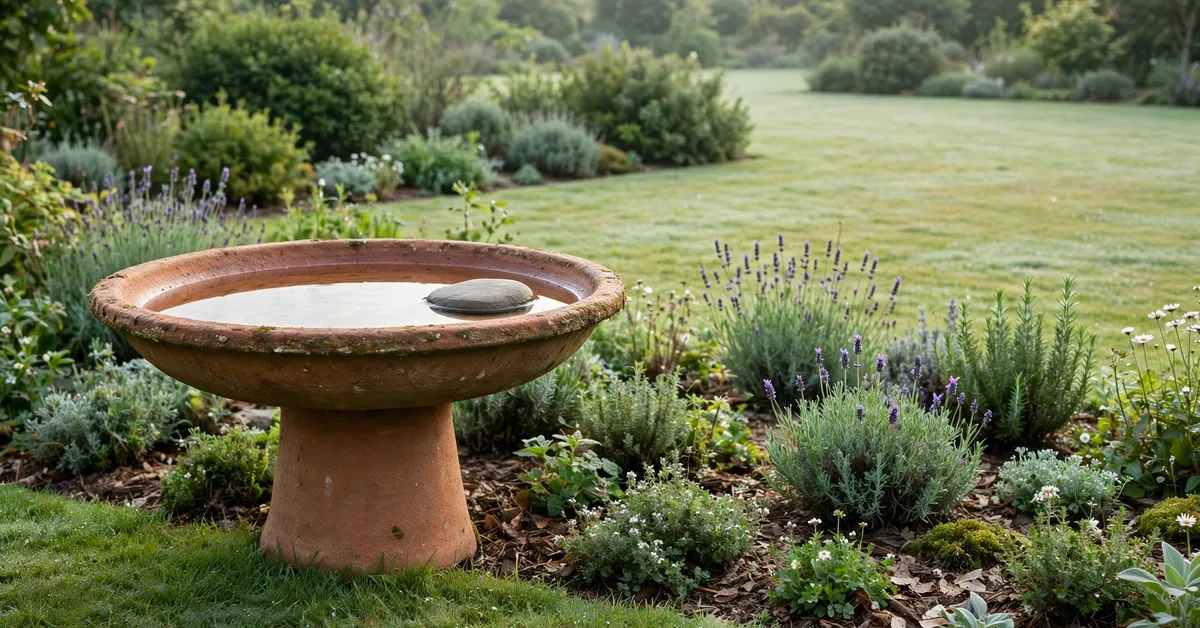
11 Enchanting DIY Bird Bath Ideas That Fit the Birds, Not Just the Garden
A bird bath looks like the simplest purchase in the yard — choose a pretty bowl, stand it among the flowers, fill it with water. It is also the purchase that fails most quietly: the bowl is beautiful and empty, week after week, while a plain saucer two gardens over is never without a queue. These diy bird bath ideas start where the photographs never do — with the bird’s own dimensions — because a bird bath is a fitting before it is an ornament: the water is sized to the depth a songbird can stand in, the site is measured by the escape a wet bird needs, and the cleaning is put on a schedule, because a dirty bath is worse than no bath at all.
The yard has been fitted in this library before, at its other gathering point: the fire pit, whose clearances are measured before a single stone is laid, is our outdoor fire pit ideas‘ subject. This article fits the yard’s water the way that one fits its fire — by measurement, by distance and by discipline, not by the photograph — and the two articles share one rule: an outdoor feature is a fitting before it is a picture.
The Method: Size It, Site It, Keep It Clean
Three decisions, in order, before a single basin is bought or built — because a bird bath fails in predictable places: in the depth nobody measured, in the site nobody thought about, and in the cleaning nobody scheduled.
Step 1 — Size It: The Birds’ Dimensions Decide
Every basin is sized before it is decorated, because a bird bath is the one garden purchase whose user cannot tell you what it needs — the birds’ dimensions decide. That is the standard these diy bird bath ideas are built to, and the Cornell Lab of Ornithology has published it: the water stands about 1 inch deep at the edge, sloping gently to no more than 2 inches in the middle. Songbirds bathe standing, and a deeper, steeper bowl simply goes unused, however beautifully it photographs. Penn State Extension allows up to 2 to 3 inches at the very deepest point; this article prints Cornell’s 2-inch maximum as its rule and the extension figure as the outer edge, never as the target. The surface is part of the size: glazed and very smooth basins are slippery, and Cornell’s remedy is footing — flat stones or rough pebbles set in the water, so a bird can stand, judge the depth and climb out. A deep basin you already own is not binned; it is rescued to the rule with stable stones or an upturned saucer that shallows it — nothing that wobbles, nothing that can trap a foot. Width serves the same rule: a wide, shallow basin lets several birds use different depths at once, and birds often prefer water at ground level (Cornell) — the pedestal is a siting tool, not the default.
Step 2 — Site It: Measured by the Bird’s Escape
The site is measured by the bird’s escape, not the gardener’s photograph. A ground bath sits about 10 to 15 feet from the nearest hiding cover (Penn State Extension): near enough that a wet, heavy bird reaches the shrubs in a few wingbeats, far enough that nothing can ambush it from inside them, with open ground around the bath so approaching predators are visible. The light is graded as the sources grade it — partial shade, morning sun and afternoon shade where the yard allows — because shade keeps the water cooler, slows evaporation and slows algae; Cornell recommends shade in hot weather. The bath never sits directly under a feeder or a busy perch branch, where hulls and droppings contaminate the water fastest. The base is level and cannot rock — a bath that wobbles is emptied by its own visitors — and the site is one you pass daily, because the third step only happens where the bath is easy to reach with a jug and a brush.
Step 3 — Keep It Clean: The Water Runs on a Schedule
The water is kept on a schedule, because a dirty bath is worse than none: it concentrates the birds it attracts at one contaminated point. In warm weather the water is dumped and replaced every day or two; Cornell’s floor is at least every three days, and oftener in heat. The basin is scrubbed at least once a week — the CDC’s rule, because mosquito eggs are laid on the container’s surfaces and survive a mere top-up; topping up is not changing. A thorough scrub with a stiff brush is the routine clean. The deep disinfection — one part household bleach to nine parts water, scrubbed or soaked, rinsed extremely thoroughly and air-dried before refilling (the solution USGS has recommended during disease events) — is reserved for algae takeovers, a sick bird at the bath, or a disease advisory; bleach is never mixed with any other cleaner, and nothing is ever added to water birds will use. Rather Be Birding’s complete guide to bird baths sets out the same care schedule from the same wildlife sources. The season turns the step, it does not end it: concrete and terra-cotta crack in freezing weather (Cornell’s warning), so freeze-fragile basins come in or are tipped and stored, and where winters freeze hard the fitted answer is a thermostatically controlled heated bath or de-icer on a GFCI-protected circuit — open water is scarcest, and worth most to birds, in the coldest weeks.
Zone A — Size the Basin Before You Build Anything
Three sizing decisions come before any building. They take one ruler and five minutes, and every later choice — the stand, the site, the pump — reads off the numbers they produce.
1. Start With a Plant Saucer at Ground Level
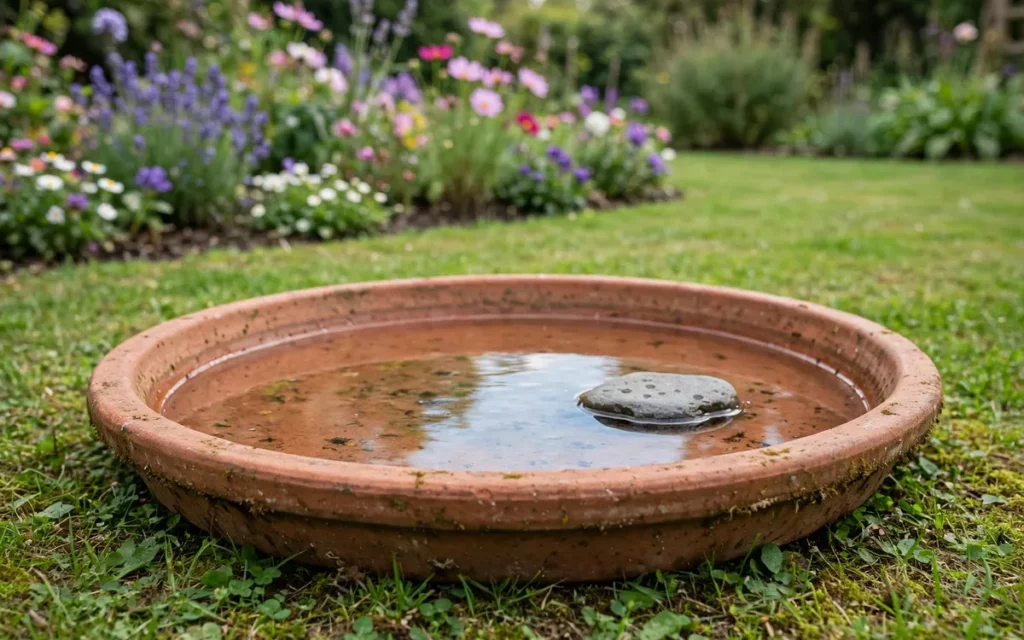
The Cornell-endorsed first build is the plainest object in the garden: a large, shallow, unglazed plant saucer on level ground, about an inch of water, one flat stone resting in it. Birds often prefer ground-level water, the saucer’s gentle slope is the depth rule already built, and the whole experiment costs less than the mistake it replaces.
2. Rescue a Deep Bowl With Stones Instead of Replacing It

A too-deep basin is shallowed, not discarded: large, stable stones or a bed of rough pebbles raise the floor until the usable water meets the depth rule, and one flat stone breaks the surface as a landing and drinking perch. The discipline is in the fitting — nothing wobbles under a bird’s weight, and nothing is stacked where it can trap a foot.
3. Thrift Wide and Shallow, Never Narrow and Deep
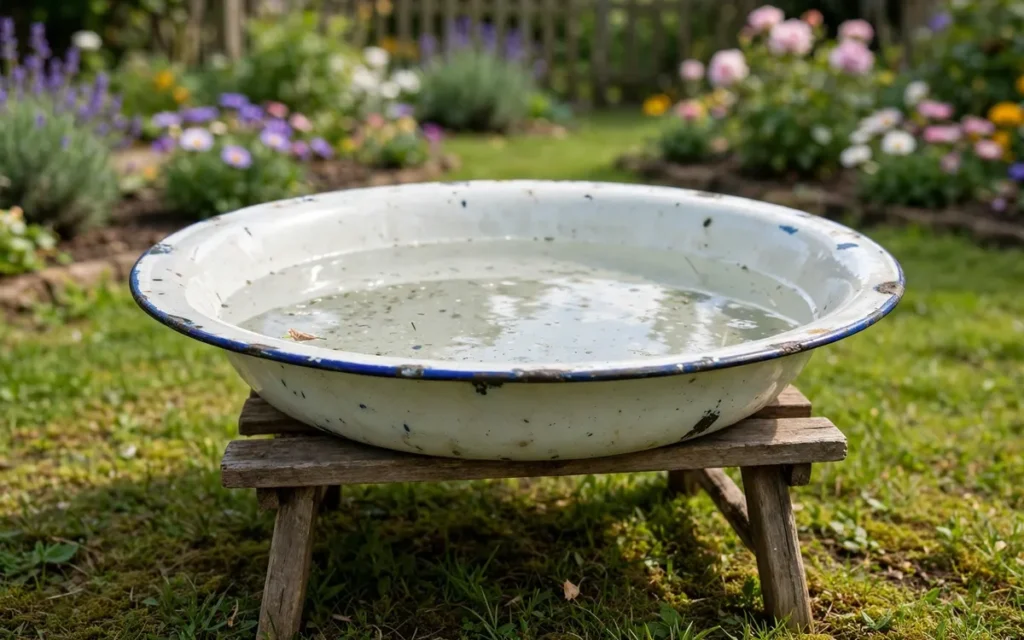
At the thrift store the test is a ruler, not the pattern. A wide dish that holds no more than about 2 inches of water at its centre, on a gentle slope, passes and comes home; the deep, steep, glazed bowl fails however pretty it is, and goes back on the shelf for someone furnishing a table instead of a bath.
Zone B — Site It Where Birds Feel Safe
Three siting decisions place the sized basin. A bath built to the depth rule still fails if a bird cannot use it without feeling hunted, so this zone measures the site the way Step 2 grades it.
4. Set a Ground Bath 10 to 15 Feet From Cover
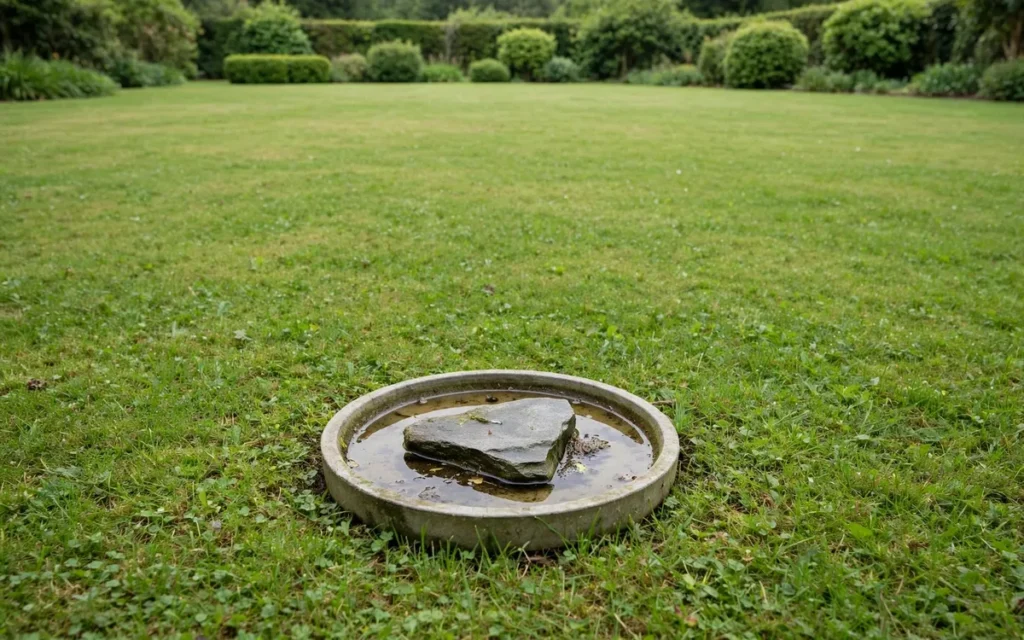
Penn State Extension’s distance, worked both ways: close enough that a soaked bird’s short escape flight ends in the shrubs, far enough that a cat cannot hunt from inside the shrub line. Open ground on every side completes the fitting — the bathers, not the gardener, need the clear view of what is coming.
5. Raise It on a Stump or Bricks Where Cats Patrol
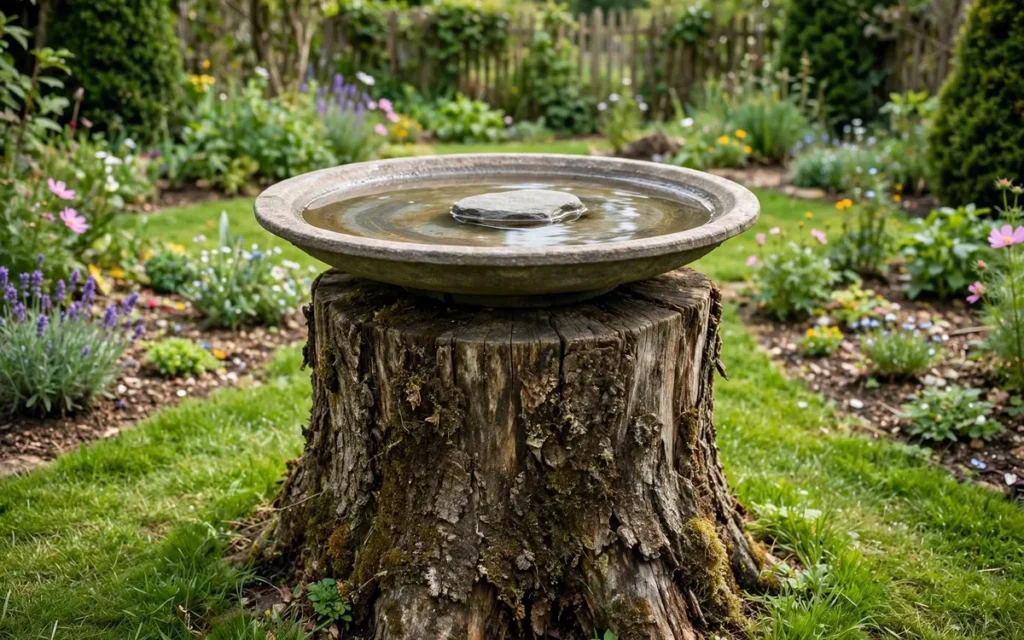
Height here is predator discipline, not styling: in a yard with roaming cats, the same saucer goes up on a stump, a stack of bricks or a stand — retail pedestal classes run about 24 to 36 inches — on a base that cannot rock. The depth and footing rules travel up with it unchanged.
6. Keep It Out From Under Feeders and Perch Branches

The contamination rule is simple geometry: a bath under a busy feeder or a favourite branch fills with hulls, droppings and leaves faster than any cleaning schedule forgives. The bath stands in the open, near the garden’s traffic but never beneath it — close to the action, out of the fallout.
Zone C — Add Movement and a Second Height
Two additions build on a bath that is already sized and sited: moving water that tells birds the bath exists, and second heights that give different birds the water they trust.
7. Hang a Jug Dripper Over the Basin
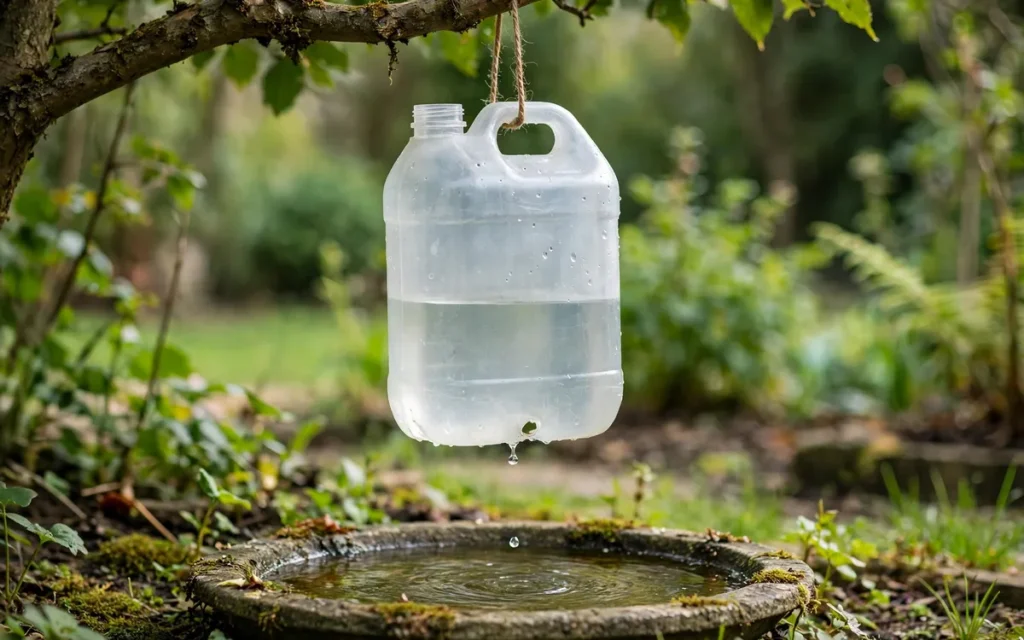
Cornell’s own build: a clean recycled jug with a pinhole near its base, hung above the bath so it releases an occasional drop, not a stream. Moving water is how birds find a bath they cannot see. Test the drip rate before the jug is left alone — a jug emptied in twenty minutes is a leak, not a dripper.
8. Run Two Baths at Two Heights

The multi-level station: one ground saucer and one raised basin in different corners, so ground-feeding birds and wary small songbirds each get the height they trust, and a busy hour never queues at one rim. A screened, watched corner — the kind of private outdoor room fitted in our apartment patio privacy ideas — serves the station well. Each bath is sized and sited by the same rules.
Raised planting works the same way, giving birds cover at a height they trust. Our raised garden bed ideas show how to build beds that frame a bath with shelter and food plants, so the station sits in a planted corner rather than on bare lawn.
Zone D — Keep It Clean Through the Seasons
The last three ideas are the system’s life after building day: the change, the scrub and the winter chapter.
9. Change the Water on the Two-to-Three-Day Rule
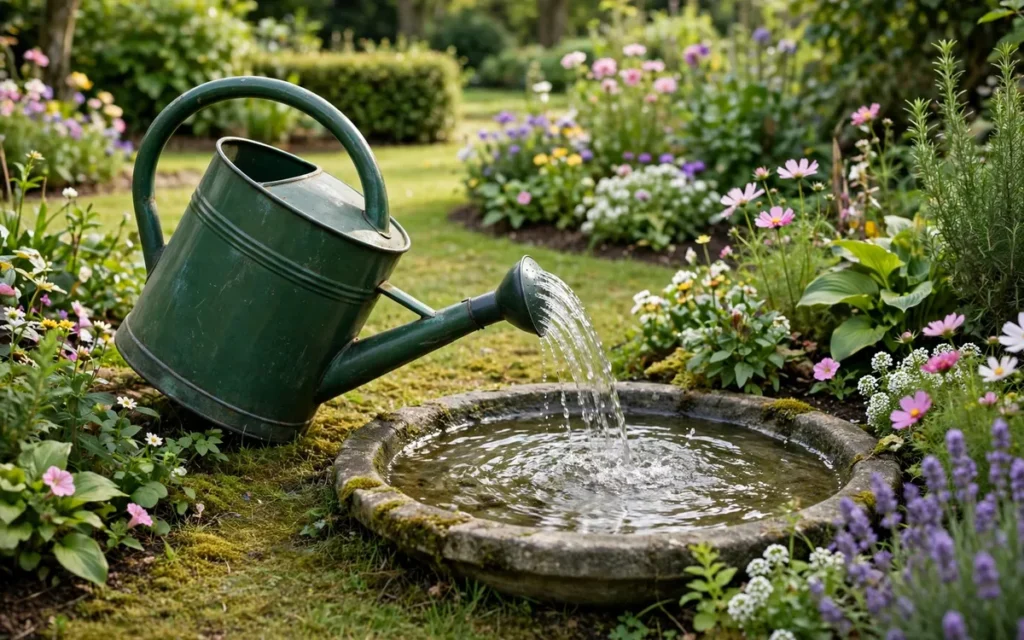
Dumped fully, rinsed, refilled: every day or two in heat, never longer than Cornell’s three-day floor, and immediately when the water clouds, films or fills with debris. The change is also the mosquito control — larvae need still water for longer than this schedule ever gives them, so the calendar does the work no additive should.
10. Scrub Weekly, Disinfect Only When the Bath Tells You To
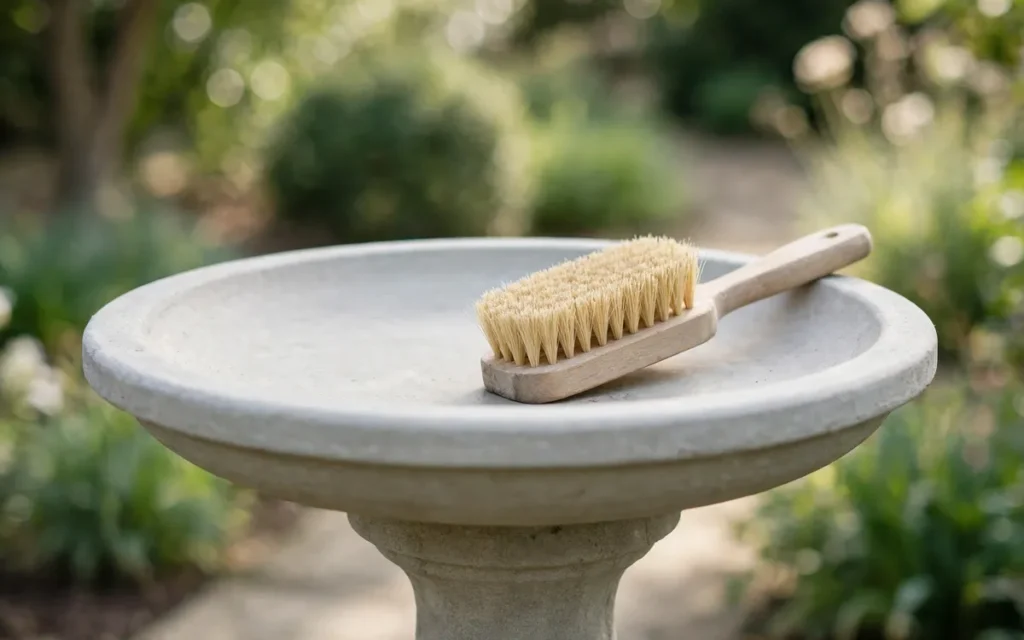
The CDC’s weekly scrub is done with a stiff brush reserved for the bath alone. The 9-to-1 bleach disinfection is held for algae takeovers, a sick bird at the bath or a disease advisory — then the basin is rinsed until no trace remains and left to air-dry. Nothing — no algaecide, no oil, no detergent — is ever dosed into water birds use.
11. Winter-Proof It: Open Water or an Empty, Stored Basin

The cold chapter the sources write themselves: birds need water most when every natural source is frozen — the same season worked at the house’s front in our small front porch winter decor. The winter bath is a thermostatically controlled heated basin or de-icer on a GFCI circuit, checked daily — or, where no power reaches, the freeze-fragile ceramic and concrete come indoors before the first hard freeze cracks them, and a tip-proof ground dish is iced out and refilled by hand.
What It Costs: Three Ways In
The saucer tier (roughly under $25). One large unglazed plant saucer, or a thrifted shallow dish that passes the ruler test, footing stones from the yard, ground or stump placement. This is the tier that proves the system: sized to the depth rule, sited by the cover distance, changed on schedule — one bath, fitted properly, before any decision about the rest of the yard.
The pedestal tier (roughly $25–$75). A terracotta stack or a thrifted stand carrying a measured saucer, the jug dripper hung above it, and a second ground dish so two heights run at once. This is where most readers land: a fitted station built from garden-centre and thrift parts, every dimension from the Method.
The all-season tier (roughly $75 and up). A gentle bubbler pump, a heated basin or de-icer for the freezing months, and a two-height station maintained year-round. Worth it where the yard’s birds are a daily pleasure of the house — and only after the layout has been lived with at a cheaper tier, because a sited bath birds trust is worth more than equipment moved twice. All three tiers are rough planning classes, not quotations.
Building It Deep Because It Looks Like a Bath
The elegant deep bowl is this topic’s founding error. Songbirds bathe standing, and water past the 2-inch rule, in a basin with steep sides, is water no bird enters — the gallery of charming photographs is full of exactly these bowls, standing empty in pretty gardens. Depth is the basin’s first measurement (Idea 3), taken with a ruler at the shop or the workbench. It is not a style choice, and no amount of mosaic makes a deep bowl shallow.
Choosing Glazed, Shiny and Slippery
Glazed china and glass photograph beautifully and give a wet bird no footing at all. Cornell names the slipperiness directly and prescribes the remedy — flat stones in the water — because a bird that cannot stand cannot judge the depth, and a bird that cannot climb out will not come back. A basin is chosen by its surface and its slope. The pretty glazed piece is rescued with footing stones (Ideas 2 and 3) or it is not used; the shine is the last thing about it that matters.
Tucking It Into the Shrubs for the Photograph
A bath hard against cover is an ambush with water in it. The cat hunts from exactly the concealment the siting rule exists to keep 10 to 15 feet away, and a bathing bird — wet, heavy and distracted — is at its most catchable. The photograph wants the bath nestled; the bird needs it standing in open ground, with cover at escape distance and a clear view on every side (Idea 4). Where the two disagree, the bird’s version is the article’s.
Topping Up Instead of Changing
Adding fresh water to dirty water changes nothing that matters. The contamination stays at full strength, and mosquito eggs fixed to the basin’s walls survive the top-up to hatch on schedule — which is why the CDC’s rule is a scrub, not a refill. A change means the old water leaves entirely: dumped, rinsed, refilled, and the basin scrubbed at least once a week (Ideas 9 and 10). The jug that only ever tops up is how a clean-looking bath stays a dirty one.
Dosing the Water With Pennies and Potions
Coins, copper scraps, algaecides and oils are unmeasured additions to somebody’s drinking water. The penny trick doses zinc from a modern coin and calls it copper; the algaecide bottle was written for a pond, not a two-inch basin a sparrow stands in. None of it can be measured by the person adding it, and none of it is needed: the change-and-scrub schedule cleans the bath, and nothing is added to the water (Method Step 3).
Leaving Ceramic and Concrete Out to Freeze
Water expands as it freezes, and in a porous basin it expands against the walls that hold it — the first hard freeze cracks the piece you spent the summer siting. Cornell’s warning is ignored every autumn, in every cold garden, one handsome concrete bath at a time. Freeze-fragile basins come indoors, or are tipped and stored dry; where the birds are to be served all winter, the winter bath is one built and powered for the cold (Idea 11).
FAQs
How deep should a bird bath be?
By the Cornell Lab’s rule: about 1 inch at the edge, sloping gently to no more than 2 inches in the middle, so a small bird stands on the bottom while it bathes. Penn State Extension allows 2 to 3 inches at the very deepest point. Deeper than that, with steep sides, is a bowl birds will not use — however handsome it looks on the stand.
Where should you put a bird bath in your yard?
On open ground about 10 to 15 feet from shrubs or a tree line — Penn State Extension’s figure for a ground bath: cover inside a wet bird’s short escape flight, ambush outside it. Partial shade where the yard allows, level ground that cannot rock, a spot you pass daily, and never directly under a feeder or a busy perch branch, where the water fouls fastest.
How often should you change bird bath water?
Every day or two in warm weather. The Cornell Lab’s floor is at least every three days, more often in heat, and immediately whenever the water clouds, films or fills with debris. Dump it fully and rinse — and scrub the basin at least once a week, because mosquito eggs stick to its surfaces and survive a refill (CDC).
Why won’t birds use my bird bath?
Work the checklist in order: too deep (past the 2-inch rule), too slippery (glazed, with no footing stones), wrongly sited (tucked into cover, or stranded in the open with no escape route 10 to 15 feet away), or dirty (water past its change day). Most empty baths fail on depth first — it is the measurement nobody took.
How do I keep mosquitoes out of a bird bath?
By the schedule, not by additives. Larvae need still water for longer than the two-to-three-day change cycle ever allows, and the weekly scrub removes the eggs fixed to the basin’s surfaces before they hatch. A gentle bubbler disturbs the surface further. No chemical is ever added to water birds drink — the calendar is the control.
Can birds use a bird bath in winter?
Yes — and open water is worth most to them then, when natural sources freeze. Use a thermostatically controlled heated bath or de-icer on a GFCI-protected circuit and check it daily. And bring ceramic and concrete basins indoors before hard freezes arrive, because water expands in a porous basin and cracks it (Cornell).
What can I use to make a DIY bird bath?
Any wide, shallow, rough-surfaced vessel that passes the ruler test: a large plant saucer, a clean trash-can lid, a shallow pan or tray — the Cornell Lab and the RSPB both suggest exactly these — set on the ground, a stump or a stand, with a flat stone for footing. Depth and surface decide whether it works. The object itself is free.
Conclusion
Work through these diy bird bath ideas in order — size it, site it, keep it clean — and the bath stops being a photograph that sits empty. The basin is sized to the birds’ inches, so a songbird can stand in it. The site is measured by their escape, so they can use it without feeling hunted. And the water is kept on their schedule, so the bath they trust stays worth trusting. What is left is the thing the photographs were promising all along: the garden’s smallest room, fitted to its smallest guests, and full of them.