
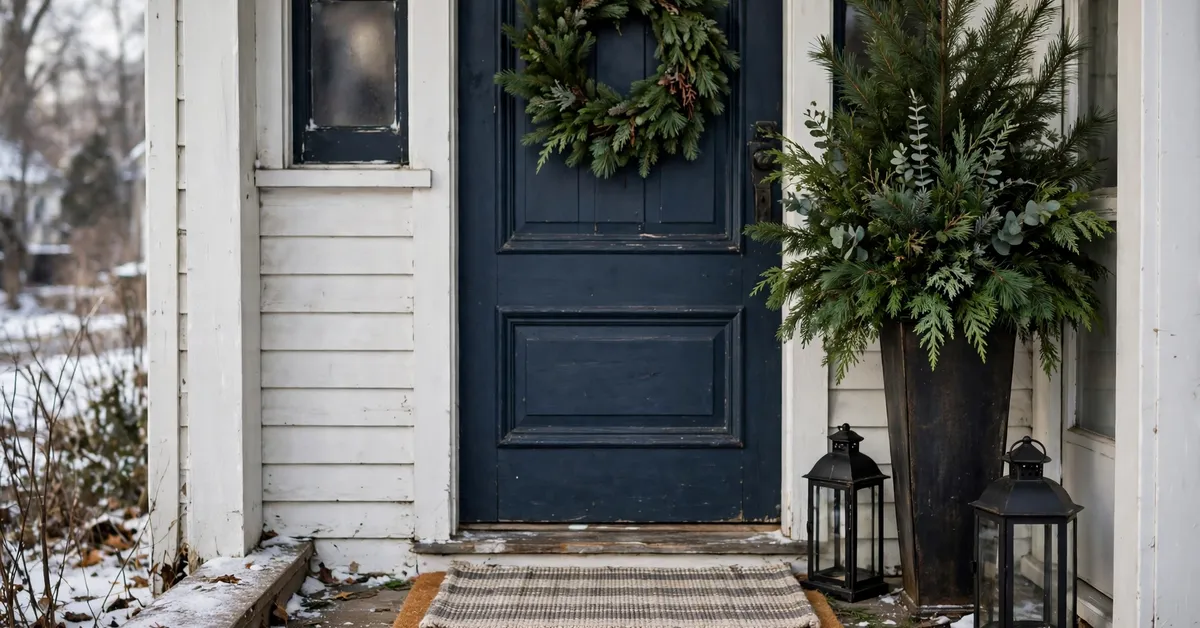
26 Smart Small Front Porch Winter Decor Ideas for a Welcoming Winter Entry
January is unkind to a small porch. The Christmas pieces are boxed away, and what is left is a few square feet that every visitor stands in — looking bare, a little forgotten, and with no spare corner where the emptiness can hide. On a big porch, a bare month is a shrug. On a small one, it is all anyone sees.
But a small porch is not a failed big porch. It is a measured composition: one focal point, a few well-sized pieces, and rules that protect the door swing and the walkway. The porches that look good in winter were not decorated by shopping; they were decorated by measuring. If you are resetting the whole house this month, the whole-home January edit covers the inside; this guide stays outside, on the smallest stage in the house. The door’s own centrepiece — the winter wreath — has its own full guide in our winter wreath ideas; here, the wreath is the anchor and the porch is composed around it. Farmhouse readers will recognise the porch from our farmhouse Christmas porch — this is its quieter season.
So: measure first, decorate second. Below is the five-step method — footprint, swing, clear lane, one focal point, vertical budget — then 26 small front porch winter decor ideas by zone, plus lean budget levels, the mistakes that undo the look, a safety section written for a walked-on winter porch, and FAQs.
Measure First, Decorate Second: The Small Porch Winter Method
Every measurement in these five steps is small, because the porch is. Work through them before choosing from the small front porch winter decor ideas below, and the composition will fit the space instead of fighting it.
Step 1: Measure the Footprint and Mark the No-Go Zones
Measure the porch’s width and depth before buying or moving anything, and protect two zones absolutely: the door’s swing arc — the door’s width plus a hand’s width of clearance — and a clear walking lane of about 36 inches (90 cm) from the steps to the door. Mark both with painter’s tape for a day if it helps; anything that only fits inside a no-go zone does not get bought. After-Christmas porch guides like For the Love of Living’s porch styling make the same point about steps and shovelling; on a small porch it becomes the whole method. If you styled this porch in fall, your numbers from the fall porch still hold.
Step 2: Anchor the Door: One Focal Point Only
A small porch gets one focal point, and it is the door: the winter wreath (or a door basket) at eye level. Everything else is cast in a supporting role and must stay quieter than the door piece. Two competing focal points on six square feet is exactly what makes small porches look cluttered in photographs. The wreath itself — sizing it to the door, converting it from its Christmas version, hanging it safely — is covered in depth in our winter wreath ideas guide; here it simply takes its place as the anchor.
Step 3: Build in Threes, Scaled Small
Compose each usable side as a trio at three heights: one tall piece (a planter, urn or slim tree), one mid piece (a lantern, basket or crate), one low piece (a mat stack or boot tray) — then stop. Choose fewer and bigger over many and small: five tiny objects read as clutter where two larger ones read as calm. If the door swing eats one side of the porch, style the other side fully and leave the eaten side nearly bare. Asymmetry with a reason looks designed; forced symmetry just waits for the first slam.
Step 4: Rise, Don’t Spread: The Vertical Budget
The floor is the scarcest material on a small porch, so spend height instead: a door-frame garland, a wall planter, a hanging lantern, tall branches in a slim bucket. A working guide: at least half the porch’s decor should hang, lean or stand tall rather than sit wide on the floor. Vertical pieces draw the eye upward, keep the walking lane honest, and make the entry feel larger than its footprint.
Step 5: The Renter and Weather Pass
Before calling it done, walk a short checklist. Nothing screwed or nailed that a landlord has not approved — rated over-door hooks and outdoor adhesive only. Every light piece weighted or tied down, because winter wind takes unsecured decor first. Materials matched to the exposure: a covered porch forgives dried and delicate pieces; an exposed one demands faux and sturdy, the same rule as the door wreath. And a two-minute weekly check — tape zones still respected, mats flat, battery packs dry, nothing migrated into the walkway.
1. Hang One Winter Wreath and Let It Lead
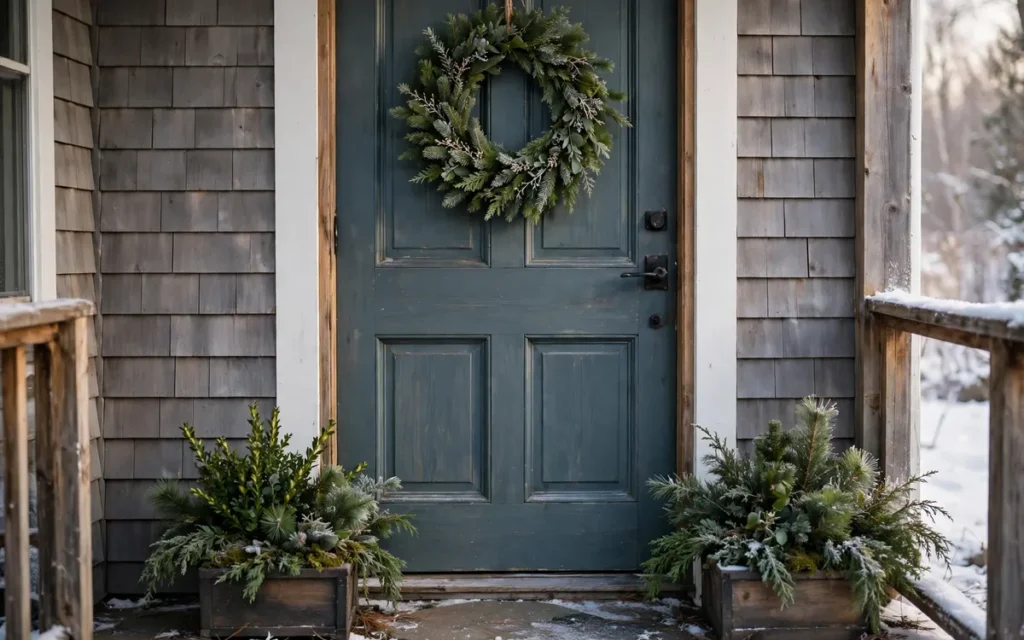
The stripped, calm January wreath at eye level — about 57 inches (145 cm) to its centre — is the porch’s whole statement. Everything else stays quieter than it. Tip: if the wreath is bold, keep the planters plain green; if the wreath is plain, the planters may carry the texture. Sizing, converting and hanging the wreath itself are covered in our winter wreath ideas guide.
2. Frame the Door With a Slim Plain Garland

One unadorned evergreen garland tracing the door frame spends zero floor space and dresses the door from the street. Keep it slim — under about 4 inches (10 cm) thick — so it reads as a frame rather than a second wreath, and secure it at the corners so wind cannot swing it against the door or the wreath inside it.
3. Choose a Door Basket When the Door Is Narrow

A flat-backed basket of frosted greenery hangs where a full wreath crowds a narrow door or fights a large glass panel. Flat-back styles sit within about 3 inches (8 cm) of the door, so they clear most storm doors that a deep wreath cannot. Fill it loosely; a basket packed tight looks like a bouquet, not a door piece.
4. Lean a Small Winter Sign Beside the Door
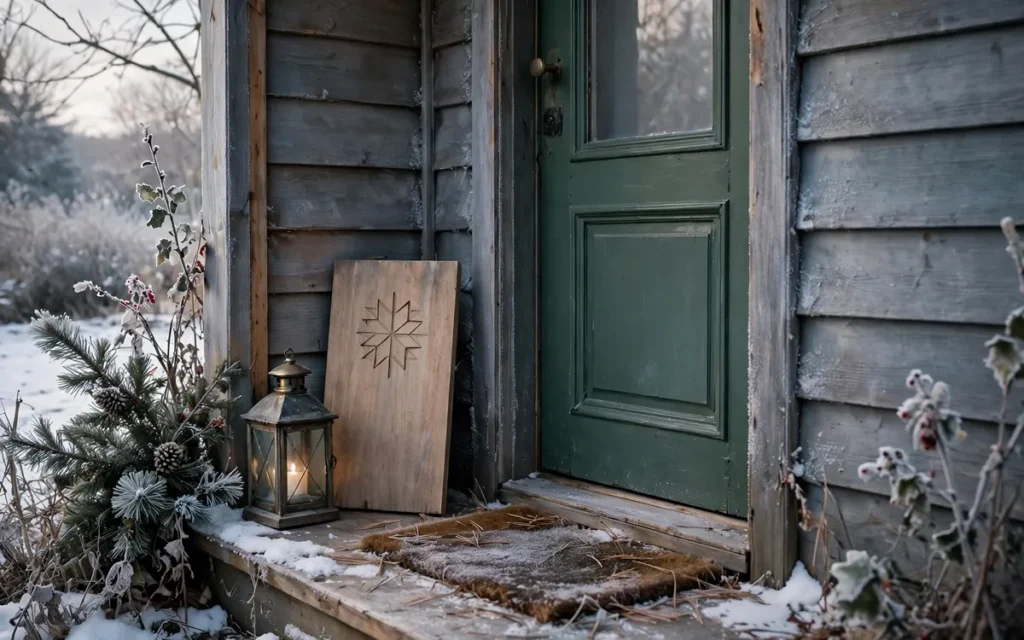
One plain sign leaned against the wall — a simple welcome, or a word-free winter motif — uses inches, not feet. Keep it under roughly a third of the door’s height and safely out of the swing arc. And keep December’s word signs in the box: dated text is exactly what expires in January, while a plain motif carries through to spring.
5. Match the Doormat to the Wreath’s Palette
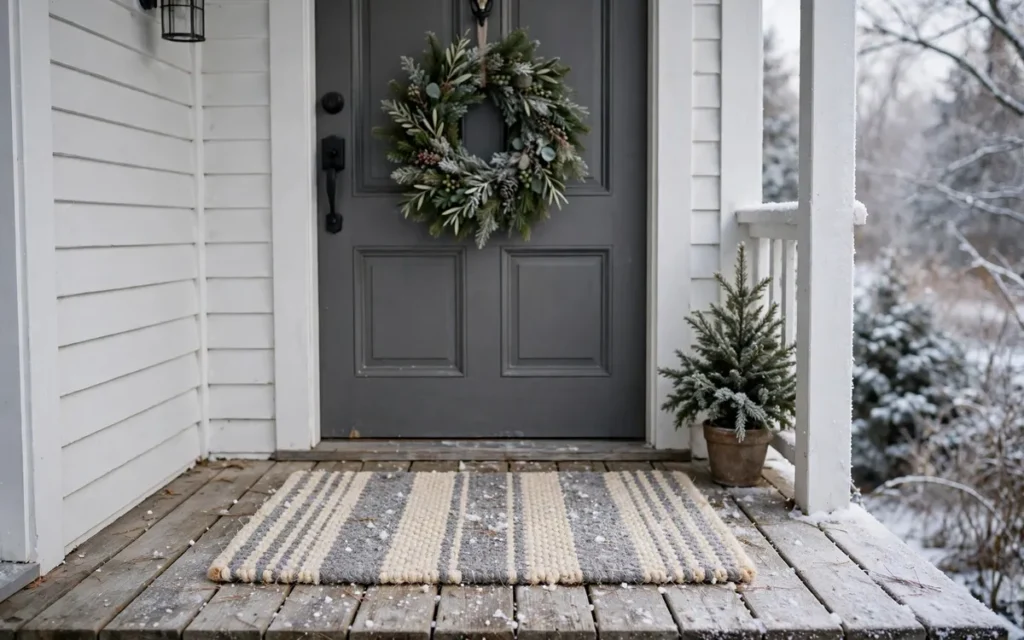
The cheapest coordination on the porch: a mat in the wreath’s cream, grey or evergreen family makes two separate pieces read as one composition. Choose coir or low-pile under about ½ inch (1.3 cm) thick, so the swinging door still clears it — a mat the door drags on will curl, bunch and become the trip hazard from the safety section.
6. Fill One Tall Planter With Winter Greenery

One statement planter of mixed evergreen, white berries and bare branches beats three small pots every time. Height about one-third of the door’s height reads in proportion from the street. Weight the base with gravel before filling: a tall planter is a sail in winter wind, and a tipped one blocks the very walkway the method protects.
7. Pair Two Slim Potted Evergreens

Symmetry is the small porch’s tidiest trick: two narrow conifers flanking the door make a plain entry look designed. Choose pots no deeper than about 12 inches (30 cm), and test the door swing with both in place before you fill them — a symmetric pair that the door hits is just two obstacles in matching pots.
8. Use a Galvanized Bucket for Tall Branches
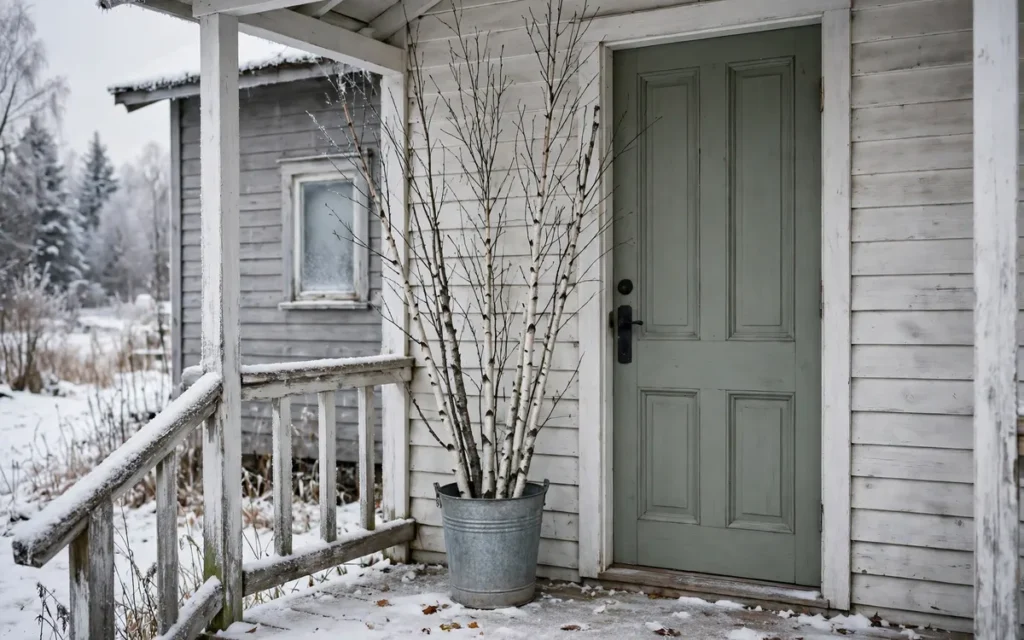
A metal bucket of birch or curly-willow branches gives real height on a footprint smaller than a dinner plate. It is the farmhouse staple from the Christmas porch, restyled: swap any red berries out for white ones, or none. Add a handful of gravel or a brick in the base — tall branches in a light bucket are the first thing a gust rearranges.
9. Stack Birch Logs in a Basket or Crate
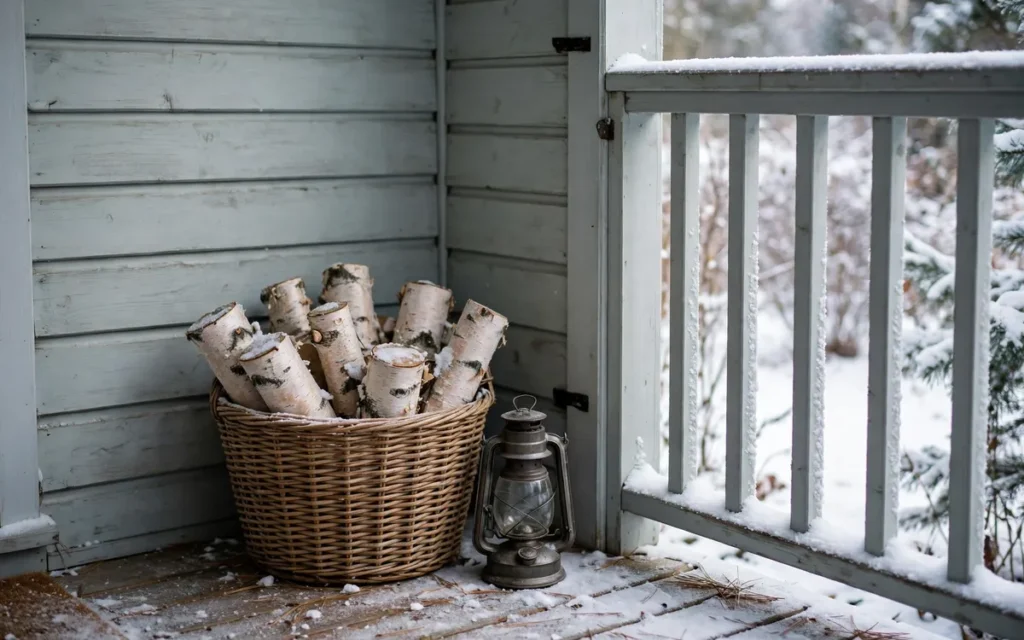
A small basket of birch logs is pure winter texture for about one square foot of floor. Logs read best cut to mixed lengths around 12–18 inches (30–45 cm). Stand the basket tight against the wall or on the decorated side of the steps — never in the walking lane, where a rolling log is a genuine hazard.
10. Fill a Basket With Pinecones and Dried Stems
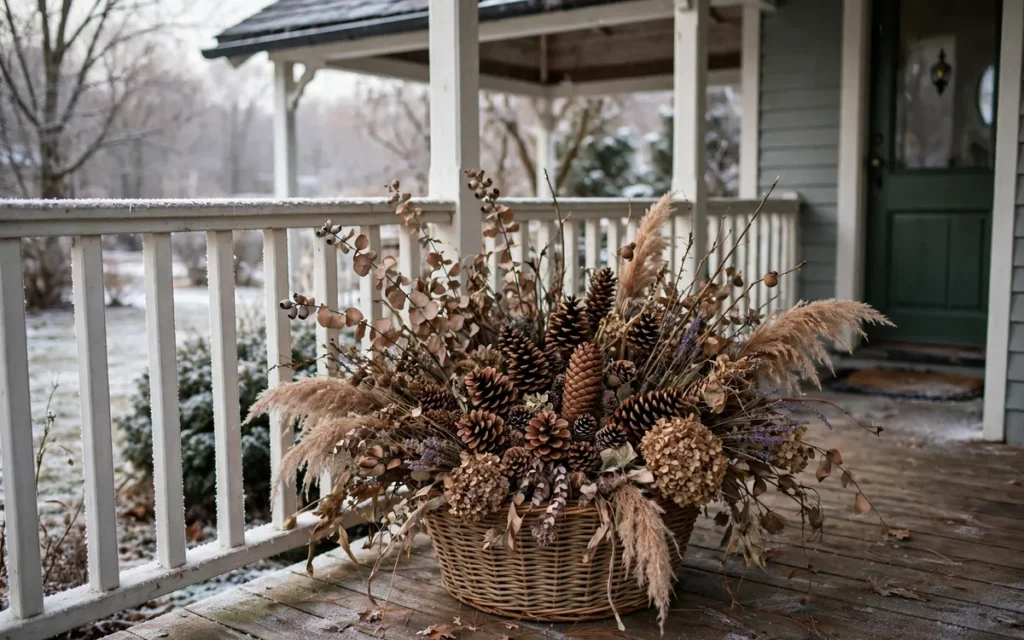
Cones are the longest-lasting free decor there is: a basket of pinecones and dried stems carries a porch from January to March untouched. Keep the dried stems under cover, because one week of rain turns them ragged — the cones themselves do not care about weather at all. Foraged cones cost nothing and never fade.
11. Tuck a Wall Planter Beside the Door
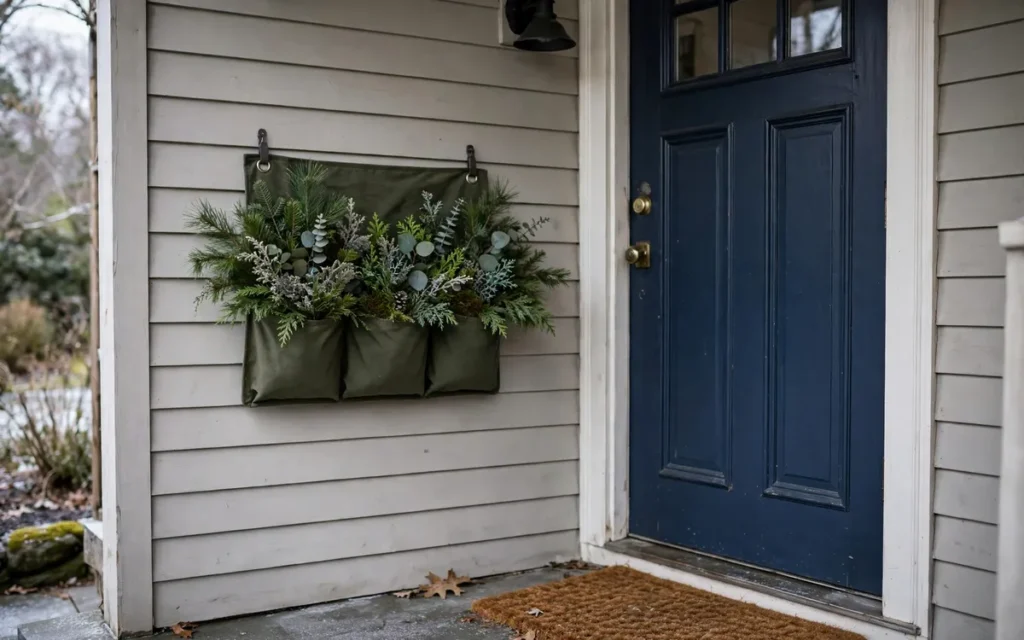
A wall-mounted pocket or half-basket of greenery beside the door spends wall, not floor — the vertical budget in its purest form. Mount it at about shoulder height on the handle side, where it greets arrivals without crowding the swing. Renters: outdoor-rated adhesive hooks do this job within their weight rating, no screws needed.
12. Layer a Doormat Over a Larger Outdoor Rug
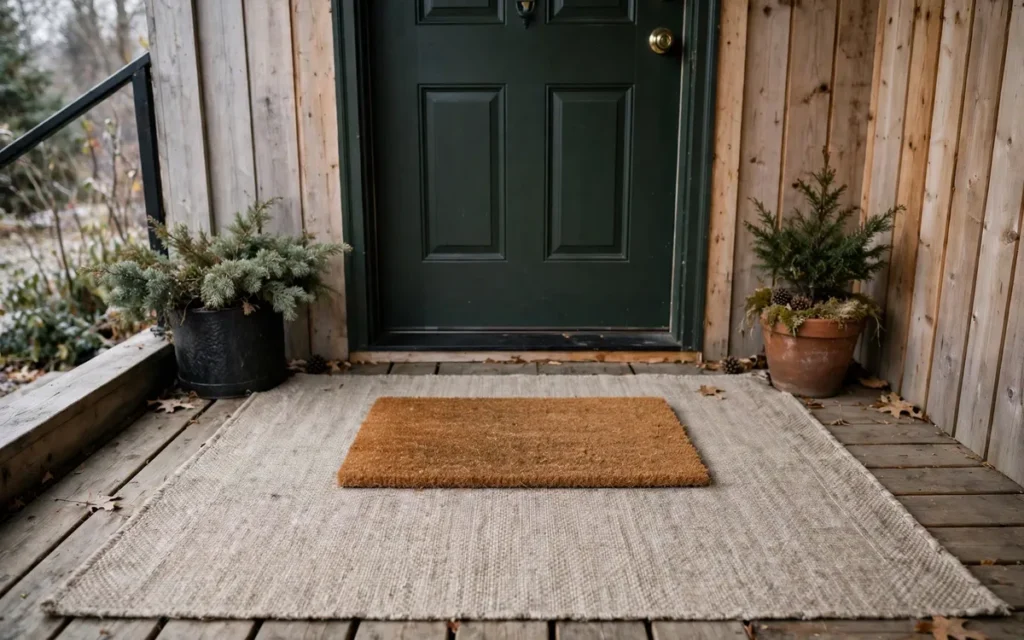
The layered-mat look, sized small: an outdoor rug a few inches wider than the door on each side, with a coir mat centred on top. Keep the total stack low enough for the door to clear and for boots not to catch the edge. Sweep snow off both layers — a rug edge buried in snow is a trip waiting to happen.
13. Keep One Side of the Steps Decorated, One Side Clear
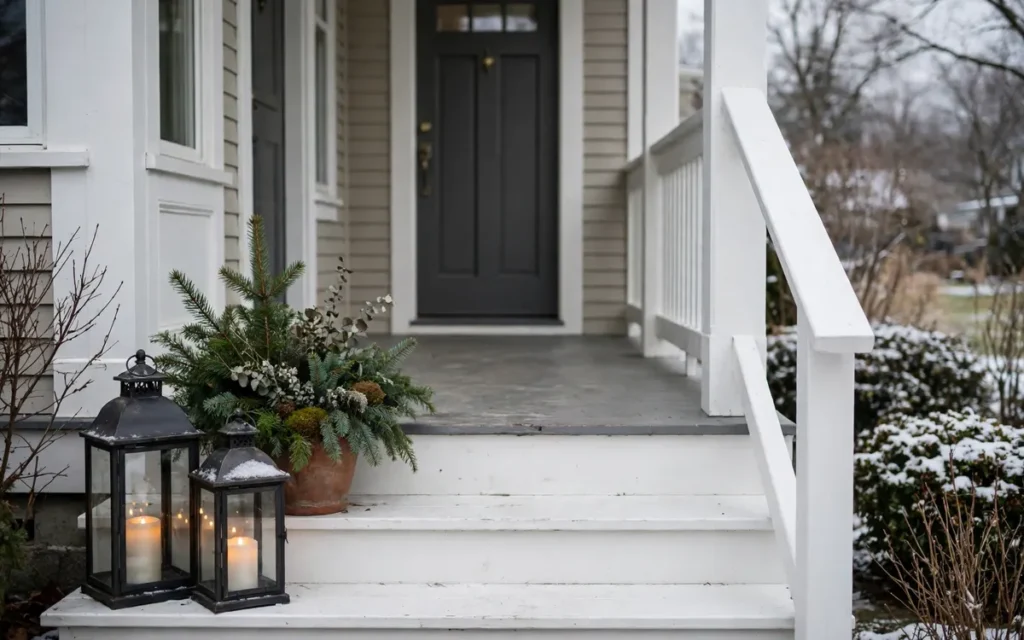
The step rule, stated plainly: decor groups on one side only. The other side stays empty for feet, the handrail, the shovel and the salt bucket. Pick the decorated side away from the handrail’s main use and the door’s swing, and hold the clear lane at about 36 inches (90 cm). This one rule does more for a small porch’s safety than any other in this guide.
14. Line the Step Edge With Lanterns on One Side Only

Two or three lanterns climbing one side of the steps light the way and look deliberate. Use flameless candles on timers, and place the lanterns on the decorated side only — on the edge or the landing beside the tread, never on the walking surface itself, where a lantern is just a well-lit obstacle.
15. Add a Boot Tray and a Small Storage Bench
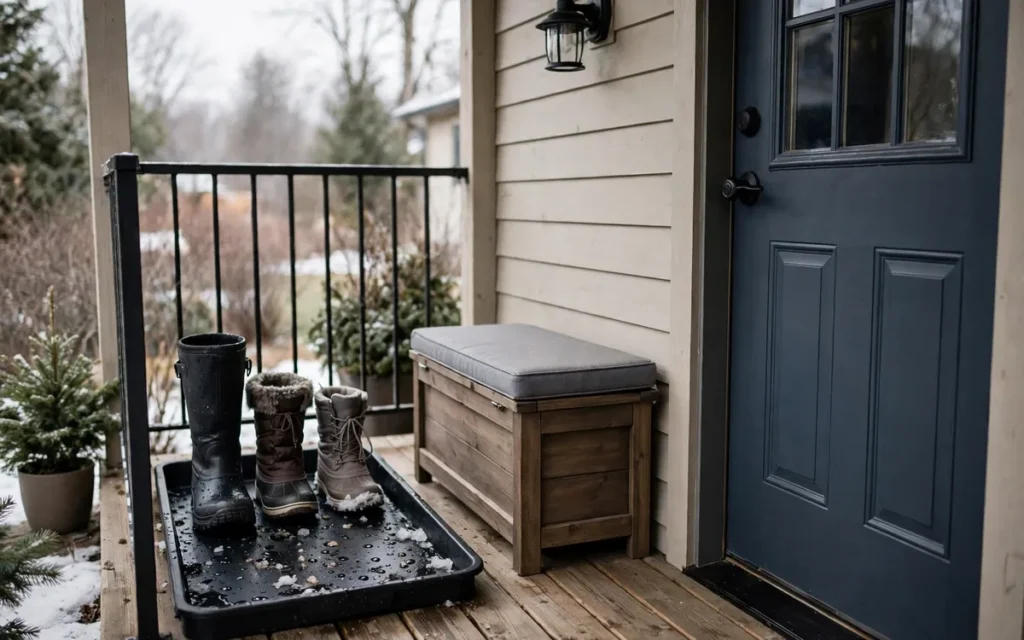
The hardest-working idea here: a boot tray catches the meltwater that winter boots carry in, and a small bench with storage swallows hats, gloves and the dog lead. The bench earns its place only if its depth stays under about 14 inches (35 cm) and the swing still clears; if it fails either test, keep the tray alone — it is the idea’s useful half.
16. Roll Out a Runner on a Long, Narrow Porch

On a shotgun-style narrow porch, a runner defines the entry zone and warms the boards without a single object taking floor space. Choose outdoor-rated, low pile, and secure both ends so it cannot creep toward the steps. Leave the last stretch before the steps bare — that is shovel room, and the runner will thank you for it in February.
17. Set Two Lanterns at Different Heights by the Door
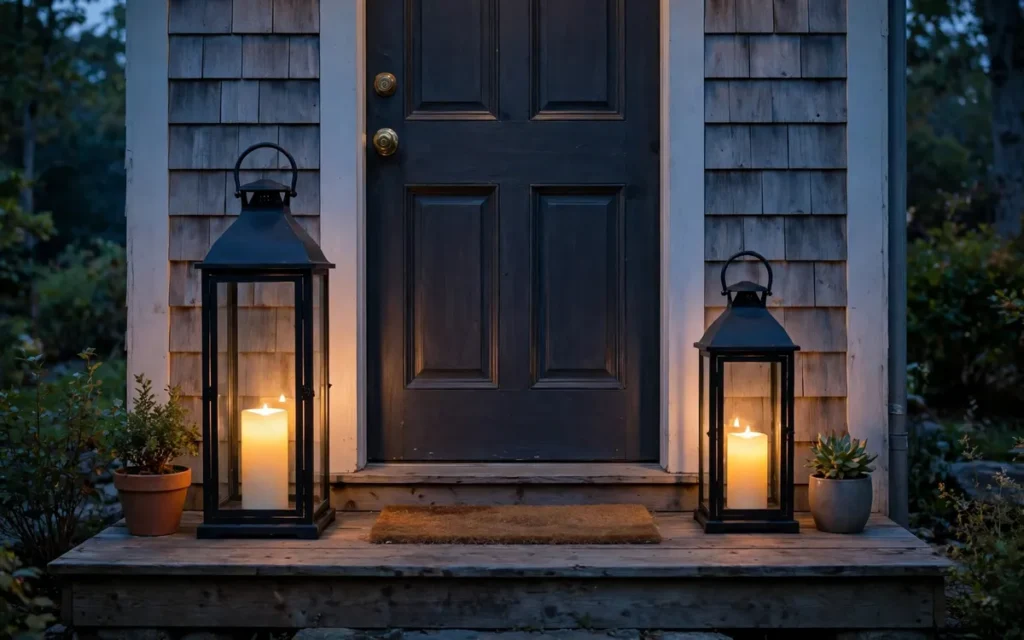
The classic pair, scaled down: one tall lantern and one short, grouped on the styled side of the door. Heights of roughly 18 inches and 12 inches (45 and 30 cm) give the stepped look without bulk. Flameless candles on a dusk timer keep the glow honest — on a small porch, two lanterns are plenty; a third starts a crowd.
18. Put a Lantern Inside a Planter

Two decorations, one footprint: a lantern nested inside a greenery planter is the small porch’s smartest square foot. Raise the lantern on an upturned pot hidden inside the planter, so its light clears the greenery rim instead of glowing into the leaves. The planter’s weight anchors the lantern against wind for free.
19. Run Battery String Lights Along the Door Frame or Rail
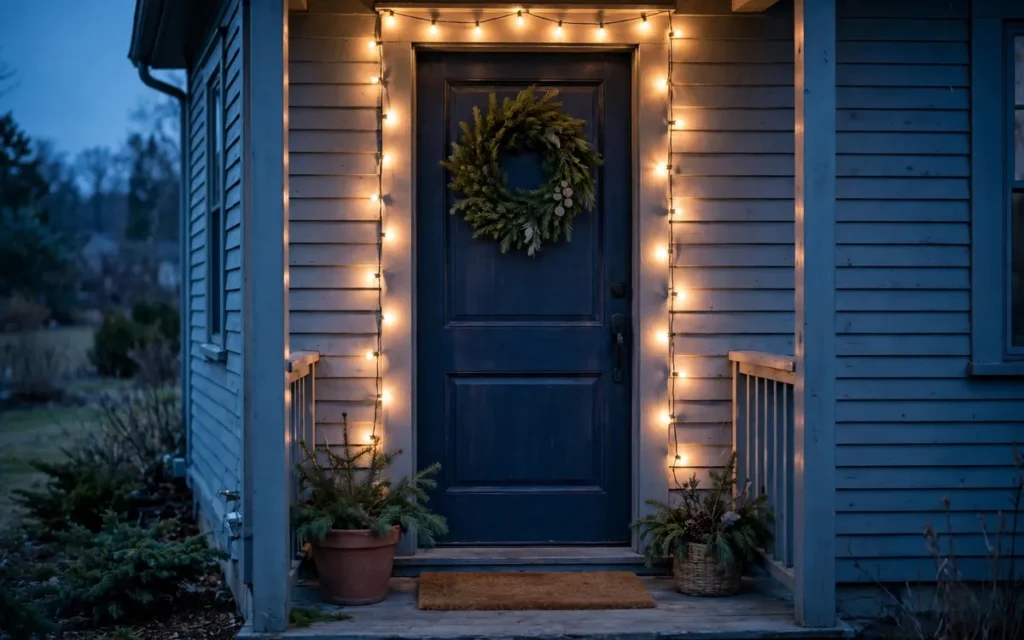
One warm-white battery strand along the frame or rail gives evening glow with no cord across the walkway and no outlet hunt. Tuck the battery pack dry inside the garland or a planter, and set the timer for the dusk hours only — the same discipline as a lit door wreath, and for the same battery-stretching reason.
20. Add a Flameless Candle Cluster in a Hurricane
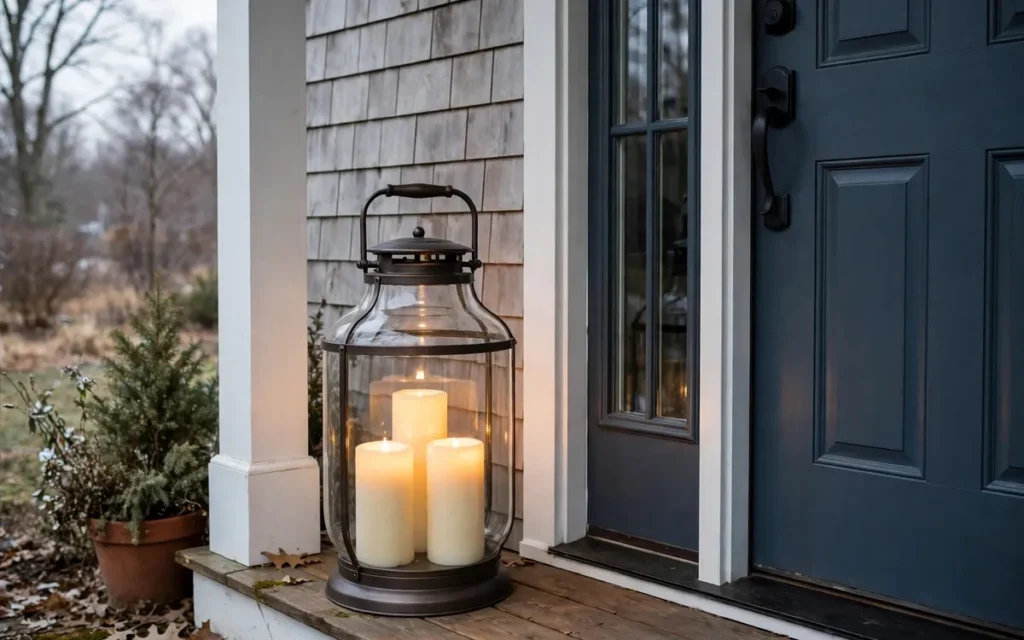
One glass hurricane holding two or three flameless pillars gives a sheltered, wind-proof glow where a lantern feels too big. The glass does the weatherproofing, which makes this the exposed-porch alternative to open lanterns. Keep it on the styled side, off the tread, and heavy enough at the base that a gust cannot walk it.
21. Light the House Number and the Step Edge

Glow with a job: a small solar or battery light washing the house number and the top step. It is the most welcome light on the porch for delivery drivers and guests finding the house after dark — and, on an icy night, the one that prevents a missed step. Decorative and safety lighting in a single small fixture.
22. Add a Small Chair With One Outdoor Cushion
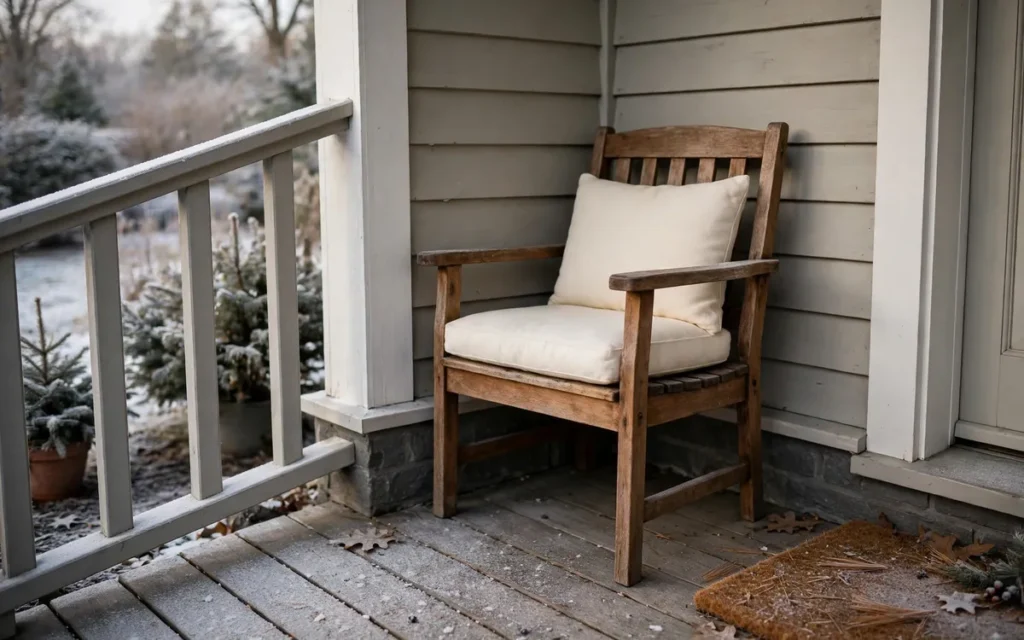
Only if the measured footprint honestly allows it: one compact chair in a winter-neutral cushion turns the porch into a place, not a passage. The swing-and-lane test decides — if the chair touches either no-go zone, skip this idea entirely. A small porch loses nothing by staying a passage; it loses everything by becoming an obstacle course.
23. Keep a Folded Throw in a Covered Basket

The cozy signal without leaving textiles in the weather: a folded outdoor blanket in a lidded basket by the door, brought out for a morning coffee and carried back in after. Lidded is the whole idea — an open basket of fabric is a sponge by February, and a wet throw convinces nobody of coziness.
24. Lean a Vintage Sled by the Wall
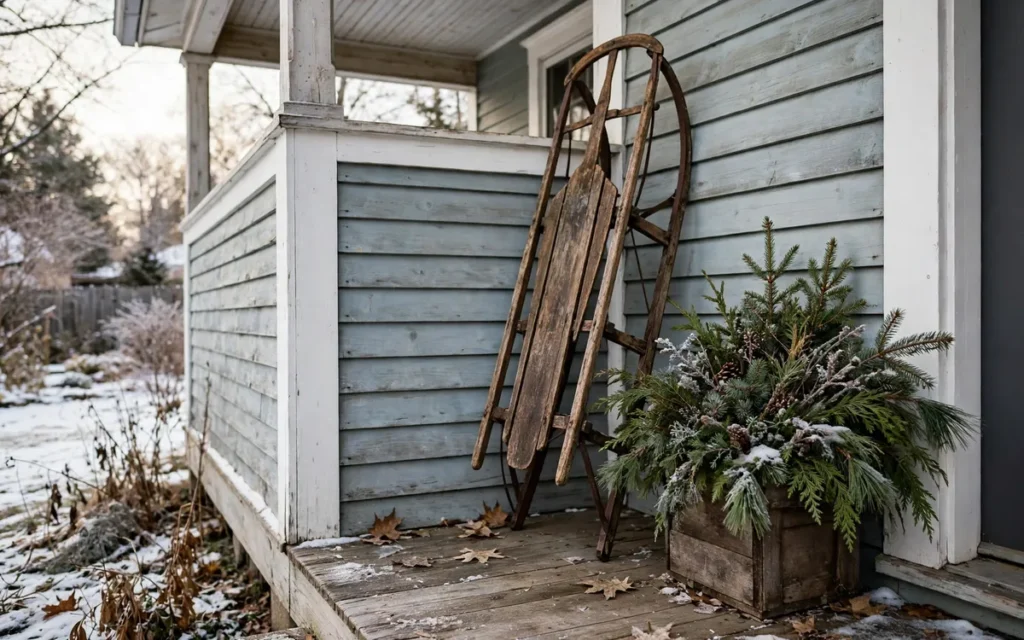
A wooden sled — or a pair of old skis — leaned against the wall is near-zero footprint and pure winter. Lean it on the wall away from the door’s swing, and secure the top with a discreet hook or strap in windy spots: an unsecured sled slides down slowly, then all at once, usually across the walkway.
25. Hang a Pair of Ice Skates or Mittens by the Door
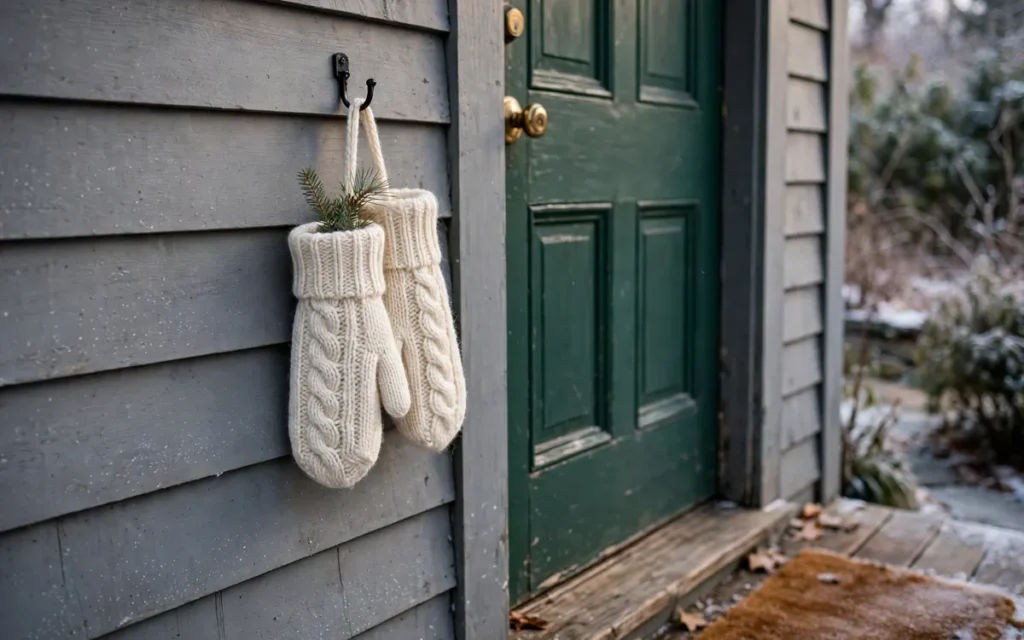
The small hanging accent: skates or knit mittens on a peg or hook beside the door, at about eye level on the handle side. It echoes the mitten wreath at porch scale and costs no floor at all. On family porches with small children, choose mittens — or keep skate blades guarded and hung high.
26. Style the Apartment Door: Wreath, Two Mini Trees, One Layered Mat

The renter’s whole porch in three removable pieces, for doors with no porch at all: a plain winter wreath, two small frosted trees flanking the mat, one layered doormat. Nothing fixed, nothing screwed; every piece light enough to carry in one trip. Keep the shared hallway and its fire route completely clear, and check the building’s rules first — they always win.
What a Small Winter Porch Costs: Three Budget Levels
Rough guidance levels, not product prices — shop your home first at every level.
$0 — the restyle. The stripped Christmas wreath stays on the door, December planters lose their red and glitter and keep their greenery, foraged pinecones and branches fill a basket, and a neutral fall doormat may even stay.
Under $30 — the refresh. A winter-neutral doormat or layering rug, one set of flameless candles with a timer, a bag of white berries or frosted cones, and painter’s tape and rated hooks if the old ones are tired.
$30–$100 — the composed small porch. One good tall planter or urn bought once for many winters, quality faux greenery sized to it, and a pair of lanterns — everything else at the lower levels. The season maths applies here too: the porch works eight to ten weeks, so cost-per-week favours one good planter over three cheap pots that crack in the first freeze.
7 Small Porch Winter Mistakes That Undo the Whole Look
- Decorating into the door swing. The first slam that knocks a planter or drags the mat announces the mistake. The swing arc is a no-go zone, measured in Step 1.
- Decorating both sides of the steps. Feet, shovels and salt need a clear side. A lantern on the walking tread is a trip hazard wearing a costume.
- Buying many small pieces instead of a few bigger ones. Six tiny objects on six square feet read as clutter; two calm, well-sized pieces read as design.
- Leaving December on the porch. Red berries, plaid bows and the Christmas mat underneath undo the winter conversion — the wreath rule, at porch scale.
- Running a mains cord across the walkway or through the door. A cord underfoot is a trip hazard; pinched in the door, it is worse. Battery lights and timers exist for exactly this.
- Leaving light pieces unsecured. The first storm redistributes unweighted baskets and sleds across the steps — and the neighbour’s lawn.
- Blocking the useful things. The house number, mail slot, delivery spot and handrail are part of the porch’s job. Decor that hides them makes the house harder to use and harder to find.
Small Porch Safety: Clear Steps, Safe Light and Secured Decor
A porch is a walkway first and a picture second, so keep the route from the steps to the door genuinely clear: decor belongs in the measured zones from the method — never on the walking surface of a tread, never narrowing the clear lane of about 36 inches (90 cm), and never where the door’s swing can push it into someone’s path. Decorate one side of the steps and keep the other bare for feet, the handrail, the shovel and the salt bucket, and clear snow and ice before styling rather than around the decor — planters and lanterns that trap meltwater against a step create the very ice patch everyone then walks on. Keep mats flat and secured, because a curled or snow-buried rug edge is a classic winter trip, and lift and re-lay them after heavy snow. Treat ice-melt as a chemical, not a garnish: keep chloride salts out of planters and off metal buckets and lantern bases, where they corrode finishes and burn the greenery they touch, sweep up the excess once the ice has gone instead of letting it grind into the porch boards, and use a plant-safer melt near beds and pots where you can. Sweep dropped needles and cones off the steps for the same reason — organic litter on a wet step is a slip layer.
Give the porch its glow the battery way: flameless candles and battery string lights rated for outdoor use, packs tucked dry inside planters or garlands, timers set for the dusk hours. Never run a mains cord across the walkway, along the steps or through the closing door, where feet trip on it and the door crushes it — a pinched cord is a fire and shock risk, not a shortcut. Real flames belong only inside enclosed lanterns, set on the decorated side away from the wreath, garlands, ribbons and the door’s swing, and never left burning unattended; on an exposed or windy porch, flameless is the honest default. Then secure the whole composition against the season: weight planter bases, tie garlands at their corners, strap or hook anything leaned against a wall, and walk the porch after the first big storm to see what the wind moved — then move it back inside the measured zones, or indoors. Change button and coin batteries with the pack out of children’s reach, since swallowed button batteries are a serious emergency. Where any of this differs from your local rules, your building’s regulations or a manufacturer’s own ratings and instructions, those win.
Frequently Asked Questions
How do I decorate my front porch for winter without it looking like Christmas?
Change the signals, not the pieces: red, glitter, dated words and novelty shapes come off; evergreen, wood, white berries, pinecones and warm battery light stay. The neutral palette — cream, evergreen, natural wood, grey — is what reads as “winter” from the street. The method and Zone 1 above are the full version.
When should I put winter porch decor up, and how long can it stay?
Right after the Christmas takedown in early January is the natural moment, and a winter porch is built to stay until the end of February — or the first spring signs in milder places. Real greenery pieces may retire earlier if they dry out, as the safety section explains.
How do I decorate a small porch with almost no floor space?
Spend height, not floor: the door piece, a door-frame garland, a wall planter and tall branches in a slim bucket decorate the porch while the floor keeps only a mat stack and at most one planter. Measure first (Step 1), hold the one-focal-point rule (Step 2), and let the vertical budget do the rest.
Can I decorate a rented porch or an apartment door?
Yes, within the no-fix rules: rated over-door hooks and outdoor adhesive instead of screws, everything removable, and nothing stored in a shared hallway or blocking its fire route. Check the building’s own rules first — they override any decorating guide. Idea 26 styles a whole apartment door in three removable pieces.
How do I stop porch decor blowing away or being ruined by weather?
Weight and tie everything light: gravel in planter bases, garlands tied at their corners, leaned pieces strapped. Match materials to the exposure — faux and sturdy on open porches, dried and delicate under cover — and walk the porch after storms to reset whatever the wind moved. Step 5 and the safety section carry the full routine.
How much does it cost to style a small winter porch?
It can honestly cost nothing: the converted Christmas wreath, restyled planters and foraged cones cover most small porches. The refresh level — a neutral mat, flameless candles, hooks — sits under about $30, and the composed level of one good planter and a lantern pair under about $100. The budget section above has the three levels.
Before a small porch is dressed for winter, it helps to sort the year-round fitting underneath. Small front porch ideas show how to spend that depth honestly, keeping the 36-inch path to the door clear and grading seating to the porch’s class. With the fixed points finished at the door’s own sizes, the winter layer then sits on a porch that already works.
The window above the porch is part of the same first impression, and it deserves the same measured planting: our window box flower ideas fit the box to the window it hangs on, so the flowers frame the door instead of fighting it. Winter evergreens at the door, colour at the window — the entrance reads as one composition from the kerb.
Conclusion
Measure the footprint, anchor the door, rise don’t spread — and a small porch stops apologising for its size. Fewer, bigger, well-placed pieces beat a crowd every time, and the rules that keep the walkway clear are the same rules that make the composition look deliberate. The wreath at this porch’s centre is styled in depth in our winter wreath ideas guide, and the whole-home version of the reset is the January edit in our winter decor guide. Next and last in this January series, the reset comes indoors to the table: a winter tablescape after Christmas, carrying the same calm palette to the dining room. Until then, these small front porch winter decor ideas all rest on one truth — a small porch does not need more decor. It needs the right decor, in the right places, measured first.



5 Comments