

29 Serene Winter Decor Ideas for the Home That Carry You to Spring
There is a sadder room than any empty January house: the living room on the day the tree comes down, when a home goes from its best-dressed month to bare in a single afternoon — and then stays bare through the darkest, coldest weeks of the year. The tree was never the whole show. It was just the loudest part of it.
Here is the reversal that organises everything in this article: winter decor is not a second decorating season, and it is not bought. It is edited out of Christmas. Most of what made December glow — greenery, warm light, candles, texture, pinecones — was never Christmas-specific at all; only the symbols were. So this article is transition-first: the takedown order, the keep/restyle/store test, the palette swap and the lighting plan. Then come 29 winter decor ideas for the home, room by room — most of them costing nothing, because they are already standing in your rooms.
The January Edit: A Christmas-to-Winter Transition System
Take Down in the Right Order
Three passes, in this order, because the order is what stops the house feeling stripped. Pass 1 — the symbols: anything that names or pictures the holiday — figures, stockings, worded signs, themed cushions, the tree’s ornaments — goes first, and the room instantly calms. Pass 2 — the colour: bright red and glitter leave next — ribbons, berries, shiny baubles — which converts most of what remains from “Christmas” to “winter” within an hour. Pass 3 — the sparkle edit: tinsel, coloured lights and novelty pieces. What survives all three passes is the winter decor, already in place. Work room by room, most-used room first, and never do pass 1 in every room on the same day unless a bare house is genuinely the goal. For another household’s walk-through of the same edit-first approach, this after-Christmas transition guide runs the same pack-away and keep-out logic room by room.
The Keep / Restyle / Store Test
Three questions, asked of every piece before it is touched. Does it name the holiday? A figure, a word, a Santa — store it. Is it red, glittery or novelty-shaped? Store it, or restyle it if the shape underneath is neutral. Is it natural, textured or a source of warm light? Greenery, pinecones, wood, wool, candles, warm-white lights — keep it; this is the winter collection. The test’s value is that it is finishable: a room’s worth of decor sorts in minutes, and the “store” pile is far smaller than most people fear — which is the budget section’s whole argument, made in advance.
The Winter Palette Swap
State the palette as swaps, not a mood board. Bright red becomes cream, or leaves entirely — deep burgundy is the one red allowed to stay. Christmas green becomes deep green and sage, which is simply the greenery itself, unadorned. Gold glitter becomes aged brass, pewter and warm wood. Coloured lights become warm white only. The result — white, cream, warm wood, deep green, one aged metal — is the same calm base our neutral christmas decor ideas built December on; winter is that palette’s second season, kept standing after the symbols leave.
Replace the Glow, Don’t Lose It
The tree’s lights were doing more work than any ornament on it, so the glow needs a plan, not a goodbye. Bulbs and string lights stay warm white, roughly 2700–3000K, never cool white. Light sits at three heights in the main rooms: a lamp, a candle group, a string of fairy lights as background. Fairy lights are relocated, not retired — into glass jars, hurricanes and along shelves, on timers so the glow arrives by itself at dusk. And the working rule is one lit moment per room, minimum — the line between an edited room and an emptied one.
The Two-Layer Rule
The stop rule that keeps the edit from becoming a second shopping season. A room reads as “winter” — not “aftermath” — when it has one texture layer (a knit, wool or faux-fur textile, or a natural material on display: wood, pinecones, branches) and one light layer (candlelight, fairy lights, a warm lamp’s glow). If a room has both, it is done; move to the next room. If it has neither, it needs exactly two additions — and the system above has just shown where in the house they probably already are.
1. Strip the Tree to a Winter Tree
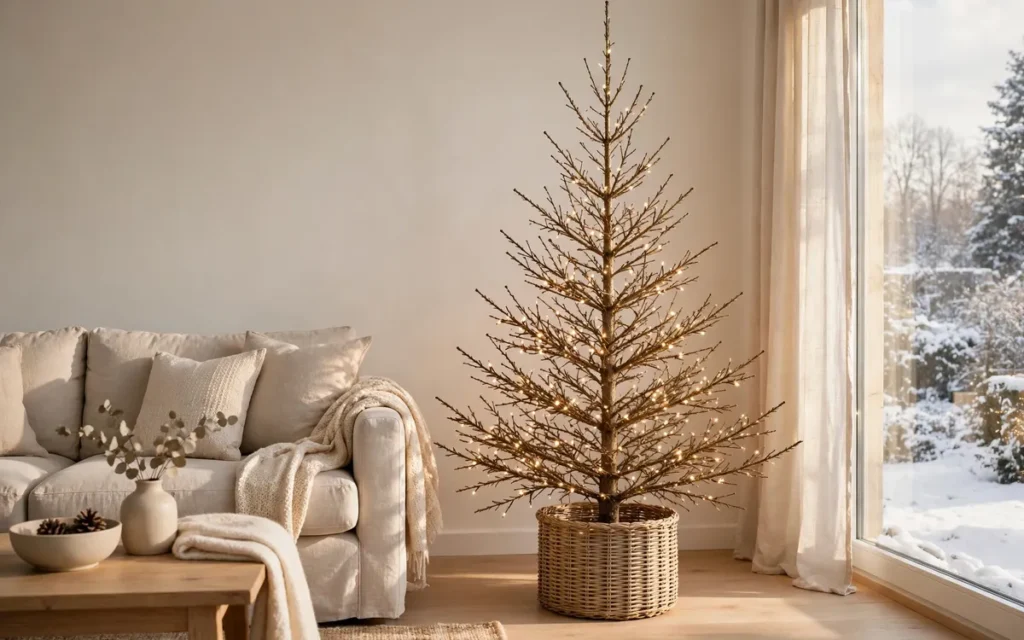
Ornaments and ribbon off, warm lights left on. A bare, lit tree — in its basket or a plain stand — reads as winter woodland rather than leftover Christmas, and it buys the room its glow back for the whole of January at the price of one honest hour’s work.
Not every tree earns this: a tree that is dropping, browning or shedding heavily goes out whole, and the glow moves to the jars of idea 5. A good artificial tree or a fresh, still-hydrated real one can hold January beautifully — sparse, lit, and somehow calmer than it ever looked in December.
2. De-Christmas the Garland, Keep the Greenery

Strip the ornaments, bows and berries out of the Christmas garland and let the plain greenery run on into winter — along the mantel, a shelf, the stair rail. A garland was always a winter object wearing Christmas accessories; remove the accessories and the season changes underneath it.
Work along it slowly, because this is where December’s clips, wires and twist ties reveal themselves. Real greenery has a lifespan (the safety section gives the touch test); a good faux garland, de-Christmassed, will do this job for years of Januarys.
3. Re-Dress the Wreath in Neutrals

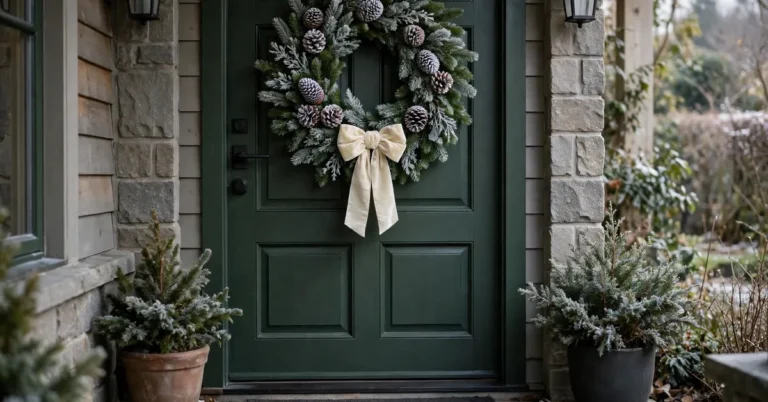
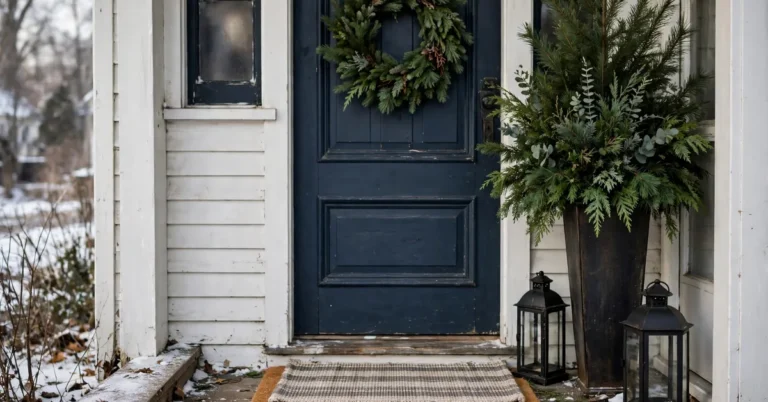
The same wreath, a new season: the red bow swapped for linen or cream, the bright berries out or swapped for white ones, the base of honest evergreen left exactly as it is. A wreath re-dressed this way hangs on the front door until spring without a single neighbour wondering why Christmas is still up.
Its care and hanging follow the same methods as our christmas wreath ideas — a sound wreath, honestly hung, out of the door’s swing path. If the base greenery is real and already brittle, re-dress a faux wreath instead and compost the real one with thanks.
4. Keep the White Ceramic Village

White houses and bottle-brush trees were always winter scenery, not Christmas symbols. Regrouped on a tray or a windowsill — with the red-roofed pieces and every Santa stored — the village stays out until spring, and January gets a small lit town of its own.
The arrangement follows the same riser and one-theme method as our christmas village display ideas, minus the Christmas figures: back row raised, one warm light colour, breathing room between buildings. On a sill it becomes the street’s favourite window; on a tray it can migrate to whichever room needs its glow.
5. Move the Fairy Lights Into Jars and Shelves

The tree’s string lights are not retired; they are redistributed. Coiled loosely into glass jars and hurricanes, run along bookcase shelves, tucked behind the village — on timers, so the whole house exhales into glow at dusk without a single switch being hunted down.
LED sets only, inspected as they move: a set that was damaged in the takedown is retired, not relocated. Battery packs and plugs stay accessible and off soft furnishings. This one relocation does more for January than any purchase in this article — the light was the luxury all along.
6. Swap Holiday Candles for White and Cream
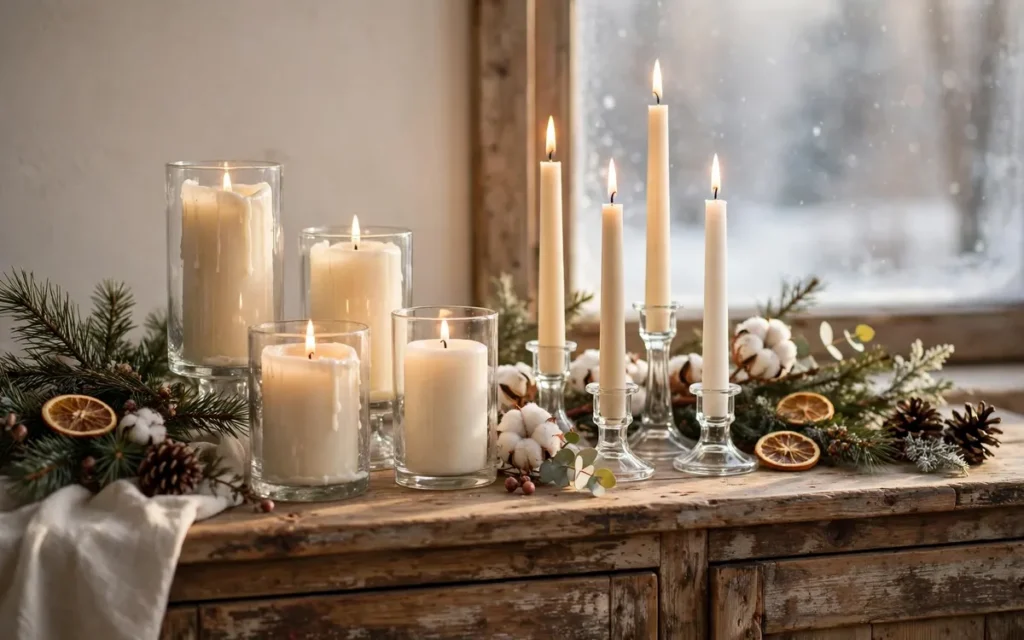
Red and green candles go into the Christmas box; white and cream pillars and tapers stay out and get regrouped — on the mantel, the table, the sideboard. Candlelight was a winter idea that Christmas borrowed, and winter is simply taking it back.
Group them in threes at varied heights, in glass or metal holders, and mix in flameless pillars anywhere the group cannot be watched. A house lit by cream candles in January looks intentional; the same house with two red candles left over looks forgotten.
7. Keep the Greenery, Lose the Sparkle

Where the decorated arrangements stood, put plain greenery: pine, cedar or eucalyptus in crocks, pitchers and vases, with the tinsel, baubles and glitter stems removed. Living texture, zero sparkle — the single most reliable “this is winter now” signal a room can send.
Eucalyptus earns a special mention: it dries gracefully instead of shedding, so a January arrangement of it still looks deliberate in March. Mist stems lightly where the plant allows, and replace any arrangement the week it starts to look tired rather than the month after.
8. Layer the Sofa in Knits, Wool and Faux Fur

The texture layer, done properly: throws in three natural textures — a chunky knit, a woven wool, a faux fur — over the sofa’s arms and back. The Christmas cushions carried visual warmth; these carry the physical kind, and January evenings are exactly when the difference matters.
Drape rather than arrange: a throw folded over an arm and one pooled in the corner seat invites use, and a winter living room should look used. Keep the palette to creams, oatmeal and one deep tone, and the sofa becomes the palette swap’s largest single proof.
9. Swap Pillow Covers to Winter Neutrals

Covers, not new pillows. Cream, oatmeal and charcoal checks, with at most one snowflake or woodland motif, zipped over the same inserts that wore December’s reds. It is the fastest palette swap in the house — ten minutes, one wash-load of old covers, done.
Covers store flat in spring, which is the entire economic argument (the budget section returns to it). If the household’s covers are all strongly Christmas, one set of cream covers is the single purchase this whole article most recommends.
10. Build a Blanket Ladder Corner

A ladder — or, with no ladder, a generous basket — holding the household’s throws in the corner where people actually sit. Storage that displays: the blankets are the texture layer, the ladder is the furniture layer, and the room’s emptiest corner gets a job.
Rungs or basket, keep it beside the seating, not across the room; a blanket stationed out of reach is decor, while one within arm’s reach is comfort. Birch or warm wood suits the palette; a metal ladder works if its finish is the room’s one aged metal.
11. Fill Tall Vases With Pinecones and Light

Pinecones layered with a string of fairy lights inside tall glass vases, grouped in odd numbers and varied heights on a console or hearth side. The pinecone — December’s filler — is promoted to the room’s lamp, and it suits the office.
Build the layers loosely so the light can travel, and use a battery set with its pack tucked at the vase’s neck for access. In front of a mirror the effect doubles. When a cone eventually gathers dust, the whole arrangement lifts out, shakes off outdoors, and rebuilds in five minutes.
12. Style a Winter Coffee Table Tray

The coffee table’s Christmas centrepiece, edited by the test: candles, pinecones, a short stack of winter-toned books and one green sprig, all contained on a tray. What remains after the symbols leave is a display that looks chosen rather than survived.
The tray keeps its other virtue — the whole arrangement lifts away for games, puzzles and feet-up evenings, and returns in one move. Keep one element of height (a candlestick, a small vase) so the flat naturals have something to gather around.
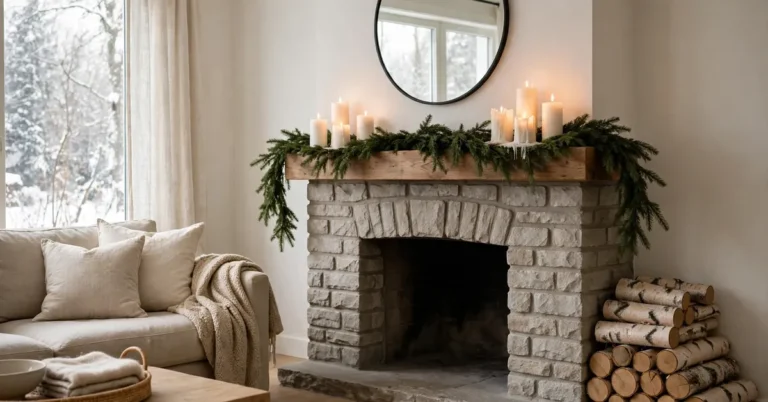
13. Light the Mantel With Candles and Bare Branches

The mantel after the garland edit: brass or glass candleholders in a row, white candles, and a tall vase of bare branches for height — no red anywhere. It is the same mantel our christmas fireplace decor ideas built for December, restyled by subtraction — and a deep winter-mantel article is coming later in this series for households who want the mantel’s own full method.
Over a working fire, candles keep their distance from heat and mantel greenery alike (the safety section sets the rule). The branches do the silhouette work the garland used to do, and bare branches, unlike greenery, never dry out mid-season.
14. Run a Candle Trough Down the Table
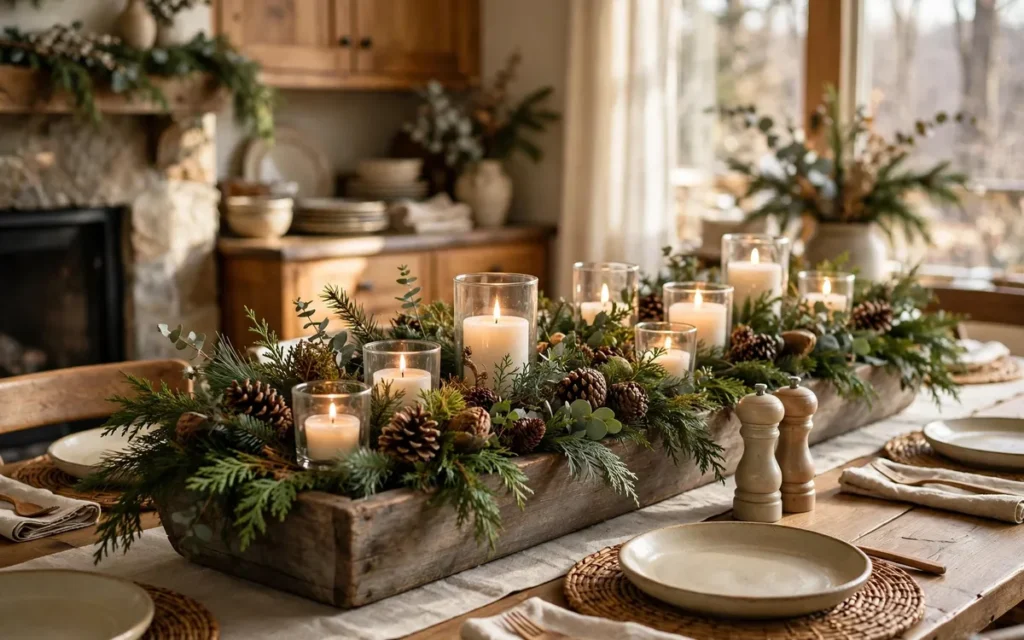
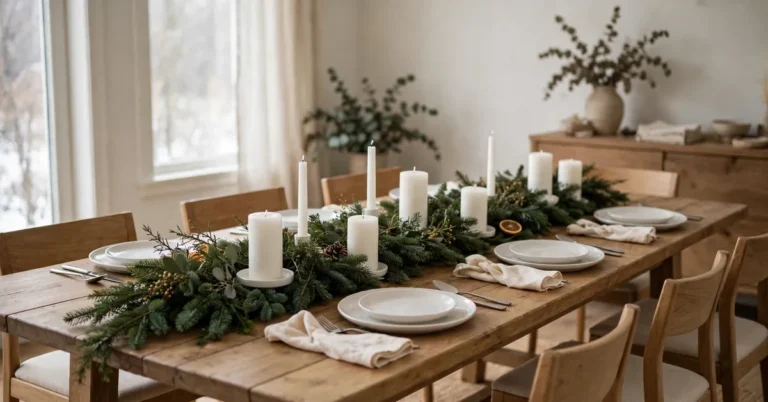
A long wooden box or trough down the dining table’s centre: candles in glass holders, pinecones and greenery tucked between them. It is built almost entirely from Christmas’s leftovers, and it turns January’s ordinary dinners into occasions without a tablecloth in sight.
Glass holders are not decoration here — they are the fire discipline that lets a candle row live on a table for months (see the safety section). Keep the trough’s contents below eye level across the table, and let one end hold a small stack of the season’s cookbooks for the kitchen-table version.
15. Set a Simple Winter Tablescape Base

A linen runner, white dishes, wood chargers and one metal, left as the table’s resting state: dressed at rest, so a January dinner needs no occasion and no effort. This is only the base layer — the full after-Christmas tablescape, course by course, gets its own article later in this series.
The discipline is subtraction again: nothing on the table that has to move before a meal can happen. Chargers and runner stay; centrepieces (idea 14’s trough) lift off in one piece. A table that is always nearly ready gets used; a table that is a project gets walked past.
16. Set Up a Hot Cocoa and Coffee Corner

One deliberate cosy station in the kitchen: a board or tray on the counter with mugs, glass jars of cocoa and marshmallows, the coffee things gathered rather than scattered. It gives winter’s longest evenings a destination, and guests find it without asking — the hallmark of a station done right.
Keep it off the prep surfaces and out of the hob’s splash zone, and let the jars be glass or stoneware in the winter palette. A small winter print leant behind it is the only decoration it needs; the mugs, marshmallows and steam do the rest nightly.
17. Tray the Kitchen Island With Mini Trees
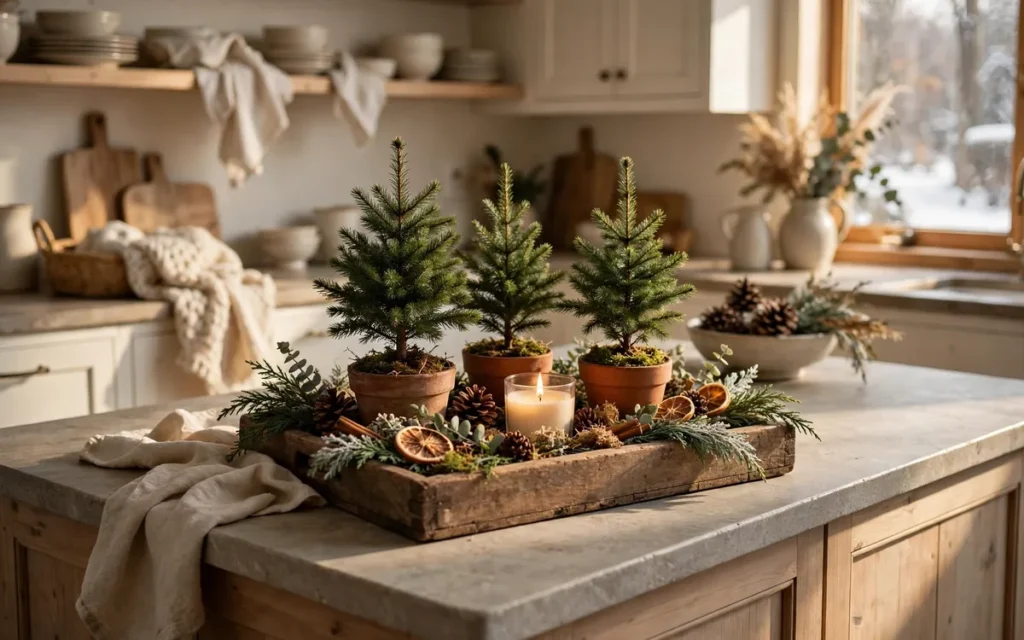
A wooden tray on the island holding a figure-free grouping: small potted evergreens, a candle, perhaps a stoneware jug. Contained, handsome, and — the island rule — slide-aside in one motion when the workspace is needed, which is most of the time.
Nothing on the tray names a holiday, so it can honestly stay until spring, changing only as the little evergreens get re-potted or swapped. Flameless candle only if the island doubles as a homework or paperwork surface where papers drift toward flames.
18. Stand Bare Branches in a Tall Vase

Birch, willow or good cut branches in the tallest vase in the house, in a corner or at the hearth’s side: winter’s own sculpture, costing nothing from the garden or very little from a florist’s bucket. Branches give an edited room its height back — the vertical line the tree took with it.
Cut them long and let the vase be heavy; a branch arrangement that can be knocked over by a sleeve will be. Pussy willow, when it appears later in the season, is this idea’s February promotion (idea 29 builds the edit around exactly that swap).
19. Fill a Basket With Logs and Greenery

A big basket of birch logs and evergreen branches by the fire or inside the front door: the outdoors brought in, and in an entryway it is the whole decoration in one object. The logs’ pale bark is practically the winter palette standing upright.
Placement carries a rule, stated fully in the safety section: the basket stands well clear of the fire’s opening and its heat — a hearth-side basket is decor at a respectful distance, never a fuel store within spark range of a lit fire. By the door, no such care is needed, and the basket can be generous.
20. Layer White Bedding With a Chunky Knit Throw

The bedroom’s winter edit: white or cream bedding kept bright against the early dark, with one heavy knit or faux-fur layer across the foot. Bedrooms benefit most from the palette swap — December’s bedroom novelties store easily, and what remains is a room that looks like a hotel in the Alps.
The chunky layer is functional, not decorative: it is the blanket reached for at 6 am. Wash or air stored winter bedding before it goes on — three seasons in a box leaves a mustiness that no amount of styling covers, and January’s bedroom should smell of nothing but clean cotton.
21. Line the Windowsill With Flameless Candles

A row of flameless candles on timers along the windowsill: the street-facing glow of a candlelit window, with no flame near curtains and no nightly rounds of blowing out. From inside, the sill becomes the room’s low horizon of light; from outside, the house looks inhabited and warm.
Timers set once, to dusk, run this idea unattended for the whole season — which is why flameless earns its keep here over real candles. Vary the heights slightly; a perfectly uniform row reads as a shop display, and a slightly irregular one reads as a home.
22. Dress the Bathroom Shelves With a Mini Vignette

A small winter print, a sprig of greenery and one white ceramic house on the bathroom shelves — everything small enough that the shelves still do their job. The bathroom is the guest-seen room, and its winter takes two minutes: this is it, complete.
Choose pieces that tolerate steam: ceramic, glass, metal, and greenery of the eucalyptus kind that dries gracefully. Paper prints go behind glass or in another room. A bathroom vignette that mildews by February helps no one, so air the room as usual and let the vignette be modest.
23. Add a Faux Fur or Sheepskin Layer

One sheepskin or faux-fur throw — over a reading chair, at the bed’s foot, under a lamp’s pool of light. Square metre for square metre, this is the highest-texture addition in winter decorating: a single layer that changes how a whole chair, and the corner it sits in, feels.
Real sheepskin wants a shake outdoors and a brush now and then; faux fur wants the wash instructions actually read, since heat ruins its pile. Either way, place it where hands land — the point of the layer is touch, and a fur draped where nobody sits is a photograph, not a comfort.
24. Hang Wooden Snowflakes Where the Garland Hung

Wooden or white snowflakes along the mantel front, in the window, or down the wall the garland vacated: the one motif that says winter while naming no holiday at all. They fill December’s exact footprints, which is a mercy — the hooks and nails are already there.
Keep them light and their fixings kind, and group them in odd numbers at uneven heights like falling snow rather than a border print. In a child’s room they can be joined by paper ones; everywhere else, wood and white keeps the palette’s calm.
25. Bring In One Vintage Winter Piece
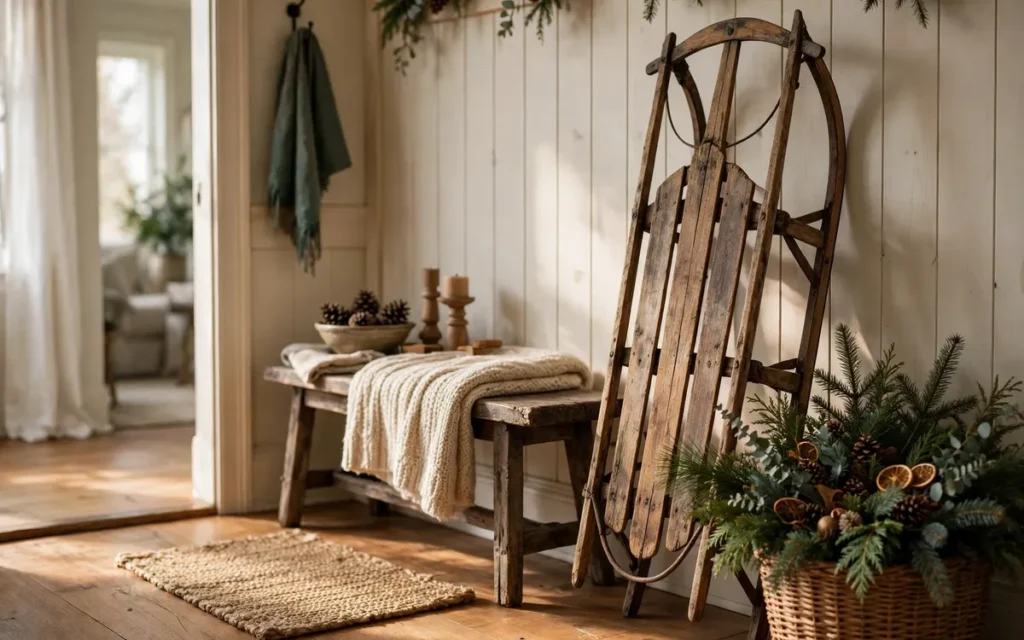
A sled leant by the entry, snowshoes or old skis on a wall, a toboggan slipped under the console: one genuine winter antique does the character work of a whole bin of themed decor — and stores flat when spring comes. It is the winter cousin of this library’s vintage Christmas thinking: real objects, honestly worn.
Check any leant piece for splinters and stability, and felt-pad the wall contact points. One piece is the discipline: two sleds is a shop. The entry is its natural home, where it greets the season at the door and asks nothing of the living rooms.
26. Fill a Bowl With Pinecones and Natural Finds
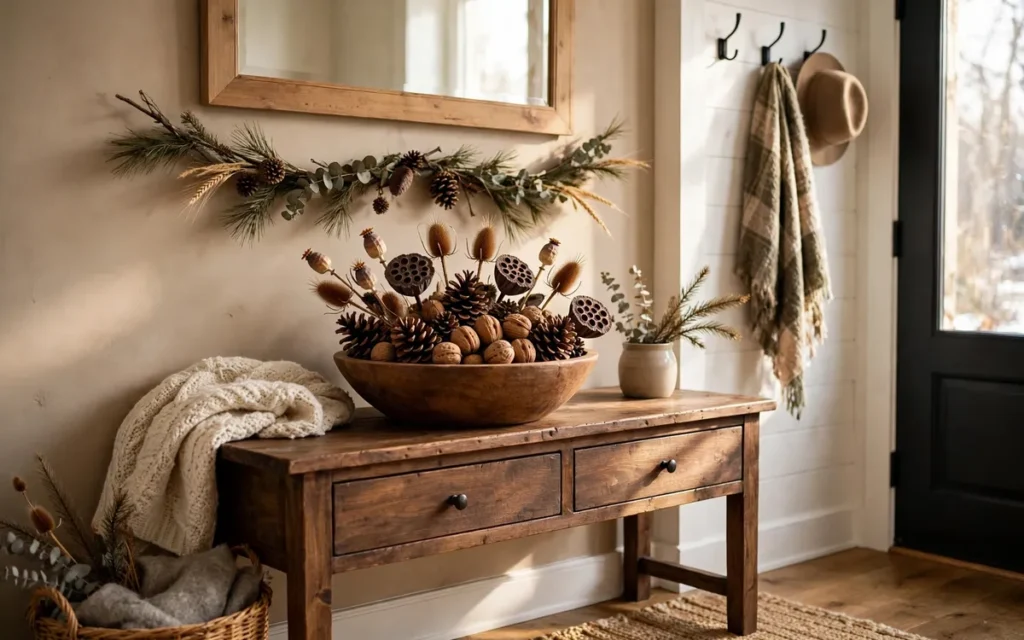
A wooden or stoneware bowl of pinecones, walnuts and dried seed heads, on the entry console or the coffee table: gathered, free, and the Keep test’s “natural” category in a single object. It is the smallest complete winter decoration there is.
Shake and air gathered naturals outdoors first — cones open as they warm, and anything living in them should stay outside. A bowl like this also ages gracefully: refreshed with a few new finds on a February walk, it is the February edit (idea 29) at tabletop scale.
27. Stack Winter Books in Creams and Blues

A short stack of books in cream, brown and winter-blue covers on the coffee table or a shelf, spines out: the palette applied to things the house already owns. Books are the decorator’s neutral — they fill a surface with colour and texture while claiming, truthfully, to just be books.
Choose books someone might actually open; a stack that gets read is decor that works for its place. Three to five is a stack; nine is a bookshelf with ideas above its station. A candle or the bowl of idea 26 can crown the stack, but not both.
28. Scent the Rooms With Dried Citrus and Spice

Winter’s scent layer, after the Christmas candles are stored: dried orange slices and cinnamon sticks in bowls and tucked into garlands where the bright berries used to sit, and a stovetop simmer pot on cooking days. The rooms should smell like a season, not a holiday that ended.
Simmer pots are cooking, and follow cooking’s rules (the safety section states them): attended, topped up, never left to boil dry. The dried citrus, by contrast, scents a room for weeks unattended, and its amber colour is the palette’s one warm accent — December’s red, matured.
29. Plan the February Edit

The closing discipline, and the reason this decor reaches spring without going stale: in February, swap one thing per room. Dried eucalyptus or pussy willow replaces the tired greenery, the heaviest fur gives way to a lighter throw, and the first tulips at month’s end stand where the branches stood. One swap, per room, is the whole assignment.
Winter decor lasts because it is maintained, not because it is ignored — the same lesson the takedown taught in January, run at the other end of the season. When spring’s edit comes, it runs in reverse: naturals out, colour back, and rooms that are already calm, neutral and ready for it.
A Whole Season That Costs Almost Nothing
- The edit itself is free: passes 1–3 of the system cost an afternoon, and most of these 29 ideas are rearrangements of pieces the house already owns from December.
- Buy covers, not cushions: a set of neutral pillow covers performs the palette swap on the sofa for a fraction of new pillows, and stores flat in spring.
- If money is spent anywhere, spend it once on texture: one good chunky-knit or wool throw out-warms and out-lasts a cart of themed novelties, and it serves every winter, not one.
- Nature is the free aisle: pinecones, branches, logs and greenery clippings are gathered, not bought — the bowl, the vase and the basket ideas cost only the containers, which the house already has.
- Flameless candles and timer plugs are the only equipment worth buying, bought once: they run the glow for winters of evenings without a single replacement candle.
- Buy nothing labelled “winter decor” that cannot also serve in spring — baskets, crocks, lanterns, trays and linen are year-round pieces; themed winter novelties are January-only money.
Winter Decor Mistakes That Make January Feel Longer
- Stripping everything on one day: the passes skipped, the house bare by New Year, and the darkest month spent in the emptiest version of the home.
- Keeping the red “because it’s still winter”: bright red is the loudest Christmas signal there is — one red cushion keeps the whole room in December.
- Leaving the tree fully decorated into February: a symbol that overstays turns the room’s best feature into its most dated one — strip it or store it.
- Buying a whole second season of decor instead of editing the first: a “winter bin” bought in the January sales is next year’s storage problem wearing a bargain tag.
- Replacing warm light with bright light: cool-white bulbs in the edited rooms undo the entire exercise — the glow was the point.
- Leaving real Christmas greenery up until it crumbles: real garlands and branches have a lifespan; decor that sheds needles onto everything reads as neglect, not winter.
- Decorating only the living room: winter that stops at the bedroom and entryway doors leaves the house half in the season — the palette swap is cheap precisely so it can reach every room.
- Over-editing into emptiness: removing the colour and the texture and the light produces a room that reads as vacant, not serene — the two-layer rule exists to catch this.
Winter Decor Safety Notes
The best winter decor ideas for the home stay up for months, not weeks, so their safety rules are about duration as much as placement. Candles lead, as they do in every candlelit season: real candles burn on stable, heat-safe surfaces, inside glass or metal holders wherever they are grouped, and never beside dried greenery, paper snowflakes or curtains — and a candle group that burns nightly for three months deserves flameless substitutes in any spot that cannot be watched, on timers so nothing is left glowing in an empty house. The fireplace rules matter more in January than December, because the fire is lit more often: log and greenery baskets stand well clear of the fire’s opening and its heat, nothing decorative hangs where sparks or rising heat can reach it, and mantel candles keep their distance from the garland — plain or not — above a working fire. Fairy lights that have moved into jars, hurricanes and garlands are LED only, inspected as they are relocated, with any set damaged in the takedown retired rather than relocated, and their battery packs and plugs kept accessible and off soft furnishings.
Dry indoor air is the season’s quiet hazard: heating dries real greenery and branches week by week until they are brittle, so real greens are checked by touch, misted where the plant allows, and composted the moment they shatter rather than shed — a dried-out garland beside a candle is the one arrangement January must not keep. Scent has a rule too: stovetop simmer pots are attended like any cooking, topped up before they can boil dry, and never left on an unattended stove. And the takedown at winter’s end is part of the system: batteries come out of fairy lights and flameless candles before storage, candles are stored cool so they do not slump, and the pieces kept out longest are cleaned before they are boxed — next December’s decorating starts with whatever this season left behind.
Frequently Asked Questions
When should I take down Christmas decor and switch to winter decor?
There is no fixed date and no decor police. Most households take the symbols down in the days after New Year, then transition in passes — colour next, sparkle last — rather than stripping the house in one day. Working through early January in passes keeps the home warm while it calms down, which is the entire point of the edit.
What Christmas decorations can I keep out for winter?
Anything that passes the Keep test: plain greenery, warm-white lights, candles, pinecones, wood, wool and other natural textures, and white or neutral pieces like ceramic houses. A tree stripped of its ornaments and left with only its lights is the most-kept piece of all — it stops being a symbol and becomes a source of light.
How do I decorate for winter without it looking like leftover Christmas?
Remove the three signals in order — symbols, bright colour, sparkle — and restyle what remains with texture and warm light. If nothing in the room names the holiday and nothing in it is bright red, the eye reads “winter”, even when half the pieces standing there are December’s.
What colours work for winter decor after Christmas?
White and cream as the base, warm wood tones, deep or sage green from the greenery itself, and one aged metal — brass, pewter or matte black. Bright red either leaves or deepens into burgundy; the green stays, but muted. It is the neutral palette with the volume turned down, and it suits every room in the house.
Can I keep my Christmas wreath or garland up for winter?
Yes — both are greenery first and Christmas second. Strip the ornaments, bows and berries, then re-dress the wreath with a linen or cream bow and tuck pinecones into the garland, and both honestly belong to winter until spring. The one condition is the greenery’s condition: the moment real greenery turns brittle, it retires.
How long can winter decor stay up?
Through February, and into early spring if it is maintained: the neutral, natural pieces do not date the way symbols do. A small February edit — fresh stems for tired greenery, one swap per room — is what carries the same decor to spring without it ever looking left over.
Take the same January edit surface by surface and the whole house settles: start where the family lives with these winter living room ideas, compose the fireplace with our winter mantel decor method, shrink the welcome with these small front porch winter decor ideas, and finish where everyone gathers with a winter tablescape after christmas.
One wall deserves its own plan inside this edit: the fireplace wall with a screen over it, where our tv above fireplace ideas run the heat test first and style the wall second.
Conclusion
The best winter decor ideas for the home fit in three lines: take down in passes (symbols, colour, sparkle), test every piece (keep the natural, restyle the neutral, store the symbolic), and give every room its two layers — one texture, one light. Underneath it sits the season’s quiet bargain: winter is the one decor season the house mostly already owns. Photograph the finished rooms — that photograph is next January’s plan, and the record of which Christmas pieces earned a second season. When spring comes, the edit runs in reverse, and the rooms are already calm, neutral and ready for it.
5 Comments