
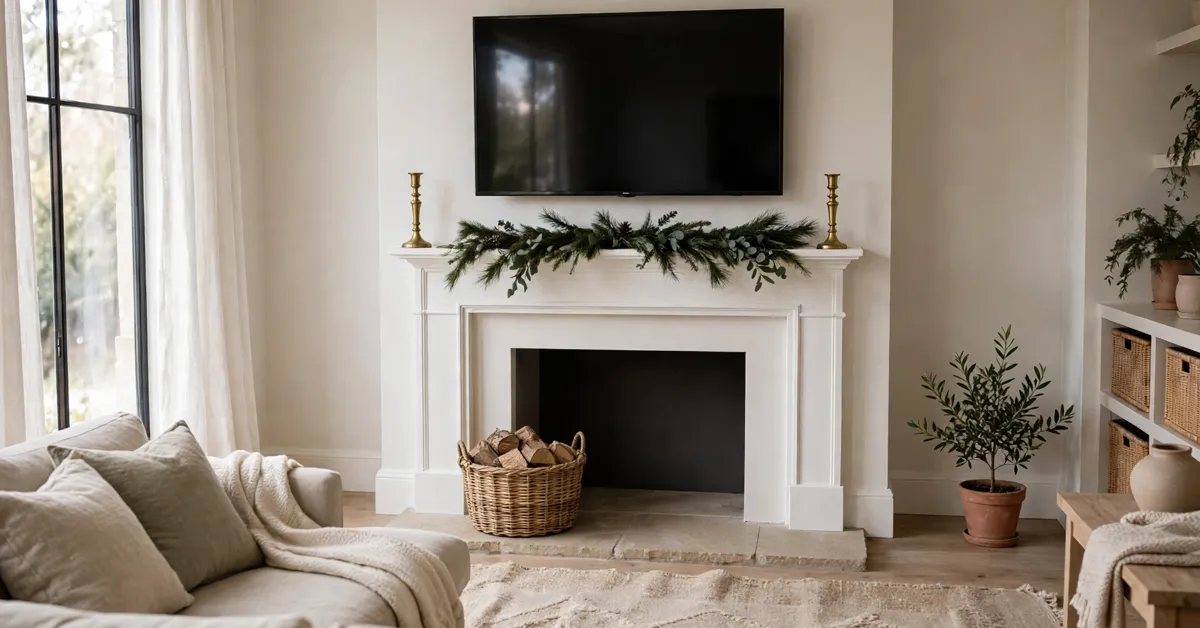
20 Clever TV Above Fireplace Ideas to Make the Screen Belong
The television ends up above the fireplace in millions of living rooms for an honest reason: it is often the only wall the furniture can face. But left to itself up there, it floats — a black rectangle parked over the warmest feature in the room, usually higher than anyone’s neck prefers, and on some walls slowly warming in the heat rising off the fire. The placement is not really a decorating problem. It is two physics problems — heat rising into electronics, and eyes tilting up at a screen — wearing a decorating problem’s clothes. Solve the physics first, with a test and a tape measure, and the decorating nearly does itself.
That is the order of work in these tv above fireplace ideas: a five-step method that tests your wall’s heat, sets the clearances, sizes the screen to the fireplace and solves the viewing angle honestly — then 20 styling ideas by zone, from the screen itself to the mantel under it and the wall around it. The mantel below the screen obeys the same house rules as the ones in our winter mantel decor guide, and this wall in December is a whole subject of its own in our christmas fireplace decor ideas. First, though, the numbers — because on this wall, the numbers decide what the decorating is even allowed to do.
Test the Heat, Mind the Height, Then Make It Belong: The Method
Every wall with a fire under it and a screen over it is a small negotiation between three things: the heat the fireplace sends up, the height the mantel forces on the screen, and the people on the sofa trying to watch it. Work through these five steps before any styling from the tv above fireplace ideas below — a wall that passes its tests is easy to make beautiful, and a wall that fails the first one gets an honest alternative instead of a slow problem.
Step 1: Run the Heat Test Before Anything Is Drilled
Light the fire the way you actually use it — not a token flame, a real evening’s fire — and let it run for an hour or two. Tape an inexpensive thermometer to the wall where the screen’s centre and lower edge would sit (an infrared thermometer does the same job in seconds) and note the hottest reading. Most televisions are rated for a maximum operating temperature of roughly 95–104°F (35–40°C), so a wall that reads around 100°F (38°C) or more at screen height fails the test. Fire type matters as much as the number: electric fireplaces, which push their heat forward into the room or can run flame-only, are the routinely workable case; direct-vent gas behind a projecting mantel is often fine; an open wood fire sends the most heat — and soot — straight up the wall, and is the case most likely to fail. If your wall fails, the honest answers are heat management or the beside-the-fireplace layout, with the screen on a flanking wall or in built-ins — a designed alternative, not a defeat. And one rule outranks every guide, this one included: the manuals for your TV, your mount and your fireplace give the binding numbers for your models.
Step 2: Set the Clearances and Let the Mantel Shield the Screen
Heat weakens with distance and deflection, so give it both. As working guidance, always under your fireplace maker’s own clearance table: the screen’s bottom edge wants roughly 12 inches (30 cm) or more above the firebox opening for a gas fire, and nearer 20 inches (50 cm) for wood-burning. A mantel shelf standing between the opening and the screen does real work here — one that projects about 8–12 inches (20–30 cm) deep pushes the rising heat out into the room instead of letting it climb the wall, which is why a deep mantel is this wall’s best friend. The mantel’s own position is a safety dimension before it is a style one: combustible mantels carry their own code clearances from the opening (nothing combustible within about 6 inches / 15 cm of it, with projection limits across the band beyond). Settle these distances first; the styling in Zone 2 is built to fit inside them.
Step 3: Size the Screen to the Fireplace and Centre It
The proportion rule the mood boards skip: the screen stays narrower than the fireplace and mantel below it. A television wider than its mantel makes the wall read top-heavy no matter how it is styled, and no styling idea in this article can fix a proportion that is wrong at the buying stage. Centre the screen on the firebox’s centreline — not the room’s, which may be a different line — and set its bottom edge a few inches above the mantel shelf, about 4–8 inches once Step 2’s clearances are satisfied, so the mantel still reads as the screen’s frame. Before a big screen is bought, do the ceiling check: over a standard mantel, a 75-inch set can put its top edge within an inch or two of an 8-foot ceiling. Measure the wall’s full run, hearth to ceiling, before the screen, not after.
Step 4: Solve the Height Honestly — Distance, Tilt, or a Lower Screen
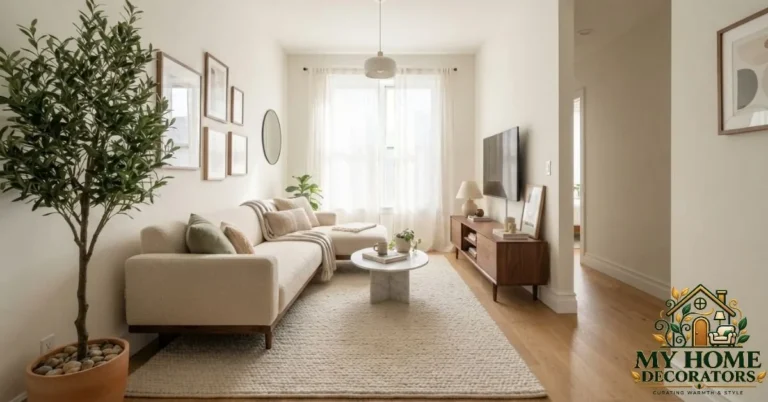
The arithmetic nobody can decorate away: a seated eye line sits about 42 inches (107 cm) off the floor, while a screen centred over a mantel lands around 60–76 inches up. From a close sofa that is an upward gaze of 20 degrees or more — the neck strain this setup is famous for. Comfort means keeping the upward angle to the screen’s centre at roughly 15 degrees or less from the main seat, and there are exactly three honest ways to buy it. Sit further back: about 10 feet (3 m) makes a 65-inch screen over a 54-inch mantel work. Tilt the screen down 10–15 degrees on its mount, so its face meets the seated eye. Or lower the screen itself with a pull-down mount that brings it near eye level for watching and parks it above the mantel the rest of the time. In a small or narrow room where the sofa cannot move back, the pull-down stops being a luxury — and the room’s layout rules are the ones in our narrow living room guide. Note what is not on this list: a prettier screen. Art mode fixes the look, never the angle.
Step 5: Plan the Cords and Power Before the Mount Goes Up
Decide every cable run while the wall is still bare, because this is the step with real rules attached. Power and signal cables either travel inside the wall in a rated in-wall power kit, fitted to code — by an electrician where required — or stay on the surface in a paintable raceway that drops down one side of the chimney breast into a flanking cabinet. Never ordinary cables loose inside a wall cavity, and never anything routed through or behind the chimney or flue. An outlet behind the screen, where the manuals allow one, keeps the mantel free of dangling leads, and the sound bar (Idea 17) gets its cable plan here too. For the breadth of treatments designers layer onto this wall once the engineering is settled, The Spruce’s expert survey of TV-over-fireplace treatments is the useful further read. Decor goes on last, over a solved wall.
1. Show Art on the Screen When It’s Off

An art-mode screen — a frame-style television, or any smart TV running an ambient art slideshow — turns the black rectangle into the wall’s picture for the twenty hours a day nobody is watching. Choose matte, low-brightness artwork in the room’s own palette, and set the display to sleep at night: a “painting” glowing at full brightness gives the trick away instantly.
2. Frame the TV Like a Picture

A slim frame or bezel around the screen gives the rectangle a deliberate edge that rhymes with the mantel below it. Match the frame’s finish to something already in the room — the mantel wood, the picture frames, the hardware — and keep its width modest, about 1–2 inches, so it reads as a frame rather than a second, larger television.
3. Paint the Fireplace Wall Dark
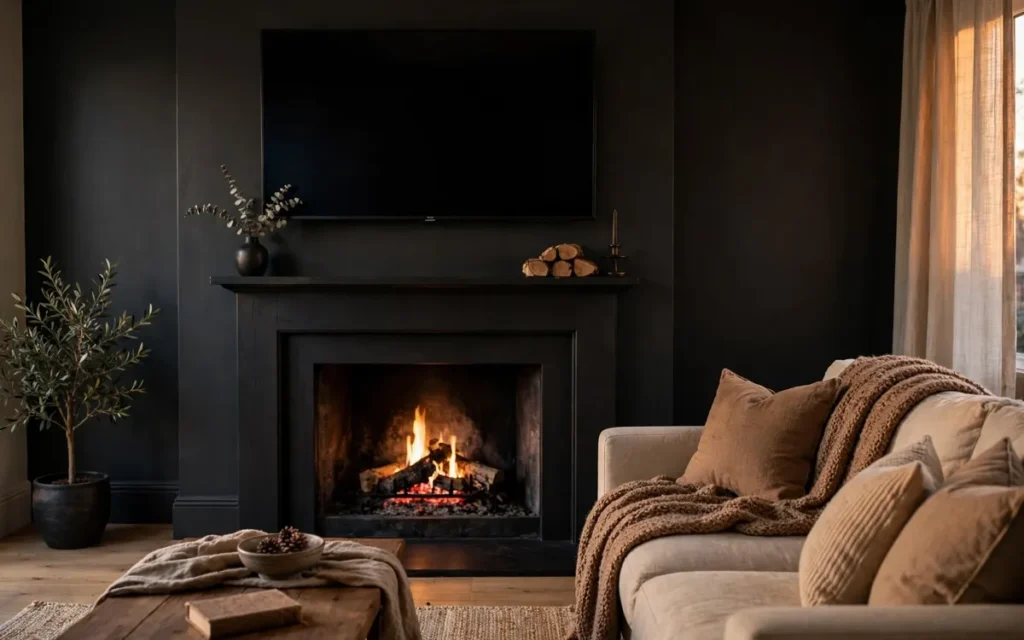
The camouflage move: a deep colour — charcoal, ink navy, deep pine green — on the chimney breast makes the switched-off screen nearly disappear into the wall. Paint the whole breast, mantel surround included, in one finish; a dark panel sliced through by a white mantel halves the effect. Test the colour in the evening with the screen on, not only in daylight.
4. Wrap the Wall in Texture

Shiplap, board-and-batten, a limewash-look finish or a stone or tile surround gives the wall a pattern of its own, so the screen becomes one rectangle among several instead of the only event. Run the texture from hearth to ceiling and size its rhythm to the screen — wide boards or large-format tile keep a big set in proportion, while small busy patterns fight it. Any combustible cladding still respects Step 2’s clearances from the opening.
5. Recess It Into a Panelled Niche

A shallow framed recess, or a panelled surround built out around the screen, makes the television sit flush like cabinetry instead of floating on a bracket. Leave the maker’s ventilation room around the set — typically a couple of inches of breathing space at the back and sides; check the manual — and never recess a screen over a wall that has not passed Step 1’s heat test first.
6. Keep the Mantel Low and Layered

The mantel’s rule under a screen: a low, layered line — a small leaning artwork or mirror at one end, a short stack of books, one trailing plant — kept clearly below the screen’s bottom edge and no wider than the screen itself. Hold pieces to roughly the bottom third of the mantel-to-screen gap, and keep the mantel’s middle quietest: that is the heat path and the sightline at once. The full composition method lives in our winter mantel decor guide.
7. Balance Both Ends of the Mantel

The classic pair: matching candlesticks, lanterns or vases at each end of the mantel give the wide screen two visual bookends and stop the wall leaning to one side. The pair should be tall enough to register against the screen’s width but stop well short of its bottom edge — and on this wall, the candles inside them are flameless, always (see the safety notes below).
8. Run a Garland Along the Mantel’s Front Edge
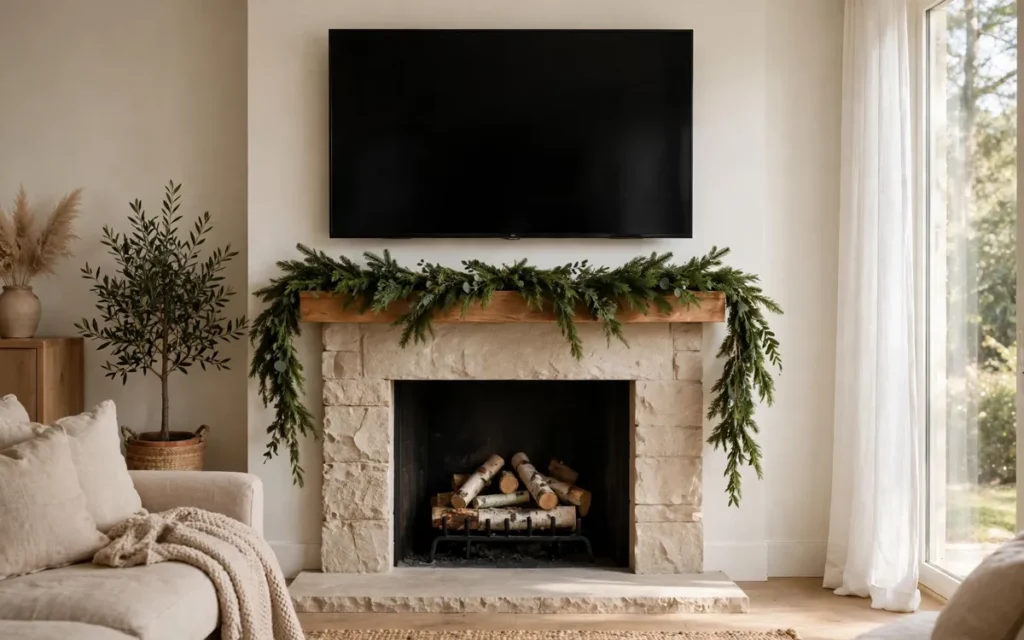
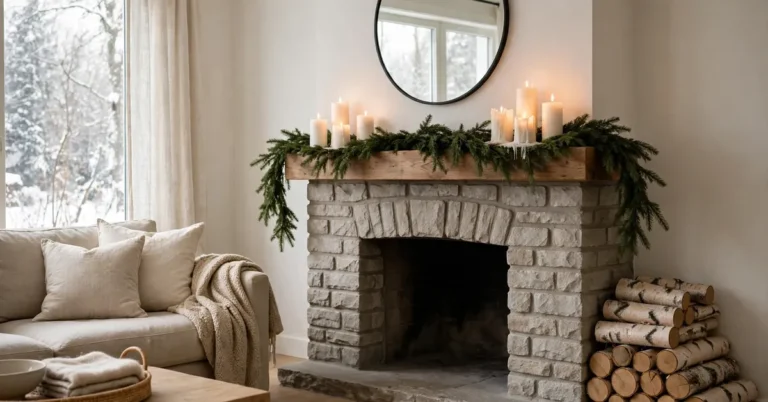
A garland pinned along the mantel’s front edge — not piled on top of it — softens the hard line between firebox and screen, and quietly camouflages a sound bar’s edge or a cable drop. Keep it on the front face, hanging below the shelf line: greenery heaped on top of the mantel sits exactly in the rising heat. Fix it at the ends, and keep it clear of the opening’s clearances.
9. Add Sconces on Both Sides

A pair of wall sconces flanking the screen at mantel height gives the wall an evening glow that is not the screen, and frames the whole composition like a picture light written large. Battery or plug-in sconces avoid new wiring on a chimney breast — never drill or chase cable into the breast’s fire structure; mount into the surrounding wall per the maker’s instructions, with shades clear of the screen’s vents.
10. Flank It With Shelves or Built-Ins
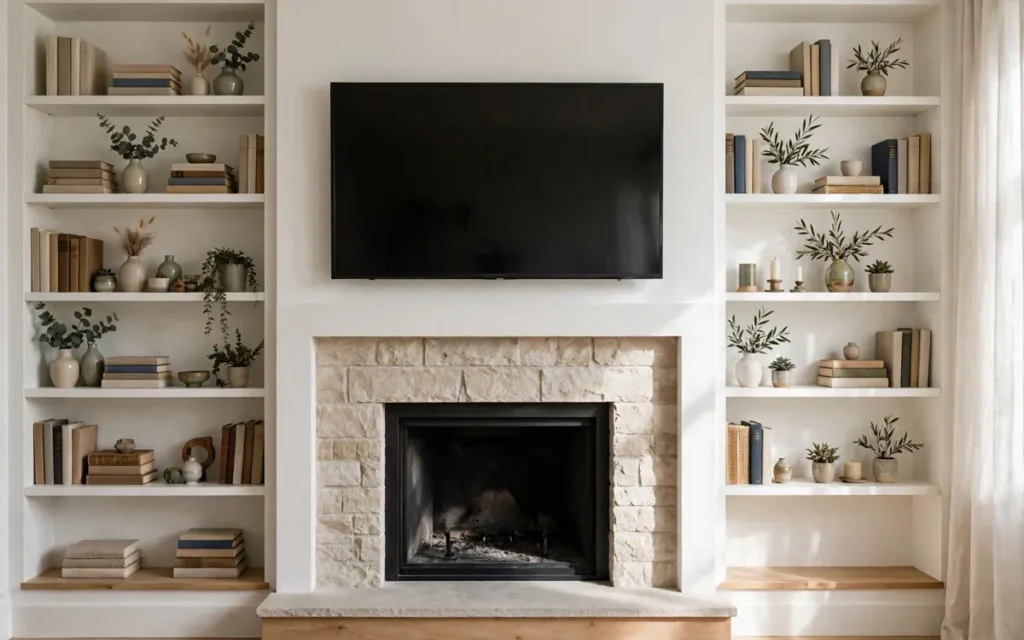
Shelving or cabinetry on both sides of the chimney breast spreads the wall’s visual weight, so the screen becomes the centre of a unit instead of a lone object. Style the shelves at the screen’s scale — a few larger pieces, books in short runs — and keep their depth, about 10–12 inches, shallower than the mantel’s projection so the breast still reads as the feature.
11. Hang Art Beside the Screen, Not Above It

On a tall chimney breast the empty band is usually at the sides, not the top: a framed print, or a pair, hung beside the screen at its own height makes the television one frame in a row. Hang the side art so its centre sits near the screen’s centre height, with a consistent gap of about 2–3 inches from the screen’s edge — from the sofa, the row should read as one composition.
12. Put a Tall Plant in Each Corner
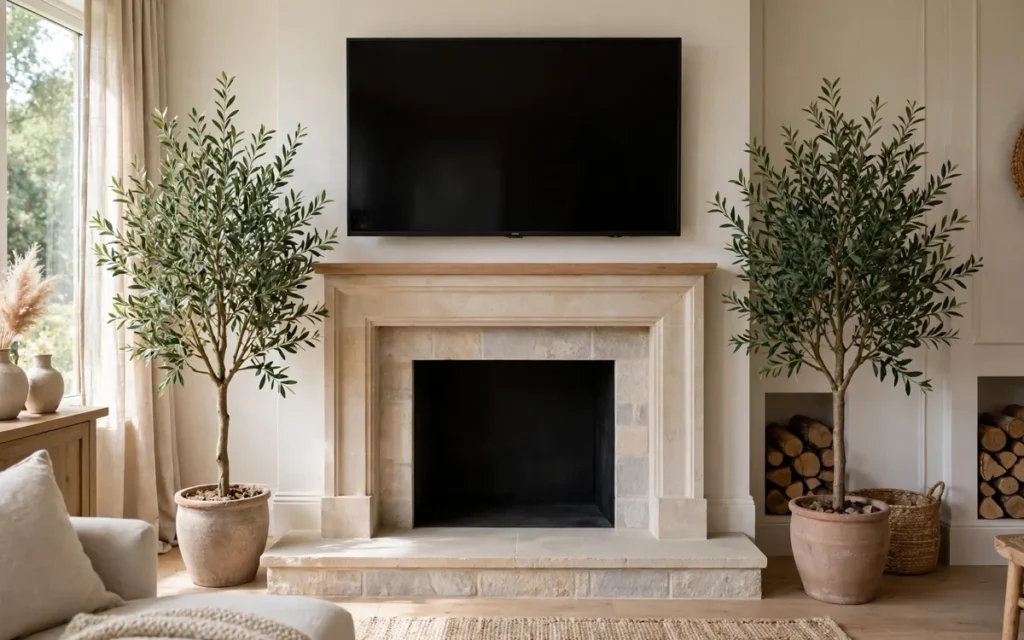
A tall plant — a real olive or fig where the light allows, a good faux where it does not — in each hearth corner fills the vertical dead space at floor level and softens the wall’s hard geometry. Keep foliage clear of the firebox opening and its clearances, and choose the pot’s height so the crown lands somewhere between mantel and screen: that is exactly the band the eye needs filled.
13. Ground It With Hearth Styling

The wall reads top-heavy until the hearth is styled: a log basket, a pair of lanterns, a low stack of books or a fireside bench gives the composition a base as deliberate as its top. Keep hearth pieces to the sides of the opening, never in front of a working firebox’s clearance zone, and repeat one material from the mantel — the same wood, the same black metal — so top and bottom belong to each other.
14. Tilt the Screen Down Toward the Sofa

The cheapest comfort fix there is: a tilting mount angled down so the screen’s face meets the seated eye instead of throwing its picture (and the window’s glare) at the ceiling. Ten to fifteen degrees of tilt is the working range for a mantel-height screen, and the mount must be rated for the set’s weight, with fixings exactly per its manual — the safety section below gives the full rule.
15. Use a Pull-Down Mount for Long Viewing
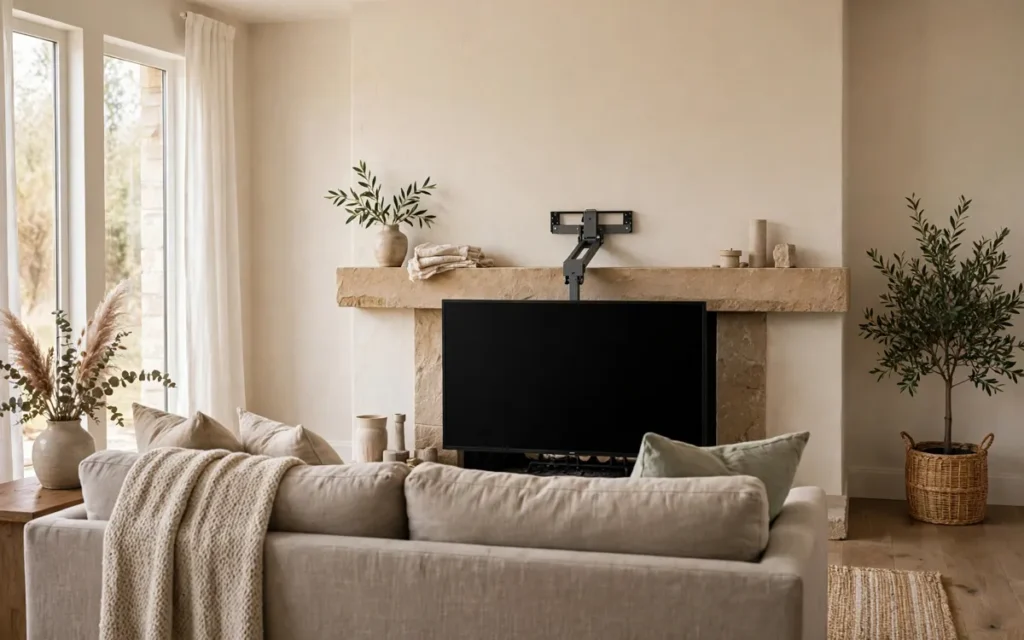
The one device that solves the height problem itself: the screen parks above the mantel for the room’s everyday look, then pulls down — out and over the mantel — to near eye level for films and matches. It needs a clear swing path, so mantel styling must stay low or moveable, and it carries one strict heat rule: never leave the screen pulled down in front of a lit fire. Park it up before the fire is lit.
16. Lower the Screen With a Slimmer Mantel
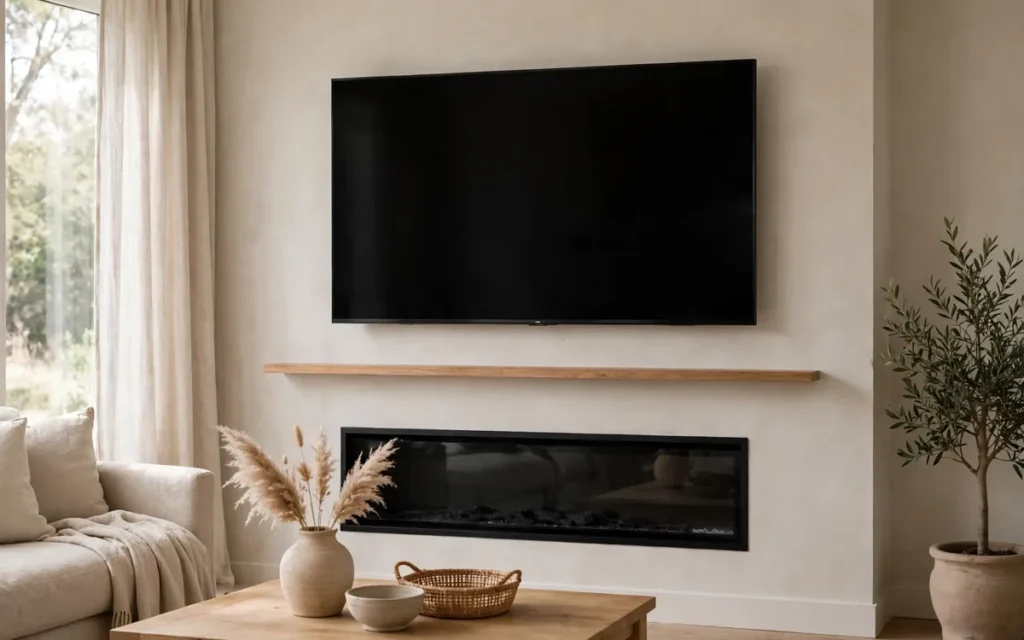
Where a fireplace is being refitted anyway, a slimmer, lower-profile mantel shelf — or a linear electric fire with a low line — buys back several inches of screen height before any mount is chosen. Every inch the mantel drops is an inch off the viewing angle. But the shelf’s depth is its heat shield, so slim the height, never the projection, and keep Step 2’s clearances intact.
17. Centre a Soundbar Under the Screen
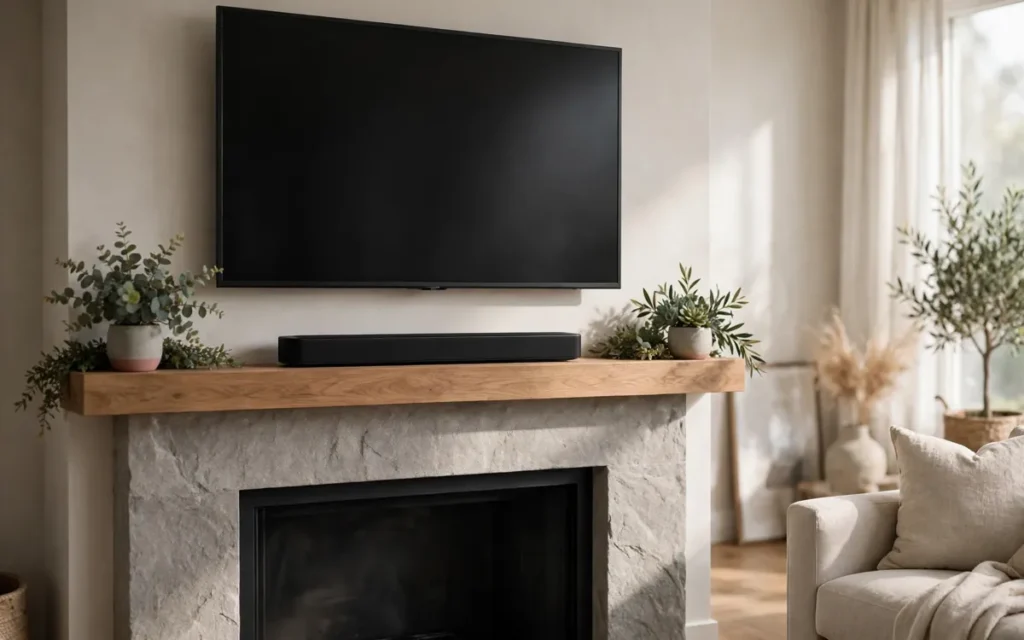
A sound bar centred on the mantel, or mounted just beneath the screen, gives the wall a finished “unit” line and puts the sound where the picture is. Keep the bar’s top clear of the screen’s bottom edge and its body out of the firebox’s direct heat path; a garland along the mantel’s front edge (Idea 8) hides its cable drop neatly. Rear speakers are a room question, not a wall one.
18. Hide the Cords the Safe Way
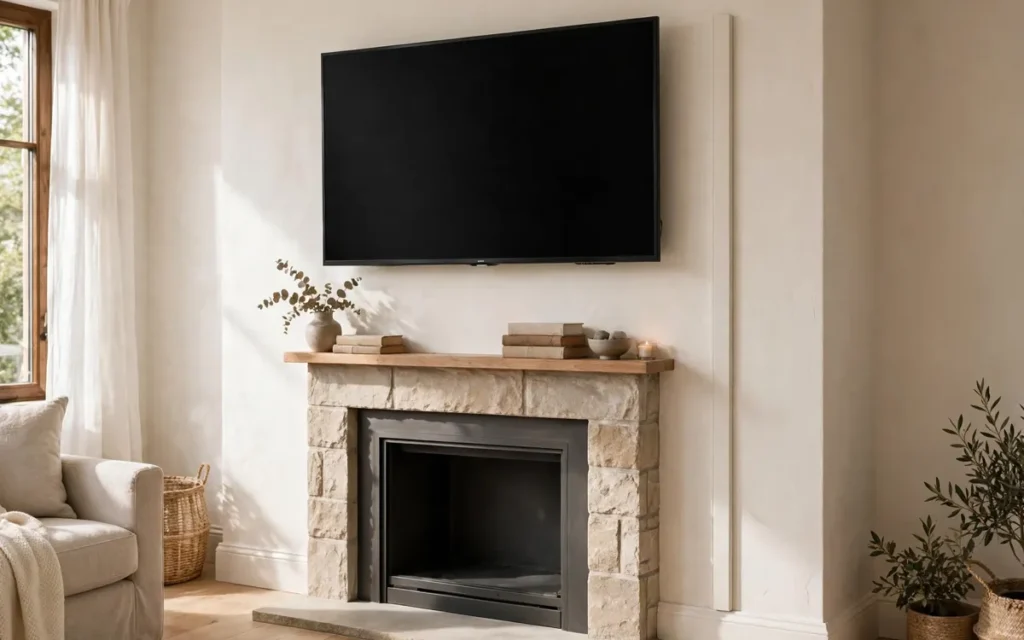
The finished wall has no visible leads: power and signal run in a rated in-wall kit, or surface-run in a paintable raceway down the breast’s side into a flanking cabinet. The two never-evers bear repeating — ordinary appliance cables loose inside a wall cavity, and any cable routed through or behind the chimney or flue. If the route is not obvious and legal, an electrician prices it in minutes.
19. Light the Wall, Not the Screen
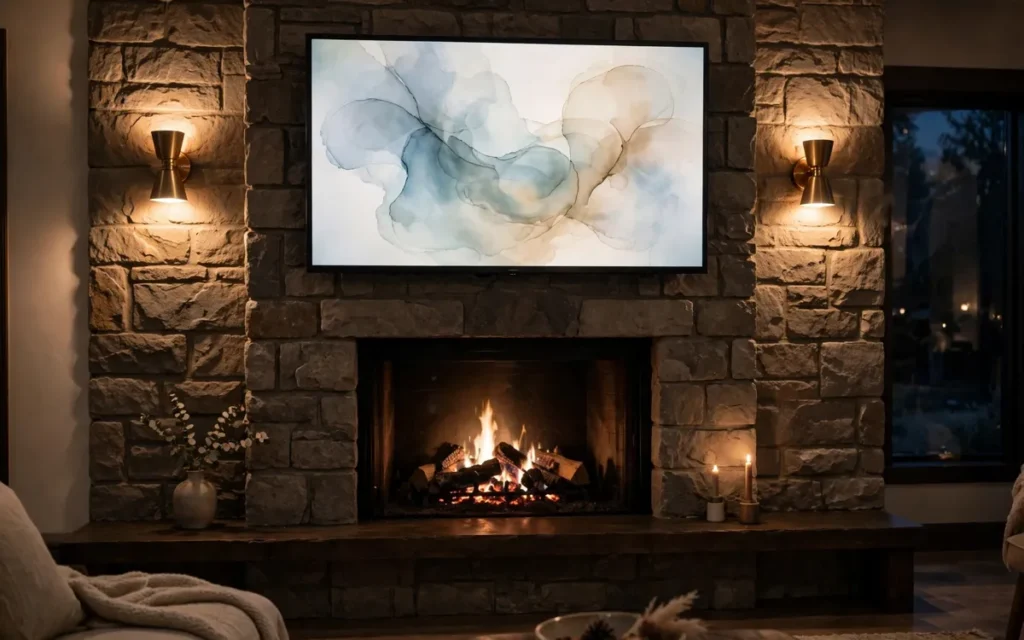
Soft light around the composition — the sconces of Idea 9, a picture-light bar above the frame, or gentle bias light behind an art-mode screen — keeps the wall alive on the evenings the television is off, and reduces contrast strain on the evenings it is on. Warm light, around 2700K, matches firelight; keep every fitting and its wiring clear of the heat path above the firebox.
20. Swap the Mantel With the Seasons

The screen stays; the mantel below it can still mark the year — plain greenery and flameless candles for deep winter, fresh stems in spring — which keeps a technology wall feeling like part of the home’s seasons. Seasonal pieces obey the same rules as permanent ones: low, front-edge, flameless near the screen. The full December dress for this exact wall is its own article: our christmas fireplace decor ideas.
What a TV-Above-Fireplace Wall Costs: Three Budget Levels
Think in levels, and shop your own home first at every one of them. The restyle — $0: the heat test costs one thermometer reading, the centring check costs a tape measure, art mode is a setting the set may already have, and the mantel restyle (Ideas 6–8 and 13) is pieces already in the house. The refresh — under about $100: a tilting mount rated for the set, a tin of paint for the chimney breast (Idea 3), a paintable cord raceway and a pair of battery sconces (Idea 9) — this level buys the two things visitors actually notice: the angle fixed and the black box blended in. The composed wall — a few hundred and up: a pull-down mount (Idea 15), a rated in-wall power kit fitted by an electrician, a frame-style bezel, or the first stage of flanking shelving (Idea 10). Name this level’s honest ceiling: a frame-style television is a replace-the-TV decision, and full built-ins are a carpentry project — both are priced as such, and neither is needed for the wall to work.
7 TV-Above-Fireplace Mistakes That Undo the Whole Look
- Mounting before the heat test. A palm held near the wall and a verdict of “feels fine” is not a measurement. Heat damage is slow and silent, and it is generally not a warranty case — the thermometer decides, through a full fire (Step 1).
- Buying a screen wider than the fireplace. A set that overhangs the mantel makes the wall top-heavy forever. The fireplace’s width is the screen’s ceiling — and the real ceiling is the second check (Step 3).
- Decorating the mantel up into the screen. Tall centre pieces block the picture’s bottom edge and sit exactly in the rising heat. The middle of this mantel stays low (Idea 6).
- Hiding ordinary cords inside the wall. Unrated cables in a cavity — or any cable sent toward the chimney — trade a tidy photo for a code and fire problem. Raceway or rated kit, nothing else (Idea 18).
- Fixing the look and calling the height solved. A framed screen at the same height strains the same necks. The honest fixes are distance, tilt or a pull-down (Step 4).
- Treating every fireplace alike. Mounting over an open wood fire with an electric-fireplace mindset ignores the hardest case on the wall: peak heat plus soot. The fire type decides what the wall may do.
- One-sided styling. Everything piled on one flank — one tall plant, one shelf, a bare other side — makes the centred screen look as if it is sliding off the wall. This wall’s whole grammar is symmetry (Ideas 7, 9–12).
TV-Above-Fireplace Safety: Heat, Mounting and Cords
Treat the heat test as a rule, not a tip: before a screen is mounted — and again if the fireplace’s use changes — run the fire at its normal setting for one to two hours and measure the wall at the screen’s planned position with a thermometer. Most televisions are rated for a maximum operating temperature of roughly 95–104°F (35–40°C), and a wall reading around 100°F (38°C) or more where the screen would sit is too hot for one. Sustained heat above the rating shortens a panel’s life, can dim or kill pixels and warp internal parts, and heat damage of this kind is generally excluded from TV warranties — so the number, not optimism, decides. Know your fire: electric fireplaces, which vent forward or can run flame-only, are the routinely safe case; direct-vent gas is usually manageable behind a projecting mantel; an open wood-burning fire produces the highest wall temperatures and adds soot and ash that can be drawn into the set’s vents. Let the mantel do its shielding work — a shelf projecting about 8–12 inches between the opening and the screen deflects rising heat — while respecting the combustible clearances around the opening itself (nothing combustible within about 6 inches of it, with projection limits across the band beyond; the fireplace maker’s clearance table governs). Keep mantel decor out of the direct heat path, never block the fireplace’s own vents or flue, and never drill into or run anything through the chimney structure to reach the screen.
A television above a fireplace is a heavy object hung over the room’s main seat-facing wall: use a mount rated for the set’s weight, fixed into studs or sound masonry exactly per the mount maker’s instructions, and re-check the fixings if the set is ever taken down and re-hung — a falling screen is this project’s one catastrophic failure, and it is prevented entirely at the fixing stage. Protect the viewers as well as the set: keep the upward angle from the main seat to the screen’s centre at roughly 15 degrees or less (distance, tilt or a pull-down mount, Step 4), never leave a pull-down screen lowered in front of a lit fire, and store remotes’ button batteries out of children’s reach, since a swallowed button battery is a serious emergency. Run every cable as if an inspector will see it: power and signal leads travel in a rated in-wall power kit installed to code, or on the surface in a raceway — never ordinary extension or appliance cables hidden inside a wall, never a cord across the hearth where heat and feet meet, and never any cable routed through or behind the chimney or flue. Add surge protection where the set plugs in. And where any of this differs from the TV, mount or fireplace manuals — or from local electrical and building codes — those win, and a licensed electrician or fireplace installer is the right call rather than a guess.
Frequently Asked Questions
Is it safe to put a TV above a fireplace?
Conditionally — and the condition is a measurement. If the wall at the screen’s position stays within the TV maker’s temperature rating through a normal fire (Step 1’s test), the fireplace’s own clearances are respected, and the mount is fixed properly, the placement is a workable one — most straightforwardly over electric and many direct-vent gas fireplaces. If the wall runs hot, as open wood fires often do, the honest answer is another wall, with the screen beside the fireplace in the room’s layout instead.
Will the heat from a fireplace damage my TV?
Sustained heat above the maker’s rating — commonly about 95–104°F (35–40°C) — can: panels age faster, pixels can dim or fail, and internal parts can warp, and heat damage is generally not covered by TV warranties. A mantel shelf between the fire and the screen deflects much of the rising heat, but the thermometer test is what gives you your own wall’s number in a single afternoon.
How much space should there be between the fireplace, the mantel and the TV?
As working guidance, under your fireplace manual’s own table: the screen’s bottom edge roughly 12 inches (30 cm) or more above the firebox opening for gas and nearer 20 inches (50 cm) for wood-burning; a mantel projecting about 8–12 inches in between as the heat shield; and the screen’s bottom a few inches — about 4–8 — above the mantel shelf, so the mantel still frames it. Your fireplace’s manual gives the binding numbers for your model.
Is a TV above a fireplace too high to watch comfortably?
It is higher than ideal: seated eye level is about 42 inches, and a mantel-mounted screen’s centre lands around 60–76 inches. Comfort is an angle — roughly 15 degrees upward or less from your seat — and it is bought three ways: sit further back (about 10 feet for a 65-inch screen over a standard mantel), tilt the screen down 10–15 degrees, or fit a pull-down mount that lowers the screen for viewing. Decorating the wall does not change the angle; these do.
How big a TV can go above a fireplace?
Let the fireplace set the width: the screen should stay narrower than the mantel and fireplace below it, or the wall reads top-heavy whatever you style around it. Then check the height you have left — mantel top to ceiling — because a large set, a 75-inch over a standard mantel, can run out of wall under an 8-foot ceiling. Measure both runs before the screen is bought, not after.
How do I hide the cords on a TV above a fireplace?
Two safe routes: a rated in-wall power kit that carries power and signal inside the wall to code, or a paintable surface raceway run down the side of the chimney breast into a flanking cabinet. Never hide ordinary cables loose inside a wall, and never route anything through or behind the chimney or flue. If the route is not obviously legal and cool, an electrician is the inexpensive answer.
If your television sits on a plain wall instead of over a mantel, the companion guide is our how to decorate around a tv: the same thinking — a measured height, a console wider than the screen, balanced sides — without the heat and clearance rules this wall demands.
If your television sits on a stand rather than above the fireplace, the same low, screen-friendly approach still works beautifully. Our guide to 14 Gorgeous TV Stand Christmas Decor Ideas That Make the Screen Part of the Scene shows how to layer garland, mini trees and warm light around the console without blocking the picture. It is a handy companion if you want the whole wall to feel dressed, not just the mantel.
Conclusion
Test the heat, mind the height, then make it belong — and hold the wall’s one-sentence rule: the fireplace decides what the wall may do; the decorating just makes it look as if it was always the plan. The mantel below the screen is composed in depth in our winter mantel decor guide, the same wall wears its December dress in our christmas fireplace decor ideas, and the room this wall anchors is layered in our winter living room ideas. Follow the measurements first, and tv above fireplace ideas stop being the wall’s apology — tested, sized and centred, the screen becomes the centrepiece it was always going to be.
6 Comments