
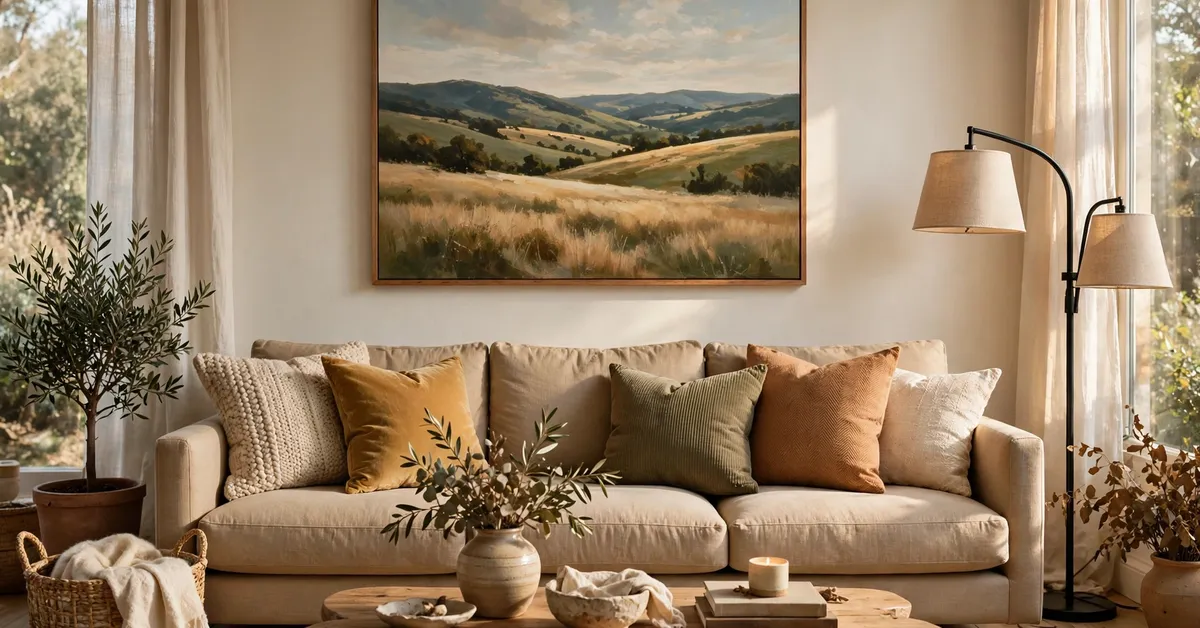
21 Timeless Above Couch Decor Ideas for a Wall That Finally Feels Finished
The wall above the couch is the largest unfinished surface in most living rooms — and the one most often finished wrong, with a frame that is too small, hung too high, floating in the middle of nowhere. The fix is not more decoration; it is measurement. These above couch decor ideas treat that wall as a sized composition: the sofa below sets the width, the sofa’s back sets the height, and everything hung there is chosen and spaced by numbers first and taste second. The room’s other focal wall — the one where a screen sits over the fireplace — has its own guide, our TV above fireplace ideas; this article belongs to the sofa’s wall alone.
The Method: Measure It, Match It, Hang It Low
Three decisions, made in order, before anything is bought: how wide the arrangement should be, which format the wall can carry, and how low it should hang. Most disappointing sofa walls fail on the first or the third — the piece was prettier than it was sized, and it was hung for the ceiling instead of for the people sitting under it.
Step 1 — Measure It: The Sofa Sets the Width
The arrangement — one piece, or a group measured across its outer edges — spans two-thirds to three-quarters of the sofa’s width. Run the numbers on your own sofa: an 84-inch three-seater takes 56–63 inches of arrangement, a 90-inch sofa takes 60–67 inches, and a 60-inch loveseat takes 40–45 inches. Centre the arrangement on the sofa, not on the wall — when the sofa sits off-centre on its wall, the art follows the sofa or the whole composition looks slightly drunk. More than any single piece, above couch decor ideas stand on this one measurement, and Raymour & Flanigan’s guide to choosing and hanging wall art walks through the same sizing and height rules from a furniture maker’s side.
Step 2 — Match It: Pick the Format the Wall Can Carry
With the width known, the format almost chooses itself: one large piece for calm rooms, a pair or a grid where the room likes symmetry, a ledge where the display must change with the seasons, a mirror where the room needs light, sconces where it needs evening light, and textiles or baskets where it needs softness. Match the frame finish to a wood or metal already in the room, so the wall belongs to the furniture below it instead of arriving from somewhere else.
Step 3 — Hang It Low: The Gap Matters More Than the Gallery Rule
The bottom edge of the art hangs 6–10 inches above the sofa back — the 6–8-inch end for tall backs of 36 inches or more, 8–10 inches for low-profile sofas. Cross-check with the gallery rule: the arrangement’s centre should land near 57–60 inches from the floor, and where the two rules disagree, the sofa gap wins, because this art is read from the seats below it. Keep every gap inside a group consistent at 2–3 inches, and template the whole arrangement in paper on the wall before the first hole is drilled.
Zone A — One Big Statement
The simplest way to fill the width band is a single piece that was born at that scale. One large artwork, mirror or clock does the whole job with one decision and two screws — and on a deep-coloured wall it often does it best of all, since one light, large piece against dark paint reads as the room’s whole focal point; the room around such a wall is the subject of our moody living room ideas.
1. Hang One Oversized Landscape Canvas
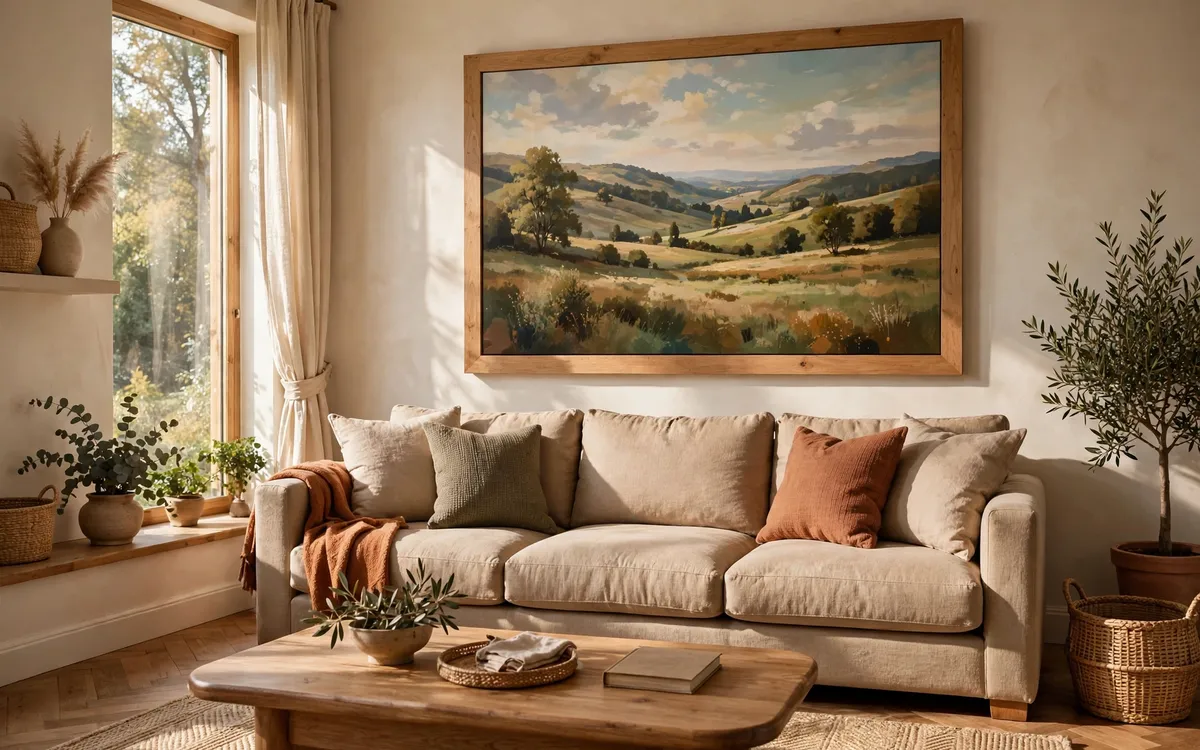
One horizontal piece at the full two-thirds to three-quarters width is the calmest answer the wall has. A 40×60-inch canvas is the standard fit over an 84-inch sofa — its 60 inches land at 0.71 of the sofa’s width, dead centre of the band. Keep the subject soft and wide rather than busy: at this scale the art is the view, not a poster.
2. Split One Image Across a Triptych
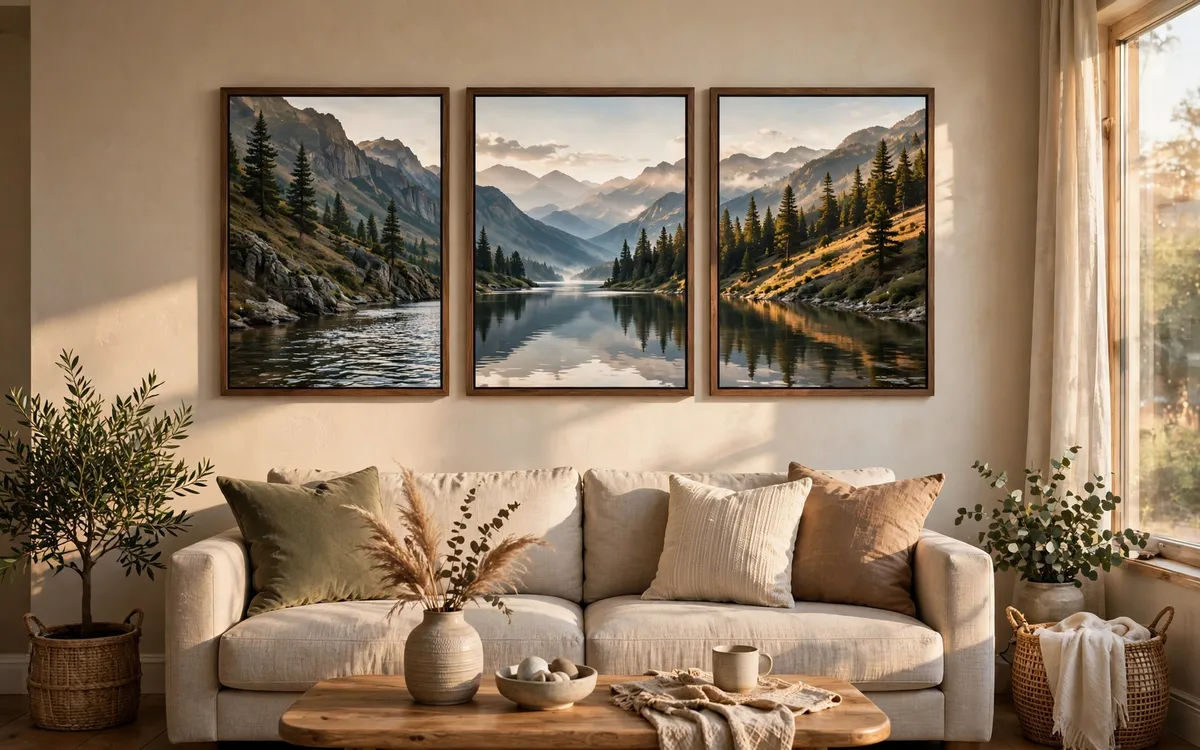
One image divided over three panels buys the same width with a rhythm a single canvas cannot. The discipline is arithmetic: the 2–3-inch gaps count inside the total width, so three 18-inch panels plus their gaps come to roughly 58 inches over an 84-inch sofa. Hang the centre panel first, centred on the sofa, and work outward.
3. Centre a Large Round Mirror
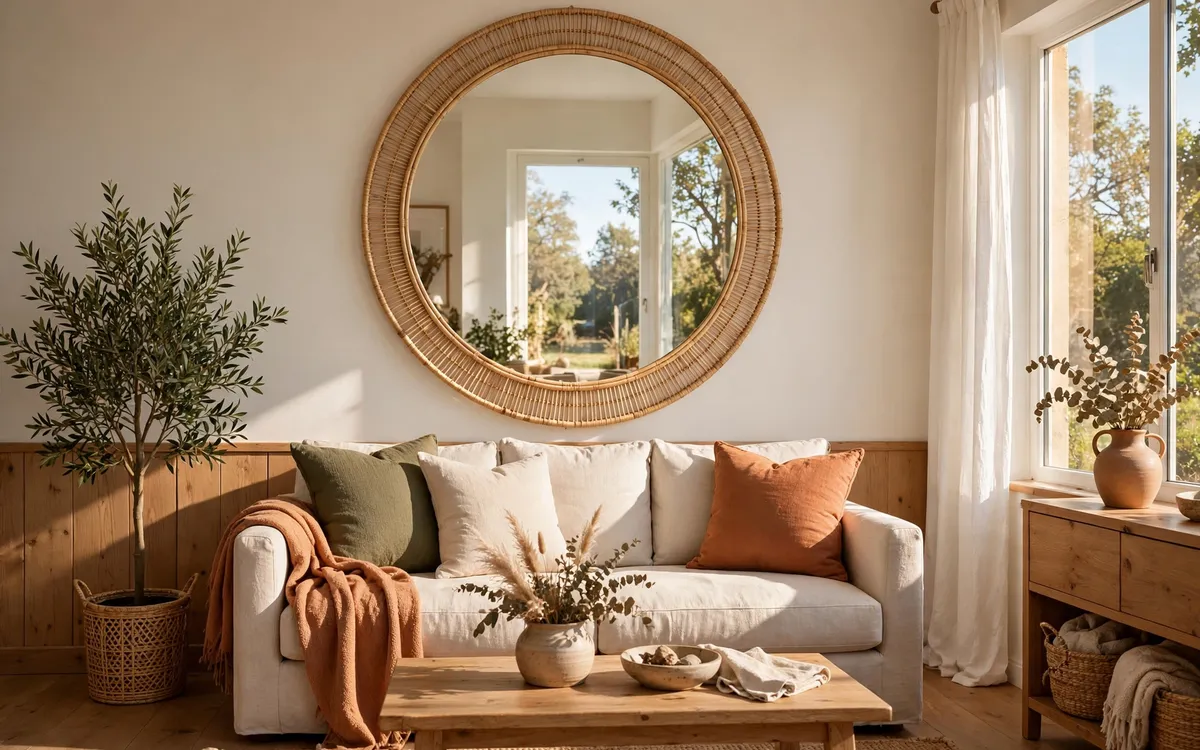
A round mirror of 32–36 inches diameter balances a three-seater’s long horizontal line and throws window light back into the room’s middle. Centre it on the sofa, keep its bottom edge on the 6–10-inch rule, and angle-check what it reflects from the seats — a mirror that reflects a bare ceiling or a cluttered corner is working against you.
4. Hang a Windowpane Mirror Grid
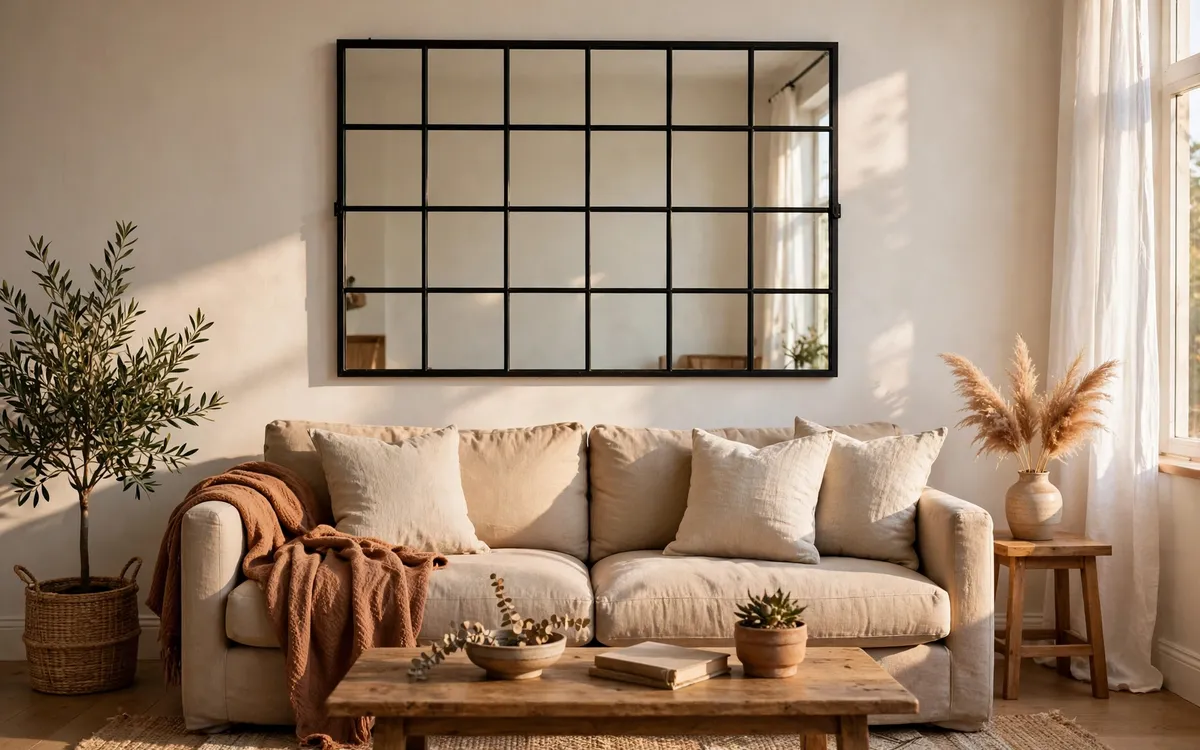
The windowpane mirror is one framed grid panel, not a set of separate small mirrors — and that distinction is the whole idea. It reads as a single piece at sofa scale, every reflection stays inside one set of edges, and it hangs with one fixing decision instead of nine. Choose the frame finish to echo a metal already in the room.
Zone B — Pairs, Rows and Grids
Where one piece feels too plain, multiplication does the work — the same frame, print family or subject repeated until the group, measured across its outer edges, fills the width band. Symmetry is the easiest composition to get right and the hardest to get wrong, provided the spacing is honest.
5. Hang a Matched Pair Side by Side
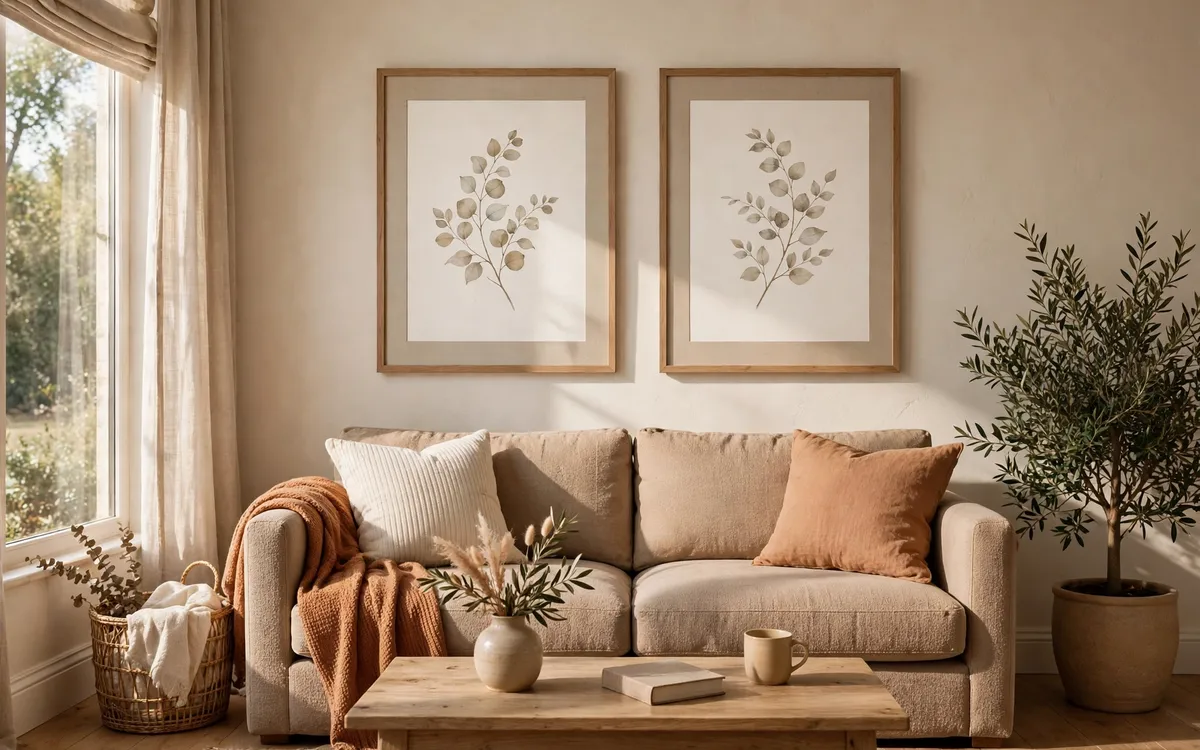
Two identical frames, two prints from one family, one 2–3-inch gap between them. The pair’s combined width — frames plus gap — must land inside the two-thirds to three-quarters band: two 24×36-inch frames come to about 51 inches, right for a 72-inch sofa. A pair suits sofas centred on their wall and rooms that like order.
6. Build a Symmetrical Grid of Four or Six
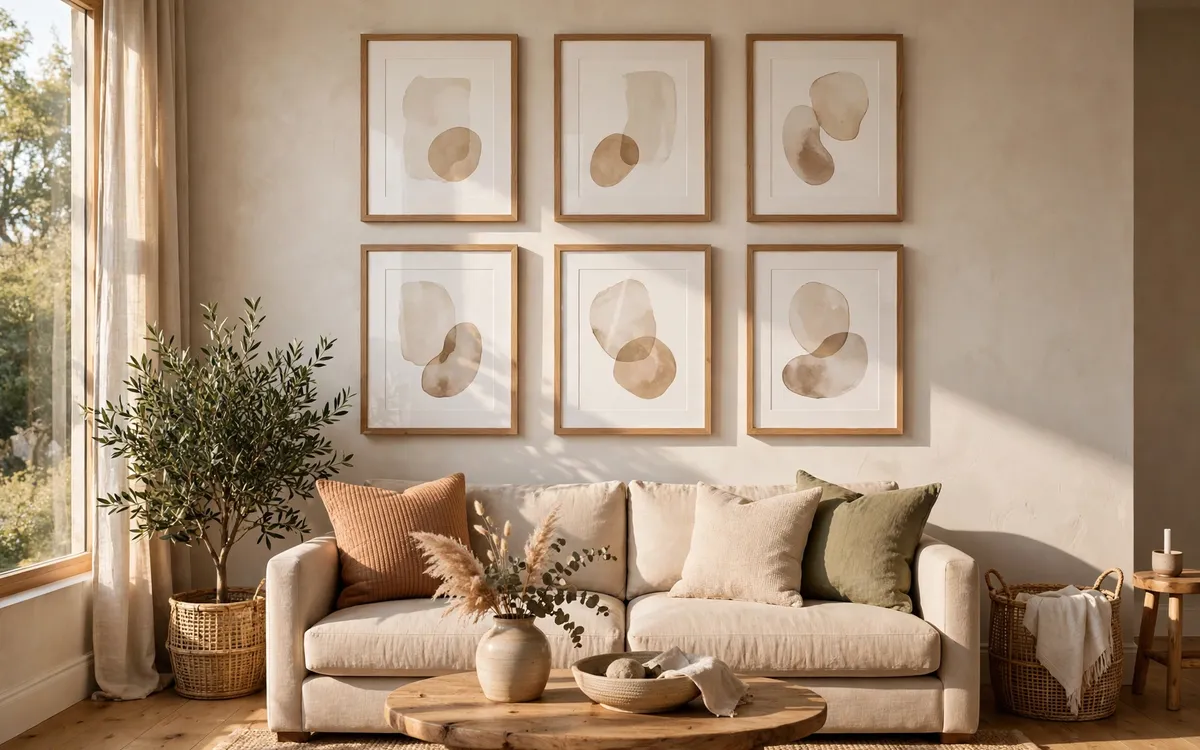
Four or six frames, same size, same frame, same mat width, 2–3 inches between every frame in both directions — the grid is measured like one piece: its outer edges are what get checked against the sofa’s width. Paper-template the whole grid first and live with the outlines for a day; a grid is unforgiving of a hole drilled two inches proud.
7. Run a Straight Row of Three Prints
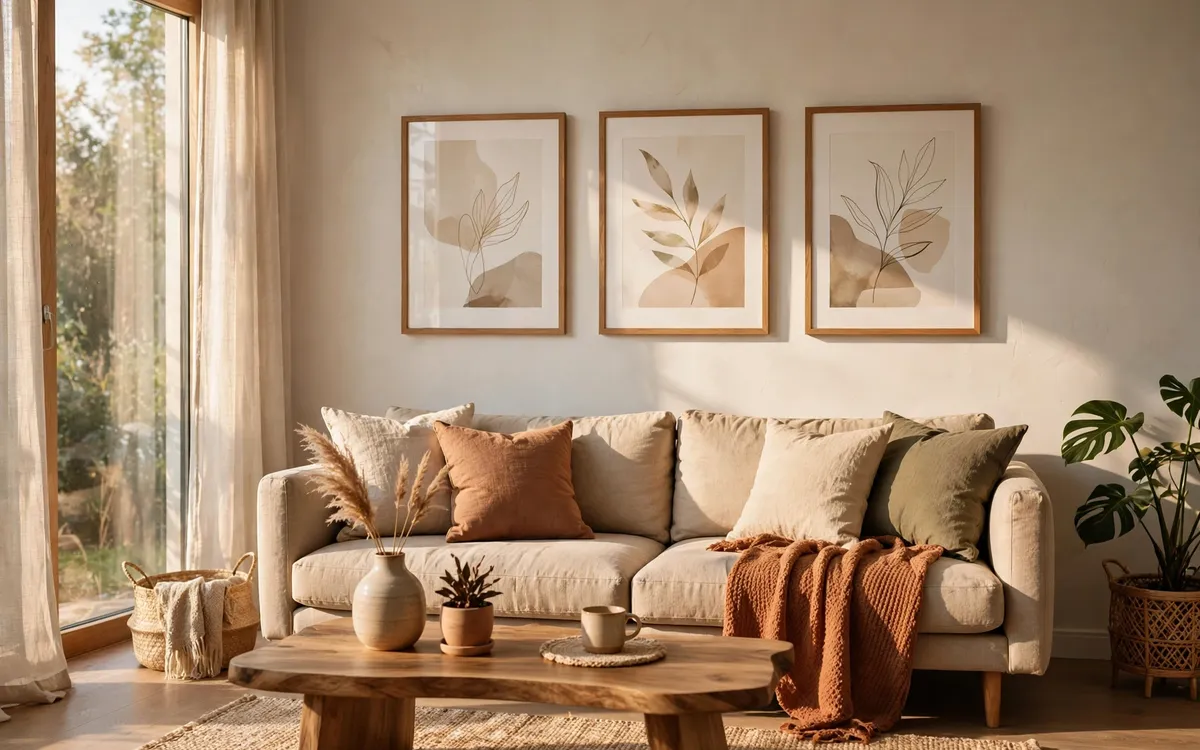
Three prints on one level line, their centres on a single string line, is the calmest multi-piece option — and the kindest under low ceilings, because nothing stacks vertically and the wall keeps its width instead of gaining height. Keep the three subjects in one family (one coastline, one garden, one set of hands) so the row reads as one sentence.
8. Mix a Relaxed Gallery Wall
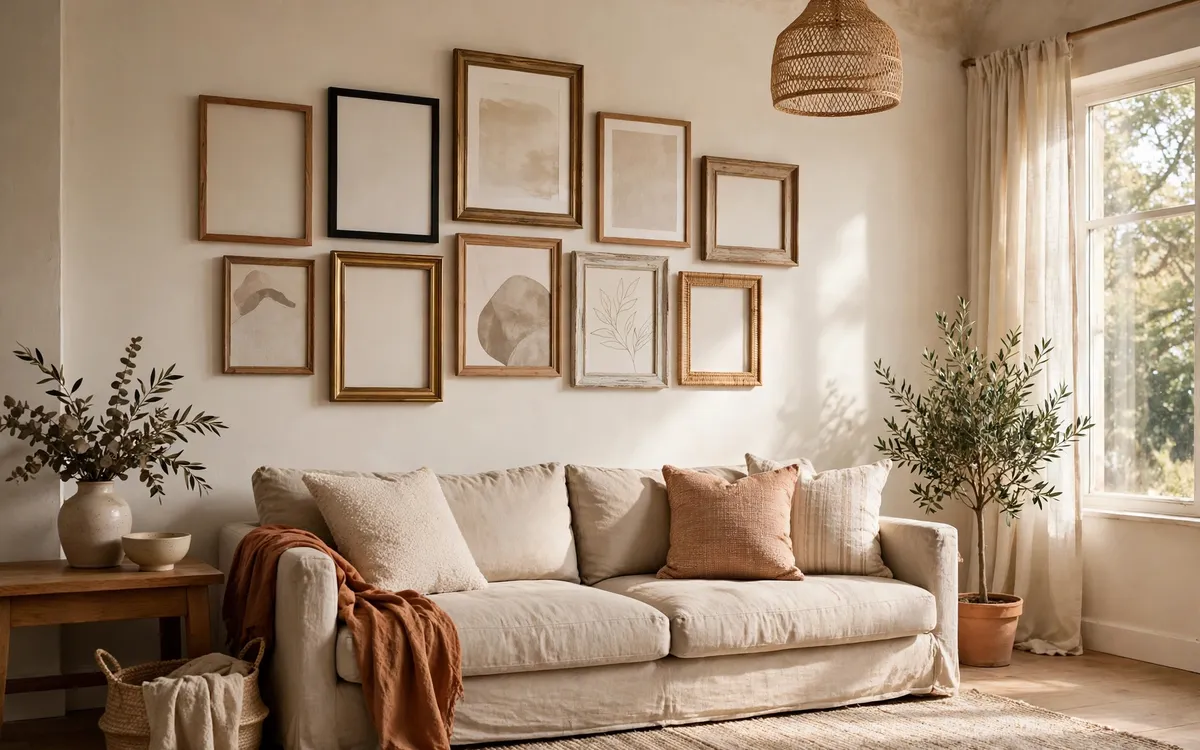
The relaxed gallery — five to seven mixed pieces — works when it obeys the same rules as the strict grid: an invisible rectangle whose outer edges sit inside the width band, 2–3-inch gaps throughout, and the largest piece placed first, just off centre, with the rest arranged around it. The full template-and-spacing discipline, worked out on a passage wall, is in our hallway decor ideas.
Zone C — Ledges and Shelves: The Changeable Wall
Some walls should not be settled once and forever. A ledge or shallow shelf turns the sofa wall into a display that rotates — prints lean, books stand, a candle appears in December and shells in June — while the holes in the wall stay exactly where they were drilled on day one.
9. Fit One Long Picture Ledge
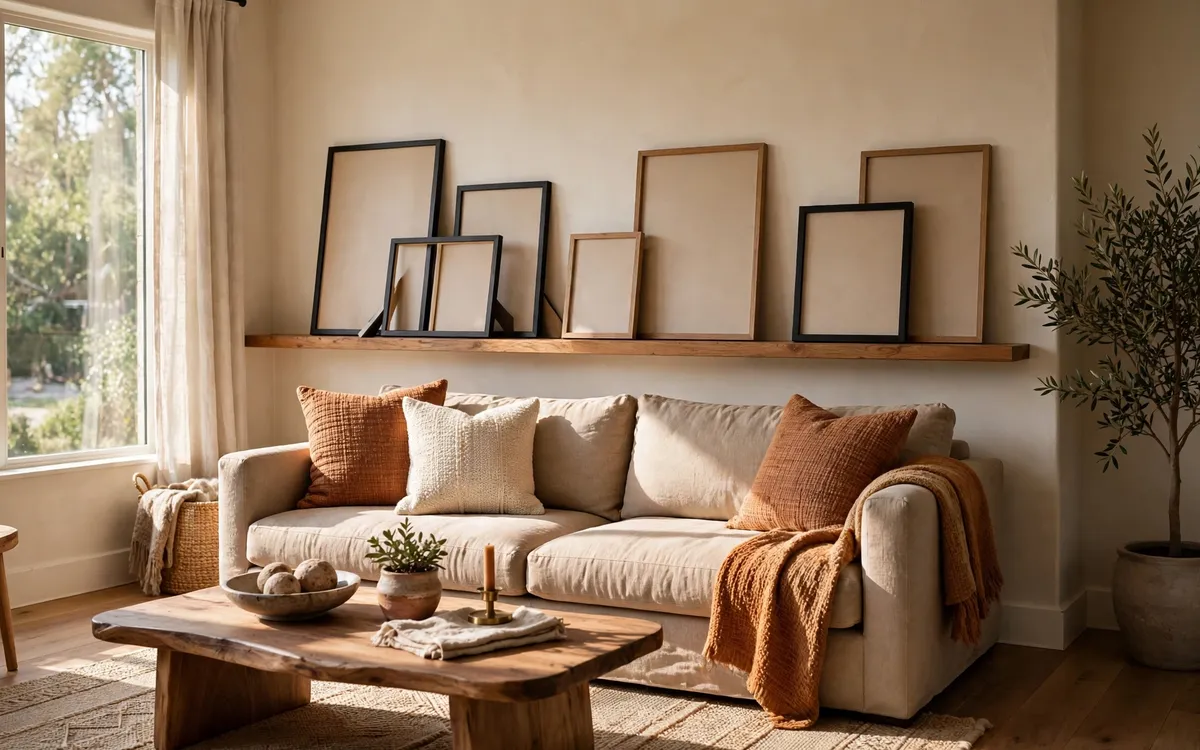
A standard picture ledge is only about 4¾ inches deep — the IKEA MOSSLANDA, the common benchmark, comes in 21¾-inch and 45¼-inch lengths at that depth — so frames lean on it at a safe angle inside the room’s air, not over it. Lean frames up to roughly 17¾ inches tall, the maker’s stated maximum for the ledge. One ledge means two screws instead of a wall of holes.
10. Layer Two Ledges at Two Heights
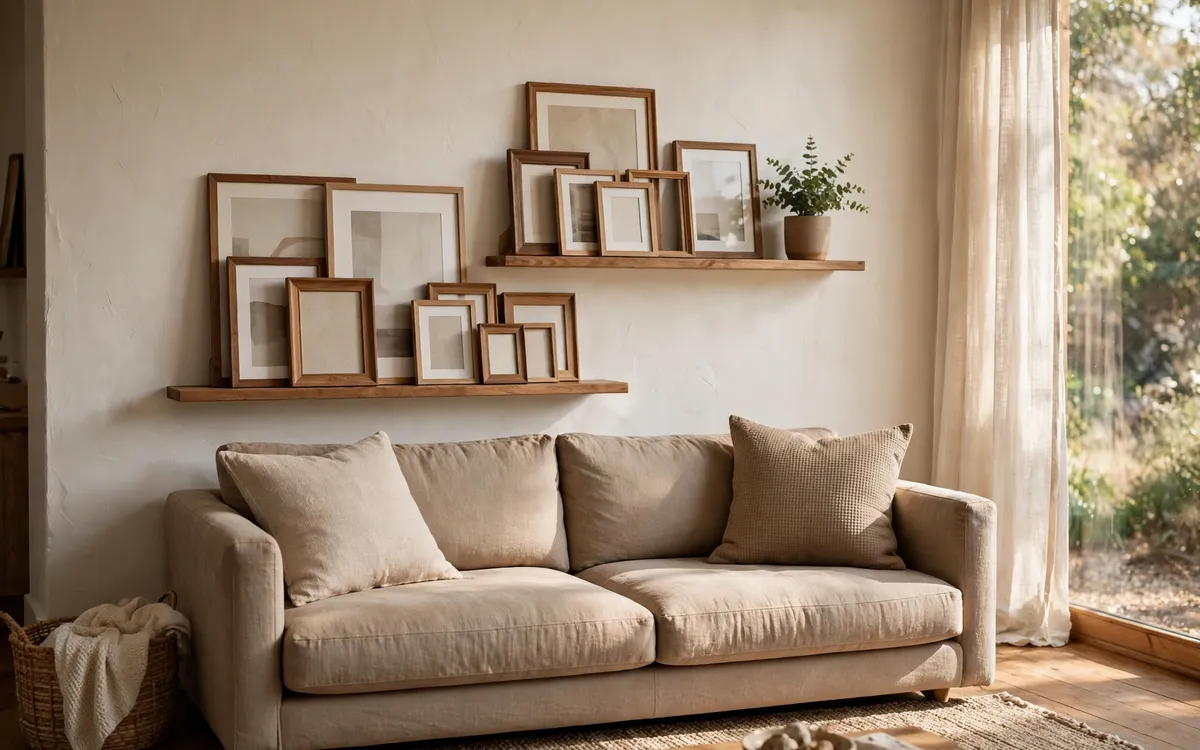
Two ledges double the display without a single new hole elsewhere on the wall. Respect the load limit — the 45¼-inch MOSSLANDA is rated to about 7.5 kg — and keep the combined composition, both ledges and everything on them, inside the sofa’s width band. Overlap one tall frame across both levels to stitch the two rows into one arrangement.
11. Style a Shallow Shelf With Objects, Not Just Frames
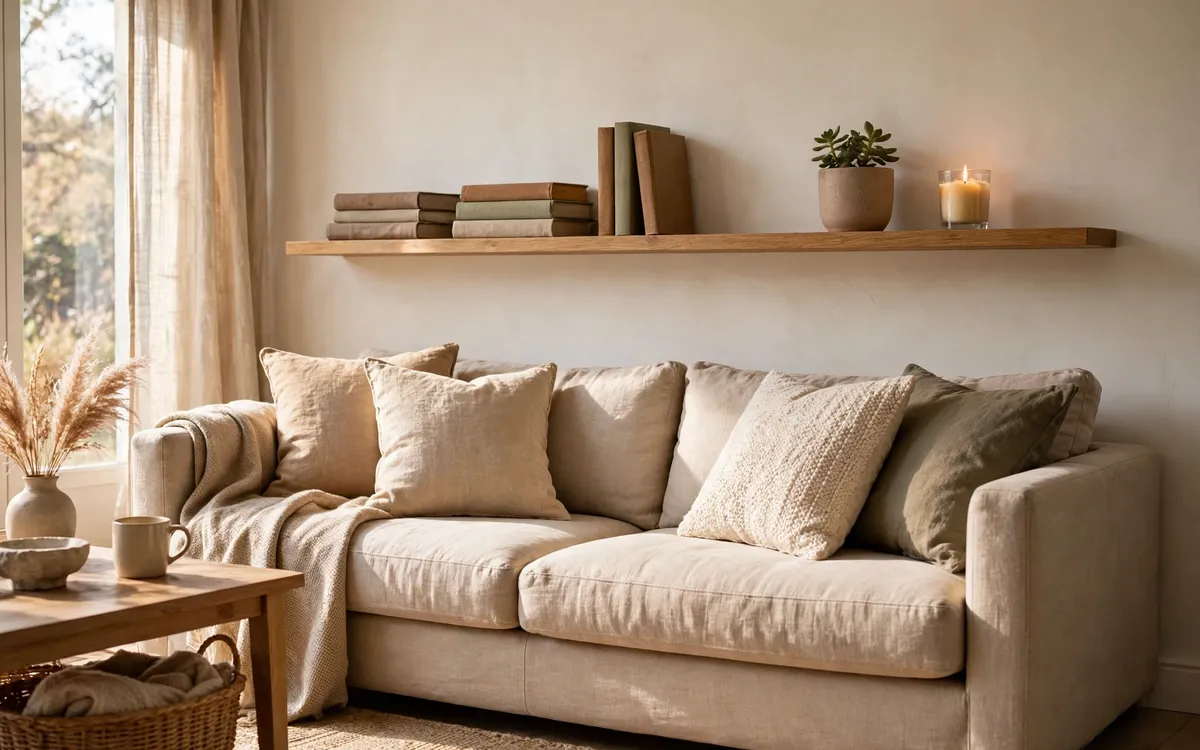
A shelf over a sofa carries objects as well as frames — a short stack of books, a small plant, one candle — provided it stays shallow: 4–6 inches deep only, so nothing looms over seated heads. Anchor it into studs or properly rated anchors, and park the heaviest pieces directly over the fixings. This is a display ledge, not a second mantel.
12. Float a Narrow Shelf With a Mirror Above It
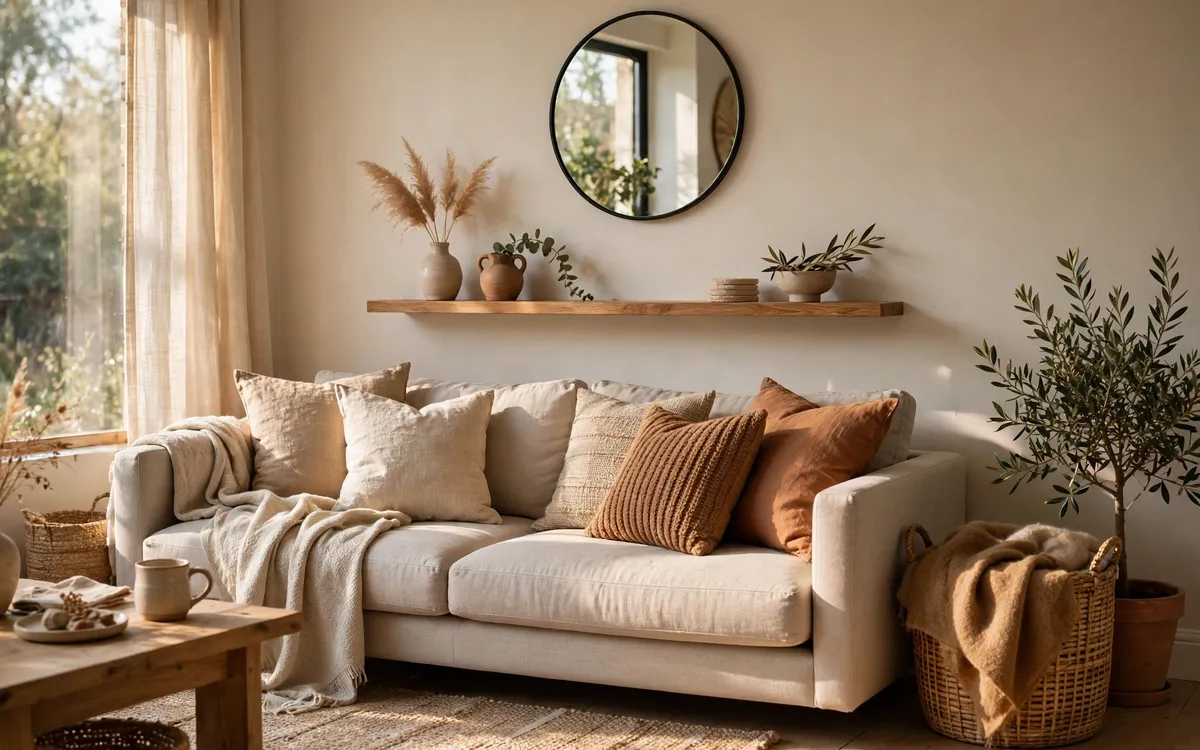
The shelf carries the changing layer and the mirror above it carries the light — the two hardest jobs on this wall, split between two simple pieces. Apply the 6–10-inch rule from the sofa back up to the shelf, and let the mirror sit 2–3 inches above the shelf’s top, so the pair reads as one composition with one measured gap at its base.
Zone D — Light and Texture
Not everything on the sofa wall has to be a picture. Light fittings, woven textiles, baskets and green leaves all fill the width band, and each solves a second problem while it is there — a dark corner, a cold wall, an echo, a room with no table space for plants.
13. Flank the Art With Two Sconces
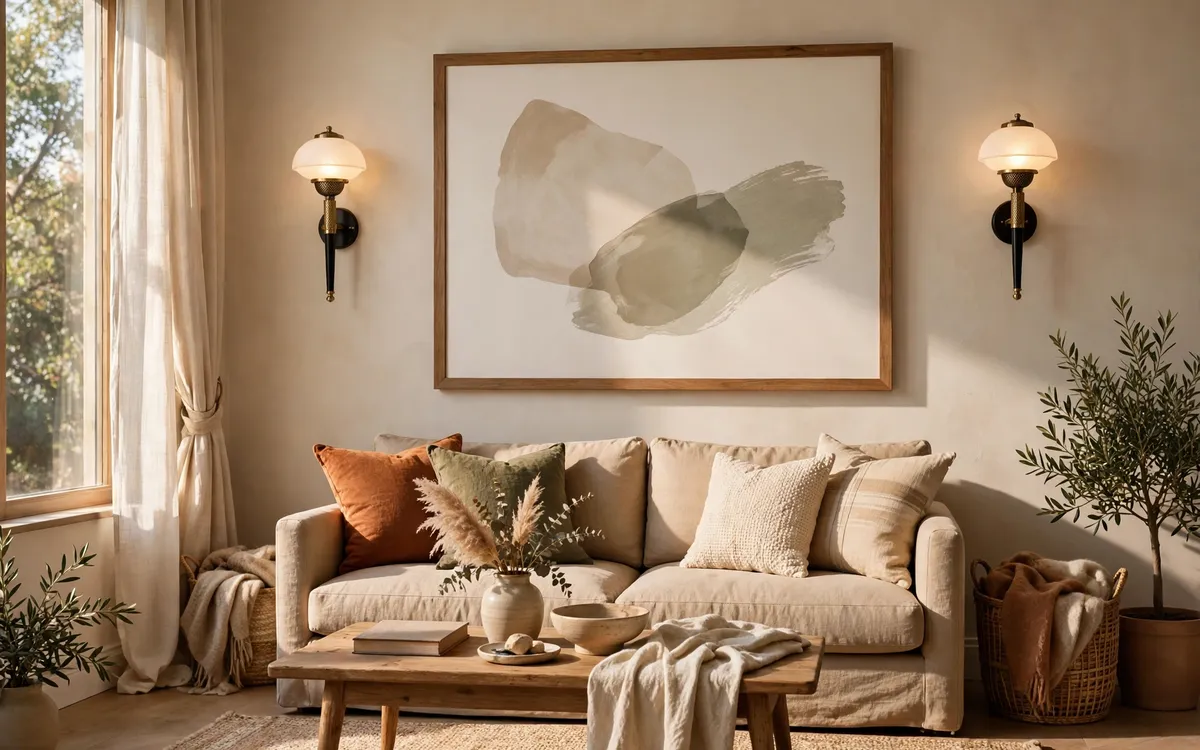
Two sconces flanking the central piece give the sofa wall its evening life. Place their centres at the standard 60–66 inches from the floor, the fixture’s bottom at least 12 inches above the sofa back so no seated head ever catches it, and each sconce at least a foot clear of the art’s edges so it lights the frame instead of shadowing it. Battery puck-light sconces need no wiring at all.
14. Hang a Woven Tapestry or Textile Panel
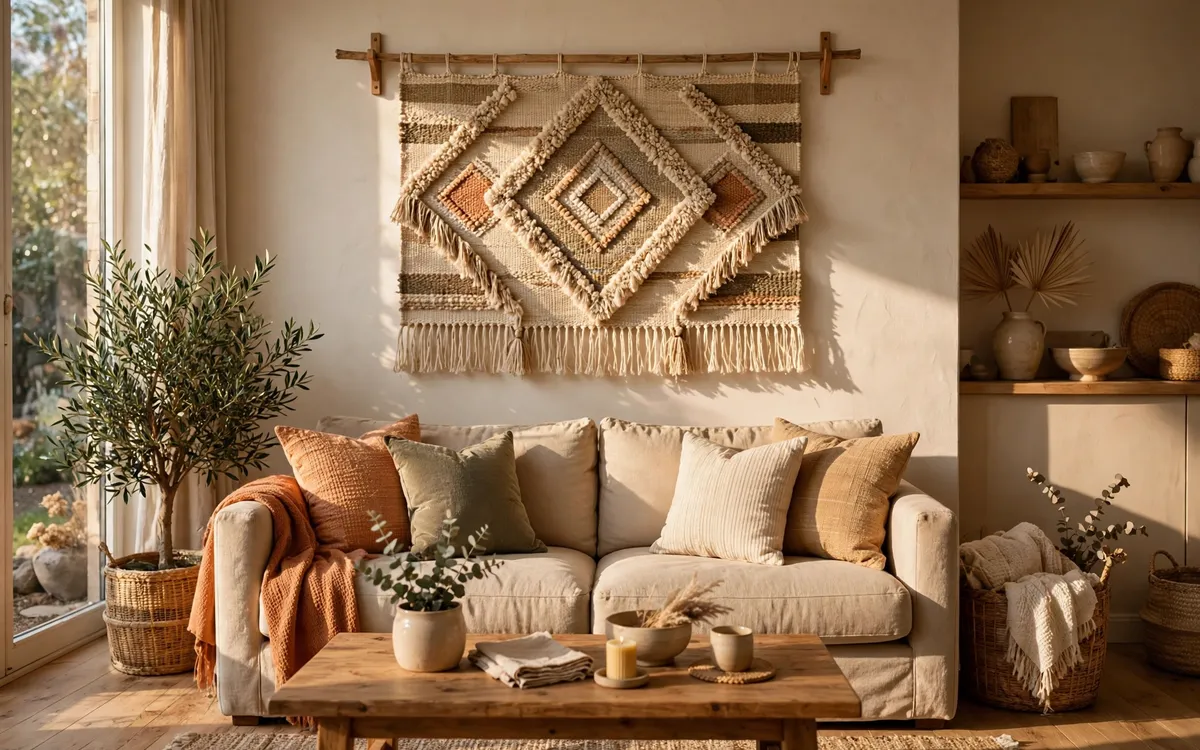
A woven panel on a dowel or slim rod, hung at the full two-thirds width, is the soft layer of the sofa wall — and in hard-floored rooms it does quiet acoustic work too, taking the echo out of conversation. Hang it by the same rule as any frame: its bottom edge 6–10 inches above the sofa back, its width measured against the sofa, not the wall.
15. Mount a Basket Wall Cluster
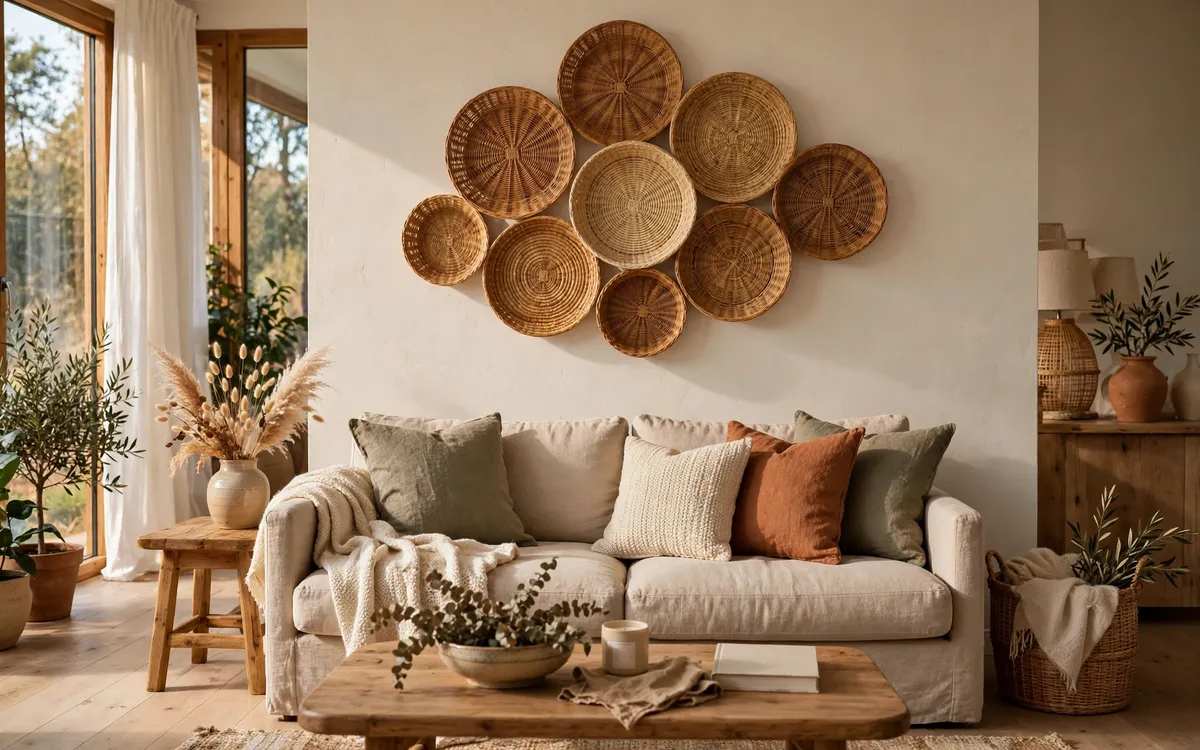
Flat woven baskets of 8–18 inches diameter, grouped tightly as one arrangement inside the width band, give the wall texture at almost no weight — which is why this is the renter’s gallery wall: baskets are feather-light, so adhesive hooks genuinely hold them. Mix two or three weave tones, keep the cluster’s outer edges disciplined, and let one large basket anchor the group.
16. Add a Large Wall Clock as the Single Piece
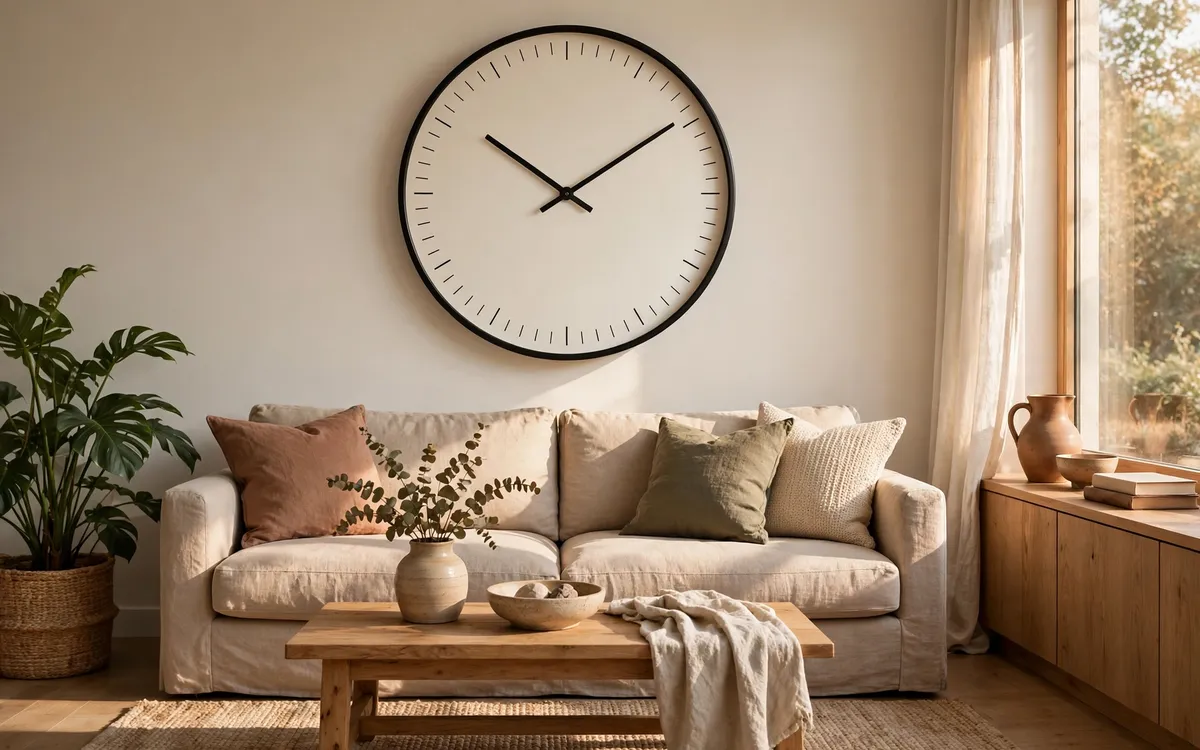
A clock can be the one big statement of Zone A in disguise — but only at the right scale. A 24–36-inch clock reads at sofa scale; the standard 12-inch kitchen clock simply disappears over a three-seater. Centre it on the sofa and treat it exactly like one large artwork for height: bottom edge on the 6–10-inch rule, centre in the 57–60-inch band.
17. Trail Plants From Wall Planters
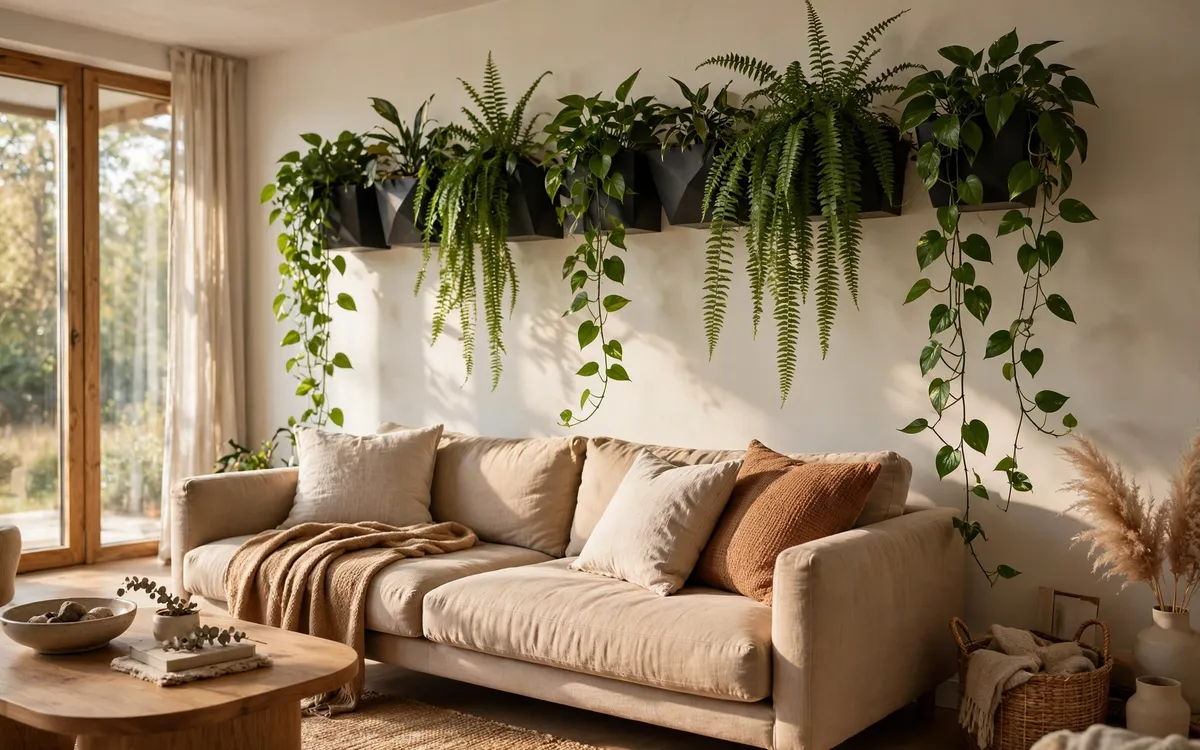
Wall-mounted planters, or one high ledge of trailing pothos, bring the wall to life where table space for plants ran out. Keep every pot secured and above head height, and never float anything heavy over the seats without a rated fixing — plants are the one decor on this wall that also needs watering, so choose faux stems where the light is honestly too low for real ones.
Zone E — Architecture and the Personal Layer
The last zone changes the wall itself, or fills it with the household’s own story. Moulding makes the arrangement out of the architecture; family photographs make it out of the people who sit underneath it. Both are sized by exactly the same numbers as everything before them.
18. Frame the Wall With Moulding Panels
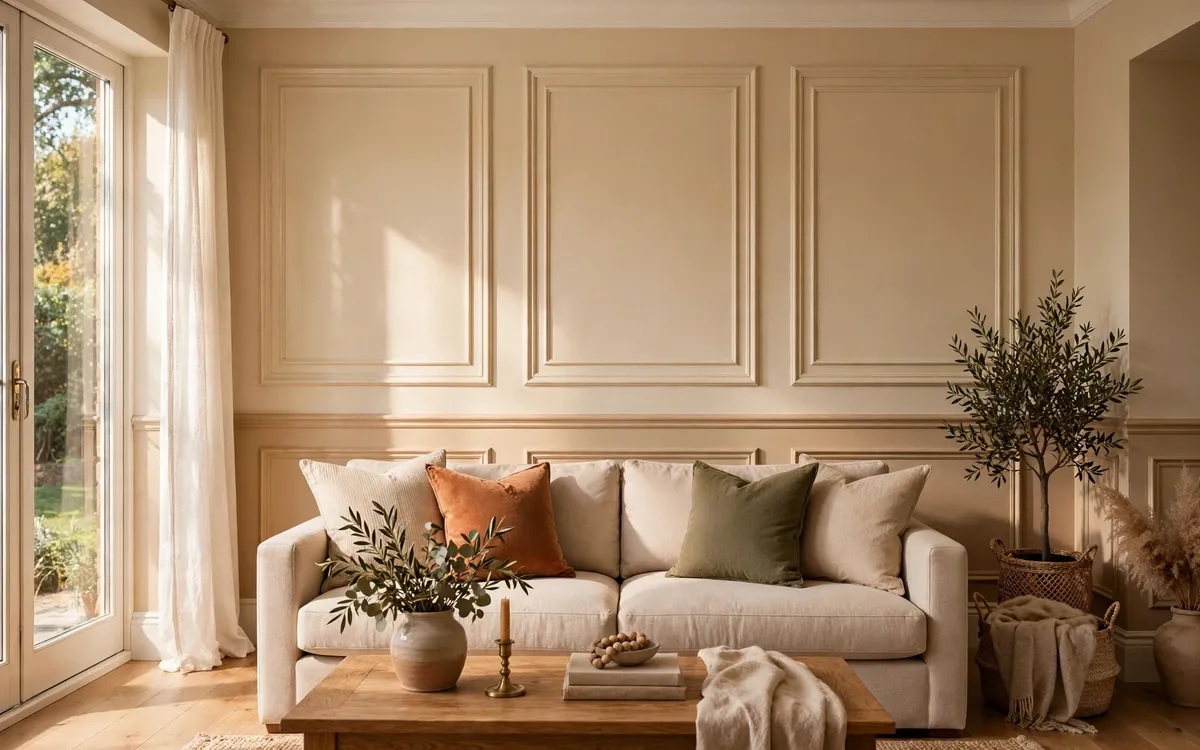
Picture-frame moulding draws the arrangement onto the wall itself: one wide panel measured to the sofa’s width, its inner space left empty, filled with one piece, or painted a shade that makes the panel the artwork. Paint it the wall colour for shadow-line subtlety or one shade deeper for definition. Peel-and-stick moulding kits make the whole treatment renter-reversible.
19. Hang Framed Family Photos in Black and White
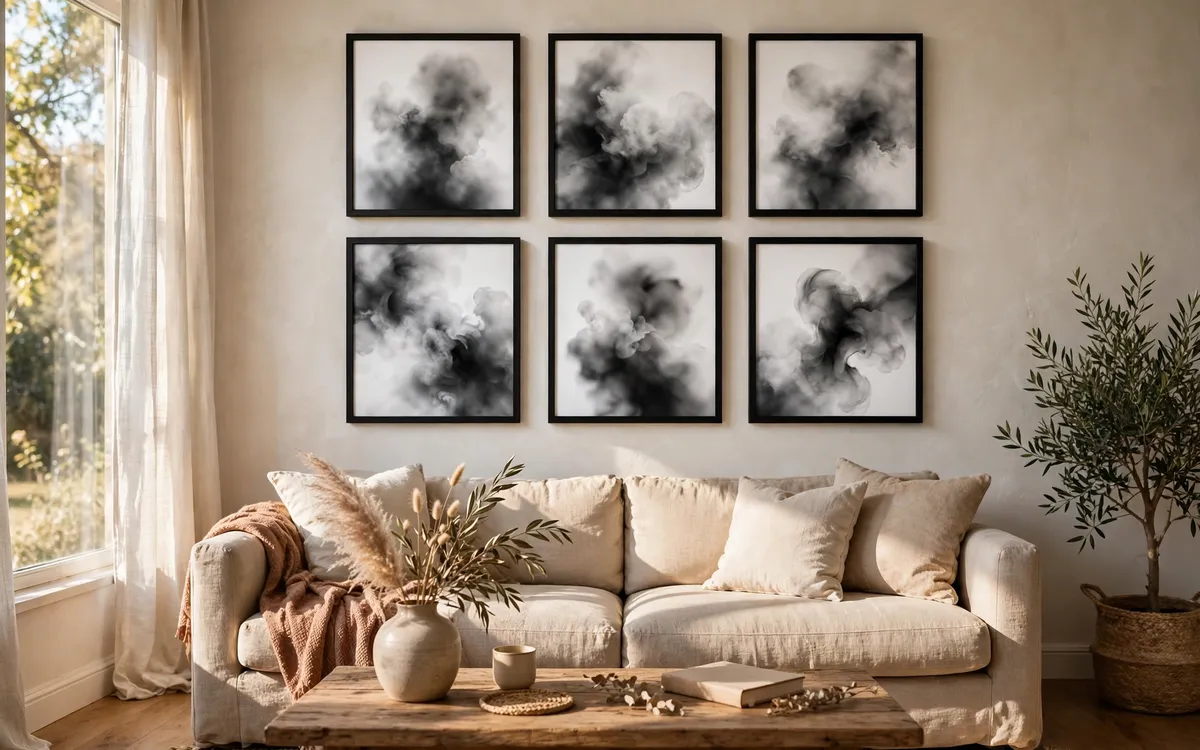
Family photos belong on this wall — they just need gallery discipline. Convert the mixed years of phone and camera shots to black and white and they unify into one calm grid: same frames, same mat widths, 2–3 inches between every frame, the group measured across its outer edges against the sofa’s width. The conversion is free in any phone’s edit menu, and it is the whole trick.
20. Lean One Extra-Large Frame From the Sofa Table
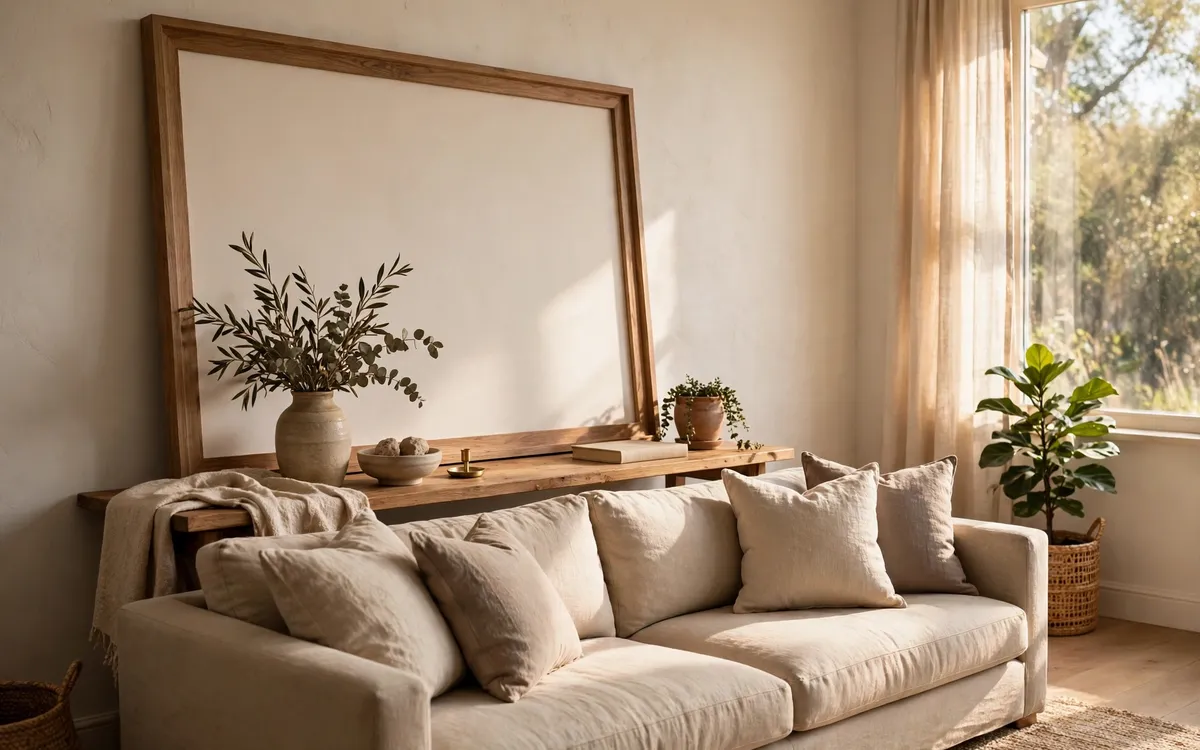
Where a sofa table stands behind the couch, one extra-large frame leaning on it against the wall bridges furniture and wall into a single composition — no holes, fully changeable, and the deepest layered look on this list. The table itself and everything that belongs on it is a subject of its own: our sofa table decor ideas. Here the table is simply the base the wall leans on.
21. Keep One Seasonal Swap Spot
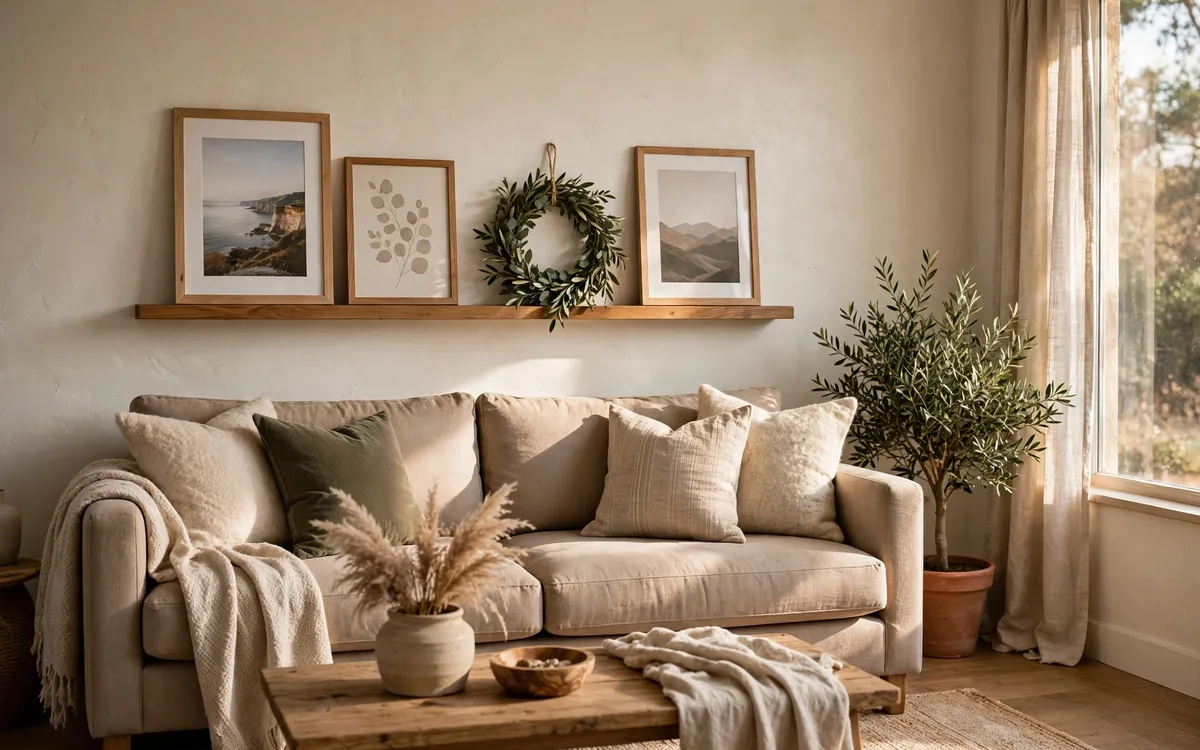
Finish the wall by deliberately leaving one spot unfinished: one frame, hook or ledge section kept changeable on purpose — a small wreath there in winter, lighter stems in spring, a child’s drawing in the week it is drawn. Because only that one spot ever changes, the wall reads as finished all year, and the seasons get their moment without a redecoration.
What It Costs: Three Ways In
The paper-and-prints tier (under roughly $75). The paper template costs nothing and does most of the work. Downloadable prints in thrifted frames, one short picture ledge, a thrifted basket cluster — this tier proves the article’s point: the numbers finish the wall, and the money is almost optional.
The composed-wall tier (roughly $75–$300). A 40×60-inch canvas print, a matched pair or a six-frame grid set, two long picture ledges, a pair of battery sconces — the full measured wall, achieved without an electrician, a carpenter or a single regret hole.
The statement tier (roughly $300–$800). A large framed statement piece or a 36-inch mirror, hardwired sconces with an electrician’s visit, or a moulding-panel wall — the near-renovation moves that change the room’s architecture, not just its decoration.
7 Mistakes That Leave a Sofa Wall Floating
- Art that is too small. A single frame under half the sofa’s width floats no matter how beautiful it is. Scale is the first decision; a group measured across its outer edges counts exactly like one big piece.
- Hung too high. A gap of more than about 12 inches between art and sofa back disconnects the two, and the eye reads them as separate accidents. The 6–10-inch rule exists because this wall is read from the seats.
- Centring on the wall instead of the sofa. When the sofa sits off-centre on its wall — and most do — art centred on the wall hangs over nothing and the whole arrangement looks drunk. The sofa is the anchor; the art follows it.
- Inconsistent gallery gaps. One inch here, five inches there reads as accident, not eclectic. Pick 2–3 inches and hold it between every frame in the group, in both directions.
- Heavy shelves and frames over heads without studs or rated anchors. This is the one mistake on the sofa wall that can actually hurt someone. Anything with real weight over a seat goes into a stud or an anchor rated for it — no exceptions.
- Ignoring the sofa’s back height. Tall backs take the 6–8-inch end of the hanging gap; hang to the 10-inch end behind a tall back and the art detaches. A ledge behind a low back, meanwhile, sits exactly where heads lean.
- Copying a photo without measuring your own sofa. The two-thirds rule is sofa-specific: a layout copied from a longer sofa shrinks on yours, and from a shorter one it crowds. Thirty seconds with a tape measure outranks every inspiration photo.
FAQs
What can I put above a couch besides pictures?
At least seven non-picture answers fill the same width band: a large mirror or windowpane mirror grid, picture ledges with lean-to frames and objects, a pair of sconces, a woven tapestry, a basket cluster, a large wall clock, and moulding panels that make the wall itself the decor. Each is measured the same way — two-thirds to three-quarters of the sofa’s width, bottom edge 6–10 inches above the back.
How big should art above a couch be?
The arrangement — one piece, or a group measured across its outer edges — should span two-thirds to three-quarters of the sofa’s width. On an 84-inch three-seater that is 56–63 inches; on a 90-inch sofa, 60–67 inches; on a 60-inch loveseat, 40–45 inches. A single standard frame under half the sofa’s width will float no matter where it is hung.
How high above a couch should I hang a picture?
Hang the bottom edge 6–10 inches above the sofa back — the 6–8-inch end behind tall backs of 36 inches or more, 8–10 inches behind low-profile sofas. Cross-check the centre of the arrangement: it should land near 57–60 inches from the floor, the usual gallery eye level. Where the two rules disagree, the sofa gap wins.
How do I decorate a large blank wall behind a couch?
With scale, not with more pieces. One arrangement measured to the sofa — an oversized canvas, a symmetrical grid, two ledges, or moulding panels drawn to the sofa’s width — finishes a big wall where a scatter of small frames only makes it look bigger and emptier. Template the arrangement in paper first and check its outer edges against the two-thirds to three-quarters band.
Should decor above a couch be centred?
Yes — but centred on the sofa, not on the wall. Find the sofa’s centre line and hang the arrangement’s centre on it, even when the sofa sits off-centre in the room. When the sofa itself is centred on its wall the two lines agree; when they do not, the sofa is the anchor the eye uses, and the wall’s centre is irrelevant.
How can I decorate above a couch without nails?
Adhesive strips rated for the frame’s actual weight carry most prints and all baskets; one picture ledge needs only two screws to replace a wall of holes; an extra-large frame can lean from a sofa table with no fixing at all; and peel-and-stick moulding is fully reversible. Check the strip’s weight rating against the frame before trusting it — that check is the whole safety of the nail-free route.
A gallery wall that runs out of wall above the sofa still has somewhere to go — around the corner. A corner gallery keeps this guide’s numbers (a centre line at 57 inches, frames 2 to 3 inches apart) and carries them around the angle, and the full measured treatment of living room corners — seating, lamps, shelves and plants, one job per corner — is set out in our empty corner in living room ideas.
One measurement sits underneath everything on this page: the sofa itself has to be standing in the right place first. Whether an L-shaped sectional belongs tucked into the corner or floated as a room divider, which way its chaise should turn, and the 30 to 36 inches of walkway that keep the seats under your art usable are all decided in our how to arrange l shaped sofa in living room guide — hang the wall after the sofa has earned its spot.
One choice underneath the measurements on this page is easy to miss: the art’s colours are chosen against the couch below it. A grey couch is not one colour — read its undertone first, and the art above it either runs warm to heat the grey or cool to sharpen it. That reading, and the palette built on it, is our grey couch living room ideas — hang the wall after the couch’s own colour has been named.
For a wall that needs the same measured approach in a bolder, more playful register, our skateboard wall decor ideas apply the same rules — level lines, honest fixings and a clear focal point — to decks hung as art. It is the same discipline, just with a little more personality on the wall.
Conclusion
A finished sofa wall is not a decorated one — it is a measured one. The sofa sets the width at two-thirds to three-quarters, the back sets the gap at 6–10 inches, the format is matched to what the room needs, and every space inside a group holds at 2–3 inches. Work through these above couch decor ideas in that order — measure it, match it, hang it low — and the wall above the couch stops floating and starts belonging to the room; it becomes one more layer of the warm, finished whole that our cozy living room ideas build underneath it.

4 Comments