
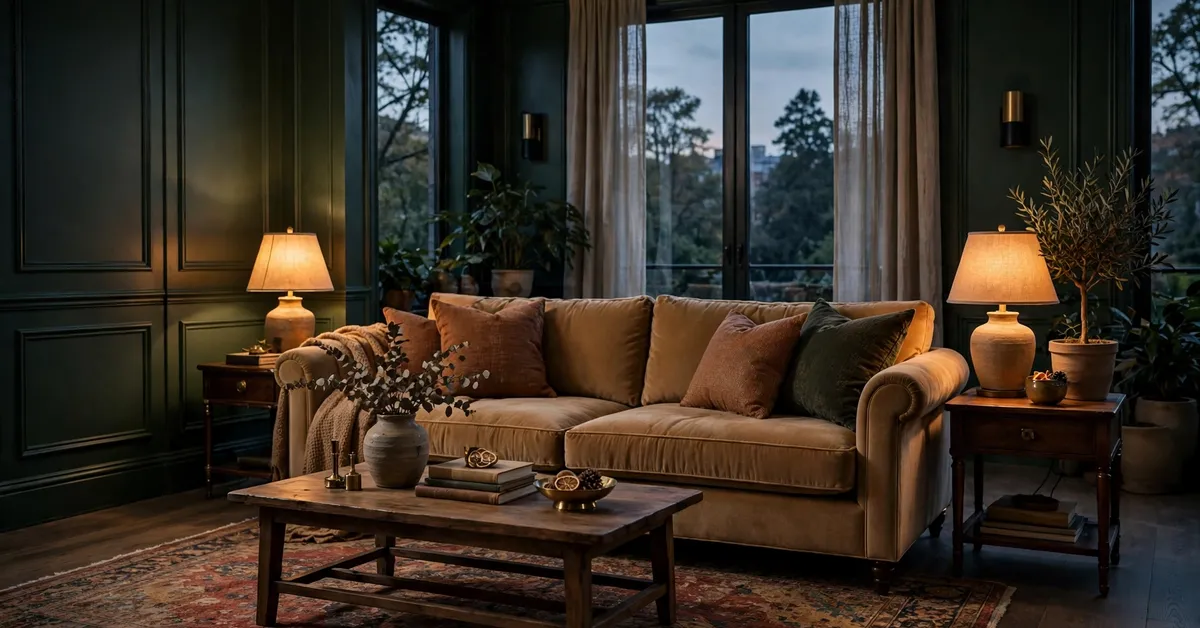
22 Gorgeous Moody Living Room Ideas for a Deep, Cocooned Room
Every moody living room photograph you have ever saved carries the same promise: a room that wraps around you at the end of the day. And everyone who has carried a dark paint tin home knows the fear that follows it through the door: that the room will not feel cocooned at all, it will feel like a cave, and by Tuesday you will be pricing up white paint to undo it.
The difference between moody and gloomy is not talent, and it is not luck either. It is three measurable decisions: how deep the colour goes, how warm the light burns, and how much contrast stands up against the dark. The moody living room ideas below are built as a system around those three numbers, for a room that has to work in daylight, welcome guests and carry a television, not just pose at dusk. The bedroom version of the same mood, tuned for sleep rather than company, lives in our moody bedroom ideas.
The Method: Drench It, Dim It, Anchor It
Three moves, in order. The paint decides the depth, the lamps decide the temperature of the dark, and the furniture decides whether the finished room reads rich or merely dim.
Step 1: Drench It
Choose the depth by number before you choose it by name: shop paint by LRV, the light reflectance value printed on the maker’s data. An LRV of 5 to 15 is the full-drama band, safe on all four walls only when the room also gets three or more light sources and one strong pale contrast, a cream sofa or a light rug. An LRV of 15 to 25 is the gentle band, the right start for a single wall, a north-facing room, or a first attempt. The colour specialists at Kylie M Interiors’ dark paint colours guide list the reliable deep shades with their LRVs, which makes shortlisting far easier. Mind the direction rule: north light is cool, so pick a shade with a warm brown or green undertone, because a blue-black in north light reads icy. Use matte or eggshell only, test a 60 by 60 cm swatch on two walls in morning light and lamplight, and expect a tinted primer plus 2 to 3 thin coats over white. Drenching means the colour goes onto the trim and skirting too, so no white cut line slices the room at ankle height.
Step 2: Dim It
Build a minimum of three light sources at three heights: a table lamp near sitting eye level, a floor lamp, and one wall-level glow from a sconce or picture light. Each source makes a pool of light, and the shadows between the pools are the mood. Every bulb sits at 2200 to 2700 Kelvin; anything at 4000K or above is daylight-white and kills the room in a single switch. Put the lamps on dimmers or smart bulbs so the evening setting is lamplight-level. The ceiling light is demoted to cleaning-day duty, off or at its lowest setting. Fit a bias light behind the TV so the screen glows against a soft halo instead of floating in a black hole, and shade every bulb, because a bare bulb against a dark wall is glare, not glow.
Step 3: Anchor It
Contrast and weight live at floor level. The sofa obeys the contrast step: it sits 2 to 3 shades lighter than the walls, or at the same depth in a clearly different texture, a matte wall behind a velvet sofa. Same value and same texture, and the piece disappears. The rug must be big enough for the front legs of every seat to stand on it, an 8 by 10 ft rug in most living rooms and 9 by 12 ft in a large one. Work a tonal 60-30-10 split: about 60 percent deep field in the walls and big textiles, 30 percent mid warmth in wood, leather and the rug’s pattern, and 10 percent lift from one bright metal or a cream textile. Repeat one warm metal, brass is the workhorse, at least three times around the room, and stack at least three textures within arm’s reach of the sofa: velvet, wool, linen or leather. In a dark room, texture is what the low light has to play on.
Zone A: Set the Depth
Paint is the biggest lever in every set of moody living room ideas, and the one everyone reaches for first. These five moves run from the full commitment down to the ceiling, and each one carries the number that makes it work.
1. Drench the Whole Room in One Deep Colour

The full commitment: one deep colour on all four walls, the trim and the skirting, so the room’s edges dissolve and the lamplight does the decorating. It belongs in the LRV 5 to 15 band, and it only works when the contrast pieces are planned before the first coat, the pale sofa, the light rug, the brass. Drench first and furnish hopefully, and the room has nothing to hold the light.
2. Paint Just the Sofa Wall Deep

The one-wall version, and the safest first wall in the house: the wall behind the sofa, painted in the LRV 15 to 25 band. It is safest because the sofa itself supplies the contrast step, a light linen or camel back standing against the depth. The other walls stay pale, daylight keeps its bounce, and if the experiment fails it is one wall to repaint, not four.
3. Take the Colour Onto the Built-Ins and the Media Wall

Painting joinery instead of walls buys depth with less paint and less commitment: built-in shelves, bookcases and the media wall in the deep shade, the room’s walls left light. The television hides in plain sight against its dark panel instead of floating on a pale one. Style the shelves with pale objects, cream pottery, light book spines, so the pieces read clearly against the dark behind them.
4. Add Panel Moulding in the Same Shade

Applied moulding frames, painted in exactly the wall colour, add the shadow lines that low light loves to catch. The panels give a flat dark wall its architecture, which is what stops a deep room reading as a painted box. Size the frames to your own wall, roughly 60 to 90 cm wide, rather than copying a photograph’s proportions, and keep every panel the wall’s own colour: the effect is texture, not contrast.
5. Wrap the Ceiling in the Wall Colour
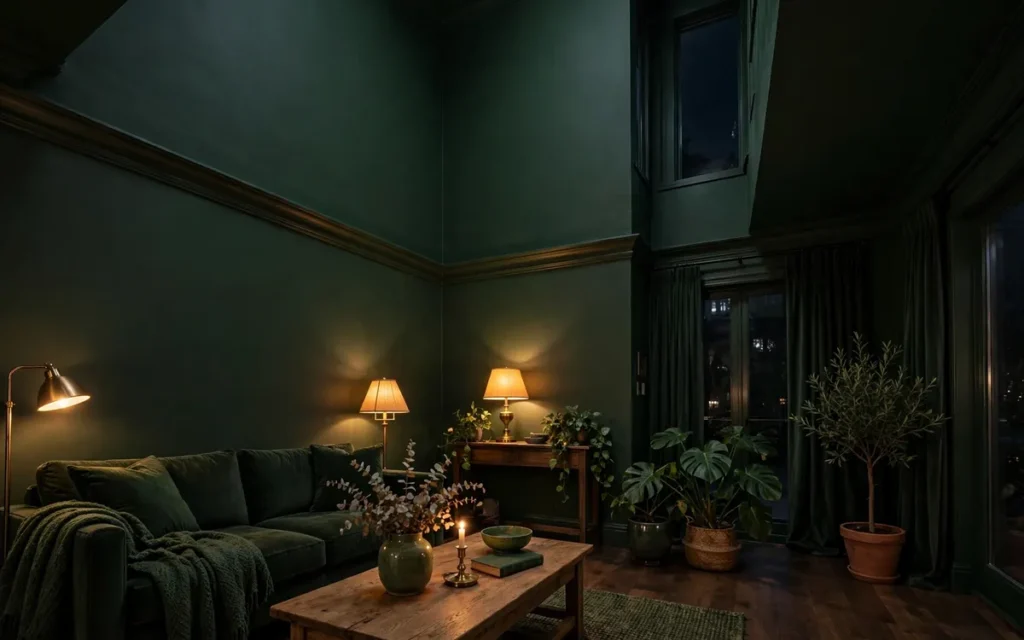
The boldest move in the zone, with a condition attached: reserve it for ceilings of about 2.7 m (9 ft) or higher, where the lid of colour closes the room in a good way. On a standard ceiling, stop at the walls and paint the ceiling one shade lighter than the walls’ lightest partner colour instead. A dark ceiling over a low room presses down; over a tall one, it cocoons.
Zone B: Light It Low and Warm
More moody rooms fail at the light switch than at the paint tin. These five moves build the three warm pools the method asks for, and fix the screen that shares the room with them.
6. Build Three Pools of Light at Three Heights

The Step 2 rule, applied before anything else is bought: one table lamp near sitting eye level, one floor lamp, and one wall-level glow from a sconce or picture light. Count your sources honestly before shopping, because most rooms that “failed” at dark paint turn out to be running a single ceiling light. Three pools, three heights, and the shadows in between are the atmosphere.
7. Swap Every Bulb to Warm and Put Them on Dimmers

Every bulb in the room goes to 2200 to 2700 Kelvin, no exceptions for the one bright corner lamp, and the main lamps go on dimmers or smart bulbs so the evening setting can drop to lamplight level. One practical check before the hardware store: confirm the LED bulbs are marked dimmer-compatible before fitting a dimmer switch, because incompatible pairs buzz and flicker instead of glowing.
8. Fit a Bias Light Behind the TV

A simple LED strip fixed to the back of the screen throws a soft halo onto the wall behind it, and that halo changes movie night entirely: the blacks on screen read deeper, the screen stops floating in a black hole, and your eyes stop straining against the contrast. It is the cheapest upgrade in this article and the one guests ask about. Choose a warm white strip so the halo agrees with the room’s lamps.
9. Wash the Art With a Picture Light

One brass picture light over the largest piece of art turns a dark wall into a gallery wall after dark: the painting glows, the wall around it stays deep, and the room gains its third height of light. Battery and rechargeable versions need no wiring, which makes this a renter-safe move too. It also repeats the brass, quietly doing Step 3’s metal work while it lights.
10. Cluster Candles on the Coffee Table
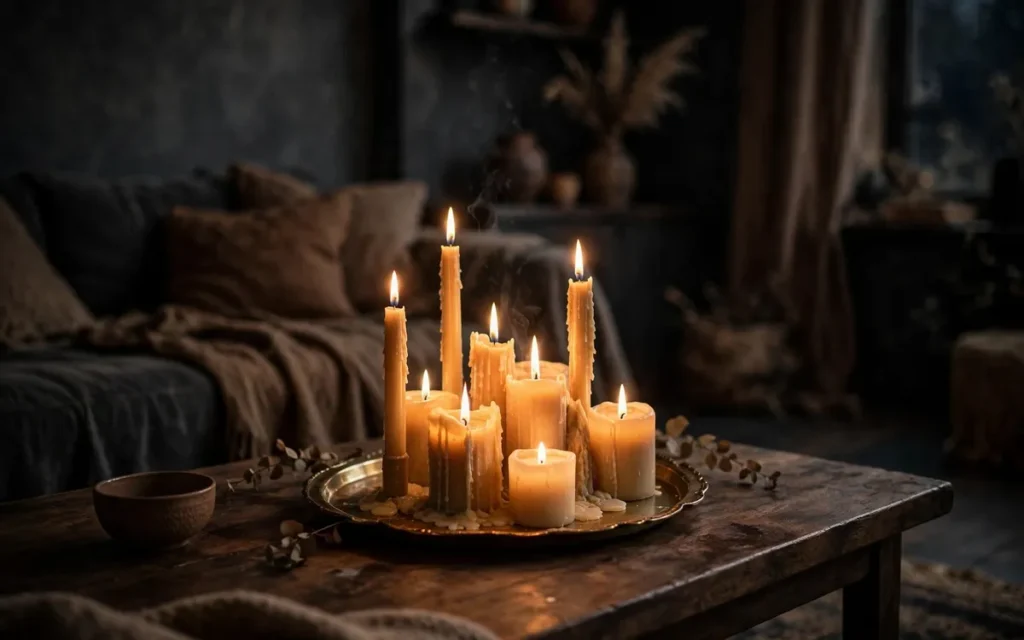
Group 3 to 5 candles at mixed heights on a tray so they read as one low, living light source at the centre of the seating. Candlelight is the warmest light there is, and at coffee-table height it flatters every face in the room. The discipline: real flames stay on the tray, at least 30 cm (12 in) from cushions and curtain fabric, and LED candles take over anywhere near textiles or in homes where flames will be forgotten.
Zone C: Ground the Seating
Dark walls are only half the room; the other half is what your guests sit on. These five moves give the seating the contrast, size and texture the method’s third step demands.
11. Keep the Sofa Two Shades Lighter, or Velvet Against Matte

The contrast step, stated as a shopping rule: the sofa sits 2 to 3 shades lighter than the walls, camel against chocolate, cream against green. If the sofa you own is already dark and staying, change its texture instead of its colour: a velvet sofa against a matte wall separates by sheen where it cannot separate by shade. What never works is same value, same finish: the room’s biggest piece simply vanishes.
12. Lay the Biggest Rug the Room Takes

Size the rug by the front-legs rule: the front legs of the sofa and every chair stand on it, which means 8 by 10 ft in most living rooms and 9 by 12 ft in a large one. A small rug floating in the middle is the fastest way to make a dark room look unfinished. Vintage-look patterns earn their place twice over, because they also hide the lint and dust that dark rooms show so honestly.
13. Bring In One Warm Leather Piece
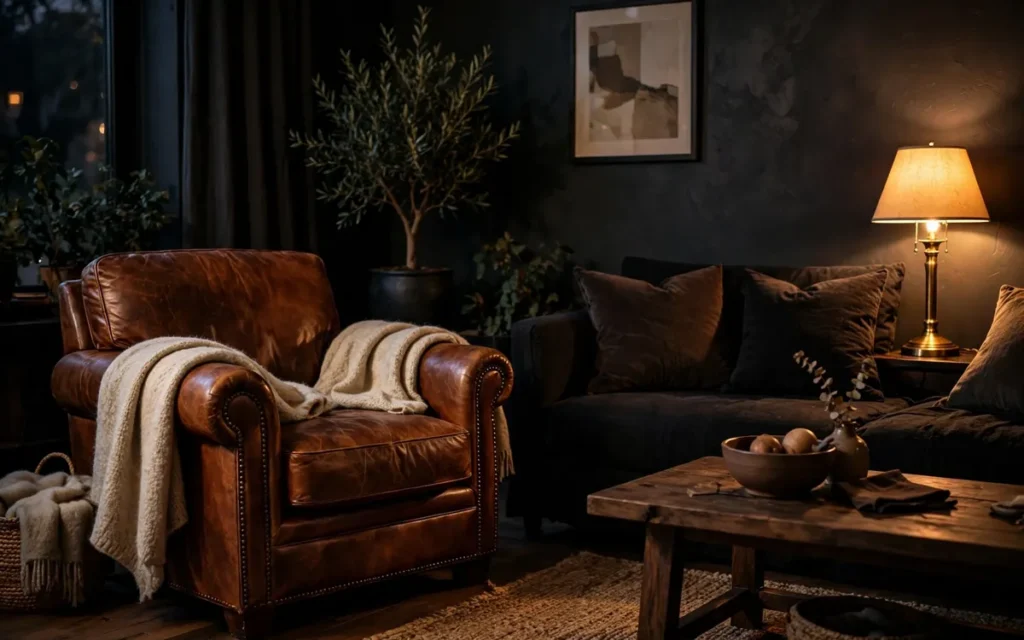
One cognac or tan leather chair, ottoman or pouf is the 30 percent mid-warmth of the method’s 60-30-10 split, and it warms every dark palette it touches: green, navy, charcoal, brown. One piece is the dose. A full leather suite tips the room from cocooned to club-room, and leather’s soft sheen under lamplight does the work that a brighter colour would do in a pale room.
14. Stack Three Textures on the Sofa

Within arm’s reach of anyone sitting down, stack at least three textures: a velvet cushion, a wool throw, a linen or leather piece. In a pale room, colour contrast does the visual work; in a dark room that contrast is given up on purpose, and texture contrast replaces it. Low light rakes across velvet, wool and linen at different depths, which is exactly what keeps a deep-toned sofa interesting instead of flat.
15. Choose Dark Wood Over Glass and Chrome

Walnut-toned coffee and side tables ground the seating where glass and chrome cannot: glass disappears against dark walls and leaves its objects floating, and chrome reads cold under warm bulbs. Dark wood keeps the tonal field unbroken from wall to floor. The console behind the sofa plays by the same rule, and its styling has its own system in our sofa table decor ideas.
Zone D: Art, the Mantel and the Screen
A dark wall is the best backdrop art ever gets, and the television is simply one more dark rectangle to compose with. Four moves for the walls that carry pictures, mirrors and the screen.
16. Hang One Oversized Moody Canvas
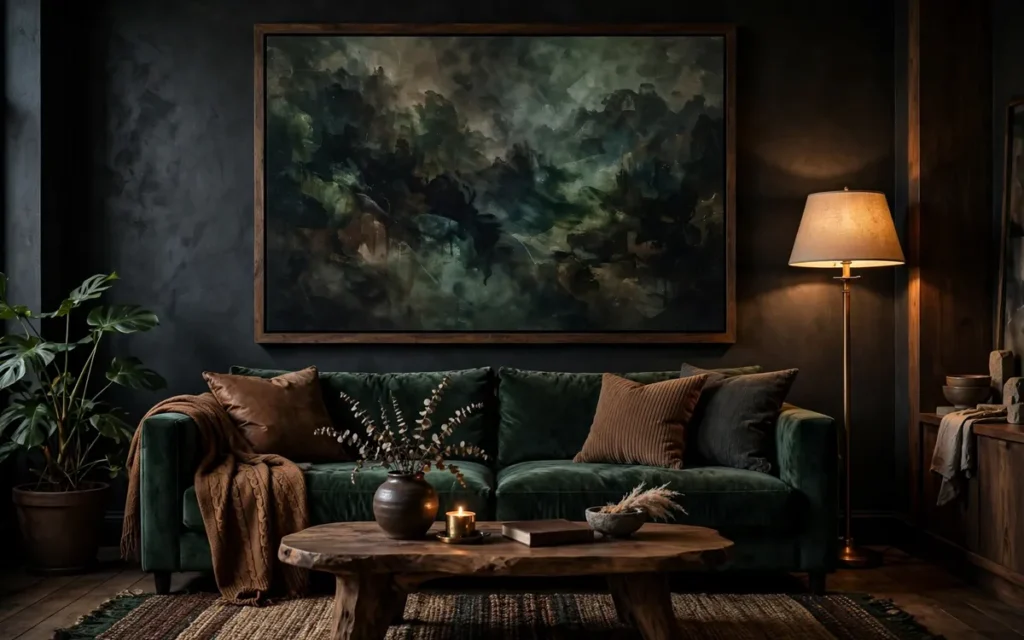
One large piece beats six small ones on a dark wall, every time. Size it by the sofa: the canvas width at about two-thirds of the sofa’s width, its centre hung at 145 to 150 cm (57 to 60 in) from the floor. A moody landscape, a dark still life or an abstract in the room’s own tones reads as a window into somewhere deeper, and the dark wall around it becomes the frame.
17. Build a Gallery Wall With Brass Frames

If the room wants many pieces instead of one, give the darkest wall the gallery: it is the backdrop art was always meant for. Brass frames do double duty here, because they also deliver the method’s repeated warm metal, three or more glints of the same warmth across the wall. Keep the art’s tones deep and its mats pale, so each piece holds its own pool of attention under the lamps.
18. Frame the TV With Art and Shelves

Treat the screen as one dark rectangle among others: hang framed art or styled shelves symmetrically on both sides of it, at similar visual weight, so the switched-off television reads as composition rather than appliance. The panel disappears into the arrangement by day and joins it by night. The fuller craft of blending a screen into its wall lives in our how to decorate around a TV guide.
19. Style the Mantel Dark With One Bright Metal

Paint the mantel with the walls and let a single bright metal be its only shine: one brass mirror or a pair of brass candlesticks against the deep surround. Angle the mirror to catch lamplight rather than the ceiling light, so it returns warmth to the room. Where the fireplace also carries the screen, our TV above fireplace ideas work through that pairing in full.
Zone E: The Mood Without Paint
No tin opened, nothing permanent: the whole zone is textiles, light and one contained panel of colour. It is the renter’s route, the landlord-safe route, and the try-it-first route for owners who want to live with the mood before committing to it.
20. Hang Deep Curtains High and Wide

A full wall of deep fabric is the renter’s paint. Hang the panels 10 to 15 cm (4 to 6 in) above the window frame and 10 to 15 cm wider on each side, falling all the way to the floor, and the window wall becomes a deep, soft field that changes the whole room’s register. Deep olive, charcoal or warm brown all work; lining the panels keeps the light out and the drape heavy.
21. Dress the Sofa in a Deep Throw Layer
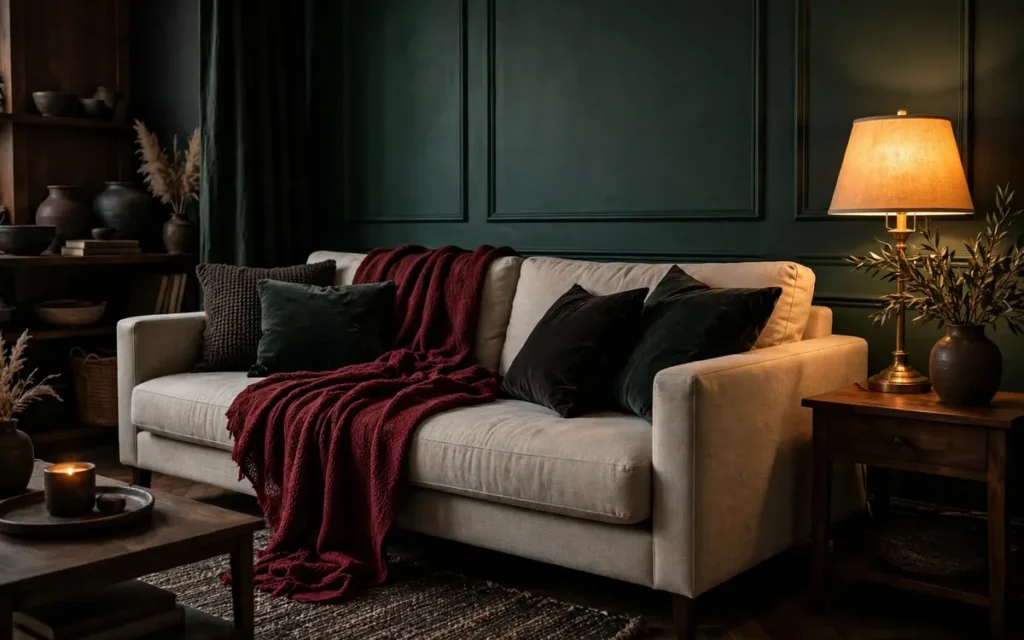
A deep throw and two dark cushions over a neutral sofa move the room a full shade moodier for the price of textiles, and the whole change reverses in minutes: a burgundy or forest throw folded along the sofa’s back, dark velvet cushions at both ends. It is also the honest test of the look: live with the deep layer for a fortnight, and you will know whether the paint tin deserves to be opened.
22. Back a Bookcase in a Deep Shade

Paint, or paper, only the back panel of an open bookcase: a contained block of depth that warms the entire wall it stands on, while the shelves and their contents stay light against it. It is the smallest possible commitment of real colour, one panel to repaint on moving day, and it borrows the built-ins idea from Zone A at a fraction of the paint. Warm the shelves with the room’s brass and the effect doubles.
What It Costs: Three Honest Levels
Free
Rearrange the lamps you already own into three pools at three heights. Swap the warm bulbs already in the house into the living room and the cool ones out. Bring the biggest rug from another room, pull throws and cushions from the bedrooms, and restyle the coffee table from pieces you own. An evening’s work and no shopping: the method’s Dim and Anchor steps, tested for nothing.
Low Cost
Warm 2200 to 2700K bulbs and plug-in dimmers. One tin of deep paint plus tinted primer for a single wall or a bookcase back. A battery picture light, a TV bias-light strip, thrifted brass lamps and frames, and an LED candle cluster for the coffee table. This level delivers most of the finished look, and every piece of it moves house with you.
Worth Spending On
The full drench done properly: tinted primer, 2 to 3 coats, trim included, because half-done dark paint is the one version that really does look like a cave. An 8 by 10 or 9 by 12 ft wool or vintage-look rug at the front-legs size. Installed dimmer switches. And one oversized framed canvas at the two-thirds-of-the-sofa width, the single piece of art the room will be remembered by.
7 Mistakes That Turn Moody Into Gloomy
- Walls, sofa and curtains all at the same value. With no contrast step anywhere, every piece melts into one dark mass and the room reads flat, not deep.
- Keeping one bright white overhead bulb. A single 4000K ceiling light flattens every dark colour beneath it. The lamps are the light now; the ceiling light is for cleaning day.
- A blue-black shade in a north-facing room. Cool daylight over a cool undertone turns icy instead of cocooned. Choose a warm-based deep colour and the same room wraps.
- Satin or gloss paint on dark walls. Sheen shows every flaw in the plaster and bounces the television screen back at the sofa. Matte or eggshell, always.
- A rug that floats. A 5 by 7 ft rug with no furniture legs on it breaks the grounded feeling the whole look depends on. Size up until the front legs land on it.
- Every surface smooth. Without a texture stack, low light has nothing to play on, and the room reads dull rather than deep. Velvet, wool and linen are the fix.
- A lamp reflected in the TV. One badly placed lamp puts a bright blob in the middle of every dark scene. Sit in the viewing seat and check the screen before fixing any lamp’s position.
A Short Safety and Practical Note
Candles. Real flames stay on a tray, at least 30 cm (12 in) from curtains, cushions and throws, and are never left burning unattended. LED candles are the default anywhere near fabric, and everywhere in a home where a flame might be forgotten.
Dimmers. Confirm LED bulbs are dimmer-compatible before fitting dimmer switches. Incompatible pairs buzz, flicker and die early; the compatibility note is printed on the bulb’s box.
Paint honestly. Dark over white needs a tinted primer and 2 to 3 thin coats, with each coat fully dry before the next goes on. Ventilate the room while painting, and judge the colour only when the final coat is dry, because wet dark paint always looks lighter and patchier than it will finish.
Cords. Run lamp and bias-light cords behind furniture, never across a walkway. Low light hides trip hazards just as kindly as it hides clutter, and a dark room is the worst place to trail a cable.
Living Room FAQs
What makes a living room feel moody instead of just dark?
Contrast and warm light. Depth of colour is only one of the three decisions: a room with a clear contrast step, a sofa standing lighter or in a different texture than its walls, and three warm pools of light reads cocooned at almost any darkness. A room with the same deep paint but one cold ceiling bulb and no contrast reads as a power cut.
Will dark walls make a small living room look smaller?
Honestly, usually not. Dark colours blur a room’s edges and corners, so a well-lit dark room tends to read calm and cocooned rather than smaller. The shrinking effect people fear comes from one harsh overhead light and a small floating rug, and both are fixable. In a genuinely small room, keep the paint in the LRV 15 to 25 band and keep all three light pools.
Which colours work best for a moody living room?
Deep green, warm navy, chocolate brown and warm charcoal are the reliable four. Choose between them by the LRV band, 5 to 15 for full drama and 15 to 25 for the gentle version, and match the undertone to the room’s daylight: warm-based shades for cool north light, and almost anything for warm south light.
How can I make my living room moody without painting the walls?
Zone E is the whole answer: deep curtains hung high and wide, a deep throw layer over the sofa, a dark bookcase back, and every bulb swapped to warm. The mood lives in textiles and light as much as in paint, and the no-paint version reverses in an afternoon, which also makes it the right rehearsal before a full drench.
What kind of light bulbs suit a moody living room?
Warm ones, without exception: 2200 to 2700 Kelvin for every bulb in the room, on dimmers where possible. Run at least three sources at three heights, a table lamp, a floor lamp and one wall-level glow, and keep anything at 4000K or above out of the room entirely, because one daylight-white bulb undoes all the others.
How do I keep a moody living room working in bright daylight?
Matte paint stops the glare, and the pale contrast pieces, the lighter sofa, the big rug, one cream textile, carry the room at noon while the walls rest. The deepest band, LRV under 10, is best kept for rooms used mainly in the evening; a daylight-heavy room is happier in the 15 to 25 band, which reads gentle at noon and properly moody by lamplight.
Conclusion
Work the moody living room ideas system in its order: drench to a measured depth, choosing the colour by LRV rather than by the name on the tin; dim the room into three warm pools and retire the ceiling light; then anchor it with a sofa that stands in contrast, a rug big enough to ground every seat, and textures the low light can play on. That is the whole difference between the room that cocoons and the room that merely went dark. And if the same home wants its warmth the bright way round instead, our cozy living room ideas build that sister system piece by piece.
4 Comments