
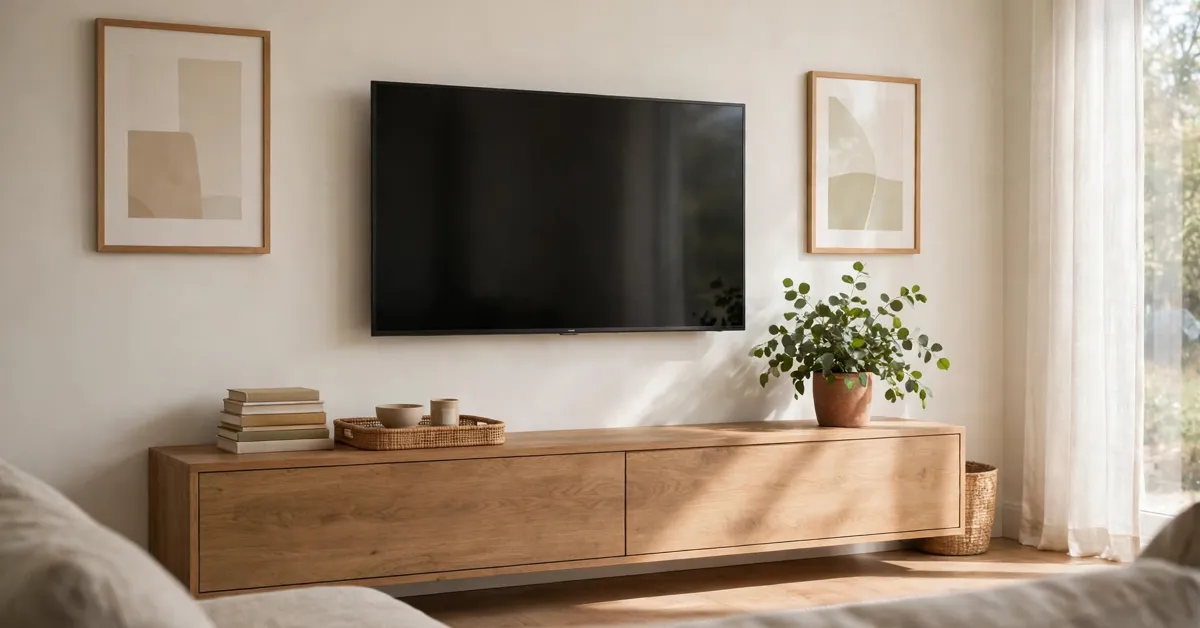
How to Decorate Around a TV: 18 Easy Ways to Make the Screen Blend In
A television is watched for a few hours a day and looked at for all the rest — and in most living rooms it is simply hung or stood against a bare wall, a black rectangle the room pretends not to see. Learning how to decorate around a tv is really learning to give that rectangle a setting: a wall with a pattern of its own, a console that grounds it, sides that balance it, and cords that do not advertise themselves. Done in the right order, the screen stops being the room’s apology and becomes one framed element in a composed wall.
The order matters more than the objects. This guide works in two passes: first a short measured method — the screen’s height taken from the sofa, a console sized against the screen’s real width, the viewing distance, and a cord plan — then 18 decorating ideas in four zones: the wall, the sides, the console, and the screen itself. One boundary before we start: a television mounted over a fireplace is a different wall with its own rules (heat, clearances, mantel styling), and it has its own guide — our tv above fireplace ideas. Everything here is for the ordinary wall and stand.
Measure From the Seat, Ground the Screen, Then Dress the Wall: The Method
Most TV walls fail for arithmetic reasons, not taste reasons: the screen hangs at standing-eye height instead of seated-eye height, the console is narrower than the set it carries, or the gallery around it is scaled for a hallway. Work through these five steps first — every styling idea in this how to decorate around a tv guide assumes them.
Step 1: Set the Height From the Sofa, Not From Standing
The only height that matters is the one from the seat. A seated eye line sits about 42 inches (107 cm) off the floor, so the centre of the screen wants to land at roughly that height for a TV watched from a sofa — a little higher is forgiven in rooms where people also watch standing or reclined, but the common failure is a screen centred at 55–60 inches, poster height, which strains every neck in the room. Measure from your actual sofa: sit, note your eye level against the wall, and mark the screen’s centre there. (Above a mantel this number is impossible — which is exactly why that wall gets its own article, linked above.)
Step 2: Size the Console Wider Than the Screen
Diagonal inches lie; measure the set’s real width. A 55-inch TV is about 48 inches (122 cm) wide, a 65-inch about 57 inches (145 cm), a 75-inch about 66 inches (168 cm). The console or stand below it should be wider than that — visually, at least a few inches of console showing at each end, and more is better: a console roughly a fifth wider than the screen grounds it, while one narrower than the screen makes the whole arrangement look perched and top-heavy. If the TV is wall-mounted, the same rule applies to whatever sits beneath it. Depth matters too: the console should be deep enough for the stand’s full footprint with room to spare, never with the feet kissing the edge.
Step 3: Check the Viewing Distance Before You Style Anything
Decorating cannot fix a sofa in the wrong place. As working guidance, a screen fills the view comfortably at a distance of roughly 1.5–2 times its width: a 55-inch set (48 inches wide) suits a sofa about 6–8 feet away, a 65-inch about 7.5–9.5 feet — the common reference point of about 7.5 feet for a 55-inch and 8.75 feet for a 65-inch sits inside that range. If your room forces a much shorter distance, a smaller screen decorated well beats a huge one endured. If the distance is long, scale the wall treatment up with it — the gallery and panelling ideas below are sized from the sofa, not from the wall.
Step 4: Plan the Cords, Boxes and Air Before the Styling
Decide where every cable and box lives while the wall is still bare. Power and signal run either inside the wall in a rated in-wall kit, fitted to code, or on the surface in a paintable raceway down to the console — never a bundle dangling in open view, and never ordinary cables loose in a wall cavity. Game consoles, streaming boxes and receivers belong in or on the console with air around them: leave the back open or a couple of inches of breathing room, and do not stack hot boxes tight in a closed cabinet. The remote’s sensor on the TV’s lower edge needs a clear line to the sofa — whatever styling lands on the console (Idea 11) must keep that little window unblocked.
Step 5: Dress the Wall in Zones, Widest First
Work from the largest surface to the smallest object. First the wall itself — paint, panelling or a gallery (Zone 1) — because it sets the screen’s proportions. Then the sides (Zone 2), which balance the wall’s width. Then the console and its styling (Zone 3), which ground the composition. Last, the screen itself (Zone 4): what it shows when it is off, and whether it is framed or hidden. Styling in this order prevents the classic mistake of arranging small objects around a wall whose big decisions are still wrong. For the breadth of treatments designers use on this wall, The Spruce’s survey of decorating ideas for around a TV is a useful further read.
1. Build a Gallery Wall Around the Screen
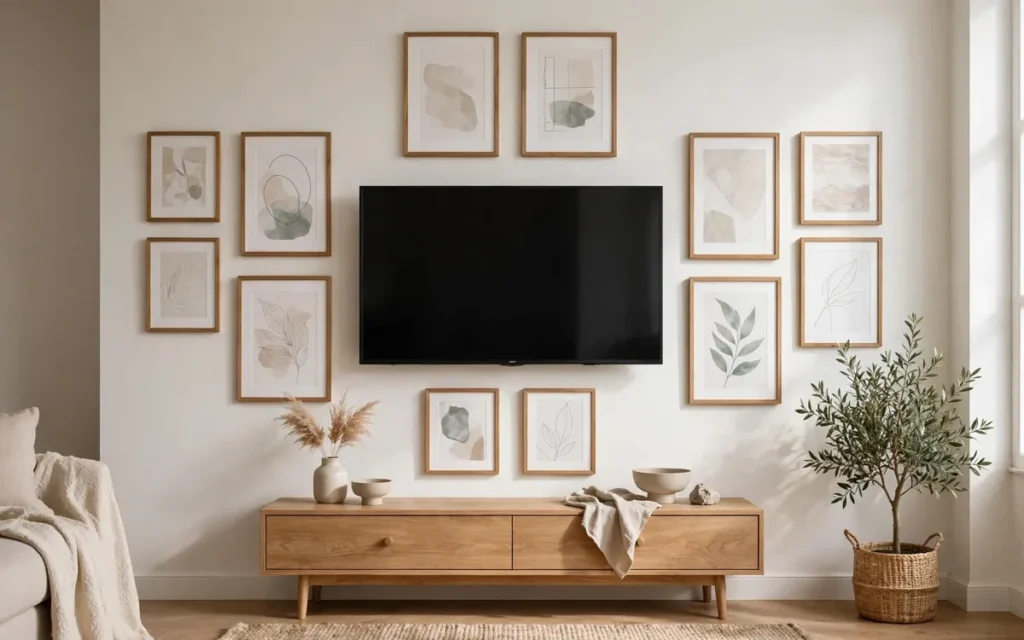
The gallery makes the television one frame among many instead of the only rectangle on the wall. Lay it out on the floor first: keep gaps between frames even at 2–3 inches, keep pieces 3–6 inches away from the screen’s edges, and let the whole arrangement run about 1.25–1.5 times the TV’s width so the screen sits inside the composition rather than beside it. Mix frame sizes but repeat one finish, and keep the art’s colours inside the room’s palette.
2. Paint the Wall Behind the TV Dark
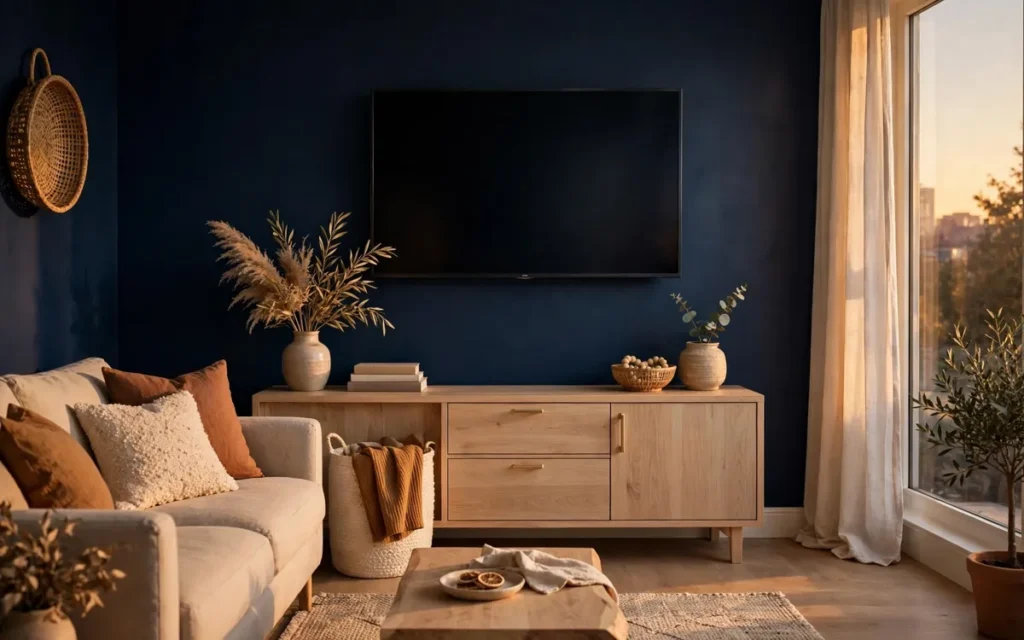
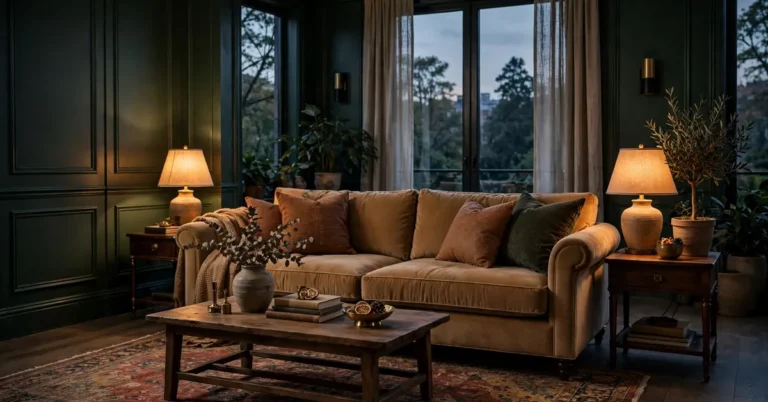
A deep wall colour — charcoal, ink navy, deep green — is the fastest camouflage a screen can get: switched off, the black panel nearly dissolves into the wall. Paint the whole wall, not a rectangle behind the TV, or the patch reads as a mistake. Test the colour in the evening with the screen on; a shade that looks rich at noon can go flat under lamplight, and the wall lives most of its life after dark.
3. Panel the Wall With Slats or Board-and-Batten
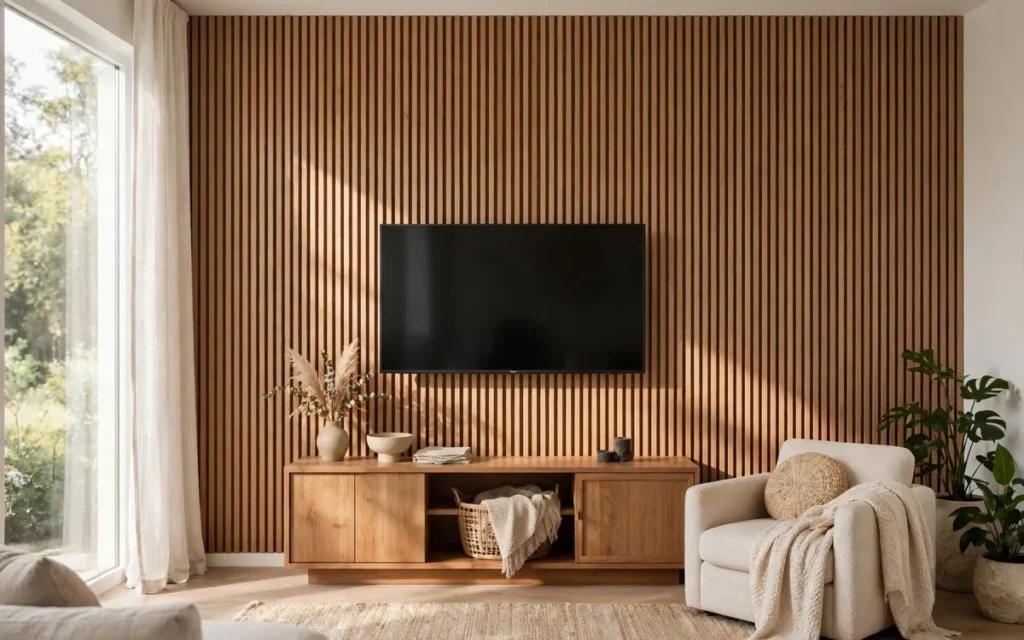
Vertical slats, board-and-batten or simple picture-frame moulding give the wall a rhythm of its own, so the screen becomes one panel in a patterned surface. Size the pattern to the set — wide spacing for a big screen — and run the panelling the wall’s full width, not just behind the TV, or it reads as a frame that slipped. Combustible panelling keeps its distance from any heat source on the wall, and cables planned in Step 4 run before the boards go up.
4. Paint an Arch or Colour Block Behind the Screen

The renter-friendly version of panelling: a painted arch, rectangle or colour block behind the television gives it a deliberate backdrop for the price of a tester pot and tape. Make the block clearly larger than the screen — about 6–10 inches of colour showing on every side — because a block the same size as the TV just looks like a shadow. A soft arch softens a boxy room; a crisp rectangle suits a modern one.
5. Hang Floating Shelves on the TV Wall
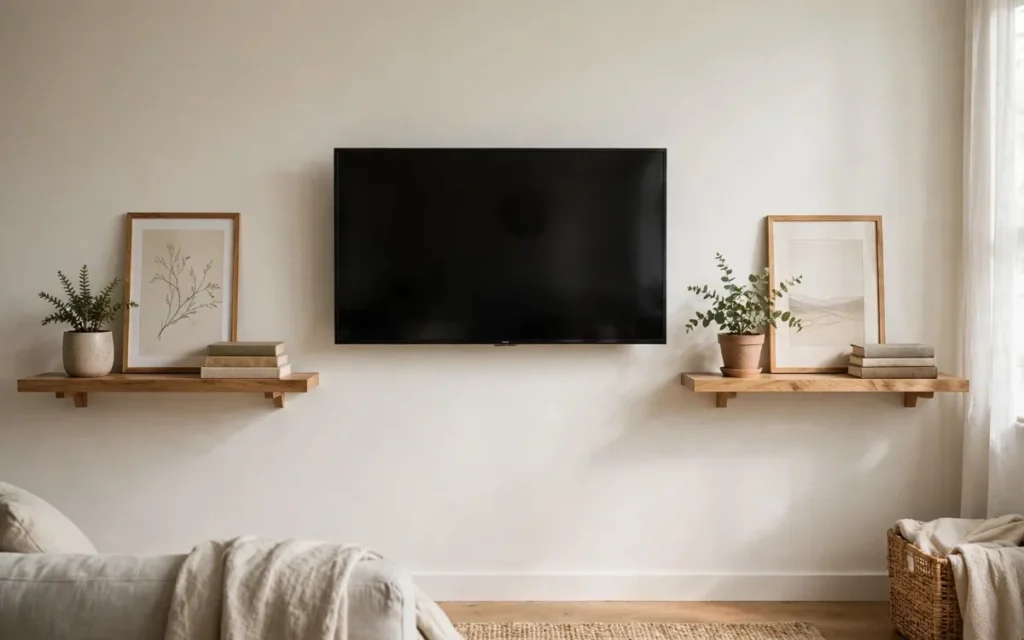
One or two floating shelves beside or above the screen break up the wall’s blankness and give small objects a home that is not the console. Keep shelf displays light and low-density — a small plant, a leaning print, a short stack — and keep anything tall away from the screen’s corners, where it fights the picture. Shelves beside the screen at its own height extend the wall’s composition sideways; a shelf above should sit high enough to clear the screen’s top edge by a comfortable margin.
6. Flank the TV With Matching Bookcases
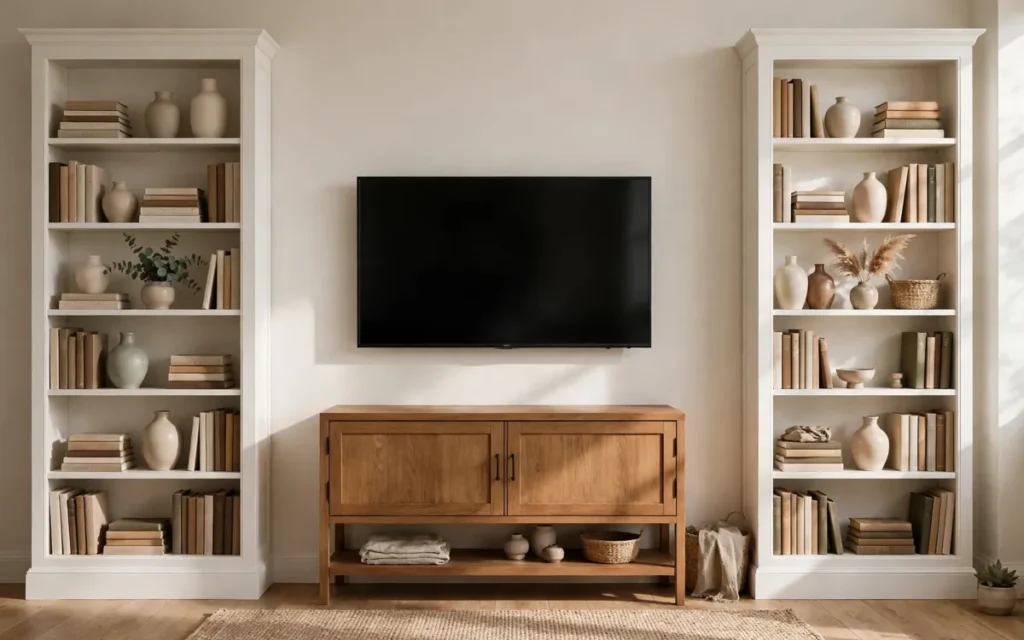
A bookcase or cabinet tower on each side turns the TV wall into a unit — the built-in look without the carpentry. Match the pair’s height to somewhere near the screen’s top edge so the composition reads as one piece of furniture, and style the shelves at the screen’s scale: books in short runs, a few larger objects, breathing room between them. Leave the inside shelves nearest the TV the quietest; the eye should land on the screen, not compete with its neighbours.
7. Put a Tall Plant on Each Side

Two tall plants — an olive, a fig, a tall grass in a substantial pot — soften the wall’s hard geometry and fill the floor-level corners the furniture leaves empty. Choose the pot and plant so the crown lands somewhere around the screen’s height; a plant that stops at the console looks like an afterthought. Where light will not keep a real plant alive, a good faux is the honest choice — a dying plant decorates nothing. Keep foliage clear of the TV’s side vents.
8. Lean a Ladder Shelf Against the Wall

A leaning ladder shelf on one side of the TV adds height, display space and a casual note a bookcase cannot. Balance it on the other side with something of similar visual weight — a tall plant, a floor lamp — or the wall leans. Anchor the ladder to the wall if the house has children or large pets (the safety notes below apply to it exactly as to the TV), and keep its top shelf’s display below the screen’s top edge.
9. Balance One Side With a Reading Corner
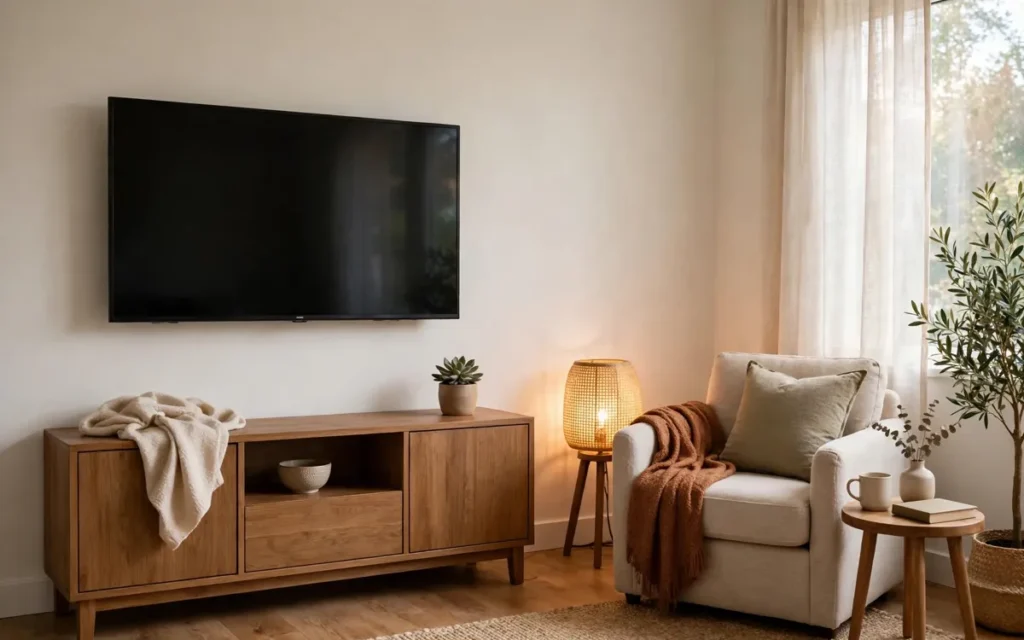
Not every wall wants symmetry. An armchair, a small side table and a floor lamp gathered on one side of the TV wall make a reading corner that balances a bookcase or plant on the other — and gives the room a second seat aimed at conversation, not the screen. Keep the corner’s lamp warm and low; in the evening it lights the room’s edge while the screen lights its centre, and the wall reads composed from both chairs.
10. Choose a Console Wider Than the TV

The single highest-value purchase on this wall. Measure the screen’s real width (Step 2 — a 55-inch set is about 48 inches wide) and choose a console that beats it clearly, with several inches to spare at each end. Match the console’s finish to the room’s other wood or metal so the wall joins the room instead of auditioning against it, and check the depth against the TV stand’s footprint and the boxes that must live in it — with their air space (Step 4) counted in.
11. Style the Console in Threes
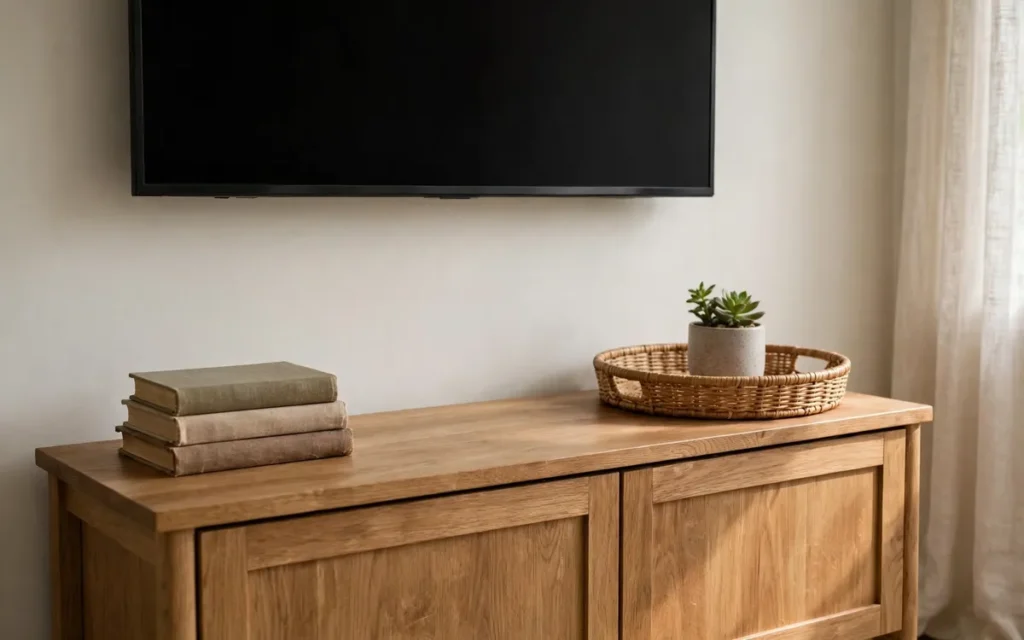
Console styling obeys one grouping rule: arrange objects in loose threes — a short stack of books, a tray or bowl, one plant or vase — placed toward the ends, and keep the middle low and quiet. The centre of the console is working space: the remote sensor’s line to the sofa crosses it, and a sound bar, if there is one, sits there. Tall objects belong at the ends, where they frame the screen instead of interrupting it, and nothing on the console should rise into the picture’s lower edge.
12. Use Baskets and Boxes to Hide the Clutter
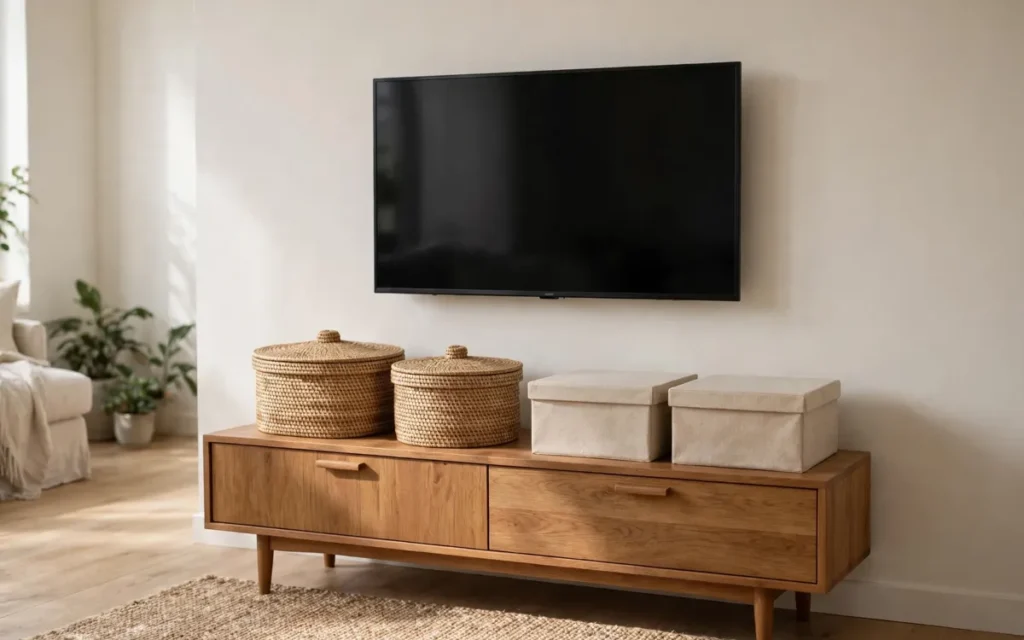
Remotes, controllers, chargers and game cases are the TV wall’s real clutter — give them a closed home. A lidded basket or a pair of matching boxes on or in the console swallows the lot and turns visual noise into two calm shapes. Keep one basket for “in play” items only, and let it be near the sofa’s end of the console; storage that is annoying to use stops being used, and the clutter migrates back to the coffee table.
13. Mount the TV and Free the Console Top

Wall-mounting the screen (at the Step 1 height) turns the console from a stand into a sideboard: the whole top becomes styling surface, and the composition reads lighter. Leave a deliberate gap between the console top and the screen’s bottom edge — about 4–8 inches — so the screen floats clear of the styling and the sound bar has its shelf. The mount’s fixings follow its manual into studs or sound masonry (safety below); a mounted set also ends the tip-over risk of a stand, which is its own argument.
14. Float a Low Shelf Instead of a Console
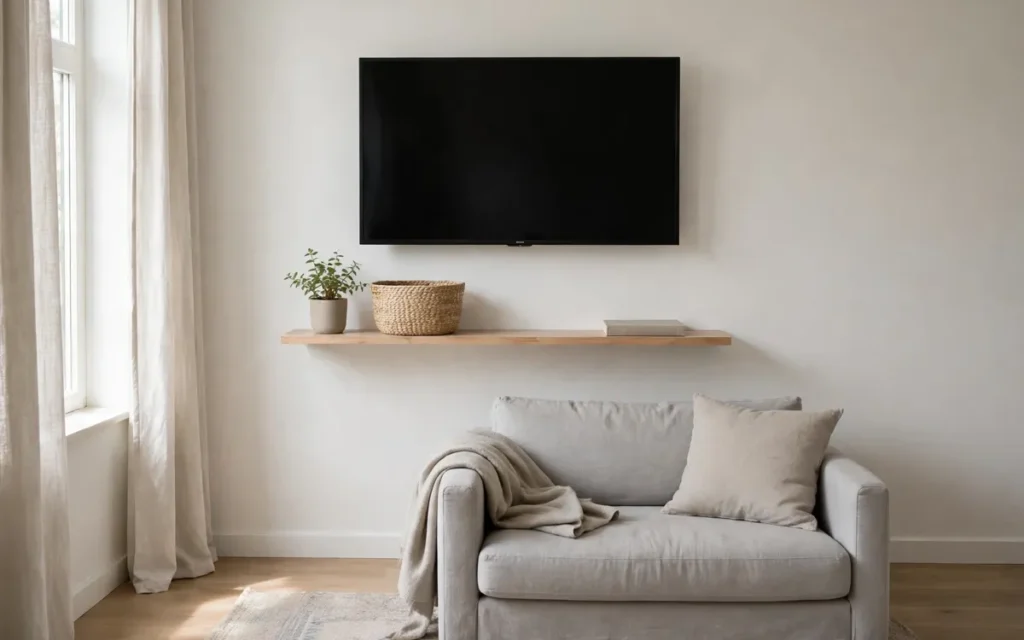
In a small room, a wall-mounted low shelf or a slim floating unit does the console’s job — a home for boxes and a grounding line under the screen — without the floor footprint. Keep it clearly wider than the screen, as with any console, and ruthless about what lives on it: two or three objects, no more. Small-room layout around the TV wall follows the same rules as our narrow living room guide: protect the walkway first, then style.
15. Show Art or a Screensaver When It’s Off
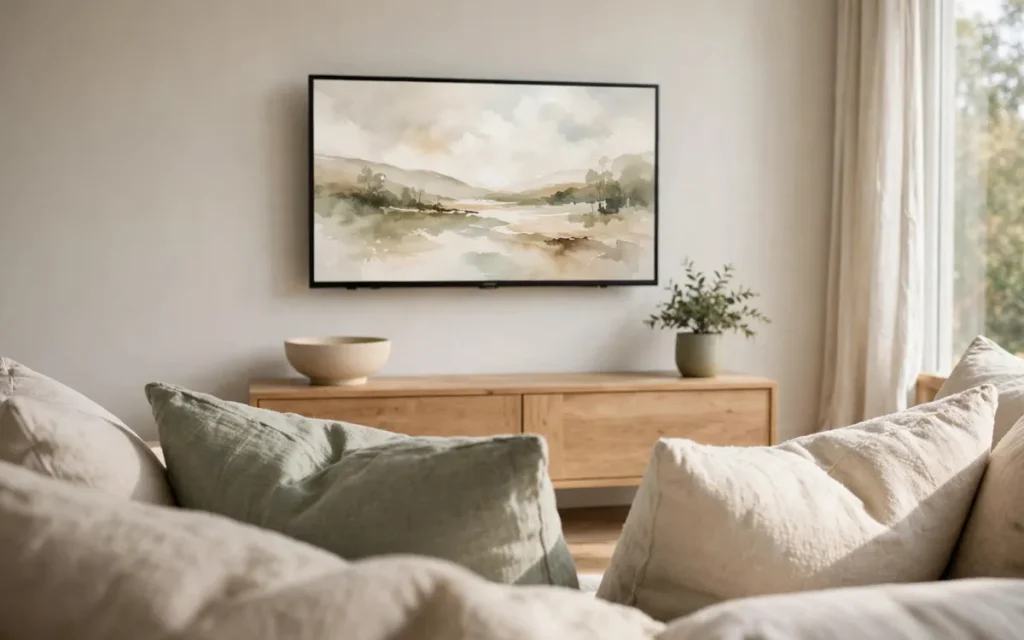
The screen is looked at far longer than it is watched, so give it a resting face: an art mode, a photo slideshow or an ambient screensaver turns the black panel into the wall’s largest picture. Choose matte, calm images in the room’s palette and keep the brightness low — a glowing rectangle at full brightness announces itself as a television pretending. Set it to sleep at night; a lit screen in a dark room undoes every other idea on this page.
16. Add a Slim Frame to the Screen
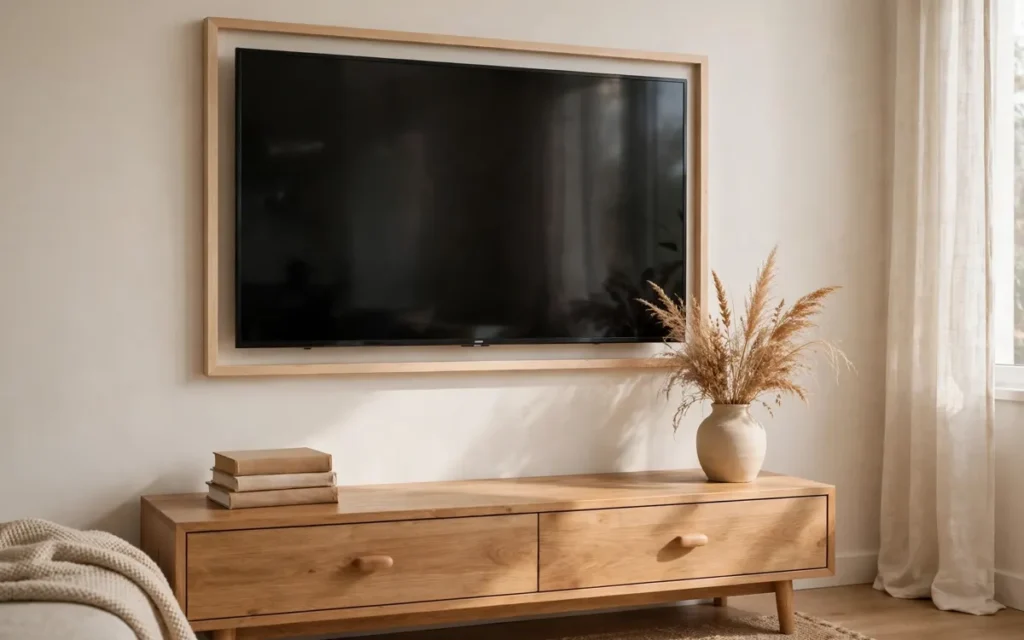
A frame or bezel fitted around the screen — bought for the set, or the reason to choose a frame-style model at replacement time — gives the panel a finished edge that agrees with the gallery and artwork around it. Keep the frame slim (about 1–2 inches) and match its finish to something already in the room — the console wood, the picture frames, the lamp metal — so it reads as part of the room’s set, not an accessory bought for the TV.
17. Hide the TV Behind a Panel, Doors or a Curtain

For rooms that must fully forget the television — a formal sitting room, a bedroom — hide it: sliding panels, a pair of cabinet doors, or a linen curtain on a discreet track. Measure honestly before committing: doors and panels need wall space to slide or swing into, and the screen still needs its ventilation when closed up after use — let it cool before the doors shut. This is the one idea that solves the off-hours problem completely, and the one that costs the most joinery.
18. Carry the Room’s Palette Onto the TV Wall

The finishing rule that ties the wall to the room: repeat two or three of the room’s own materials and colours on the TV wall — the sofa’s linen tone in a basket, the rug’s colour in one art print, the floor’s wood in the console or frame. A TV wall styled in a foreign palette always looks like equipment; one dressed in the room’s own colours looks like furniture. It is the same layering instinct that carries a whole room through winter in our winter living room ideas.
What It Costs: Three Budget Levels
Work in levels, and shop your own home first at every one. The restyle — $0: rehang or re-seat the screen at the measured height, build the gallery from frames already in the house, restyle the console in threes, give the clutter a basket it already owns, and switch on art mode if the set has it. The refresh — under about $100: a tin of paint for the wall or the colour block (Ideas 2, 4), an anti-tip anchor strap (safety below), a paintable cord raceway, and one good plant or its honest faux. This level buys the two things visitors notice: the cords gone and the wall coloured. The composed wall — a few hundred and up: the wider console (Idea 10), panelling (Idea 3), a pair of bookcases (Idea 6), a rated in-wall cord kit fitted by an electrician, or the sliding-panel hide (Idea 17). Name this level’s ceiling honestly: a frame-style television is a replace-the-set decision, and built-ins are a carpentry project — neither is needed for the wall to work.
7 Mistakes That Keep a TV Wall Looking Like Equipment
- Hanging the screen at poster height. The centre belongs at seated eye level, about 42 inches — every inch above it is paid for in neck strain (Step 1).
- A console narrower than the TV. The arrangement looks perched no matter what sits on it. The screen’s real width is the console’s minimum (Step 2).
- Gallery pieces too small and too tight. Saucer-sized frames crowded against a 55-inch screen read as clutter, not composition — even 2–3 inch gaps, and an arrangement wider than the set (Idea 1).
- Cords left dangling. One visible cable bundle undoes an afternoon of styling. Raceway or rated in-wall kit — planned before the styling, not after (Step 4).
- Blocking the sensor or the speakers. A beautiful vase in front of the remote’s window or the sound bar is a daily annoyance wearing decor’s clothes. The console’s middle stays low (Idea 11).
- Everything at one small scale. Small plant, small frames, small ornaments around a large screen — the wall needs its objects at the screen’s scale, in fewer, bigger pieces.
- Forgetting the off-hours. The screen is decor for the twenty hours it is off. A wall that only works while a film plays is not decorated (Ideas 15–17).
TV Wall Safety: Tip-Overs, Cords and Air
A flat-screen television on a stand is a tall, heavy, front-loaded object, and tip-overs are a documented household danger — safety authorities such as the U.S. Consumer Product Safety Commission report tip-over injuries every year, with children at the greatest risk, because a child pulling up on the screen or climbing the console can bring the set down. Anchor the television to the wall with an anti-tip strap fixed into a stud, even when it sits on its stand; place the stand well back from the console’s edge on furniture sturdy and wide enough for it (Step 2’s proportions are a safety rule as well as a style one); never put remote controls, toys or anything tempting on top of the set, where a child reaching for it pulls the screen toward themselves; and anchor tall furniture on the same wall — bookcases and ladder shelves (Ideas 6, 8) — with the same straps. A wall-mounted set, fixed per its mount maker’s manual into studs or sound masonry, removes the tip risk at the screen itself.
Run the cables as if an inspector will see them. Power and signal leads travel in a rated in-wall power kit installed to code, or on the surface in a raceway — never ordinary cables loose inside a wall cavity, never a cord pinched under a rug or a console foot where it can fray and overheat unseen, and never a trailing lead across a walkway. Add surge protection where the set and its boxes plug in. Give the electronics their air: televisions vent through their backs and sides, and consoles, streaming boxes and receivers run hot in closed cabinets — leave the cabinet’s back open or a couple of inches of clearance behind and above each box, do not stack hot units directly on each other, and keep the TV’s own vents clear of plants, frames and shelving (Ideas 3, 5, 7). Keep drinks and plant-watering away from the console’s electronics. Where any of this differs from the TV, mount or furniture manuals, or from local electrical codes, those win — and a licensed electrician is the right call rather than a guess.
Frequently Asked Questions
How high should a TV be mounted on the wall?
At seated eye level: the centre of the screen around 42 inches (107 cm) from the floor for a sofa-based room. Sit in the actual seat, find your eye line against the wall, and centre the screen there. A little higher suits reclined or standing viewing; poster height — the centre at 55–60 inches — is the common mistake and the neck strain that comes with it (Step 1).
How wide should a TV console be compared with the TV?
Wider — always. Measure the screen’s real width rather than trusting its diagonal name: a 55-inch TV is about 48 inches wide, a 65-inch about 57. The console should show at least a few inches of surface at each end of the set; about a fifth wider than the screen is the proportion that looks grounded. Narrower than the screen, and the arrangement looks perched however it is styled (Step 2).
How far should the sofa be from the TV?
Roughly 1.5–2 times the screen’s width. For a 55-inch set (about 48 inches wide) that is about 6–8 feet; the commonly quoted figures of about 7.5 feet for a 55-inch and 8.75 feet for a 65-inch sit inside the same range. Much closer and the picture overwhelms; much further and the wall’s styling must scale up to be read at all (Step 3).
How do I hide the cords without opening the wall?
With a paintable surface raceway: a slim channel that runs from behind the screen down to the console or skirting, painted the wall’s colour, carrying power and signal together. It is inexpensive, reversible and renter-safe. The step up is a rated in-wall power kit fitted to code. What never to do: drop ordinary cables loose inside the wall cavity, or hide a cord under a rug (Step 4 and the safety notes).
Can I put decor on the console in front of the TV?
Yes — at the ends, and low. The console’s middle is working space: the remote sensor near the screen’s lower edge needs its line to the sofa, and a sound bar needs its shelf. Style the ends in loose threes (books, a tray, a plant), keep heights below the picture’s lower edge, and let baskets take the clutter that would otherwise spread across the middle (Idea 11).
How do I make the TV blend in instead of standing out?
Attack the contrast. A dark or panelled wall shrinks the black rectangle (Ideas 2, 3); a gallery makes it one frame among many (Idea 1); a slim frame gives it a finished edge (Idea 16); and art mode gives it a resting face for the hours it is off (Idea 15). Any two of these together change the wall completely; the full hide — doors or panels — is Idea 17, for rooms that want the screen gone entirely.
Once the area around the screen is sorted, the stand itself deserves the same care. In 14 Gorgeous TV Stand Christmas Decor Ideas That Make the Screen Part of the Scene, we share low garlands, matched mini trees and flameless candle groupings that keep vents, sensors and the picture clear. Together, the two guides make it easy to dress the television wall from every angle.
Conclusion
Measure from the seat, ground the screen, then dress the wall — the whole method in one line. Get the height, the console’s width and the cords right, and the styling almost arranges itself: a gallery with honest spacing, sides that balance, a console styled in threes, and a screen with a resting face. That is how to decorate around a tv so the wall reads as furniture all day, not equipment waiting for the evening — and in a room that also asks its walls to work through winter, the same layering continues in our winter living room ideas.
5 Comments