

23 Dreamy Moody Bedroom Ideas for a Deep, Restful Retreat
A moody bedroom is not a black room. It is a room with the lights turned down on purpose: deep colour on the walls, lamplight low and warm, and a bed that glows pale against the dark like the last lit window on a street. Get any one of those three wrong and the same room turns murky instead, which is why so many dark bedrooms disappoint. The colour was fine; the system around it was missing.
The moody bedroom ideas below are built as a measured system, not a pile of photographs: how deep to go (there is a number printed on the paint swatch), how warm the bulbs must be, how many light sources a dark room actually needs, and how big the rug, curtains and art should be so the dark reads calm instead of heavy. And if your worry is that your room is too small for all this, hold that thought, because dark colour behaves counterintuitively in small rooms; the full size system lives in our small bedroom decor ideas, and the short answer is in the FAQs below.
The Method: Deepen It, Soften It, Light It Low
Every room in this article runs on the same three moves, in this order. Colour first, contrast second, light last, because each step corrects the one before it: depth without softness is a cave, and depth without low light is just a dark-painted room with the glare left on.
Step 1: Deepen It
Choose ONE depth source before anything else: a deep paint colour, a dark wallpaper, or, if paint is off the table, deep bedding and curtains instead. On the paint route, read the swatch properly: the number that matters is the LRV (Light Reflectance Value) printed on most fan decks, and true moody shades sit at LRV 20 or below, with charcoal, deep green, navy and plum typically between 3 and 15. Test before committing: paint a 12 by 12 inch swatch or a sample board and check it in morning light and again under lamplight, because deep colours dry darker and swing warmer under evening bulbs. For a fuller walk through palettes and finishes, Mighty Paint’s moody bedroom guide is the deep reference worth reading.
Step 2: Soften It
Now give the dark something to push against. The main layer of the bed stays 2 to 3 shades lighter than the wall, or warm cream, so the bed remains the room’s light centre. Three textures on the bed, linen, velvet and wool or knit, keep the depth feeling rich rather than flat, and warm wood plus a tonal rug underfoot stop the floor from going cold. Contrast is the whole ballgame here: it is what separates moody from murky.
Step 3: Light It Low
Finally, rebuild the light rather than just the colour. Every bulb in the room goes to 2200 to 2700 Kelvin, the warm candlelight-to-lamplight range; anything 3000K or above reads daylight-clinical against dark walls and greys the paint out. A dark-walled bedroom needs at least three low sources, a dimmed overhead plus two bedside lights, because dark walls absorb light instead of returning it. Add blackout curtains for true sleep darkness and one accent glow, and the room performs at night, which is when a moody bedroom is actually used.
Zone A: Deepen the Walls
The wall is the fastest way to depth, but depth has settings: one wall or all four, paint or paper, trim included or left bright. These five are the honest range, from the full commitment to the trial size.
1. Colour-Drench One Deep Shade, Trim Included
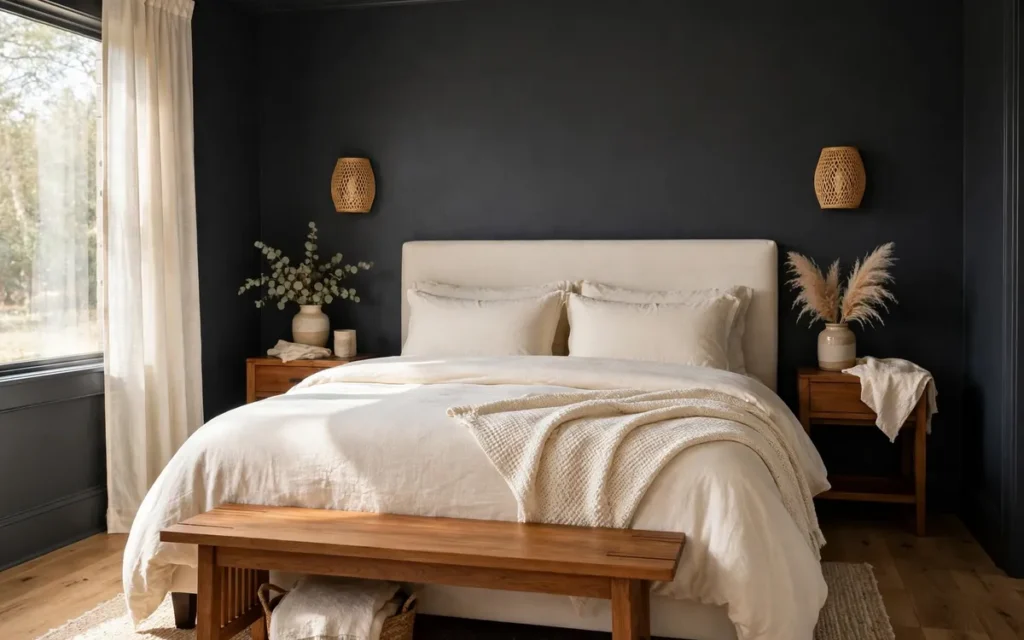
Paint the walls and the trim in the same deep colour, the trim one sheen step up (eggshell walls, satin trim), and the room’s edges blur into one soft field. Add the ceiling in the same shade and the bright cut line at the top disappears too, which in a small room can read taller, not lower. Budget for it honestly: a gallon covers roughly 350 to 400 square feet, and deep colour over white needs 2 coats, sometimes 3, over a tinted primer.
2. Start With the Headboard Wall Only

The trial-size version, and for many rooms the finished answer: one deep wall behind the bed, the other three left pale. The bed gains its dark backdrop, the room keeps its daylight, and if the shade is wrong, you are repainting one wall on a Saturday, not four. Choose the wall the bed already owns, because a dark side wall with a pale bed wall splits the room’s focus in two.
3. Choose Deep Green for a Natural Kind of Dark

Deep green (forest, pine, a greyed eucalyptus) is the moody shade that feels least like a cave, because the eye reads it as nature’s own dark: leaves at dusk rather than a box closing in. It pairs with warm wood, cream bedding and brass without arguing, and it forgives both north and south light better than blue does. Keep it at LRV 15 or below; mid-greens go classroom quickly.
4. Pick Plum or Burgundy for Warm Drama

The red-family darks, plum, burgundy, oxblood, are the warmest way to go deep: they flatter skin, candlelight and evening faces, which makes them natural in the room where the day ends. Balance them with restraint elsewhere: cream bedding, black or dark-wood furniture to ground them, and green as the cooling accent (a plant, an olive cushion). Under warm 2200K light they glow; under cool bulbs they turn muddy, which is why Step 3 of the method is not optional with this family.
5. Lay Dark Floral Wallpaper on One Wall
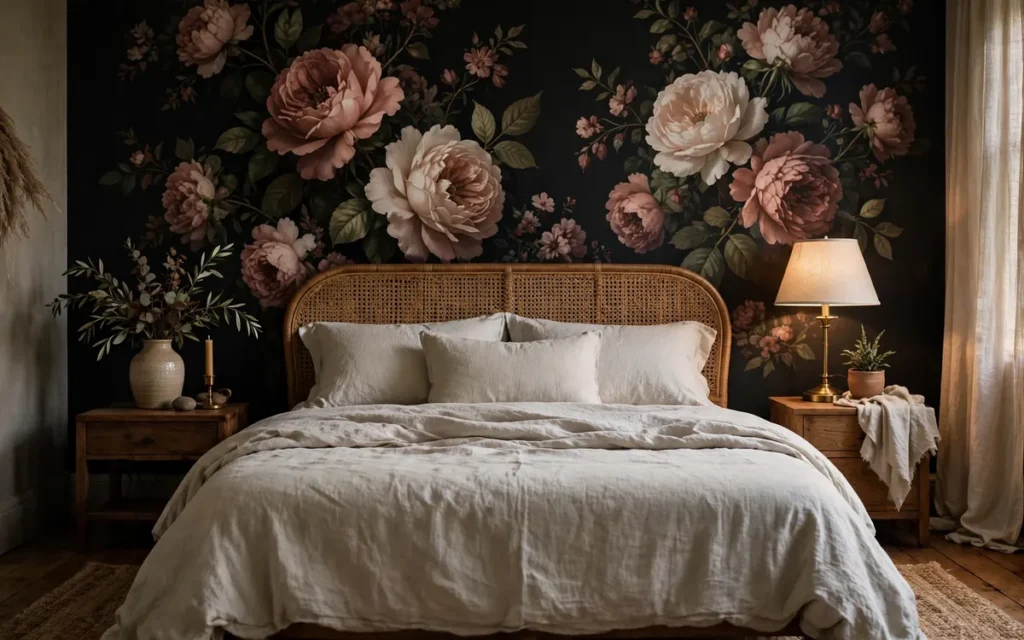
Large-scale dark florals, a near-black ground with oversized blooms, give depth with pattern built in, so the wall never reads as a flat slab of colour. Keep the scale large: small ditsy prints turn busy and cheap-looking against the dark. One wall is plenty, behind the bed, with the remaining walls in a quiet shade lifted from the pattern’s palest petal.
Zone B: Soften the Bed
The bed is the largest object in the room and the one your eye lands on first, so it carries the contrast the walls gave up. Five moves keep it the light, touchable centre of a dark room.
6. Contrast the Bedding Against the Wall

Against a deep wall, dress the bed 2 to 3 shades lighter, or in warm cream and ivory, so it stays visibly the softest thing in the room. This single contrast is what makes visitors say “cosy” instead of “dark”. Keep the contrast warm rather than blue-white: a crisp optic-white duvet against charcoal reads like a hospital corner, while ivory reads like candlelight.
7. Layer Three Textures on the Bed

Flat colour reads flat, so layer three textures with different surfaces: a linen duvet (matte, slightly rumpled), a velvet cushion or throw (light-catching pile), and a wool or chunky knit (visible weave). The count that reads rich without clutter: the duvet, one throw, two sleeping pillows and at most 2 to 3 accent pillows. More than that and the dark room starts storing cushions instead of displaying them.
8. Anchor the Bed With a Deep-Toned Headboard
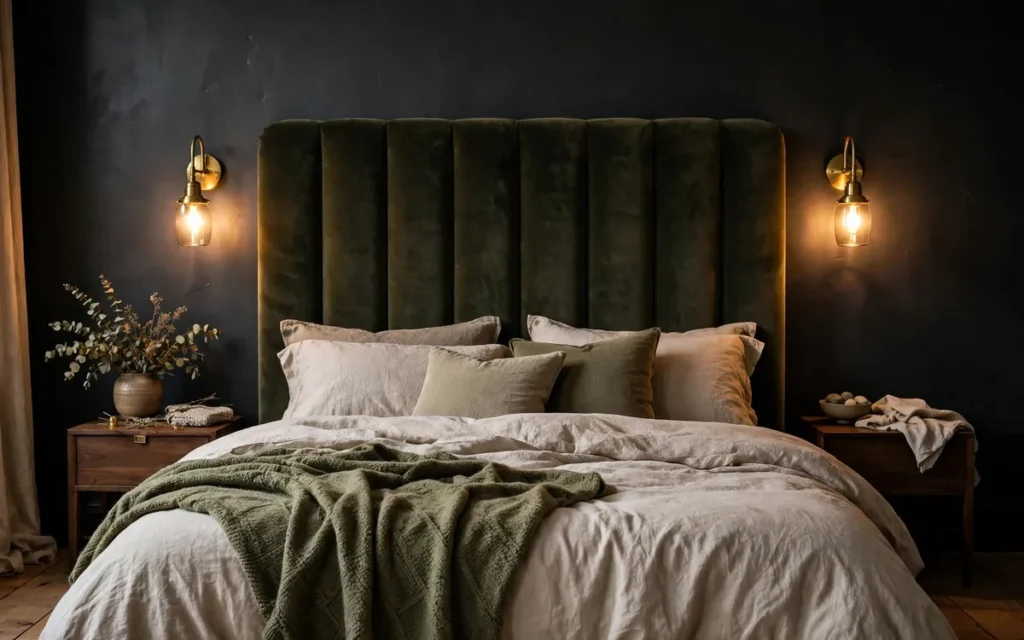
A tall upholstered headboard in a deep tone, olive velvet, espresso linen, charcoal wool, gives the bed its own architecture against a pale wall, or a tonal step against a dark one. Height matters more than price: a headboard that rises well above the pillows reads as a backdrop; a low one disappears behind the bedding. If the walls are already deep, keep the headboard close in tone and let texture, not contrast, do the separating.
9. Ground the Bed With a Tonal Rug

In a dark room, choose a low-contrast, tonal rug so the floor reads as one calm field rather than a pattern shouting up from the gloom. Size it generously: the rug should extend 18 to 24 inches beyond the sides and foot of the bed, which means an 8 by 10 foot rug under a queen and a 9 by 12 under a king. A washed, vintage-look pattern in the wall’s own family is the easiest version to live with.
10. Hang Blackout Curtains High and Wide
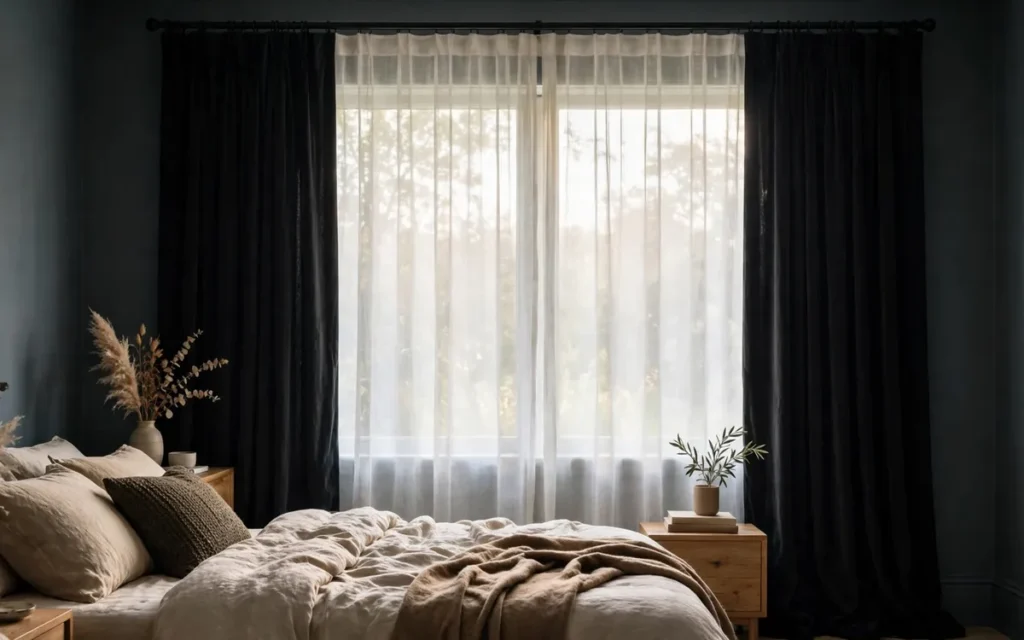
Moody is a night setting, and sleep needs real darkness, so hang properly lined blackout panels, mounted 4 to 6 inches above the window frame and 3 to 4 inches wider on each side, falling to half an inch above the floor (or a soft 1 to 2 inch break). Behind them, a light sheer keeps daytime privacy without killing the daylight, so the room can be bright at noon and a cave at midnight, on purpose.
Zone C: Light It Low
Colour makes a room dark; light makes it moody. This zone is the difference, and it matters more than the paint. The lamps you are about to place sit on the nightstand, and once they land, that surface has its own styling system in our nightstand decor ideas.
11. Swap Every Bulb to 2200–2700K

The cheapest transformation in this article: walk the room and replace every bulb outside the warm range. Check the Kelvin on the box, 2200 to 2700K for everything, overhead included, because one 4000K bulb in a ceiling fixture will grey the whole paint job from above. The bulbs are, quite literally, half the colour of a moody room; deep paint under daylight bulbs is the single most common reason the look fails.
12. Put the Overhead Light on a Dimmer

A dark-walled room lit by one full-bright overhead is an interrogation cell with better paint. A dimmer turns that same fixture into the ambient layer it should be: bright for dressing, low for the evening. Pair it correctly, an LED-rated dimmer with bulbs marked dimmable, or expect flicker and buzz. A plug-in dimmer on a lamp circuit is the no-electrician version that still gets the effect.
13. Glow the Bedside With Shaded Lamps or Sconces

Two matching shaded lights, one each side, are the working heart of the room’s glow: the shade throws light down and out at bed height, where faces and books are, instead of down from the ceiling. Position by the reader, not the wall: the shade should sit roughly at chin height when you are sitting up in bed, and sconces mount so the shade lands just above shoulder height in that same position, about 60 inches from the floor as a starting point for average bed heights.
14. Wash One Wall With Accent Light
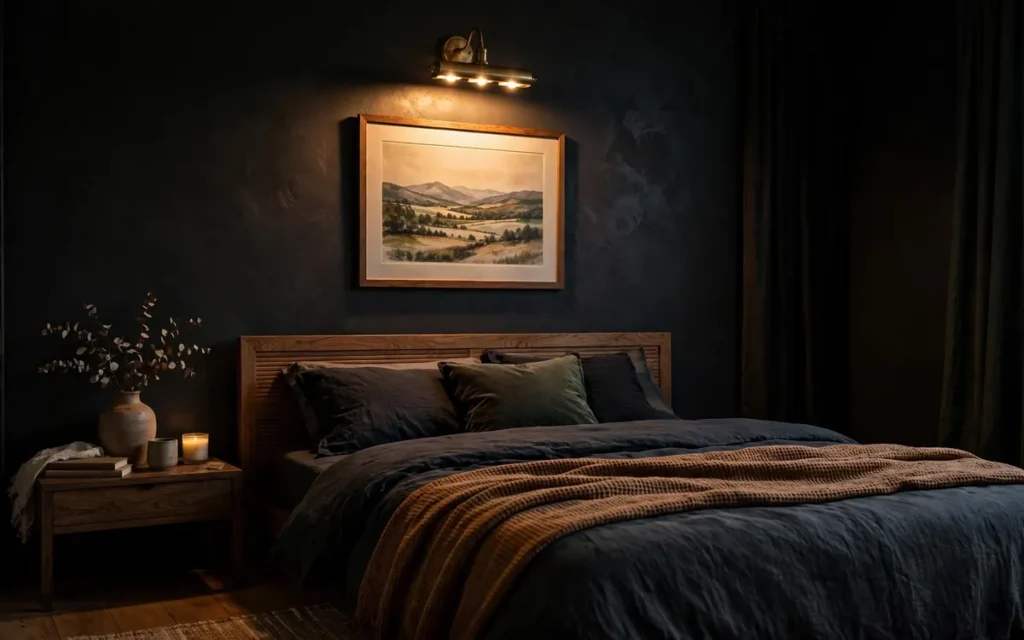
Add one light that exists purely for atmosphere: a picture light over the artwork, a small uplight behind a plant, a shaded lamp on the dresser. Accent light creates the pools and shadows that read as “evening” to the eye, and it gives a dark room depth that flat ambient light cannot. The dresser is the usual home for this third source, and its surface has its own measured system in our top of dresser decor ideas.
15. Add Candlelight the Safe Way

Candlelight is the original 1800K light source, and a moody room asks for its flicker, but real flame beside draped bedding is the classic bedroom fire risk. Take the flameless route: good flameless pillars on a hard tray, on the dresser rather than the bed, give the same moving glow with none of the hazard. If real candles are used at all, they live on that tray, away from fabric, and never while anyone sleeps.
Zone D: Warm the Hard Edges
Walls, bed and light are set; what remains is the room’s skeleton, the wood, metal, wall texture and art that keep deep colour feeling collected rather than bare.
16. Bring In Warm Wood Against the Dark
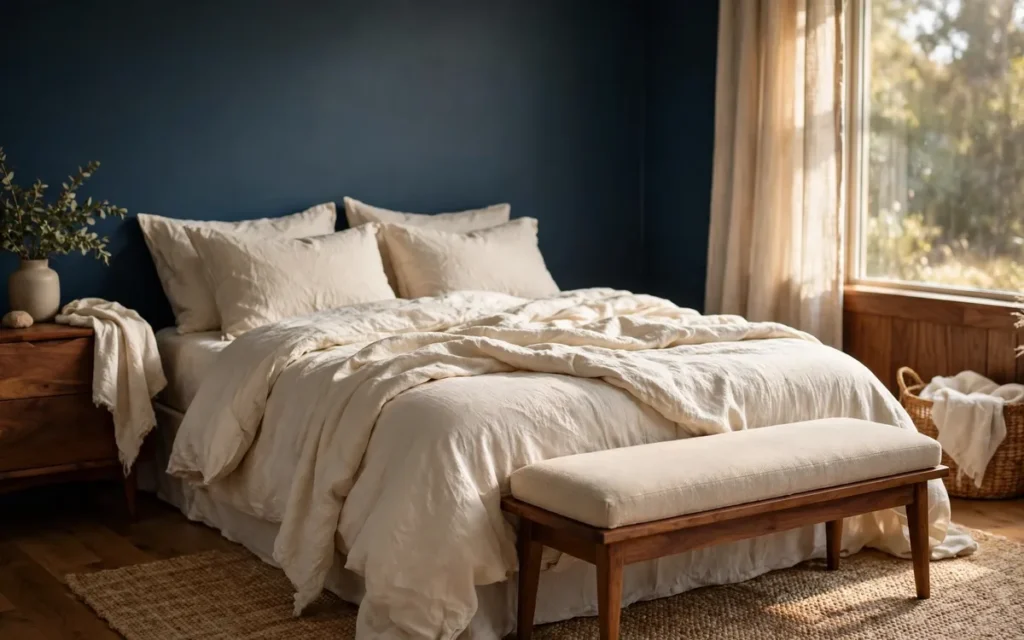
Warm mid-tone wood, walnut, warm oak, anything with honey in it, is dark paint’s best friend: it keeps the room’s temperature up and stops deep colour reading cold. One substantial piece is enough, a bench at the foot of the bed or real wood nightstands. Avoid very orange pine and very grey weathered finishes, which fight deep shades instead of flattering them.
17. Use Aged Brass as the Room’s Jewellery
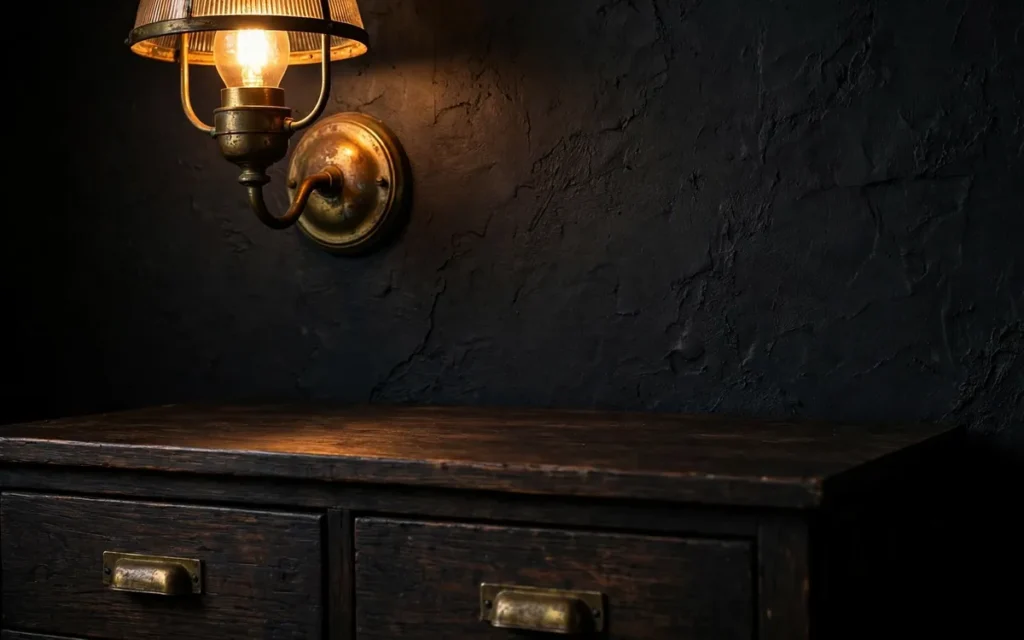
Against dark walls, metal reads at a glance, so choose one and repeat it: aged or brushed brass is the classic moody partner, warm enough to glow under low light, soft enough not to glare. Carry it through sconces, drawer pulls, a tray, a frame, three or four touches in the same finish. Chrome and bright nickel read cold and clinical against deep colour; save them for the bathroom.
18. Panel or Slat the Headboard Wall
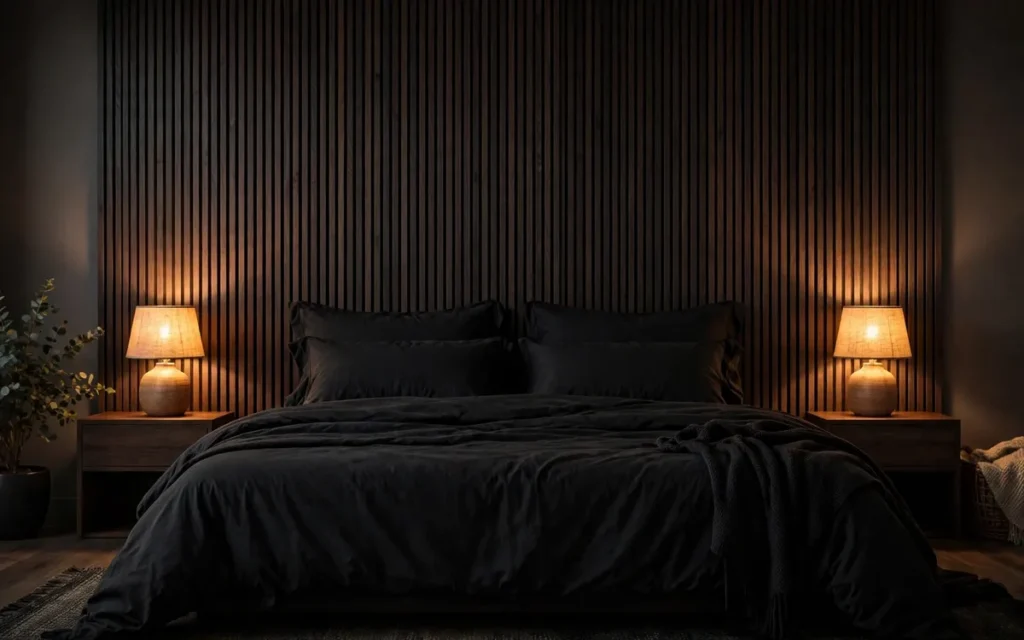
Texture on the dark wall itself, shallow panelling, picture-frame moulding or wood slats painted in the same deep shade, gives lamplight something to rake across, so the wall gains shadows and depth instead of sitting flat. Paint the added woodwork the wall’s exact colour, trim included, one sheen up; the effect is architectural, not contrasting, which is precisely why it feels expensive.
19. Hang One Large Piece of Moody Art

Skip the scatter of small frames, which reads as clutter against dark walls, and hang one large piece: a moody landscape, a dark portrait, an abstract in the room’s own tones. Scale rules: the centre of the piece sits at about 57 to 60 inches from the floor, and over the bed the art should run about two-thirds the width of the headboard. Add the picture light from idea 14 and it becomes the room’s evening focal point.
Zone E: Moody Without Paint
No landlord permission, no deposit risk, no problem. If paint is off the table entirely, the moody bedroom ideas in this last zone build the same atmosphere out of textiles, reversible walls and light. It is the same trick the seasons use, incidentally: our cozy fall bedroom ideas warm a room without touching a wall, and this zone does it in a darker key, all year.
20. Go Dark Through Bedding and Curtains Only
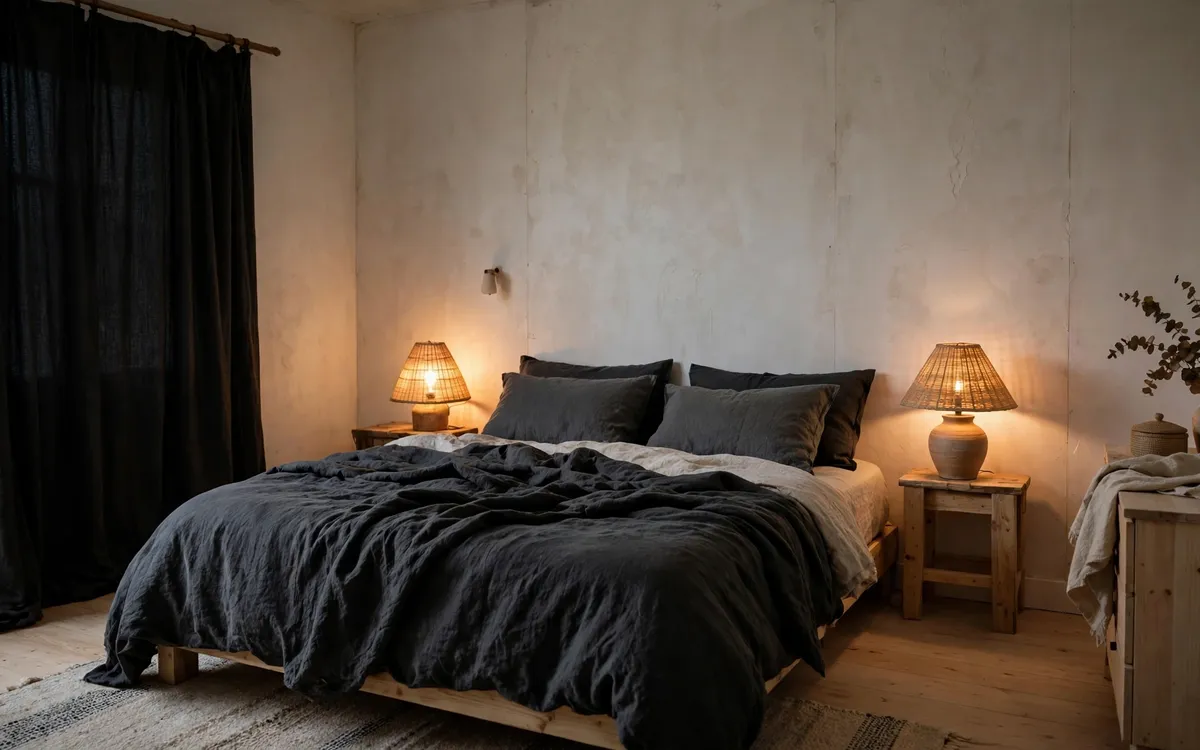
Keep the pale walls and put the depth where fabric lives: a charcoal, espresso or deep olive duvet set, floor-length curtains in a dark tone at the window, and the warm bulbs from idea 11. The room’s two largest soft surfaces now carry the mood, and the pale walls bounce what little light there is, so the effect reads surprisingly deep. Everything reverses in one laundry cycle when you move or change your mind.
21. Use Peel-and-Stick Wallpaper for a Reversible Wall

Removable wallpaper is the renter’s paint: a dark botanical or moody texture behind the bed, up in an afternoon, down without a trace when the lease ends. Do the maths before ordering: a standard roll is about 20.5 inches wide by 16.5 feet, roughly 28 square feet, so one roll covers a headboard-width strip behind most queen beds in vertical panels, and two rolls handle a full accent wall in a small room. Order all rolls in one go so the dye lots match.
22. Darken a Small Bedroom on Purpose

The counterintuitive one, stated plainly: in a small bedroom, colour on all the walls, ceiling included, blurs the corners, and when the eye cannot find the edges it stops reporting the room as tiny. What actually shrinks a small dark room is scarce light and a dark bed. Keep the method’s rules, three low light sources, a bed dressed 2 to 3 shades lighter, and a 10 by 10 foot room carries the full moody treatment comfortably.
23. Finish With One Living, Collected Layer

The last layer keeps the dark from feeling like a showroom: something alive and something collected. A leafy plant in the corner (deep rooms flatter big green leaves), a small stack of real books, one framed piece with a story. Keep it to one corner or one shelf; the calm of a moody room comes from most surfaces staying quiet, with the life concentrated in a single spot.
What It Costs: Three Honest Levels
Free
Rearrange what you already own: swap in the warmest bulbs from other rooms, carry your darkest throw and cushions to the bed, move the moodiest artwork you own to above the bed, and clear the surfaces so the dark reads calm rather than cluttered. An evening’s work, and it teaches you whether you like living darker before a single tin is opened.
Low Cost
The working kit that delivers most of the mood: one gallon of deep paint plus tinted primer for a single headboard wall (or two rolls of peel-and-stick), two 2200 to 2700K bulbs, a plug-in dimmer, and a set of flameless candles. Every item on this list appears in the zones above, and together they are the 80 percent version of the whole article.
Worth Spending On
Spend where the room touches you nightly: a full colour-drench paint job if you hire it out (the labour is the cost, not the paint), properly lined blackout curtains at the right drop, an electrician-fitted dimmer that will never flicker, and a genuinely comfortable upholstered headboard. These four are seen, used or leaned on every single night, which is the honest test for any upgrade.
7 Mistakes That Turn Moody Into Murky
- Painting dark but keeping 4000K daylight bulbs. The room reads murky grey-blue instead of moody. The bulbs are half the colour; change them first.
- Going dark on walls, bedding AND curtains. With nothing lighter left, there is no contrast point and the bed disappears into the wall.
- One harsh overhead as the only source. Dark rooms need three low sources, not one bright one bearing down.
- Satin or gloss paint on deep walls. Glare, and every bump in the plaster shows under lamplight. Matte or eggshell is the moody sheen.
- Skipping the swatch test. Deep colours dry darker and swing warm under evening bulbs; a 12 by 12 inch test, day and night, is the cheapest insurance in this article.
- Small, busy art and ditsy patterns. They read as clutter against dark walls. Scale up: the two-thirds-of-the-headboard rule, large-scale prints.
- Killing the daytime to keep the night mood. Blackout panels left closed all day make the room a cave you avoid. Sheers underneath and panels open is the whole point of layering the window.
A Short Safety Note
Flame near textiles. Real candles beside draped bedding and curtains are the classic bedroom fire risk. Flameless pillars give the same glow; if real candles are used, they live on a hard tray away from fabric, never on the bed or a fabric-covered surface, and never while sleeping.
Dimmer and bulb compatibility. Use an LED-rated dimmer and bulbs marked dimmable. The wrong pairing flickers, buzzes and shortens bulb life.
The low-light trip path. A moody room is deliberately dim, so keep the path from bed to door and bathroom clear of bench ends, baskets and curling rug edges, and consider one very low, warm night-light along that path.
Fresh paint. Choose low-VOC paint, ventilate during and after painting, and give a strong-smelling room a night before sleeping in it.
Moody Bedroom FAQs
What makes a bedroom feel moody?
Four things together: deep, low-LRV colour; low, warm, layered light; texture; and at least one contrast point, usually the bed. Remove any one of the four and the room slides: no contrast and it turns murky, no warm light and it turns cold, no texture and it turns flat.
Will dark walls make my small bedroom look smaller?
Not on their own. Deep colour blurs the corners the eye uses to measure a room, so a well-lit dark room can read larger and calmer than a pale one. The failure mode is scarce light, not dark paint: keep three low sources and a light bed, and if the room also needs the full size treatment, our small bedroom decor ideas cover it.
What are the best colours for a moody bedroom?
Charcoal, deep green, navy, plum and burgundy, and chocolate brown are the reliable family. Choose by your room, not by trend: green forgives most light, the red-family shades glow warmest at night, and blue-based darks need the warmest bulbs to stay kind. Whatever you pick, test a 12 by 12 inch swatch in morning light and lamplight first.
How can I make my bedroom moody without painting?
Work Zone E: depth through bedding and curtains only, a peel-and-stick wallpaper wall behind the bed, dark-toned textiles, and every bulb swapped to 2200 to 2700K. The light change alone does a startling amount of the work, and every piece of it is reversible.
What lighting works best in a dark bedroom?
Warm and layered: 2200 to 2700K in every bulb, three sources minimum (a dimmed overhead plus two bedside lights), shaded bedside lamps at reading height, and one accent source for atmosphere. Never a single bright overhead; dark walls absorb light, so the layers have to be supplied deliberately.
Can a moody bedroom still work in the daytime?
Yes, if you build for both: sheers underneath the blackout panels, the pale bed as the room’s bright centre, and one mirror hung opposite a window or lamp to return the daylight. Moody is a night setting you can switch on, not a cave you live in around the clock.
This room sits at the deep end of the tonal ladder — but the same ladder climbs the other way. If you love the moody version in winter and want its pale, warm twin for the lighter months, the system is identical: undertone first, textures counted, one dark anchor repeated twice. That version, with named warm whites and the swatch test that keeps them from turning cold, is in our cozy neutral bedroom ideas.
Conclusion
Work the moody bedroom ideas above in their order: deepen first with one honest depth source, soften it with a lighter, textured bed, then light it low and warm until the room glows instead of glares. The numbers in this article, LRV 20 or below, bulbs at 2200 to 2700K, three sources, curtains high and wide, are what carry you past the competitor photo lists into a room that actually performs at night. And when the bedroom’s evening mood is set, the same warm-the-light principle transforms the room you live in too, which is where our cozy living room ideas pick up the thread.



5 Comments