
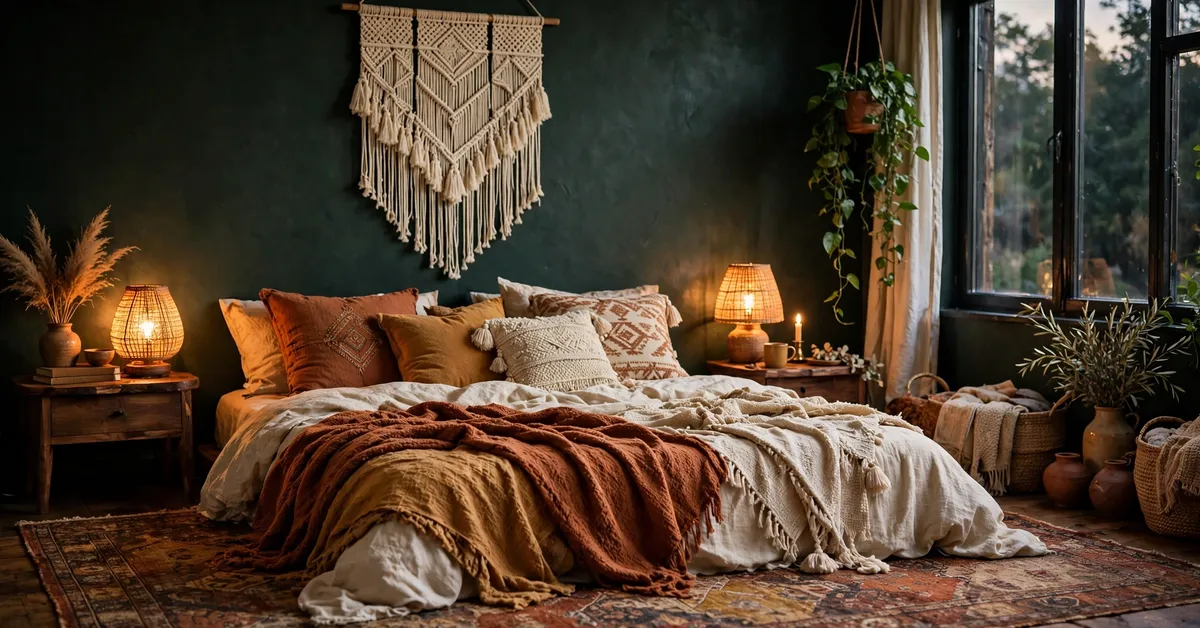
17 Enchanting Dark Boho Bedroom Ideas That Stay Warm, Not Gloomy
A dark boho bedroom is the room people save most and commit to least — and the hesitation is honest, because a photograph never prints the three settings the room actually runs on. These dark boho bedroom ideas begin with those settings, in order: a wall chosen by a printed number, a bed layered by touch before pattern, and light set to a temperature instead of left to whichever bulb came with the house. (The site’s other dark bedroom came first: our moody bedroom ideas drenches a room in one color and keeps its surfaces sleek; this article keeps the darkness and warms it — woven texture, one pattern, plants and lamplight. Sleek dark there, layered dark here.)
The Method: Number It, Layer It, Warm It
Three decisions, in order, before a single cushion is bought — because a dark boho bedroom is not a mood board; it is three settings (a wall value, a texture count, a bulb temperature) that no photograph of someone else’s room will ever print for you.
Step 1 — Number It: The Wall Is Chosen by LRV, Not by Name
LRV — light reflectance value — is the percentage of light a paint reflects, printed by the manufacturer on a 0–100 scale, and it is the only honest way to shop for dark. This article’s walls live in the LRV 3–10 band: Sherwin-Williams Tricorn Black at 3, Iron Ore at 6, Urbane Bronze at 8. The warm accents sit a clear step up, in the LRV 20–36 band — Cavern Clay at about 20, with terracotta and ochre textiles in the same range. The full palette grid this step rests on is set out in Quiet Minimal’s dark boho palette guide. The logic is the living room’s, deepened: our grey couch living room ideas chose the wall behind the couch by the same reflectance numbers and swapped its bulbs to the same 2700K; the bedroom runs both settings darker. More than any cushion, dark boho bedroom ideas stand on that one printed number, because every layer, lamp and plant that follows is chosen against the wall’s reflectance, never against a photograph.
Step 2 — Layer It: Texture First, Pattern Second, Sized by the Bed
Darkness flattens pattern but never touch, so the layering order is law: three textures minimum on the bed — linen, wool, woven cotton — before the first pattern is allowed in, then one pattern family run at two scales. The rug is sized by subtraction, not by the room: rug width minus bed width, halved, must land between 18 and 24 inches showing on each side. The bed is the room’s largest surface; in a dark room it does the work the walls cannot, and it is built by number like everything else here.
Step 3 — Warm It: The Light Is a Setting, Not a Fixture
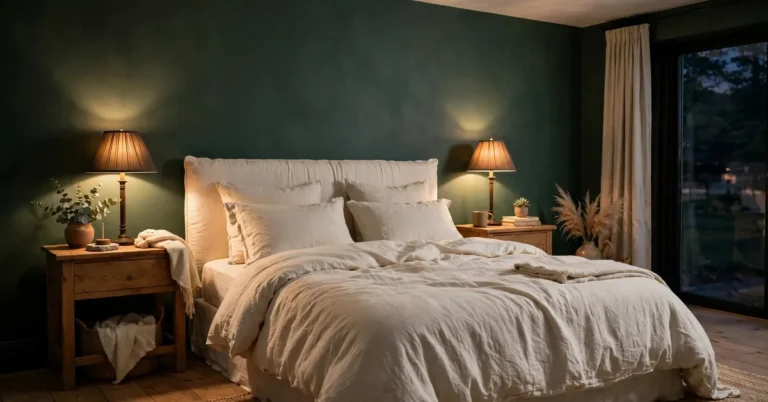
Every bulb in the room goes to 2700K, inside the 2700–3000K warm band, because the same forest green that turns olive and warm at 2700K turns grey and flat under a cool bulb — most “my dark room feels gloomy” verdicts are bulb verdicts, delivered before the paint was even dry. Then light in threes, none of them the ceiling light: two sources at the bed, one in the room’s far corner, so the dark is lit in pools and the layered texture casts shadows worth looking at.
Zone A — Set the Dark
Three color decisions before anything is bought: how dark the walls go, how the color is tested, and which single warm accent is allowed to repeat against it.
1. Paint by LRV, Not by the Chip’s Name
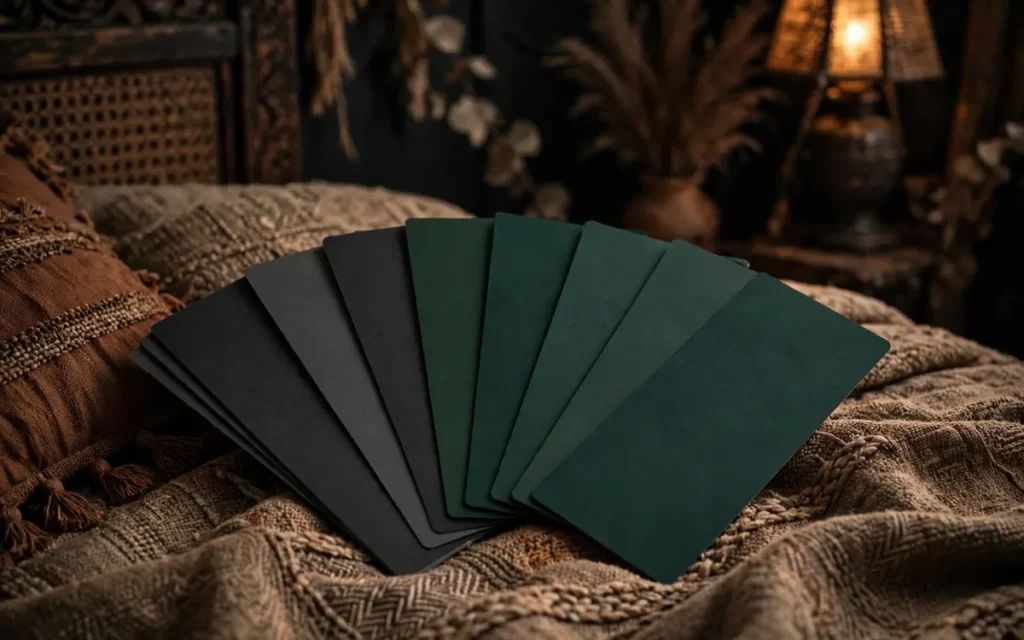
The wall decision is a band, not a name: walls at LRV 3–10 — Tricorn Black at 3, Iron Ore at 6, Urbane Bronze at 8 are the examples — because below 10 a color reflects almost nothing, and the room’s light, not the paint, decides the mood. Two greens with pretty names can sit ten LRV points apart. The number is the color; the name is just shopping.
2. Test on a 24-Inch Board First
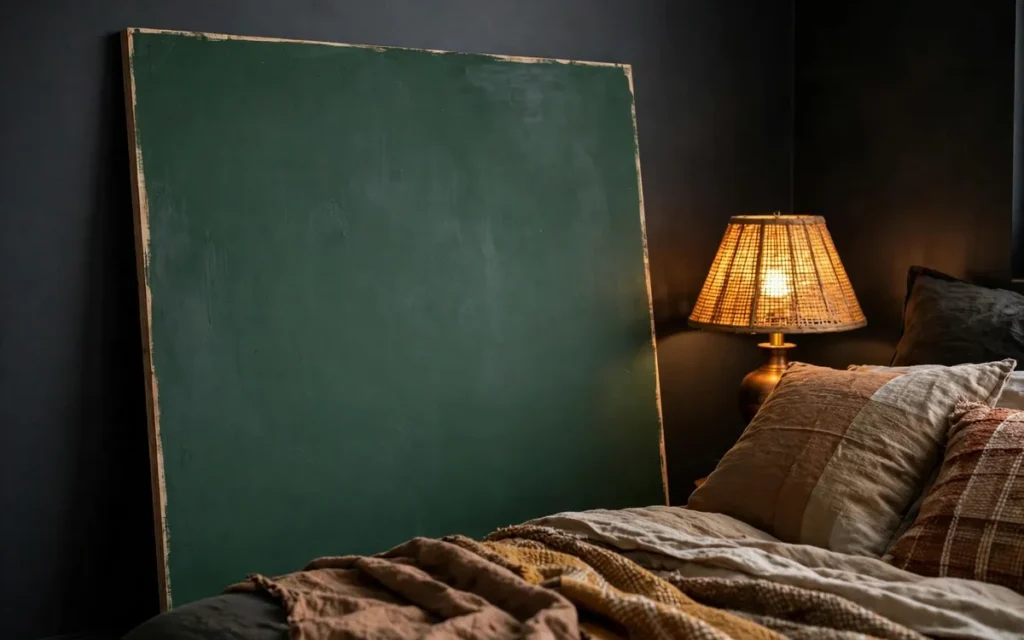
Dark paint is the one purchase in the room that cannot be returned, so it is auditioned: paint a 24-inch board, carry it around the room, and read it in morning light and lamplight before a single wall is committed. Start with the bed wall only — a one-wall room can always be drenched later, while an over-dark room is un-painted at the price of the whole job.
3. Pair the Dark With One Warm Accent

One accent family, in the LRV 20–36 band — terracotta, rust, ochre, with Cavern Clay at about 20 as the paint anchor — repeated in three or four movable places: the throw, one cushion, a clay pot, the warm thread running through the rug. The discipline is the ratio: one dark, one warm, repeated. A second accent color is exactly where collected turns into clutter.
Zone B — Build the Bed
The bed is built by touch, in a fixed order. (It is the neutral bedroom’s own layering, inverted: our cozy neutral bedroom ideas run texture in threes, one pattern and a repeated warm accent over cream; here the same order runs over near-black. Readers who built the light room already own this method — only the depth changes.)
4. Layer Three Textures Before One Pattern

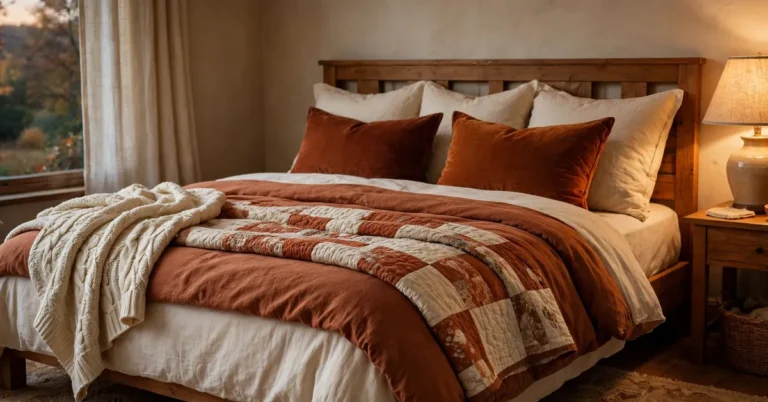
The boho bed is built by touch first: three textures minimum — a linen duvet, a wool or knit throw, a woven cotton blanket — before any pattern is allowed to enter. At wall LRV 3–10, a pattern printed flat reads as noise, while a texture still casts a shadow the lamplight can find. Pattern is the next idea’s job; this one is the foundation it stands on.
5. Run One Pattern at Two Scales

One pattern family only, at two sizes: the large scale on the room’s biggest textile — the rug or the quilt — and the small scale on exactly one pillow or the curtain’s edge, with one color thread shared between them and idea 3’s accent. A second pattern is admitted only if it carries the same thread. That single rule is the whole difference between eclectic and random.
6. Drop the Bed Low
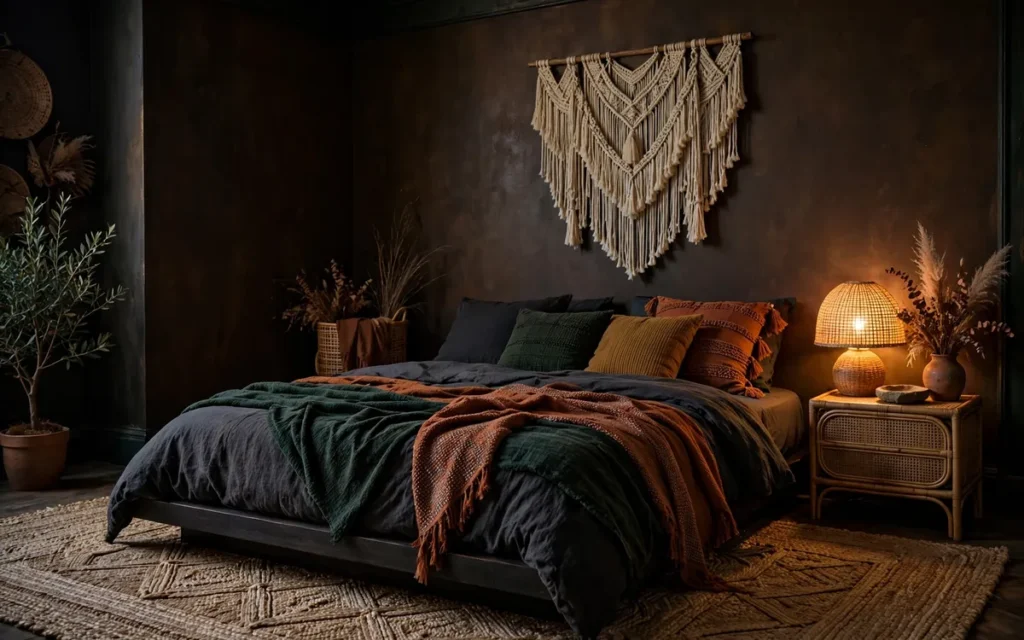
The low profile is the boho base: a platform setup puts the mattress top at roughly 20–24 inches, against 24–28 inches for a standard frame-and-box-spring bed, and those four inches change the room’s proportions — the walls read taller, the layers read wider. Measure your own stack (frame, foundation, mattress) before shopping; the nightstands in Zone C are sized from the same number.
7. Check the Canopy Against the Ceiling

The canopy is this style’s signature frame and its only geometry test: posts are commonly 78–83 inches tall, and the frame wants roughly 12 inches of air below the ceiling to read as furniture, not a near-miss. Under a standard 96-inch ceiling that caps the frame at about 84 inches, and the drapery belongs on the head half only, framing the pillows.
Zone C — Weave the Room
Four weaves finish the room’s shell: the rug under the bed, the hanging over it, the stands beside it, and the plants wherever the light allows. (The stands are measured here, in idea 10; what goes on top of them — lamp, stack, tray — is our nightstand decor ideas system, dressed there rather than re-taught here.)
8. Lay the Rug by the 18–24 Inch Rule
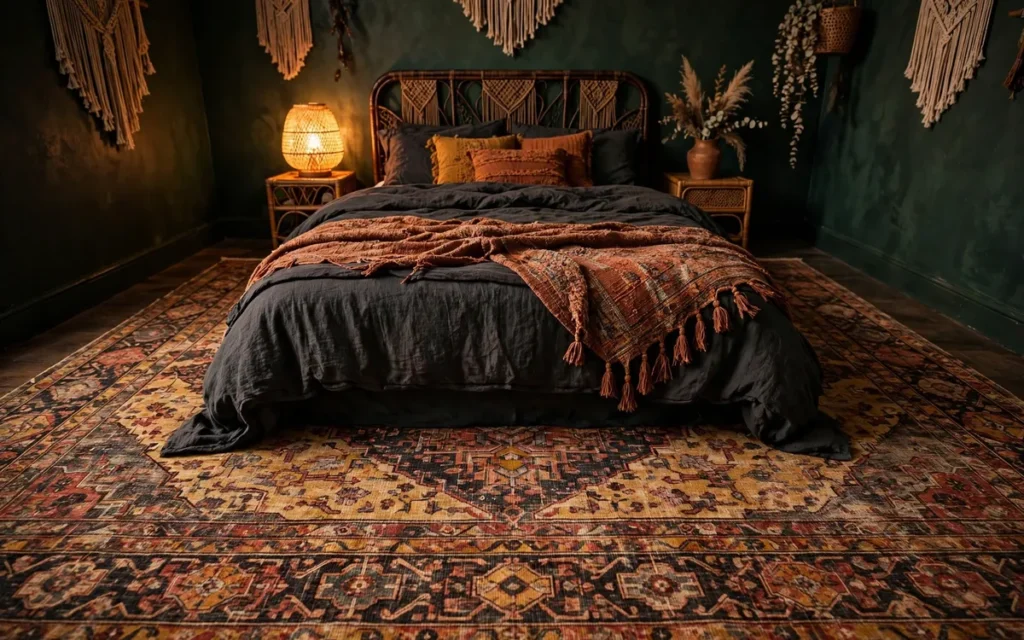
The rug is sized by subtraction: rug width minus bed width, halved, must land at 18–24 inches on each side and past the foot. A queen (60 × 80 inches) takes an 8×10; a king (76 × 80) takes a 9×12. Nightstands join the rug on the 9×12 — 60 plus two 22-inch stands makes 104 inches, fitting the 108-inch width, not the 96.
9. Hang the Woven Piece at Two-Thirds Width
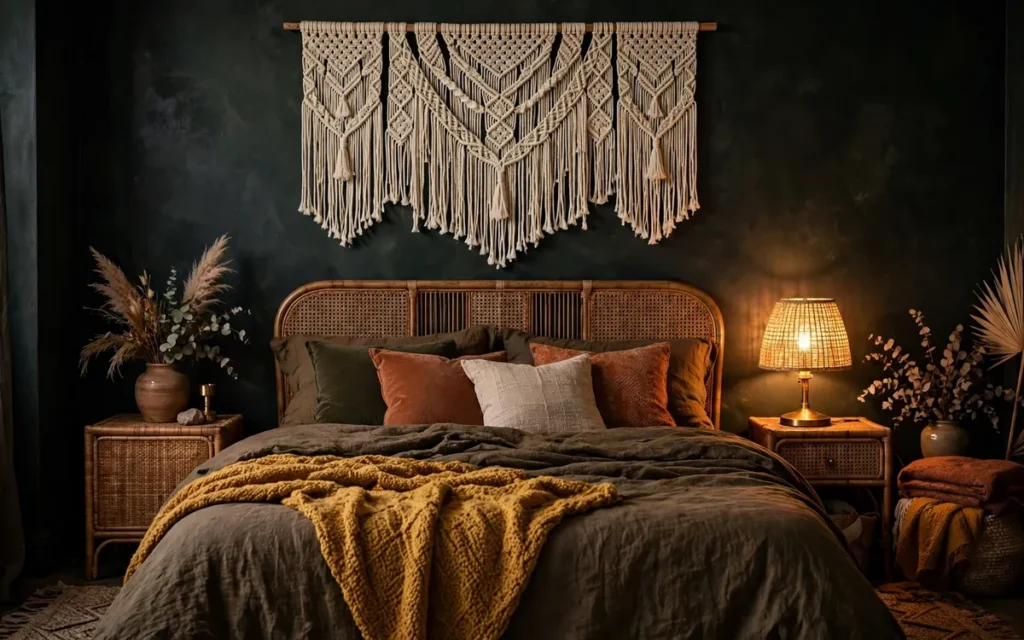
The macramé or tapestry above the bed follows the anchor rule for anything hung over furniture: two-thirds to three-quarters of the width of the piece below it — 40–45 inches over a 60-inch queen — with its bottom edge 6–12 inches above the headboard. Narrower than half the bed, a hanging reads as a towel that lost its way; sized right, it is the headboard’s crown.
10. Set Nightstands Within Two Inches of the Mattress
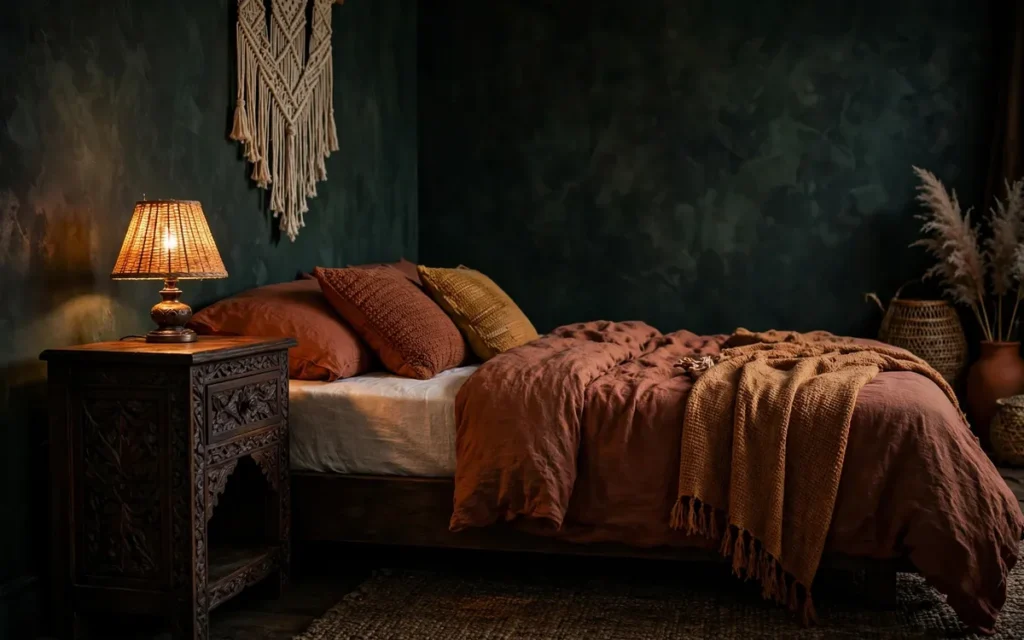
The stand’s top lands within 2 inches of the mattress top, above or below — which is why most stands are sold at 24–28 inches, and why a low platform bed (idea 6) needs a lower stand than the catalog’s standard. Carved wood or rattan is where the rule meets the style: the one furniture pair in the room bought by measurement first and material second.
11. Trail the Plants Where the Light Actually Is

The dark room’s plants are placed by the window’s evidence, not by the styling photograph: the trailing plant (pothos is the forgiving classic) goes on the tallest piece within the window’s light and spills down the wall the light already reaches. A plant exiled to the darkest corner is a slow goodbye, not decor — where no light reaches, the honest boho answer is the woven basket and dried stems.
Zone D — Warm the Light
The paint is not judged until the light is set: three moves — the bulb swap, the three sources, and the wall that is hung by a line, not by eye.
12. Switch Every Bulb to 2700

Before the paint is judged, the bulbs are: the whole room into the 2700–3000K warm band, with 2700K as the target. Under a cool 4000K bulb, Zone A’s forest green turns grey and its black turns blue; at 2700K both turn warm. It is the cheapest idea in this article, and the one that rescues more dark rooms than any other — including rooms whose owners were about to repaint.
13. Light in Threes, None of Them Overhead

Three sources at three heights: two bedside lights — table lamps on the idea-10 stands, or sconces centered 60–66 inches from the floor — and one low source in the corner: a floor lamp, a pendant over the reading chair, lanterns on the dresser. The ceiling light retires to cleaning duty. Pools of light make texture visible; a single overhead source flattens a dark room into a cave with furniture.
14. Hang the Gallery Wall on the 57-Inch Line

The collected wall — vintage landscapes, botanical prints, thrifted frames — is hung as one unit centered 57 inches from the floor, the gallery standard, with 2–3 inch gaps: at close spacing a boho cluster reads collected, at wide, scattered. Above the bed the rule converts — the group’s bottom edge sits 6–12 inches above the headboard — and the 57-inch line is taken from the group’s center.
Zone E — Finish It Honestly
Three honest finishes: a mirror placed as a light tool, one surface deliberately left alone, and the whole look rebuilt without paint. (The mirror hangs above the dresser in idea 15 and idea 16 keeps a surface bare; what stands on the dresser when it is not the bare one is our top of dresser decor ideas system, cited rather than re-taught.)
15. Put the Mirror Where It Can Steal Light

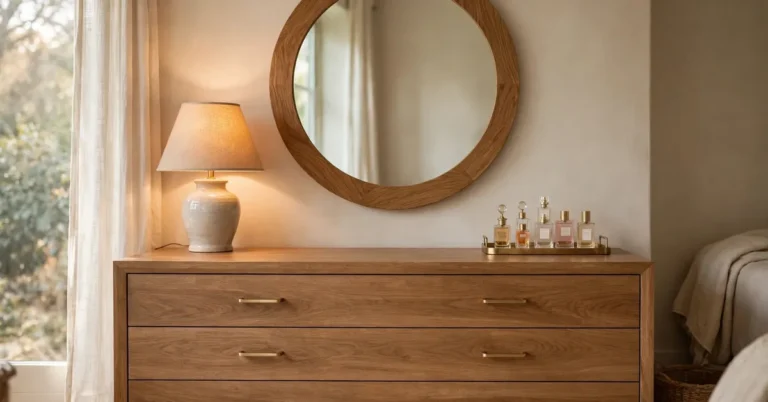
The arched mirror earns its place as a light tool before it is decor: hang it on the wall opposite or beside the window, where it returns daylight into the room’s dark half by day and lamplight by night, sized at about two-thirds the width of the dresser or console beneath it. On the window’s own wall it reflects a dark corner back at itself, and helps nothing.
16. Keep One Surface Bare
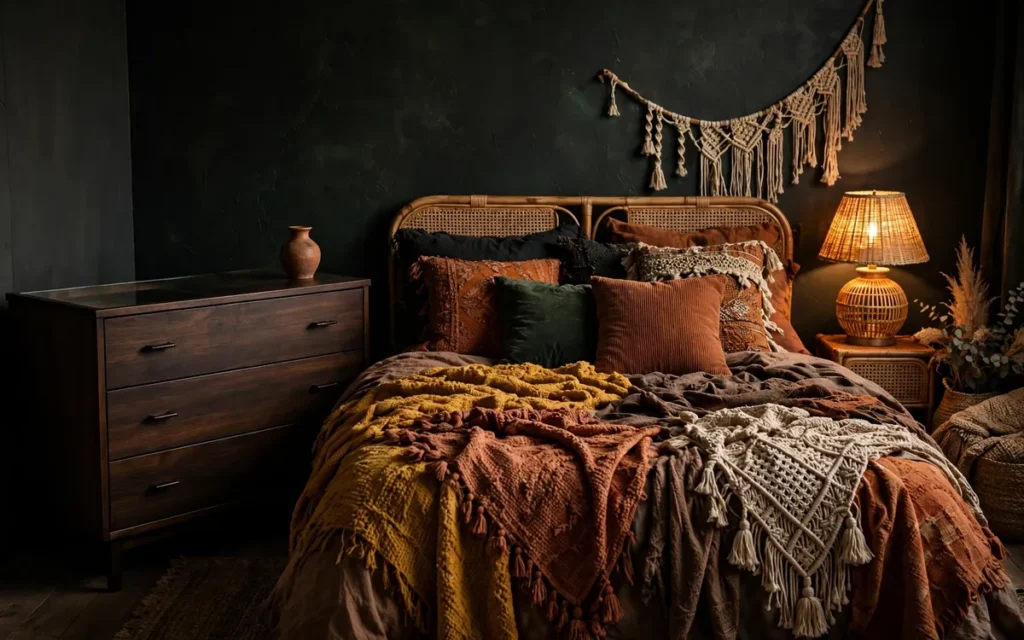
The counterweight that keeps the layering honest: of the room’s surfaces, one stays unlayered — the dresser top clear but for one object, or the wall opposite the gallery left entirely empty. Boho is collected, not complete. The bare surface is the rest the eye reads the layers against, and it is planned from the start, never whatever happened to be left over.
17. Do the Whole Look Without Paint

The renter’s route: the palette moves onto the three largest soft surfaces instead of the walls — a dark duvet in Zone A’s band, the idea-8 rug in a deep vintage wash, curtains — while walls stay landlord-white. The LRV logic transfers unchanged: deep surfaces, one warm accent repeated, texture before pattern. What paint does in a weekend, cloth does in an afternoon — and it all leaves with you.
What It Costs: Three Ways In
The textile tier (under roughly $100). The 2700K bulb swap for the whole room, sample pots and one 24-inch test board, a dark throw, one patterned cushion pair in the accent, a trailing pothos. This tier proves most dark-boho failures are a setting problem — wrong bulb, untested color — not a shopping problem, and it is fixed for the price of a night out.
The layer tier (roughly $100–$600). One wall’s paint (or the full drench, priced honestly per gallon), the 8×10 vintage-look rug, the woven wall hanging, a pair of bedside lamps or sconces, thrifted gallery frames. The tier that does the visible work, bought in method order: color tested, bed layered, light warmed.
The furniture tier (roughly $600 and up). The low platform or canopy frame — bought against Zone B’s ceiling arithmetic — the 9×12 rug, carved-wood nightstands at the measured height, a full-room paint with the ceiling included. The tier that changes the room’s bones, and worth it only after the first two tiers have proven the palette in the room’s own light.
7 Mistakes That Make Dark Feel Gloomy
- Choosing the paint from the chip or a photograph. Every color under LRV 10 reads darker on the wall than on the chip, and a phone photo of someone else’s green was taken in someone else’s light. The 24-inch board in your own room, morning and lamplight, is the only honest sample there is (idea 2).
- Painting dark, then lighting it cool. A 4000K bulb turns the green grey and the black blue, and the owner blames the paint. The 2700K switch (idea 12) comes before the second coat is judged — most “wrong color” dark rooms are wrong-temperature rooms.
- Layering pattern before texture. Three patterns on a flat bed read busy, not boho: darkness eats pattern and spares touch. Three textures first (idea 4), one pattern family after (idea 5) — the order is the style.
- Buying the rug by the room instead of the bed. A rug showing under 18 inches a side reads as a mat the bed is standing on, not a layer. The subtraction — (rug width − bed width) ÷ 2, landing at 18–24 — is done before the rug is chosen, not after it is unrolled (idea 8).
- Ordering the canopy before measuring the ceiling. An 83-inch frame under a 96-inch ceiling leaves 13 inches and passes; taller frames crowd the ceiling and the drape has nowhere to fall. Posts, ceiling, clearance — in that order, on paper, before the frame is bought (idea 7).
- Matching the nightstand to the catalog instead of the mattress. A standard 24–28-inch stand strands its lamp a foot above a low platform bed’s 20-inch mattress top. The stand is bought to the bed’s own number, within 2 inches (ideas 6 and 10); furniture follows the stack, never the other way around.
- Copying a bright-room boho photograph into a dark room. The layers that glow in a white room’s daylight vanish against LRV 3–10 walls under warm, dim light. The dark room needs its texture coarser, its pattern larger in scale and its accent warmer than the photograph’s — which is why these rules are stated for the dark version, not adapted from the light one.
FAQs
Will dark walls make my bedroom look smaller?
The room measures exactly the same. What changes is the light: a low-LRV wall absorbs light instead of returning it, so the wall itself recedes rather than advancing — what actually closes a dark room in is flat texture and cool light, not the color. The three guards are all in this article: the one-wall start (idea 2), the 18–24-inch rug border (idea 8) and the 2700K rule (idea 12).
What colors go with dark boho walls?
One warm accent family in the LRV 20–36 band — terracotta, rust, ochre, muted mustard — repeated three or four times over a wall at LRV 3–10. Cream and natural wood are the neutrals, aged brass the metal. The pairing works because the two bands sit far enough apart to read as depth rather than contrast: the dark stays the field, the warm stays the thread.
How do I keep a dark bedroom from feeling gloomy?
Gloom is a recipe with three ingredients — flat surfaces, cool light, and one unbroken dark — and the method removes all three: a three-texture minimum on the bed, every bulb at 2700K, one warm accent repeated until it reads as intention. A dark room that feels gloomy is almost never too dark; it is too flat, or too cool, and both of those are fixable in an afternoon.
Can dark boho work in a small or low-light bedroom?
Yes — it is arguably the small room’s own style, since the low bed, the wall-hung layers and the retired ceiling light all suit a compact footprint. Start with the bed wall only, put the mirror where it can steal the window’s light (idea 15), and let the rug arithmetic shrink honestly: a full or twin takes the same 18–24-inch rule at a smaller rug size.
Can I get the dark boho look without painting, in a rental?
Yes — idea 17’s order: the palette moves onto the duvet, the rug and lined dark curtains, the three largest soft surfaces in the room, and the walls stay white. Add the 2700K bulb swap and the three-texture count and the room reads dark boho by lamplight — which is when a bedroom is mostly seen anyway.
How many pillows does a boho bed actually need?
Five is the working formula: two sleeping pillows, two shams standing behind them, and one long lumbar in the accent color across the front. Fewer reads bare against a dark wall; more reads hotel, and every extra cushion is one more thing moved twice a day. The lumbar is where idea 5’s small-scale pattern lives.
Conclusion
A dark boho bedroom is not too dark; it is unnumbered, unlayered and lit by the wrong bulb. Work through these dark boho bedroom ideas in order — number it, layer it, warm it — and the same deep color stops reading as a risk and starts reading as a room: dark by measurement, warm by texture, and lit the way it was always meant to be.

2 Comments