

24 Chic Grey Couch Living Room Ideas That Make Grey Feel Warm
The grey couch is the most bought and most blamed sofa in the modern living room — endlessly versatile in the showroom, somehow cold and boring by the second winter at home. These grey couch living room ideas start with the one thing the showroom never tells you: which grey you actually own. A warm greige and a blue-grey are different colours wearing the same name, and they take entirely different rooms. (This guide assumes the couch is already standing in the right place: placement — corner or floated, chaise direction, clearances — is decided in our how to arrange L shaped sofa in living room guide. Colour is chapter two; that one is chapter one.)
The Method: Read It, Warm It, Layer It
Three decisions, in order, before a single cushion is bought — because a grey couch is not one colour but a family of them, and every failed grey room was decorated as if it were.
Step 1 — Read It: Name Your Grey Before You Decorate Around It
Every grey has an undertone — blue, green or violet — plus a depth. The test costs nothing: hold a sheet of pure white paper against the fabric in daylight. If the grey looks beige or brownish beside the white, it is a warm grey (a greige); if it looks blue or steely, it is cool. Then name the depth — light, mid or charcoal — because the three depths take different partners. More than any single cushion, grey couch living room ideas stand or fall on this reading: warm greys take warm partners, cool greys take cool ones, and most “my grey looks wrong” rooms are an undertone argument nobody knew they were having.
Step 2 — Warm It: Set the Shell Against the Cold
Grey’s one real vice is coldness, and it is cured by the shell, not the sofa. Walls: a warm greige in the LRV 55–69 band — Agreeable Gray (SW 7029, LRV 60), Repose Gray (SW 7015, LRV 58), Revere Pewter (HC-172, LRV 55) — warms a cool couch without fighting it. Light: a north-facing room’s light is itself cool and bluish, and makes a cool grey read colder still; warm greys and warm bulbs (2700K) are the north room’s correction, while a south-facing room’s warm light forgives a cool grey — and can push a warm one toward yellow.
Step 3 — Layer It: Build the 60-30-10 Around the Anchor
The couch is the room’s anchor, so the palette is built in the designer’s ratio: roughly 60% dominant (walls, rug, the couch’s own grey family), 30% secondary (curtains, chairs, wood tones), 10% accent (cushions, throws, small decor) — and the accent is where the warmth and colour live, repeated at least three times around the room so it reads as a scheme, not an accident. The shade-by-shade pairing chart behind this step — light grey with navy and white, mid grey with olive and mocha, charcoal with terracotta, emerald and brass — is set out in Furniture Choice’s guide to what colours go with a grey sofa.
Zone A — Read Your Grey First
Four readings before any decorating: the undertone, the depth, the room’s light, and the colours that cannot move. Skip them and every later choice is a guess wearing confidence.
1. Read the Undertone Against White Paper

The paper test from Step 1, done properly: daylight, not lamplight, fabric held flat against pure white. Beside white, a warm grey shows beige or brown — it is a greige, and it takes cream, camel and warm wood; a cool grey shows blue or steel, and takes navy, sage, black and chrome. Decorating before this test is how a room ends up warm-cushioned against a blue-grey couch, arguing with itself.
2. Name Your Shade: Light, Mid or Charcoal

The depth decides the partners. A LIGHT grey needs contrast or it washes out — navy, charcoal accents, a deeper rug. A MID grey is the true neutral and takes almost anything, warm or cool. A CHARCOAL couch is a statement that wants saturated company — terracotta, emerald, brass — and light around it, so it does not swallow the room. One couch, three different rooms.
3. Check the Room’s Light Direction

The same couch reads two colours in two rooms. North-facing light is cool and bluish and pushes any grey colder — a blue-grey couch in a north room is the coldest legal combination in decor. South-facing light is warm and golden: it softens cool greys but can turn a warm greige muddy by evening. The room’s compass point is part of the couch’s colour — read it before choosing a single partner.
4. Match the Colours You Cannot Change

The floor, the fireplace stone, the fixed cabinetry: these are the room’s permanent colours, and the couch’s undertone must sit with THEM first. Grey-washed or ash flooring doubles down on cool — warm the textiles harder. Orange-toned wood floors warm the room for free but fight a blue-grey couch; the bridge there is a rug that covers the clash zone between floor and sofa.
Zone B — Set the Shell: Walls and Light
The shell is the room’s temperature control: wall colour behind the couch, and the light that falls on it. Get these two right and the couch is halfway warmed before a single cushion arrives.
5. Paint Warm Greige Walls Behind a Cool Grey

The single biggest warmth lever in the room: a warm greige wall in the LRV 55–69 band — Agreeable Gray (SW 7029, LRV 60), Revere Pewter (HC-172, LRV 55), Collingwood (OC-28, LRV 61.5) — sits a few points of warmth behind a cool couch, and the cold disappears without the wall ever reading “beige”. Wall COLOUR is this article’s territory; what hangs on that wall, at what measurements, is measured out in our above couch decor ideas.
6. Go One Shade Deeper for a Cocooned Wall

The deliberate opposite: a wall one full shade deeper than the couch — a mid grey couch against a charcoal-leaning wall — turns the seating wall into a cocoon and makes the couch glow lighter by contrast. This is a doorway, not a destination: the full deep-colour room, drenched and moody end to end, is a scheme of its own in our moody living room ideas. Here it is one wall, used on purpose.
7. Keep Walls Crisp White With a Light Grey Couch
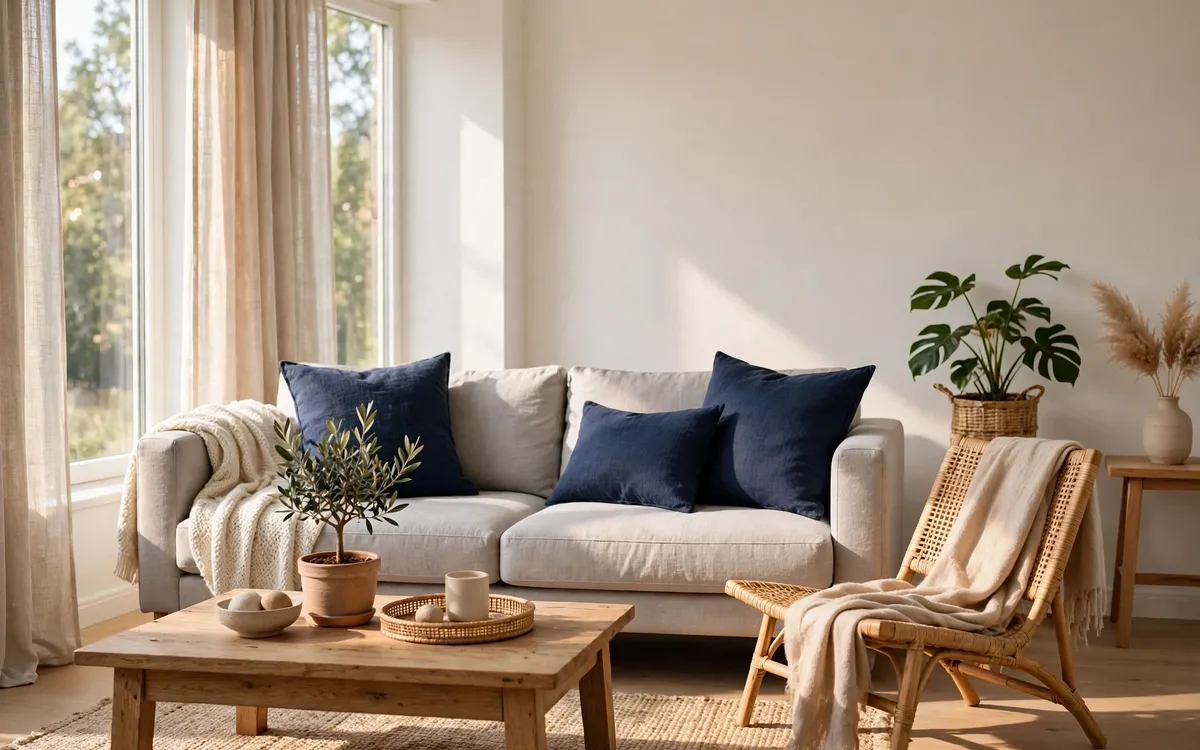
A light grey couch against a warm white wall is the airy Scandinavian shell — but the white must be WARM white, a creamy white around LRV 80+, never a blue-white: two cool near-whites together read as a dentist’s waiting room. The contrast rule keeps it honest: wall and couch should differ by at least roughly 15 LRV points, or one of them must carry the pattern.
8. Switch Every Bulb to 2700K

The cheapest fix in the entire article: daylight bulbs (4000–5000K) pour blue light over a grey couch and make any grey read institutional; warm 2700K bulbs (2700–3000K at most) pour the golden light the couch was photographed in at the showroom. Swap the bulbs before repainting anything — half of all “cold grey room” complaints are a lighting temperature wearing a paint problem’s clothes.
Zone C — Warm It With Wood, Metal and Texture
The layer between the shell and the colour: the materials. Wood warms, metal sets a temperature, texture gives flat grey a surface to live on — three levers, pulled in that order.
9. Add Warm Wood Tones

Walnut, warm oak, teak: mid-to-dark warm woods are grey’s oldest friendship, because wood supplies the brown-orange warmth grey lacks. One substantial wood piece — a coffee table or sideboard — warms more than five small ones. The caution runs the other way: grey-washed, ash and weathered-grey woods are the SAME temperature as the couch, and stacking them is how a room turns into a fog bank.
10. Use Brass or Gold to Lift a Cool Grey

Metals are temperature in solid form: brass, gold and warm bronze heat a cool grey on contact — lamp base, tray, frame edges; roughly three touches is a scheme. Chrome and brushed nickel are cool metals that keep a cool room sleek but colder; matte black is the neutral referee that sharpens either. Pick ONE metal family to lead, or the room wears jewellery from three different outfits.
11. Layer at Least Three Textures
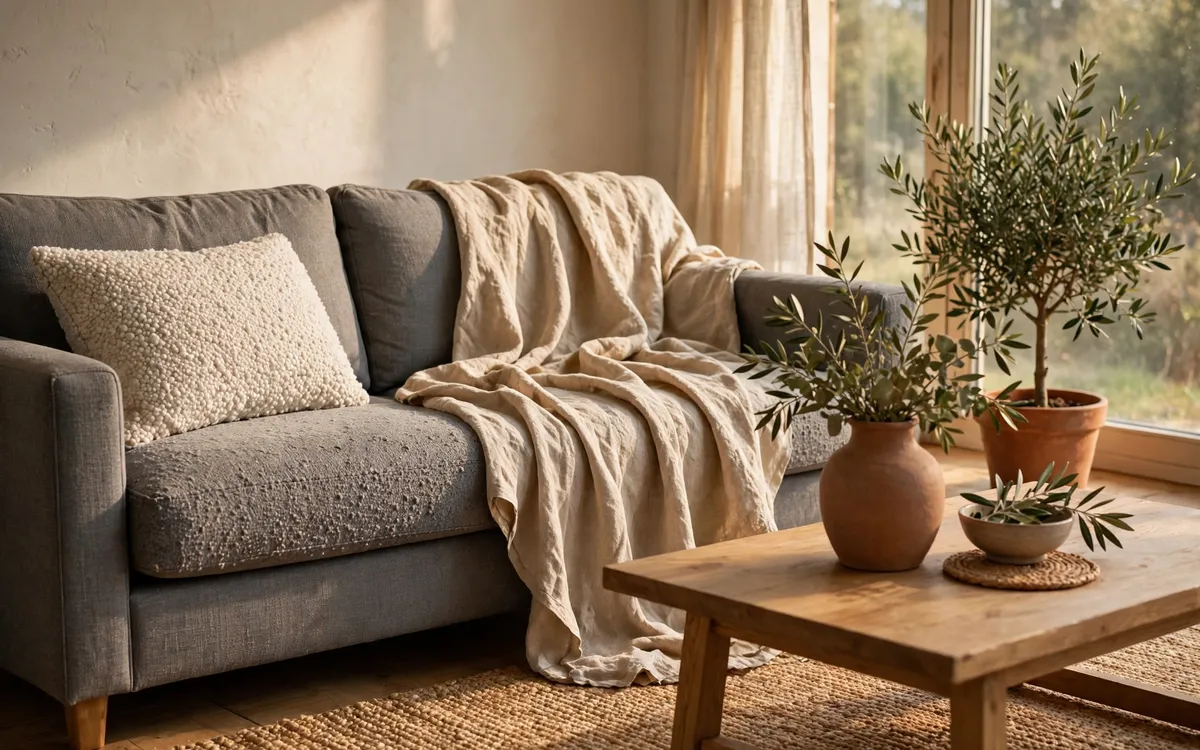
Grey is flat by nature, so texture does the work colour does elsewhere: count three or more distinct textures in the seating zone — a nubby bouclé or wool cushion, a flat linen throw, a woven jute or high-pile rug, a smooth leather or wood surface. Two rooms with identical grey palettes, one textured and one not, are the difference between “calm” and “waiting room” — and texture is the difference you can buy for cushion money.
12. Add Cognac Leather as the Warm Bridge
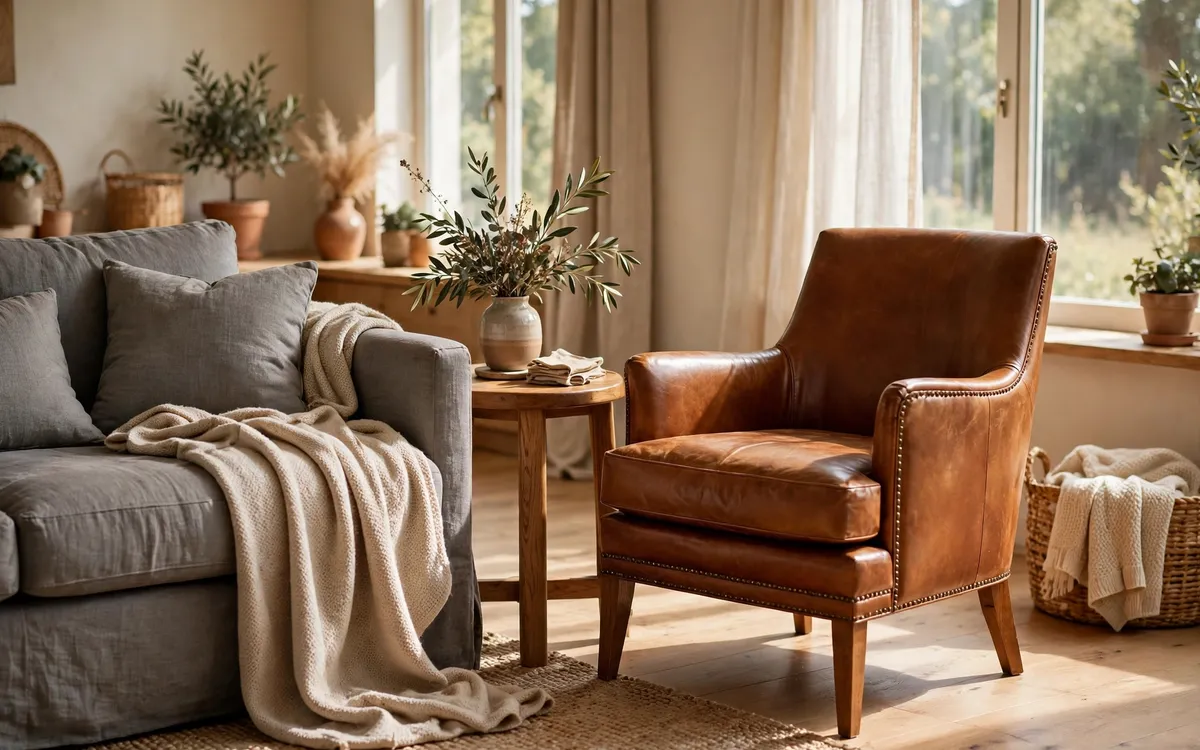
One cognac or tan leather piece — an accent chair, an ottoman, even a cushion — is the classic bridge between a grey couch and a warm room: leather’s orange-brown is the exact warmth grey is missing, it ages instead of dating, and it mediates between the couch and warm wood floors that would otherwise argue. One piece is the bridge; a full leather suite is a different room.
Zone D — Colour Pairings That Work
The accent layer, where the 10% lives. Five pairings, each with its temperature and its dose — because with grey, the colour is rarely wrong; the temperature or the amount is.
13. Pair Navy for Classic Contrast

Navy is the cool grey’s best-dressed partner: deep enough to give a light or mid grey the contrast it needs, and blue-family enough to never fight a cool undertone. Two navy cushions plus one navy echo across the room — a throw’s edge, a book, a vase — is the whole scheme. Against a WARM greige couch, swap navy for its warmer cousin, ink or petrol, so the blues stay in the same temperature family.
14. Use Terracotta and Rust to Warm It Fast
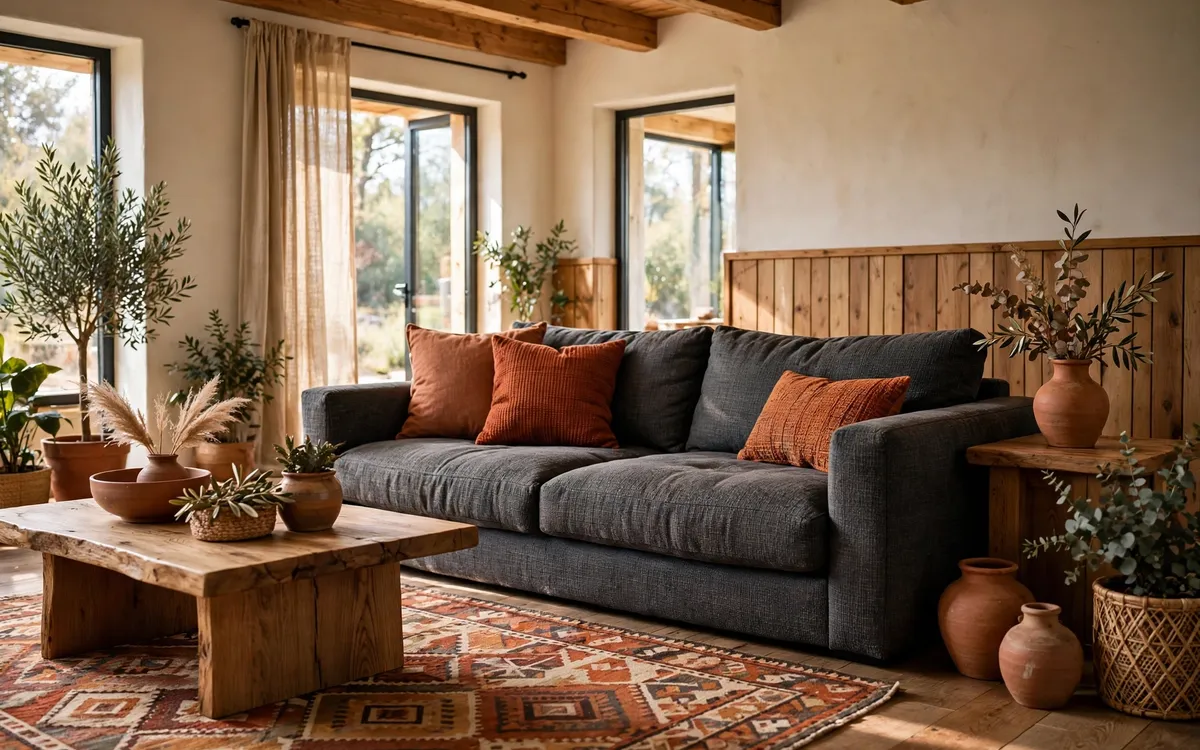
The fastest warmth money can buy: terracotta and rust are grey’s complementary opposites on the warm side, and they heat even a blue-grey couch on contact. Cushions and a throw first — the 10% layer — and a terracotta-toned rug if the room still reads cold. This is the pairing the charcoal couch was born for: saturated warmth against deep grey.
15. Try Sage and Olive for the Calm Route

Green is nature’s neutral and grey’s calmest partner: sage — soft, greyed green — sits quietly beside a cool grey; olive — warmer, earthier — is the version for a warm greige couch. Plants do double duty here: a single large plant beside the couch is a sage accent that also breaks the grey’s straight lines with organic shape, which is why every good grey room has exactly one.
16. Add Mustard in Small Doses Only
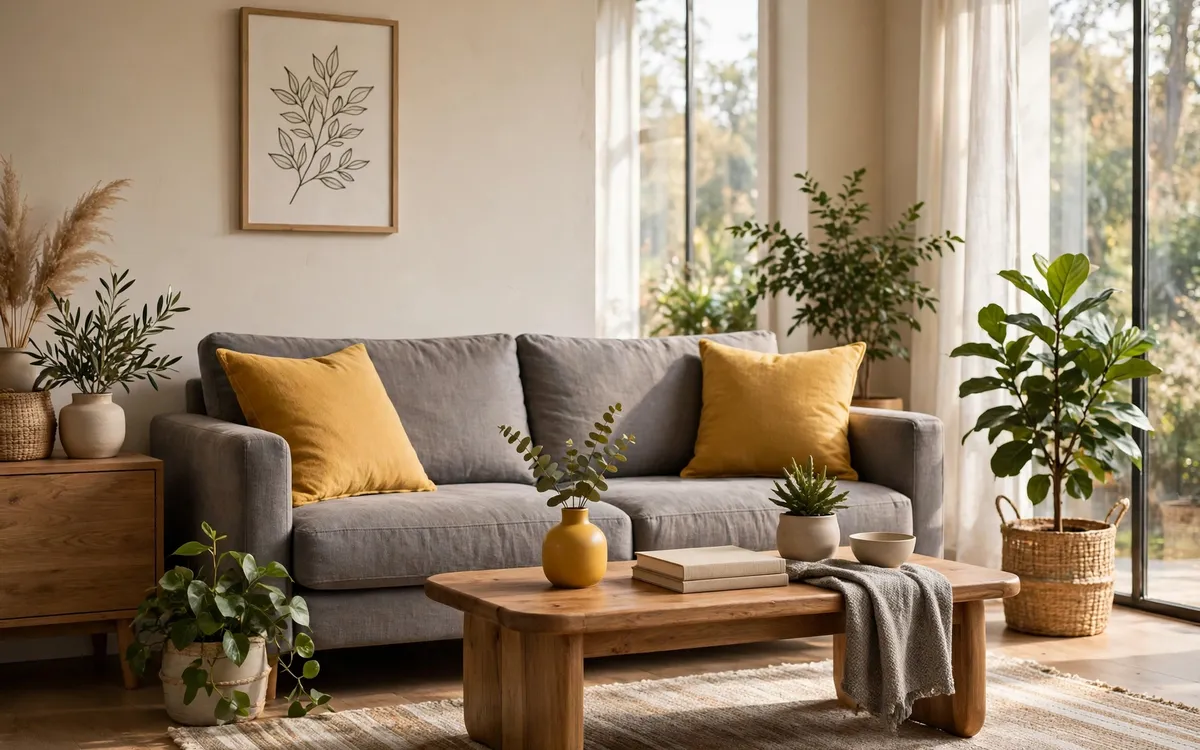
Mustard yellow is grey’s highest-energy partner and its most dangerous: it is a 10% colour, never a 30% one — two cushions or one throw, repeated once more in a small object, and no more. Grey-and-mustard is also the most dated-prone pairing in the set, so the dose is what keeps it current: mustard as a spark, not a scheme.
17. Soften It With Blush Pink

Blush and grey is the soft pairing: pink’s warmth flatters a cool grey without heating the room the way rust does, and it is the one pastel that survives adulthood. Keep the pink dusty, not sugary — a greyed blush, not a candy pink — support it with the brass from idea 10, and it reads tailored rather than sweet: cushions and one throw, the pink repeated in art tones if the wall carries any.
Zone E — Ground It and Finish It
The finishing moves: the rug that grounds the couch, the cushions that dress it, the table styled against the grey and the rule that repeats every accent three times — then the curtains that close the room’s edges, the seasonal swap that refreshes the scheme for cushion money, and the two-light check that proves the whole room works.
18. Choose a Rug a Shade Apart, Never a Match

The rug rule for a grey couch is VALUE contrast: the rug must sit clearly lighter or clearly darker than the couch — roughly 15–20 LRV points apart — or carry a pattern that does the separating, because a rug the same grey as the sofa erases the seating zone’s edge and the couch floats in fog. A warm-toned rug (cream, beige, a faded terracotta pattern) under a cool couch also does Zone C’s warming from below. Front legs of the couch on the rug, as always.
19. Build the Cushion Formula, Not a Cushion Pile
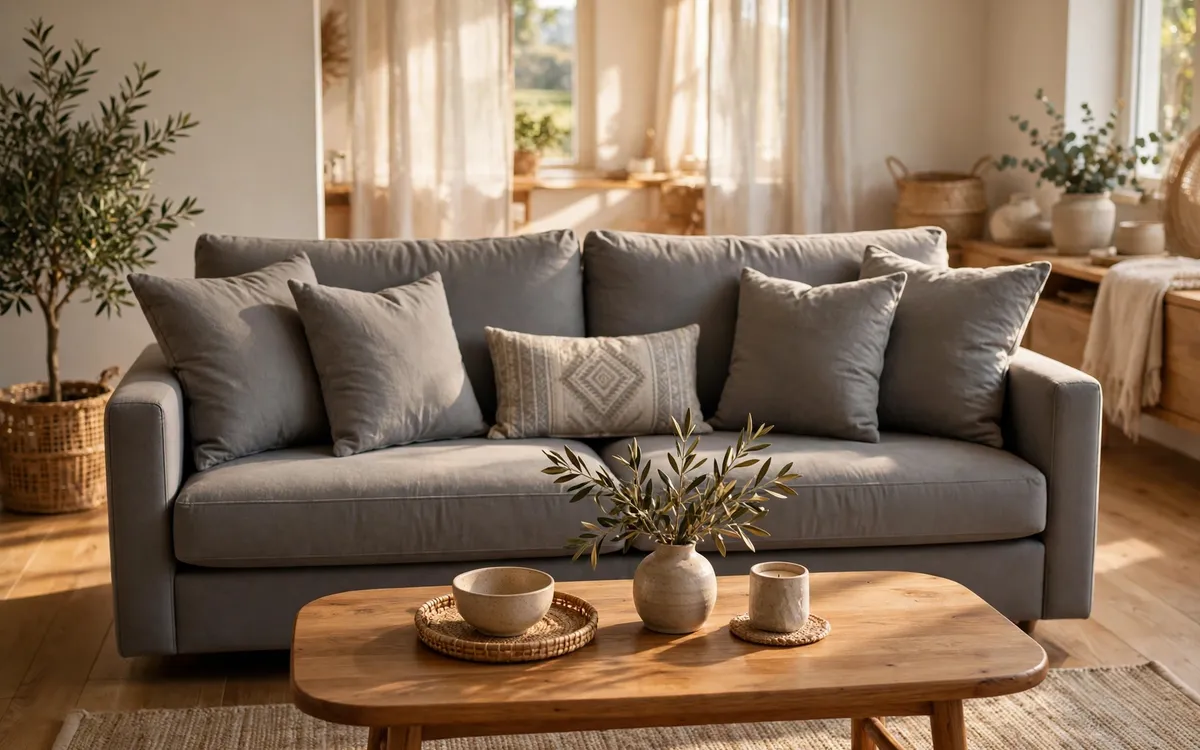
A working formula beats a pile: for a three-seat couch, five cushions — two large (20–22 inch) in the accent colour at the ends, two medium (18 inch) in a neutral texture, one small lumbar in the pattern that ties them. Odd numbers, two sizes minimum, one pattern maximum per scheme. The formula is the 60-30-10 in miniature: mostly neutral, one colour story, told three times across the five.
20. Style the Coffee Table Against the Grey

The table in front of a grey couch is where the room’s warmth gets displayed at eye level: a warm wood or brass tray, one green or terracotta object, one book with a warm spine. The full tray method — sizing, stacking, breathing room — is its own guide, our coffee table tray decor ideas; here the rule is only this: everything on the table is chosen AGAINST the grey, as its warm foreground.
21. Repeat Every Accent Three Times
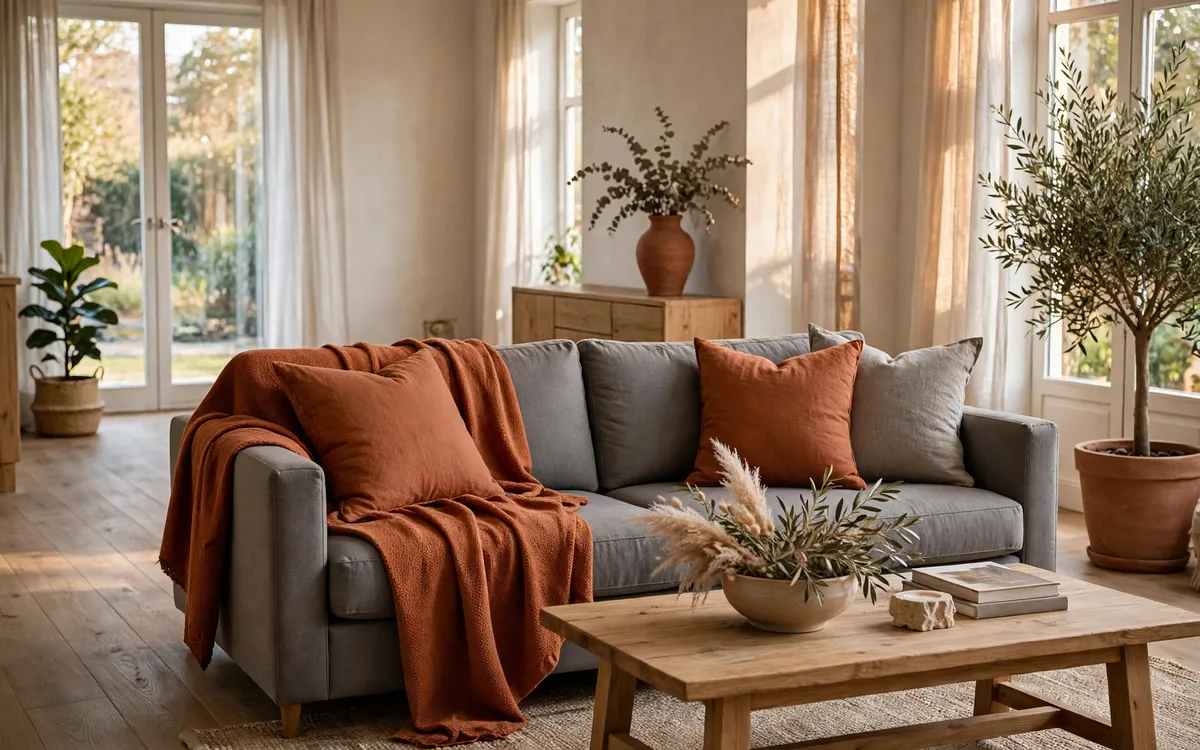
The rule that separates a scheme from a shopping trip: any accent colour or material introduced at the couch must appear three times in the room — cushion plus throw plus one object across the room; brass lamp, brass tray, brass frame. Once is an accident, twice is a coincidence, three times is a design decision — and it is the cheapest rule in the article, because the third echo is usually something you already own, moved.
22. Hang Warm Curtains in the Secondary Layer
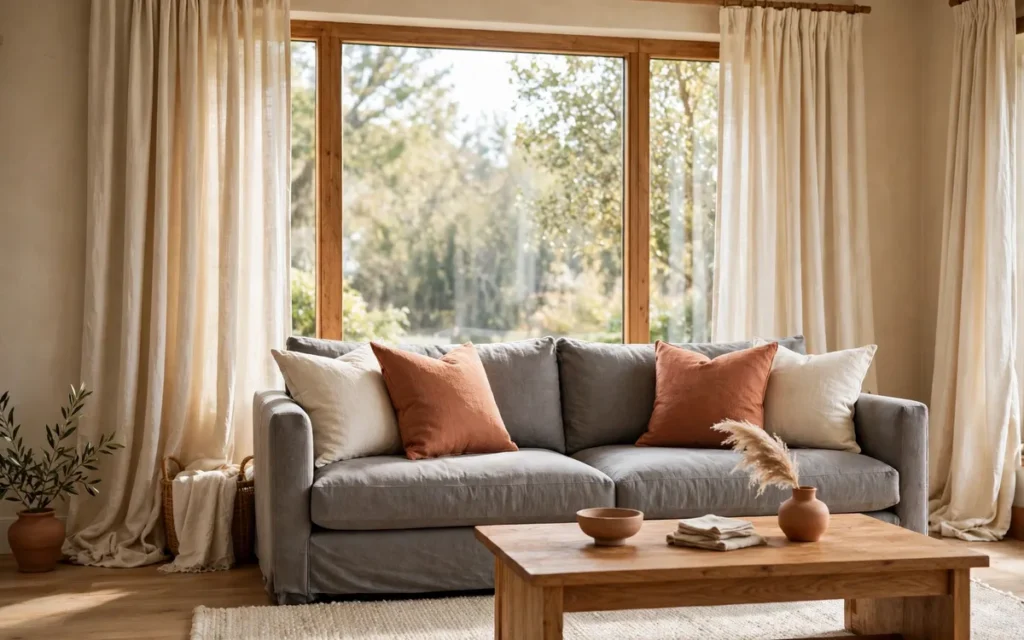
Curtains are not a finishing touch here; they are a third of the palette. In Step 3’s 60-30-10, curtains sit in the 30% secondary layer with the chairs and wood tones, so their colour counts at room scale. Warm linen, cream or greige keeps a cool couch’s shell warm; icy white or blue-grey drapes undo idea 5’s wall work. Match the curtain’s temperature to the walls, not to the couch.
23. Swap the Accent Layer With the Season
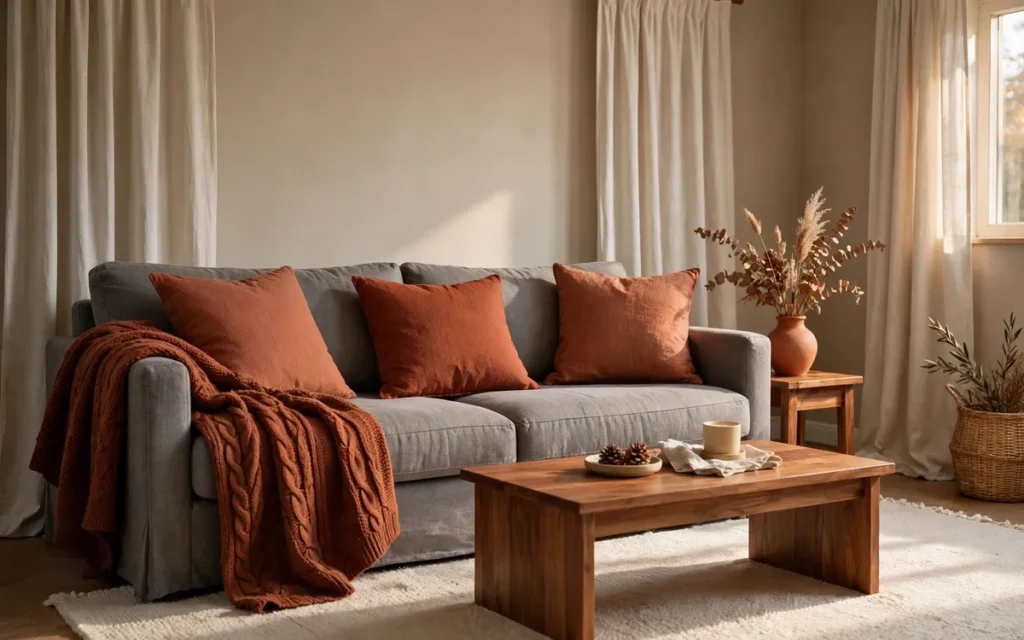
The 60 and the 30 stay put all year; only the 10% accent layer is built to move. Twice a year, swap just the cushion covers and the throw: terracotta and rust for the cold months, sage and blush when the light turns warm. The couch, rug and curtains never change, and the room reads new — the swapped-in colour still repeats three times (idea 21).
24. Check the Room in Daylight and Lamplight

Grey is the one colour that has to pass the test twice. Read the finished room once at midday and once after dark, under the 2700K lamps of idea 8: daylight shows the undertone honestly, lamplight shows the room you actually live in. If the couch reads blue only in the evening, the fault is a bulb’s temperature, not the palette — change a bulb, not a cushion.
What It Costs: Three Ways In
The textile tier (roughly $50–$150). The cushion formula (five covers, not five new cushions), one warm throw, the 2700K bulb swap throughout, one plant. This tier proves most grey-couch coldness is a textile-and-lighting problem, not a furniture problem — the couch stays, the room warms.
The ground tier (roughly $150–$500). The correctly contrasted rug, warm linen curtains, one warm wood side table or the brass lamp set. The pieces that change what the couch sits in — and glows under.
The shell tier (roughly $500 and up). Repainting the walls in the LRV 55–69 warm band, the cognac leather chair, a warm wood coffee table or sideboard. The tier that changes the room the couch lives in — priced honestly as a room project, not a sofa accessory.
7 Mistakes That Make a Grey Couch Look Cold
- Matching grey to grey. Same-value grey rug, grey cushions, grey walls, grey couch: the monochrome that photographs as sophistication and lives as fog. Grey rooms are built on CONTRAST (idea 18’s 15–20 LRV points), not on matching — the couch needs neighbours that differ from it, not relatives that disappear into it.
- Decorating without reading the undertone. Warm rust cushions against a blue-grey couch, cool chrome beside a warm greige: every pairing slightly wrong and the room “off” in a way nobody can name. The undertone (idea 1) is read FIRST; it is a two-minute test that decides every purchase after it.
- Daylight bulbs over a grey couch. 4000–5000K bulbs pour blue light on the fabric all evening — the couch looks colder and bluer at night than it did in the shop, and the owner blames the sofa. 2700K (idea 8) is a bulb swap, not a renovation.
- Painting the walls cool grey in a north-facing room. Cool light plus cool walls plus a cool couch is the triple-cold room; northern light already enhances cool undertones. North rooms get warm greige walls (idea 5) precisely because the light will not supply any warmth of its own.
- The rug that matches the couch. A same-shade rug erases the seating zone (idea 18) — and a too-small rug compounds it, stranding the couch on an island of its own colour. Value contrast first, pattern second, size always front-legs-on.
- One accent, used once. A single mustard cushion, one pink throw, a lone brass lamp: an accent used once reads as a mistake somebody forgot to return, not a scheme. The rule is three echoes (idea 21) — or the accent is removed, which is also a decision.
- All texture or no texture. No texture at all (flat weave couch, flat rug, flat cushions) makes grey read institutional at any palette; the opposite failure — every surface nubby, fringed and woven — makes it read as a craft fair. The count is three-plus textures, mixed smooth against rough (idea 11), not ten.
FAQs
What colours go best with a grey couch?
It depends on the grey you own: light grey takes navy, white and deeper contrast; mid grey takes olive, mocha and warm neutrals; charcoal takes saturated warmth — terracotta, emerald, brass. Read the undertone first (warm greys pair warm, cool pair cool), then build 60-30-10 with the colour living in the 10%.
How do I make a grey couch look warm instead of cold?
Work the shell, not the sofa: warm greige walls in the LRV 55–69 band, every bulb at 2700K, one warm wood piece, and terracotta or rust textiles in the accent layer. In a north-facing room all four matter, because the light itself is working against you.
What colour walls go with a grey couch?
Warm greiges and creamy whites for most greys — Agreeable Gray (LRV 60), Revere Pewter (LRV 55) — keeping roughly 15 LRV points between wall and couch so they do not merge. Cool grey walls double the cold, especially in north-facing rooms; a deliberately deeper wall, one shade past the couch, is the cocoon exception.
What colour rug should go under a grey couch?
Any colour a clear shade apart from the couch — lighter or darker by roughly 15–20 LRV points — or a pattern that separates the two. Warm-toned rugs (cream, beige, faded terracotta) warm a cool couch from below; a rug the same grey as the sofa is the one choice that never works.
What colour cushions suit a grey couch?
Follow the formula: five cushions on a three-seater — the accent colour (navy, terracotta, sage, blush) on the two large ends, neutrals in the middle, one pattern to tie them. The accent must echo twice more in the room, and the cushion colours must sit in the couch’s own temperature family.
Does a grey couch go with brown or wood furniture?
It is grey’s best pairing — wood supplies the warmth grey lacks. Warm woods (walnut, warm oak, teak) warm the room; one substantial piece beats five small ones. The caution is the grey-washed and ash woods, which are grey’s own temperature and stack into fog instead of warming anything.
Conclusion
A grey couch is never the problem; an unread grey is. Work through these grey couch living room ideas in order — read it, warm it, layer it — and the couch stops being the room’s apology and becomes its anchor: the same grey, finally surrounded by the colours, woods and light it was asking for all along. And once the palette is warm, the lived-in finish layered over it — the throws, the cushions, the room that feels inhabited — is our cozy living room ideas: the couch is fixed here and made cozy there, in that order.


One Comment