
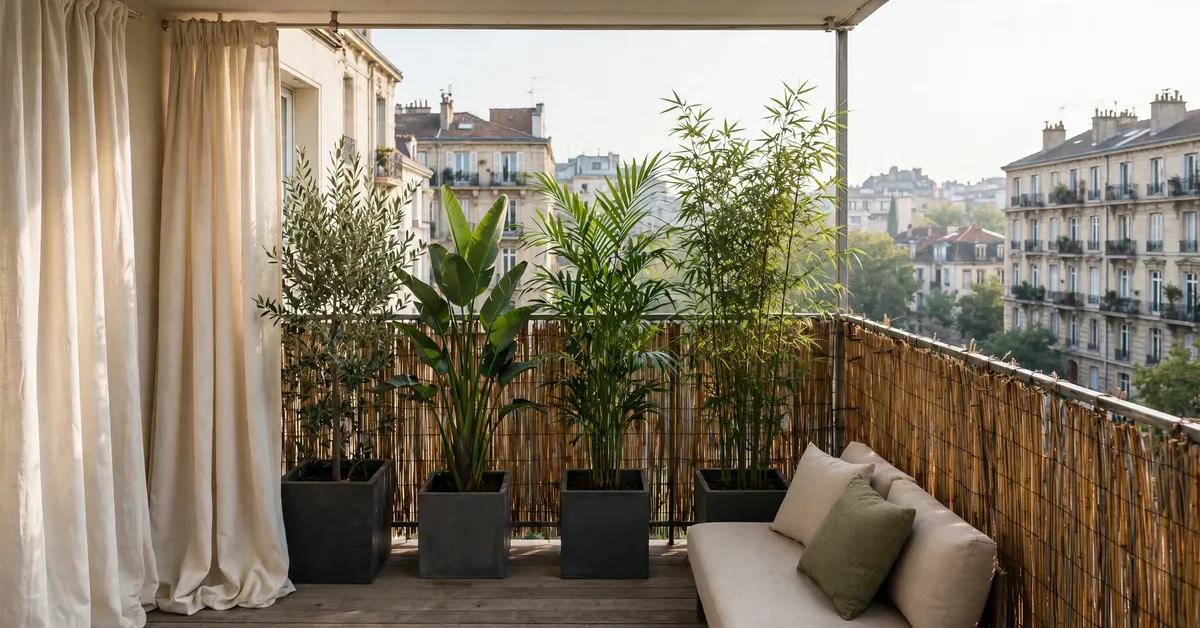
15 Proven Apartment Patio Privacy Ideas That Block the View, Not the Light
There is nothing quite like stepping out onto your apartment patio with a fresh cup of coffee, ready to enjoy a quiet morning — until you make direct, awkward eye contact with the neighbors across the way.
Apartment living comes with a lot of perks, but outdoor privacy usually isn’t one of them. Whether you’re dealing with a shared balcony divider, metal railings that leave you completely exposed to the street, or neighbors whose windows look right down onto your outdoor seating, a lack of privacy can easily turn a great patio into dead space.
Fortunately, you don’t need to build a brick wall or risk your security deposit to fix it. These apartment patio privacy ideas work on a simpler principle: find the one sightline that actually reaches your chair, and screen that line at the height you actually sit at. Screened that way, a small balcony keeps its light, its breeze and its lease — and gives you back your mornings.
The Method: Find the Sightline, Fit the Height, Fasten It Lease-Safe
Three decisions, in order, before anything is bought. Most balcony screens fail for one of three reasons: they cover a line nobody looks along, they stop below the eyes they were meant to hide, or they fasten in a way the lease never allowed. The steps below remove all three.
Step 1 — Find the Sightline: Sit Down and Look Back
Privacy is a geometry problem before it is a shopping problem. Sit in the chair you actually use, coffee in hand, and look back at the building the way it looks at you. Three lines can reach a seated person: through the railing, from the street or the windows opposite; from the side, along a shared divider or from the next balcony’s window; and from above, where higher floors look down into the seating. Most balconies have one bad line, occasionally two. The apartment patio privacy ideas that work start from that seat, because the numbers are unforgiving: your eyes, seated, sit roughly 44 to 48 inches off the floor, while apartment guard rails stand 36 or 42 inches high — building codes set 36 inches as the minimum for houses and 42 inches for multi-family buildings. That gap is the whole problem in one measurement. The rail was built to keep you safe, not to keep you unseen, and a seated reader’s head and shoulders sit above it.
Step 2 — Fit the Height: Screen to the Eyes, Not the Sky
Once the line is known, the height follows from it. A screen whose top edge sits around 48 inches covers a seated person completely — book, coffee and all — without walling in the balcony. Standing-height privacy is a different, heavier product class: freestanding screens around 6 feet high by 4 feet wide, side awnings about 71 inches tall. Buy that height only for the side line, where the neighbors are standing on their own balcony and looking across at standing height. And match the screen’s position to the line, not just its height: a railing line takes railing-height fabric or reed, while the line from above is closed at the top edge of the balcony — with shades, curtains or trailing plants — not by making the front screen taller.
Step 3 — Fasten It Lease-Safe: Nothing Drilled, Nothing Glued
Every screen in this article hangs, ties, leans or stands — nothing is drilled into stucco, brick or railing, and nothing structural is glued. Zip ties at every eyelet, snug rather than drum-tight, carry the fabric screens; use UV-stable ties outdoors, because plain ones go brittle in the sun. Tension rods work between two solid surfaces and realistically span up to about 10 feet in the heavy-duty class — but a rod cannot cross an open front, which is why curtains belong to balconies with side walls or pillars. Anything freestanding stands on weight: planters and ballasted bases on the floor, never weight hung on the rail. Adhesive hooks are the weakest link in the system — the large outdoor class is rated to about 5 pounds — so they carry light panels and shades only, and even those soften in summer heat. Two habits finish the job: photograph the railing before you start, and get the screen approved in writing — one short message naming what it is, its height and color, how it fastens, and that it removes without leaving a mark.
Zone A — Block the Railing Line
The railing line is the view through the rails — from the street, the path, and the windows of the building opposite. It is the most common bad line and the cheapest to close, because the screen only has to work at railing height, up to the 48-inch seated line from Step 2.
1. Cover the Railing With a Canvas Shield
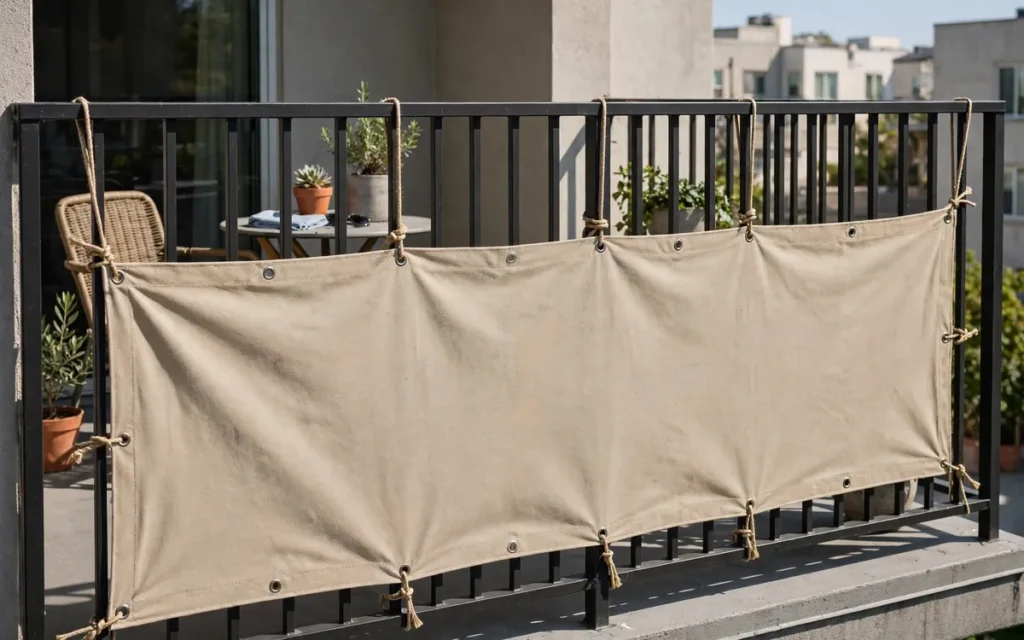
The canvas shield is the full stop at the end of the railing line: a strip of purpose-made privacy fabric strapped flat across the inside of the rails, with grommets along every edge. The fabric that matters is knitted HDPE. Coolaroo’s fabric buying guide explains how makers rate these lines by UV block, from 30% up to 95% — and the dense screening and sun-protection lines at the top of that range, around 90%, are the ones that hide a seated figure rather than merely shade it. Knitted, not woven, is the detail to check: the open knit lets air move through, so the shield screens without behaving like a sail. Standard mesh screens sell 3 feet high by 10 or 15 feet long; on a 42-inch rail, that leaves a little height above the top rail, which is strapped down, not stretched. A tie at every grommet, top and bottom, is what keeps it flat and quiet.
2. Wrap the Railing in Bamboo Reed Fencing
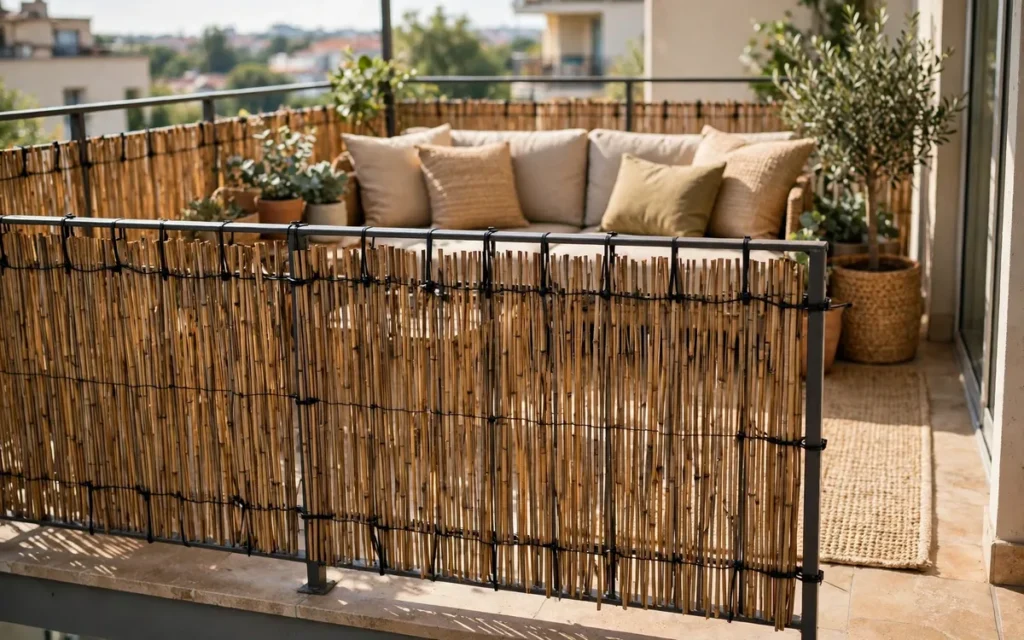
If your balcony has wrought iron or open metal railings, you’re essentially on display to anyone walking or driving by — and reed fencing is the warm, textured answer, as well as one of the most affordable. Rolls of bamboo or willow screening sell 4 or 6 feet tall and 8 to 16 feet long. Buy to the seated line, not to the sky: the 4-foot roll, cut so its top sits near the 48-inch mark, does the whole job on a standard rail, and the offcut can line a planter or cover a side return. Unroll it along the inside of the railing and fix it with zip ties every 12 inches or so along the top and bottom rails, snug rather than drum-tight. The honest limit is lifespan: natural reed and willow go brittle after roughly two to four seasons outdoors, so price it as a screen you renew, not one you inherit.
3. Stretch Faux Ivy Across the Railing
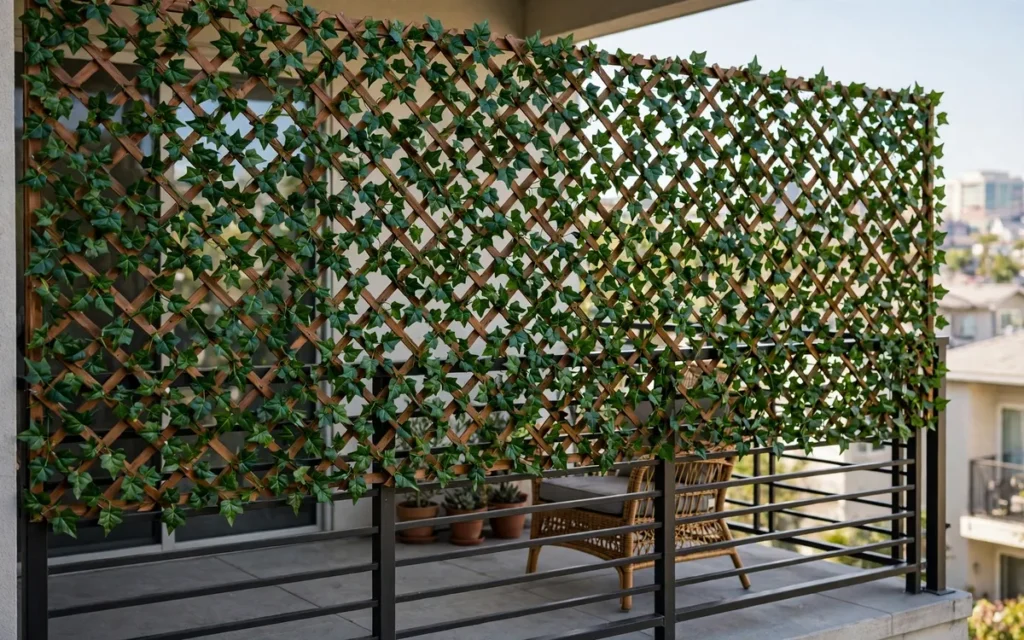
Faux ivy screens are a staple for apartment balconies because they’re lightweight, affordable and up in minutes: an expandable wooden or plastic lattice panel covered in artificial leaves, stretched across the railing and tied at the corners and mid-points. The density is instant — no growing season, no watering — but read the fine print before it goes outdoors. Only panels rated UV-stable belong on a sunny rail; unrated leaves grey and thin within a season, which is the fading question from the FAQs arriving early. And coverage beats uniformity: two layers crossed over each other at the worst stretch of the sightline, where the opposite window lines up with your chair, screen better than one perfect layer spread thin along the whole rail.
4. Build a Wall of Tall Potted Plants

Plants are nature’s privacy screens, and a row of tall planters along the railing edge is the softest way to close this line — provided the plants are honestly tall enough. To screen a seated person, the foliage has to reach 4 to 5 feet in the pot, with the leaves overlapping; a row of knee-high pots is a garden, not a screen. Clumping bamboo is the classic filler: the Fargesia types reach roughly 3 to 5 feet in containers and grow a foot or three a year, in pots at least 12 inches deep, spaced 3 to 5 feet apart. It must be a clumping type, never a running bamboo, whose roots treat a planter as a starting point. The planters stand on the floor against the building side, spread along the rail rather than bunched — wet soil is heavy, and Step 3’s weight rule applies. No light, or no green thumb? High-quality artificial plants are the zero-maintenance fallback — a look, honestly, not a plant, and chosen UV-rated for the same reason as the ivy.
5. Line Up Tall Ornamental Grasses
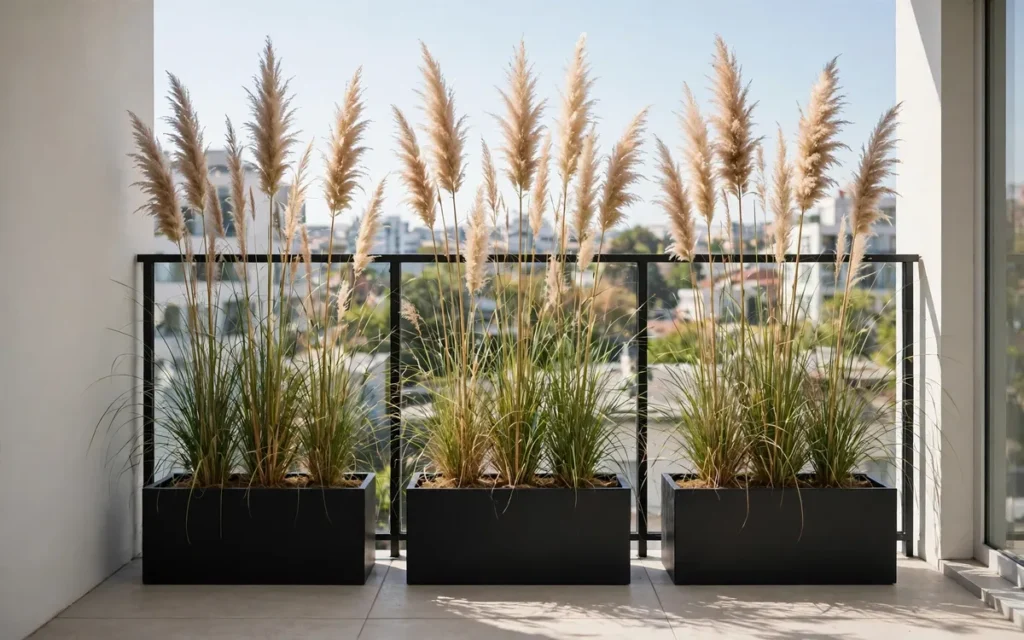
For a contemporary, high-end look, swap bushy traditional plants for tall, structured grasses in sleek black planters. Feather reed grass is the named workhorse — the ‘Karl Foerster’ cultivar reaches 4 to 5 feet in bloom and about 2 feet wide, in full sun and a large pot — which puts its plumes exactly across the seated sightline while the stems below stay open and airy. That movement is the point: a grass screen sways and rustles, screens the seated line, and never reads as a wall. Zebra grass stripes well in bright light; pampas is the bigger, heavier commitment — taller, wider, and a planter you will not enjoy moving. Choose the species by your balcony’s light, not by the photograph: a sun-lover thins in constant shade, and a shade-lover scorches on a south-facing rail.
Zone B — Block the Side Line
The side line runs along the shared divider — the neighbor’s window, their chair, their standing figure at their own rail. This is the one line where standing-height screens earn their keep, because the person you’re screening from is usually standing too.
6. Pull a Retractable Awning Across the Side
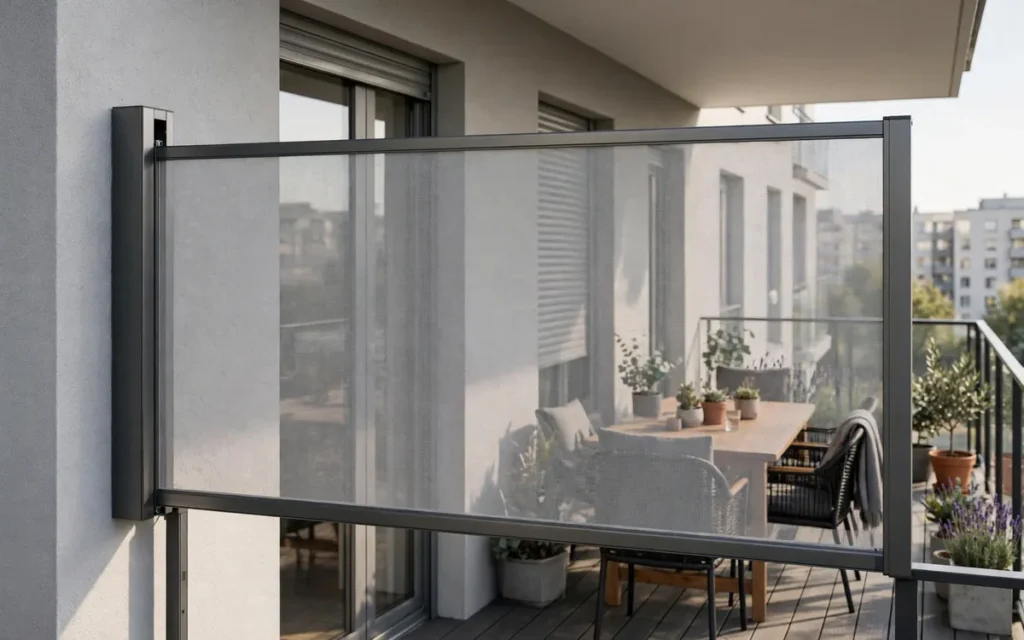
A retractable side awning is a roller shade turned sideways: a metal housing at one end, and a fabric screen that pulls out across the side of the balcony and hooks to a post at the other. The standard unit in this class stands about 71 inches tall — near enough 6 feet — and pulls about 9.8 feet, roughly 3 meters. That is standing-height cover exactly where standing neighbors are, drawn in seconds and gone just as fast when you want the open side back. Freestanding and tension-mounted versions keep the whole thing lease-safe. The wind rule is built into the design: the housing only carries the load once the screen is retracted, so the habit is simple — screen out while you’re seated, screen away when the weather turns.
7. Fold Out a Freestanding Divider
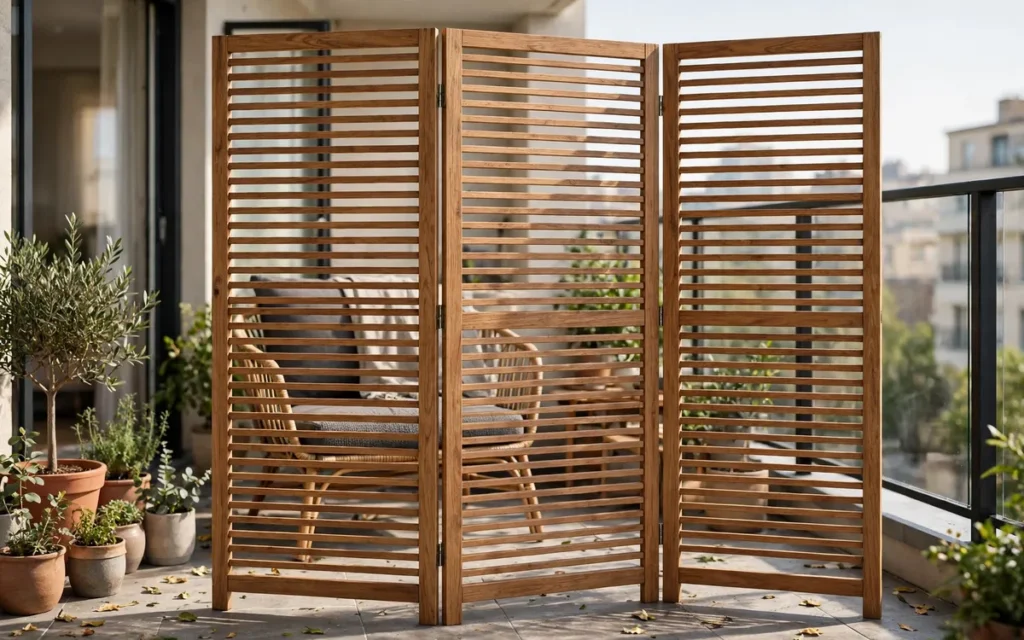
Sometimes you only need privacy in one specific spot — the chair that lines up with the neighbor’s living room window. A freestanding outdoor divider screens exactly that spot and nothing else, which is Step 1’s discipline in furniture form. The outdoor product class runs about 6 feet high by 4 feet wide, in slatted wood, woven resin or metal. The fitting that matters is at the floor: weight at the base. A light indoor divider tips in the first gust; an outdoor one is ballasted, or stands on wide feet. It folds flat to come inside during storms, and to leave with you at the end of the lease — completely drill-free, which is exactly why landlords tolerate them.
8. Lean a Slatted Pallet Wall
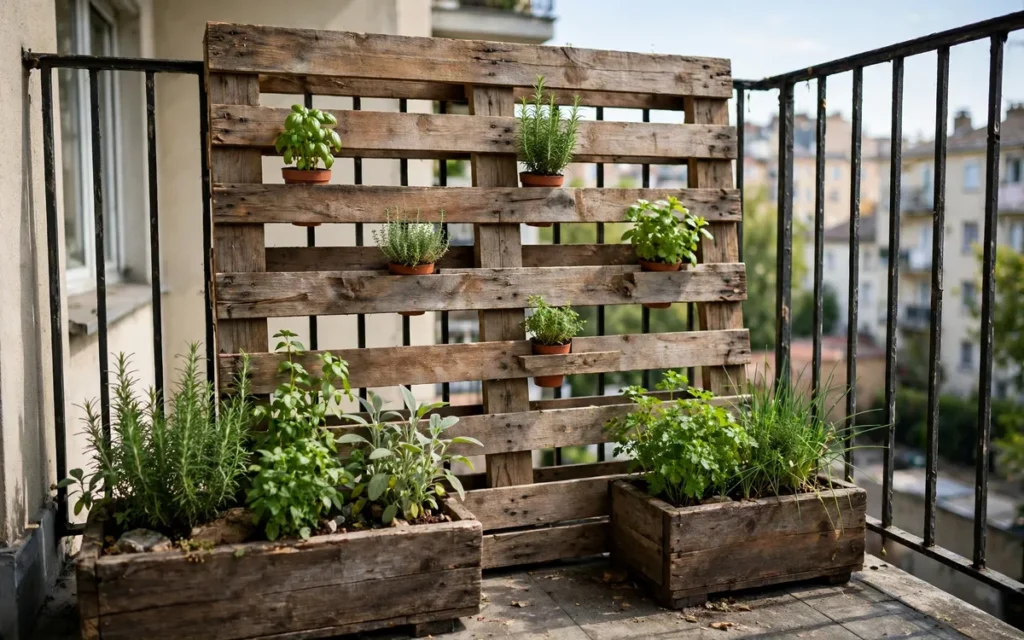
A cleaned, sanded and stained pallet — or a slatted panel built the same way — leans against the shared wall or railing as a rustic screen with one structural virtue: the slats pass air. On an exposed, windy balcony that permeability is what keeps a screen standing, and it’s the fix for mistake 2 below. Nothing is screwed to the building; the ballast is the fitting — heavy planter boxes or the weight of the balcony furniture itself at the base, holding the lean in place. And the slat gaps are a dial, not a compromise: set them tight at seated eye height, where the line actually runs, and looser above it, where they can let the light through. The slats will even carry small pots of herbs, hung on the inside face where their weight helps rather than hangs.
9. Grow a Trellis Wall of Vines

A freestanding trellis paired with climbing vines builds a living wall on the side line. The tidy version is a planter box with the trellis built into its back — the screen stands exactly where the roots are, and the planter’s weight is the ballast. Plant fast-growing climbers at the base — jasmine, clematis, morning glories — and be honest about the calendar: the vines weave the grid closed over a season, not a weekend. If the side line is bad right now, weave artificial vines through the trellis for the first season — the original version of this article’s own trick — and let the real ones take over behind them. Set the trellis top by the line it answers: around 48 inches is plenty opposite a seated neighbor; go taller only where they stand.
Zone C — Block the View From Above
The from-above line is the one new renters miss: the balconies above look down into your seating at an angle no front screen can reach. This line is closed at the top edge of the balcony, not at the railing.
10. Hang Weatherproof Outdoor Curtains

Outdoor curtains instantly give a standard apartment patio the secluded feel of a resort cabana, and hung at the balcony’s front edge they close the downward view as well as the straight one — a drawn curtain stands in the diagonal line of sight from the floors above, not just in the line from across the street. Panels come in the 84-inch class, long enough to run from the top edge down past the rail. For renters the fitting is an outdoor-rated tension rod wedged between the balcony’s side walls or pillars: heavy-duty rods realistically span up to about 10 feet, and a rod cannot cross an open front, so curtains belong to balconies that have those two solid surfaces. Choose weather-resistant, mildew-proof fabric in a neutral cream or soft gray, tie the panels back when you want the sunshine in, and draw them when the floors above are occupied.
11. Drop Outdoor Roller Shades From the Top
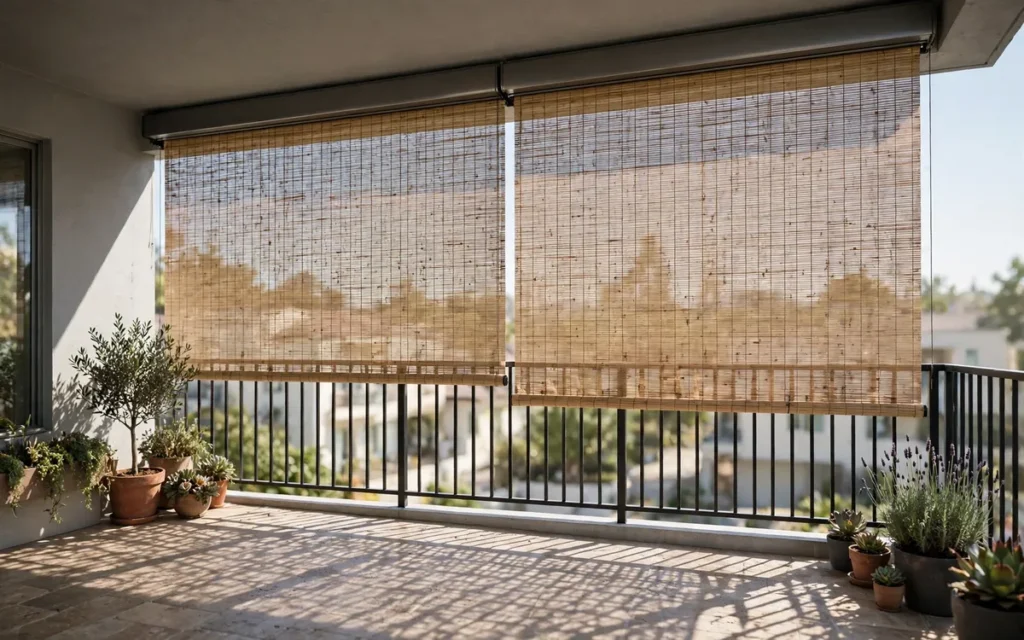
Roller shades mount where the from-above line enters: at the ceiling or overhang edge of the balcony, so the lowered shade angles the downward view shut before it reaches your chair. Bamboo or weather-resistant fabric, rolled down for a private dinner or morning yoga, rolled up again for the view — and bamboo in particular casts beautiful, relaxing shadows across the patio as the sun sets. The fitting caution is the hooks. Heavy-duty exterior adhesive hooks can carry a light shade, but the large outdoor class is rated to about 5 pounds per hook, and adhesive softens in summer heat — where a mechanical fixing exists, a clamp or a tension rod, it beats glue every time. Choose the material by the line you’re closing: bamboo filters, fabric blocks.
12. Trail a Hanging Garden From the Top Rail
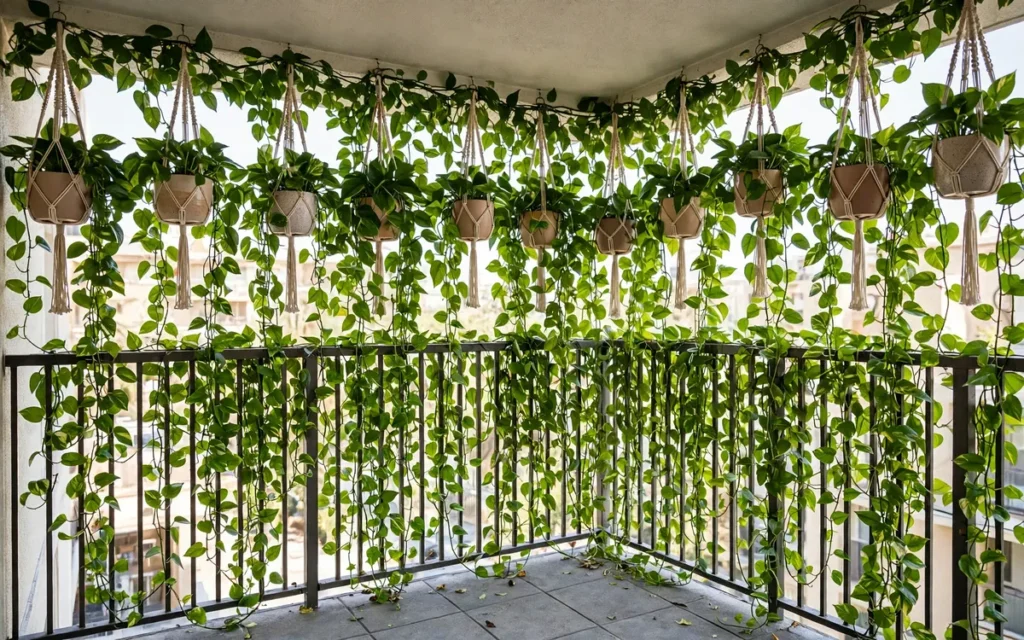
If your privacy issue comes from the neighbors above you, focus on the top half of the balcony. A row of hanging planters along the ceiling edge or top railing creates a cascading curtain of greenery: trailing plants like English ivy, pothos or string of pearls drape downward as they grow, and the moving leaves make it genuinely difficult for anyone looking down to see clearly into your seating area. Keep these planters light and their hooks and clamps well within what they’re rated for — the heavy soil in this article always stays in floor planters. And the honest limit, stated plainly: a living curtain filters and disrupts the downward view; it does not black it out. Where the line from above is direct, pair the garden with the roller shades of idea 11 and let each do half the work.
Zone D — Filter It, Layer It, Glow
Not every line needs a wall. Sometimes the neighbor is a presence rather than a stare, the light is worth more than the last degree of cover, or the problem only exists after dark. This zone filters, layers and glows instead of blocking.
13. Hang Macrame Privacy Panels
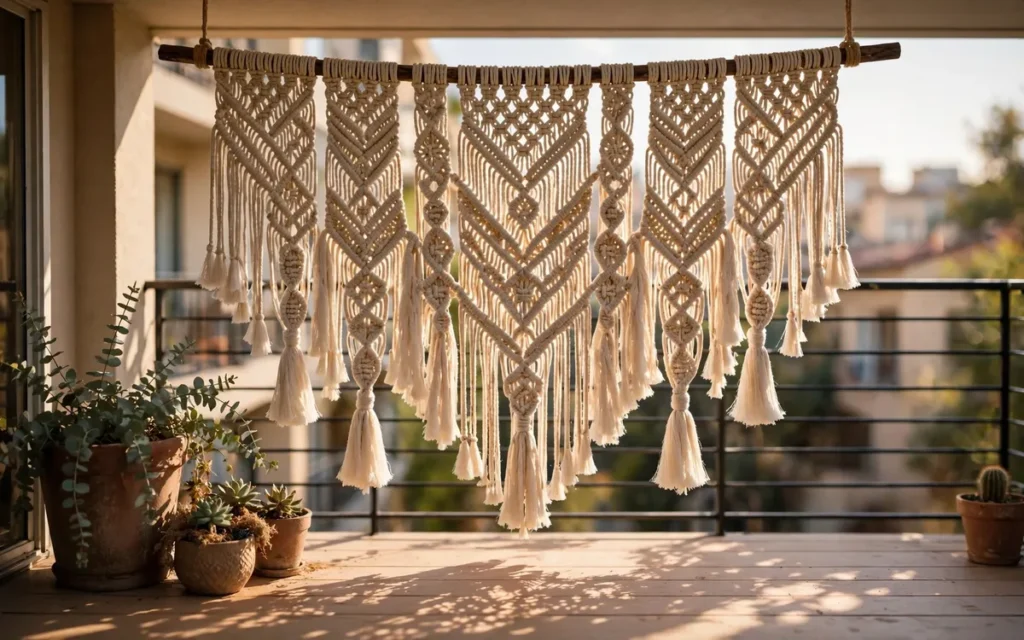
If you love a bohemian look, macrame panels are the filter class of privacy: intricate knots and thick cotton rope that won’t block 100% of the view, but break it up so thoroughly that a strong sense of seclusion remains — with the evening breeze and the harsh afternoon light softened as they pass through. That makes them the right screen for the side line where the neighbor is company, not surveillance. The fitting is a laundry habit, and it’s the original article’s own caution: natural cotton dries slowly and can develop mildew if it’s left out through heavy rain, so panels come inside to dry and live indoors between spells of good weather — or choose a synthetic-cord panel that doesn’t care. Hung from the top rail or a tension rod, they weigh almost nothing, which keeps them in the lightest fixing class in this article.
14. Line Up Leaning Ladder Planters

A leaning ladder planter is a tiered wooden structure that rests against the wall — and while one ladder won’t provide much privacy on its own, placing two or three side by side creates a vertical garden that doubles as a privacy screen. The construction is its own ballast: the ladder leans, and the heavy pots on its shelves weigh the lean down, so absolutely no drilling is required and the whole thing packs up easily when your lease ends. Arrange the shelves by the height rule from Step 2: dense, bushy potted plants at seated eye height, where the line actually runs; trailing vines on the top shelf to soften the edge; a decorative lantern or two where a plant isn’t needed. It’s the planter version of fitting the height — cover at the eyes, air above.
15. Layer Sheer Fabric Behind String Lights
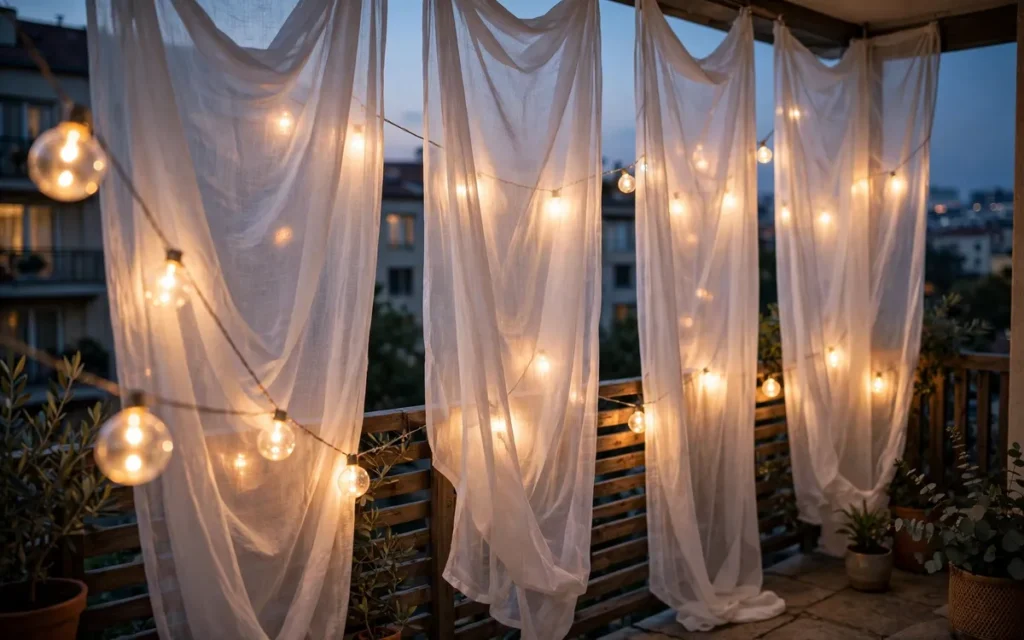
If you mostly use your patio in the evenings, privacy changes its physics. Hang sheer, lightweight outdoor fabric across a tension rod and weave outdoor globe string lights in front of and behind it. During the day, the sheer fabric softens the view in both directions. At night it works by the backlight principle from mistake 5 — the same effect that turns you into a silhouette — run in your favor: the bright lights against the fabric make it nearly impossible for anyone outside to see past the glare, and you stay completely hidden in the cozy glow. Keep both layers outdoor-rated, and keep the fabric clear of hot bulbs: drape it beside and behind the string, never resting on it.
What It Costs: Three Ways In
The fabric tier (roughly under $50). A mesh railing shield, a reed or willow roll, or a faux ivy panel, plus a packet of UV-stable zip ties. This tier closes the railing line — the most common bad line — in an afternoon, and everything in it comes off with scissors at the end of the lease.
The fitted tier (roughly $50–$150). Curtains and a tension rod, outdoor roller shades, or the planters and plants for a living screen. This is where most renters land: the from-above line closed, a soft green layer growing along the rail, and every fixing still drill-free.
The structure tier (roughly $150 and up). A retractable side awning, freestanding dividers, trellis planters — the standing-height, side-line hardware. Worth it where the shared divider is the bad line and the lease has years left to run. All three tiers are rough planning classes, not quotations.
5 Mistakes That Undo a Good Screen
Every screen in the zones above can be undone by one of these — and most of them began life as the original article’s “things to consider”, promoted to where they belong. None of them needs a purchase to fix; most need a removal or a rethink.
Screening Every Side
Step 1 exists because of this mistake. A balcony wrapped on all three sides is dark, tight and loaded with wind area, and most of that fabric is screening lines nobody looks along. Screen the line you found from your chair — one, occasionally two — and leave the rest open to the light and the breeze. Privacy is a line problem, not a compass problem.
Putting a Solid Screen on a Windy High Floor
Wind is the balcony force nobody budgets for. A solid barrier — heavy canvas pulled drum-tight, a big divider left standing in a gale — acts like a sail, and on a high floor the gusts arrive with nothing to slow them down. Permeable screens survive exposed balconies: knitted mesh, slats, trellis grids and reed let the air through and stand a chance. Natural reed and willow have their own clock — they go brittle after roughly two to four seasons — but a permeable screen that ages beats a solid one that sails.
Putting the Weight Where It Doesn’t Belong
Soil is the heaviest thing in this article. Wet potting soil runs roughly 40 to 60 pounds per cubic foot — an extension-source range — so a 36-inch planter can hold somewhere around 80 to 150 pounds once it has been watered. That weight belongs on the floor, against the building side, spread along the balcony rather than bunched in one corner — and never hung on the railing, which was built as a guard, not a shelf. Your building sets whatever load limit applies to your balcony; the honest move is to ask management rather than guess at a number from the internet.
Expecting Plants to Screen Alone in One Season
A potted garden rarely closes a sightline in its first season: the climbers are still climbing, the bamboo is still filling out, and the gaps sit exactly at eye height. Plants are the soft layer of a privacy system, not the whole of it — pair the planter row with a fabric or reed screen on the same line, and let the green take over the job gradually. Clumping bamboo in a pot reaches roughly 3 to 5 feet, which is seated-screen height; it just doesn’t arrive there in the first month.
Forgetting the Night
Every screen in this article was fitted by daylight, and privacy changes after dark. With your indoor lights on, you become a lit figure behind the fabric — a silhouette that reads clearly from outside, especially above the screen’s top edge. The fix is light direction, not more fabric: keep your own lighting low and pointed outward, or down at the plants, and close the door blinds behind you. Or take idea 15’s route and make the glare work for you instead.
FAQs
What is the cheapest way to block my neighbors’ view of my patio?
The fabric tier: faux ivy privacy screens, bamboo reed fencing rolls, or a mesh fabric shield. All of them are relatively cheap online or at hardware stores, and all attach to the existing railing with inexpensive zip ties. It is also the tier that removes cleanest when the lease ends.
How can I get privacy on my balcony without blocking the light?
Choose the filters from Zone D and the permeable screens: loosely spaced slatted wood, macrame panels, light-colored sheer outdoor curtains, and grasses that screen at eye height and sway above it. They blur the view from the outside while sunlight still filters through. The trade is deliberate — some cover given up, the light kept.
Can my landlord force me to take down my balcony privacy screen?
Yes — if the screen violates the terms of your lease, alters the exterior aesthetic in a way the Homeowners Association (HOA) forbids, or poses a safety hazard, such as a heavy item that could blow off a high-rise balcony. The protection is in the process from Step 3: temporary, damage-free installation methods, the building rules checked first, and the screen approved in writing before it goes up.
Do artificial plants fade on a sunny balcony?
Standard artificial plants will eventually fade and crack under direct, intense sunlight. If you’re using faux ivy or artificial boxwood panels for privacy, look specifically for products labeled “UV-resistant” or “UV-treated” — they’re manufactured to withstand the outdoor elements and hold their color much longer. The same label is the one to check on faux vines woven into a trellis.
How high should a balcony privacy screen be?
Work from the seat, not the skyline. Seated, your eyes sit roughly 44 to 48 inches off the floor, and apartment guard rails stand 36 or 42 inches — so a screen whose top edge reaches about 48 inches hides a seated person completely, coffee and all. Standing height is a bigger, heavier class, screens around 6 feet, and it’s only worth buying for the side line, where the neighbors are standing too.
How do I get privacy on my balcony at night?
Expect the silhouette effect: indoor light turns you into a readable figure above and behind the screen. Keep your own lamps low and pointed outward or down at the plants, close the door blinds behind you — and if the evening is your main patio time, use idea 15’s trick: sheer fabric lit by string lights glares outward and hides the person sitting behind it.
How do I keep a privacy screen from blowing away?
Choose permeable over solid: knitted mesh, slats and reed pass air that a solid sheet catches. Tie at every eyelet or fixing point, snug rather than drum-tight, so the load is shared instead of concentrated. Stand freestanding pieces on real weight at the base. And fold, retract or bring in anything designed to move before a storm arrives, not after.
A patio screen is usually arranged; a fence line can be planted instead. If you own the fence, the same privacy can grow in place — evergreens sized by the sightline they must block and spaced by the half-width rule, so the screen arrives at full size without crowding itself out. Our landscaping along fence ideas show how that planted screen is measured and layered, for readers ready to trade panels and pots for something permanent.
Some of the planters in this guide can do more than screen a sightline — they can also grow food. Our raised garden bed ideas show how to choose a bed height and reach that suit a small patio, so a privacy planting can double as a kitchen garden.
Once the screening is sorted, the next step is making the space feel like a room of its own. Our small balcony decor ideas show how to layer seating, lighting and planting on a small balcony, so a private patio becomes a place you actually want to spend time in.
Once the screen is up, the evenings are what make the patio feel finished. Our outdoor string light ideas show how to measure spans, choose warm bulbs and hang lights safely, so a private patio glows softly without dazzling the neighbours.
Privacy also makes a patio a calmer place for wildlife, especially in the morning. Our DIY bird bath ideas show how to make a shallow, stable bath from simple materials, so birds visit a screened patio without needing a large garden.
The private outdoor room this article fits is the room a movie night seats, and its screen wall is chosen by the darkness discipline in our backyard movie night ideas. Privacy screens and planting that block the neighbours’ view also block the stray light that washes a picture out. Fit the room for both and the same small patio becomes a proper open-air cinema.
The private, shaded patio this article fits is the room an outdoor kitchen is measured into, and its cooking run is fitted in our Texas outdoor kitchen ideas. Shade, screening and a clear work aisle matter as much beside a grill as they do beside a lounger. Measure the kitchen into the private room first and the cooking stays as comfortable as the sitting.
Conclusion
Transforming an exposed apartment balcony into a private, cozy retreat doesn’t have to involve structural changes or broken lease agreements. Find the sightline, fit the height, fasten it lease-safe — and these apartment patio privacy ideas stop being a shopping list and become a system: fabric for the railing line, height for the side line, a closed top edge for the floors above. Pick the idea that matches your bad line first, secure it safely, and get ready to enjoy your morning coffee in total peace.
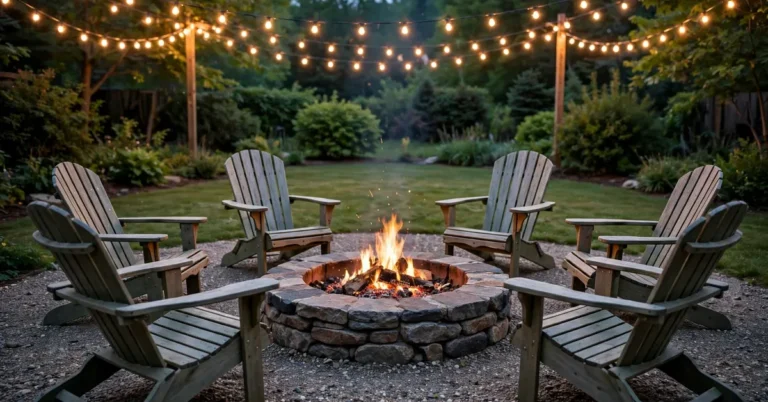
Privacy makes a small patio usable; a fire is what makes it the spot everyone chooses. Once the neighbors are screened out, a small fire pit placed by the clearance and seating numbers — a 36 to 44 inch pit, a 7 to 8 foot circle of chairs, and at least 10 feet of clearance — turns that private corner into an evening room, and our measured guide to outdoor fire pit ideas works through the placement, sizing and seating in full.
Whether you choose the lush, vibrant look of a faux ivy wall, the resort-style elegance of outdoor curtains, or the modern simplicity of tall ornamental grasses, the right privacy screen will make your patio feel like a real extension of your home. And if you want to carry that cozy outdoor feeling into autumn, start with these fall porch decor ideas.


10 Comments