
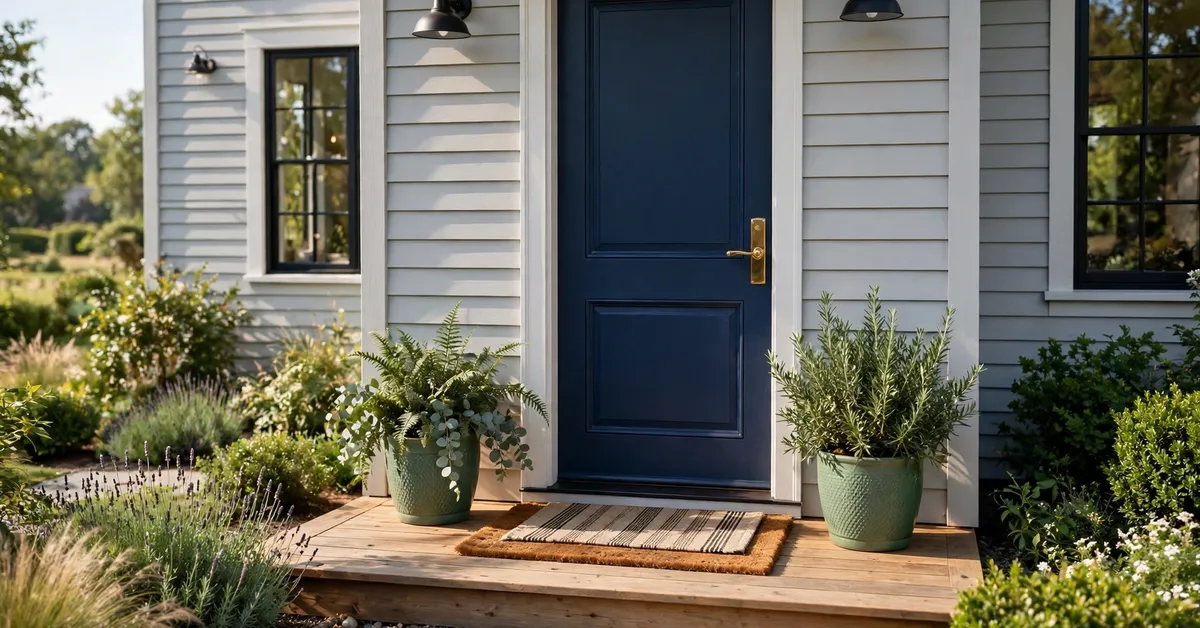
21 Charming Front Door Decor Ideas for Instant Curb Appeal
The front door is the handshake of the whole house, and most doors are shaking hands in clothes a size too small. An 18 inch wreath floats on a 36 inch door, an apartment-sized mat sits lost in front of it, the house numbers are too small to read from the pavement, and the porch light belongs on a cupboard. These front door decor ideas fix the proportions first and the prettiness second, because on a door, the two are the same thing: everything sized to the door itself, in the right order.
Be honest about the door’s day job while you style it. A front door swings a hundred times a week, takes parcels, sheds rain, and gets shouldered by people carrying shopping. Decor that crowds the swing, creeps onto the step, or stacks so high the door scrapes it will be quietly removed by real life, usually within the month. So this article keeps the swing arc and the step completely clear, sizes every piece from the door’s own measurements, and saves the styling for the frame around the work.
This is also the outside of a door this site already knows from within. The inside of the same door, with its console table and key tray, has its own measured system in our guide to entryway table decor ideas. The porch around the door belongs to the porch articles. This one owns the door itself: the slab, what hangs on it, what frames it, and what lies at its feet.
The Method: Measure It, Frame It, Layer It
Every reliable list of front door decor ideas is secretly the same three moves, done in the same order. Measure everything against the door first, so the proportions are right before a single thing is bought. Frame the door second, with colour on the slab and green structure at its sides. Layer the welcome last, mats, hanging pieces and details, in sizes the measurements already decided. Here is the system, move by move.
Step 1: Measure It — Size Everything to the Door
A standard front door is 36 inches wide and 80 inches tall, and every proportion in this article derives from those two numbers. The wreath is the door’s width minus 8 to 12 inches: 24 to 28 inches across, hung with its centre at eye level, 57 to 60 inches from the floor. The doormat spans at least 80 percent of the door’s width, so 29 to 30 inches or more. House numbers stand 4 inches tall at minimum, 6 inches on homes set well back from the street. And the porch light is a quarter to a third of the door’s height, 20 to 27 inches, centred about 65 to 72 inches up. Measure your own door before buying anything; a 32 inch or a double door changes every number, and the ideas below say how.
Step 2: Frame It — Colour on the Slab, Green at the Sides
With the sizes settled, give the door its frame. Colour comes first: paint the slab a colour pulled from the house’s own fixed materials, the brick, the siding, the roof, so it belongs to the building instead of arguing with it. Green structure comes second: a matched pair of planters whose planted height reaches about a third to a half of the door frame’s height, set an equal distance out on each side. And the metal comes third: handle, knocker, numbers and light brought into one finish family, so the small bright pieces read as a set. Frame first, and the layers that follow have something to sit inside.
Step 3: Layer It — The Welcome, in the Decided Sizes
Last, layer the welcome onto the frame. The ground layer is a mat stack: a 3 by 5 foot flatweave base rug with a 2 by 3 foot coir mat on top, wide enough for the door and thin enough for its swing. The hanging layer is one wreath or basket, at the measured size and height, never two competing pieces. The detail layer is the readable numbers and the right-sized light. And the finishing layer is a single seasonal swap, a bow, a filler, a top mat, that refreshes the same frame a few times a year instead of redoing it. Layers in the sizes the first step decided: that is the whole method.
Use the ideas below by zone, not all at once. Paint and planters change the door more than everything else combined, so start there if the door is bare. If the door is dressed but still looks off, check the sizes before you check the style: a too-small wreath or mat is the usual culprit, and it is cheaper to fix than a repaint. Renters and porch-less doors are not an afterthought here; zone six is written for entries with no floor to style at all.
The Door Itself: Colour and Finish
1. Paint the Door a Colour Pulled From the House
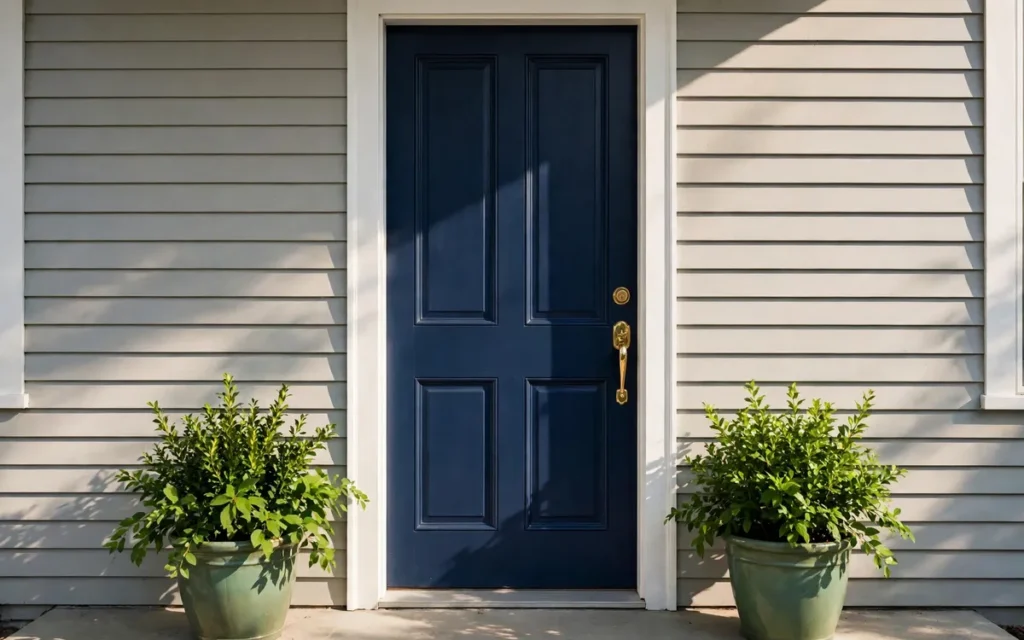
The single biggest change on this list costs one tin of paint. Choose the colour from the home’s fixed materials, the undertones in the brick, the siding, the roof, rather than from a trend photograph of a different house. Test a large swatch on the door itself and judge it in morning light and again in the evening before painting the whole slab, because a colour that sings at noon can sulk at dusk.
2. Use a Satin or Semi-Gloss Sheen That Wipes Clean
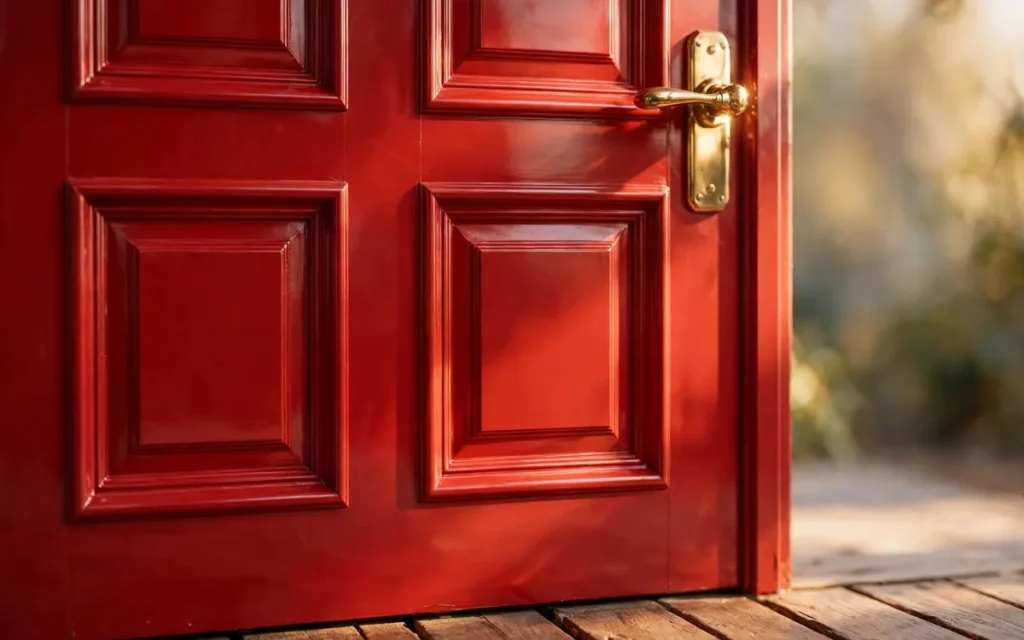
Sheen is decor too. A satin or semi-gloss exterior enamel shows the colour’s real depth and shrugs off the scuffs, fingerprints and kicked-up grit a front door collects, where flat paint records every knock. Prepare honestly: sand, clean, and prime over bare wood or glossy old paint, then lay two thin coats instead of one thick one. The finish line you see from the street is built in the boring steps.
3. Refresh the Trim Around the Door, Not Just the Slab
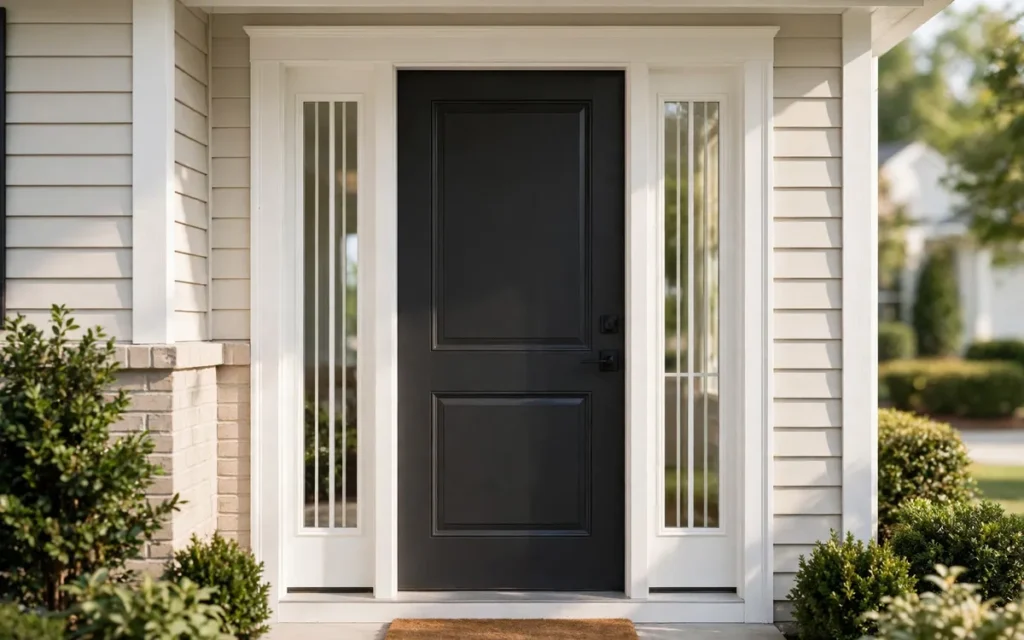
A painted door inside tired trim reads as a job half finished. Crisp contrasting trim makes the slab look deliberate; trim painted to match gives the modern single-colour look. Either way, keep the line sharp with painter’s tape and leave a clean reveal of about an eighth of an inch at the frame’s edge. From the pavement, the trim is the picture frame, and the door is only as smart as its frame.
The Hanging Layer: The Wreath, Sized and Hung Right
4. Size the Wreath to the Door, Not the Shop Shelf
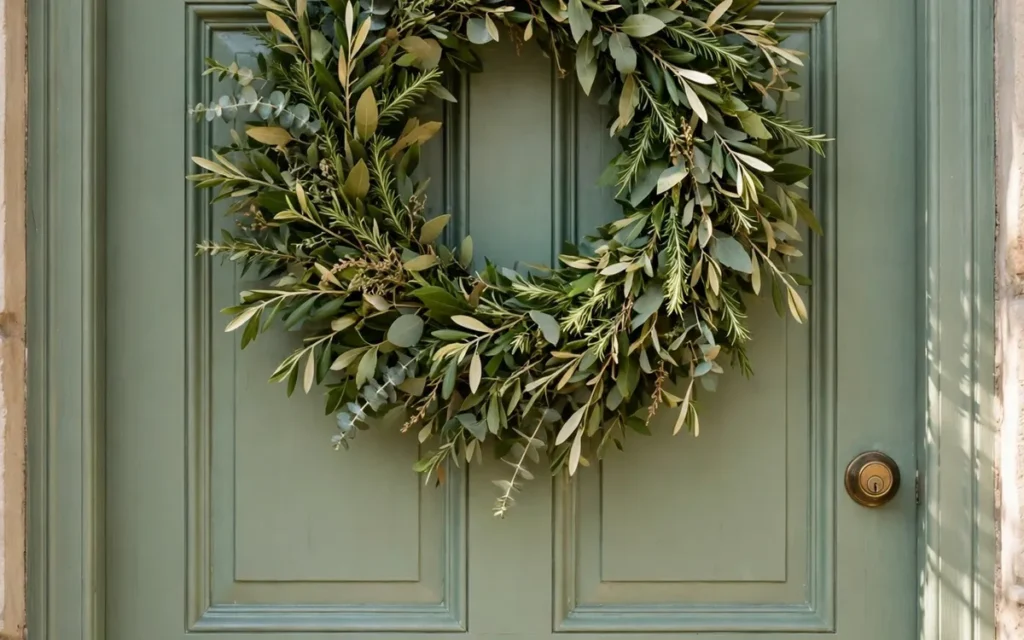
The too-small wreath is the most common front door mistake in the street. Work by the two-thirds rule: on a standard 36 inch door, choose a wreath 24 to 28 inches across, the door’s width minus 8 to 12 inches, leaving about 4 to 6 inches of door showing on each side. Measure across the full diameter, bows and picks included. A narrow 32 inch door takes 18 to 20 inches instead. This article hangs one evergreen wreath well; the seasonal wardrobe of wreaths lives in our guide to winter wreath ideas.
5. Hang It at Eye Level, on the Right Hanger
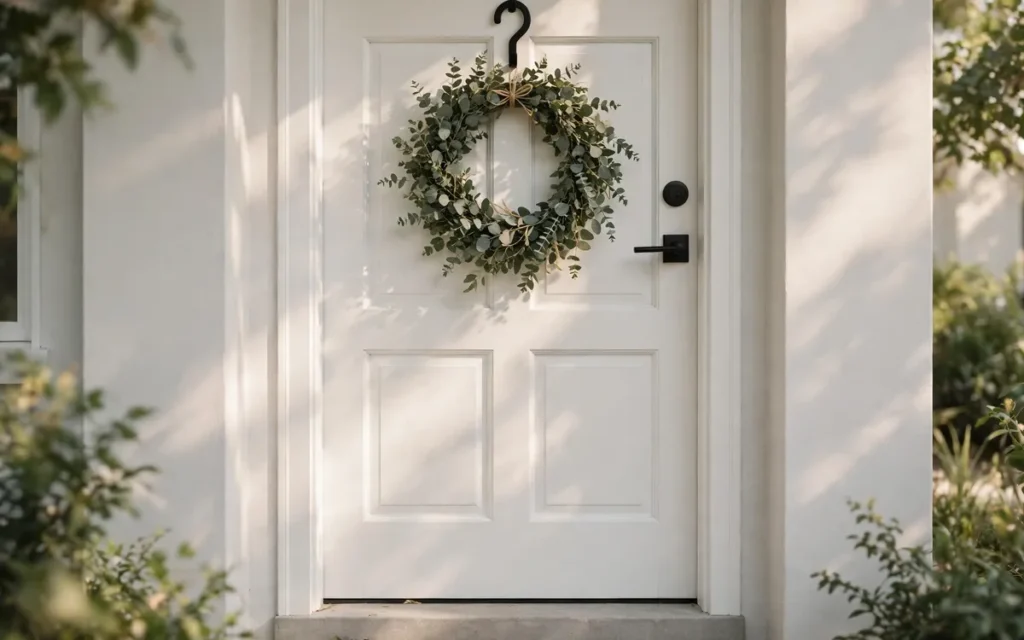
Height, not style, is what makes a wreath look placed instead of parked. Hang it with its centre at eye level, 57 to 60 inches from the floor, which is roughly 14 inches below the top of a standard 80 inch door, and keep about 2 inches clear of a knocker. Use an over-door hanger or a hook rated above the wreath’s weight. Never drive a nail through the door’s face for a seasonal piece; the hole outlives every wreath.
6. Swap the Wreath for a Door Basket When You Want Softer

A hanging basket is the wreath’s softer sibling: same hook, same measurements, a gathered look instead of a ring. Size it like a wreath, about two-thirds of the door’s width across its fullest point, and keep the fillers light, greenery and dried stems rather than heavy arrangements, so the hanger is never strained. It suits doors where a ring feels formal, and it changes its filling in minutes.
7. Dress Double Doors as a Pair
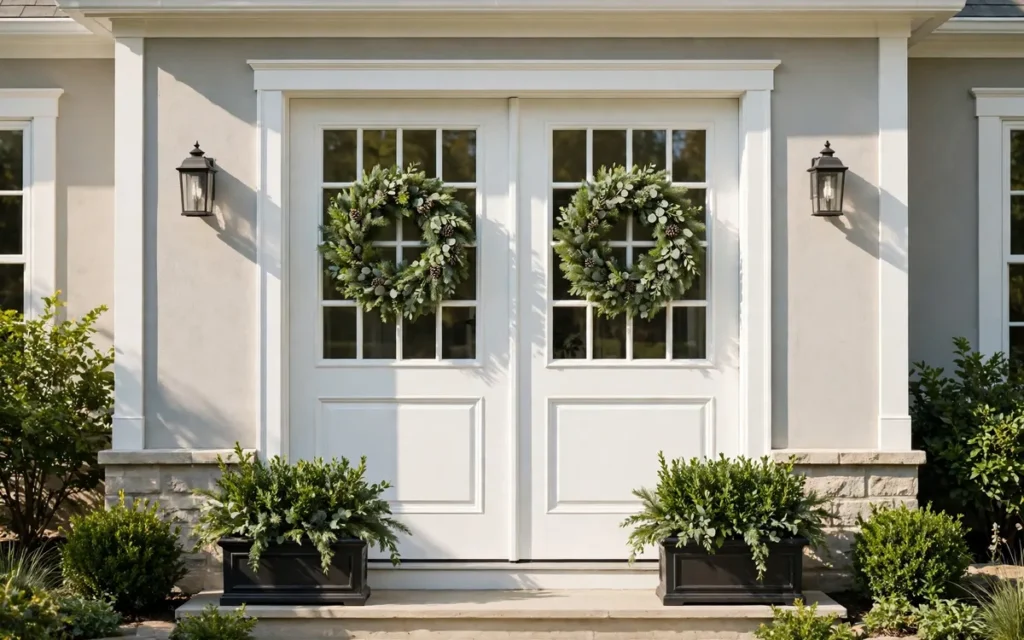
Double doors go lopsided the moment they are dressed singly. Hang two identical wreaths at identical heights, one centred on each door: 20 to 22 inches each is the working size. Measure both centres up from the floor, 57 to 60 inches, rather than down from each door’s top, so the pair matches even if the doors sit a fraction unevenly. Symmetry is the entire effect; protect it with a tape measure.
The Frame: Planters and Symmetry
8. Flank the Door With a Matched Pair of Planters
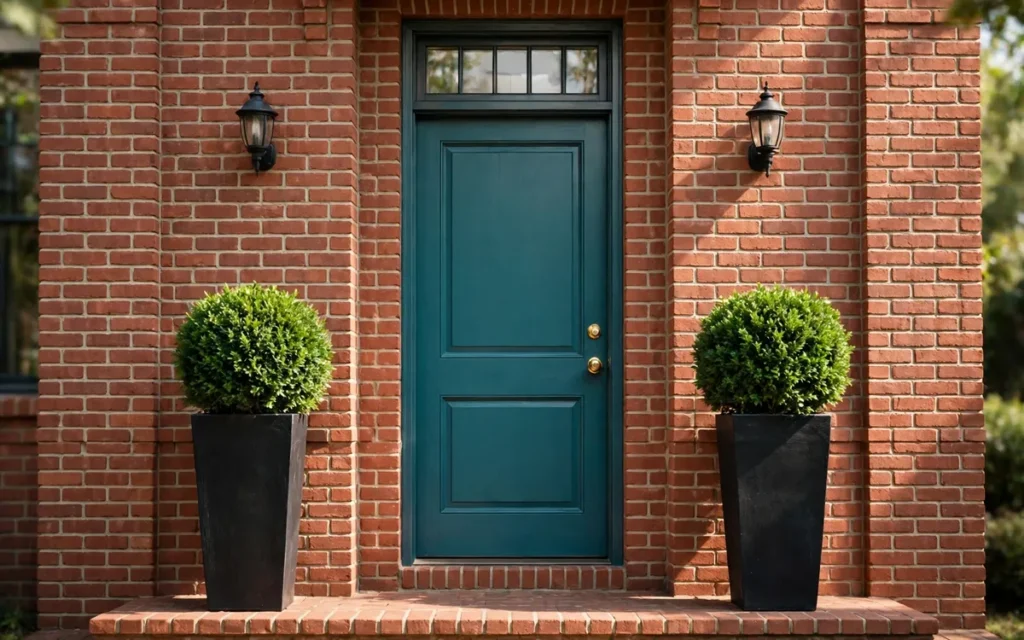
Symmetry is the frame the door hangs in, and one matched pair of planters does more than five odd pots ever will. Choose planters whose planted height, pot plus plant, reaches about a third to a half of the door frame’s height, and set them an equal distance out from each side of the frame. Measure the gap with your feet or a tape, not by eye; a pair two inches out of line reads as a mistake from the street.
9. Plant Structure First, Colour Second
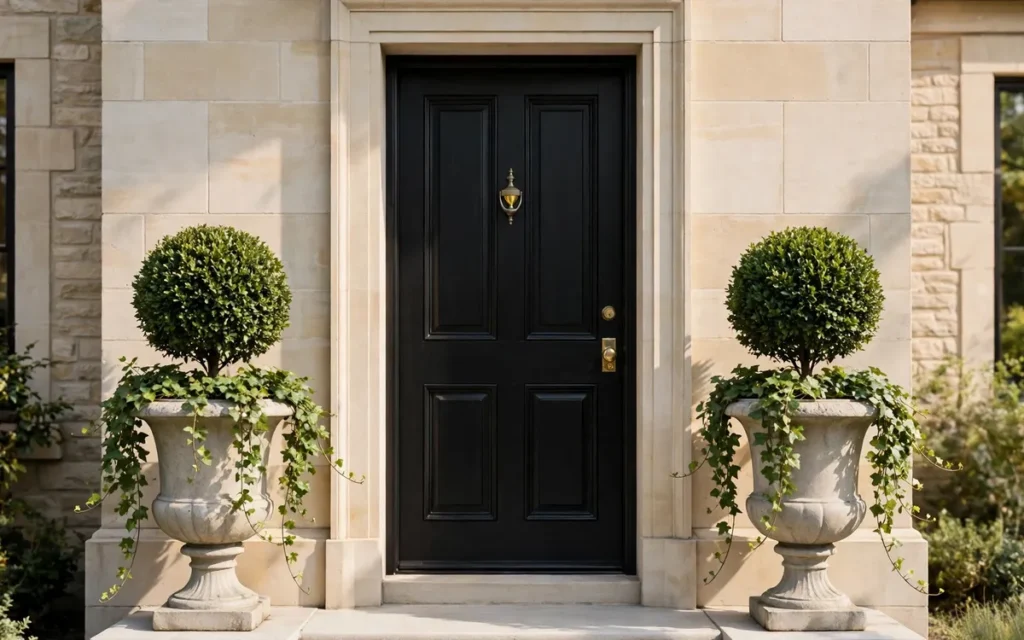
Clipped evergreen shapes hold the frame all year: boxwood-style balls or cones that look the same in January as in June. Seasonal flowers are only the changeable filling around them. Build each planter in layers, one structural evergreen, one trailing plant softening the edge, and seasonal colour tucked between the two. When the colour tires, the structure stays, and the planter never has an empty season.
10. Change the Planters With the Season, Not the Planters Themselves

The pots stay; only the filling swaps. Spring bulbs, summer annuals, autumn grasses and seed heads rotate through the same two containers, so the frame is never rebought and never re-measured. The working trick is to keep the plants in their nursery pots dropped inside the planters: the swap then takes minutes, with no replanting, no soil on the step, and the evergreen structure lifted out and back in one piece.
The Ground: Mats That Fit
11. Size the Mat to the Door, Not the Default
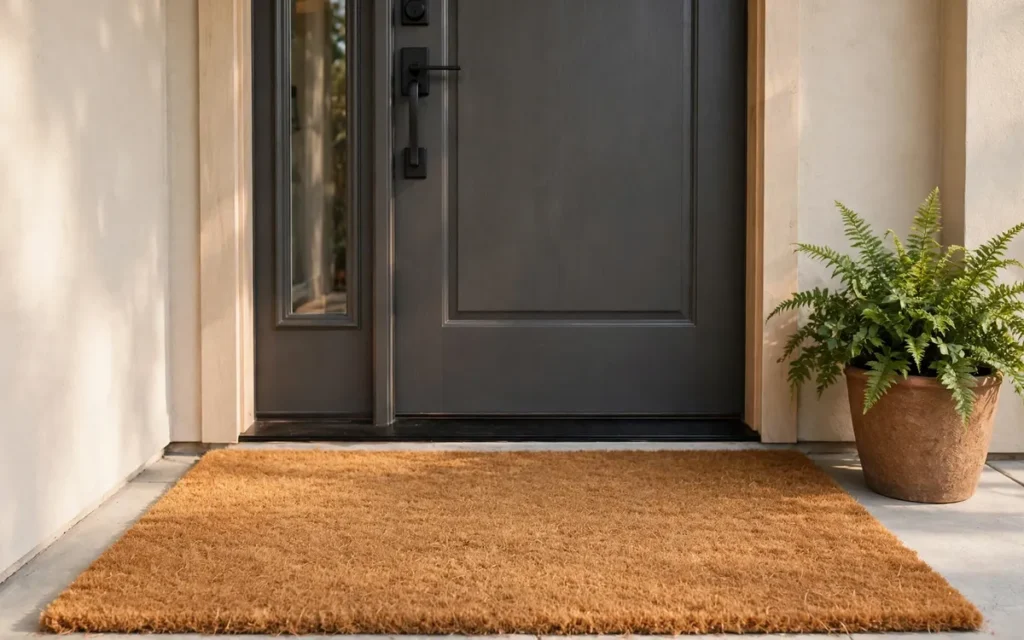
The standard 18 by 30 inch mat is made for apartment doors, and on a house door it reads as a postage stamp you wipe your feet on. The mat should span at least 80 percent of the door’s width: 29 to 30 inches or more across a 36 inch door, with 24 by 36 inches as the honest minimum size. Give the depth two full steps if the porch allows it, roughly 36 inches, so nobody balances on the mat’s edge in the rain.
12. Layer the Mat the Designer Way

The layered look is two sizes, not a style. A flatweave base rug, 3 by 5 feet, gives the border and the colour field; a coir top mat, 2 by 3 feet, sits centred on it and does the actual work of scraping shoes. Double doors break the pattern in one direction only: they take one wide top mat, about 60 inches, never two small ones side by side. Bigger base rugs belong to grand entries; on a standard door they swamp the step.
13. Keep the Stack Low Enough for the Door to Swing
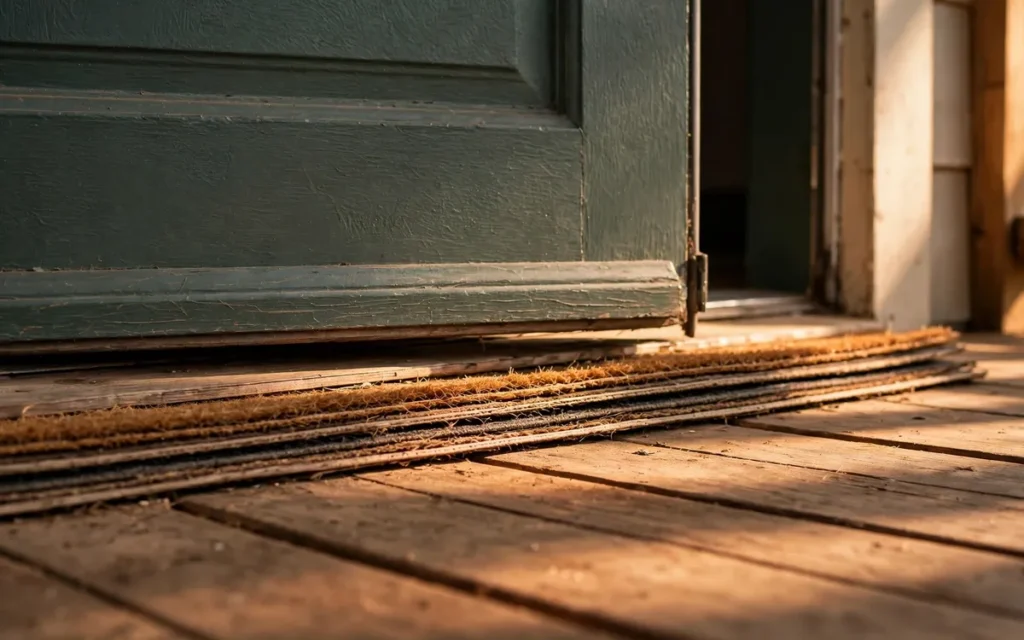
A beautiful mat that the door scrapes is a daily annoyance and a curling trip edge within the season. Before buying, check the stack’s total height against the clearance under the door’s bottom edge, and choose low-profile base rugs where the gap is tight. Brush the coir briskly once a week so grit never builds into a ridge, and the stack stays the height you bought rather than the height it grows to.
The Details: Numbers, Light and Hardware
14. Put Up House Numbers That Can Actually Be Read
House numbers are decor that the delivery driver and the ambulance both judge. Sized and lit, they finish the entry; tiny script numerals in wall-coloured brass fail everyone who needs them. Stand them 4 inches tall at minimum, 6 inches if the house sits 50 feet or more from the street, working on about an inch of digit height per 10 feet of viewing distance. Mount them at eye level, roughly 4 and a half to 5 and a half feet up, inside the porch light’s throw, in plain numerals that contrast hard with the wall behind them.
15. Size the Porch Light to the Door
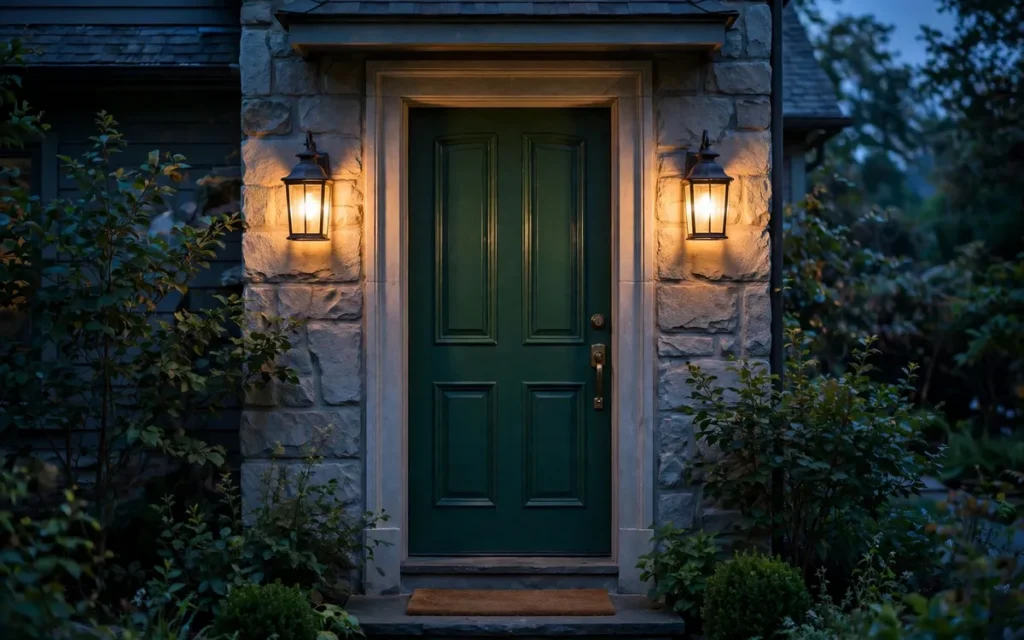
Most porch lights are too small and hung too high, chosen like cupboard fittings and then forgotten. Size the fixture to the door instead: a height of a quarter to a third of the door’s height, 20 to 27 inches on a standard door, with its centre about 65 to 72 inches from the ground. A flanking pair can run to the smaller end of the range; a single light earns the larger, set on the handle side where hands and keys need it. The sizing guidance at This Old House’s front entry lighting guide makes the same point from the trade side: the fixture should be a presence, not an apology.
16. Bring the Hardware Into One Finish Family

Handle, knocker, kick plate, house numbers and light fitting in one finish family reads as designed; three clashing metals read as accidental, however good each piece is alone. Choose the family from the door’s colour: warm brass against deep colours, matte black on light or modern doors are the reliable pairings. Then change the smallest pieces first, the numbers and the knocker before the lockset, and the entry coheres for the price of the little items.
Small and Porch-Less Entries
17. Choose a Slim Wreath Where a Storm Door Has to Close
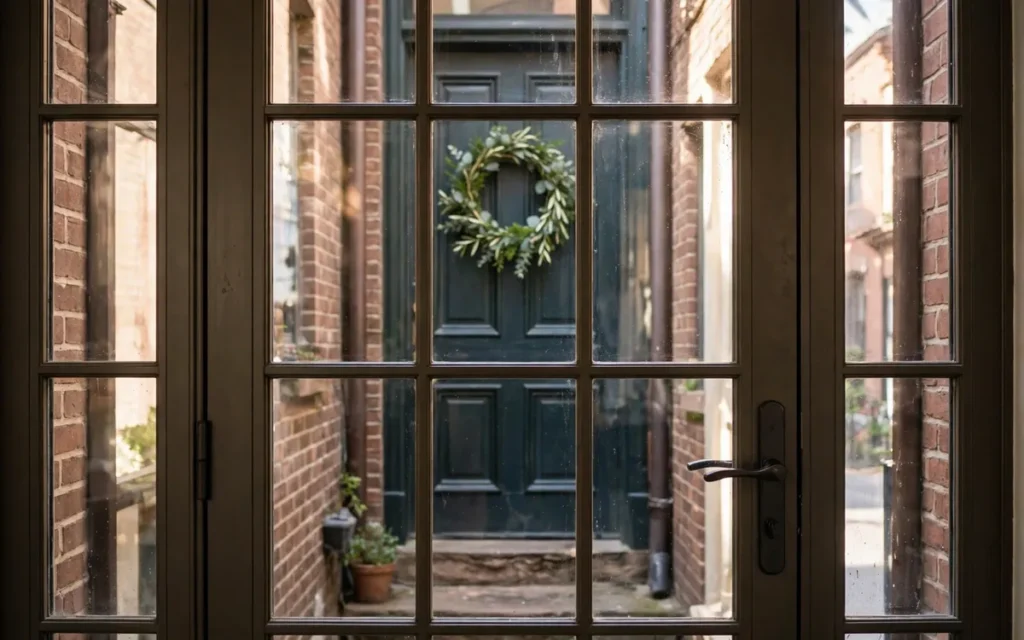
Doors without porches often live behind storm doors, and a fat wreath gets crushed flat or stops the storm door latching. Measure the gap between the door and the closed storm door before buying anything, and choose a slim-profile wreath or a flat-backed basket that fits inside it. Or move the dressing outside altogether and hang the wreath on the storm door’s outer face, where nothing compresses it and the street sees it undimmed by glass.
18. Hang Planters on the Wall When There Is No Floor

A stoop with no room for pots still gets its green frame, on the wall instead of the floor. Two wall-mounted planters, or a railing planter where a railing exists, flank the door at the frame’s sides while the swing and the step stay completely clear. Water them with a small can rather than a hose, so nothing drips onto visitors standing underneath, and choose the same structural evergreens as the floor planters, just in miniature.
19. Style One Side Well Instead of Both Sides Badly

On a narrow stoop, one strong side beats two cramped sides competing with the door swing. Put the single planter and the house numbers on the handle side, where the eye and the hand already travel, and leave the hinge side completely clear. The asymmetry reads as intention, not shortage. And when that narrow entry opens onto a small porch in winter, our small front porch winter decor ideas style the rest of the footprint.
The Finish: The Swap and the Upkeep
20. Make One Seasonal Swap, Not a Whole Redo

The frame is permanent; only the dressing changes. A bow and new filler on the same wreath, a seasonal top mat laid over the same base rug, planters refilled rather than replaced: the swap takes about ten minutes when one small storage box per season holds its pieces. Autumn dresses this same door more fully in our fall porch decor ideas, and in December the garland goes around this same frame in our farmhouse christmas porch decor ideas. The measurements underneath never move.
21. Keep a Two-Minute Monthly Tidy
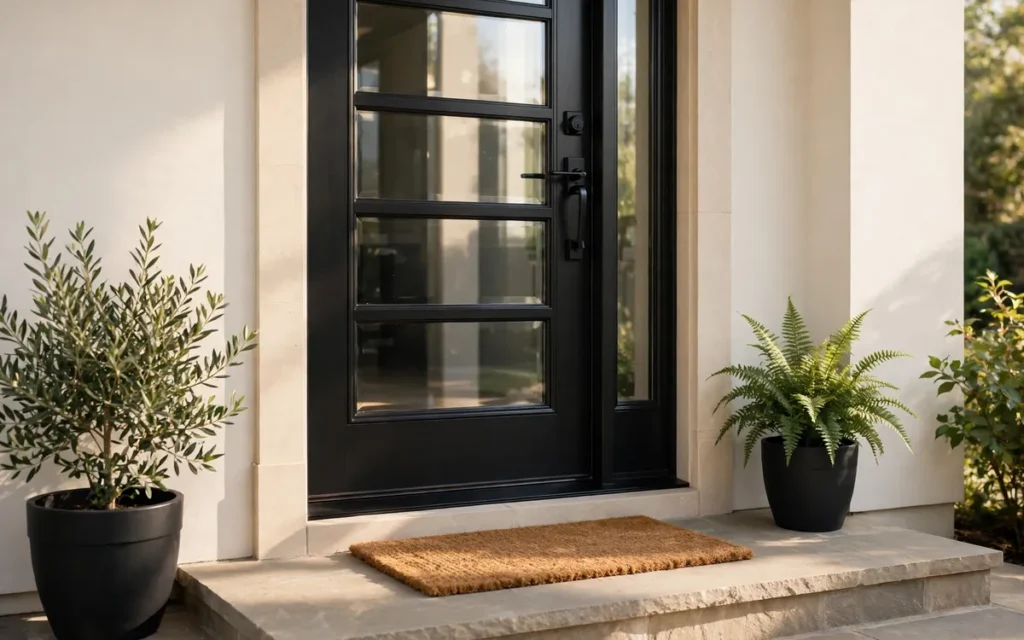
The best-dressed door in the street still fails if it is dusty, cobwebbed and dim, so upkeep is the last decor layer. Once a month: sweep the step, shake out and brush the mats, wipe the door and its glass, clear the cobwebs from around the light, and test the bulb while you are there. Replace a dead bulb the same week it dies. Two minutes of maintenance is what a styled door actually runs on; the rest is furniture.
What It Costs: Three Honest Levels
A front door is the cheapest facade a house has, because its biggest lever, paint, costs one tin, and its second biggest, correct sizes, costs nothing but a tape measure. Spend in the order the method works: sizes first, frame second, details last.
Under $50: The Clean-and-Size Refresh
One tin of door paint, or a correctly sized coir mat if the colour already works, plus a rated over-door hanger and the monthly tidy done properly. Do not split a small budget across both paint and mat and do each thinly; the single finished change is what the street notices.
$50–$200: The Framed Door
Paint plus the layered mat stack, the 3 by 5 base rug under the 2 by 3 coir, plus a matched pair of planters planted with structural evergreens. Or, on a door that is already painted, this level buys the readable house numbers in the chosen finish family instead of the planters. Either route ends with the door framed, not just decorated.
$200 and Up: The Full Frame
Everything above, plus a door-sized porch light at a quarter to a third of the door’s height and a matched hardware set in the one finish family. Where a light fitting is new rather than a like-for-like swap, its wiring and fitting belong to an electrician; the budget honestly includes the trade, not just the fixture.
7 Front Door Mistakes to Skip
- The too-small wreath. An 18 to 20 inch wreath on a 36 inch door reads as a postage stamp, however pretty it is. Fix: the door’s width minus 8 to 12 inches, so 24 to 28 inches, measured across the full diameter including bows.
- The wreath hung at the top of the door. Centred near the frame, it crowds the top and abandons the middle where eyes actually land. Fix: the centre at eye level, 57 to 60 inches from the floor, about 14 inches below the top of a standard door.
- The default 18 by 30 inch mat. An apartment-sized mat in front of a house door makes the whole entry look underfunded. Fix: at least 80 percent of the door’s width, 24 by 36 inches as the minimum, layered over a 3 by 5 foot base rug.
- House numbers nobody can read. Small, script-styled, unlit, or finished the same colour as the wall. Fix: 4 inches tall at minimum, 6 on set-back homes, plain numerals in strong contrast, mounted inside the porch light’s throw.
- A porch light sized for a cupboard. A 10 inch fixture on an 80 inch door, mounted up near the ceiling, lights nothing and dresses less. Fix: a quarter to a third of the door’s height, centred about 65 to 72 inches from the ground.
- Three metal finishes fighting. A brass handle, chrome numbers and a black light fitting cancel each other out. Fix: choose one finish family for every metal piece, and change the smallest pieces, numbers and knocker, first.
- Decor blocking the door’s job. Planters crowding the swing arc, a mat stack the door scrapes, parcels with nowhere dry to land. Fix: keep the swing arc and a parcel-sized patch beside the door completely clear, and use slim or wall-hung pieces on small stoops.
A Quick Safety Note
A front door is first a way in and out, in the dark and in a hurry as well as on a sunny afternoon, and decor never outranks that. Keep the doorway, the step and the walkway completely clear and unobstructed: planters out of the swing arc and off the step’s edge, mats flat with no curled corners, nothing stored against the door. Never block or cover the lock, the peephole or the doorbell, leave deliveries a clear patch to land on, and keep the path lit after dark so family and guests can see every step they take.
Work at height carefully while you dress the door. Hang high wreaths and fit lights or numbers from a stable step ladder standing on level ground, never from a chair, a railing or the ladder’s top step, and keep one hand free. Anything wired, a new porch light above all, and anything drilled into masonry or a door slab follows the maker’s instructions or goes to an electrician or tradesperson. Adhesive hooks are for light pieces only; nothing heavy ever hangs over a walkway on adhesive alone.
Front Door Questions, Answered
What size wreath do I need for a 36-inch front door?
Between 24 and 28 inches across: the door’s width minus 8 to 12 inches, which leaves about 4 to 6 inches of door showing on each side. Measure the wreath across its full diameter, including any bow or picks, since those count toward the width on the door. Narrower doors scale down with the same rule; a 32 inch door takes an 18 to 20 inch wreath.
How high should I hang a wreath on my front door?
With its centre at eye level, 57 to 60 inches from the floor. On a standard 80 inch door that is roughly 14 inches down from the top of the slab, and it leaves about 2 inches of clearance above a knocker. Hang from an over-door hanger or a properly rated hook; a nail through the door’s face is a permanent hole for a seasonal decoration.
How big should a front doormat be?
At least 80 percent as wide as the door in front of it. On a 36 inch door, 24 by 36 inches is the honest minimum, and the common 18 by 30 inch mat is undersized for a house door. For the layered look, set that coir mat on a 3 by 5 foot flatweave base rug, and keep the whole stack low enough that the door still swings clear above it.
What size should my house numbers be?
Four inches tall at minimum, and 6 inches if the house sits 50 feet or more from the street; the working rule is about an inch of digit height for every 10 feet of viewing distance. Mount them at eye level, where the porch light reaches them after dark, in plain numerals with a strong contrast against the wall, so they can be read from a moving car as well as from the step.
How can I decorate a front door with no porch?
Work on the door and the wall, not the floor. A slim wreath or basket sized by the same two-thirds rule, wall-mounted planters instead of floor pots, one-sided styling on the handle side, a correctly sized mat, and colour on the door itself carry the whole effect. Zone six of the ideas above is written for exactly these entries, including doors behind storm doors.
What colour should I paint my front door?
One pulled from the home’s own fixed materials, the brick, siding and roof undertones, rather than a colour copied from a different house. Test it on the door and look at it in morning and evening light before committing. Deep colours, navy, black, red and sage among them, are the broadly safe family in a satin or semi-gloss exterior enamel; a dark door in full sun runs hot, and homes under an HOA or historic rules should check them first.
Open that finished door and the walk continues into a passage with its own rules: no windows, three long lines and a clear width to defend. Its full treatment, layered light, a sized runner and one calm gallery line, is in our hallway decor ideas: the inside half of the arrival this door begins.
The door this article decorates opens onto a porch, and that porch deserves the same measured thinking. Small front porch ideas fit the space by its depth, so a porch under four feet stays a simple landing, seating begins at six feet, and a swing is hung only where its clearance adds up. Even the lantern and house numbers are sized by the door itself, so the whole entrance reads as one considered whole.
The same measured eye that sizes a wreath to the door should size the flowers beneath the window: our window box flower ideas match the planting to the width of the window it hangs on, so the box reads as part of the house rather than an afterthought. Colour on the slab, green at the sides — and a little of it spilling over the sill.
Conclusion
A front door does not need more decoration; it needs its decoration at the door’s own size. Measure the slab, frame it with colour and a matched green pair, layer the welcome in the sizes the measurements decided, and keep the swing and the step clear while you do it. Do those things and the front door decor ideas above stop being a seasonal project and become the way the house simply greets people, every month of the year.


6 Comments