
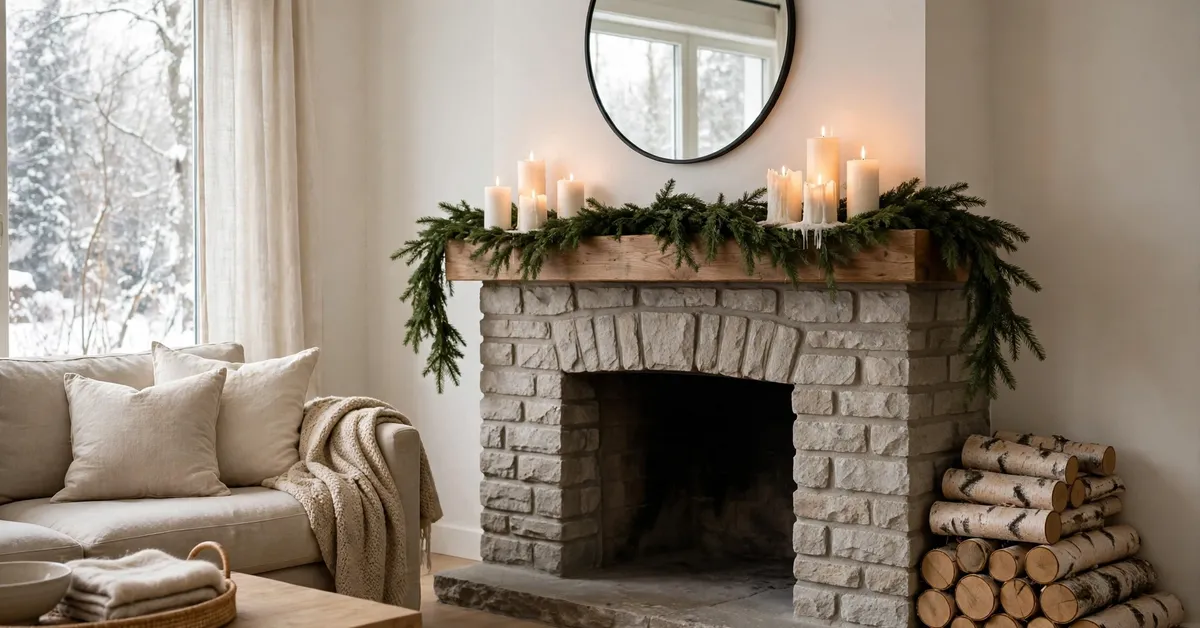
31 Peaceful Winter Mantel Decor Ideas for a Calm, Cozy Fireplace
The stockings are down, the garland is sagging, and the fireplace — the one spot the whole room faces — suddenly looks abandoned. The mantel is where January hits hardest, and it is also where winter decor does its best work. A winter mantel is not a smaller Christmas mantel. It is a calmer composition built from fewer, longer-lasting pieces, and it has to hold up for the rest of the season, not one holiday week. If you are doing the whole-home edit as well, these winter decor ideas for the home cover the rest of the house. This article stays on the fireplace wall: a composition method first, then 31 winter mantel decor ideas by zone — shelf, greenery, glow, hearth, and the hard cases like shallow shelves and TVs — plus budgets, mistakes, safety and the questions everyone asks in January. The after-Christmas approach is shared by dedicated guides like StoneGable’s winter mantel guide, which builds its January mantels from the same clean slate.
Style the Mantel as One Picture: The Anchor, Rhythm, Glow Method
A mantel is a narrow shelf with a wall above it and a hearth below, and it reads as one picture. The mantels that work are composed, not collected: an anchor placed first, a deliberate rhythm of heights, and glow set at a few chosen points. These winter mantel decor ideas all hang on that order. Style the picture in six steps and almost any combination of the pieces below will sit comfortably together.
Step 1 — Set the Anchor First
Choose one tall piece — a large print, a mirror or a plain wreath — and place it before anything else goes on the shelf. Everything after it is chosen to support it. As a sizing guide, the anchor wants to be roughly one-half to two-thirds the width of the mantel shelf; if two pieces share the anchor role, their combined width follows the same guide. Centred is the classic choice; deliberately off-centre is the relaxed one. What never works is no anchor at all — a row of small objects with nothing tall behind them is why most January mantels look bare.
Step 2 — Build the Height Rhythm
Give the shelf a skyline: something tall at one or both ends (branches, tapers or a lantern, roughly 30–60 cm above the shelf), a medium band in the middle, and low pieces along the front. Two shapes fail every time — everything at one height, which reads as a hedge, and one tall centrepiece with nothing around it, which reads as a shrine. Group candles and objects in odd numbers, and let the heights step down gradually rather than jump.
Step 3 — Layer Front to Back on a Narrow Shelf
A mantel shelf is shallow, so depth is built in rows. Back row: the anchor and the tall pieces. Middle: the garland line. Front: small, low pieces only — votives, pinecones, a scent bowl. Keep the front 5–8 cm of the shelf completely clear so nothing lives on the edge, and on a genuinely shallow shelf (under about 20 cm deep) drop the front row altogether and hang the interest on the wall instead, as Idea 19 does.
Step 4 — Place the Glow, Don’t Spread It
Light belongs at two or three points, low and toward the ends of the shelf, so the middle stays calm. Warm white only — fairy lights, candle flames, lantern glow. A mirror or a piece of glass behind one glow point doubles it for free. And the standing rule that the safety notes spell out in full: anywhere near greenery or a working fire, the glow is flameless. Placed glow looks designed; spread glow looks like the Christmas lights never came down.
Step 5 — Working Fire or Unused Fireplace? Two Different Rule Sets
Decide which fireplace you have before styling anything. On a working fireplace, the firebox and the space in front of the opening stay completely clear, nothing drapes over the front edge of the shelf, decor sits well back, and anything hanging comes down before a fire is lit — the festive version of those rules lives in these christmas fireplace decor ideas. On an unused fireplace, the firebox becomes a third styling level of its own — candle clusters, log stacks — and the hearth carries more of the composition’s weight.
Step 6 — When a TV Hangs Above the Mantel
Measure the gap between the shelf and the bottom of the screen before buying or placing a single piece. Everything on the shelf stays below the screen’s bottom edge, so styling goes low and long instead of tall: a skinny garland under the screen replaces the full garland, candlesticks stay short, and the hearth below is styled a little more strongly to balance the wall. Zone 5 (Ideas 26–28) works this case in full.
1. Lean One Large Winter Landscape Print
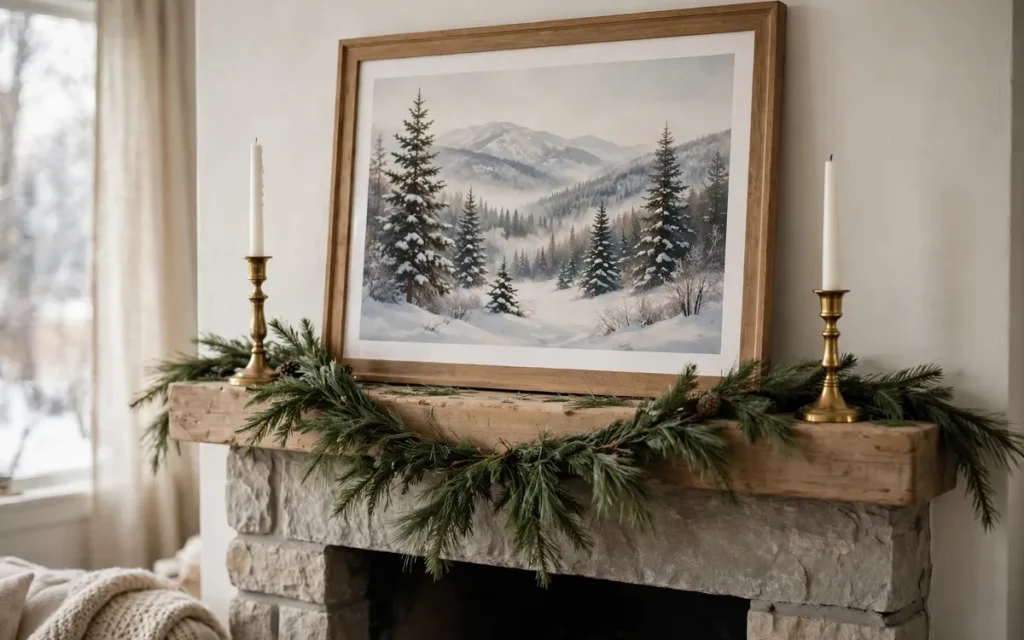
The fastest anchor there is: one big print — snowy woodland, a misty field, bare trees against a pale sky — leaned against the wall on the mantel instead of hung. Leaning keeps it casual, lets it overlap the garland line slightly for depth, and means it can swap out in seconds when spring comes. Size it by the Step 1 guide: about half to two-thirds of the shelf’s width.
Printable winter art in a frame you already own keeps this idea close to free. Choose a frame with some presence — dark wood, aged gold, black — because the frame’s edge is what the eye reads as the mantel’s top line all season.
2. Hang a Round Mirror to Double the Glow

A round mirror softens all the fireplace’s straight lines and pays rent every evening: it reflects candlelight and firelight back into the room, doubling the glow points you placed in Step 4. Hang it centred on the firebox — not on the shelf’s width, which can be a different centre — and on a proper fixing rated for its weight, as the safety notes insist.
Mirrors are the January anchor for small or dark rooms, where a print would absorb the little light there is. Keep the reflected view in mind: the mirror should return the room and its lamps, not a bare ceiling or the back of a door.
3. Layer Two Smaller Frames in Front of the Anchor
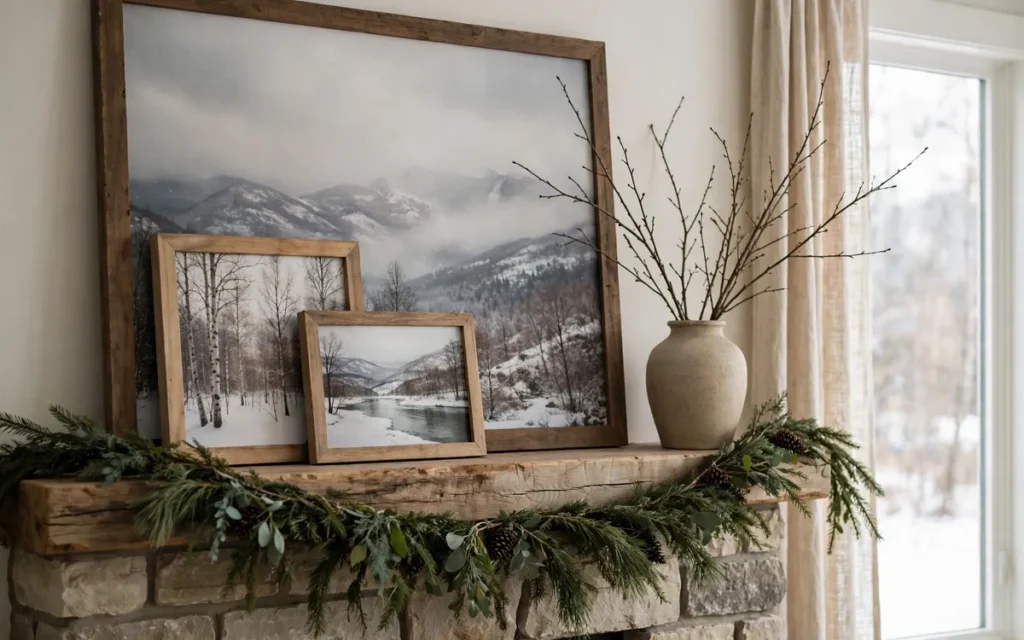
Depth on a narrow shelf comes from overlap. Lean one medium frame and one small frame in front of the anchor, both at the same side, so the big piece shows behind and above them. A winter sketch, a black-and-white woodland photograph, an old map — the subjects matter less than the stepped sizes.
Keep the pair to one side only. Frames layered at both ends turn the mantel into a gallery shelf and break the calm asymmetry the rhythm depends on. Two frames, one side, nothing else at that height: that restraint is what makes it look styled rather than stored.
4. Hang a Plain Evergreen Wreath Over the Anchor
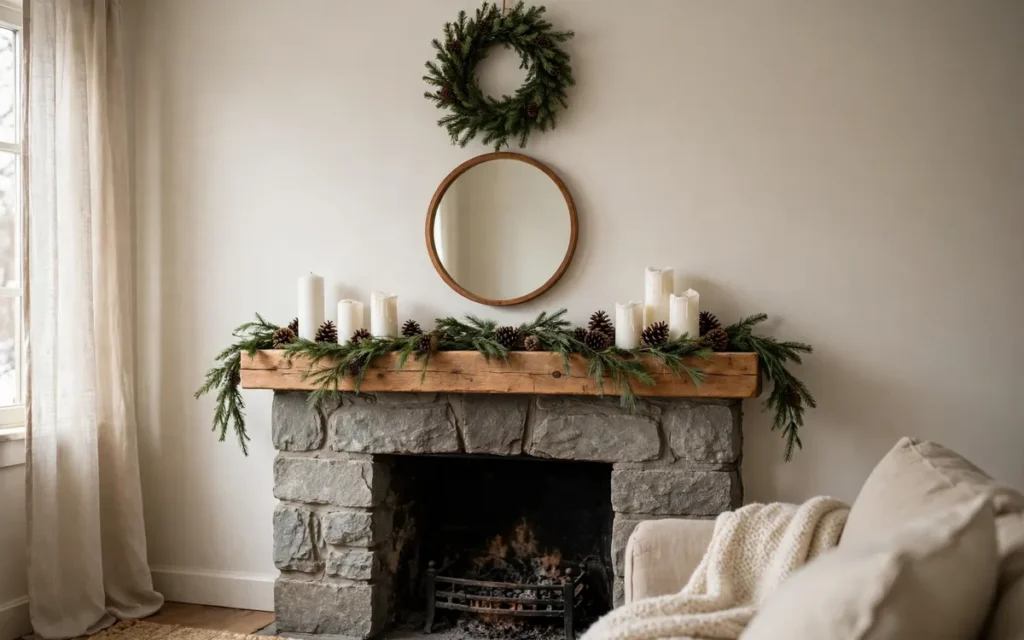
The classic January move: one undecorated evergreen wreath hung centred over the mirror or print. No bow, no berries, no ornaments — the plain green circle against the anchor is the whole statement, and it tops the composition the way a frame tops a picture.
Hang it from the same fixing point or a ribbon over the anchor’s frame so no new hole is needed, and keep it flat against the wall, clear of candle flames below. If making the wreath is the project you actually want, these christmas wreath ideas include plain styles that strip down to winter exactly this way.
5. Restyle the Christmas Village Along the Shelf

The white ceramic village does not have to go back in its box. Take the December row, remove Santa, the coloured houses and anything with lettering, and re-run the plain white and cream pieces along the mantel shelf on stacked books at slightly different heights — a quiet winter street instead of a Christmas scene.
Set the row toward one end of the shelf rather than across its whole length, with the garland running behind it. The full village-styling method — levels, light, spacing — is in these christmas village display ideas; the mantel version is simply that display edited down to its calmest pieces.
6. Prop Up One Vintage Winter Piece

Every good mantel has one object with a past. An old landscape painting in a worn frame, a pair of vintage ice skates leaned at the hearth end, a small wooden sled — one collected piece gives the composition a story that new decor cannot fake. The discipline is in the number: one piece, not a vintage theme.
Place it where it can be seen up close — the end of the shelf nearest the room’s seating, or at hearth level — and let everything around it stay plain. More collected winter pieces, and how to judge them, live in these vintage christmas decor ideas; the mantel borrows just one.
7. Keep the Garland, Strip the Christmas Trim
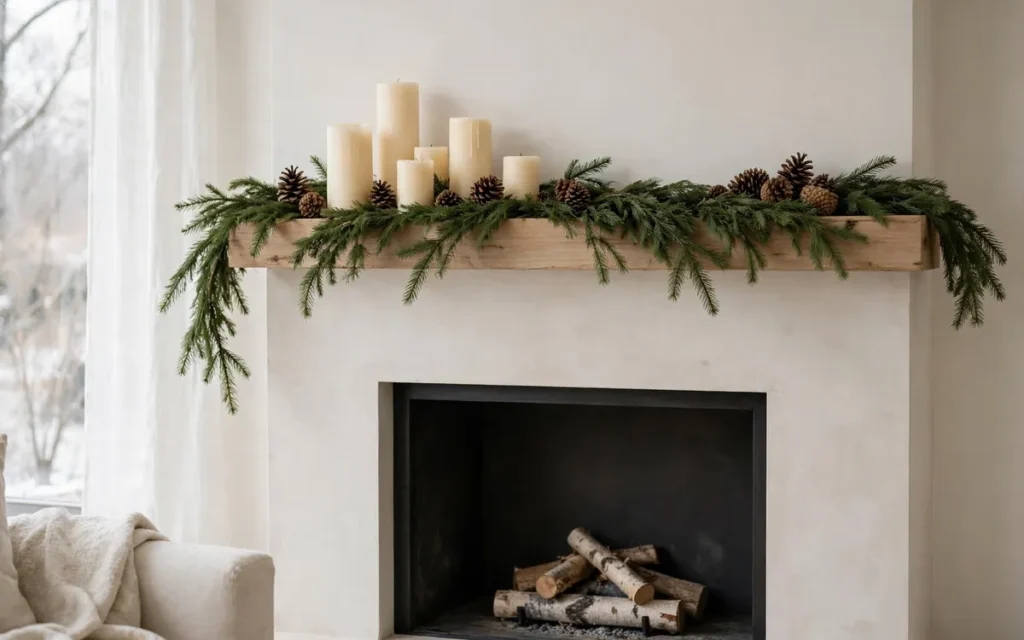
The single highest-value January move costs nothing. Take the Christmas garland down, pick off every ornament, berry, bow and coloured piece, and put the plain evergreen line back up. The shape the room loved in December stays; every signal that said “holiday” is gone.
While it is down, do the safety check the season demands: real greenery that crumbles or sheds at a touch has finished its run and should be replaced with faux or fresh stems, not rehung beside a fire. A stripped garland in good condition, though, will carry the mantel to March.
8. Drape the Garland Off-Centre

How the garland hangs matters as much as what is on it. Instead of a perfect symmetric swag, let it sit fuller at one end — gathered deeper on the left, say, and trailing lower on that side, with the other end finishing higher and lighter. The relaxed line reads as “winter styling” rather than “decorated for an event”.
Pin or hook the garland at three points — both ends and one off-centre point — so the drape is deliberate and stays where you put it. Keep every part of it on top of the shelf or against the wall, never spilling over the front edge above a working firebox.
9. Stand Bare Branches in a Tall Vase at One End
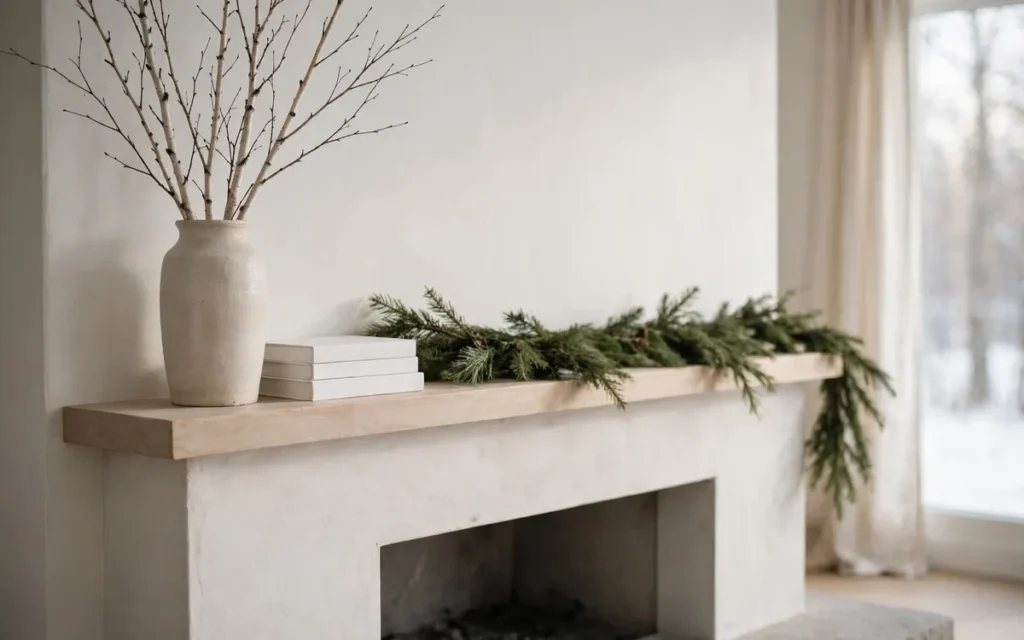
Branches supply the tall end of the height rhythm for free. Birch, willow, or pruned garden branches in a tall, heavy vase at one end of the shelf give the composition its vertical line and its most winter texture — no leaves, no colour, just structure against the wall.
Weight the vase at the base with stones or sand so a tall arrangement cannot topple, and angle the branches so none lean over the candle zone. Cut branches last the whole season without water or care, which makes them the hardest-working free decoration on this list.
10. Fill Glass Jars with Pinecones and Faux Snow

Two or three glass jars in different sizes, filled with pinecones and a layer of white faux snow, make the low front-row texture a shallow shelf can hold. The glass catches candlelight, the cones bring the natural material, and the white keeps the palette in winter.
Group the jars together rather than spacing them along the shelf — a cluster reads as one low point in the rhythm, which is what the front row wants. This is also the safest home for small found pieces children bring in: inside glass, admired and untouchable.
11. Tuck Frosted Pinecones Along the Garland

Pinecones turn a plain garland wintry without a single Christmas signal. Tuck or wire cones at intervals along the stripped garland from Idea 7 — unevenly, in small clusters of two or three rather than a marching row — and choose frosted tips if you want the echo of snow.
The frosting does quietly what glitter did loudly in December: it catches the light. Keep it matte and white rather than sparkly, and the garland stays calm. Cones gathered outdoors should be dried indoors for a few days first so they open fully and leave their moisture — and any residents — behind.
12. Lay a Short Row of Birch Logs Along the Shelf

Three to five short birch pieces laid horizontally along the shelf make a low, sculptural band that ties the mantel visually to the log store below. The pale bark is practically a winter colour of its own, and the horizontal line calms a mantel whose other pieces are all vertical.
Set the row slightly back from the front edge, in the garland’s row or just behind the front pieces. On a shallow shelf this band can replace the front row entirely — it is low, stable, and in no danger of being knocked off by a passing sleeve.
13. Add a Small Forest of Mini Trees

A cluster of small trees — bottle-brush or ceramic, in creams, whites and soft greens — grouped at one end of the shelf brings the forest indoors at mantel scale. Odd numbers again: three or five, at stepped heights, close enough together to read as one grove rather than a scattered set.
Keep the grove clear of the garland’s candle zone and away from any real flame on the shelf; bottle-brush material is decorative, not fire-friendly. Against the plain garland and white candles, this is the one idea children consistently claim as their favourite part of the winter mantel.
14. Group White Pillars in Mixed Heights

The winter mantel’s workhorse. Three or five white or cream pillar candles at staggered heights, grouped on one side of the shelf on a tray, plate or directly on holders — this cluster is one of Step 4’s glow points, and it works with every anchor and garland on this list.
On a working fireplace, make the whole group flameless and put it on a timer; beside an unused fireplace, real pillars are possible but flameless still wins for a season of evenings, because nobody has to remember them. Vary the heights by raising shorter candles on small stands rather than buying new ones.
15. Line Up Slim Tapers in Brass Holders

Where pillars are the glow, tapers are the height. Slim cream tapers in aged brass holders supply tall, thin verticals that echo the branches at the other end of the shelf — height without bulk, which a narrow mantel always needs. Brass is winter’s metal: warm, muted, and happy in firelight.
Keep real tapers well away from the garland line and never beside dried greenery — a tall flame near dry needles is the exact combination the safety notes warn against. In most homes the honest answer is flameless tapers in the same brass holders, giving the same skyline with none of the watching.
16. Set Lanterns at the Ends with Flameless Candles

Lanterns frame a composition. One at each end of the mantel, each holding a flameless candle on a timer, gives the shelf its two outer glow points and a matched pair of verticals that make everything between them look intentional. The contained flame-effect also reads beautifully through glass on dark afternoons.
This is the right candle choice beside a working fire and in homes with children or pets: no flame to guard, no wax to drip, nothing to knock into trouble. Choose lanterns tall enough to register in the height rhythm — roughly the medium band — rather than small ones that vanish against the anchor.
17. Weave Warm Fairy Lights Through the Garland

The stripped garland gets its evening life from a strand of warm-white micro fairy lights woven loosely along it, front and back, so the green itself glows. On a timer, the mantel lights itself at dusk — the same habit as the living room’s lamps, and for the same reason: a routine survives tired evenings.
Inspect any strand moved over from its Christmas position before it goes into the garland — no frayed cord, no cracked bulbs — and route the cord down the end of the mantel, tucked against the wall, never across the hearth floor. Warm white only: the coloured and twinkle modes stayed in December.
18. Add Mercury-Glass Votives for Soft Sparkle

January still deserves a little sparkle — it just has to be the quiet kind. Mercury-glass votive holders, grouped in threes along the front row, give points of soft, mottled light that read as winter frost rather than party glitter. Tea lights or flameless tea lights both work at this size.
Scatter is the enemy: one group of three, or two groups flanking the anchor, never a dotted line of single votives along the whole shelf. Kept in clusters, they are the low front-row points of the height rhythm, twinkling at exactly the height the eye passes last.
19. Hang Paper Star Lanterns Above a Shallow Mantel

When the shelf is too shallow to hold decor, the wall does the work. Two or three white paper star lanterns hung above the mantel give a shallow shelf the height and presence it cannot hold — the anchor and the rhythm move onto the wall, and the shelf itself needs only the garland and one candle group.
Hang them from proper fixings, at uneven heights, and do the heat check the safety notes describe: if the wall above your fireplace gets distinctly warm during a fire, paper stays off it. On unused fireplaces and electric fires, this is one of the prettiest solutions on the list.
20. Fill the Unused Firebox with Pillar Candles
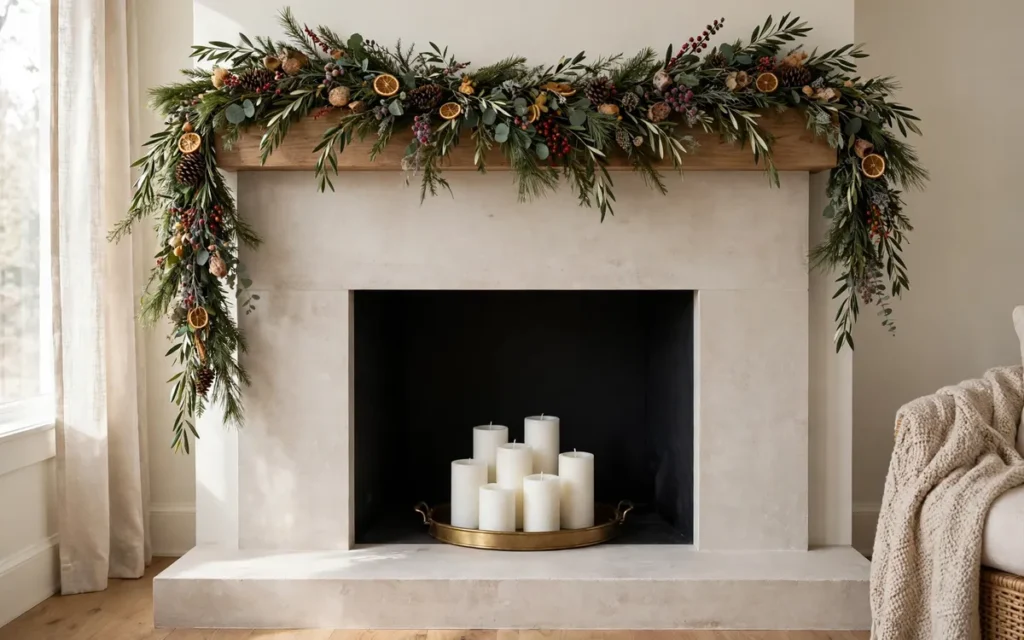
An unused firebox is a dark hole at the centre of the composition — fill it with light. A cluster of flameless pillar candles at different heights, set on a tray or a mirror tile inside the clean, swept firebox, turns the opening into the mantel’s lowest and most beautiful glow point.
The rule is absolute: this is only for a fireplace that will not be lit this season. Everything comes out and the firebox is swept before any fire, ever — and if there is any chance someone might light it, treat the fireplace as working and keep the firebox empty. Candle clusters belong in certainty, not in hope.
21. Stack Birch Logs In or Beside the Firebox

A neat log stack is winter’s most honest signal. In an unused firebox, stack birch logs to fill the opening, ends out in even rows. Beside a working fireplace, the same stack stands in a holder or directly on the hearth — seasoning within reach, ready for real fires.
Keep the stack disciplined: one wood, one direction, cut ends aligned. A mixed jumble reads as storage; an ordered stack reads as styling. The pale birch bark also repeats Idea 12’s shelf band, tying the top and bottom of the composition together without a single matching purchase.
22. Set a Basket of Blankets at One Side

The hearth level needs one soft thing. A woven basket with one or two folded cream or oatmeal blankets, standing at one side of the fireplace, balances all that stone, brick and iron with the texture the rest of the room is wearing — and puts a throw within reach of the nearest chair.
On a working fireplace the basket stands outside the clearance zone the safety notes set out — to the side, on the hearth’s edge or just off it, never in front of the opening. One basket, neatly folded blankets, no overflow: the moment it becomes a laundry pile, the composition is gone.
23. Style the Log Basket and Fire Tools as Decor
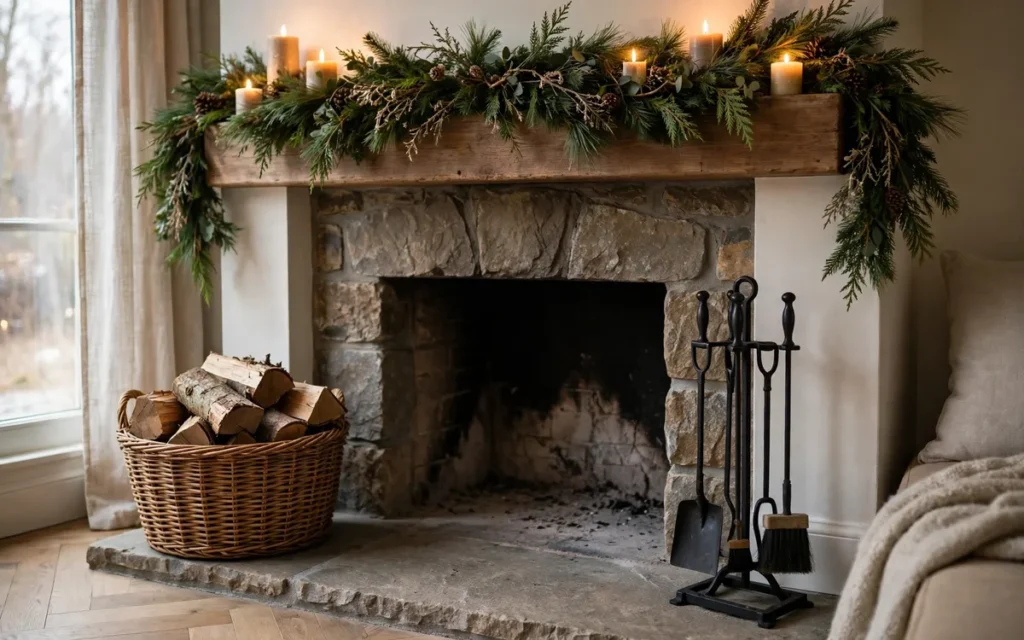
A working fireplace already owns half its hearth styling: the log basket and the tool set are there because they are needed. Style around them instead of hiding them — choose the basket and tools as deliberately as any decor (iron and woven textures suit winter), and place them where the composition wants weight: tools at one side, basket at the other.
Practicality is part of the picture’s honesty: the set stays complete and within reach of the fire, because a styled hearth that cannot be used safely is a failure. Everything in its working place, and looking good doing it — that is the whole trick of this idea.
24. Drape a Knit Throw Over One Mantel Corner

A chunky cream knit throw, folded long and draped over one end of the mantel, softens the shelf’s hard line like nothing else on this list. It is the textile note at the top of the fireplace, echoing the throws on the sofa below, and it makes the whole composition feel touchable.
The working-fire rule is strict: the drape stays on top of the shelf and comes off before any fire if any part of it hangs near the front edge. Fabric above a firebox is styled only when it cannot drift, slip or hang into the heat path — when in doubt, the throw moves to the basket from Idea 22 until the fire is out.
25. Hang Neutral Knit Stockings a Little Longer

This one surprises people: stockings can stay into winter if they change their signals. Cream, oatmeal and brown cable-knit stockings, with no names, no red and no motifs, read as winter texture hanging in a row — closer to a line of knitwear than to Christmas Eve.
Hang them from proper hooks, and hold the safety line without exception: on a working fireplace, stockings come down before a fire is lit, every time. In homes with nightly fires, the honest version of this idea moves the row to wall hooks beside the fireplace, where the look survives and the rule never has to be remembered.
26. Style Low and Long When a TV Sits Above

The TV case, worked in full. Measure the gap between the shelf and the screen’s bottom edge, then cap every piece below that line with room to spare. The styling stretches horizontally instead of vertically: a low stack of books, a shallow bowl, one group of short candles, the skinny garland from Idea 27 — a long, calm band under the screen.
Let the hearth carry the height the shelf cannot: the lantern-and-basket pairing and the log stack give the wall its verticals at floor level. Done this way the TV stops looking like a black hole over a bare shelf and becomes the top edge of a composed fireplace wall.
27. Run a Skinny Garland Under the Screen

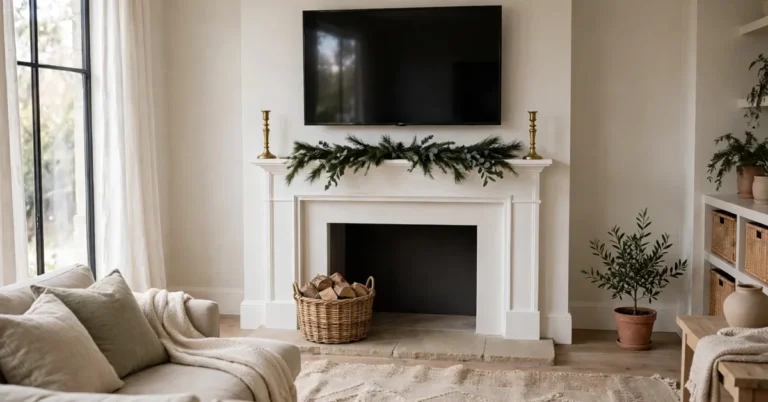
A full garland will not fit under a TV; a skinny one will. A slim eucalyptus or narrow pine line, tucked along the shelf directly under the screen, softens the rectangle’s hard bottom edge and gives the wall its green line without entering the screen’s space or touching its vents.
Keep the line genuinely slim — one stem deep, lying mostly flat — and route any fairy-light cord away from the TV’s cables and vents. Where the gap is very tight, the garland alone, with no objects at all, is a complete styling: green line below, screen above, hearth styled below that.
28. Keep Candlesticks Low Below the Screen
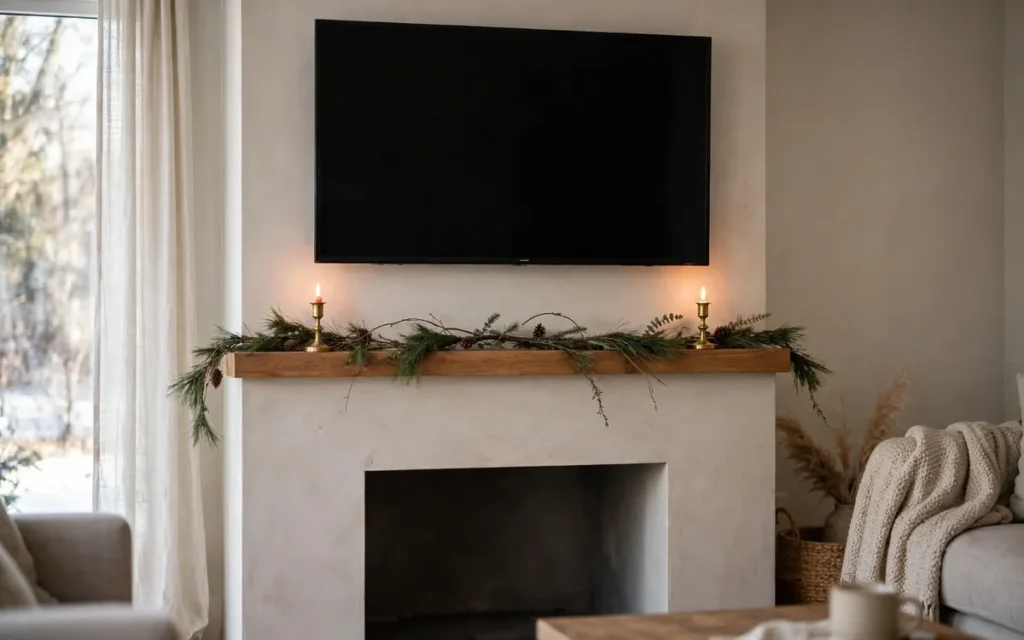
Two short candlesticks, placed below the TV’s lower corners, echo the screen’s shape and warm its edges. Short is the discipline: pillar stubs or low holders whose tops stay comfortably below the screen’s bottom edge, with flameless candles the default where the gap is tight or the set runs warm.
The pair gives the TV-case mantel its glow points at the ends, exactly as Step 4 prescribes, and leaves the centre under the screen clear. Symmetry suits this case — the screen is a rectangle, and the matched low pair answers it calmly.
29. Finish with One Metal: Brass Bells and Accents

Pick one metal for the whole mantel and repeat it three times: brass taper holders from Idea 15, a brass tray under the candle group, and a small cluster of aged brass bells hung at the garland’s full end. The repetition is what turns three objects into a scheme, and the bells are winter’s quiet answer to Christmas sparkle — a soft gleam, and a softer sound when the garland is touched.
One metal only: mixing brass, chrome and copper on one shelf reads as a shelf of leftovers. Aged and brushed finishes keep the glow warm and matte. If your mantel’s metal is already pewter or iron, the rule still holds — one metal, three appearances, nothing else shiny.
30. Set Out a Bowl of Dried Citrus and Cinnamon

The mantel’s scent layer needs no flame. A shallow bowl of dried orange slices, cinnamon sticks and star anise, set at the low front row, perfumes the warm air rising past the shelf and brings the one note of colour — muted amber — that the winter palette allows itself.
Replace the bowl’s contents when the scent fades, usually after a few weeks, and refresh it rather than enlarging it. Keep it out of pet reach: dried citrus and spices are decor, not food, and a hearth-level bowl on a shallow mantel should sit where only human hands go.
31. Tie Velvet Bows Along the Garland

December’s red ribbon gets one winter replacement: a few large bows in a neutral velvet — cream, oatmeal, charcoal or deep green — tied at intervals along the stripped garland. Velvet is the season’s fabric, the neutral keeps it calm, and the bows give the plain green line its finished detail.
Space them unevenly, three or five along the run, and keep every ribbon tail short and pinned back from the garland’s underside. Tails that hang toward the firebox opening or trail near candles break the safety rules this article keeps repeating — beautiful is only beautiful when it stays on top of the shelf.
What a Winter Mantel Costs: Four Budget Levels
Think in levels rather than a shopping list, and shop your own home first at every one of them. The restyle — $0: strip the Christmas garland back to green, re-run the village without its Christmas pieces, and raid the house for frames, jars, books, branches and bowls. Most of this article can be built from a home that decorated for December.
The refresh — under about $25: printable winter art for a frame you own, pinecones (bought or gathered), and one set of flameless pillars on a timer. The composed mantel — roughly $25–$75: a good faux garland that will survive several winters, brass taper holders, a thrifted mirror or large frame. The anchor investment — $75 and up: one large piece, a mirror, framed print or quality lantern pair, bought once and reused every winter while everything else stays at the lower levels.
The season’s maths favours this shape: winter decor runs eight to ten weeks, so cost per week is lowest on one anchor plus restyled basics, and highest on a whole new “winter set” — which also tends to look staged rather than lived-in. Spend where the eye lands (the anchor), save where it glances (everything else).
8 Winter Mantel Mistakes That Keep It Looking Like Leftover Christmas
- Leaving one Christmas-coded piece “for now”. A single red or Santa-adjacent item re-Christmases the whole shelf, however calm everything around it is. The edit has to be complete to read as winter.
- Keeping the December garland untouched. Bows, berries and ornaments left in place say the decorations simply never came down. Strip it to green — ten minutes changes the season.
- The hedge. Everything lined up at one height along the front edge, with no tall or low points. The height rhythm exists precisely to break this shape.
- Filling every centimetre. A mantel with no breathing room reads as storage. Winter looks calm because the pieces are fewer and spaced.
- Real candles inside the garland line. Flames tucked among greenery — greenery that is drying out week by week — is the season’s main fire risk, not a styling choice.
- Ignoring the hearth. A dressed shelf above a bare hearth (or a styled hearth under an empty shelf) leaves the picture half-finished. The mantel is one composition, top to bottom.
- Buying a matching “winter set”. One style, one shop, one afternoon — and the mantel reads staged. Collected and restyled pieces read as winter; sets read as displays.
- Forgetting the February test. Pieces chosen in January that are already tired by February — browning greenery, novelty snow items — with no small refresh planned. Winter decor has to last; choose like it.
Mantel Safety: Fire, Candles, Heat and Heavy Things
A mantel concentrates everything flammable a home owns — greenery, ribbon, paper, fabric, wood — directly above its heat source, so clearances come before styling. Keep anything that can burn well away from the firebox opening: fire-safety guidance commonly uses about 3 feet (roughly 1 metre) as the safe distance for combustibles around an opening, and your own fireplace manufacturer’s figures overrule any general guide, including this one. Nothing combustible hangs in front of the opening, ever. Garland ends, ribbon tails, stockings and throws that drape over the front edge sit in the heat path on a working fireplace — style them on top of the shelf or pinned back, and take stockings and hanging pieces down before lighting a fire. Candles beside drying greenery are the season’s main risk: a real garland dries out over a long winter indoors, faster beside a heat source, so prefer flameless candles anywhere on a working fireplace’s mantel and inside any garland, keep real flames in contained holders such as lanterns or hurricanes and away from the garland line, and never leave a flame unattended. Check real greenery weekly — when needles snap instead of bending, or shed at a touch, it comes down.
Heat rises, so check the wall and the shelf: after a fire has burned for a while, feel the wall above the mantel and the shelf’s underside, and if either is distinctly warm, move paper stars, dried pieces and anything plastic further away or down — and keep TV vents and the screen’s bottom edge clear of decor and garland. Secure the heavy things properly. Mirrors and large frames belong on fixings rated for their weight, not balanced on the shelf; leaned art gets an anti-slip pad or museum putty; tall vases of branches are weighted at the base; and nothing heavy sits where a child or pet can pull it down by a trailing ribbon or cord. Around children and pets, matches and lighters live away from the hearth, glass and ceramic stay off hearth level within toddler reach, battery candles are the default in busy family rooms, cords and battery packs stay tucked where they cannot be chewed or tripped over, and dried citrus and cinnamon stay out of pet reach — they are decor, not food. Fairy lights moved from their Christmas positions get a quick inspection first: no frayed cords, no cracked bulbs, no overloaded sockets, and their timers treated as the safety feature they are. Finally, the unused-fireplace rule: firebox styling — candle clusters, log stacks — only goes in a fireplace that will not be lit this season; if there is any chance of a fire, the firebox stays empty and swept. When any rule here and your fireplace’s manual disagree, the manual wins.
Frequently Asked Questions
What do you put on a mantel after Christmas?
The short winter kit: plain greenery with the Christmas trim stripped off, white candles in mixed heights, one anchor — art, a mirror or a plain wreath — natural texture from pinecones, birch and branches, and one metal repeated in a few places. Everything Christmas-coded goes back in the box. That is the whole recipe; the 31 ideas above are its variations.
How do I decorate a winter mantel without it looking bare?
Compose, don’t accumulate. A mantel looks bare when it has no anchor and the hearth is ignored — not when it has too few objects. Set one tall anchor, build the tall-medium-low rhythm, place glow at two or three points, and style the hearth level too. Five deliberate pieces in a composition will always look fuller than fifteen small ones in a row.
Can I keep my Christmas garland up for winter?
Yes — stripped. Ornaments, berries, bows and coloured pieces come off; the plain green line stays, dressed with pinecones and warm fairy lights instead. The one condition is condition: real greenery has a lifespan indoors, and when it dries to the snap-and-shed stage described in the safety notes, it comes down and a faux garland or fresh stems take over.
How long can I keep a winter mantel up?
It is built for January to early March — the whole run between the Christmas takedown and the first spring signals. Plan one small February refresh rather than a second full decorate: fresh branches, a new scent bowl, a candle swap. Pieces chosen to last (faux greenery, wood, metal, ceramic) will still look right at the end of that run.
Should a winter mantel be symmetrical?
Either way works, if the heights are deliberate. Symmetry — mirror centred, matched lanterns at the ends — reads calm and formal. Asymmetry — anchor off-centre, garland draped fuller to one side — reads relaxed and collected. What fails is accidental near-symmetry: pieces almost matched, heights almost level, which looks like a mistake instead of a choice. Commit to one or the other.
How do I decorate the mantel when a TV hangs above the fireplace?
Measure the gap between the shelf and the screen’s bottom edge, and keep every piece below that line. Style low and long — a skinny garland, short candlesticks under the screen’s corners, a shallow bowl, low book stacks — keep garland and decor clear of the TV’s vents and cables, and let the hearth carry more of the styling to balance the wall. Ideas 26–28 work this case piece by piece.
Complete the welcome outside: the greenery language of the mantel continues at the door with these winter wreath ideas, sized and hung to welcome all season.
And if a television hangs above this mantel, the styling rules tighten — low, centred and clear of the heat path: our tv above fireplace ideas work through the heat test, the clearances and the styling for that exact wall.
Conclusion
Anchor first, rhythm second, glow last — and fewer pieces than December, chosen to last until March. That is all a winter mantel asks. The fireplace wall is one picture: shelf, wall and hearth composed together, warm without a single Christmas signal left in it. If the rest of the house needs the same treatment, the whole-home edit is in the article linked at the top, and the room around this fireplace is covered in the winter living room ideas guide. Next in the January series, the front door gets its own winter moment. Until then, this is winter mantel decor at its simplest: a calm shelf, a lit hearth, and nothing left over from a holiday that has already ended.


3 Comments