
26 Timeless Vintage Christmas Decor Ideas for a Nostalgic, Collected Home
Some Christmases look bought in one afternoon. The memorable ones look collected over decades — a grandmother’s glass ornament beside this year’s find, a ceramic tree that has glowed since the seventies, a plaid blanket on its third generation of sofa. That collected feeling is what vintage christmas decor ideas are really about, and the good news is how little of it needs to be genuinely old. One chosen era, a handful of hero pieces (real finds or good reproductions), and a few sourcing and safety rules will build it.
Below is the collector’s system first: how to pick an era, where pieces actually come from, the 80/20 rule for mixing old with new, how to judge condition, and how to display a collection without it turning into clutter. Then come 26 ideas in four groups — the tree, the mantel and candlelight, the table and kitchen, and textiles, paper and finishing touches. Unlike a themed room, a collected Christmas is supposed to grow slowly: this year’s one good find is next year’s heirloom.
Shop Like a Collector, Style Like an Editor: The Vintage System
Pick One Era Before You Buy Anything
Three eras do most of the work, each with its own palette. Victorian-inspired: burgundy, forest green, velvet, brass and paper details — rich and layered. 1940s–50s: colourful glass ornaments, handmade paper, bottle brush trees and cheerful Santas, with tinsel kept restrained. 1960s–70s: ceramic trees, bubble-look lights, metallics and warm amber and gold. Choose the era first and the palette follows it. Mixing all three in one room is the single most common reason “vintage” ends up reading as “junk shop”.
Know the Three Sources — and What Each Is For
Pieces come from three places. Family heirlooms first — free, and the stories attached to them are the one decoration money cannot buy. Thrift stores, estate sales, antique shops and online marketplaces for genuine finds. And reproductions for anything electrical, anything fragile that will be handled daily, and anything whose genuine version is priced beyond sense. Two definitions readers always ask about: a piece counts as vintage at roughly 20 years old or more, and antique at 100 years or more. For a real collector’s sourcing walk-through, this guide to collecting vintage Christmas decorations shows what a lifetime of patient hunting actually looks like.
The 80/20 Mix Rule
Roughly 80% of the room stays everyday, modern basics; vintage pieces form about 20%, concentrated in two or three focal areas — the tree, the mantel, one table — rather than sprinkled across every surface. Then repeat every vintage colour and material at least twice in the room: brass here and brass there, tartan on the table and tartan on the sofa. A lone antique looks lost and slightly sad; an echoed one looks collected on purpose.
Read Condition Like a Dealer
Patina yes, damage no. Gentle fading, tiny chips and the fine crackle called crazing are character — they are the proof of age the look depends on. Walk away from flaking paint (pre-1978 paint can contain lead), frayed or stiff cords, cracked glass and wobbly joints. Check maker’s marks and ornament caps, never test anything electrical in the shop, and never pay “genuine” prices for a piece you cannot verify. Patience is the collector’s whole advantage: another one always turns up.
Display Rules: Collected, Not Cluttered
Group small pieces in odd numbers, contain them (bowls, trays, cloches), and give each hero piece empty space around it — breathing room is what separates a museum piece from a pile. Keep fragile glass high and toward the tree’s inner branches. And borrow the editor’s trick at the end: photograph the finished room, look at the photo, and remove one thing. That single removal, repeated in every room, is the difference between a collection and an accumulation.
1. Hang Heirloom Glass Ornaments in Jewel Tones

Ruby, emerald, sapphire and gold glass, mixed across the tree in different shapes and sizes — balls, teardrops, finials, the odd bunch of grapes. The collected-over-time look comes from variation inside one palette: no two ornaments identical, every one of them belonging. Genuine mid-century glass mixes happily with good modern reproductions once they share the tree.
Hang the oldest and most fragile pieces high and toward the inner branches, where hands, tails and toddlers reach last. Our christmas tree decorating ideas cover the tree’s structure and dressing order — lights, garland, ornaments — and this collected glass is the layer that goes on last and means the most.
2. Add a Light-Up Ceramic Tree on a Side Table

The 1960s–70s icon, and the single most recognisable vintage Christmas object there is: a ceramic tree with little coloured bulbs, glowing on a side table, a kitchen counter or a hall console. One small lit tree does a whole corner — it is a lamp, a sculpture and a memory in a single object.
A modern LED version is a perfectly honourable choice: it gives the look with none of the old-wiring risk the safety section covers. If a genuine vintage tree comes your way, have its cord checked or replaced before it glows nightly, and swap hot original bulbs for cool LEDs. Either way, it earns its place as many families’ one hero piece.
3. Drape Tinsel in Sparse Single Strands
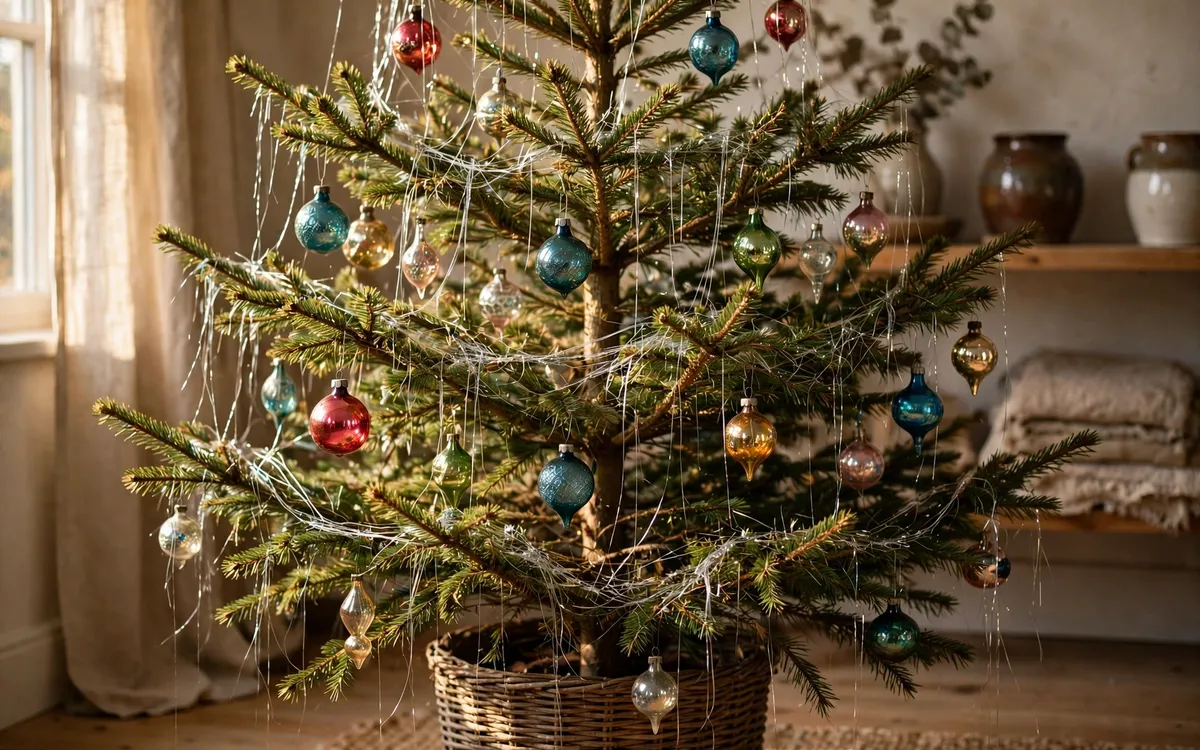
Tinsel, done properly, because dosage is everything: lay it in fine, sparse single strands over the outer third of the branches, with plenty of green left showing between them. That restraint is the whole difference between the nostalgic shimmer of a 1950s photograph and the silver haystack that swallows a tree.
Work strand by strand from the top down, and step back every few minutes — tinsel blindness is real, and the tree that looked delicate at strand twenty looks metallic at strand two hundred. Modern tinsel only: vintage foil strands are a fire and pet hazard (see the safety notes), and all tinsel stays well away from candles and hot bulbs.
4. String a Popcorn and Cranberry Garland

The handmade garland of the 1940s tree: plain popcorn and fresh cranberries on a long thread, looped in swags between the branches. Use day-old, air-popped popcorn — fresh popcorn crumbles as the needle passes — and string popcorn first in sections, adding a cranberry every few pieces as the rhythm and the colour.
Make it a family production line on one evening and count it as an event, not a chore. Hang finished strands high and inside the tree: popcorn strings are pet snacks and pest invitations at low level. Faux versions exist and suit homes with dogs; the real thing gets binned after the season, never stored — it is food, and it knows it.
5. Top the Tree With a Classic Star or Angel

An era-matched silhouette instead of a modern finial: a simple tin or gold star for the Victorian and farmhouse-leaning tree, a spun-glass or fabric angel for the 1950s tree, a glowing star for the sixties. The topper is the tree’s full stop — it should be the sentence’s own period, not a word from another language.
Scale it to the tree: a topper roughly a tenth of the tree’s height reads right. Keep old toppers display-only if their fittings are electrical and aged; a classic shape in a modern, safe version beats a genuine antique glowing on a perished cord. Whatever you choose, let it be the same one every year — repetition is how decorations become traditions.
6. Display Spare Glass Ornaments in a Bowl
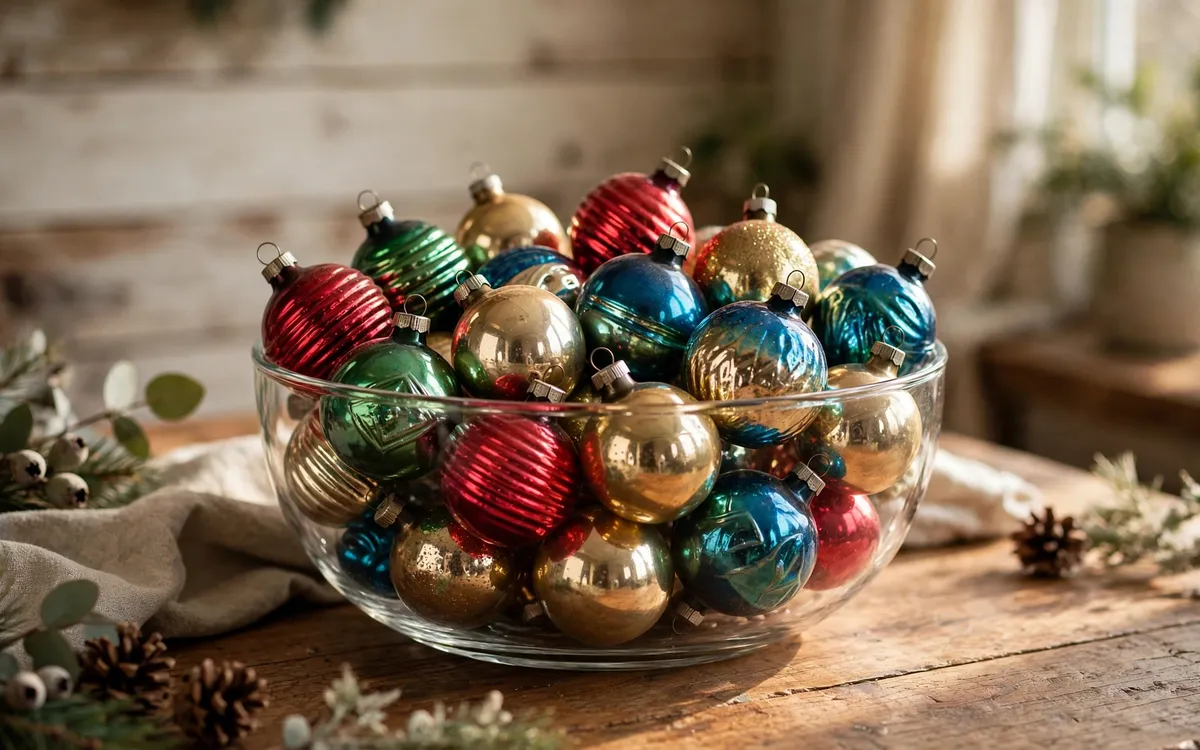
Every collection has extras — too fragile for the tree, too many for the branches, too loved to store. Pour them into a clear glass bowl or a wide jar on the table and they become a tabletop collection: the jewel tones glowing against each other, no hooks, no hanging, no risk of the cat’s opinion.
A bowl is also honest storage in plain sight — ornaments rest on each other gently in a way a crowded box never manages. Mix sizes and finishes, keep the very finest piece for the cloche in Idea 26, and let the bowl live where light reaches it. It is the cheapest display in this article: the ornaments already exist.
7. Build a Mercury Glass Mantel Display

Silvered glass — candleholders, vases and ornaments with that cloudy, antique-mirror finish — grouped along the mantel with greenery woven behind it. Mercury glass is the vintage mantel’s engine: it catches candlelight and fairy light and gives back a soft, doubled glow that clear glass cannot imitate.
Group asymmetrically — a cluster of three heights at one end, a pair at the other, greenery and one ribbon tying the line together. The mantel framework itself (garland placement, heights, the working-fireplace rules) is set out in our christmas fireplace decor ideas; this display is the collected layer that sits inside it.
8. Line Up Bottle Brush Trees in Mixed Heights

The 1950s staple that never really left: bottle brush trees in green, cream and the odd pastel, lined up in odd numbers and three heights along a mantel, a shelf or a windowsill. They are the collection’s foot soldiers — cheap, light, unbreakable in any way that matters, and instantly era-setting wherever they stand.
Vary the heights in a rhythm (tall, short, medium, tall) rather than a staircase, and give a few of them tiny baubles or a dusting of faux snow. Genuine vintage brush trees shed bristles and charm in equal measure; modern ones are so close in look that this is a piece where reproductions carry no shame at all.
9. Hang Vintage-Style Stockings From Brass Holders
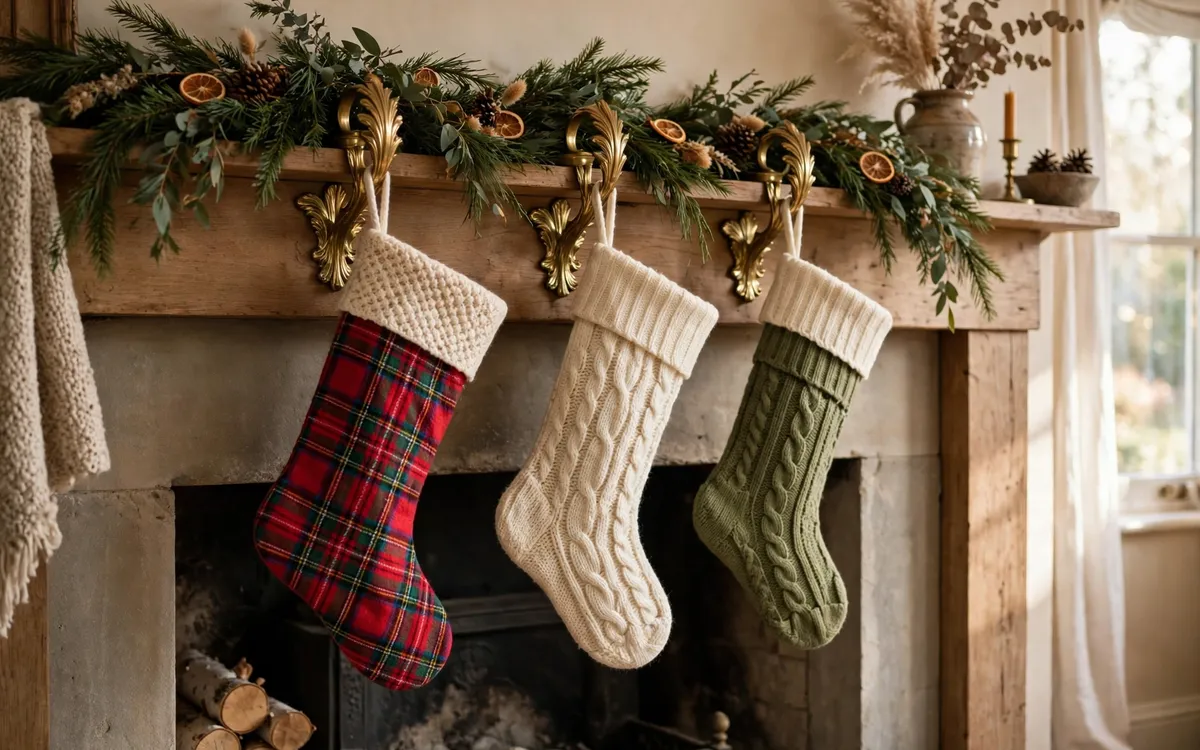
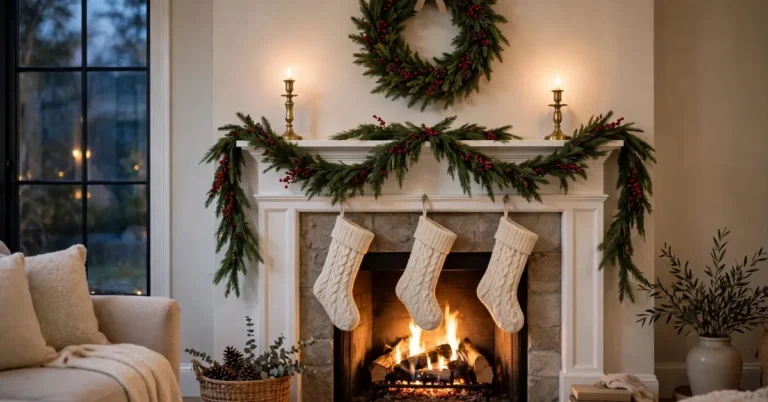
Plaid, needlepoint or knitted stockings — the patterns families actually hung — on weighted brass holders along the mantel edge. Brass suits the vintage palette twice over: it matches the candlesticks and mercury glass, and its weight quietly does the safety work of keeping a filled stocking off the floor.
Hang stockings with a little shape in them (a ball of tissue in the toe) rather than flat and sad, and keep them well back from any flame’s reach — stockings are fabric, hung at the fireplace, and deserve the respect that combination demands. Holders rated for real weight, always: a stocking on Christmas Eve is heavier than it looks in December’s first week.
10. Stand Nutcrackers in Odd-Numbered Groups

Collected figurines staged as a small guard — three or five nutcrackers of graduated height on the mantel end, a shelf or the hearth — not scattered one per room like lost soldiers. Grouping is what turns individual figurines into a collection; a single nutcracker is an object, five are a tradition with ranks.
Mix eras and uniforms freely (that is what collected means) but keep the group on one surface with space around it. Old wooden nutcrackers are decorative, not functional — never actually crack a nut in a vintage piece, whose jaw mechanism is the first thing age weakens. Dust them with a dry brush, and store them upright, wrapped, never stacked.
11. Choose Modern Bubble-Look Lights for Retro Glow
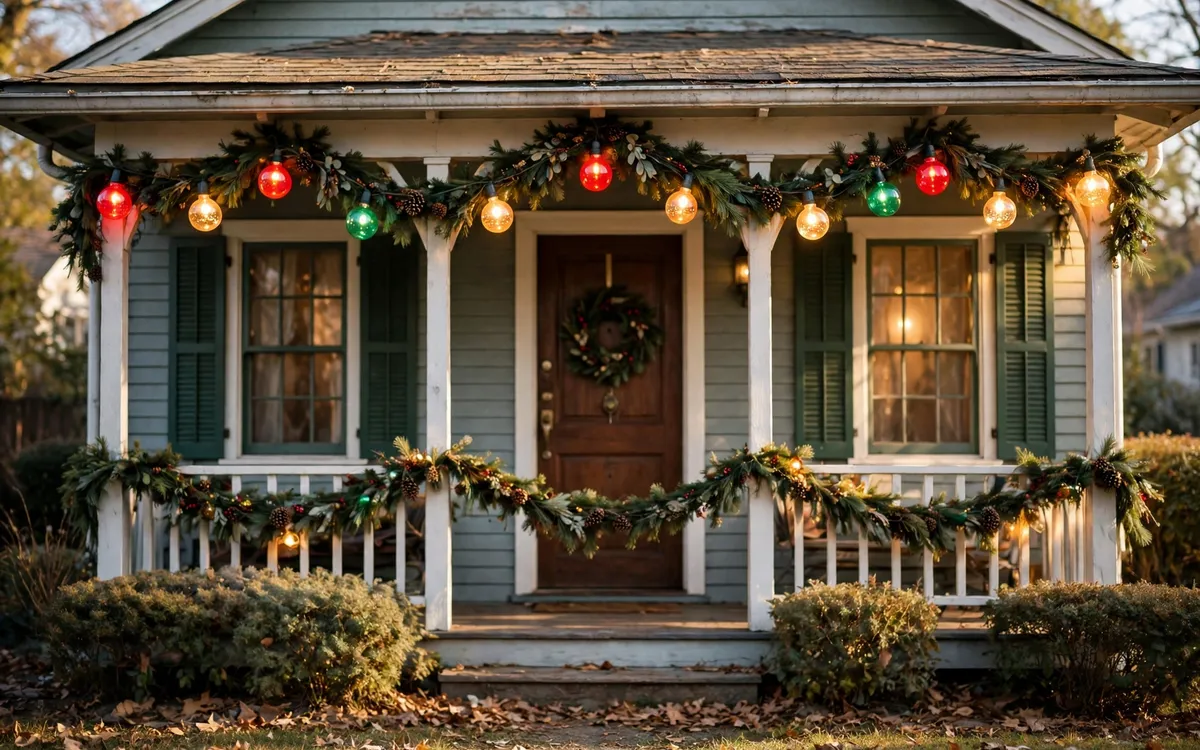
The most nostalgic light of all — the bubbling candle-shaped tubes of a mid-century tree — is available again in modern LED and properly certified sets that give the look with none of the risk. That distinction matters, and this article makes it plainly: original bubble lights and vintage light strings belong in the display-only category, admired unplugged.
Run the modern versions along the mantel garland or the tree’s inner branches, where their warm, moving glow does its period work. The safety section gives the full reasoning on old cords; the short version is that insulation perishes invisibly, and no glow is worth a perished cord inside a dry tree.
12. Set Out Thrifted Brass Candlesticks With Tapers
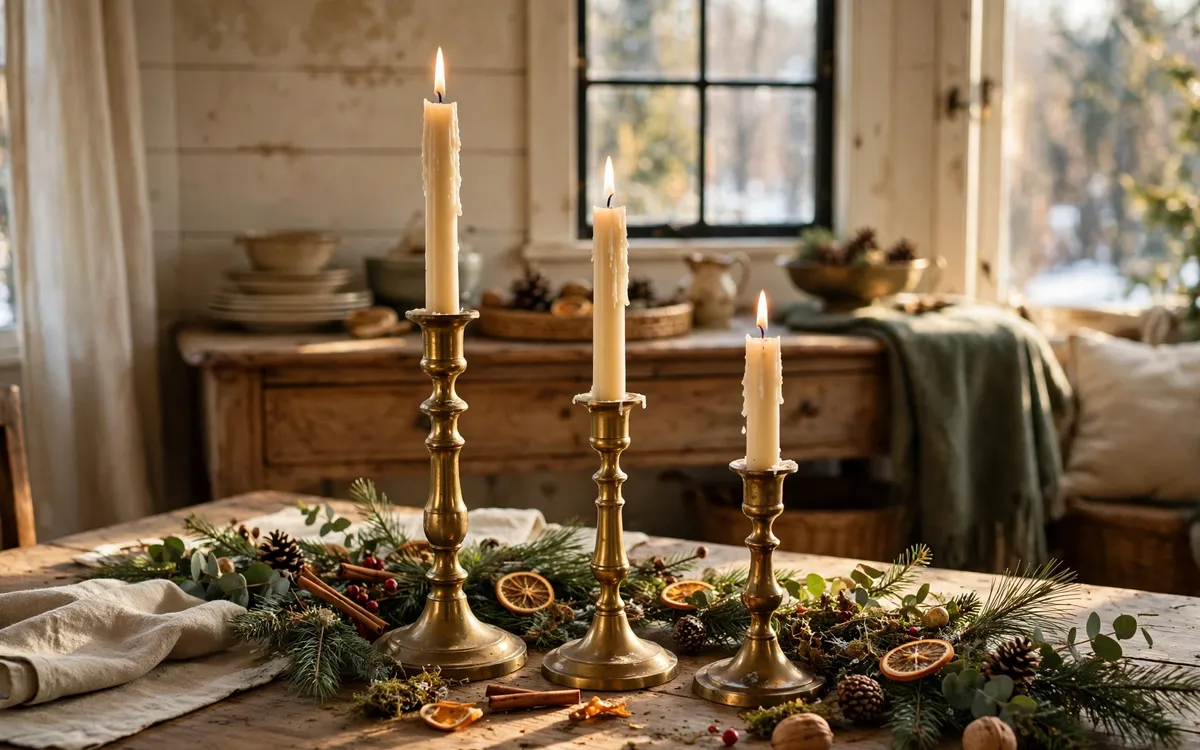
Mixed heights, mixed patinas, gathered from thrift stores one or two at a time: brass candlesticks down a mantel or a dining table, holding cream tapers. Brass is the vintage connector — it rhymes with the stocking holders, the mercury glass and the tree’s gold ornaments, so separate finds across a room read as one intention.
Do not polish them mirror-bright: the soft, uneven patina is both the value and the look, and a gentle wipe is all they want. Tapers belong in stable holders, well clear of tinsel, paper and garland, and out before bed — or choose flameless tapers and let the discipline relax. Never leave a real flame burning in a room nobody is in.
13. Lean a Vintage Wooden Sled Beside the Fireplace
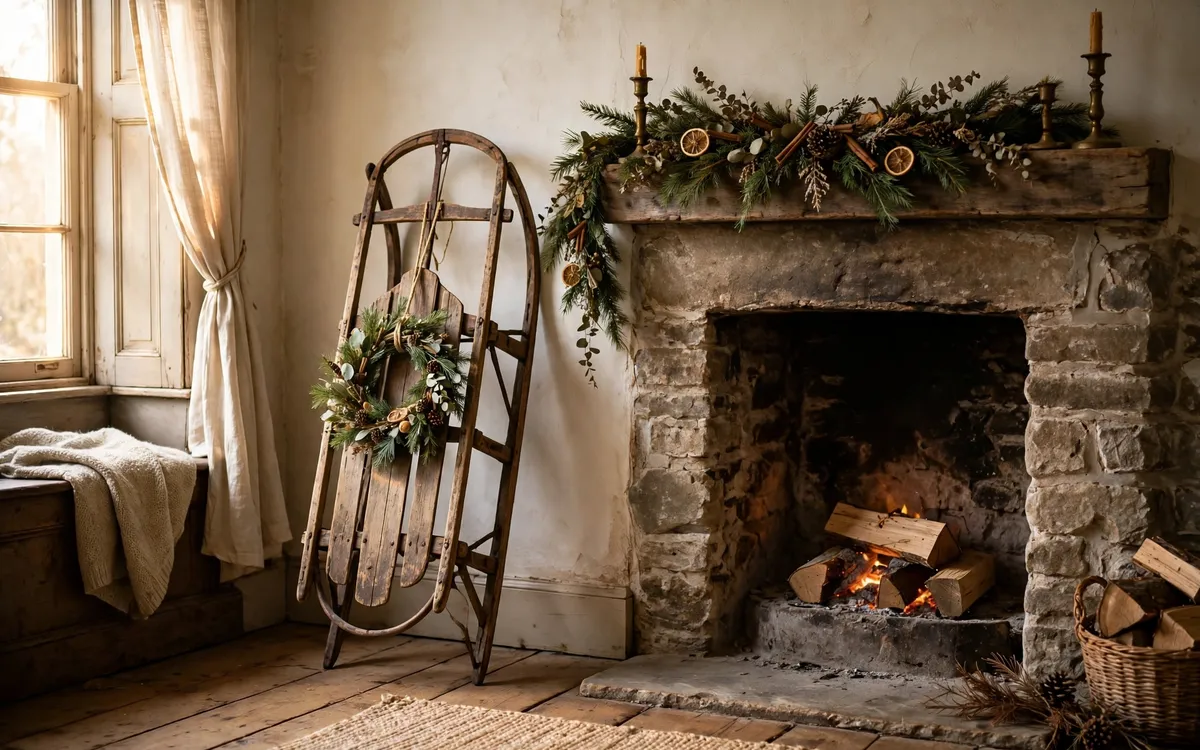
One big, honest statement piece for the room’s dead corner: an old wooden sled or sledge leaning against the wall beside the fireplace, dressed with a small wreath, a pair of old skates, or nothing at all. It is the collection’s largest syllable — the piece that tells a guest the room’s story before they have spotted a single ornament.
Check a genuine sled for sound wood and loose runners before it leans anywhere, and keep it out of the walkway — statement pieces fail the moment somebody trips over the statement. Reproductions and garden-centre versions carry the silhouette just as well; what matters is the scale and the restraint of everything around it.
14. Lay a Tartan Runner Under Collected Dinnerware

Plaid textile first, then the collected layer: mismatched-by-design vintage plates, pressed glass and brass on a tartan runner down the table’s centre. “Mismatched by design” is the skill — one shared colour or pattern family across different finds, so the table reads curated rather than cupboard-emptied.
The runner and dinnerware form the layer around the centrepiece — our christmas centerpieces build that centrepiece itself, and the two articles’ tables stack: runner, collected dishes, then the glowing middle. One honesty rule with teeth: genuine old painted dinnerware is display-only. Pre-1978 glazes can carry lead, so serve Christmas dinner on modern plates and let the antiques carry the candles.
15. Stack Vintage Cookie Tins on the Counter

Painted Christmas tins — the biscuit and sweet tins every decade produced beautifully — stacked in twos and threes on the kitchen counter: storage and display in the same objects. Their lithographed Santas, robins and snowy villages are period artwork that happens to hold biscuits.
Group them where they will not live in steam (paint and tin both dislike a kettle’s daily cloud), and keep genuinely old tins for dry, display-side storage rather than daily food use — the lead-paint caution applies to anything that touches food. Modern reproduction tins, bought once, do the daily work and age into next decade’s vintage honestly.
16. Fill a Stoneware Crock With Greenery

The utilitarian crock — grey stoneware, a maker’s stamp, a chip worn smooth — filled with evergreen branches, red berries and a rolling pin or two for company. Crocks are the vintage kitchen’s vases: heavy enough to hold tall branches without tipping, humble enough to suit every era from Victorian to farmhouse.
A crock’s weight is its virtue, but check the base for hairline cracks before trusting it with water; a cracked crock gets dry branches only, or a jar of water hidden inside it. Stoneware is also one of the safest genuine buys — no paint risk in the plain salt-glazed finishes, no wiring, nothing fragile but its own dignity.
17. Serve Cocoa From a Collection of Santa Mugs

The mug collection out of the cupboard and onto a tray or mug tree where it decorates daily: red-suited Santas, winking faces, the whole cheerful regiment, with a pot of cocoa standing by. Collections hidden in cupboards are inventory; collections on trays are decor — and this one gets used, which is the best kind.
Modern Santa mugs (reproductions of the mid-century designs are everywhere) do the drinking; any genuinely old painted mug joins the display end of the tray instead. It is the same honesty split as the dinnerware: the look is vintage, the food contact is modern. Line the mugs up in odd numbers and let the tray live on the counter all season.
18. Dry Orange Slices for Garlands and Wreaths

The oldest natural decoration in the article: orange slices dried low and slow, then strung on twine for garlands, wreaths and tree drops — translucent amber discs that glow against greenery and scent the room faintly for weeks. Slice about half a centimetre thick, blot dry, and bake on the oven’s lowest setting for three to four hours, turning hourly, until they are dry and leathery, not tacky.
Thread them with a large needle, alternating with bay leaves, cinnamon sticks or wooden beads. Fully dried slices keep a season and more in a dry cupboard; under-dried ones mould, which is how you learn the lesson once. Like all food decor they stay clear of candles and heat, and they retire to the bin, not the storage box, if they soften.
19. Turn Vintage Christmas Cards Into a Display
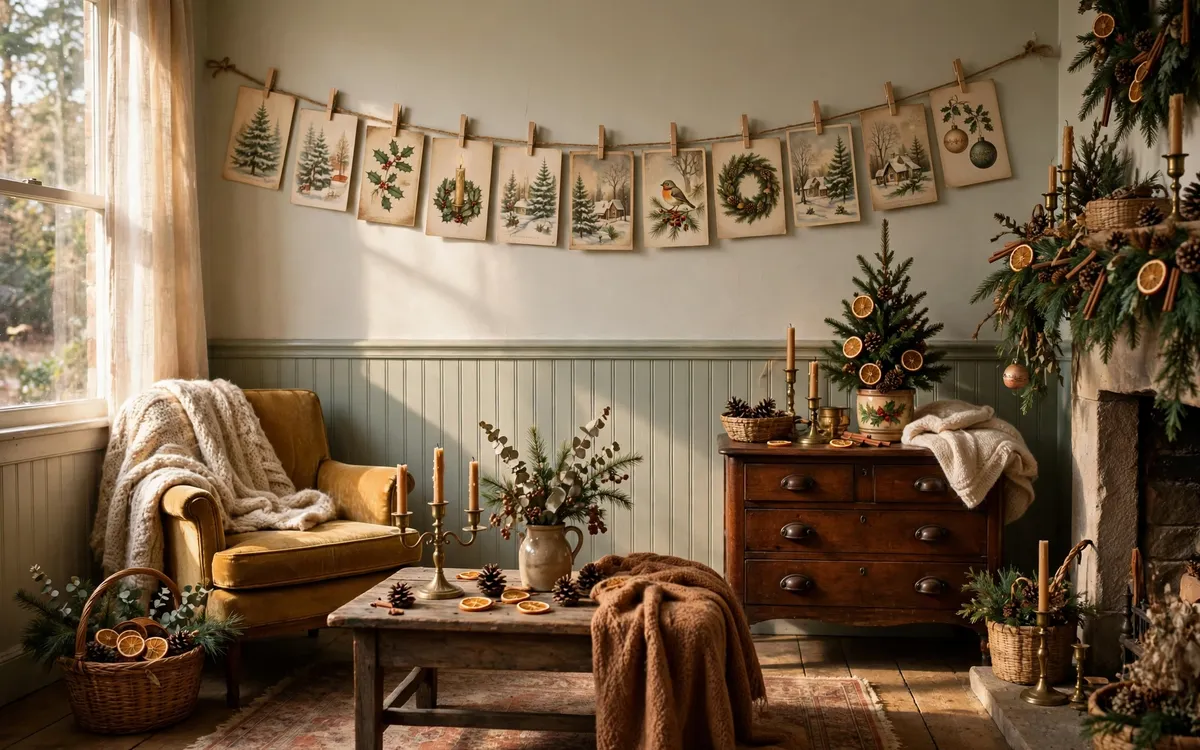
The cheapest authentic vintage art there is: Christmas cards — genuinely old ones from market stalls, and this year’s arrivals as they come — strung on a ribbon across a wall or lined along a shelf edge. Cards are period graphic design at postcard scale: robins, stagecoaches, fat Santas and lettering no modern designer would dare, all of it genuinely of its era.
String them unopened-side out on twine with small pegs, or prop them along the mantel and shelf edges where the collection already lives. Keep paper well away from candle flames and the fire’s spark range. At season’s end, this year’s cards join a labelled envelope in the box — next year’s display starts with a readymade archive.
20. Drape Plaid Wool Blankets Over the Sofa

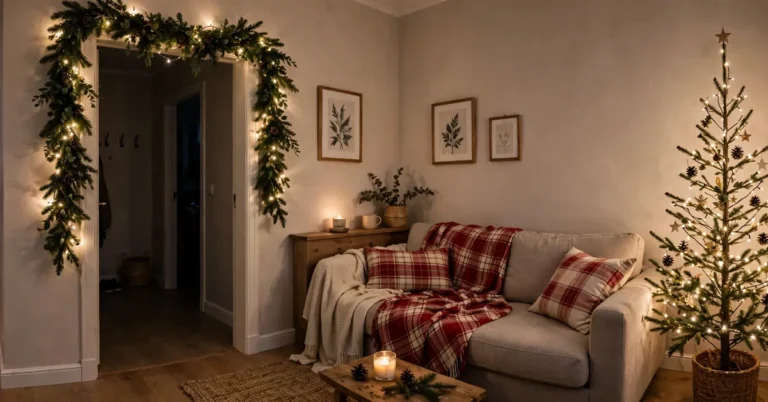
The fastest whole-room nostalgia move there is: plaid wool blankets and flannel throws layered over the sofa’s arm and back. Textiles change a room’s temperature visually before anything else registers, and nothing says collected-Christmas like tartan that looks as if it has warmed three generations — because the good ones have.
Layer two, not five: one folded over the arm, one across the back, in the room’s era palette. Genuine old wool wants a gentle airing and a moth check before its season (store it clean, with cedar, in January), and it stays off radiators and away from open flames — wool is slow to burn but the throws’ other fibres may not be. Modern plaid throws carry the look at arm’s length from the fire.
21. Make a Paper Chain Garland With the Family

Coloured-paper chains in era colours — burgundy, forest, cream and gold for the Victorian mood; bright primaries for the fifties — looped along the mantel, the banister or a doorway. The materials cost pennies, the making is an evening’s family work, and the slight irregularity of hand-glued loops is not a flaw in the vintage look; it is the vintage look.
Use a glue stick rather than tape for loops that last the season, and work in arm-length sections joined at the hanging, which spares both the chain and the family’s patience. Paper is flammable, full stop: chains hang clear of candles, bulbs that run hot, and the fire’s reach, and they come down without regret in January — their cheapness is their charm.
22. Repeat One Velvet Ribbon Everywhere
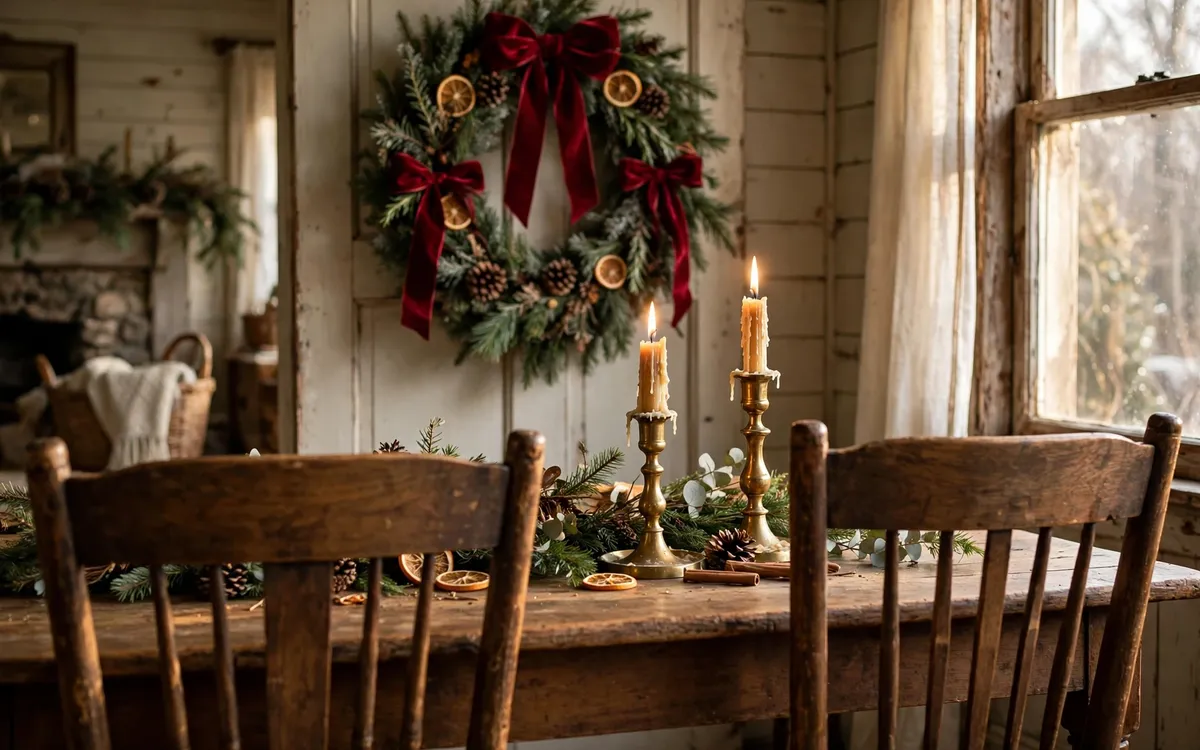
A single velvet ribbon — burgundy or forest green — tied on the wreath, the candlesticks, the chair backs, the stair newel and the gifts, so pieces collected across decades and shops read as one collection. Ribbon is the cheapest unifier in decorating: five metres of one good velvet does more for the collected look than another ornament ever will.
Choose wired velvet for bows that hold their shape, and cut lengths generously — skimpy bows look apologetic. This is also the era dial: the same room reads Victorian with burgundy velvet and mid-century with a narrower satin, so the ribbon quietly enforces the one-era rule from the system section without a single new purchase.
23. Dress a Wreath With Vintage Ornaments

A plain evergreen wreath clustered with small vintage glass ornaments and finished with the room’s velvet bow: the tree’s jewel tones echoed at the door, in miniature. Cluster the ornaments in two or three groups rather than spacing them evenly — collections gather, they do not distribute.
Wire each ornament on rather than trusting hooks (a door moves, and glass falls), and keep the most fragile pieces for the indoor face of the door or a protected wall. Our christmas wreath ideas cover wreath sizing and damage-free hanging in full — this dressed wreath is where that method meets the vintage palette.
24. Wrap Gifts in Brown Paper and Real Ribbon

Parcels under the tree styled as part of the room: brown kraft paper, plaid offcuts, real ribbon or string, and a sprig of greenery tucked under each bow. Brown paper is the vintage wrapper — it predates printed gift wrap, it costs almost nothing, and a pile of kraft parcels under jewel-toned glass ornaments is the collected tree’s natural floor.
Wrap early and let the pile build through December as decor, tagging each parcel discreetly underneath. Use the room’s one velvet ribbon on the special gifts and string or plaid scraps on the rest — the hierarchy reads as generosity, not economy. Keep wrapped gifts clear of the fireplace’s spark zone and any real candles, paper being paper.
25. Stack an Old Suitcase With Books and Greenery

The collected vignette in one stack: a worn suitcase or wooden crate pressed into service as a side table, carrying old books, a lantern and one green branch. It is the 80/20 rule made furniture — one genuinely characterful base letting a small, deliberate group of objects read as a still life instead of a pile.
Check an old suitcase for sound hinges and a clean, aired interior before it joins the furniture, and never store textiles in one that smells of attic — air it first, line it, or keep it closed as pure display. The stack also hides useful overflow: board games, the good candles, next week’s wrapping, all inside the decor.
26. Give One Precious Piece a Glass Cloche

The finale, and the smallest idea in the article: the single most fragile or meaningful heirloom — a great-grandmother’s ornament, a first Christmas bauble — displayed under a glass cloche on the sideboard or mantel. The glass protects it from dust, fingers and tails, and promotes it, unmistakably, to the room’s museum piece.
Set the piece on a small stand or a fold of velvet inside the cloche so it sits at viewing height, and let it be alone: a cloche crowds at two objects and fails at three. This is the editor’s answer to the heirloom dilemma — the most precious thing in the collection gets the most protection and the most attention, in the same gesture.
A Collected Christmas on a Small Budget
- Shop your own house and family first. Heirlooms are free, and the stories attached to them are the one thing money cannot buy.
- Buy out of season. Thrift stores and estate sales are cheapest in January; December antique-shop prices are the year’s highest.
- Collect one hero piece per year. A collected look is built over seasons — one great find beats a cart of filler every time.
- Use reproductions for the pricey icons. A modern ceramic tree or vintage-style glass set costs a fraction of a genuine original — and can actually be plugged in and handled.
- The handmade materials are the cheapest decor there is: paper chains, popcorn, dried oranges and brown-paper wrapping cost pennies per room.
- Set a per-piece ceiling before you shop, and walk away above it. Vintage rewards patience; another one always turns up.
Vintage Mistakes That Turn Collected Into Cluttered
- Mixing all three eras in one room, so it reads as a junk shop instead of a chosen decade.
- Plugging in vintage lights, ceramic trees or blow molds on their original cords — the dangerous mistake; see the safety notes.
- Hanging fragile heirloom glass on outer branch tips, or at toddler, pet and cat-swat height.
- Over-restoring: polishing brass mirror-bright or repainting worn ornaments. The patina is the value and the look.
- Covering every surface until hero pieces have no breathing room — the museum effect.
- Buying a bulk set of vintage-style filler, so that nothing in the room is actually old, handmade or meaningful.
- Serving food or drink from genuine old painted pieces — the lead risk keeps them display-only.
- Storing ornaments loose in a hot attic. Heat and crushing destroy more collections than breakage does.
Vintage Decor Safety Notes
Old electrics lead, because they are the real hazard hiding inside vintage christmas decor ideas: never run vintage light strings, ceramic trees or blow molds on their original wiring — insulation perishes invisibly with age. Have a treasured piece rewired by an electrician, keep it unplugged as display, or choose modern LED retro-look versions for anything that glows nightly.
Lead paint follows: pieces painted before 1978 may carry lead, so display them out of small children’s reach, wash hands after handling, never use old painted tins, mugs or dishes for food or drink, and do not sand or strip them indoors. Fragile silvered glass shatters into fine shards — hang vintage ornaments high and toward the tree’s inner branches, away from pet zones, and store each one wrapped, in divided boxes, in a cool dry room. Fire discipline matters because so much of this style is flammable: tinsel (especially old foil), paper chains and dried oranges all burn, so keep them clear of candle flames, hot bulbs and open fires; tapers belong in stable brass holders, blown out before bed, with flameless swaps the sensible choice near paper and textiles. Ceramic trees need their bases checked for cracks, and original hot bulbs swapped for LEDs. Food-based decor — popcorn strings, orange slices — attracts pets and pests, so hang it high and bin it after the season rather than storing it. And cleaning has one rule: no water or sprays on painted glass or silvered finishes — a dry soft brush only, or the colour comes off with the dust.
Frequently Asked Questions
What is the difference between vintage and antique Christmas decor?
Vintage means roughly 20 years old or more; antique means 100 years or more. Most pieces traded as “vintage Christmas” are from the 1940s to the 1970s — glass ornaments, ceramic trees, bottle brush trees. In practice the label matters less than condition and fit: a sound 1960s piece that suits your chosen era beats a fragile genuine antique that does not.
Where is the best place to find real vintage Christmas decorations?
Family first — attics and relatives’ cupboards hold the pieces with stories. Then thrift stores, estate sales, antique shops and online marketplaces, checking maker’s marks, paint condition and cords as you go, and never paying genuine prices for anything you cannot verify. Buy out of season when you can: January’s prices are the year’s lowest, December’s the highest.
How do I mix vintage Christmas pieces with modern decor without it looking like a museum?
Use the 80/20 rule: let modern basics carry the room, and concentrate vintage pieces in two or three focal areas — the tree, the mantel, one table. Repeat each vintage colour and material at least twice so finds echo each other, and give hero pieces empty space around them. A room that still functions as a modern room, with a collected layer on top, never reads as a museum.
Are vintage Christmas lights and old ceramic trees safe to plug in?
Not on their original cords — insulation perishes invisibly with age, and a perished cord inside a dry tree or a hot ceramic base is a genuine fire risk. Have a treasured piece rewired by an electrician, keep it as unplugged display, or buy modern LED retro-look versions for anything that glows nightly. On a ceramic tree you do use, check the base for cracks and swap hot original bulbs for LEDs.
How do I clean and store fragile vintage glass ornaments?
Clean with a dry, soft brush only — water and sprays strip the paint and silvering from vintage glass. In season, hang the fragile pieces high and toward the tree’s inner branches, away from children, pets and tails. For storage, wrap each ornament individually, use divided boxes, and keep them somewhere cool and dry — never loose in a hot attic, where heat and crushing do the real damage.
Can I get a vintage Christmas look using only new reproductions?
Yes — the icons reproduce well: ceramic trees, jewel-tone glass ornament sets, bottle brush trees, Santa mugs and bubble-look lights all exist in modern versions that carry the look at a glance. Hunt genuine where it is safe and rewarding — brass, stoneware crocks, textiles, tins — and let one or two real finds sit among the reproductions. Genuine pieces lift the whole set the way one real jewel lifts costume jewellery.
Collections grow the same way whatever they are made of — our christmas village display ideas apply the same one-piece-a-year rule to a tiny glowing town.
Burgundy velvet on a snowy tree is this article’s palette standing in branches — our flocked christmas tree ideas tie velvet bows instead of garland.
Conclusion
The best vintage christmas decor ideas fit a system of three lines: one era, three sources, 80/20 — and the patience to let a collected Christmas grow one good find at a time. Walk the finished rooms in the evening with the tree lit, and photograph each focal area. Those photos are next December’s styling plan and a record of what you own — genuinely useful when a January estate sale asks whether you truly need another brass candlestick. Store the collection in one labelled box marked “vintage — fragile”, and next year the whole collected Christmas comes back out of it, one year older and one story richer.


2 Comments