
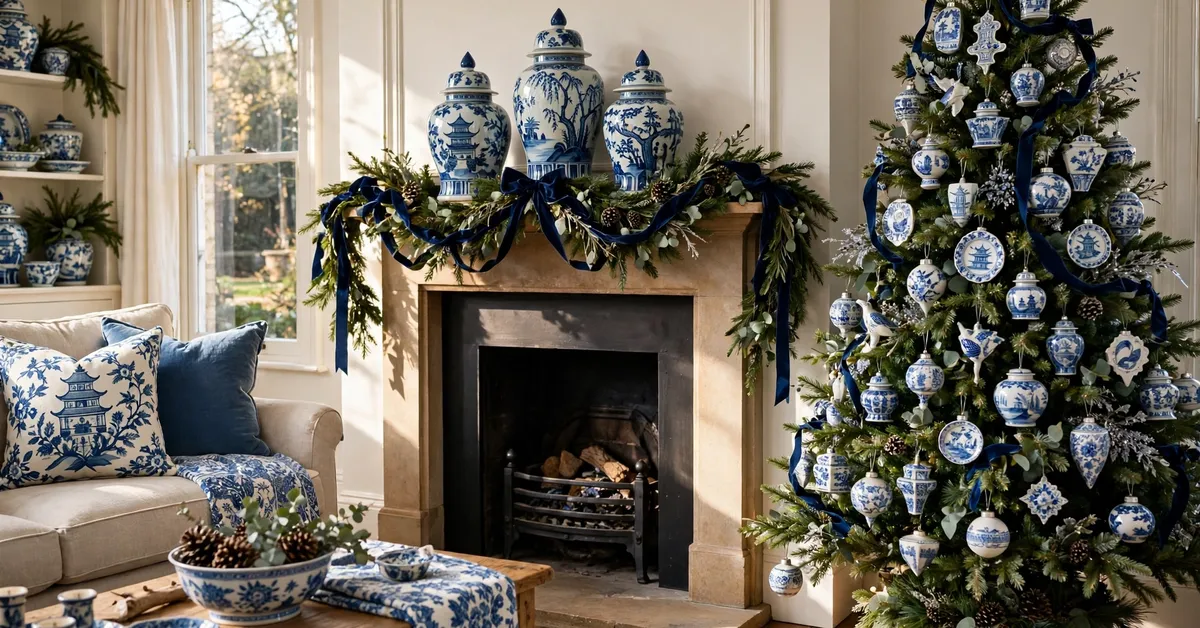
14 Chic Chinoiserie Christmas Decor Ideas for a Blue and White Holiday
Most Christmas styles are bought in December. A chinoiserie Christmas is layered — onto blue-and-white porcelain that already lives in the house all year: a pair of ginger jars on the mantel, a planter by the window, a plate wall that has been there since spring. Greenery, navy velvet and warm light do the seasonal work, and the porcelain does the rest. It is the freshest-looking Christmas in this library, and the one that costs its natural homes the least.
It is also, honestly, the easiest palette to get wrong: one lonely jar reads as an accident, five patterns at the same scale read as a headache, and the wrong accent turns a room into two Christmases at once. So this article is pattern-first: the colour formula, the repetition and pattern-scale rules, where porcelain goes (and where it must never go), and the care rules for decorating with breakables. Then come 14 chinoiserie christmas decor ideas, from the tree to the gift wrap.
Build the Blue and White Base First: The Chinoiserie Christmas System
Start With the Base You Already Own
Chinoiserie Christmas is a layer, not a purchase. Gather every blue-and-white piece in the house first — ginger jars, temple jars, planters, bowls, plates, a patterned lamp — and group them in one place so the collection can be seen whole. The anchor rule: two or three strong pieces anchor a room, whether that is a pair of ginger jars, one large vase, or a bowl that can hold ornaments. And the repetition rule that makes a theme: one piece is an accent, but the same colours in three separate places in a room is a scheme. Decorate the base first; add Christmas second. For a collector’s walk-through of building that base room by room, this blue-and-white Christmas guide shows the same base-first method in a real home.
The Colour Formula: Two Blues, One White, One Metal
State the palette as numbers and it stops drifting. Navy does the depth work — ribbon, stockings, the largest ornaments. Soft or powder blue transitions between navy and white. Porcelain white is the ground everything stands on. And one metal only — aged gold or brass — brings the warmth. Natural greenery counts as a neutral bridge, not a colour, which is why this style can carry so much of it. Lights are warm white only (roughly 2700–3000K): cool white flattens porcelain patterns and turns the whole scheme showroom-cold.
Pick One Accent — Red, Tartan, or None
This is the discipline that separates the styled rooms from the confused ones. Classic red — berries, a bow, a ribbon — is the festive accent. Tartan is the warmer, more collected accent. And no accent is the serene, all-blue version. Choose one per home, or at most one per room, repeat it at least twice wherever it appears, and never run red and tartan as equal partners in the same view: two accents means two Christmases competing in one room, and blue and white is too calm a host to survive the argument.
The Pattern Scale Rule
Chinoiserie is a pattern style, so pattern is managed by scale. In any single view, mix one large-scale motif (a big ginger jar’s painted scene), one medium scale (plate patterns, ornament motifs) and one small scale (gingham, a narrow stripe, tiny sprigs) — never two large patterns side by side. Then rest the eye: roughly a third of the pieces in any display should be solid — solid navy ornaments, plain white ceramics, unpatterned ribbon — or the pattern has nowhere to breathe and the display reads as noise, however beautiful each piece is alone.
Place Porcelain Like It Can Break — Because It Can
The placement method follows from the material. The heaviest pieces live low and on stable surfaces — under the tree, on consoles and sideboards — never teetering on a mantel edge. Pairs flank for symmetry, which is this style’s native grammar. On the tree, porcelain-look ornaments obey the weight rule: heavy ceramic pieces on the lowest, sturdiest branches only, hung on ribbon loops or wired firmly, while lightweight patterned pieces (wood, tin, resin-look) do the upper tree. Genuine antiques — a real antique ginger jar is a collector piece, and most homes will build this style on thrifted and reproduction porcelain instead — go in the safest spots in the house, out of the bump zone entirely.
1. Dress the Tree in Porcelain-Look Ornaments
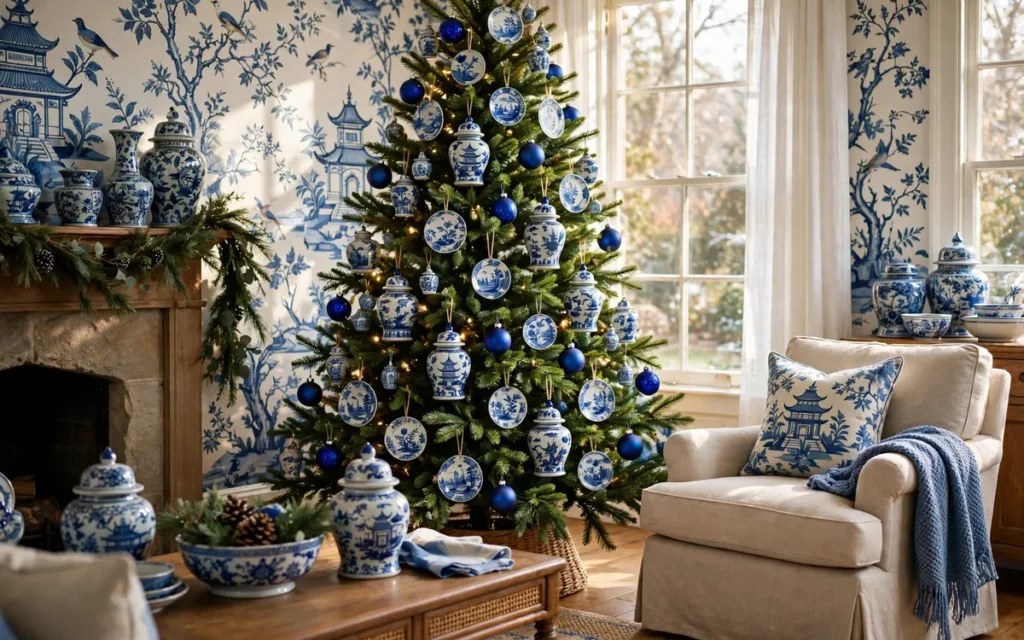
The signature tree: ginger-jar ornaments, mini plate ornaments and painted floral baubles, mixed with solid cobalt pieces so the pattern can rest. A tree of nothing but patterned ornaments buzzes; the solids are what let the eye land on the jars. Keep the metal to brass and gold, the ribbon to navy, and the tree reads as porcelain come to life.
The dressing order is the one our christmas tree decorating ideas set out — biggest pieces deep, groups of three and five, topper last — with one adaptation layered on top: weight. Heavy ceramic ornaments hang low on the sturdiest branches, wired or ribbon-looped, and the light patterned pieces take the upper tree. Sort the ornaments by weight before the first one is hung, not after the first one falls.
2. Layer Navy Velvet and Gingham Ribbon
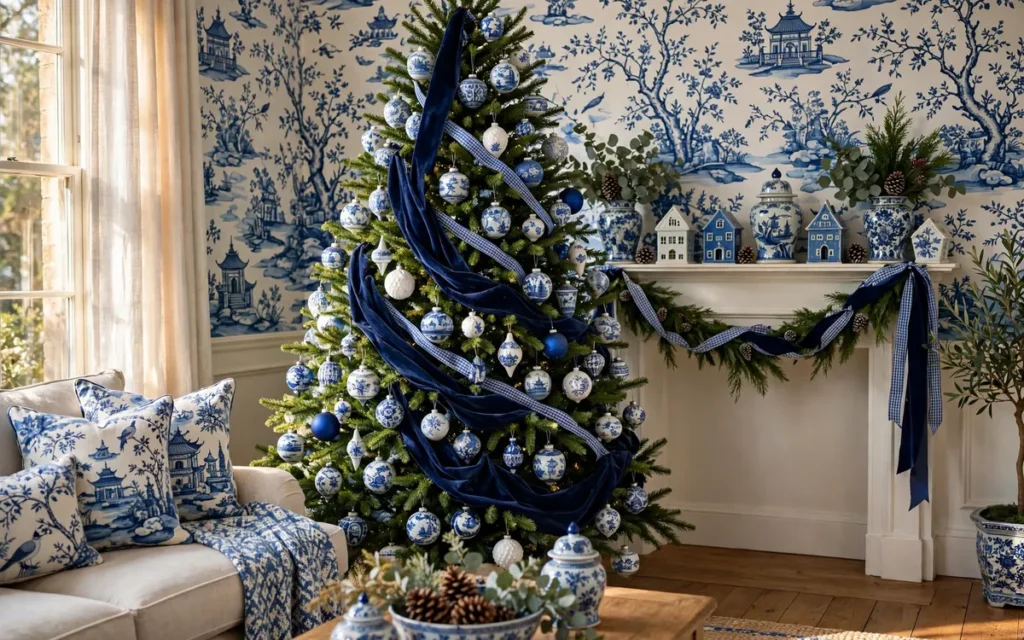
Two ribbons, two scales — the pattern scale rule demonstrated on a single tree. Wide navy velvet moves in loose vertical folds as the strong colour layer: it is the formula’s depth colour in the room’s richest texture. Narrow blue gingham is tucked in smaller loops and bows as the small-pattern layer, the sprig scale that keeps the big jar patterns company without competing.
Vertical folds suit this tree better than swags: they echo the plate wall’s order and the jars’ upright shapes, and they leave more green (and more pattern) visible between them. Velvet first, gingham second, ornaments last — each layer placed with the previous one already in view.
3. Set a Mini Tree in a Ginger Jar
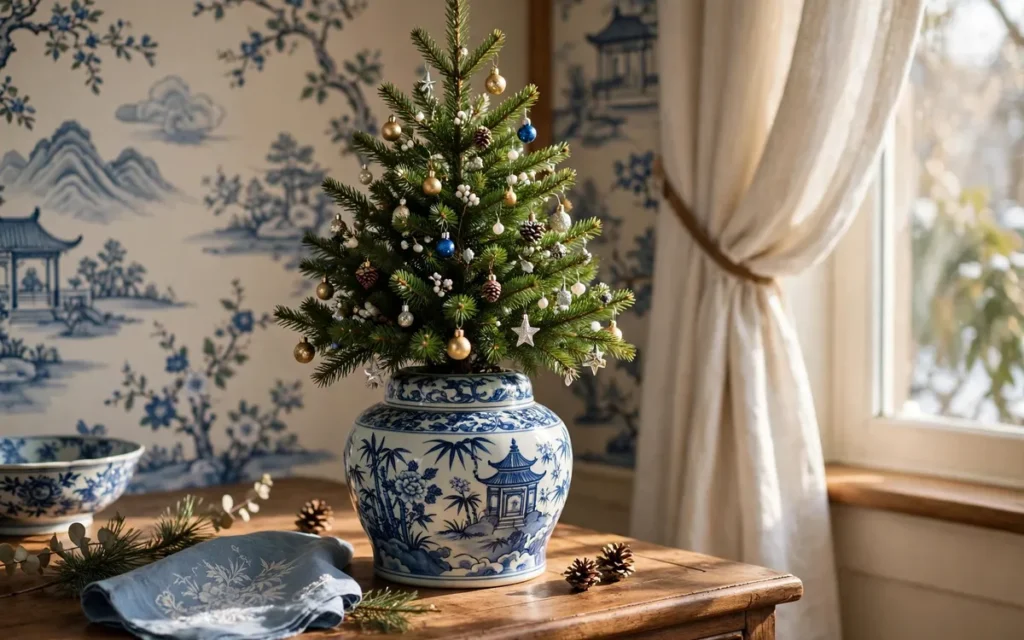
The whole style in one object: a small tabletop tree standing in a ginger jar or a blue-and-white planter, dressed with mini ornaments and a tassel or two. It is the small-scale try-out of the entire article — the formula, the scales, the accent — on a windowsill, a desk or a side table, at a price that lets a household test whether blue-and-white Christmas is for them.
Weight the jar if the tree is top-heavy (a little gravel or sand in the base settles it), and keep the mini tree’s own scheme to two colours so it reads as a miniature of the big tree rather than a separate idea. A pair of these, flanking a mirror or a doorway, is the style’s symmetry in its cheapest form.
4. Stage Ginger Jars Beneath the Tree

The base layer: a grouping of ginger jars at the tree’s foot, among and behind the gifts, echoing the ornaments hanging above them. A chinoiserie tree is one of the few that gets better at the bottom — the jars give the tree a foundation of actual porcelain, and the eye travels jar, gift, jar, ornament, jar, all the way up.
The framing follows the same finishing logic as this library’s snowy-tree base rules in our flocked christmas tree ideas — the base is half the photograph, and gifts are wrapped to the palette rather than against it. Keep the largest jar slightly off-centre and the group uneven: beneath a tree, a collected cluster beats a rigid line.
5. Flank the Mantel With Ginger Jars
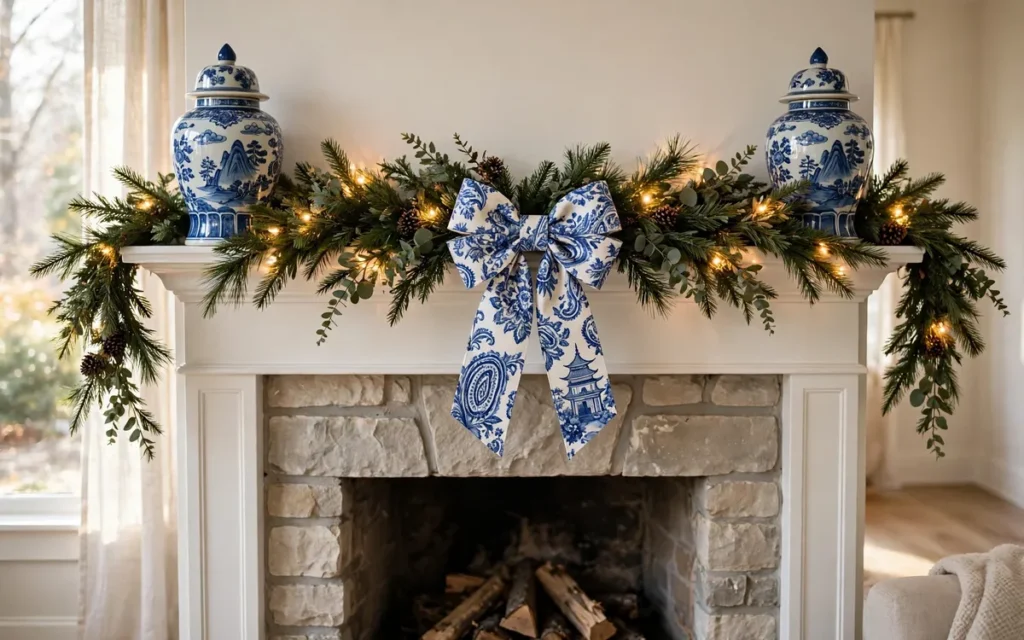
The style’s classic symmetry: a matched pair of ginger jars, one at each end of the mantel, with the garland and warm lights running between them and one blue-and-white bow at the centre. The mantel becomes the room’s pattern anchor — the largest, calmest statement of the scheme — and every smaller blue-and-white moment in the room is a quotation of it.
Jars sit back from the mantel’s front edge, always: a mantel is a walked-past, reached-across surface, and porcelain at its edge is porcelain on a countdown. If the pair is unmatched, flank with two jars of similar height and let the garland’s symmetry do the pairing — at garland distance, height reads louder than pattern.
6. Hang Navy Velvet Stockings With Blue-and-White Bows
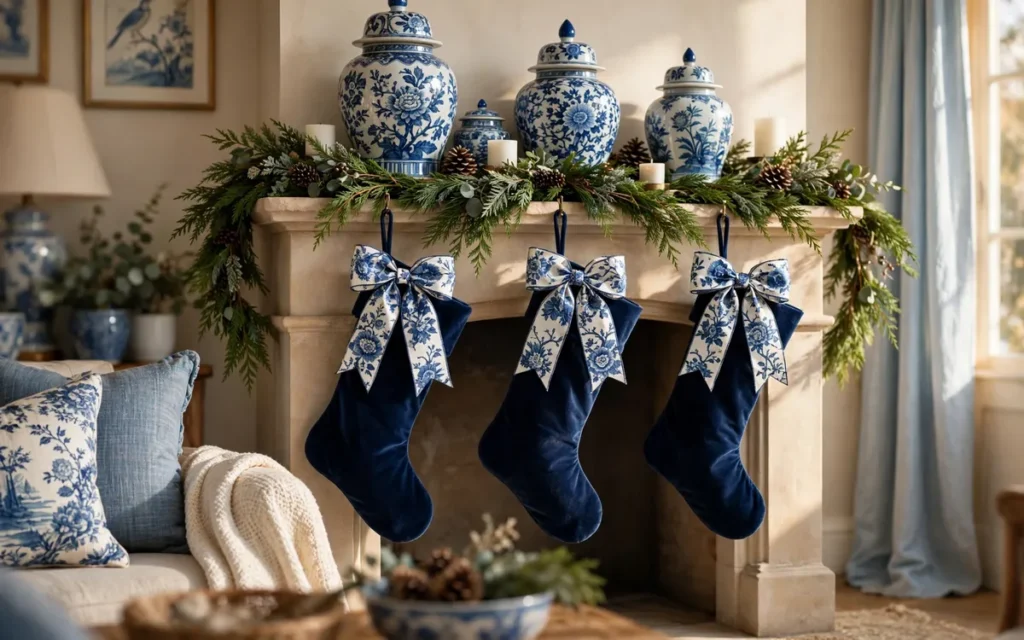
Navy velvet stockings — the formula’s depth colour in the room’s softest texture — each tied with a blue-and-white floral or gingham bow where it hangs. Stockings are usually where a room’s scheme goes to die (every household’s are different, most are red); here they are drafted into the pattern system instead, carrying navy down the mantel and the small-pattern scale with them.
Use holders rated for a full stocking’s weight and hang the stockings with a little shape in them. Velvet near a working fireplace follows the usual rule: stockings hang to the side of the fire’s reach, well back from flame and spark, and flameless glow nearby beats real candles on a stockinged mantel every time.
7. Make a Plate Wall the Christmas Backdrop
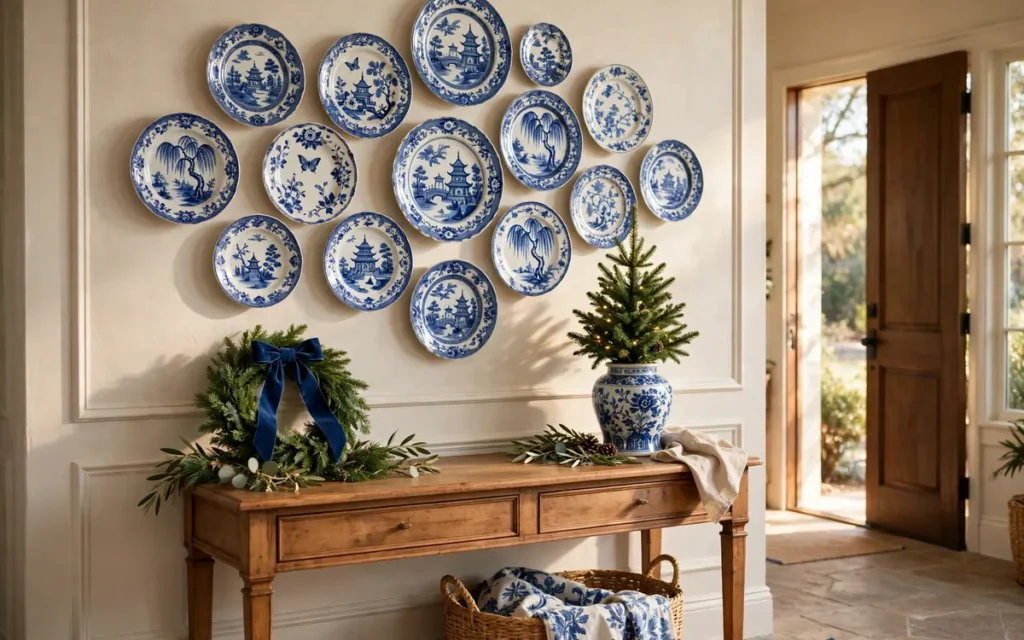
Many blue-and-white homes already own this display and do not know it: an existing plate wall becomes the Christmas backdrop the moment a small wreath with a navy bow hangs at its centre, or a mini tree in a ginger jar stands on the console beneath it. The wall does the decorating; Christmas just points at it.
Check the plate hangers before the season (the safety section explains why) and add nothing heavier than the wreath to the wall itself. A plate wall’s gift to Christmas is that it needs so little: one wreath, one bow, warm light from the room — and a wall that was spring decor becomes the most photographed corner of December.
8. Build a Ginger Jar Table Centerpiece
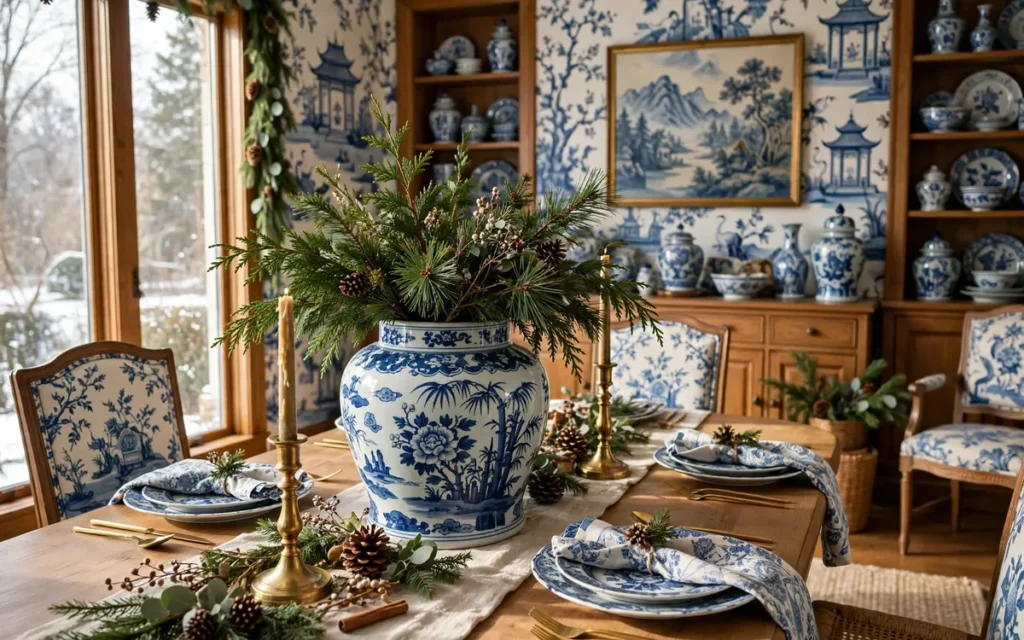
A ginger jar or a large blue-and-white vase filled with cedar, pine or magnolia, standing at the table’s centre, flanked by brass candlesticks and a patterned bowl of ornaments. It is the style’s tablescape anchor: one large-scale pattern, height from the branches, the meal’s colour story told before a plate is set.
The method underneath the style is the one our christmas centerpieces teach — height that keeps sightlines open across the table, a footprint that leaves room for dishes, candle clearance respected — with the chinoiserie layer simply choosing what the centrepiece is made of. Fill the jar with water-heavy branches and it is also the most stable centrepiece in this library.
9. Style a Blue-and-Gold Coffee Table Vignette
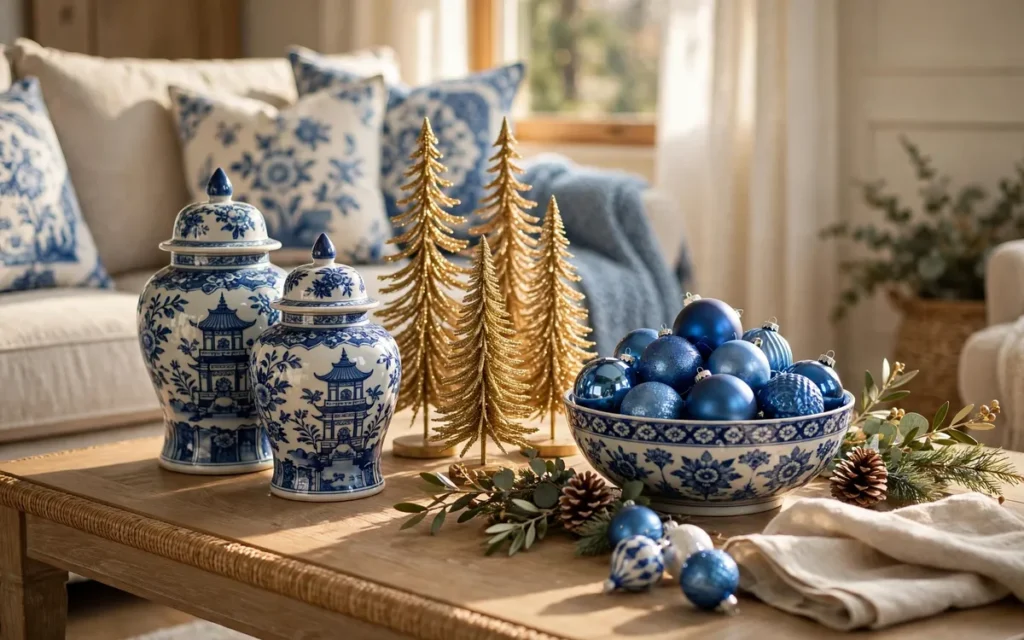
Porcelain, metal and pattern in one contained display: ginger jars grouped on the coffee table with small gold trees and a blue-and-white bowl of ornaments. A tray underneath turns it into a single lift-away arrangement, which matters on the hardest-worked surface in the house — the vignette moves for board games and comes back in one piece.
Keep the group to odd numbers and mixed heights, and let the gold be the table’s only metal. A coffee table is also a bump zone, so this is a display for reproductions and sturdy pieces; the best jar watches from the mantel instead.
10. Set the Table in Layered Blue and White
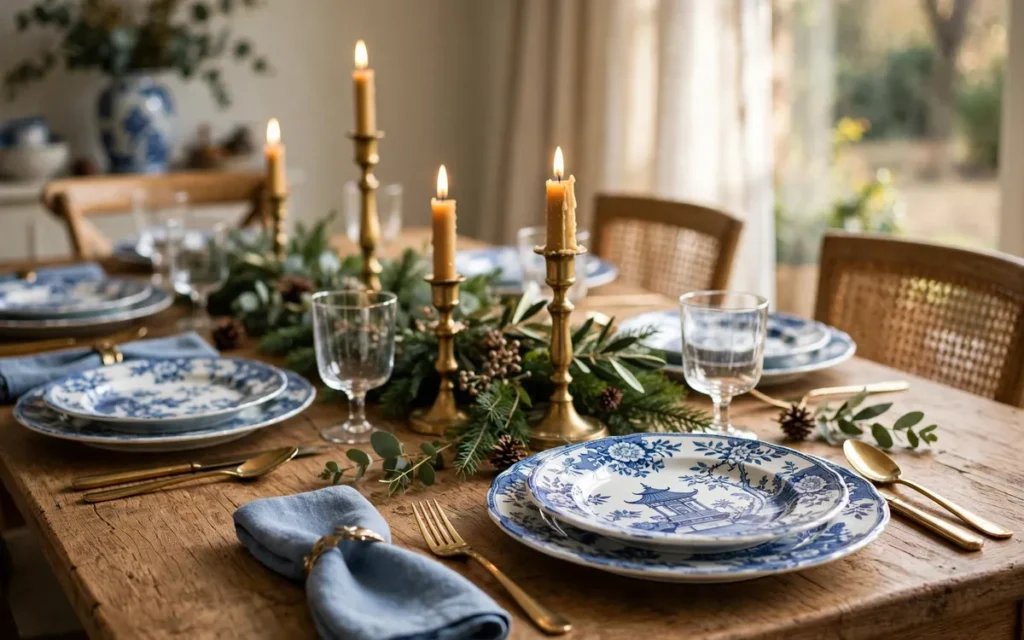
Pattern mixing taught at place-setting scale: blue-and-white plates layered pattern on pattern — a larger motif under a smaller one, same colours throughout — with a floral or greenery runner down the table’s centre and brass as the only metal in the flatware or candlesticks. Between the patterned layers, solid napkins and plain glassware rest the eye: the pattern scale rule, eaten off.
Genuinely old plates are for looking at, not serving on (the safety section gives the food-contact reason), so the antique plates can stand as chargers or lean in the display while dinner itself is served on modern dishes. The table loses nothing — the pattern is present at every place, and so is the meal’s safety.
11. Put Planters to Work in the Kitchen
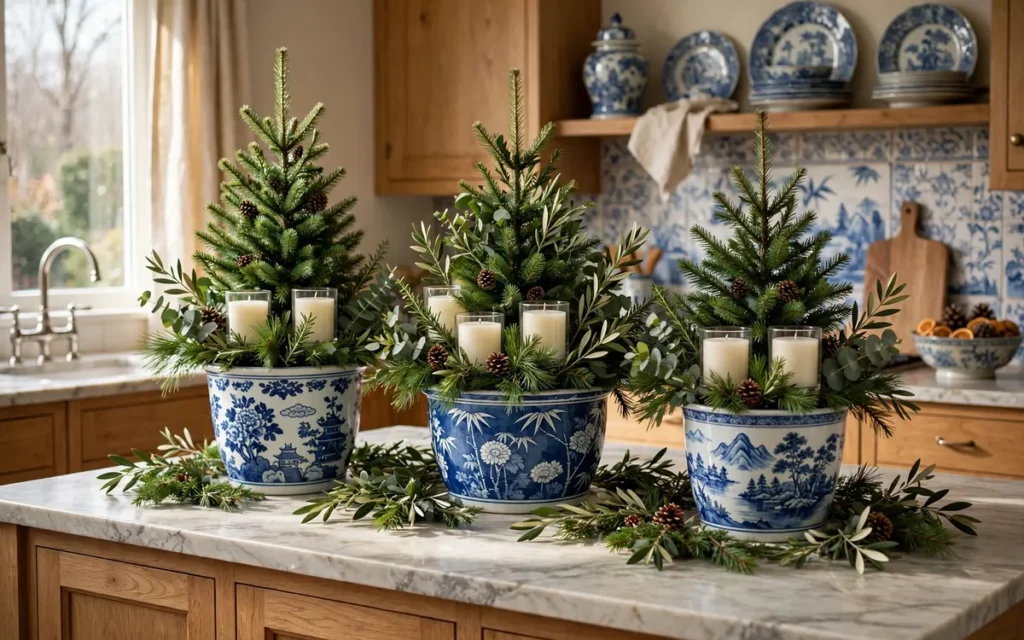
The kitchen is where porcelain already lives, so its Christmas comes from containers rather than clutter: blue-and-white planters holding mini trees, herbs or flameless candles along the island or counter. A planter is a jar that was already earning its place; dressed, it becomes the room’s whole decoration.
Keep planters clear of the hob’s steam and splash zone and out of the prep path — a working kitchen’s counters are spoken for. Flameless candles only near the cooking side, and the mini trees small enough that no branch reaches a flame, a knife block or a boiling pot’s steam.
12. Welcome Guests at a Chinoiserie Console
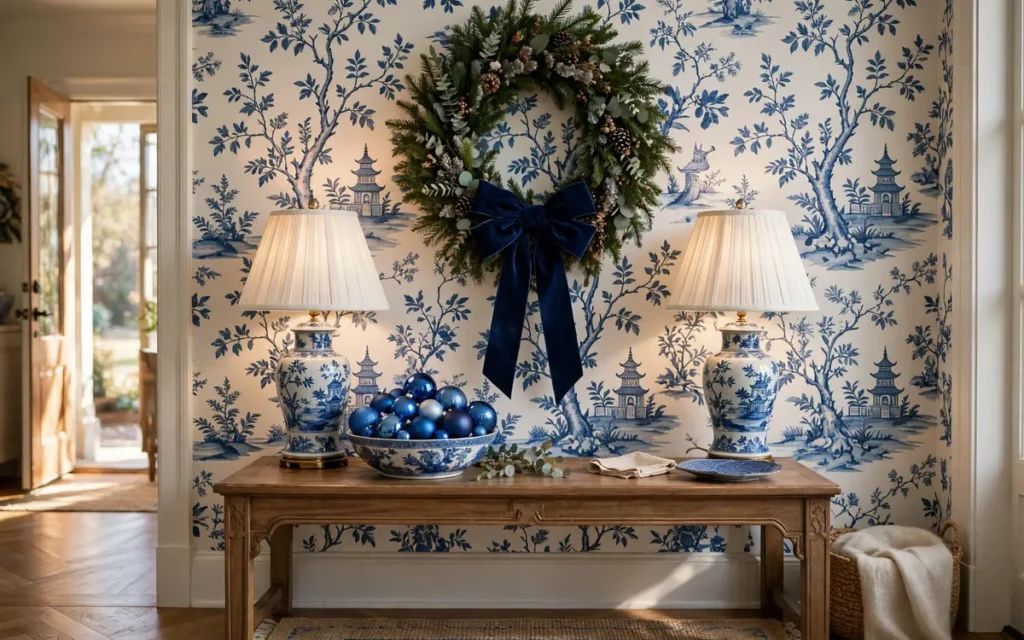
The entryway moment: a pair of blue-and-white lamps or jars on the console, a small bowl of ornaments beside them, and a wreath with a navy bow on the wall above. The palette is announced at the door, in the style’s own grammar — a pair, a pattern, one bow — before a guest has seen a single other room.
The console obeys the measurement system our christmas entryway decor ideas set out: a shallow surface kept mostly clear, the walkway fully open, one focal point rather than a crowd. In an entryway the bump-zone rule applies double — coats, bags and umbrellas swing here — so the console’s porcelain stands against the wall side, out of the swing path.
13. Warm the Blue With Tartan and Red Berries
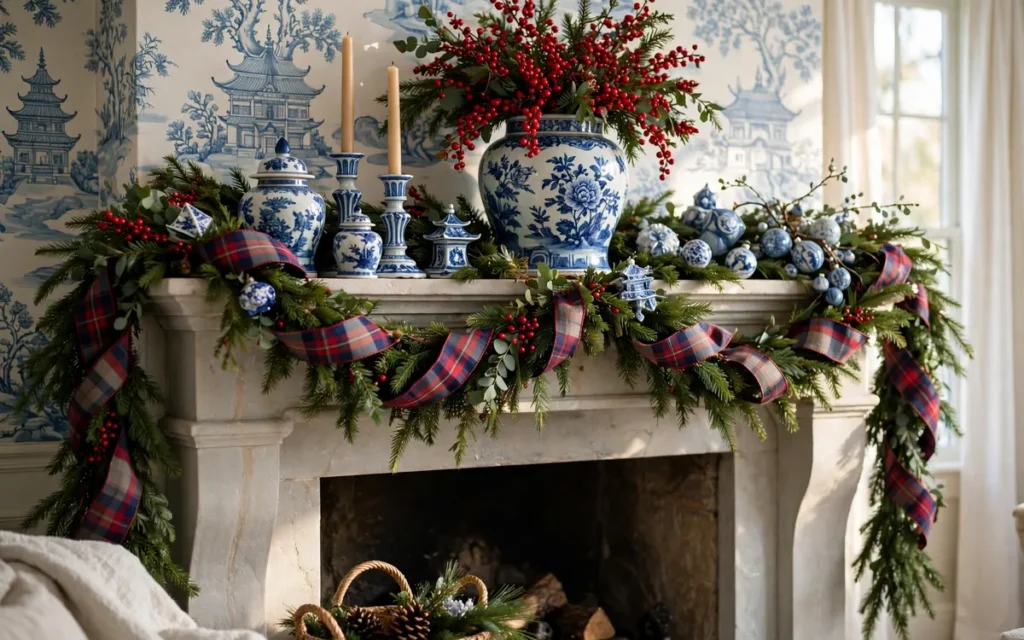
The accent idea, with its rule applied visibly: choose one. Tartan ribbon woven through the mantel garland gives the warmer, collected version — pattern answering pattern, with the tartan’s own reds and greens kept as a whisper inside the plaid. Or red berries and a red bow worked through the tree gives the classic version, the one that says Christmas loudest. What this idea never does is both at once.
Whichever accent is chosen, repeat it at least twice in the room and let brass, velvet and greenery carry the rest of the warmth. This is the idea that answers the style’s most common fear — that blue and white will feel cold — and the answer is not more colour; it is one warm note, played twice, over a warm-lit room.
14. Wrap the Gifts in Blue Gingham and Navy

The floor layer, kept in pattern: parcels wrapped in blue gingham, navy and white, tied with navy or brass-toned ribbon, stacked beneath the tree and beside the fireplace. In this style the presents are not a pause in the scheme — they are its small-scale pattern, the gingham layer, spread across the floor.
Gingham wrap is inexpensive, forgiving to wrap with (the checks hide every imperfect corner), and available in exactly the palette’s blues. Mix in solid navy and white parcels at roughly the pattern rule’s ratio — a third solid — so the pile under the tree rests the eye the same way the tree itself does.
A Porcelain Look Without Antique Prices
- Start with the blue-and-white pieces already in the house — this style is a layer on what exists, so the first room can cost nothing but greenery and ribbon.
- Thrift stores, estate sales and resale listings are full of porcelain and porcelain-style pieces; a mismatched jar in the same colours still obeys the formula.
- Reproductions carry the pattern honestly: modern porcelain-style jars, planters and ornaments give the motif at a fraction of antique prices — save genuine antiques for one hero pair, if any.
- Buy in pairs only where symmetry is the point — the mantel, the console. Singles and odd groups are cheaper everywhere else.
- The cheapest pattern layers are paper and fabric: gingham wrap, navy ribbon and one velvet ribbon dress a whole room.
- Ornaments first, furniture never: a set of porcelain-look ornaments plus ribbon converts an existing tree — no blue furniture or rugs required, and January-you will be grateful.
Chinoiserie Mistakes That Break the Blue and White Spell
- Running two accents at once — red ribbon and tartan and gold tinsel — until the room holds two or three competing Christmases.
- Mixing patterns all at one scale, so every motif shouts at the same volume and the display reads as noise.
- Using cool-white lights, which flatten the porcelain patterns and turn the warmest room showroom-cold.
- One lonely ginger jar with no repetition — a single piece is an accident, not a scheme; the motif needs three placements.
- Hanging heavy ceramic ornaments on high, weak branches, where they swing, slip and smash.
- Placing genuine antiques or the best jars in the bump zone — mantel edges, low tables in toddler and pet traffic.
- Pattern on every surface with no solids to rest the eye — the room becomes a fabric shop, not a Christmas.
- Skipping the greenery: blue and white without green reads as a china cabinet, not a holiday.
Chinoiserie Christmas Safety Notes
Breakables lead, because chinoiserie christmas decor ideas are built on heavy glazed ceramic: keep the largest jars and any genuine antiques low, on stable surfaces, back from edges, and out of the rooms’ traffic paths — and in homes with toddlers or pets, the good porcelain lives up high inside a display, on a plate wall or a top shelf, or not at all, with reproduction pieces taking the reachable spots. On the tree, weight is the rule: heavy ceramic and porcelain-look ornaments hang only on the lowest, sturdiest branches, on ribbon loops or wired firmly — never on a thread loop near a branch tip — and anything irreplaceable does not go on the tree at all. Plate walls need hangers rated for each plate’s actual weight, checked before the season, since a falling plate is heavy and sharp and usually lands on something else fragile.
Candles need one caution: use flameless candles inside or beside greenery and patterned holders rather than open flame near garland, and never leave a real candle burning in a ceramic holder that has hairline cracks, because heat finds them. Food contact carries the antique rule: older painted and gilded ceramics can have glazes that are not food-safe by modern standards, so genuinely old plates, bowls and jars are display pieces — serve Christmas dinner on modern dishes and let the antiques hold ornaments and branches instead. The electrical standards are unchanged: inspect light sets before they go near fabric ribbon and paper wrap, keep cords off the walkways to the console and the tree, and switch lit displays off before bed. Finally, storage is next year’s safety: porcelain wrapped individually, jars stored upright and never stacked, plates kept in padded vertical storage — a chinoiserie collection survives for decades only if January is gentle with it.
Frequently Asked Questions
What is chinoiserie Christmas decor?
Christmas decorating built on chinoiserie — the long European tradition of Chinese-inspired design: blue-and-white porcelain patterns, ginger jars and temple jars, pagoda shapes, painted florals and landscapes. The Christmas layer — greenery, ribbon, ornaments, warm light — is added to a blue-and-white base that, in a chinoiserie home, usually stays in the room all year round.
What colours go with a blue and white Christmas?
The base formula is navy, soft blue and porcelain white, with aged gold or brass as the one metal and natural greenery as the bridge between them. Beyond the base, pick a single accent if you want one: classic red, or tartan. Never both at full strength in the same room — one accent repeated is a scheme; two accents competing is an argument.
How do I start a chinoiserie Christmas if I don’t own any ginger jars?
Start with two or three anchor pieces, not a collection: one pair of porcelain-style jars or planters, or a single patterned bowl — thrifted and reproduction pieces carry the pattern without antique prices. Porcelain-look ornaments and navy ribbon on the tree are the cheapest first layer of all. And remember the repetition rule: the motif only needs to appear in three places in a room to read as a scheme.
Can I mix chinoiserie with traditional red or tartan Christmas decor?
Yes — it is one of the most popular ways to wear the style, and the rule is one accent, repeated. Red berries and a red bow worked through the blue and white, or tartan ribbon woven through the greenery. Both accents at once, at equal strength, splits the room into two Christmases; either one alone makes the blue and white feel more festive, not less.
How do I keep a blue and white Christmas from feeling cold?
Warmth is added in four places: warm white lights, never cool white, which flattens the patterns; brass or aged gold as the metal; soft textures — velvet ribbon and stockings, a wool throw on the nearest chair; and generous greenery, which is the palette’s natural warmth. Candlelight, real or flameless, does the rest — a blue room lit warmly never reads cold.
Where should ginger jars go at Christmas?
Wherever the style needs an anchor: in a pair flanking the mantel or a console, grouped beneath the tree, filled with winter branches as a table centerpiece, or holding a mini tree on a side table. The practical half of the rule matters as much as the styling half: the heaviest jars go low, on stable surfaces, back from edges — and genuine antiques go in the safest spots in the house, out of the bump zone.
Conclusion
The best chinoiserie christmas decor ideas fit in three lines: build the blue-and-white base, obey the formula (two blues, one white, one metal, one accent at most), and place porcelain like it can break. Underneath it sits the style’s quiet bargain: for the homes it suits, this is the Christmas that costs least, because the foundation was already standing in the room before December arrived. Photograph the finished rooms before the season ends — next December, that photograph is the decorating plan and the collection record in one. Then wrap the porcelain individually and store it upright and unstacked: next year, the blue and white is already home, waiting for its greenery.






One Comment