
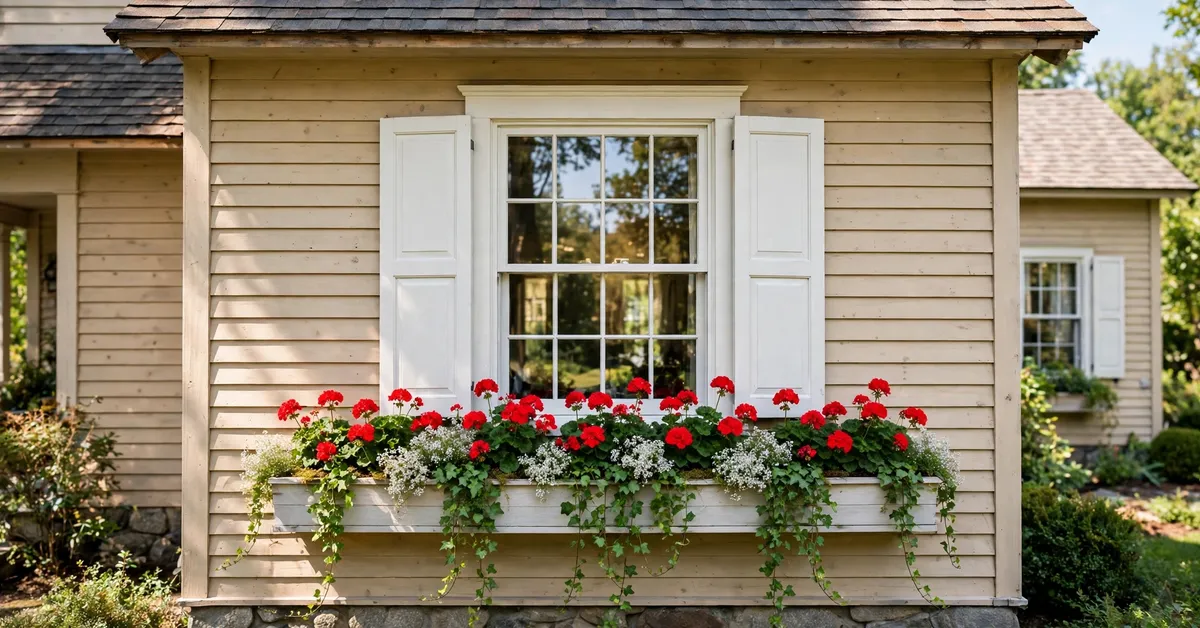
16 Elegant Window Box Flower Ideas That Fit the Window They Hang On
Most window boxes are bought the way they are photographed: a pretty box, a flat of flowers, and no measurement taken anywhere. Then the box arrives shorter than the window, gets hung on two screws driven into the siding, and spends its first summer either parched or slowly working loose. These window box flower ideas start at the other end, with the tape measure. A window box is hardware first and a planting second — sized to the window’s trim, bracketed for the weight of wet soil, and only then filled with flowers.
That order is the whole secret, because the two halves of the job live on different clocks. The box and its brackets are bought once and stay on the wall for years; the planting inside them is the layer that changes. It is read off the hours of sun that particular window actually gets, and it rotates with the seasons — pansies in the cool months, annuals through the summer, mums and kale in fall, evergreen structure in winter. Fit the box once, properly, and every later change is a short replant instead of a rebuild.
The Method: Size It, Mount It, Plant It
Three decisions, in order, before a single flower is chosen — because a window box fails in predictable places: in the sizing that never happened, in the mounting that was never asked to carry wet soil, and in the planting that was copied from a photograph of somebody else’s sun.
Step 1 — Size It: Measure the Trim Before the Box
The window is measured before the box is shopped for, because the box is bought once and every later number reads off it. The governing measurement is the window’s outside trim width: the box runs the full width of the trim or slightly longer — up to about 8 inches longer on a window without shutters, and tucked under shutters for up to a third of the shutter width where shutters frame the window. Shorter than the trim is the one size that is always wrong; it reads as an afterthought from the street. The cross-section is a class, not a guess — a standard box stands about 8 inches tall (extra-large boxes reach 10) and holds 6 to 8 inches of soil, the depth most flowering annuals ask for. Retail lengths run in classes — 24, 30, 36, 48, 60 and 72 inches — and the makers print the soil each class holds, about 3.5 gallons for a 36-inch box and about 5 gallons for a 48-inch, so the mix is bought by volume rather than by hope. Then measure your own window and your own shortlisted box: the classes are the guides’ and makers’ ranges, and the tape is the authority.
Step 2 — Mount It: Hang It for Wet Soil, Not Shop Weight
The box is mounted for the weight it will carry wet, not the weight it has in the shop. A filled box is a planning class of roughly 10 to 15 pounds per foot of length once watered, derived from the makers’ soil capacities — so the operative instruction is simple: fill the box on the ground, lift it, and know the real number before a single hole is drilled. Placement is set by the window’s own mechanics. The box hangs 1 to 2 inches below the sill of a double-hung or sliding window, and 6 to 8 inches below the frame of a casement or awning window, so the outward-swinging sash clears the plants. The span rule is two brackets set 2 to 4 inches in from each end, with a third bracket in the centre of any box longer than 48 inches, because a long span sags under wet soil. The fixings go into structure — studs, solid backing or masonry anchors — never into siding alone, and the wall behind the box is kept dry with a liner and a small air gap. The placement heights and bracket rules in this step are the same discipline set out in Sensible Digs’ window box hanging guide, which works through the bracketed and no-drill routes side by side.
Step 3 — Plant It: Read the Sun, Then Rotate by Season
The planting is the swappable layer, and it is read off the window, not off a photograph. First the sun: a window’s hours are observed before its colours are chosen. Six or more hours is the full-sun class — geraniums, petunias, calibrachoa; part sun takes the middle list; and a shaded window is planted with the shade class — begonias, impatiens, coleus, ferns — instead of being asked to perform a sun photograph. Every box is then built on the one container formula: an upright thriller at the back, fillers through the middle, spillers over the front edge, spaced at container density — about 6 to 8 inches between centres for annuals, 4 to 6 for small herbs — off each plant’s label. That rotation is what these window box flower ideas are built around: the box and its brackets are the fitted layer and stay, while the planting rotates by season — pansies in spring and again into early winter, the summer annuals in the warm months, mums and ornamental kale in fall, dwarf evergreen structure in winter — so the fitting is bought once and only the planting is ever re-bought.
Zone A — Size the Box to the Window
Four sizing decisions come before any mounting. They take one measuring session, and every later choice — the bracket, the soil bag, the plant count — reads off the numbers they produce.
1. Match the Box Length to the Trim
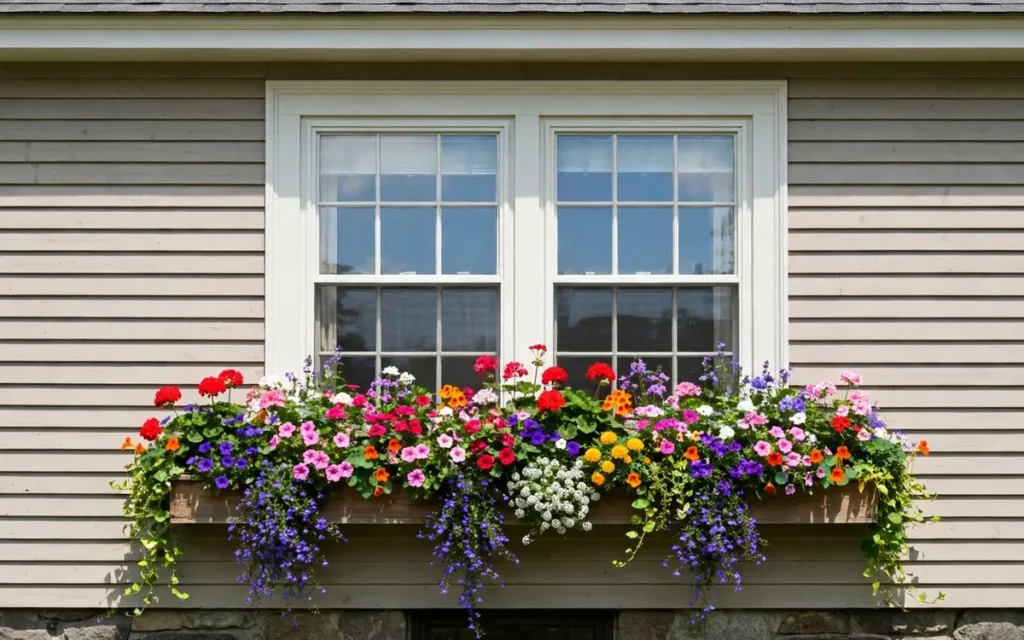
The box runs the full outside trim width or slightly longer: up to about 8 inches longer on a window without shutters, and tucked under shutters for up to a third of the shutter width where shutters frame it. Retail lengths run in classes from 24 to 72 inches, so there is always a class at or just past the trim. Shorter than the trim is the size to refuse — it reads undersized from the street at any planting quality.
2. Buy Soil Depth Before Extra Length
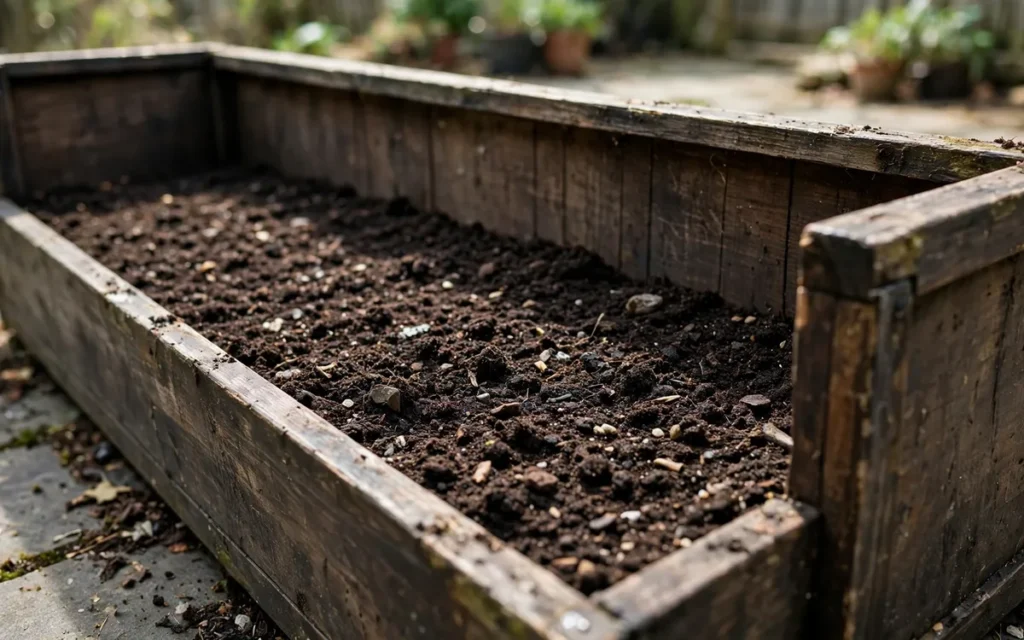
The cross-section decides what can grow. A standard box stands about 8 inches tall — 10 in the extra-large class — and holds 6 to 8 inches of soil, the depth most flowering annuals need. A shallow, pretty box is a watering sentence: its small volume dries first and gives roots the least room. When the budget forces a choice between a longer box and a deeper one, depth wins.
3. Count the Soil Before You Buy the Box
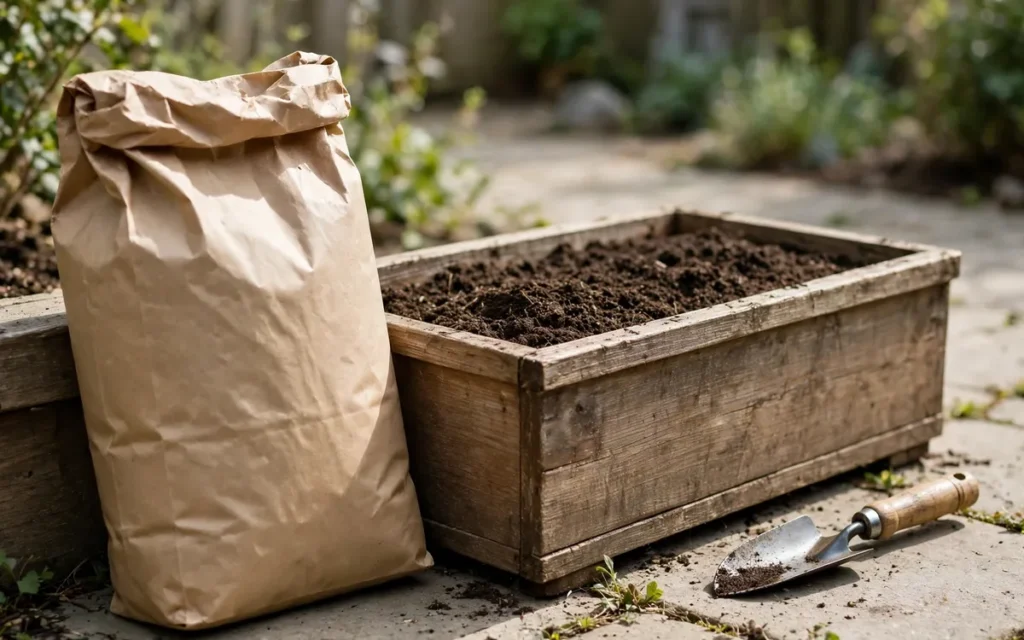
The makers print the volume, so use it: about 3.5 gallons of soil in a 36-inch box, about 5 gallons in a 48-inch. Buy the mix against that figure instead of guessing at the till, and fill to about an inch below the rim, so watering settles down into the soil rather than washing it over the front of the box.
4. Pick the Material by Its Weight and Its Upkeep
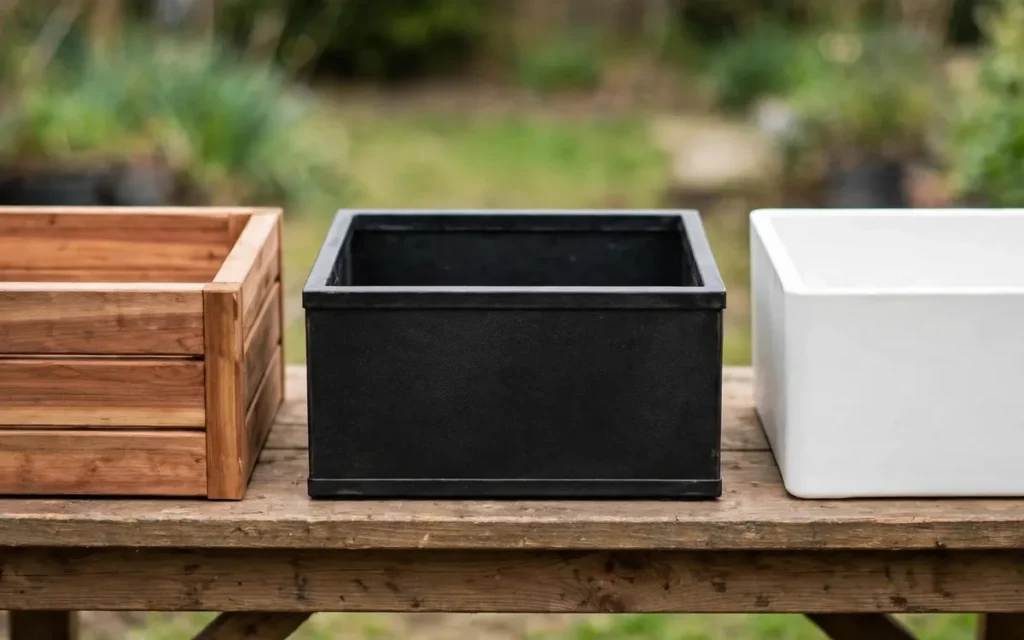
The box itself is part of the load: a moulded 36-inch box weighs about 13 pounds empty, and its 48-inch version about 17 — before a drop of water. Wood rots and asks for a liner, metal heats roots in full sun, and resin and fibreglass stay light and rot-free. The material is chosen against the wall’s sun and the brackets’ rating, not against the photograph.
Zone B — Mount It to Carry Wet Soil
Four mounting decisions carry the whole weight of the article — literally. A box that is sized well and planted well still fails if it hangs crooked, hangs on the wall’s skin, or slowly soaks the siding behind it.
5. Set the Height by the Window Type

Mount the box 1 to 2 inches below the sill of a double-hung or sliding window, and 6 to 8 inches below the frame of a casement or awning window, so the sash swings out over the plants without crushing them. The mounting height is a mechanical clearance, not a styling choice — settle it before a single bracket position is marked.
6. Bracket by the Span, Not by the Pair in the Packet
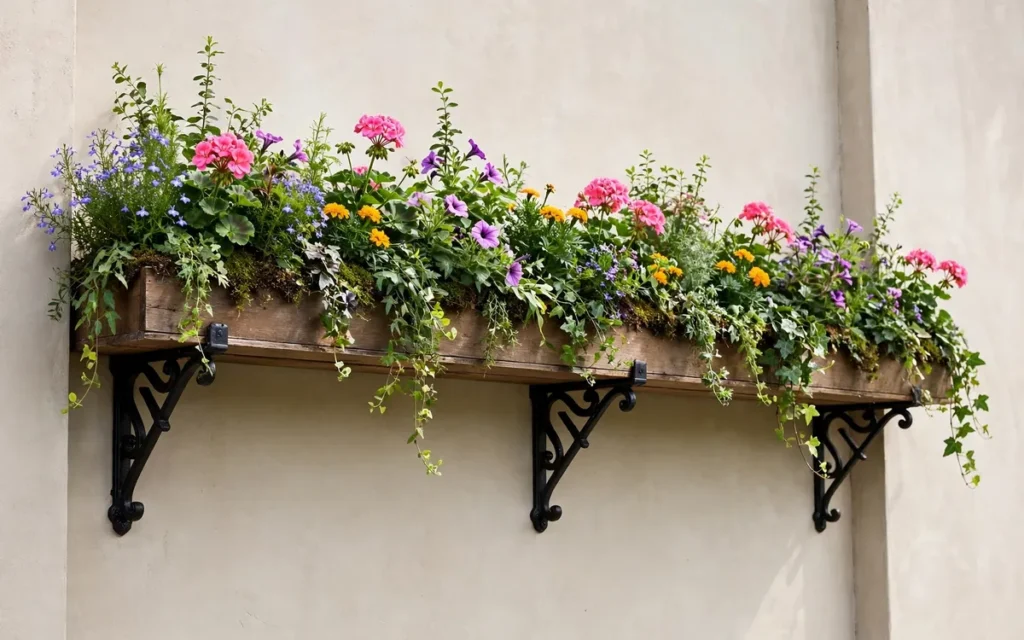
Two brackets, set 2 to 4 inches in from each end, carry a standard box; any box longer than 48 inches takes a third bracket in the centre, because a long span sags under wet soil. Level the line before drilling, too — a box that hangs crooked waters crooked, and one end drowns while the other bakes.
7. Fix Into Structure, Never Into Skin
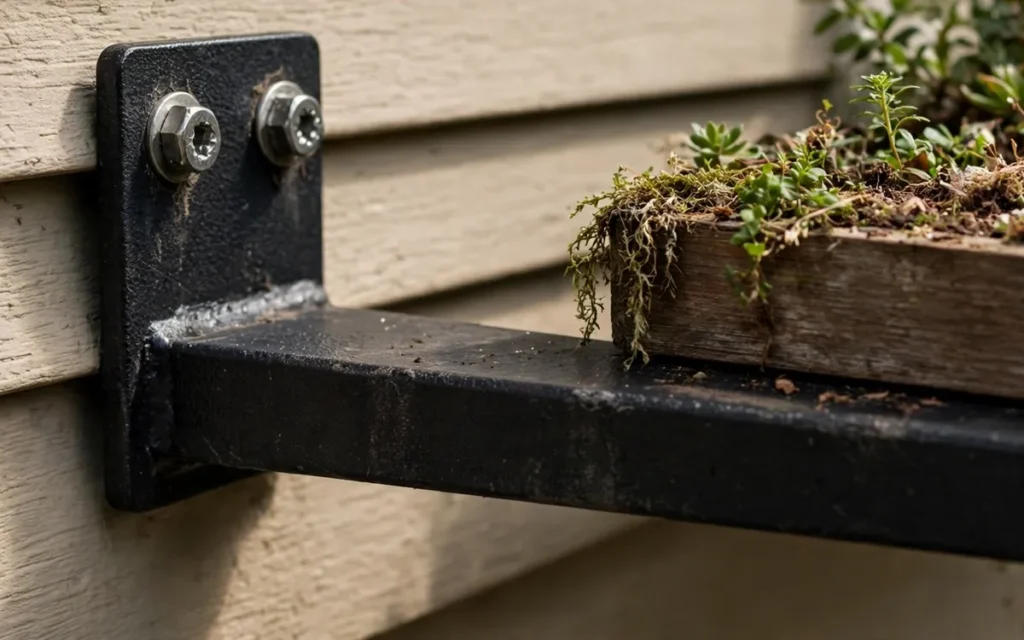
Screws land in studs, solid backing or masonry anchors sized to the filled weight. Siding alone is a skin, not a structure, and a box hung on it works loose as the soil drinks and dries. Renters and vinyl walls take the graded alternatives inside their printed ratings — most vinyl siding hooks rate at roughly 5 to 12 pounds each, which keeps a no-drill box under about 15 pounds once filled and watered — and the lease or HOA check comes before any drilling. It is the same rules-first discipline our apartment patio privacy ideas apply at ground level: read what the home allows, then hang accordingly.
8. Keep the Wall Dry Behind the Box

Fit a liner inside the box, leave a small air gap between box and wall, and keep the drainage holes along the box’s base open — about one per foot, never sealed by the liner — so overflow runs clear of the siding instead of down it. The wall is part of the fitting: a stained, damp wall is a failed box, however good the flowers look from the street.
Zone C — Plant It by the Sun It Actually Gets
With the box fitted, the planting is read off the window itself — its hours of sun, its place in the front’s one palette, and the label spacing that decides how many plants the box honestly holds.
9. Read the Window’s Hours Before Its Colours

The sun classes are the planting brief. Six or more hours is full sun — geraniums, petunias, calibrachoa, verbena. The part-sun middle takes geraniums, pansies, calibrachoa and herbs. Shade takes begonias, impatiens, coleus and ferns. One day spent watching the wall beats any assumption, because the same house usually has all three windows on it.
10. Build Every Box as Thriller, Filler, Spiller
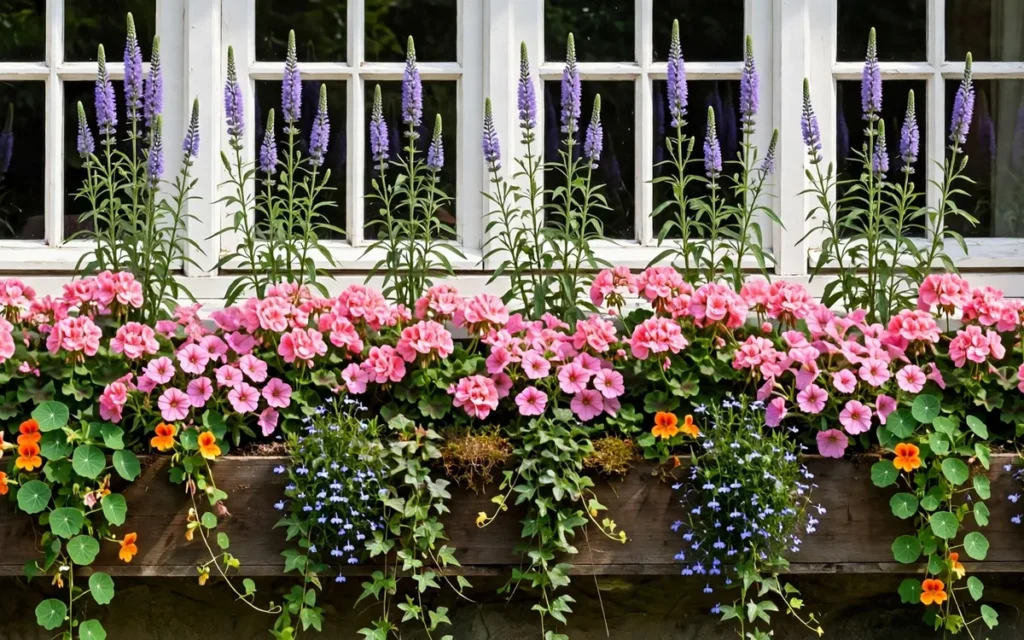
Apply the container formula in the box’s own depth: one upright plant at the back for height, mounding fillers through the middle for body, and trailers at the front edge to break the box’s hard line. A box planted in one flat layer reads as a shelf of pots; the three layers are what make the same plants read as a planting.
11. Space by the Label, at Container Density

Set annuals at about 6 to 8 inches between centres and small herbs at 4 to 6: a 24-inch box takes roughly 6 to 8 small-to-medium plants across its staggered rows. Containers are planted tighter than beds for a full look sooner — and the trade is stated honestly: tighter planting drinks and feeds faster, so the density is bought knowing its watering cost.
12. Give the Front Windows One Palette, Repeated
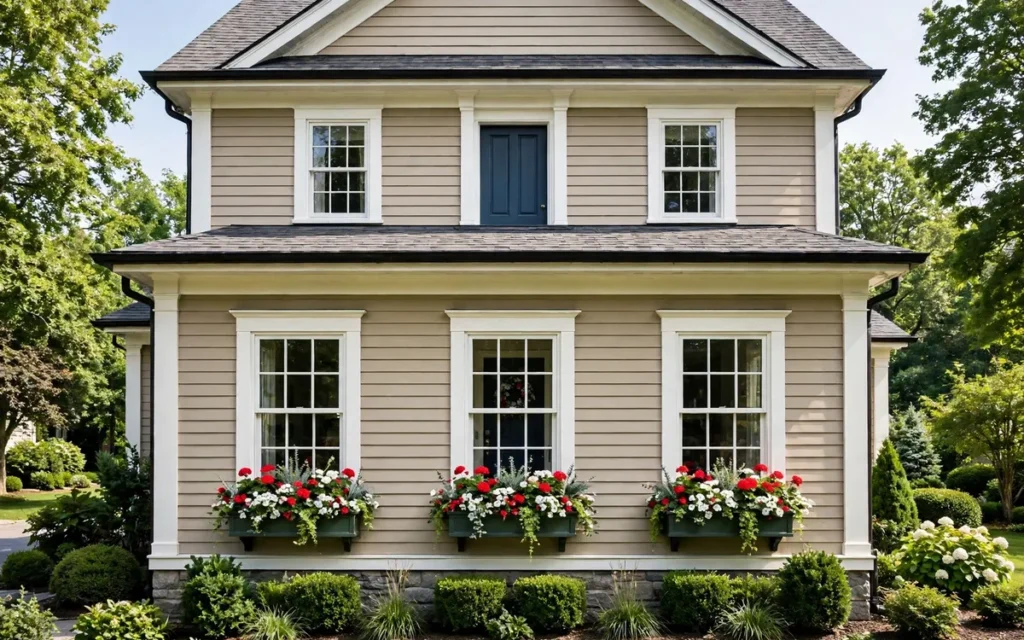
Choose one main colour, one supporting colour and green to fill, then repeat the scheme box to box across the front. The windows flank the door that our front door decor ideas dress, and door and boxes read as one street-facing system. A different scheme at every window reads as five accidents; one palette, repeated, reads as a house that was designed.
13. Plant the Kitchen Window as a Herb Box

The working version of the same fitting: thyme, oregano, parsley, basil, rosemary and chives in the box outside the kitchen window, at the small-herb spacing of 4 to 6 inches, under the same sun rule — most kitchen herbs want the sunny classes. It is the one box in this article that gets harvested, and it earns its brackets every week of the season.
Zone D — Keep It Alive and Swap It by Season
The last three ideas are the box’s life after planting day: the watering its small volume demands, the seasonal rotation that keeps the fitted layer earning its brackets, and the small upkeep loop that carries a planting from one swap to the next.
14. Water by the Box’s Small Volume
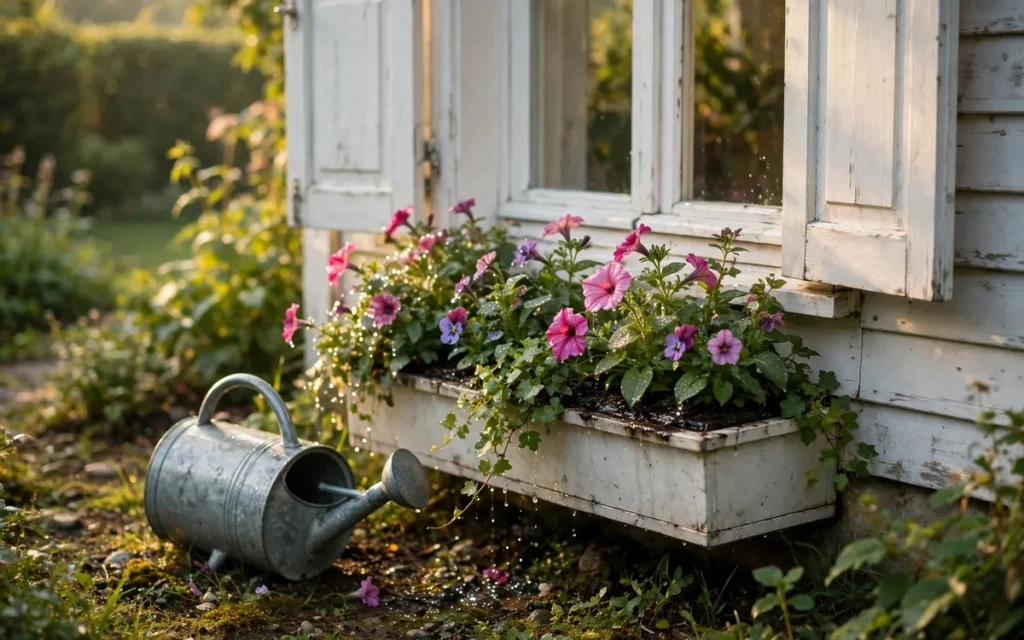
A few gallons of soil held against a sunny wall is the fastest-drying planting in the garden. In heat, check daily — a finger in the top inch; dry means water. Where a daily round is impossible, the self-watering class of box, its reservoir sitting under the soil (makers rate the reservoir on a 36-inch box at roughly 2.5 to 3 gallons), is the honest upgrade.
15. Rotate the Planting, Not the Box
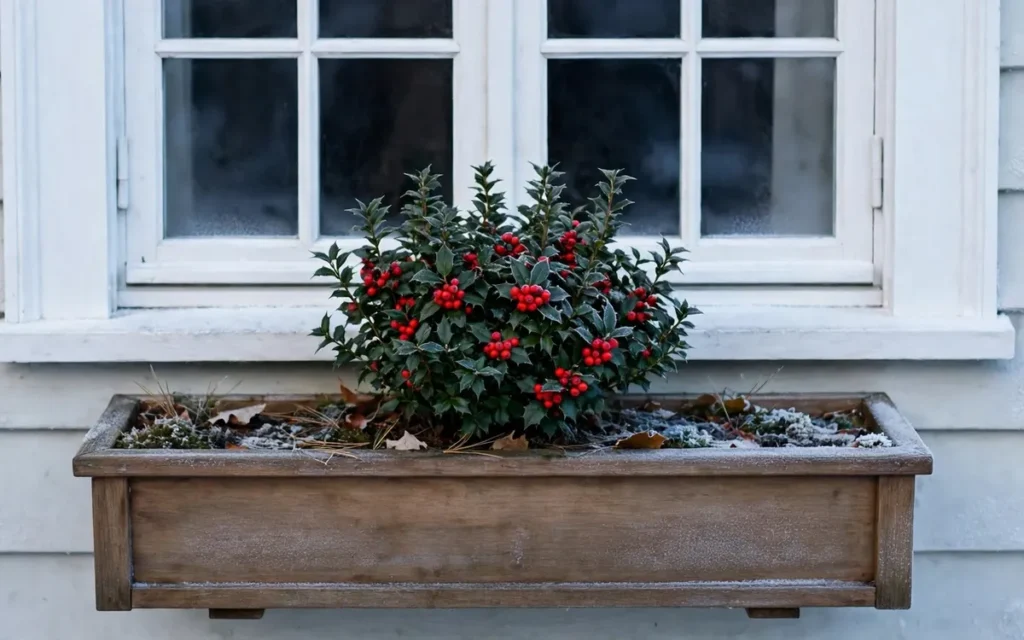
The four-season swap runs on the fitted layer: pansies in spring; the summer annuals — petunias, geraniums, calibrachoa — in the warm months; mums and ornamental kale in fall; and dwarf evergreen structure, a dwarf boxwood holding about 12 inches, with berries in winter. It is the same cold-season thinking our small front porch winter decor applies to the porch below. A box fitted in any month simply enters the rotation at that month’s quarter. For the porch itself — its depth, its seating, its own measured fit — our small front porch ideas take the same approach at ground level.
16. Feed and Tidy on a Small Loop
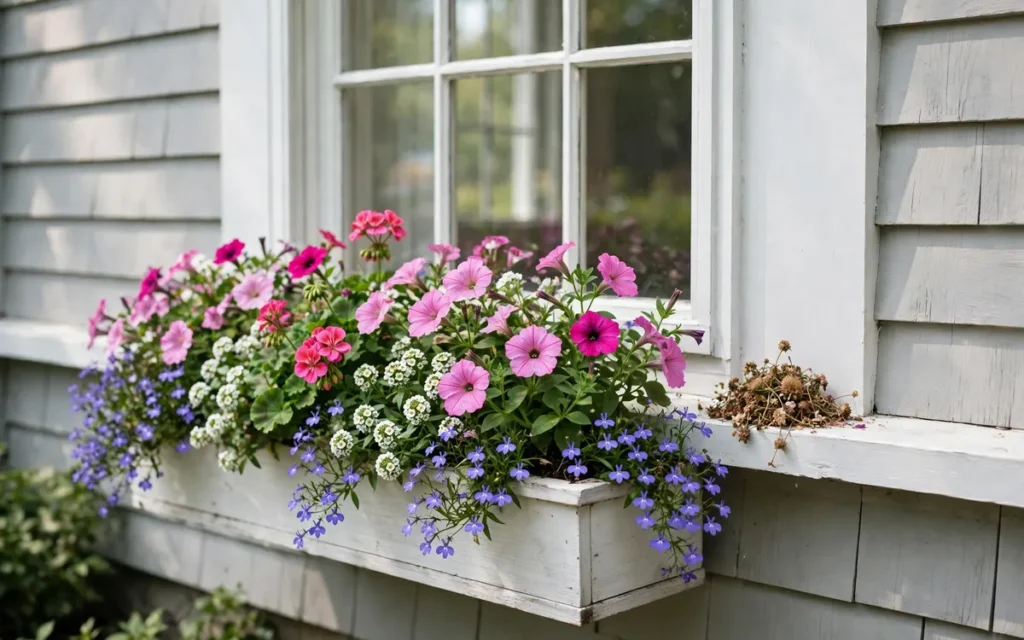
Containers leach feed with every watering, so a slow-release fertiliser goes in at planting time, and spent blooms are pinched off as they finish to keep the plant’s energy in new flowers. The loop takes minutes a week — and it is the whole difference between a box that peaks in June and one still performing when the fall swap arrives.
What It Costs: Three Ways In
The one-window tier (roughly under $50). One standard box in the 24-to-36-inch class, its two brackets, a bag of potting mix bought against the maker’s printed volume, and one flat of annuals planted as thriller, filler, spiller. This tier proves the system: sized to the trim, fixed into structure, planted by the sun — one window, fitted properly, before any decision about the rest of the front.
The street-front tier (roughly $50–$200). Boxes repeated across the front windows on one palette, third brackets where spans pass 48 inches, liners in every box, and the full three-layer planting throughout. This is where most readers land: the whole front reading as built-in rather than hung on, because every window was measured the same way and planted to the same scheme.
The fitted-front tier (roughly $200 and up). Long boxes in the 60-to-72-inch class or premium self-watering boxes, cleat or heavy bracket systems, and a year’s rotation budget for the four seasonal plantings. Worth it where the front windows are the house’s main face — and only after the layout has been lived with at a cheaper tier, because a long box mounted in the wrong place is an expensive pattern of holes. All three tiers are rough planning classes, not quotations.
Buying the Box Shorter Than the Window
A box that stops inside the trim reads as an afterthought at any planting quality — the eye measures it against the window before it ever notices the flowers. The length rule costs nothing to obey: full trim width to a few inches longer, in the standard classes (Idea 1). It is the cheapest curb appeal in this article, and the mistake is made in the shop, in about four seconds.
Hanging the Box on the Siding Alone
Siding is a skin. A box filled with wet soil and hung on skin fixings sags, pulls and works loose a little more with every watering cycle — and the failures the sizing guides name, sagging brackets, rotted boards and waterlogged plants, all start with this one shortcut. Structure or rated anchors, always (Idea 7). The wall was never asked to hold the garden, and it will not.
Sealing the Drainage to Protect the Wall
A liner folded over the base holes, or a box bought with no holes at all, waterlogs the roots it was meant to save — the planting drowns politely, from the bottom up. The wall is protected by the air gap and the drip line, never by drowning the box (Idea 8). Drainage is not the wall’s enemy; standing water is the plant’s.
Planting a Shade Window From a Sun Photograph
The most common failure in the whole topic: petunias copied onto a north wall because they looked wonderful on somebody else’s south one. The window’s hours are read first (Idea 9), and the shade class — begonias, impatiens, coleus, ferns — is planted without apology. A shade box planted as a shade box is lush; a sun box planted in shade is just a slow disappointment.
Spacing by Guess
Bed spacing in a box never fills, and the row reads as prisoners in a line; root-to-root jamming rots in its own humidity and drinks the box dry by noon. The middle is printed on the label: container density, about 6 to 8 inches between centres for annuals (Idea 11). Guessing costs the same money as measuring and buys a worse box.
Fitting the Box and Forgetting the Watering
A few gallons of soil on a sunny wall dries faster than any bed in the garden, so a box watered on the garden’s schedule is dead by the first heat week — fitted beautifully, bracketed honestly, and dead. The daily check, or the reservoir class of box, is not an extra; it is part of the fitting itself (Idea 14).
FAQs
What size window box should I buy?
The trim rule: the full outside width of the window’s trim or a few inches longer — up to about 8 inches longer on a window without shutters — in the standard length classes from 24 to 72 inches, standing about 8 inches tall with 6 to 8 inches of soil depth. Shorter than the trim is the size to avoid, at any price.
How much does a filled window box weigh?
Plan on roughly 10 to 15 pounds per foot of length once the soil is watered. A 36-inch box lands around 40 pounds in most fittings — about 13 pounds of box plus its 3.5 gallons of wet mix. That is a planning class, not a rating: fill the box on the ground, lift it, and buy brackets rated above the number you actually feel.
How far below the window should a box hang?
1 to 2 inches below the sill on a double-hung or sliding window, and 6 to 8 inches below the frame on a casement or awning window, so the sash swings out over the plants without crushing them. The window’s own mechanics set the height; measure from the sill or the frame, not from the glass.
Can you hang a window box without drilling?
Graded honestly: yes, inside limits. Siding hooks — most rated at roughly 5 to 12 pounds each — and rail-hung brackets carry standard boxes inside their printed ratings, which keeps a no-drill box under about 15 pounds once it is filled and watered; that is the renter’s fitting. A long or premium box, and any box on masonry or wood, takes drilled brackets into structure. The lease and HOA check comes first either way.
How many plants fit in a window box?
By the spacing: annuals at 6 to 8 inches between centres, so a 24-inch box takes roughly 6 to 8 small-to-medium plants across its two staggered rows of thrillers, fillers and spillers, and a 36-inch box takes roughly half as many again. The label’s spacing, tightened at most to container density, is the count — not the size of the flat at the garden centre.
What flowers do best in a window box?
The window’s sun decides. Geraniums, petunias and calibrachoa in the 6-plus-hour class; begonias, impatiens and coleus in shade; pansies in the cool seasons at either. There is no best flower for a window box — there is a best flower for that window, and the hours it actually gets are the only honest way to choose it.
How often does a window box need watering?
More often than any bed: the soil volume is a few gallons, held against a wall in the weather. In heat, check daily and water when the top inch is dry; in cool weather the round stretches. A self-watering reservoir box is the upgrade where a daily round cannot be kept — it stretches the interval; it does not abolish it.
Conclusion
Work through these window box flower ideas in order — size it, mount it, plant it — and the bare front window stops being an afterthought. The box is the trim’s width, not the shop’s guess; the brackets carry wet soil into structure, at the height the window’s own sash demands; and the planting is read off the sun that window actually gets, free to rotate through all four seasons on a fitting that never has to be bought again. That is the whole discipline: fitted like hardware, planted like a layer, and changed like a season.


One Comment