21 Stylish Coffee Table Decorating Ideas You’ll Love
Most coffee tables end up in one of two states: a dumping ground where keys, remotes and unopened mail live in front of the sofa, or a display shelf so carefully arranged that nobody dares put a mug down. Neither table is badly decorated. Both are un-anchored — nothing gathers the objects into one place, everything sits at the same height, and the surface is filled right to the edges, so the eye reads clutter no matter how nice each piece is.
The good news is that styling a coffee table is not a talent for buying beautiful objects. It is four decisions made in order: where the table sits, what anchors it, how tall the arrangement stands, and what is deliberately left empty. Make those four decisions and most tables need very little shopping — the pieces already in the room usually finish the job.
This guide gives you that four-step method first, then 21 coffee table decorating ideas in five zones, so you can see the system working on real tables of every shape. There are budget levels for every pocket, the seven mistakes that quietly clutter a table, a short safety note on flame, glass and heat, and answers to the questions people actually ask about this small, hard-working surface. One boundary before we start: this is the all-year, any-shape table — its Christmas version and the small-room layout system live in their own guides, linked where they belong.
Anchor It, Lift It, Leave a Third Empty: The Coffee Table Method
Every good coffee table decorating ideas list is secretly the same four moves. Here they are as one method you can run on any table you own, in this order, before a single decorative object is bought.
Step 1 — Check the Placement First
Before styling, check the table itself. It should measure about two-thirds the length of your sofa — much shorter and it strands the seating, as long as the sofa and it swallows the room. It should also sit 14–18 inches (35–45 cm) from the sofa’s front edge: close enough to set down a mug without standing, wide enough for knees and for walking past. If the distance is wrong, no arrangement will save the table, so move it first. That gap is part of the wider room system covered in our cozy living room ideas guide; here it is simply the placement check everything else stands on.
Step 2 — Set One Anchor
One anchor gives every object a home. Choose a tray, a stack of two or three large books, or one substantial bowl, and size it by the surface: the anchor should cover roughly one-third to one-half of the tabletop — big enough to feel deliberate, small enough that the table is not just a tray with edges. A round tray on a rectangular table is the classic shape contrast; a rectangular tray on a round table fights the table’s own line. From this step on, everything loose either lives inside the anchor or in the empty third. Nothing drifts.
Step 3 — Build Three Heights in a Triangle
An arrangement needs a peak, a middle and a base. Aim for one tall piece at 12–15 inches (30–38 cm) — a vase with stems, a candlestick, a small sculpture — one mid piece at 4–6 inches (10–15 cm), such as a candle or a decorative box, and one low piece at 2–4 inches (5–10 cm), like a bowl or a stack of books. Nothing should pass about 18 inches (45 cm): taller blocks conversation across the table and the view beyond it. Place the three so they form an invisible triangle from the sofa — tallest to one side, mid piece at the opposite corner, low piece between them — never in a straight row, which reads as a shelf display. If you want to read more on the anchor, height and texture formula, Z Gallerie’s styling guide walks through the same system from a retail stylist’s angle.
Step 4 — Edit by Leaving a Third Empty
The last decision is subtraction: about one-third of the surface stays deliberately bare. That empty third is the landing zone for mugs, a book left open and the remote — it is what makes the styled part read as styled. Test the result with a phone photo: step back, take the picture, and remove whichever piece your eye trips over first. If the table holds two objects, add one; if it holds four, remove one or merge two onto the tray. A table that is full cannot be used, and a table that cannot be used is cluttered again within the week.
Zone 1 — Anchor the Table
1. Start With a Wooden Tray

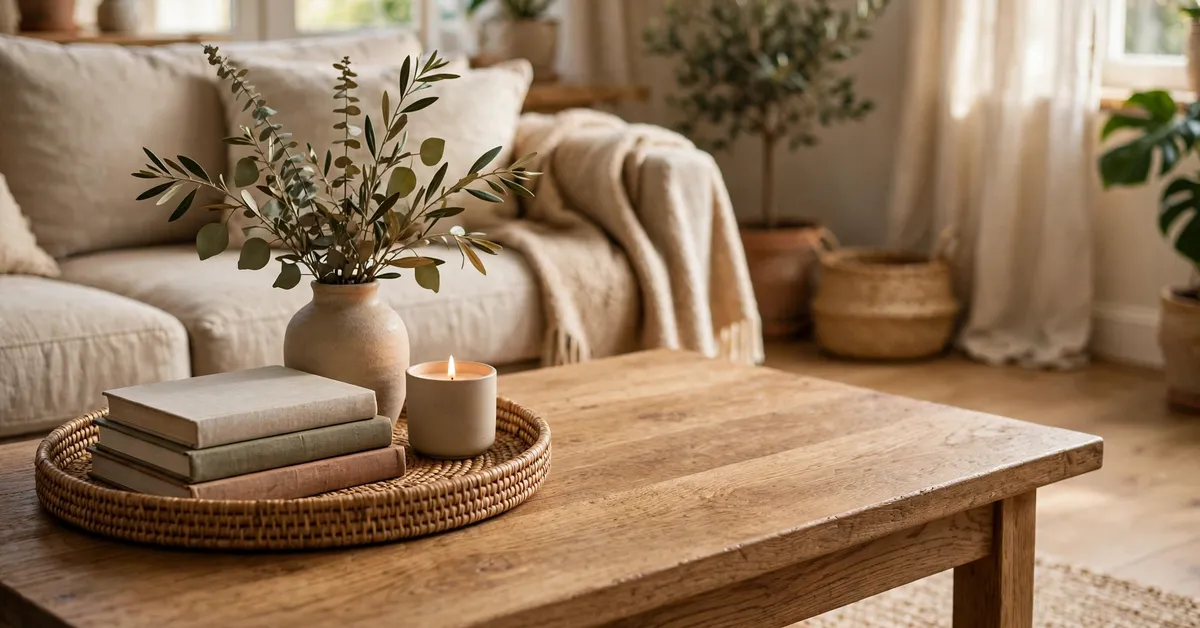
A wooden tray is the single most useful styling tool this table owns. It turns loose objects into one composed unit, adds warmth against almost any top, and lifts off in one move when the table needs clearing for games or dinner trays. Size it to cover one-third to one-half of the surface, choose a round tray on a rectangular table for shape contrast, and keep only three or four pieces inside it so the table still breathes.
2. Stack Books as Your Riser
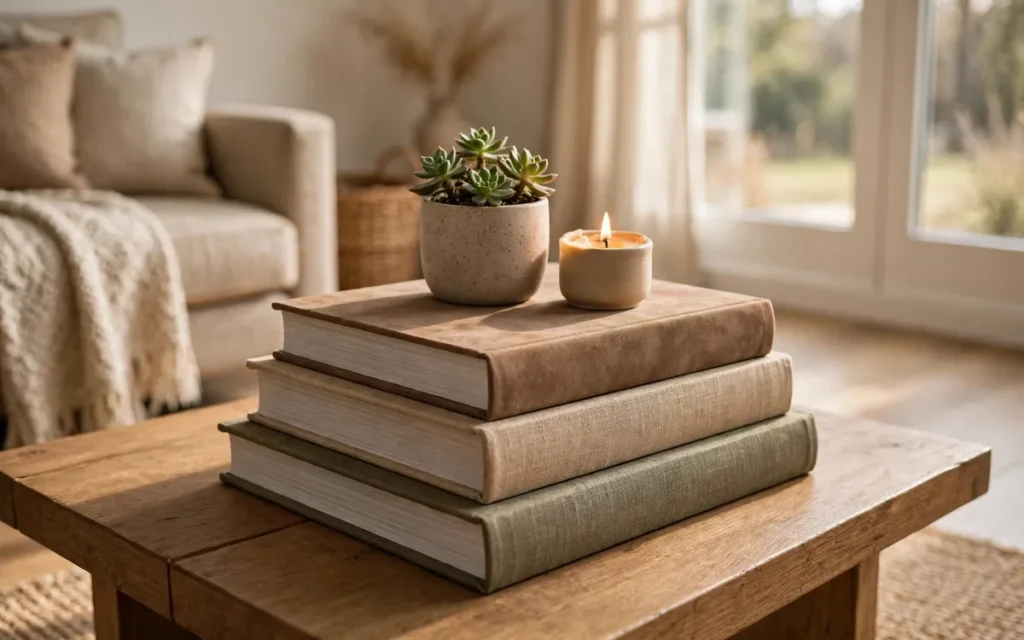
A stack of two or three large books is an anchor that also gives height, lifting a candle, a small plant or a bowl into the mid-height band where it can be seen. Put the largest book at the bottom with spines facing the room’s main seat, and leave the top book open on a favourite page — an open book reads as a home, a closed stack reads as a prop.
3. Ground It With One Substantial Bowl

A wide, low bowl in ceramic, stone or wood anchors tables that hate trays: it holds the eye at the centre without raising the arrangement’s profile, so conversation flows over it. Fill it with one thing only — a tumble of decorative beads, a few pinecones, a single sculptural object. A bowl holding five different fillings is not an anchor; it is a junk drawer with a rim.
4. Let the Table’s Own Material Show
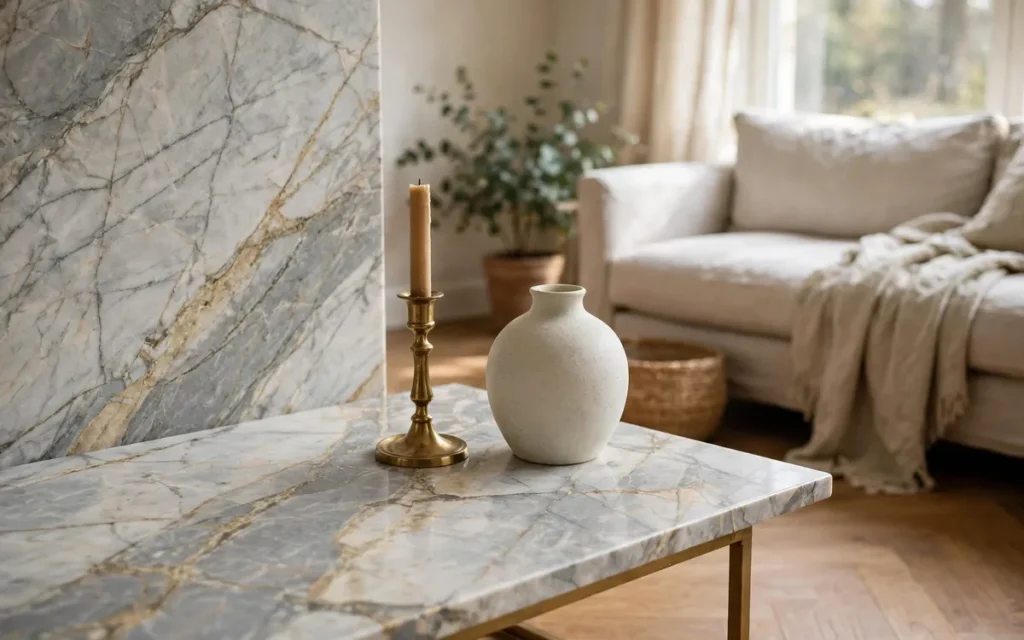
Leave a generous sweep of the tabletop visible and let the grain, the veining or the patina do the decorating. One candlestick and one low vase are enough on a marble or a live-edge top — the table is the largest object in the arrangement, so it should not be covered up. If you have spent money on the material, show it; a styled table that hides its own top is a table styled for a photograph, not a room.
5. Anchor With a Woven Basket Underneath, Not On Top

If the table has a lower shelf or a simple frame underneath, that is where a woven basket belongs — holding throws, magazines or children’s books, out of the sightline but within reach. The basket gives the table a base and a soft texture the top cannot, and because it sits below the surface it does not count against the one-third budget of the tabletop. Keep the top for the styled group and the bottom for the useful one.
Zone 2 — Build the Heights
6. Add One Tall Vase With Stems

One tall vase with stems is the peak of most good coffee table arrangements: it lifts the eye, takes up almost no surface and gives the triangle its highest point. Choose stems that lean gently and are cut to about one and a half times the height of the vase — dried branches, eucalyptus or a single spray of blossom — and keep the vase itself simple so the stems, not the container, carry the height.
7. Layer Candles at Three Heights
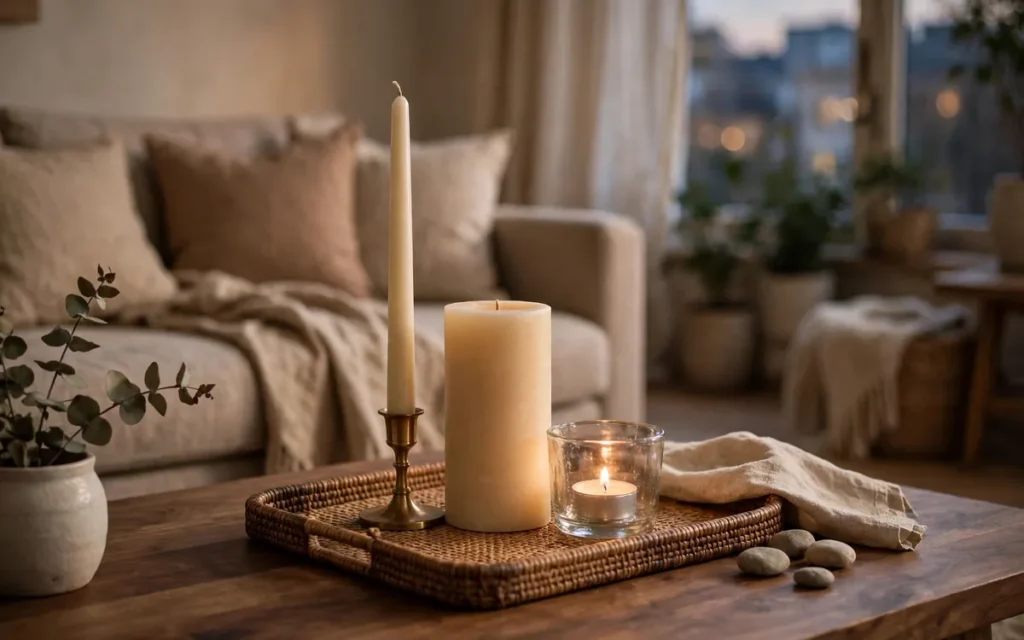
Candles are adjustable height. Group a tall taper, a mid pillar and a low tea light in glass on one tray — three heights that read as one deliberate arrangement instead of three separate objects. Keep the flames at least a hand’s width from stems and books, and use unscented candles where the table sits with food or coffee, so the room smells of coffee, not candle.
8. Use a Sculptural Object as the Peak
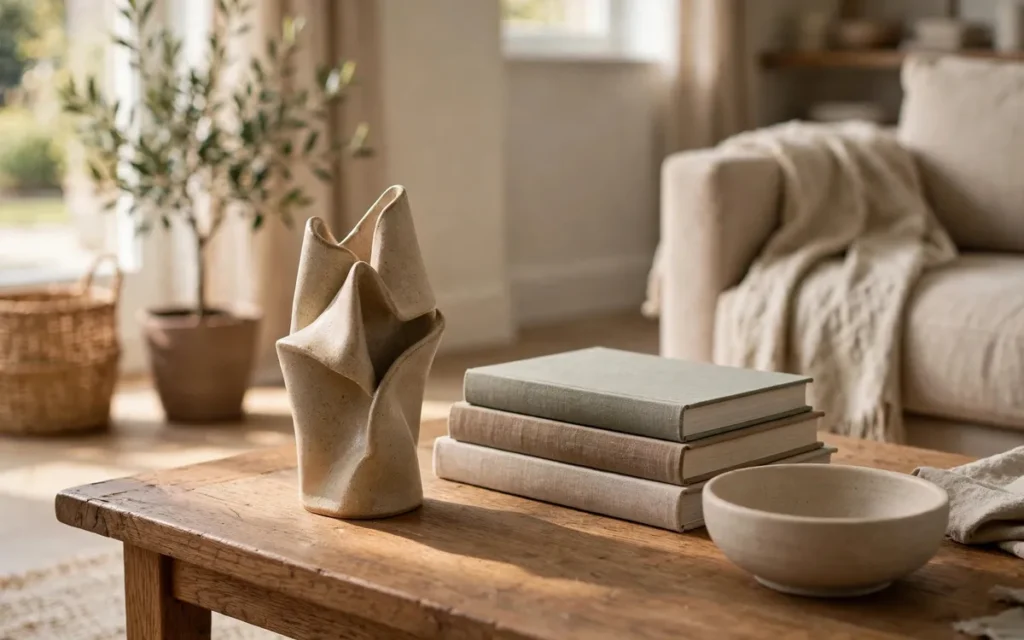
A small sculptural object — a carved figure, a knot of ceramic, a piece of driftwood — can be the peak of an arrangement when a vase would be too pretty or too busy. Place it so it is the tallest thing on the table, then keep everything else lower, and give it a little empty surface around it: a sculpture that touches the books and the bowl reads as clutter, one with breathing space reads as a collection.
9. Keep a Small Lamp on the Table’s Edge
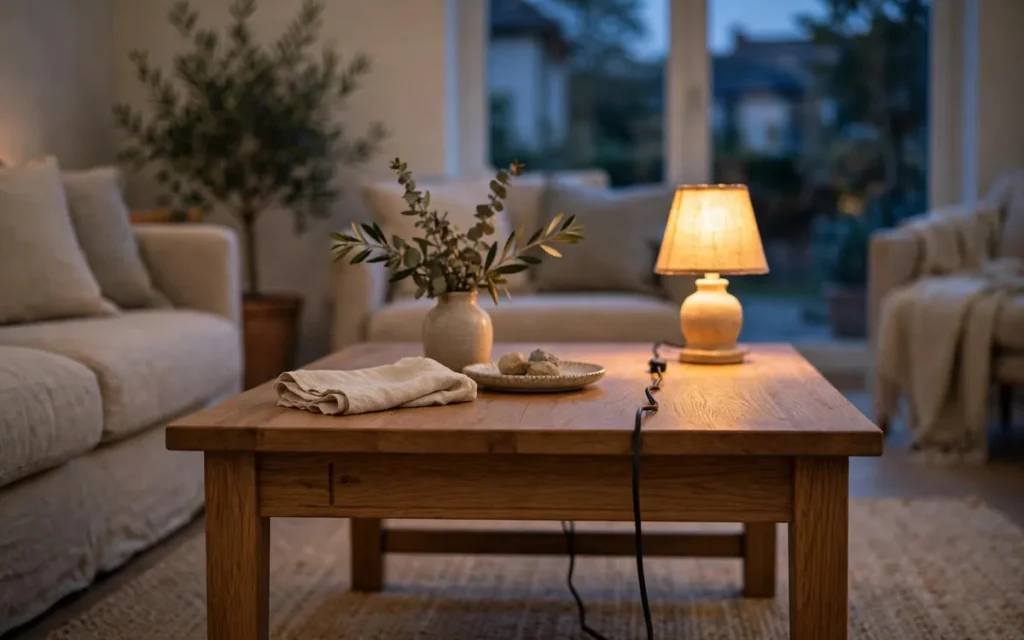
A small lamp on a coffee table is practical, not just decorative: it puts low, warm light at hand height in the evening and makes the table usable after dark. Keep the lamp at the far end from the main seat, run its cord down the back of the table, and leave the shade small enough that the lamp is the tallest object without being the whole arrangement. If the lamp must go, a tall candlestick does the same job with less wiring — but the lamp’s evening light is worth the cord.
Zone 3 — Texture, Life and the Personal
10. Add Greenery at One Height Only

One small plant on a coffee table does the work; three do not. Keep greenery at one height only — a single pot, low and simple — so it reads as a living note rather than a forest. Choose something that tolerates a low table and occasional neglect: a hardy trailing plant, a small succulent or a bunch of fresh eucalyptus, and keep the pot plain so the green, not the pot, is the colour.
11. Mix Three Materials, Never One

A table styled entirely in wood, or entirely in glass, looks flat from the sofa. Mix three materials every time: wood with glass and brass, or stone with linen and metal — one warm, one reflective and one textured. The tray gives one material, the bowl or vase a second, and a candlestick or the table itself the third. Three materials give the eye something to move between; one material gives it nothing to look at.
12. Put One Personal Object on Show
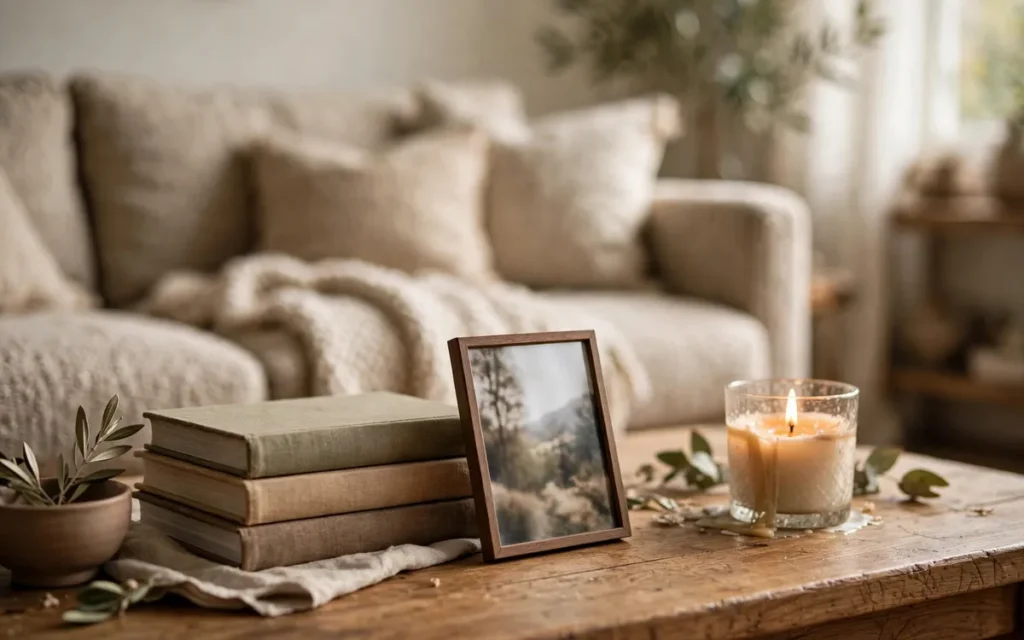
One personal object makes a styled table into your table: a small framed photograph, a souvenir from a trip, a book that is actually being read. Keep it to one, put it where it can be seen from the main seat, and let it sit at the mid height — too high and it dominates the arrangement, too low and it vanishes. A table with one personal object is lived-in; a table with five is a display case.
13. Style the Coasters Into the Arrangement

Coasters are the most practical thing a coffee table owns, and they look better as part of the arrangement than as a hidden stack in a drawer. Keep them as a neat stack on the tray, or laid flat as a small set, with the top one ready to use. A coaster under a mug is styling and protection at once — and a table with coasters visible is a table that expects to be used.
Zone 4 — Colour and Material
14. Build the Palette From the Room, Not the Shop

Take the coffee table’s palette from the room around it, not from the shop’s display: repeat the sofa’s neutral, the rug’s warm tint and the cushion’s clay, and the table settles into the room. A coffee table styled from shop colours can look imported from another house; one styled from the room’s own colours looks like it has always been there.
15. Warm a Cool Table With Wood and Brass

A cool material — marble, glass or polished stone — can feel cold in a pale room. Warm it with wood and brass: a wooden tray, a brass candlestick or a small wooden bowl, which bring the room’s warm notes onto a surface that would otherwise read as ice. The cool top still shows, and the warm metal and wood keep it from feeling hard.
16. Let One Bold Colour Lead

One bold colour on a coffee table is a decision; two is an argument. Pick a single accent — terracotta, deep green or a clear blue — and repeat it once, in a bowl or a book jacket, while everything else stays calm. The rest of the room can hold many colours; the tabletop should hold one.
17. Dress the Table for Its Material
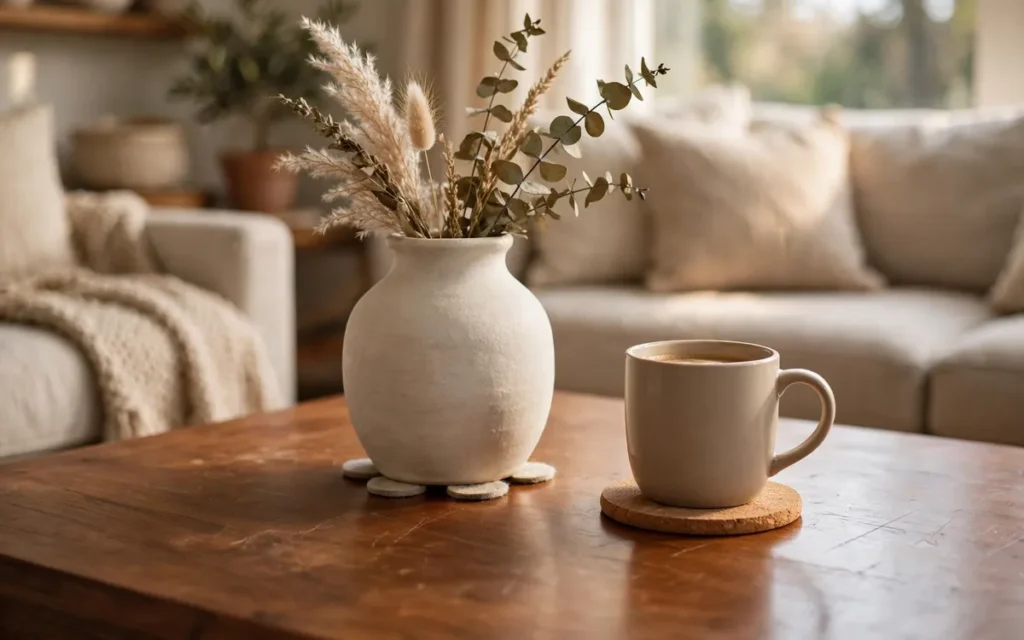
A polished wood top that is always scratched is not a styled table; it is a table being damaged slowly. Match the dressing to the material: felt pads under anything heavy or likely to slide, a coaster under every mug, a soft cloth under a vase on lacquer. The protection is invisible when it is done well — and a table that is protected lasts long enough to be styled again and again.
Zone 5 — Shape, Small Tables and Seasons
18. Style a Round Table as a Triangle

A round table needs the same triangle thinking, only curved: anchor one zone with a tray or a book stack, place the tall piece at the back edge and the low piece at the front, and leave a clear arc of the edge empty. Three uneven zones, not three symmetrical ones — a round table styled in three equal parts looks like a pie chart, one styled in a triangle looks like an arrangement.
19. Style a Small Table With One Anchor Only

A small table cannot hold a tray, a book stack and a sculpture — so give it one anchor and three objects, and leave a third of its surface empty. Choose the anchor, add the tallest piece you can without blocking conversation, and stop: on a small table the empty third matters more than on any other, because it is the only place left for an actual cup. If you need more storage, move it to the basket underneath, not onto the top.
20. Divide a Long Rectangular Table Into Zones
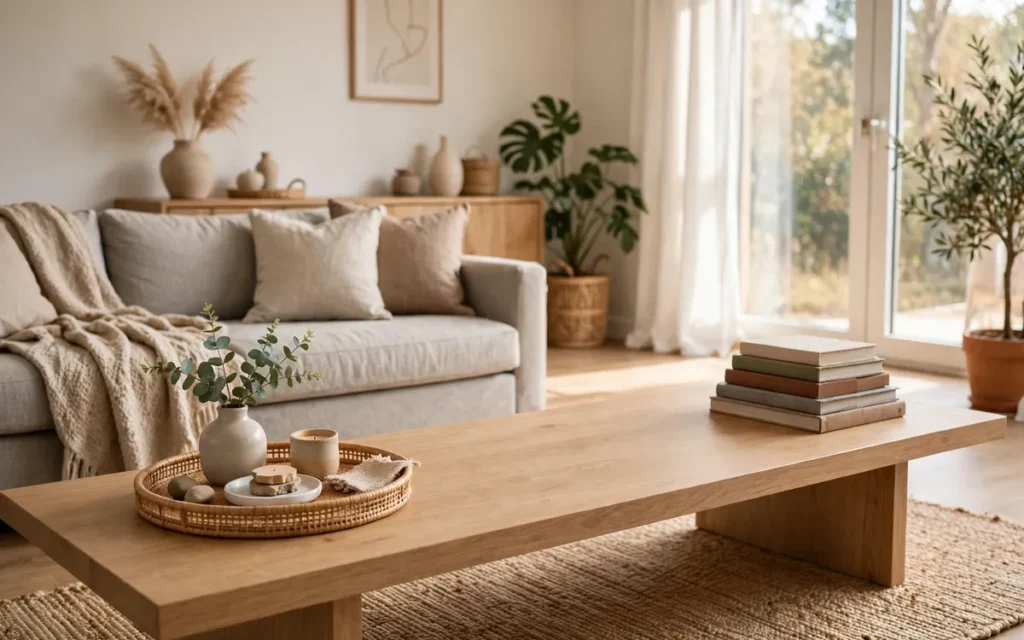
A table 36–48 inches (91–122 cm) long is two tables joined in the middle: a tray at one end and a book stack at the other, with a low piece between them, and one end left clear. Style each end as its own group, then let the clear end be the landing zone the table is mostly used from. Two groups and one empty third — the same method, stretched.
21. Swap One Layer With the Season

The simplest way to keep a coffee table fresh is to keep the anchor and the book stack, and change only one layer with the season: fresh stems in the vase in spring, a pinecone or a small gourd in the bowl in autumn, a pine sprig or a single candle in winter. Everything else stays. A table that changes one thing with the season looks looked after; a table that is restyled from scratch every few months looks restless.
What Coffee Table Styling Costs: Three Budget Levels
$0 — The Styled Reset
Start with what you already own. Empty the table completely, place a tray or a stack of books you already have, add one candle, one bowl and one plant from another room, and leave a third empty. A styled reset costs nothing but an hour, and most rooms already own all three heights.
Under $50 — The Layered Refresh
At this level the budget should go on a single anchor, not on many small things: a wooden tray or a wide bowl, plus a pillar candle and a small vase with stems. Skip the matching set, however tempting, and put the money on the anchor — it carries the whole arrangement, so it should be the piece you actually like.
A Few Hundred and Up — The Grounded Table
At this level you may be buying the table itself, a substantial stone or wood bowl, or a real lamp — pieces that last beyond one season. Spend on the table and the anchor, and on one good candlestick or sculpture, and let everything else be borrowed from the room. The table at this level keeps the same method, only with materials that improve with age.
7 Coffee Table Mistakes That Clutter the Room
- No anchor, everything drifting. Five or more small pieces scattered across the surface read as clutter, however expensive each piece is.
- More than three heights. A table with pieces at five or six different heights reads as a skyline, not an arrangement. Pick one peak, one middle and one low.
- A table filled edge to edge. A surface with no empty third has nowhere for a mug, a book or a hand to land. Leave the landing zone empty on purpose.
- A matching set on a matching table. A tray, bowl and vase in the same finish on the same material disappear into one note. Mix at least three materials.
- Oversized branches and over-tall stems. Anything taller than 18 inches (45 cm) blocks the view across the table and reads as an obstacle, not a height.
- Small, fussy pieces at floor level. Tiny objects scattered at the table’s base need bending to see and read as mess from the sofa. Keep small pieces on the tabletop only, or on the tray.
- Decor that cannot be moved. A table that cannot be cleared for a board game, a work session or dinner is not styled, it is staged. Everything on it should lift off in one move.
Styled, Safely: Flame, Glass and Heat
Three rules keep a styled coffee table safe: keep candle flames away from stems and paper, keep hot mugs on a coaster or a trivet rather than on raw wood or a cold stone top, and keep glass vases out of the direct sun where they could magnify light onto the table. Style it beautifully, but test it like a table that will actually be used — it will be.
Frequently Asked Questions
What should I put on a coffee table so it looks stylish but not cluttered?
Four things, in this guide’s order: one anchor, one tall piece, one mid piece and one low piece, with a third of the table left empty. That is the method, not a shopping list — use what you already own before buying anything new.
How does the rule of three work on a coffee table?
The rule of three means one tall piece, one mid piece and one low piece, placed so they form a triangle from the sofa. Three heights give the eye a path to follow; three pieces of the same height give it a row. Keep the tallest piece about 12–15 inches (30–38 cm) and nothing taller than about 18 inches (45 cm).
How many items should go on a coffee table?
Three objects, plus one anchor that gathers them — five pieces counting the anchor’s own parts, or three if the anchor is a tray holding them. If you are holding a fourth loose object and cannot find a home for it inside the anchor, the table already has enough.
How do I style a small coffee table without it looking cluttered?
One anchor, three objects and an empty third. Small tables need the empty space more than large ones, and the basket underneath is where the storage goes. If in doubt, take the smallest object away: a small table is styled by what is left out, not what is added.
How tall should coffee table decor be?
One tall piece at 12–15 inches (30–38 cm), one mid at 4–6 inches (10–15 cm) and one low at 2–4 inches (5–10 cm), with nothing taller than about 18 inches (45 cm). Taller pieces break conversation across the table; shorter ones are lost under the tabletop’s own edge.
How do I style a round coffee table?
Anchor one zone with a tray or a book stack, place the tall vase at the back and the low bowl at the front, and leave a clear arc of the edge empty. A round table with three uneven zones reads as an arrangement; one with three identical zones reads as a wheel.
And remember that the sofa has two working sides. This table dresses the front of it; the tall table behind it has its own fit-first system, sized to the sofa’s back and styled for the view from behind, in our guide to 21 Graceful Sofa Table Decor Ideas for a Sofa That Looks Finished From Behind.
Of everything that goes on a coffee table, one piece does the most quiet work: the tray. Sized to a third to a half of the table, filled by a three-piece formula and left a third empty, it gathers the whole arrangement into one group that lifts away the moment the table is needed — the full measured system is in our coffee table tray decor ideas.
Conclusion
A coffee table that is styled by a method — one anchor, one triangle of three heights and one-third left empty — looks intentional whether it is a tray or a marble slab, a small table or a long one. It does not need a shopping list, and it does not need to copy a photograph. It needs a placement check, one anchor, three heights and a decision about what to leave out.
Start with the simplest version of that method tonight: clear the table, set one anchor from the room, and leave a third of it bare. Then build the room around the table that works: the narrow living room ideas in our small-space guide, the Christmas coffee table decor ideas for the festive table, and our guide to how to decorate around a TV all use the same starting point — a calm surface with room to be used.


7 Comments