

17 Charming Homework Station Ideas for Small Spaces That Fit the Child, Not Just the Room
A homework station should be the easiest corner of the house for a child to use, and it is usually the hardest to fit: the desk is bought from a photograph, set down where it looks right, and only then discovered — an adult-height top under a seven-year-old whose feet dangle and whose shoulders climb toward his ears, in a corner so quiet he will not sit in it. These homework station ideas for small spaces begin with the spot chosen by the child’s age, the desk fitted from the height chart, and the supplies stored inside the station’s own footprint — because a homework station does not fail on looks; it fails on measurements nobody took. (The room this station most often lives in is decorated as a whole in our small bedroom decor ideas for kids; this article takes one corner of that room and fits it as a workstation instead — the decor there, the fitting here.)
The Method: Spot It, Size It, Stock It
Three decisions, in order, before a single pencil cup is bought — because a homework station is not decorated, it is fitted, and every fitting is decided by something measurable: where a child of that age actually works, the desk and chair heights their body needs this year, and whether the supplies live inside the station’s footprint or colonise the house.
Step 1 — Spot It: The Spot Is Chosen by the Child’s Age
The guidance the measured guides share — Cornell Cooperative Extension’s homework-space advice — puts a younger child’s station in or beside the kitchen and family space, where an adult passes and homework happens under a light touch of supervision; an older child graduates to the quietest corner the home has, away from the television’s traffic. Against that rule, every candidate spot is tested on three services: daylight, or a lamp’s reach — a dark closet is storage until it is lit; an outlet inside the desk’s own footprint, for the lamp and any laptop; and the backpack’s walk — the station sits on the route between the front door’s drop zone and the child’s room, or the school bag will simply live where it lands. The spots this article claims are all spots the home already owns: a closet whose doors come off, the wedge under the stairs, the end of a kitchen counter, the strip behind a sofa, an armoire that closes.
Step 2 — Size It: Fit the Desk and Chair From the Chart
The chart is the article’s governing figure — desk and seat height by age. Ages 6–8 take a desk of 20–22 inches and a seat of 12–14; ages 8–10, a desk of 22–24 and a seat of 14–16; ages 10–12, a desk of 24–26 and a seat of 16–17; ages 12–14, a desk of 26–28 and a seat of 17–18; and from about 14 the standard adult desk of 28–30 inches, with a seat of 18–20, fits. Two rules hold in every row: the desk sits 7–8 inches above the chair seat, and the fit is confirmed by the 90-90-90 test — knees, hips and elbows each bent at 90 degrees, feet flat and supported, forearms resting flat on a desktop that itself sits 7–8 inches above the top of the thigh. The desktop is sized separately: at least 36 inches wide for an elementary child’s workbook, cup and folder, 48 inches once a laptop joins, and 20–24 inches deep — never deeper, because a desktop beyond about 24 inches pushes everything on it out of a child’s reach. More than any pegboard, homework station ideas for small spaces stand on the desk height and the 7-to-8-inch gap beneath it, because those two numbers decide whether a child can sit at the station for an hour or only endure it for ten minutes. Autonomous’s children’s desk height chart publishes the same chart by age and by standing height, with the same test and the same 7-to-8-inch rule — the standing-height version lives there.
Step 3 — Stock It: Everything Lives Inside the Footprint
The desktop itself holds almost nothing permanently — the current book, the pencil cup, the in-tray and the out-tray — because a 36-inch desktop spent on storage is a 24-inch desktop. The daily supplies live in the vertical and rolling storage the zones build: the pegboard on its 1-inch grid above the desk, the cart parked at the desk’s end, and the low shelf inside the child’s own reach, with daily things kept between knee and shoulder height and nothing a child needs daily stored where they must climb or call an adult. The rule runs the whole article: if it is used every school day it lives inside the footprint; if it is used weekly it goes on the cart’s bottom tier or the shelf; and if it has no home inside the station, it does not belong to the station. A station stocked this way is reset in two minutes and read at a glance; a station stocked by photograph is excavated every afternoon from under yesterday’s papers. One plain note: the heights and distances here are general setup guidance from published charts and standards, a starting point to check against your own child — not medical advice.
Zone A — Fit the Desk Itself
Five ways to fit the desk before the spot is even chosen: its depth capped by a child’s reach, a top that folds away, one long surface shared by two, a height that adjusts as the child grows, and the corner spent as desktop — every one of them sized off the chart in Step 2.
1. Pick a Slim Desk 20 to 24 Inches Deep

Depth is the small-space measurement nobody checks. A desktop 20–24 inches deep holds the workbook, the cup and the screen’s arm’s-length distance, with everything on it inside a child’s reach; anything deeper spends floor space pushing the far edge away and turns the back half into a shelf the child leans across. Width is where the generosity goes — depth never is.
2. Fold the Desk Away When the Bell Rings
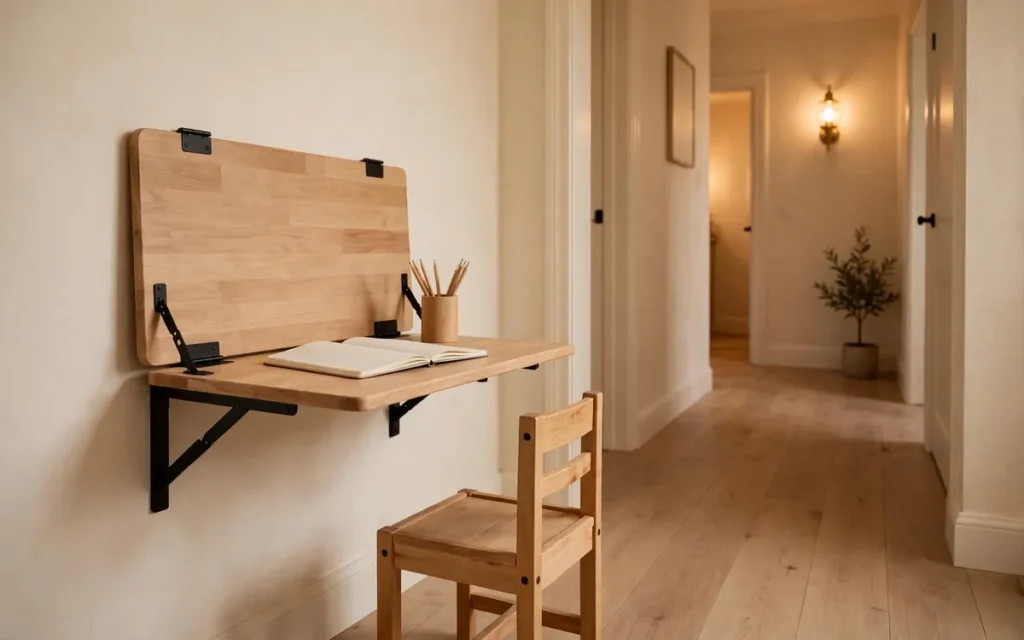
A wall-mounted fold-down desk spends zero floor space closed and opens to a desktop in the same 20–24-inch depth class, fitted at the child’s chart height rather than at adult table height. The hallway wall and the bedroom’s spare stretch both qualify, and the chair is the only furniture that stays out — folded up, the station returns the whole strip of room to the house.
3. Run One Long Desk With 24-Inch Zones

Siblings share better on one long surface than on two small desks. The planning rule is 24 inches of width per child — the minimum honest zone — so a 48-to-60-inch top seats two, divided by a low shelf or a bookend line rather than a wall, with a tray and a cup each. Two small desks side by side give each child less honest room than one long top divided.
4. Buy the Height Once, Adjustably

Children grow 2–3 inches a year, so a fixed desk fitted perfectly in September is outgrown in roughly two to three school years — the chart’s rows are about that wide. A height-adjustable desk crosses the whole chart in one purchase. The honest bridge for a desk already owned: an adjustable chair plus a footrest, reset each September against the 90-90-90 test.
5. Turn the Corner Into the Desk
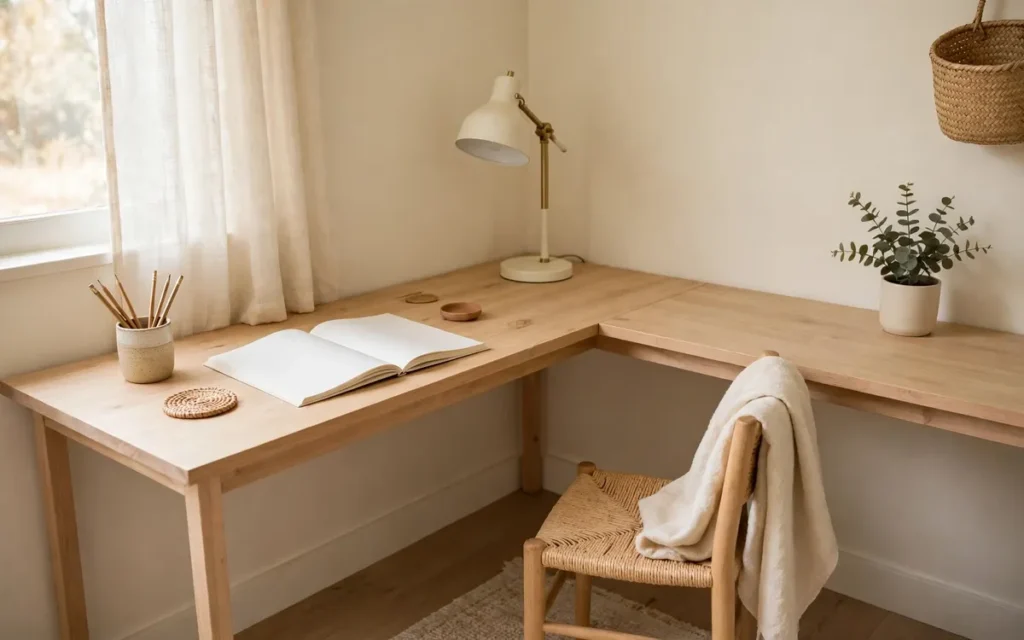
A corner desk spends the room’s dead wedge on desktop: the two runs along the walls give the 36-plus inches of width in an L, while the corner itself — the part no one can reach across anyway — holds the lamp and the screen at its arm’s length. Fitted at chart height, the corner becomes the station instead of the place the station is squeezed beside.
Zone B — Claim a Spot You Already Own
Five spots a small home already has, each claimed by its own measurement: the closet’s standard depth, the under-stair wedge, the counter end inside the supervision zone, the strip behind the sofa, and the armoire that closes on the whole school day.
6. Convert the Closet, Keep the Depth
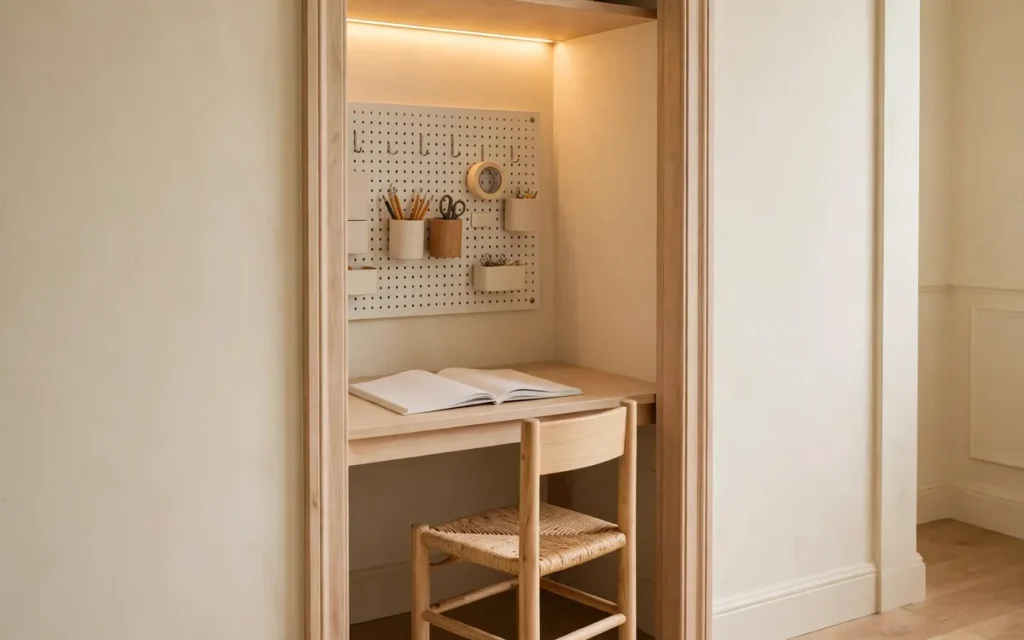
A standard reach-in closet is 24 inches deep — exactly the slim desktop’s depth class. Doors off, rod and shelf out, a 20-to-24-inch-deep desktop fitted at your child’s chart height, a lamp or light strip added because closets are dark, and a pegboard on the back wall inside. The chair lives outside and slides in; nothing about the conversion is permanent. (The closet usually opens off the hall our hallway decor ideas dress as a room to look at — this is the same square footage worked as a room to sit in.)
7. Take the Wedge Under the Stairs

The under-stair triangle is the small home’s spare room: a typical nook of this kind runs about 4 feet wide by 3 feet deep — enough for the slim desk and the chair where the slope is still above a seated child’s head. Measure your own slope before promising it; the low end, where no head fits, is given to the cart and the book box instead of wasted.
8. Perch the Young Ones at the Counter End

For the youngest children the station is a seat, not a room: the end of the kitchen counter, inside the supervision zone the guidance asks for. Fit it honestly — a standard counter is about 36 inches high, adult height, so the perch is a stool or chair raised to it with feet supported on a box or rung, never dangling. Nothing is built; the counter is borrowed, and the homework happens where the adults already are.
9. Slide the Station Behind the Sofa

The strip behind a sofa is already furniture depth and already lit by the room’s lamps: a slim desk in the 20–24-inch class stands there at child height, borrowing the living room’s light and its adult traffic for a younger child. This is a worktop to be used, not a console to be styled — styling that same strip is our sofa table decor ideas‘ whole system; this article puts a child-height desk in it instead.
10. Close the Whole Station Inside an Armoire

The station that disappears: an armoire or secretary desk holds the desktop fitted at chart height, a pegboard on its inside back and the supplies on its shelves — and at bedtime the doors close on the school day. It is the renter’s and the studio’s answer, and the one spot in this article that needs no wall at all: the footprint is the furniture’s own, and the reset is a pair of doors.
Zone C — Store It Inside the Footprint
Four storages that keep the desktop a worktop: the pegboard on its standard grid, the cart parked at the desk’s end, two trays doing all the filing, and a reach rule that puts daily supplies where a child’s own hands are.
11. Hang a Pegboard on the 1-Inch Grid

Standard pegboard holes run 1 inch on centre, in 3/16- or 1/4-inch diameters, so cups, scissors and the sharpener hang in a grid the child can rearrange as the kit changes. Mount the board on spacers or furring strips, never flat to the wall — the hooks need the clearance behind the panel to seat. The whole supply wall costs the desk zero inches of its 36.
12. Park a Rolling Cart at the Desk’s End

The supply tower on wheels stands on roughly a 14-by-18-inch footprint — the standard three-tier cart in that class, IKEA’s RÅSKOG, is listed at 13¾ by 17¾ inches — so it parks in the dead space at the desk’s end. Papers and workbooks ride on top, the art kit in the middle, backstock below; on project days it rolls to the dining table, and at reset time it rolls back.
13. Give Papers an In-Tray and an Out-Tray
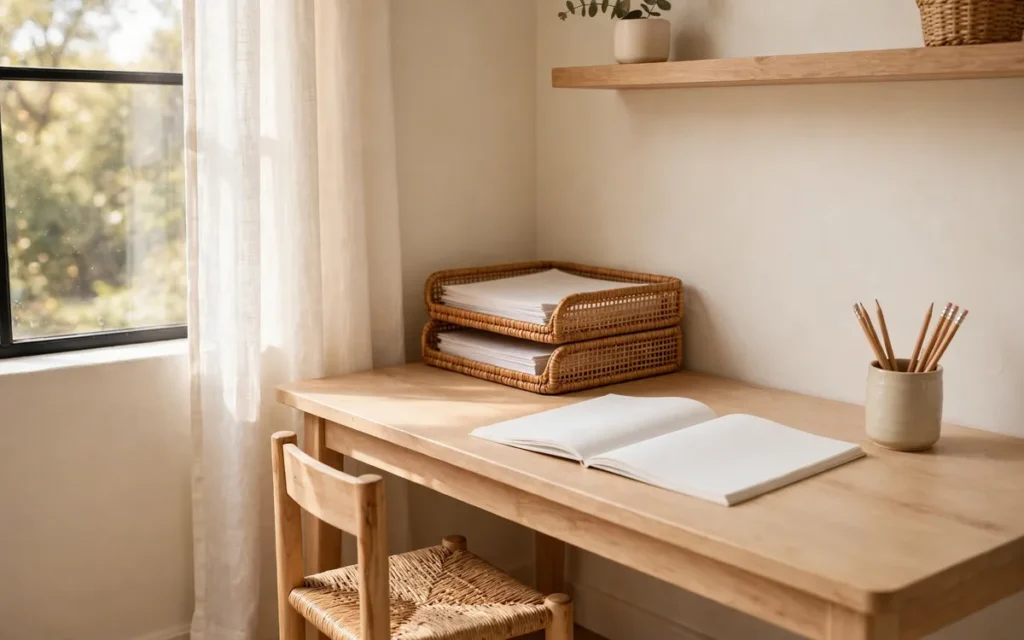
Two stacked letter trays are the station’s whole filing system: unfinished work in, finished work out, and the desktop between them stays a worktop. The stack goes vertical precisely because the desktop is only 36 inches wide and cannot afford the spread — a pile lying flat spends the workbook’s room, while the same papers standing in two trays spend about a sheet’s width.
14. Keep Daily Things Between Knee and Shoulder

The reach rule for everything stored: daily supplies live between the child’s knee height and shoulder height, the shelf or rail mounted to that band rather than to adult eye level. Weekly things may go one shelf higher; nothing used daily is ever stored where a child must climb or call an adult — a supply that needs help to reach is a supply that stops being put away.
Zone D — Light It, Screen It, Reset It
Three finishing systems: the screen placed by the eye-guidance numbers, the desk turned so daylight helps instead of glaring, and the two-minute reset that keeps every other idea in this article true.
15. Set the Screen at Arm’s Length, Top at Eye Level

Where a laptop or tablet joins the station, the screen sits about an arm’s length away — roughly 18–24 inches, the American Academy of Ophthalmology’s guidance for laptops — with its top at or just below eye level. A stack of books is the honest riser. The same guidance pairs the distance with a break rhythm: eyes look away from the screen every 20 minutes or so. General setup guidance, checked against the child in the chair — not a prescription.
16. Turn the Desk Side-On to the Window

Glare is a placement problem, not a brightness problem: the desk and screen sit perpendicular to the window — Cornell’s ergonomics guidance for children — so daylight falls across the work instead of onto the screen or into the child’s eyes. The task lamp fills the rest from the side. Turned this way, the same window that washed the screen out becomes the station’s best light.
17. End the Day With a Two-Minute Reset

The system that keeps all 16 ideas true: finished work in the out-tray, tomorrow’s books in the bag by the door, supplies back inside the footprint, desktop empty but for the pencil cup. A station that resets in two minutes gets reset; one that takes twenty becomes the pile it was built to replace. The reset is short because Zone C gave everything a home the child can reach.
What It Costs: Three Ways In
The borrow-and-fit tier (under roughly $50). A secondhand small desk, or a shelf board on brackets cut to the closet or wall and fitted at chart height, a footrest box, two letter trays, a pencil cup and a hook rail. This tier proves a homework station does not fail for lack of furniture; it fails because the desk was never fitted to the child and the spot was never tested.
The fitted tier (roughly $50–$200). A new slim or fold-down desk in the 20–24-inch depth class, a pegboard with its hooks and cups, a three-tier rolling cart, a task lamp, and an adjustable chair. The tier that does the visible work, bought in method order: the spot chosen first, the size checked second, the storage fitted last.
The grow-with-them tier (roughly $200 and up). A height-adjustable desk and chair that cross the whole chart in one purchase, the armoire conversion for a home that needs the station to disappear, and the lighting done properly. Worth it only where the station will serve the same child for years — and only after the cheaper tiers have proved the spot, because furniture forgives nothing and a spot can be re-chosen for free.
6 Mistakes That Leave a Child Working at the Wrong Height
- Sitting a small child at an adult desk. The standard 28–30-inch desk fits the last row of the chart, not the first: under a seven-year-old it leaves feet dangling and shoulders hunched to reach — the exact fit the 90-90-90 test exists to catch. The desk is chosen from the child’s own row, or the chair and a footrest bridge the gap honestly (Method Step 2, idea 4).
- Buying the desk deeper than the child can reach. A desktop beyond about 24 inches deep looks generous in the photograph and works as a shelf the child leans across all afternoon. Depth is 20–24 inches; width is where the generosity goes (idea 1).
- Exiling the station to the quietest room. For a young child, the silent spare room is where homework goes to be avoided; the guidance puts the young child’s station where the adults already are. The spot is chosen by age first and by quiet second (Method Step 1).
- Letting the desktop become the filing system. No trays, no cart, no pegboard — so every paper lives on the worktop and the station is cleared by excavation each day. Storage inside the footprint is the station, not an accessory to it (Zone C).
- Facing the screen into the window. Glare on the screen, and a laptop flat on the desk, tire the eyes and bend the neck within the hour; the desk turns side-on to the light and the screen rises to eye level at arm’s length (ideas 15–16).
- Buying the cute fixed desk with no growth plan. At 2–3 inches of growth a year, the perfectly fitted desk of this September is the hunch of two Septembers later. Adjustable furniture — or the September ritual of chair, footrest and chart — is the plan (idea 4).
FAQs
How much space does a homework station actually need?
Less than the photographs suggest: a desktop at least 36 inches wide and 20–24 inches deep, a chair, and the storage inside that footprint. The whole station fits a standard closet’s 24-inch depth, a roughly 4-by-3-foot under-stair wedge, or the strip behind a sofa — and the width rises to 48 inches once a laptop joins, or when two children share.
What height should my child’s desk be?
Read it off the chart by age: 20–22 inches at ages 6–8, 22–24 at 8–10, 24–26 at 10–12, 26–28 at 12–14, and the adult 28–30 from about 14 — with the chair seat 7–8 inches below the desktop in every row. Then confirm it on your own child with the 90-90-90 test: knees, hips and elbows at 90 degrees, feet flat and supported, the desktop 7–8 inches above the top of the thigh.
Where is the best place for a homework station in a small home?
By the child’s age before anything else: a younger child in or beside the kitchen and family space, where an adult passes — the placement Cornell Cooperative Extension’s homework-space guidance recommends — and an older child in the quietest corner available. Then the spot must pass three tests: light, an outlet inside the footprint, and a short walk for the school bag from where it lands at the door.
Can two children share one homework station?
Yes — on one long desk, in the measured guides’ shared-desk pattern: at least 24 inches of width per child, so 48–60 inches of top for two, a low shelf or bookend line dividing the zones, and a tray and a cup each, so the border is furniture, not negotiation. Two small desks side by side give each child less honest room than one long top divided.
How do I make a homework station in a closet?
Use the closet’s own number: a standard reach-in closet is 24 inches deep, the slim desktop’s exact class. Doors off, rod and shelf out, a 20-to-24-inch-deep desktop fitted at your child’s chart height, a lamp or light strip added — closets are dark — and a pegboard on the back wall for the supplies. The chair lives outside the closet and slides in; nothing about the conversion is permanent.
What if my child’s feet don’t reach the floor?
Support them — feet flat is not optional in the fit test, because dangling feet are what start the slouch. A footrest, a step stool, a sturdy box or a stack of books under the feet closes the gap at any chair height, and it is the cheapest correct purchase in the whole article.
How long will a child’s desk last before it is outgrown?
Children grow about 2–3 inches a year, so a fixed desk fitted perfectly today is outgrown in roughly two to three school years — the chart’s rows are about that wide. A height-adjustable desk spans the school years in one purchase; the budget bridge is an adjustable chair and a footrest, re-checked against the chart every September.
Conclusion
A homework station is not a small desk in a cute corner; it is a fitting — for one child’s body, in one found spot, in this school year — and it succeeds or fails on whether the fitting was measured or guessed. Work through these homework station ideas for small spaces in order — spot it, size it, stock it — and the corner stops being a desk parked against a wall and becomes a station: placed where a child of that age will actually sit, fitted to the body that sits there this year, and stocked so the school afternoon runs itself.

One Comment