

24 Glowing Christmas Window Decor Ideas to Brighten Every Room
A window is the hardest-working Christmas surface in the house. Every other display decorates one room; a dressed window decorates the room you are sitting in and the street outside, for the price of one arrangement. It is also the surface people most often get wrong — wreaths hung too small, candles glowing beside curtains, suction cups letting go at 3 a.m., and windows decorated so thoroughly they no longer open. Good christmas window decor avoids all of that, and it is mostly a matter of method, not money.
Below are 24 window ideas organised by where they live: on the glass, hanging in the pane, on the frame and sill, in the lights, and outside the house. Just as important is the short system section first — how to hang anything on a window without damage, how big the pieces should be, and how to keep the window working all season. Learn those rules and every window in the house becomes an easy one.
Plan It, Hang It, Light It: The System Behind Every Good Window
The Two-Sided Rule
Plan both views before you hang anything. Pieces on or near the glass read as silhouettes from the street after dark; sill scenes face into the room. Decide which audience matters more for each window — front windows are mostly for the street, back windows mostly for you — and put the lit, bold pieces where that audience actually is. A window planned from both sides never disappoints from either.
Five Damage-Free Ways to Hang Anything
Match the method to the weight. Ribbon looped over the top of the frame, or tied to the curtain rod, is the strongest option and the right one for wreaths and anything with real weight. Clear suction cups on the glass suit light pieces only: clean the glass with rubbing alcohol first, press the air out firmly, and re-seat them weekly, because cold glass weakens the seal. Removable adhesive hooks on the frame work if you test one on a hidden spot first and respect its weight rating. A tension rod sprung inside the frame makes a rail for rows of stars, baubles or mini wreaths. And the curtain rod itself carries ribbons, bows and light garlands. Two things never to do: nails or screws into uPVC or vinyl frames — the damage is permanent and can void the window’s warranty — and tape on painted frames. For a deeper renter-focused treatment of removable hanging, this guide to damage-free window decorating is worth reading before you start.
The Sizing Rules
A window wreath should measure at least two-thirds of the pane’s width — a 22-inch wreath on a 30-inch window. Under half the width reads lost rather than minimal. Small windows take top-only treatment (a swag or short garland) so the view survives, and on any window you actually look out of — the kitchen sink, a desk, a favourite chair — keep the bottom third of the glass clear. December daylight is short enough without decorating it away.
Keep the Window Working
A decorated window still has a job. Nothing goes across latches, handles or sliding tracks; opening panes get their decor on the frame or the fixed pane only; blind cords stay clear of ribbons and hanging threads; and bedroom windows that serve as escape routes must still open fully — decorate around them, never across them. If a display stops the window working, the display moves, not the window’s job.
Inside Pieces, Outside Pieces
Anything exterior must be outdoor-rated: faux greenery, shatterproof pieces, outdoor battery lights. Indoors, remember that most windows sit directly above a radiator — fresh greenery there dries out within days, so use faux or hardy cedar near heat, or give fresh pieces a cooler north-facing window. Winter glass also sweats with condensation, which is why plugs and battery packs stay off the wet edge of the sill.
1. Paper Snowflakes Across the Glass

The daylight idea: paper snowflakes in varied sizes, clustered toward the corners and top of the pane with some glass left bare, so the window still reads as a window. Cut them from white or pale paper, mix large feature flakes with small fillers, and fix them with a dab of removable adhesive or a loop of clear tape on the back.
Snowflakes earn a second shift at night — with the room lit behind them they glow like frost patterns. This is the cheapest idea in the article and the best one to make with children on a wet December afternoon. Vary the designs; a pane of identical flakes looks printed, a pane of different ones looks like weather.
2. A Chalk-Marker Winter Village Drawn on the Glass

Draw the village instead of buying it: houses, rooftops, pine trees and falling snow, sketched in a white chalk marker directly on the glass. Work big shapes first — rooflines and tree triangles — then add windows, doors and snow dots. From inside it is a storybook; from the street at dusk, silhouetted against the warm room, it is the prettiest window on the road.
Chalk markers wipe off in January with a damp cloth, weigh nothing, store in a drawer and cannot fall down. Sketch lightly in pencil-thin strokes first if your hand is unsure, or print a simple village silhouette to trace from the other side of the glass. Keep drawings to the edges and top if the window is one you look out of all day.
3. A Static-Cling Snowflake Border
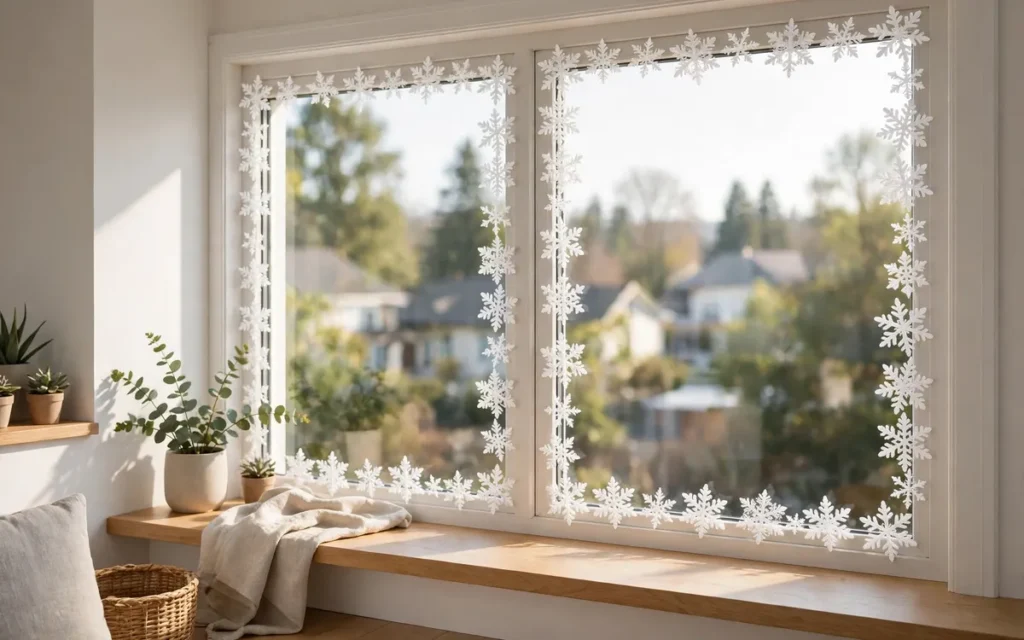
The true renter option: snowflake window clings run along the edges of the pane, framing the view instead of covering it. Clings stick by static alone — no adhesive, no residue, no marks — peel off in January and store flat for next year. A border arrangement keeps the middle of the glass and the daylight completely untouched.
Apply clings to clean, dry glass and smooth them from the centre outward to push air bubbles out. Because there is nothing to hang, clings are also the answer for windows that are hard to reach, roof windows, and glass doors where hanging pieces would swing. Buy one good set and it will outlast several Christmases.
4. Removable Frost Spray With a Star Stencil

A frosted band across the lower pane, or a corner of clear stars stencilled through frost, buys privacy and turns evening light into a soft diffuse glow. The stencilled version is the handsome one: stars, snowflakes or a simple skyline left clear while the glass around them frosts over, so the shapes shine when the room is lit.
Use a removable frost formula only, and test it on one corner of one window before committing — some products are far more permanent than their labels suggest. Mask edges carefully with tape for a crisp line, spray in light coats, and peel stencils while the last coat is still tacky for the cleanest shapes.
5. One Wreath on a Long Ribbon, Hung From the Top of the Frame

The classic window wreath, done properly: one full wreath sized to the two-thirds rule, hung on a long ribbon looped over the top of the window frame or tied to the curtain rod, so the ribbon itself becomes part of the display. Choose the ribbon colour for the street view — deep red reads at distance; pale linen disappears after dark.
Ribbon-over-the-frame is the strongest damage-free hanging there is, and the wreath to hang is worth choosing well: our christmas wreath ideas cover sizes, styles and more damage-free hanging options. Centre the wreath on the pane, step outside at dusk to check it, and adjust the ribbon length from the pavement’s view, not the sofa’s.
6. A Row of Mini Wreaths Across a Wide Window
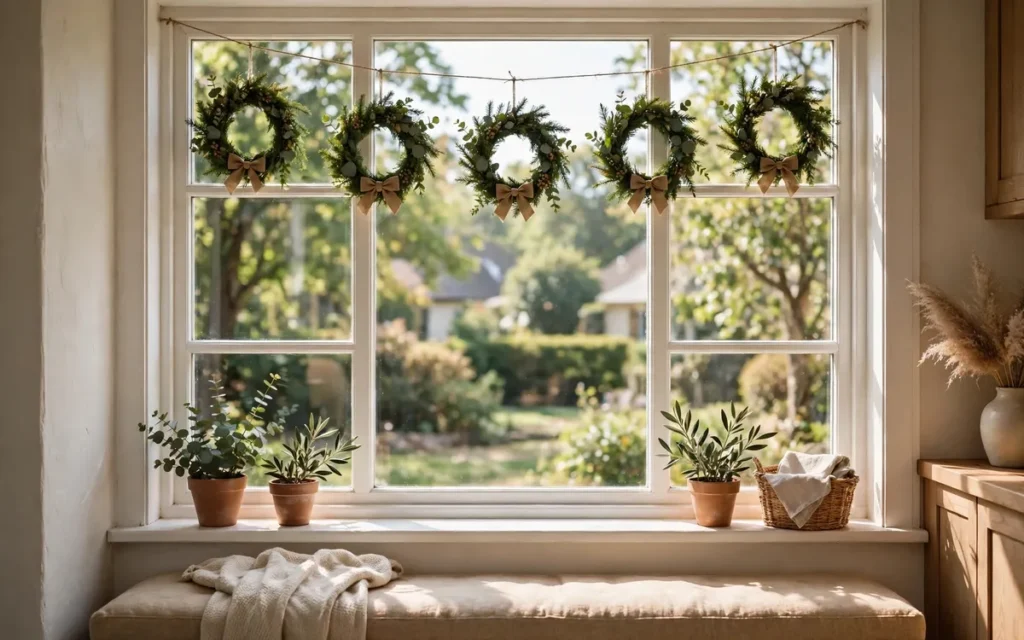
On a wide or multi-pane window, one wreath gets lost — a rhythm of small ones does not. Hang three or five mini wreaths across the window on individual ribbons cut to identical lengths, or strung along a tension rod sprung inside the frame. Repetition does the styling work; the eye reads the pattern instantly, from both sides of the glass.
Keep the wreaths small and light (about 6 to 8 inches), all the same, with matching bows. This is the window version of the rhythm trick that works on a staircase rail too — our christmas staircase ideas use the same row of mini wreaths along a banister. Odd numbers, even spacing, level tops: that is the whole recipe.
7. Pinecones on Ribbons at Staggered Lengths
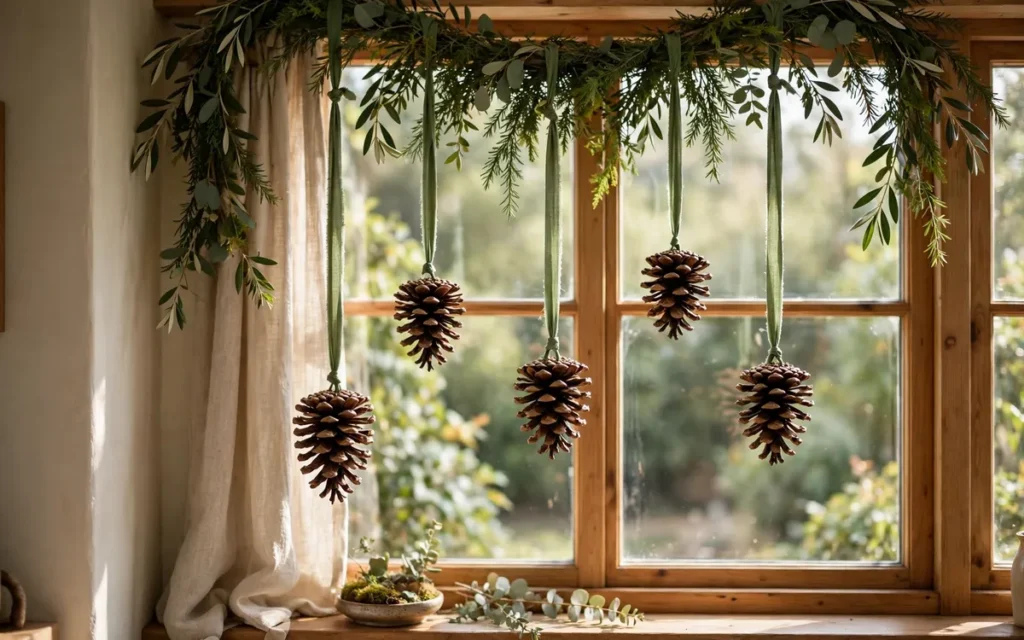
Foraged pinecones, each tied to a length of green or velvet ribbon and hung at deliberately varied heights in front of the glass, with a little greenery across the top of the frame to finish it. The staggered lengths are the design — cones hanging loosely at different drops look gathered and natural; cones in a straight soldier row look like a mistake.
Screw a small eye hook or wrap wire around the cone’s top scales to give the ribbon something secure to hold, and weigh bigger cones individually before trusting a suction cup — ribbon from the rod or frame is safer for anything heavy. A dusting of white paint on the cone tips makes them read as frosted from the street.
8. Baubles Floating on Clear Thread

Shatterproof baubles hung at staggered heights on transparent fishing line from the curtain rod or the top of the frame, so they appear to float in front of the glass. They catch daylight, tree lights and passing headlights in turn, and after dark they become a constellation of little reflections hovering in the window.
Group them in loose clusters of one colour family rather than spacing them evenly — three heights per cluster, odd numbers, nothing touching the glass (a bauble resting against the pane looks parked, not floating). Use only shatterproof ornaments here: hanging pieces get knocked whenever the window or curtains move, and glass at ankle height below a window is a hazard.
9. Paper Stars Hung on Fishing Line
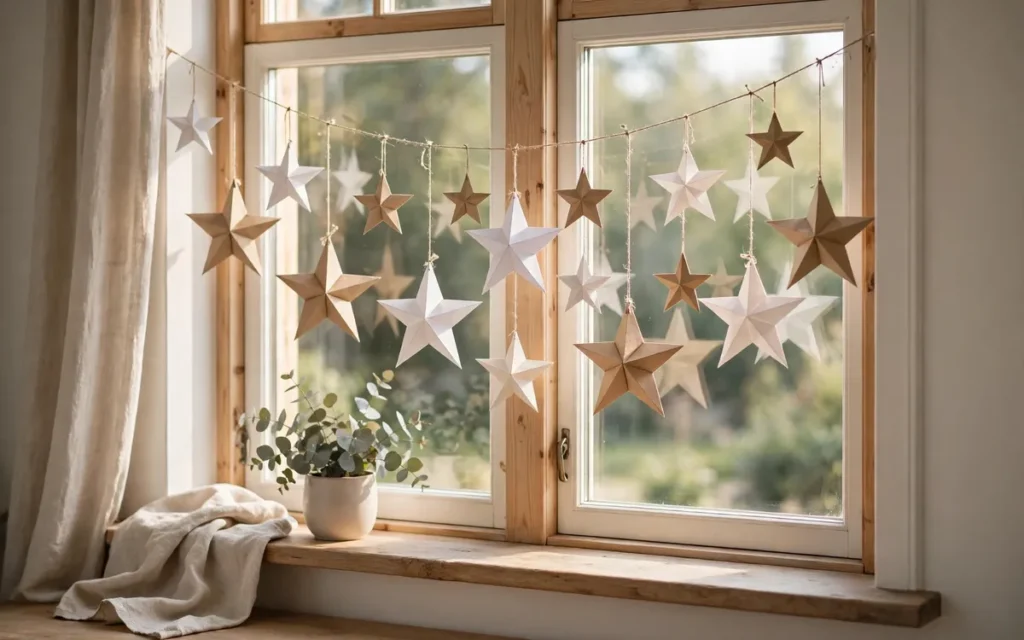
The Scandinavian staple: folded paper stars in white or kraft, in two or three sizes, hung on fine line at varied heights. They are near-weightless — the safest hang there is for delicate or rented-home frames — they glow softly if a lamp or tree light sits behind them, and in January they fold flat and store in an envelope.
Hang the largest star lowest and slightly off-centre, with smaller ones stepping up and out, rather than in a symmetrical row. Paper stars and staircase displays share the same trick — the staircase article in this series uses the same stars with fairy lights — and a set bought once can move between the hall window and the landing window year about. Keep them away from direct radiator heat rising under the window.
10. A Dried Orange and Cinnamon Garland Across the Top
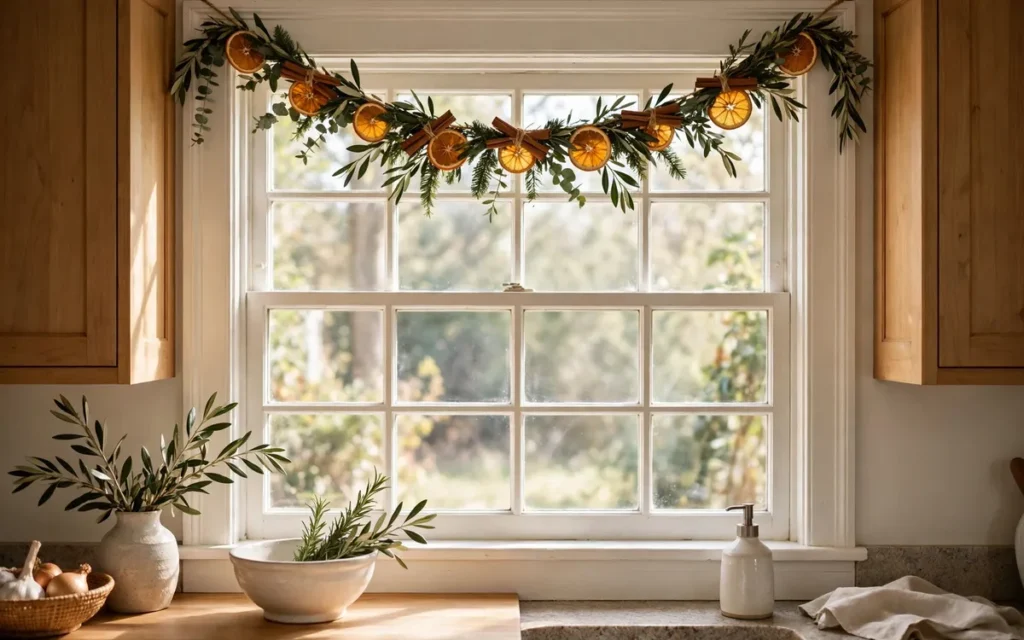
Thread dried orange slices and cinnamon stick bundles along a length of twine with a slim strand of greenery, and string it across the top of the window. The amber slices catch the light like stained glass, the cinnamon scents the room every time the radiator warms the air beneath, and the whole garland costs little more than a bag of oranges.
Top-of-window is the right home for this garland: high enough to leave the view and the daylight alone, close enough to the light to glow. Keep it slim — a heavy garland across a window sags into the sightline. In the kitchen window above the sink, this is the single best idea in the article (see Idea 18 for its sill partner).
11. Long Velvet Ribbons Hanging From the Curtain Rod
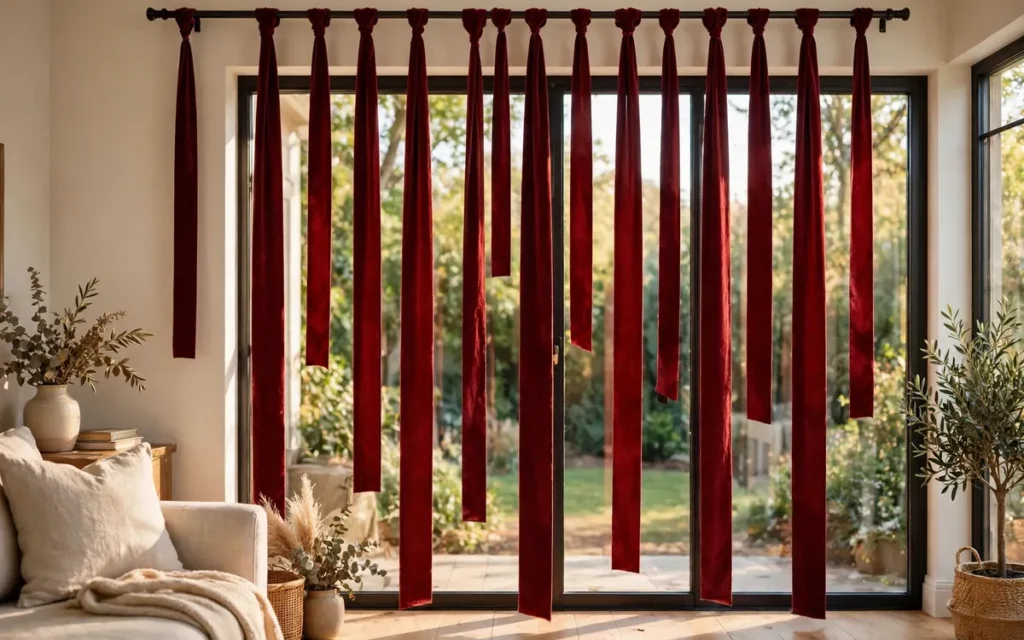
Sometimes the window needs height and movement, not objects: two or three lengths of wide velvet ribbon tied to the curtain rod, falling at different lengths down the glass, ends snipped into a V once they have settled. Against winter light the ribbons read as colour and softness, and they sway almost imperceptibly whenever the heating breathes — a window that feels alive.
Deep red, burgundy or forest green velvet suits traditional rooms; natural linen suits calm ones. Cut the ribbons longer than you think and trim after a day, because ribbon stretches and settles. Keep lengths clear of latches and handles, and away from any candle on the sill — ribbon plus flame is a combination this article’s safety section exists to prevent.
12. A Garland Framing the Whole Window

The full treatment for a picture window: one garland run up one side of the frame, across the top and down the other side, fixed to the frame itself so the glass stays completely clear. Weave battery fairy lights deep into the greenery, tuck in pinecones and berries, and the window becomes a framed picture of the winter garden by day and a glowing arch by night.
Measure before you buy: two sides plus the top, with a little extra for corner fullness — the staircase article’s rule of one and a half times the straight length applies here too. Fix with removable hooks on the frame, never tape, and hide the battery pack behind the curtain edge. This is the one idea to spend time on, because it is the one the whole street photographs.
13. A Single Swag Across the Top Corner

For small windows and arched ones, the asymmetric answer: one lush swag of greenery — a folded-back length of garland with a bow at its gathered point — draped across just the top corner. It follows an arch where a straight garland cannot, dresses a small window without eating its light, and looks deliberately styled rather than unfinished.
Build the swag on the table (greenery, cones, bow wired in), then hang the finished piece from one strong point: a ribbon over the frame or a removable hook rated for the weight. Asymmetry needs confidence — place it, step back, and resist adding a second swag to “balance” it. The empty glass beside it is the design.
14. Flameless Candles in a Row on the Sill
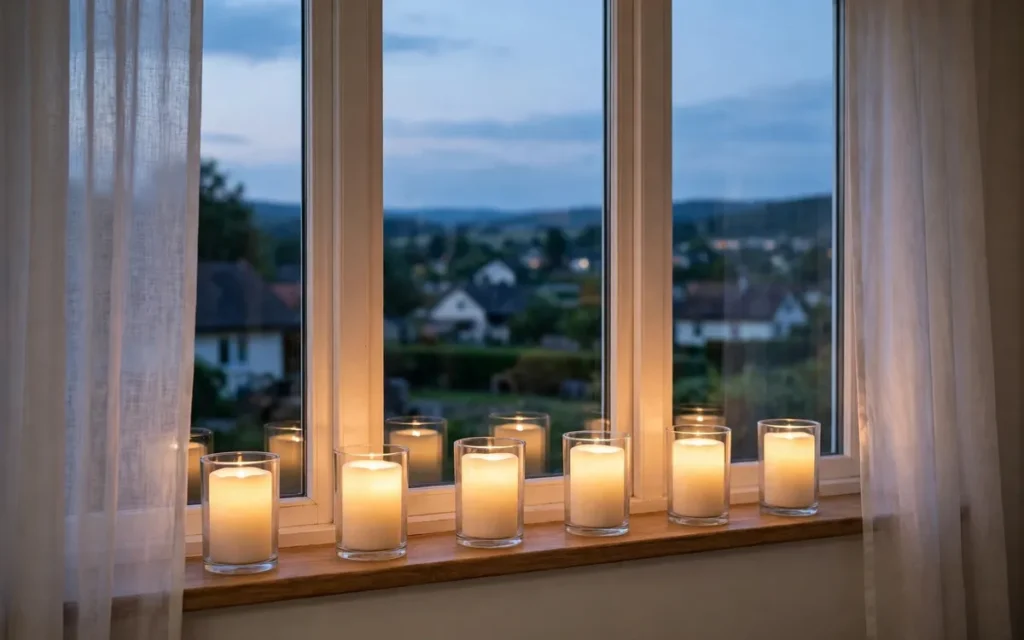
The traditional welcome, done safely: a row of battery candles on timers, evenly spaced along the sill, glowing for the street and the room at once. This is the window display with the longest history — a candle in the window has meant welcome for centuries — and the timer version switches itself on at dusk and off at bedtime without being touched all season.
Flameless is not a compromise here, it is the rule: curtains, blinds, nets and paper stars all live within inches of a windowsill, and no real flame belongs among them (the safety notes below give the full reasoning). Choose warm-white flickering candles in glass holders for height, set the timers once, and let the window do its greeting every evening on its own.
15. A Christmas Village on a Bay-Window Sill

A bay window’s deep sill is a stage built for a village: lit ceramic houses, bottle-brush trees and a drift of fake snow, arranged along the sill where the whole room can see it and the street gets the glow through the glass behind. Raise the back row on books or boxes hidden under the snow cloth so every roof shows.
Use battery-lit houses so no cord crosses the room or trails into condensation on the sill. Keep the village to the sill’s depth with a clear margin at the edges, and check from outside at dusk — a bay village seen from the pavement, windows glowing within windows, is the cosiest sight on the street. Small sills can host three houses; do not force a town onto a ledge.
16. A Mini Potted Tree on the Sill
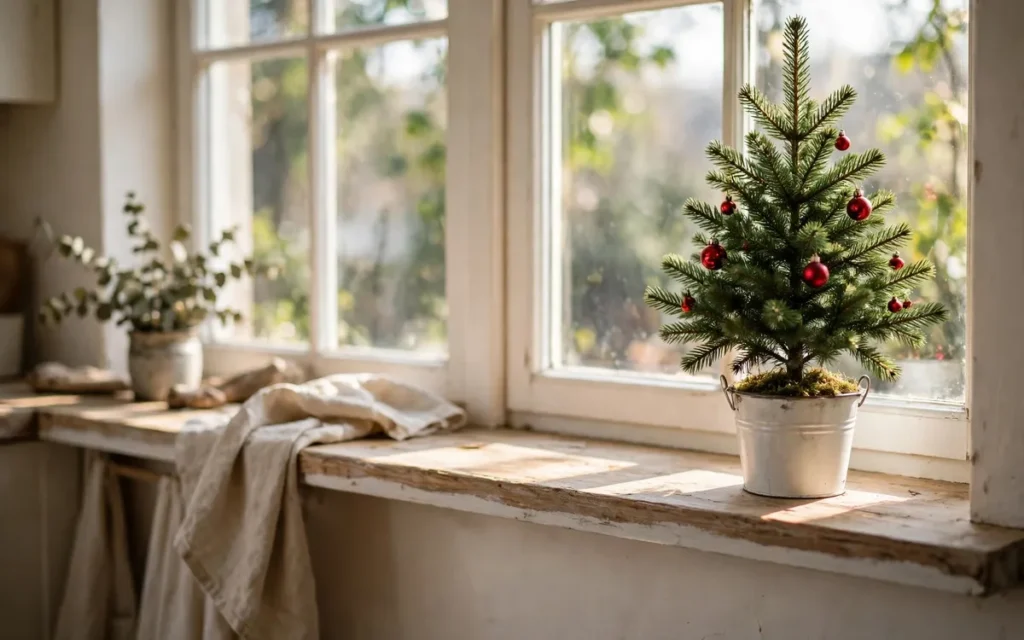
One small tree in a bucket, basket or ceramic pot, standing at one end of the sill: narrow enough to leave the view, tall enough to anchor the window, and dressed as simply or as richly as the room’s main tree. From the street it reads as a silhouette with lights; from the room it is a second, smaller Christmas.
Choose a pot with weight to it so the tree cannot be knocked off the sill by a curtain or a cat, and keep the tree’s lights battery-powered for the same cord reasons as the village. A mini tree is also the kindest window idea for a room with no floor space for a full tree — a bedroom, a study, a small flat’s only window gets its Christmas anyway.
17. A Greenery Runner Along the Sill

A short strand of faux evergreen laid along the sill with pinecones tucked in and a battery strand of fairy lights woven through — the quietest window idea in the article, and often the only one a calm room needs. It stops short of the corners, leaves the glass, the view and the window’s working parts entirely alone, and takes five minutes to lay.
Faux is the right material on a sill: it sits above the radiator (see the system section) and under condensation drips, and neither bothers it. Wooden bead garlands or a line of small lanterns work the same way if greenery feels too much. From the street, the fairy lights in the runner outline the bottom of the window like a horizon.
18. Cranberry and Candle Jars on the Sill

The window version of the dining table’s floating-candle trick: clear jars filled with cranberries and water, with flameless tealights or battery pillars glowing among them, set along the sill on a bed of greenery. The red berries in glass catch both daylight and candlelight, and the kitchen window above the sink — the most-looked-through window in the house — is their natural home.
If your kitchen follows the zone approach, our christmas kitchen decor ideas keep the worktops clear while this sill does the festive work above them. Use flameless lights only in the jars — water, real flames and windowsills are a poor combination — and refresh the cranberries weekly; they keep well in water but not forever in a warm kitchen.
19. Curtain Icicle Lights Behind Sheer Curtains

The maximum-glow option: a curtain of icicle or net lights hung across the whole pane behind sheer curtains, so the window becomes a soft wall of frosty light. From inside, the sheers blur the individual bulbs into a glow; from the street, the whole window shines like ice. It is the boldest idea here and transforms a plain room in an evening.
Hang the light curtain from the curtain rod or a tension rod, keep its plug and controller off the sill’s wet edge, and choose warm white unless the room is deliberately cool-toned — icy blue light flatters almost nothing at home. Check the street view after dark: if the glow overwhelms the room’s other lights, put the curtain on a timer for the evening hours only.
20. One Strand of Fairy Lights Outlining the Frame
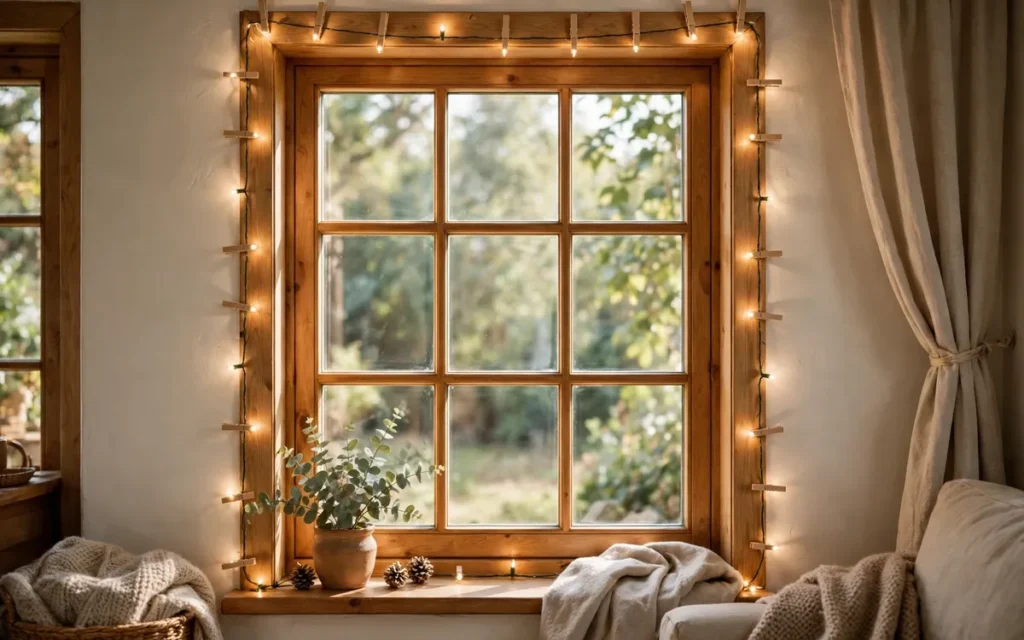
The subtle counterpart to Idea 19: a single strand of warm-white fairy lights clipped around the inside edge of the frame, outlining the window and nothing more. It costs the least, uses the least electricity, and suits windows and rooms that prefer understatement — the outline glows, the glass stays dark, the view survives.
Clip the strand at regular intervals so the line stays crisp rather than sagging into loops, and hide the battery pack behind the curtain or frame edge. Battery strands beat mains here: no cable crosses the sill, no plug hunts for a socket behind the radiator. One strand per window, matched across every window in the room, looks calmer than one hero window and three bare ones.
21. A Filled Exterior Window Box

Outside, the window box does what the sill does inside: pack it with evergreen cuttings or faux stems, red berries, pinecones and one oversized bow, and the plainest window becomes a display. In cold weather fresh cuttings pushed into the soil or foam stay green for weeks outdoors; faux stems in floral foam work anywhere and shrug off storms.
Build the arrangement taller in the middle and trailing at the edges, and secure everything properly — a window box in a December wind is a sail, and loose pieces end up in the garden. Water fresh cuttings on mild days if the soil dries. This is the street’s favourite version of the window: colour at eye level, no lights required, handsome in daylight when indoor displays are invisible.
22. An Outdoor Wreath and Garland Frame

The curb-appeal version of the two indoor classics: a wreath centred on the outside of the pane and a garland fixed across the top of the frame, built entirely from outdoor-rated pieces. Together they frame the lit window like a picture, and on a house with several street-facing windows, repeating the same frame on each is what makes a home look “done” from the road.
This is where the window story joins the rest of the front of the house — our outdoor christmas decor ideas cover the porch, path and yard that sit below these windows. Fix exterior pieces with outdoor hooks or ties rated for weather, never through the frame, and always check the finished window from the pavement at dusk: spacing that looks right from the ladder looks different from the street.
23. A Lit Paper Star for the Street View

One strong shape, lit from behind: a large paper star (or a tree or house silhouette) hung in the centre of the window with a warm light behind it, so after dark the window becomes a lantern the whole street can see. It is the simplest display in the article and the one neighbours remember — a single glowing shape beats a crowded window every time.
Use an LED bulb or a battery light inside or behind the star — paper and hot bulbs never share a space — and hang the star on clear line from the top of the frame so it appears to float. Indoors, the same star glows softly into the room. Choose the biggest star the pane can hold with a border of dark glass around it; small stars in big windows read as lost.
24. Twin Wreaths on French Doors or a Pair of Windows
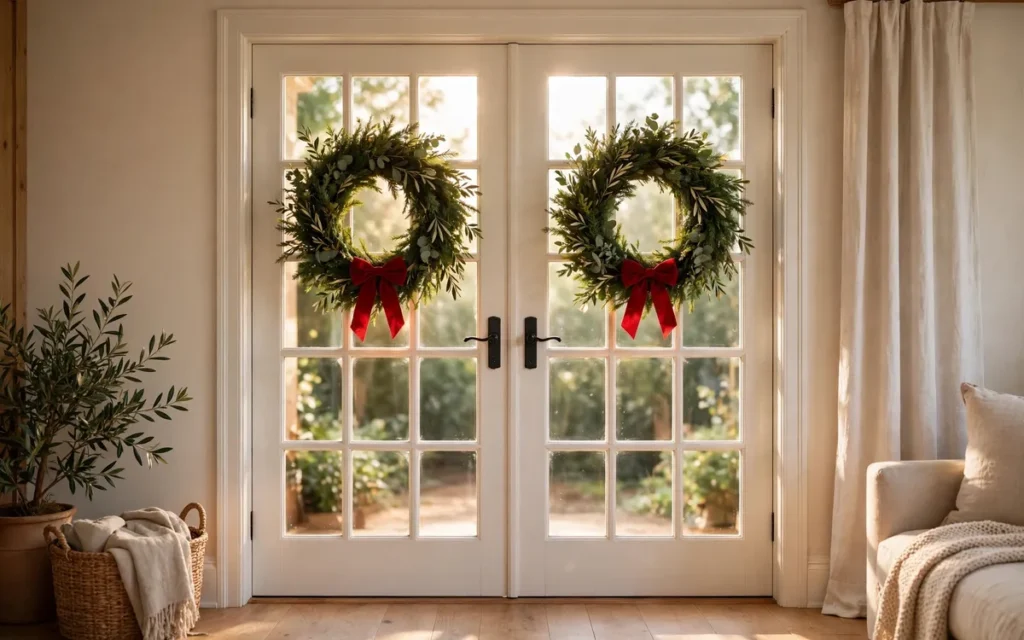
Some panes come in pairs, and a single wreath cannot dress a pair: hang matching wreaths at matching heights on matching ribbons, one on each French door or each of two side-by-side windows. Symmetry is the entire effect — the pair reads as one considered display, and doors get the bonus that the wreaths move with them, gently, every time they open.
On doors, hang each wreath from ribbon looped over the top of the door itself so nothing is fixed to the glass and the wreath travels with the door. Measure both ribbons against each other before tying; a pair of wreaths one inch apart in height looks like an error, while a deliberate difference of six inches looks like design. Size each wreath to its own pane using the two-thirds rule.
Budget Tips for Windows That Look Expensive
The good news is that christmas window decor is one of the cheapest displays in the house to do well — most of these rules are about spending on one window and making the rest from paper and the garden.
- Paper is nearly free. Snowflakes, stars and chalk drawings (Ideas 1, 2 and 9) come from white or kraft paper, a chalk pen and leftover wrapping paper.
- Forage the hanging and sill pieces. Pinecones on ribbon, garden evergreen clippings for sill runners and window boxes (Ideas 7, 17 and 21) cost nothing but a walk.
- Do one window properly first. Dress the street-facing window fully rather than thinning the same supplies across every window in the house; add windows in later years.
- One strand of battery fairy lights is the cheapest glow there is. It frames a whole window (Idea 20), needs no socket, and the battery pack hides behind the curtain.
- Buy the hardware in the January sales. Suction cups, clings and tension rods store flat, last for years, and are the only window “props” truly worth owning.
Common Window Decorating Mistakes to Avoid
- Covering the whole pane, so the room loses its daylight. Keep the bottom third clear on any window you look out of.
- A wreath too small for the window. Under half the pane’s width reads lost, not minimal — two-thirds is the rule.
- Real candles beside curtains, blinds or paper stars. Flameless only in a window, always.
- Trusting a suction cup with a heavy wreath on cold or dirty glass. It will let go, usually at night — heavy pieces go on ribbon over the frame.
- Decorating across the latch, handle or track, so the window cannot open for air — or, on a bedroom escape window, cannot open at all.
- Trapping a light cord in a closing sash, or running plugs where condensation drips onto them.
- Putting indoor-only paper and lights outside, where one wet week destroys them.
Window Decor Safety Notes
Flameless candles are the only sensible choice in a window: curtains, blinds, nets and paper decorations all live within inches of the sill. Fire services record thousands of candle-started home fires every year; if a real candle is ever used anywhere near a window, it needs at least 12 inches (30 cm) of clear space from anything that can burn and must never be left unattended — and beside curtains, the honest advice is simply not to.
Mind the condensation, too: winter glass sweats and sills pool water, so keep plugs, sockets and battery packs off the wet edge of the sill, use outdoor-rated lights on windows that sweat heavily, and never let a cable sit in pooled water. Clean glass before suction cups and re-seat them weekly, and put anything heavy on ribbon over the frame instead — falling decor breaks what is below it. Choose shatterproof pieces for anything hanging within reach of children or pets, and keep blind cords and added ribbons looped up out of small hands’ reach, because cords plus ribbons are a tangle hazard. For exterior work, use a stable ladder for upper windows, outdoor-rated leads and timers, and never fix anything across a window that serves as an escape route.
Frequently Asked Questions
How do I hang a wreath on a window without nails or damage?
Loop a long ribbon over the top of the window frame (or tie it to the curtain rod) and hang the wreath from that — it is the strongest damage-free method and the ribbon becomes part of the display. For light pieces, clear suction cups on glass cleaned with rubbing alcohol work well; removable adhesive hooks on the frame are the third option, tested on a hidden spot first. Never put nails or screws into uPVC or vinyl frames.
How big should a wreath be for a window?
At least two-thirds of the pane’s width — a 22-inch wreath suits a 30-inch window. Smaller than half the width reads lost rather than minimal. On a pair of windows or French doors, size each wreath to its own pane by the same rule, and hang them at exactly matching heights.
Can I put candles in a Christmas window safely?
Only flameless ones, honestly. Curtains, blinds, nets and paper decorations all live within inches of a windowsill, and a real flame among them is a risk with no upside — battery candles on timers give the same welcome glow and switch themselves on at dusk. If a real candle is ever used, keep it at least 12 inches (30 cm) from anything flammable and never leave it unattended.
How do I decorate a window that still needs to open — or one with blinds?
Decorate the frame, the fixed pane or the sill instead of the opening pane, and keep latches, handles, sliding tracks and blind cords completely clear. Top-of-window garlands, sill runners and glass clings all leave the window fully working. Bedroom escape windows must still open fully — decorate around them, never across them.
How do I make my window decor look good from the street as well as from inside?
Plan both views before hanging anything: lit pieces and bold silhouettes (a wreath on a visible ribbon, a lit star, glowing sill candles) read from the street after dark, while detailed scenes face the room. Then check the result from the pavement at dusk, not just from the sofa — that is where spacing and sizes reveal themselves.
What are the best Christmas window decorations for renters?
The ones that leave nothing behind: static-cling snowflakes (no adhesive at all), paper snowflakes and stars (near-weightless, hung from the curtain rod), chalk-marker drawings (they wipe off), and removable hooks tested on a hidden spot first. Avoid nails in any frame, and keep every piece clear of the window’s working parts so nothing is strained when the window opens.
Bathroom windows live in the steamiest spot in the house, and they get their own treatment in our bathroom christmas decor ideas — steam-safe clings, privacy and glow included.
A row of lit village houses is the sill layer of a window display — our christmas village display ideas cover that display and sixteen more.
Conclusion
The best Christmas window is not the fullest one. It is the one planned from both sides, hung without damage, sized to its pane, and still able to open when the room needs air. If you are starting from zero, the ribbon-hung wreath to the two-thirds rule, paper stars on fishing line and a timer row of flameless sill candles are the three safest first windows — each quick, cheap and easy to adjust. Use flameless light near curtains, hang heavy pieces on ribbon rather than suction, keep the bottom third of your view clear, and photograph every finished window from the street at dusk before it comes down. Next December will start from those pictures instead of from memory.



4 Comments