

21 Artful Empty Corner in Living Room Ideas for a Room That Feels Finished
Every living room has one: the corner nothing fits and everything avoids, where the vacuum rests and the eye slides past. It is rarely a small problem disguised as a big one — it is a big space wearing the wrong treatment. These empty corner in living room ideas start by measuring the corner before styling it, because a corner is finished by numbers first and objects second: the walkway it must not block, the one job it is given, and the single anchor piece that fills it at full scale. The warmth of the room as a whole is a bigger system — our cozy living room ideas build it wall to wall — but this guide is about the room’s edges, where that warmth is most often left undone.
The Method: Measure It, Assign It, Anchor It
Three decisions, in order, before anything is bought: whether the corner may hold anything at all, what single job it will do, and which one piece anchors it. Fill a corner in the wrong order — object first, questions later — and it stays a storage accident no matter how pretty the object is.
Step 1 — Measure It: The Route Past the Corner Decides What May Live There
Measure the corner’s depth along both walls, then check the walking route past it: a main walkway needs 30–36 inches clear — the U.S. Access Board’s accessible-route standard is a 36-inch continuous clear width — and a door’s swing arc needs the same courtesy. Then classify the corner honestly: a deep corner (roughly 36 inches or more of usable depth on both walls) can hold a chair; a shallow corner gets wall and vertical treatments only; a route corner, one the walkway passes through, gets nothing on the floor at all. The fuller spacing picture behind these numbers is set out in OROA’s living room furniture spacing guide.
Step 2 — Assign It: One Corner, One Job
A corner fails when it tries to be seat, shelf, plant stand and dumping ground at once. Pick the single job the room is missing — a seat, light, storage, display, greenery or work — and let everything in the corner serve that job. More than any single object, empty corner in living room ideas stand on this assignment: a corner with one job reads as furnished; a corner with four jobs reads as the place things were put down.
Step 3 — Anchor It: One Piece at Full Scale, Hung and Lit by the Numbers
Whatever the job, the corner is anchored by ONE substantial piece, not three small ones: art and gallery groupings centred at 57 inches from the floor — the gallery standard — with frames spaced 2–3 inches apart, and a lamp chosen so the bottom of its shade lands at seated eye level, which on a standard 58–64-inch floor lamp means roughly 40–48 inches from the floor. Small pieces scattered in a corner read as leftovers; one anchor reads as a decision.
Zone A — Seat the Corner
The most valuable job a corner can do is hold a person: a seat turns dead square footage into the room’s most fought-over chair. One caution before this zone — if the “corner” in your room is actually the dead strip behind a floating sofa, it is not this article’s corner at all; that strip belongs to our sofa table decor ideas. These four ideas are for the true corner, where two WALLS meet.
1. Angle an Accent Chair on the Diagonal

The classic fix, done by numbers: an accent chair 30–35 inches wide fits most corners. Angle it about 45 degrees across the corner point instead of pushing it flat against either wall, and pull it 2–3 inches off the walls so it reads as seating, not storage. Keep the route behind it at 30 inches if people pass that way.
2. Build a Reading Nook With Shelves Above the Chair
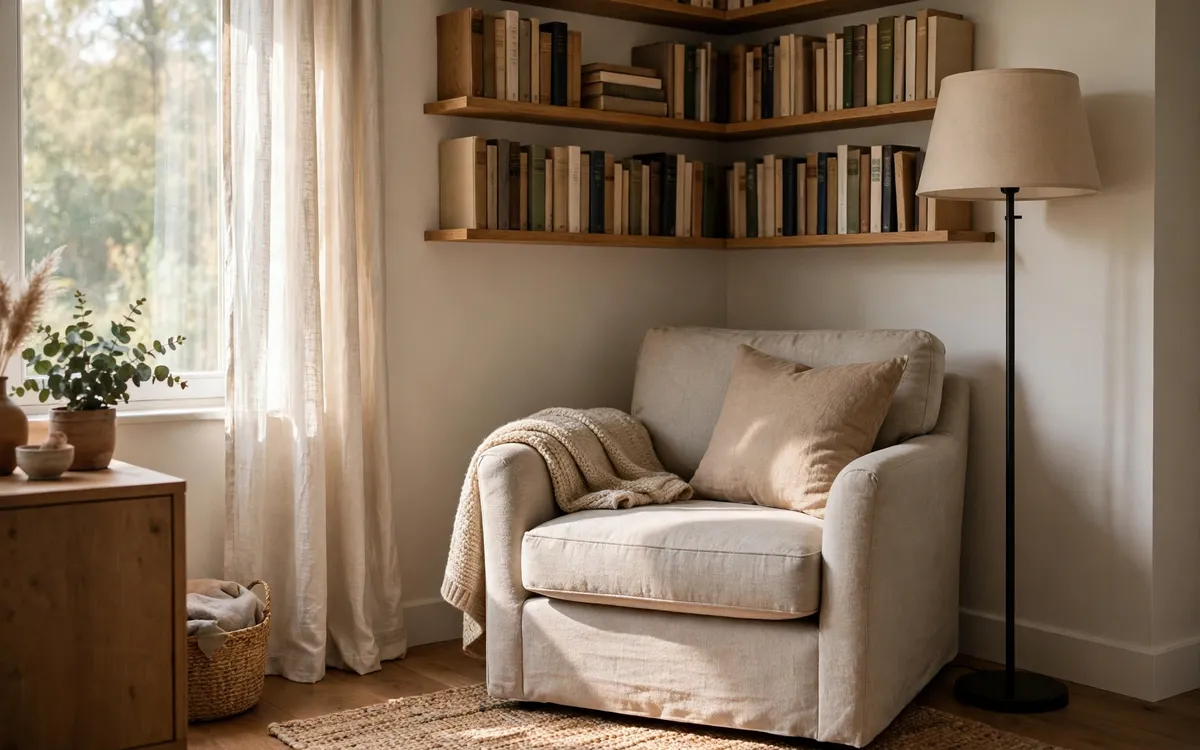
The chair from idea 1 becomes a nook when a shelf line goes above it: the books live over the seat, within reach of the person in it. Set the lowest shelf high enough that a seated reader’s head clears it with room to spare, and pair the nook with the reading lamp in idea 5 — its shade bottom at seated eye level, about 40–48 inches from the floor.
3. Choose a Swivel Chair That Turns to Talk

A swivel solves the corner chair’s one flaw: angled into the corner, a fixed chair faces away from the room. A swivel turns to join the conversation, then turns back to the window or the lamp when the talk dies down. Allow its full turning circle — nothing stored inside the swing, or the nook’s second job becomes moving clutter.
4. Fit a Corner Bench With Hidden Storage

A hinged-top bench built or bought to the corner’s angle: seat height at the standard 17–19 inches, so it doubles as spare seating at a pinch, and the box under the seat swallows the blankets and board games that otherwise colonise the corner floor. It is the one seat in this zone that also tidies.
Zone B — Light It, Mirror It
Corners are dark by geometry: two walls meeting means light arrives from one direction only. This zone fixes the corner’s light first and its reflection second. One related wall needs care: the corners flanking a TV compete with the screen, so keep corner pieces there lower and quieter — the screen wall itself is the subject of our how to decorate around a TV guide.
5. Stand a Floor Lamp at Reading Height
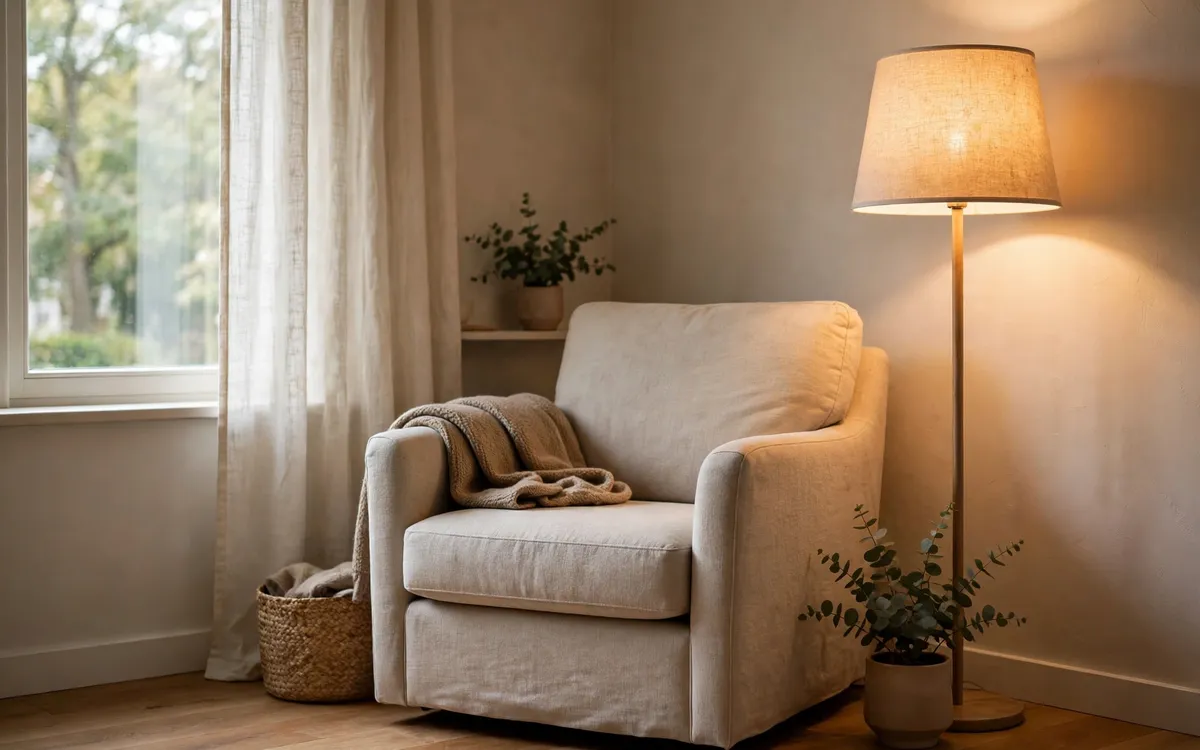
The dark corner’s fix, sized properly: a standard floor lamp stands 58–64 inches tall, but the number that matters is the shade’s bottom edge, which should sit at or just below seated eye level — about 40–48 inches from the floor on typical seating — so the bulb is hidden and the light lands on laps and pages, not in eyes.
6. Arc a Lamp Over the Corner Seat

An arc lamp planted in the corner throws light over a chair or the sofa’s end without needing a side table at all. Keep the arc’s lowest point comfortably above a seated head, and let the base sit fully inside the corner, so the stem — not the shade — is what the walkway passes.
7. Lean a Tall Mirror Against the Corner
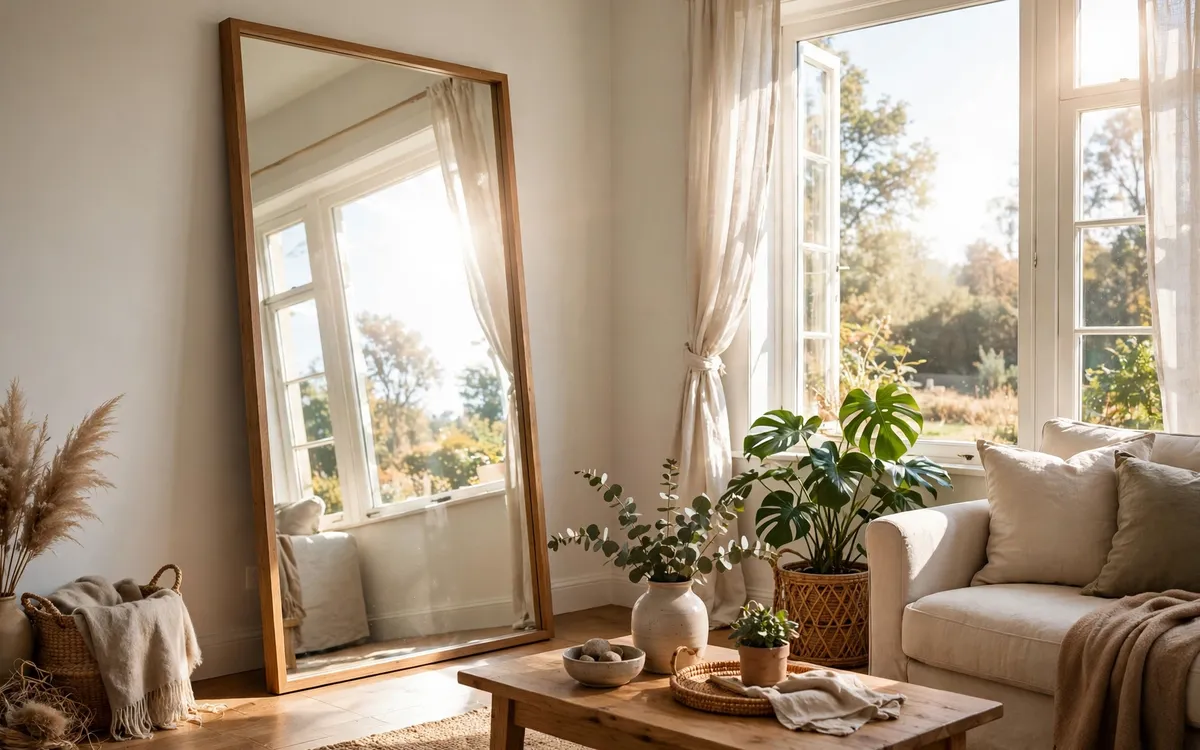
A leaning mirror of 60 inches or taller reads as furniture, not a picture. Face it toward a window or the room’s best view so it returns light and depth into the room’s darkest angle. In homes with children or large dogs, fix the top to the wall with an anti-tip strap — a leaned mirror is a climbed mirror.
8. Add a Plug-In Sconce Beside the Chair

The renter’s reading light: a plug-in sconce mounts with two screws, needs no electrician, and puts light exactly at the reader’s shoulder. Mount it so the shade sits about 60 inches from the floor beside the chair, and run the cord down the corner’s seam, where the angle hides it.
Zone C — Shelve It, Store It
A shallow corner has no floor to give, but it has two walls — and walls are storage that costs no walkway. This zone climbs the corner: shelves, bookcases and one closed cabinet for the things no room should have to display.
9. Float Corner Shelves Up the Walls

Floating shelves that wrap the corner use the only space a shallow corner has. Depths of 8–12 inches hold books and objects without eating the walkway, and the run obeys the corner’s classification: on a route corner, shelves start above head height or not at all.
10. Lean a Ladder Shelf Into the Corner

The ladder shelf’s narrowing profile — deep at the base, shallow at the top — suits a corner’s geometry and needs no fitting. Style it heavy-low, light-high: baskets and books on the bottom rungs, one trailing plant at the top. Anchor it to the wall; a loaded ladder shelf is top-heavy by design.
11. Wrap a Corner Bookcase Around Both Walls

A true corner bookcase turns two short wall runs into one library. Size it to the corner’s SHORTER wall so neither side overhangs, and leave the top shelf for display — the working shelves are the ones between knee and eye height, where books are actually reached for.
12. Hide the Clutter in a Corner Cabinet

The closed-door answer: a triangular-footprint corner cabinet swallows board games, chargers and the router behind doors, with a styled surface on top. Closed storage is what separates a corner that works from a corner that merely displays its mess at eye level.
Zone D — Grow It, Hang It
Greenery and art are the corner’s soft finishes — but both fail at the wrong scale. This zone keeps every plant and every frame at the size the corner actually needs, and hangs both by the method’s numbers.
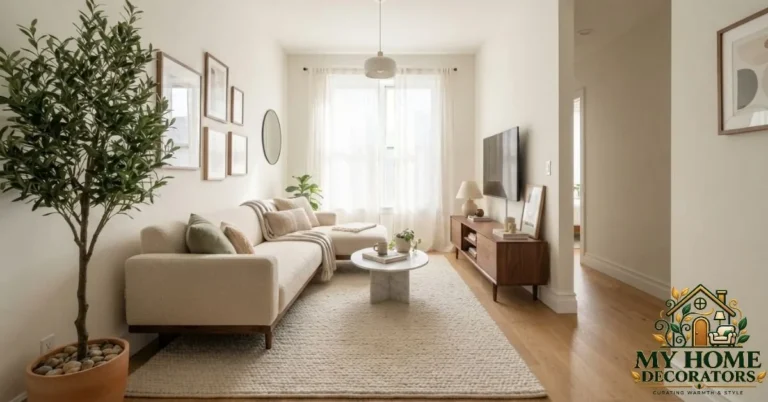
13. Stand a Tall Tree in a Heavy Pot

The plant fix at the right scale: for an 8-foot ceiling, plant and pot together should stand 4–6 feet tall; a 12-inch tabletop plant on a floor corner reads as lost property. Choose the species by the corner’s light, not by the photograph — the dark-corner species are FAQ 5’s subject.
14. Layer Plants on Stands at Three Heights

One tree is a statement; a trio at staggered heights — stands of roughly 12, 20 and 28 inches — is a composition. The stands do in one corner what lesser guides spread across three separate plant ideas: the eye reads one layered corner, not three orphaned pots.
15. Hang Trailing Plants From the Ceiling

When the floor is a route, the corner’s airspace is still free: a ceiling hook set into a joist, a trailing pothos or fern, and the pot’s bottom kept above head height anywhere people pass. One hook, properly anchored, carries what a shelf of small pots cannot.
16. Wrap a Gallery Wall Around the Corner

The gallery that does not stop at the corner point: treat frames on BOTH walls as one grouping, its centre on the 57-inch line and frames 2–3 inches apart, continuing around the angle. It is the wrap-around cousin of the gallery our above couch decor ideas build over the sofa back — same centre line, carried around the turn.
Zone E — Work It, Play It
The last zone gives the corner a working life: a desk, a drinks station, a pet’s address, a child’s library, and — for the corner the method says must stay nearly empty — the discipline of a single piece.
17. Set Up a Corner Desk for Laptop Work
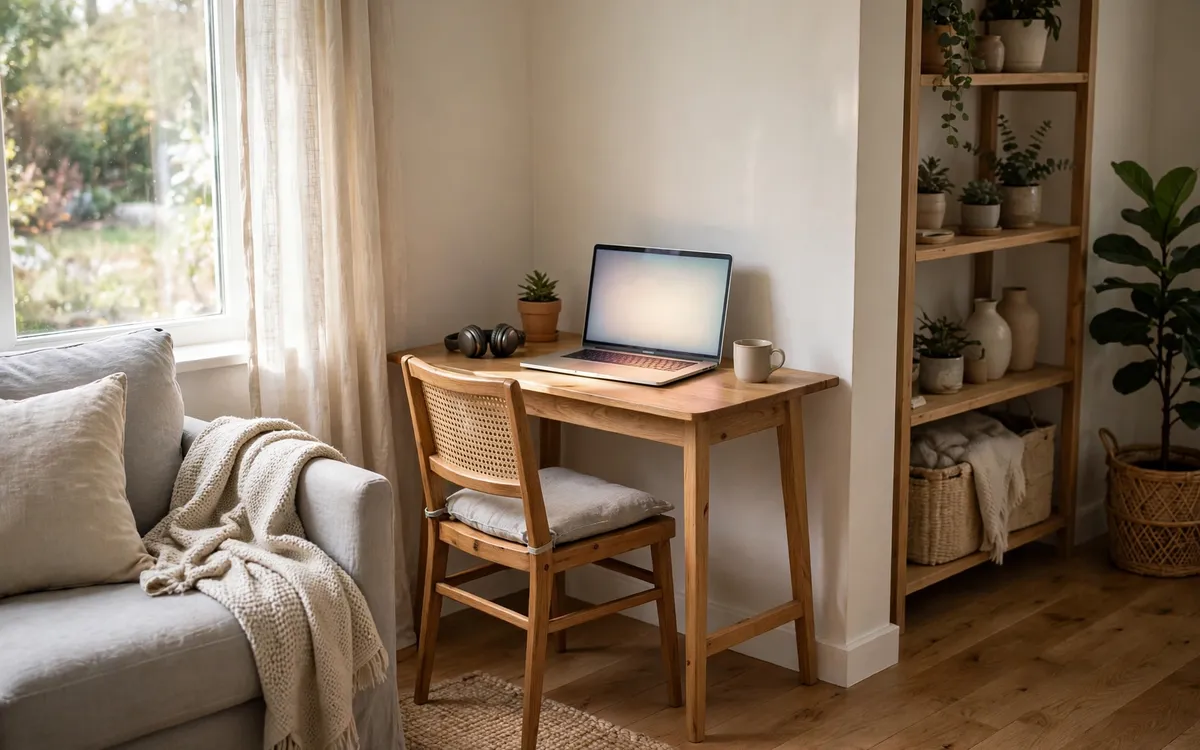
The corner office, ergonomically honest: workplace guidance puts the screen 20–40 inches from the eyes with its top at or slightly below eye level, and a standard desk height is 28–30 inches. A corner desk that hits those numbers is a workplace; one that does not is a perch. The diagonal position a corner offers is exactly why it works.
18. Roll In a Bar Cart for Hosting Nights

A two-tier bar cart parks inside the corner’s triangle and rolls out when guests come: heavy bottles on the lower tier — a cart’s stability lives low — glassware above. Between parties it is the corner’s display piece; on the night, it is the drinks station that keeps traffic out of the kitchen.
19. Make a Pet Corner That Still Looks Designed

The pet bed corner, upgraded from apology to intention: a bed sized so the dog can stretch fully — measure nose to tail and add a few inches — a washable cover in a fabric that matches the room, and bowls on a mat at the corner’s edge. The pet gets an address; the room keeps its dignity.
20. Build a Kids’ Book Nook at Child Height

A front-facing book sling or low shelf a child can reach unaided — the working shelves below about 36–48 inches, by the child’s height — a floor cushion, and a lamp by idea 5’s rule scaled down. This corner gives children a seat in the living room that is theirs, beside the grown-ups’ seats rather than exiled from them. Anchor anything climbable to the wall.
21. Lift One Statement Piece on a Pedestal

The minimal corner, done deliberately: a pedestal of 36–42 inches lifts a single vase, sculpture or plant into the sightline a corner deserves, and the discipline is the idea — one piece, at height, with empty space around it. This is the answer for the corner beside the room’s busiest route, where the method says furniture may not go.
What It Costs: Three Ways In
The rearrange-it tier (under roughly $75). The corner furnished from the rest of the house — the spare chair, the lamp from the bedroom, the plant from the hallway — plus one woven basket and a thrifted mirror. The method’s numbers cost nothing; this tier proves the corner was a layout problem, not a shopping problem.
The one-anchor tier (roughly $75–$400). ONE proper anchor bought for the corner — a 30–35-inch accent chair, a 58–64-inch floor lamp, a corner bookcase or a 60-inch-plus leaning mirror — styled with what the home already owns.
The built-in corner tier (roughly $400–$1,500 and up). Built-in corner shelves or a storage bench fitted to the angle, a quality swivel chair with an arc lamp, or a full corner-desk setup — the carpentry-and-furniture moves that make the corner a room within the room.
7 Mistakes That Leave a Corner Looking Unfinished
- Three small things instead of one anchor. A tiny plant, a small stool and a picture hung high read as leftovers, not a decision. The method’s third step exists because scale, not quantity, finishes a corner.
- Blocking the walkway. Anything that cuts the route past the corner below 30 inches — or parks inside a door’s swing — makes the whole room feel tight, and the corner piece gets blamed and bumped daily.
- A chair pushed flat into the corner. Square against the walls, a chair reads as stored furniture. Angled on the diagonal (idea 1), the same chair reads as the best seat in the room.
- A plant at the wrong scale or in the wrong light. A 12-inch pot on the floor of an 8-foot corner, or a light-hungry fig in the room’s darkest corner: both fail within a month — one visually, one literally.
- The lamp at the wrong height. A shade bottom above seated eye level shows the bare bulb to everyone sitting down — pure glare — and too low, the light pools uselessly in laps. The 40–48-inch shade line is the difference between a reading lamp and a nuisance.
- Stopping the treatment at the corner point. Shelves, paint or a gallery that end dead at the angle make the corner look like two half-walls. Wrap it (ideas 9, 11, 16) or commit to one wall only.
- Filling a corner that should stay empty. A route corner or a corner inside a door’s swing is better bare: an honest empty corner reads as breathing room; a blocked one reads as a mistake.
FAQs
What can I put in the corner between two sofas?
A lamp table or a slim side table with a lamp whose shade bottom sits at seated eye level — or, if the gap is wide, the tall tree of idea 13. The between-sofas corner is a lighting corner first: it is the one spot that can light both seats at once.
How do I decorate an empty living room corner without plants?
One substantial piece: a 58–64-inch floor lamp, a leaning mirror of 60 inches or more, a blanket ladder, or the wrapped gallery of idea 16. The rule is scale, not species — the corner fails on size long before it fails on subject.
How do you fill a corner in a small living room?
Go vertical and keep the floor: floating shelves at 8–12 inches deep, a ladder shelf, hanging plants — and defend the 30-inch walkway, because in a small room the route is worth more than the object standing in it.
What size chair fits in a living room corner?
An accent chair 30–35 inches wide, angled about 45 degrees across the corner point. Measure the corner’s depth first: with under roughly 36 inches of usable depth on both walls, skip the chair and choose the wall treatments instead (Zones B and C).
What is the best plant for a dark living room corner?
Low-light-tolerant species — snake plant, ZZ plant, pothos — and keep the scale: a tall specimen, or a mid-size plant raised on a stand, reaching the 4–6-foot presence a floor corner needs. Even tolerant plants want some indirect light; rotate the pot a quarter turn weekly so it grows evenly.
Should every empty corner be filled?
No. Corners on the main walking route and corners inside a door’s swing are better left open. The method’s first step classifies the corner before anything is bought, and “leave it” is a legitimate answer for a route corner — breathing room is a finish too.
Conclusion
A corner is finished the way a room is: measured first, given one job, and anchored by one piece at full scale. Work through these empty corner in living room ideas in that order — measure it, assign it, anchor it — and the room’s forgotten square metres join the room again. Corners matter most in narrow rooms, where every vertical inch has to earn its keep — which is why this guide’s natural partner is our 10 smart ways to make a narrow living room look bigger, the layout these corners live inside.

3 Comments