
27 Festive Christmas Centerpieces for a Warm, Glowing Holiday Table
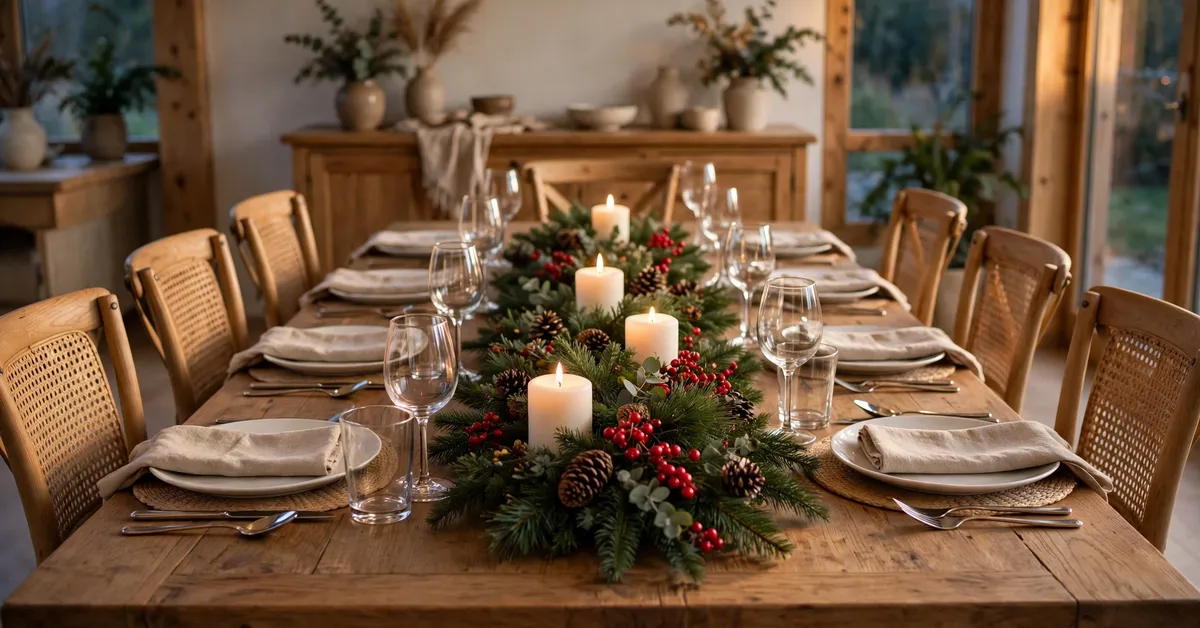
A Christmas table is judged before anyone sits down — the moment guests walk in, the table tells them how the evening is going to feel. And the centerpiece is the one piece of Christmas decor that has to earn its place, because it shares the table with dinner itself: it must look generous, glow a little, and still leave room for the turkey, the gravy and a proper conversation. These christmas centerpieces are chosen with all three jobs in mind.
Below are 27 centerpieces for long tables, round tables, small tables and sideboards — from a five-minute bowl of spare baubles to a gingerbread house that gets eaten for dessert. Just as useful is the short system section first: how tall a centerpiece may be before it blocks the view, how much of the table it may cover, and the five-layer method that makes almost any arrangement work. Learn those three rules and you can build a centerpiece from whatever you already own.
Size It, Layer It, Light It: The Three Rules Behind Every Good Centerpiece
The Height Rule: Low, or Slim
Keep the solid body of a centerpiece under about 12 inches (30 cm) tall, so seated guests can see and talk over it comfortably. The band between roughly 12 and 24 inches is the no-go zone — it sits exactly at face height, and dinner becomes a conversation held around a hedge. Height is welcome only when it is slim or see-through: taper candles, bare branches, glass. Anything tall and lush belongs on the sideboard or buffet, where nobody has to talk across it. For a fuller walk-through of the sizing and layering method, this guide to making a Christmas centerpiece covers the same rules step by step.
The Footprint Rule: The Middle Third
A centerpiece should cover roughly the middle third of the table’s width and about a quarter to a third of its length — no more. On a long table that means one longer arrangement down the spine, or two or three repeated smaller clusters. On a round table it means one contained focal point, about a third of the diameter. On a small table it means one low, narrow piece and nothing else. Always leave both long sides completely clear for place settings, plus a landing zone where serving dishes, water jugs and elbows will actually go.
The Five-Layer Build
Almost all of these christmas centerpieces are built the same way. Layer one, the base: a tray, board, wooden box, cake stand, flat wreath or dough bowl — the base sets the footprint and makes the whole arrangement movable. Layer two, greenery: faux or fresh sprigs tucked and fluffed to hide the base’s edges. Layer three, height: candles, mini trees or branches, placed now and checked from a seated eye level, not a standing one. Layer four, details: baubles, pinecones, berries, fruit or little houses. Layer five, light: fairy lights woven deep into the greenery, battery pack hidden underneath, or the candles themselves doing the glowing.
Fresh, Faux, or Both
Fresh greenery looks and smells best for about a week indoors; seating the stems in water-soaked floral foam and misting lightly stretches it further. Good faux greenery is a one-time cost that comes back every year. The practical hybrid used by most hosts: build the whole base early in December with faux, then tuck in fresh sprigs, cranberries or fruit a day or two before the dinner, when it matters.
The Candle Rule
Two lines cover it. Near food, candles should be unscented — a scented candle fights with the meal from the first course. And wherever children, pets, paper decorations or dried foliage are involved, flameless candles give the same warm glow with none of the worry. The safety section at the end of this article has the full rules; the kitchen where the dinner is cooked matters just as much, and our christmas kitchen decor ideas cover decorating that room without getting in the cook’s way.
1. Classic Evergreen, Pinecone and Pillar Candle Runner
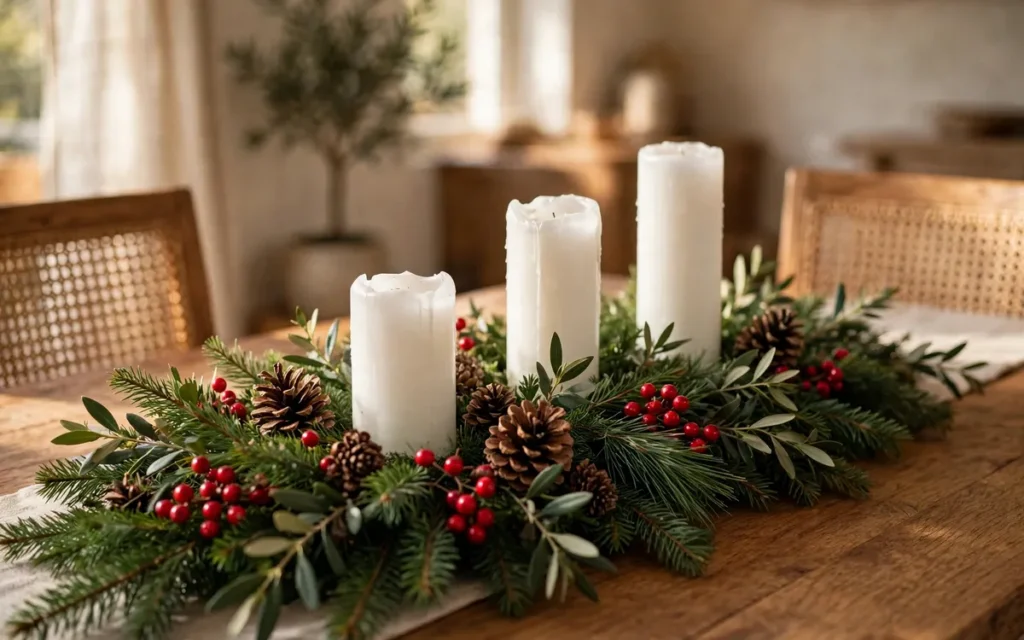
The traditional long-table build, and still the one to beat: layers of cedar and pine laid down the spine of the table, three white or ivory pillar candles at staggered heights along it, and pinecones and red berries tucked into the greenery between them. It is generous without being tall, and every ingredient is cheap or free.
Build it directly on a runner or a long board so it can shift if a serving dish needs the space, and keep the pillars in odd numbers — three or five reads as a rhythm, four reads as an accident. Check the tallest candle from a chair before you light anything: if you cannot see your neighbour’s eyes over it, swap it for a shorter one.
2. Wreath Laid Flat With a Hurricane Candle

Take a wreath — plain evergreen, or one already dressed with berries and cones — lay it flat in the middle of the table, and set a glass hurricane candle holder with a pillar candle in the centre. The wreath becomes a ready-made arrangement with a perfect footprint, and the glass chimney protects the flame, the foliage and the tablecloth from wax all at once.
This is the fastest route to a round-table centerpiece that looks professionally made, and it is why a spare wreath is worth owning. If you are choosing or making one, our christmas wreath ideas include the sizing rules that help here too — a wreath of about 18 to 24 inches suits most dining tables. Use a flameless pillar if the wreath is dried or the table will be crowded.
3. Taper Candles in Mixed Brass Holders on a Linen Runner

Height without a sightline problem: a row of slim taper candles in brass holders of different heights, standing on nothing more than a natural linen runner. There is no arrangement to build and nothing to block the view — the flames float above the table like a line of little lanterns, and the mixed holders look collected rather than bought as a set.
Ivory or white tapers are the classic choice; deep red tapers turn the same setup dressy for Christmas Eve. Use dripless tapers if the linen is good, and space the holders unevenly — pairs and gaps look more natural than a soldier-straight row. This is also the kindest centerpiece for a narrow table, because its footprint is barely wider than the runner.
4. Cranberries and Floating Candles in Glass Bowls

Fill low glass bowls with water, scatter fresh cranberries through it, and float a tealight on top of each. The berries bob and glow around the flames, the whole thing reflects in the glass and the water, and it assembles in about five minutes. Two or three bowls down a long table, or one wide bowl on a round one, is all it takes.
Use unscented floating candles, top the water up before guests arrive, and keep a spare box of cranberries in the fridge — they stay fresh in water for days, so this centerpiece can be built the day before. Real floating tealights burn for a few hours; for a long evening, set out replacements or choose the battery floating versions and keep the real ones for the photographs.
5. A Clear Bowl of Spare Baubles With Fairy Lights

The five-minute centerpiece from the ornament box: a clear glass bowl or wide vase filled with spare baubles in one colour family — all gold, all red, red and gold together — with a battery strand of fairy lights woven through them and the battery pack tucked underneath. In daylight it is a bowl of colour; at dusk it glows from inside.
The one-colour rule is what makes this look deliberate instead of like storage. Add a few pinecones or a sprig of greenery on top if the bowl is wide, and stand it on a small board or plate so it can be lifted away when the serving dishes land. Every household already owns this centerpiece — it is sitting in the decoration box waiting to be noticed.
6. A Trio of Mini Trees Down the Middle of the Table

Three little trees — bottle-brush, ceramic or small potted faux spruces — stepped in height down the middle of the table like a tiny forest, with a dusting of fake snow or a slim garland threading between them. Odd numbers and varied heights do all the styling work; the eye reads a landscape, not a row of objects.
Mini trees are the friendliest centerpiece for families because nothing is hot, sharp or fragile-looking, and children love them. Keep the tallest tree under the 12-inch rule on a dining table; taller forests are for the sideboard (see Idea 21). A few tiny baubles or a star on the middle tree is plenty of extra decoration.
7. A Ceramic Village Scene With Bottle-Brush Trees

Group small lit ceramic houses on a board or tray, add bottle-brush trees, a sprinkle of fake snow, and perhaps a tiny lamp post or two. The scene glows from its own windows, needs no candles at all, and turns the middle of the table into the thing children detour around the dining room to look at before dinner.
Build it on the tray from the start — villages sprawl as you arrange them, and the footprint rule still applies: if the board covers more than the middle third, move two houses to the sideboard and start a second scene there. Battery-lit houses keep cords out of the gravy entirely.
8. Dried Orange, Cinnamon and Star Anise Garland
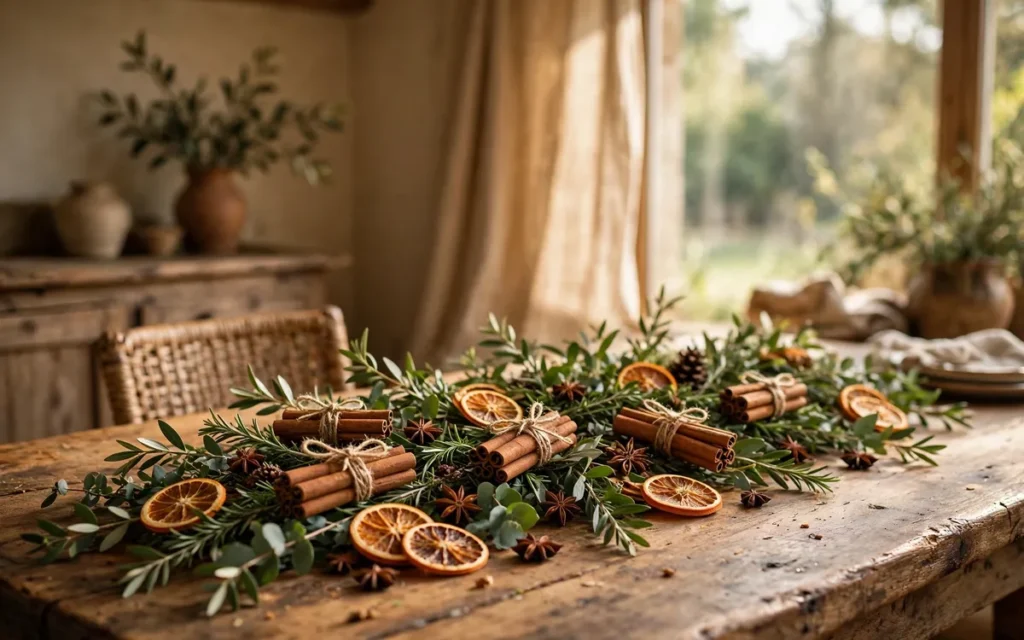
A greenery spine dressed with dried orange slices, bundles of cinnamon sticks and whole star anise, laid as a loose garland down the table. It is the scented centerpiece: warm, spiced and homemade-smelling before a single dish arrives, and its amber and rust colours suit wooden tables and country-style dining rooms best.
Wire the orange slices through a hole near the rind and cluster the cinnamon in tied bundles of three, with the star anise scattered between like punctuation. Almost everything here comes from the food shop rather than the craft shop, which keeps it cheap — and when January comes, the spices can go into the mulled wine instead of the bin.
9. Gold and White With Mercury Glass

The dressy Christmas Eve palette: mercury-glass votive holders and candle cups, ivory candles, white berries, a little gold foliage, all on white or cream linen. Mercury glass does something plain glass cannot — it makes candlelight look doubled and diffused, so a table lit this way glows rather than sparkles.
Keep gold as the only metallic and repeat it at least three times (holders, berries or ribbon, cutlery or charger plates) so the scheme reads as one decision. This is a grown-up table: no red, no green beyond the foliage, and nothing novelty. It photographs beautifully, which is half its job at a celebration dinner.
10. A Rustic Wooden Box of Evergreens and Candles
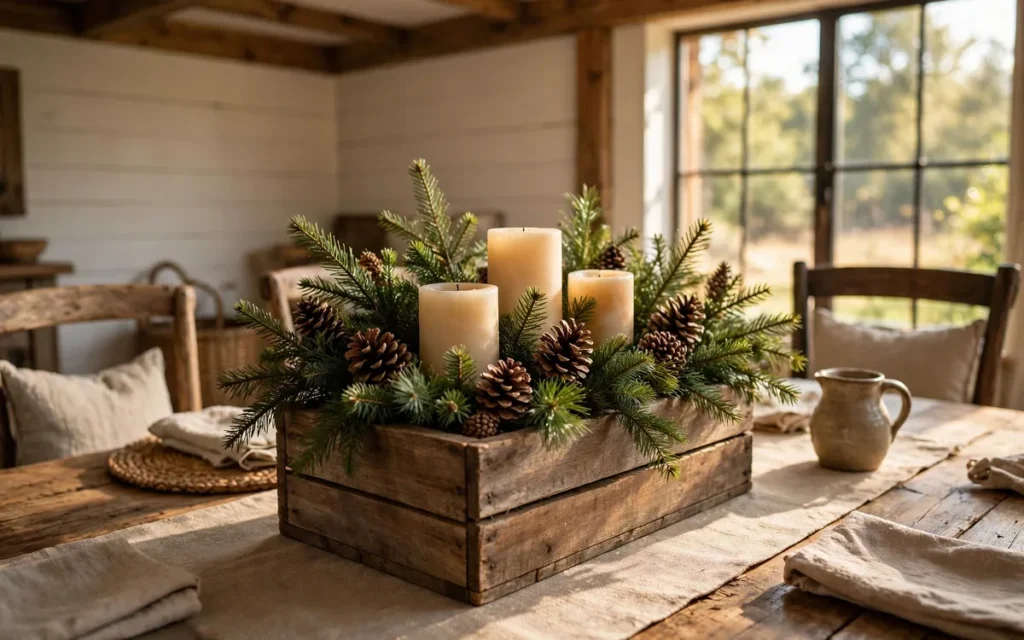
The farmhouse build: a low wooden box or crate lined with evergreen sprigs, pinecones tucked along the edges, and pillar candles standing in the middle. It is sturdy, contained and forgiving — the box hides the mechanics, defines the footprint in one move, and shrugs off a long dinner of passed dishes and poured drinks.
Line the box with a little floral foam or a folded cloth so candles stand level, and keep flame heights varied — one tall pillar, two shorter. If real candles feel risky in a box of foliage, flameless pillars look identical through a whole evening. Farmhouse tables that already wear plaid and pinecones outside can echo this box inside for one joined-up look.
11. A Lantern Pair With Faux Snow and Greenery

Two lanterns of different heights, each with a flameless candle inside, a drift of faux snow at its base and a curl of greenery around the feet. The lantern glass contains the glow and the mess, the pair gives you height that is see-through rather than solid, and the whole arrangement can be carried in with two hands.
Lanterns are the safest “candle” centerpiece there is for real family dinners: nothing to knock into the food, nothing for a sleeve to catch, nothing for a toddler to reach. Set them on a board if the table is small so they lift away together. Black lanterns read classic; brass or wood versions lean farmhouse or glam.
12. Pomegranates, Apples and Evergreen in a Low Bowl
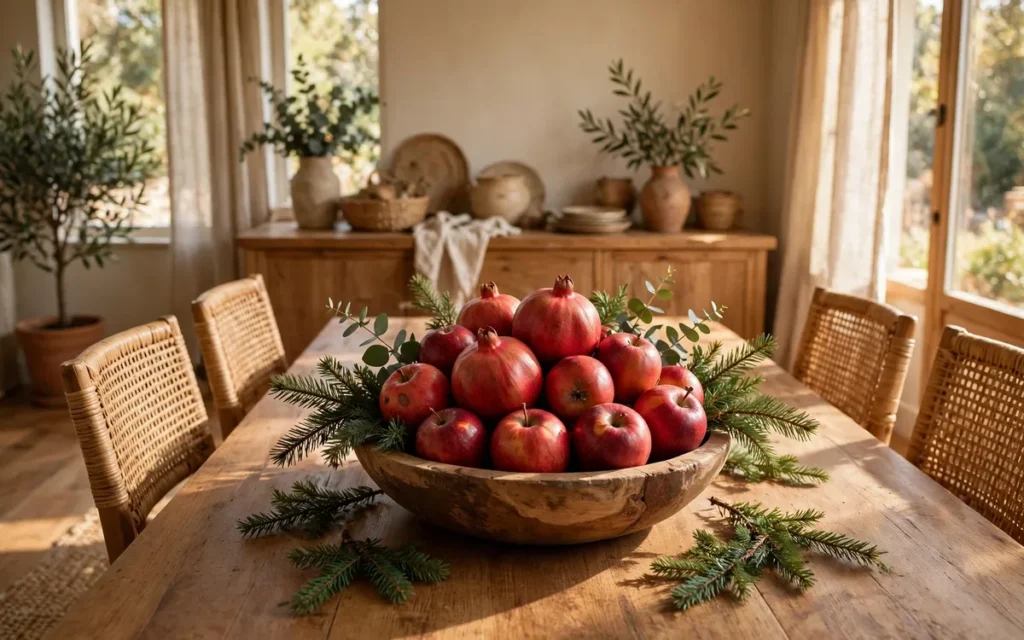
Fresh fruit doing the decorating: a low bowl heaped with whole pomegranates and red apples, dark evergreen sprigs tucked between them. The gloss of the fruit against matte greenery looks like a still-life painting, it takes five minutes, and it requires no arranging skill at all — abundance is the entire technique.
Buy the fruit a day or two ahead and keep the bowl somewhere cool until the table is laid. Afterwards, the centerpiece becomes dessert, baking or lunchboxes, which makes it the least wasteful idea on this list. Wash display fruit before anyone eats it, and skip this one if the bowl would sit in a hot room for days — fruit peaks fast in central heating.
13. Clementines Studded With Cloves in a Crystal Bowl
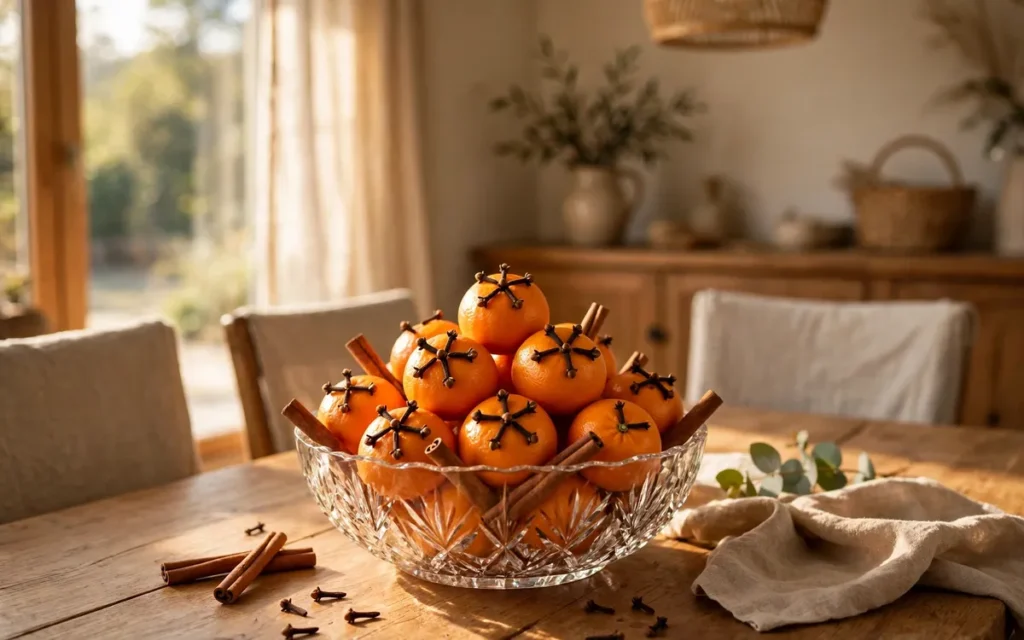
An old-fashioned pomander bowl: clementines or small oranges pressed with whole cloves in simple patterns — rings, stars, a spiral — stacked high in a crystal or glass bowl with a few cinnamon sticks standing between them. The scent is the decoration nobody sees: warm citrus and spice that meets guests before the food does.
Push the cloves in with a cocktail stick first if the peel is tough, and make them a day ahead — the oranges dry slightly around the cloves and hold the pattern better. This is a lovely one to make with children on a December afternoon, and any leftovers perfume a wardrobe for weeks if they are dried properly.
14. Frosted Mason Jars With Tealights and Pinecones
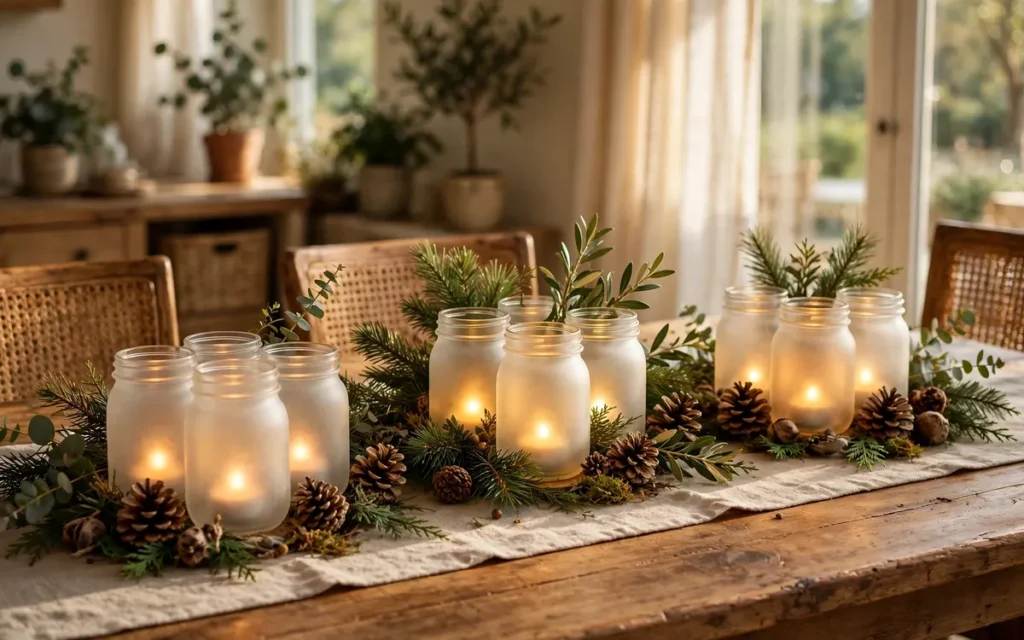
The budget DIY classic done well: mason jars with a snowy frost finish — bought frosted, or coated at home — with tealights glowing inside, grouped in threes along the table with pinecones and short greenery sprigs around their bases. The frost diffuses the light so the jars look like little lanterns of ice.
Groups of three at intervals beat one long row on a big table, and a single group of three is exactly right for a small one. Battery tealights make the jars safe to nestle into greenery. Keep the frost finish on the outside of the jar if you make your own, so heat and flame never touch the coating.
15. Candy Cane Vases for a Playful Family Table

Tie or glue candy canes around a plain jar or tin, hooks outward, and the container itself becomes the decoration: a striped red-and-white vase holding white flowers, greenery, or more candy canes. It is cheerful, a little silly, and exactly right for a family table where children outnumber critics.
A ribbon around the middle hides the mechanics and stops the canes sliding. Real flowers in water inside an inner jar keep the candy dry; faux stems are simpler. Do not expect it to survive the season intact — candy canes within reach of children have a natural lifespan, and replacing casualties is part of the fun.
16. Neutral Linen, Ivory Candles and Eucalyptus
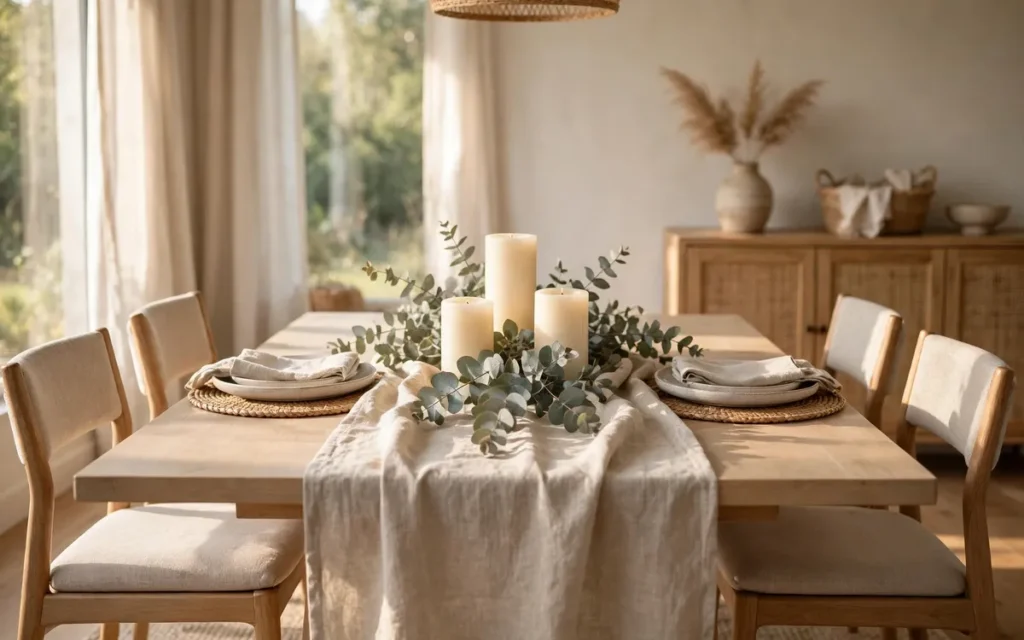
The calm table: a natural linen runner, silvery eucalyptus laid loosely along it, ivory pillar candles in small groups, and nothing shiny anywhere. The palette is all texture — matte leaves, rough linen, smooth wax — and it turns a loud holiday into a quiet one for an evening, which some dinners genuinely need.
If your living room already follows the calm scheme, our neutral christmas decor ideas will help the tree and mantel match this table. Warm white fairy lights woven through the eucalyptus are the one permitted sparkle; keep them sparse, and let the candlelight do most of the work.
17. A Plaid Runner With Pinecones and Red Pillar Candles

The pattern does the work: a red tartan or plaid runner down the table, three red pillar candles in a loose line, and pinecones scattered between them on the cloth. It is the cosiest version of Christmas — cabin-warm, unpretentious, and quick enough to lay while the potatoes roast.
Because the runner carries the colour, the candles can be plain and the greenery optional; a few short sprigs under the cones stop it looking bare. This pairs naturally with a farmhouse porch and staircase in the same plaid — one fabric, bought once, dressing the whole arrival-and-dinner route through the house.
18. A Lift-Away Tray Centerpiece for Serving Dinners

Less a look than a strategy, and the most useful idea in this article for real hosts: build any centerpiece — greenery, candles, baubles, a mini tree — entirely on one tray or board. When the platters arrive and the middle of the table is suddenly needed, the whole display lifts away to the sideboard in five seconds, intact and still beautiful.
Choose a tray with handles and a footprint inside the middle-third rule, and decorate it at the sideboard or kitchen counter rather than on the table. The tray method is the difference between a centerpiece that survives dinner and one that gets dismantled by the second course. If you use the same trick in the living room, our christmas coffee table decor ideas show the coffee-table version of the tray method — keep the two displays in the same colour family so the rooms agree with each other.
19. A Gingerbread House on a Cake Stand
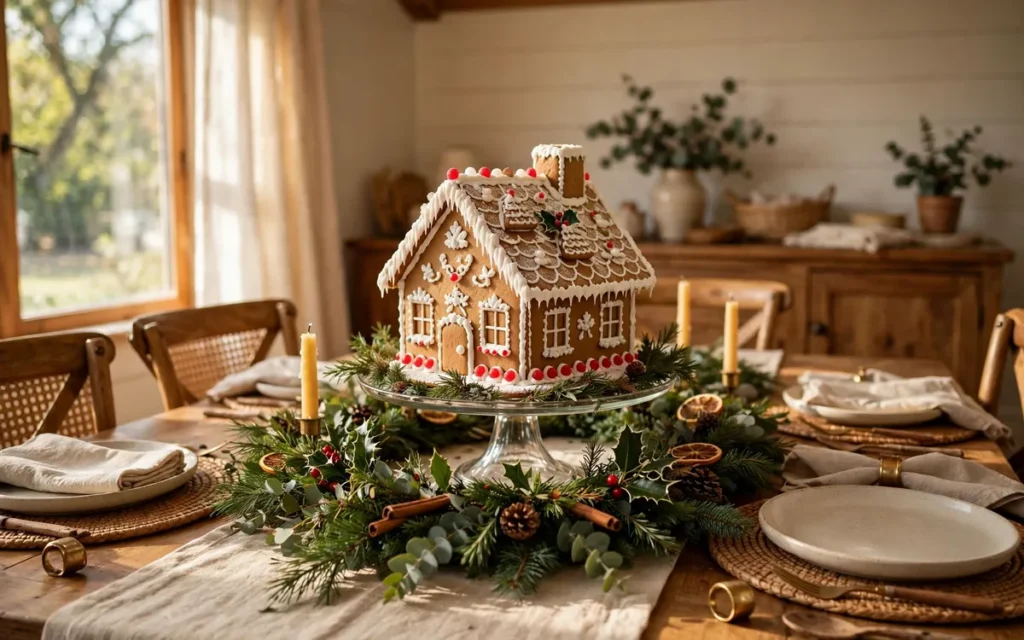
The edible showpiece: a decorated gingerbread house raised on a cake stand in the middle of the table, greenery and a few baubles around its base, maybe a dusting of icing-sugar snow. It is admired through every course and then, at the family’s discretion, demolished for dessert — no other centerpiece ends the evening to applause.
Build or buy the house at least a day ahead so the icing sets hard, and keep the stand’s footprint modest on a small table. A bought house decorated at home is the honest middle path most families take, and there is no shame in it. Photograph it before dinner; by Boxing Day the evidence will be gone.
20. Baubles Under Glass Cloches on Cake Stands

Display-case shine with nothing to arrange: pile beautiful baubles under glass cloches (bell jars) standing on cake stands of different heights, and let the glass do the styling. The cloches give you height that is completely see-through, so they obey the sightline rule while still feeling grand, and the ornaments inside stay dust-free and untouched by passing sleeves.
Use your best baubles here — the fragile heirloom ones are safer under glass than on the tree’s lower branches. Two or three cloches in a loose triangle beat a straight row, and a sprig of greenery under each stand softens the formality. This is the centerpiece to choose when the table itself is beautiful and you want decoration that hovers rather than spreads.
21. Tall Winterberry Branches for the Sideboard

Every rule in this article has an exception, and it lives on the sideboard: tall arrangements belong where nobody talks across them. Bare winterberry branches — or any tall berried or twiggy stems — in a heavy vase on the buffet or sideboard give the room its drama, echo the table’s colours at eye level, and leave the table itself low and sociable.
Choose a vase with real weight at the base; tall branches are top-heavy and a buffet gets bumped by serving traffic. Echo, do not duplicate: if the table is red and green, the branches carry the red; if the table is gold and white, a few gold-sprayed twigs tie the two together. This is also the place for the arrangement that was simply too tall for the table — move it, do not shrink it.
22. Fresh Amaryllis or Paperwhites in a Low Bowl

The living centerpiece: a low bowl of amaryllis or paperwhites that grows, buds and opens across the season, so the table looks different at every December meal and peaks — if you time it right — on Christmas Day itself. Moss or greenery tucked around the bulbs hides the mechanics and keeps the bowl inside the height rule while the flowers are young.
Buy plants already budding in early December, or force bulbs six weeks ahead if you are the organised kind. Paperwhites grow tall and can flop; tie them loosely with twine to a slim twig pushed into the bowl. Keep the bowl out of direct heat, and accept the deal you are making: a living centerpiece needs a drink of water now and then, unlike every other idea here.
23. Blue and Silver for a Cool Winter Table

The frosty alternative to red and green: silver foliage and eucalyptus, blue berries, pale blue or white candles, on white or deep navy linen. It reads like the moment after snowfall — calm, elegant and quietly dramatic — and it flatters dining rooms that are already blue, grey or white far better than forcing the traditional palette into them.
Silver is the light-catcher, so put the mercury glass and metallic foliage where the candles can reach them, and keep the blue in two shades at most. Warm candlelight is the softener that stops the scheme feeling cold; if the table still feels chilly, add cream napkins and wooden chargers to bring the temperature back up without touching the colours.
24. Vintage Brass Candlesticks on a Stack of Old Books

Heirloom height with a story: two or three old books — cloth-bound, in the room’s colours — stacked as a low plinth, with vintage brass candlesticks and white tapers standing on top. The books give modest, stable height and a talking point; the brass gives the glow somewhere beautiful to come from.
Keep the stack at the table’s centre or end, two or three books at most, so the plinth stays well under the sightline rule. Protect the books: candles in holders with drip cups, flameless tapers if the books are precious, and never a flame directly above old paper without a holder between. Charity shops are full of both halves of this centerpiece for very little money.
25. A Five-Minute Cake Stand Centerpiece

The last-minute rescue, worth memorising: cake stand, a ring of greenery laid around its foot and edge, baubles tucked into the ring, and one candle or mini tree standing on the plate. Five minutes, no shopping, and it looks like a plan rather than a panic — the stand’s height and the ring’s fullness do the persuading.
Every kitchen with a cake stand and a decoration box owns this centerpiece twice over. Add fairy lights if guests arrive after dark. Because it is small and contained, it is also one of the best answers for a small dining table (see the FAQs) — and it lifts away in one hand when the dishes land.
26. A Safe, Flameless Centerpiece for the Kids’ Table

If children get their own table, decorate it like you mean it — safely. Paper trees and paper stars, jars of candy canes and sweets as the colour, battery tealights in frosted cups for glow, and a runner they helped make. Nothing hot, nothing sharp, nothing heavy, nothing breakable, nothing that matters if it ends the evening sticky.
The trick is abundance at small scale: more colour, more little things, everything touchable. Let the children arrange it themselves from a tray of pieces and it becomes an activity as well as a centerpiece. Keep display sweets wrapped, and check the battery tealights’ compartments are screwed shut before small hands get to them.
27. A Dough Bowl Filled With Greenery, Cones and Candles
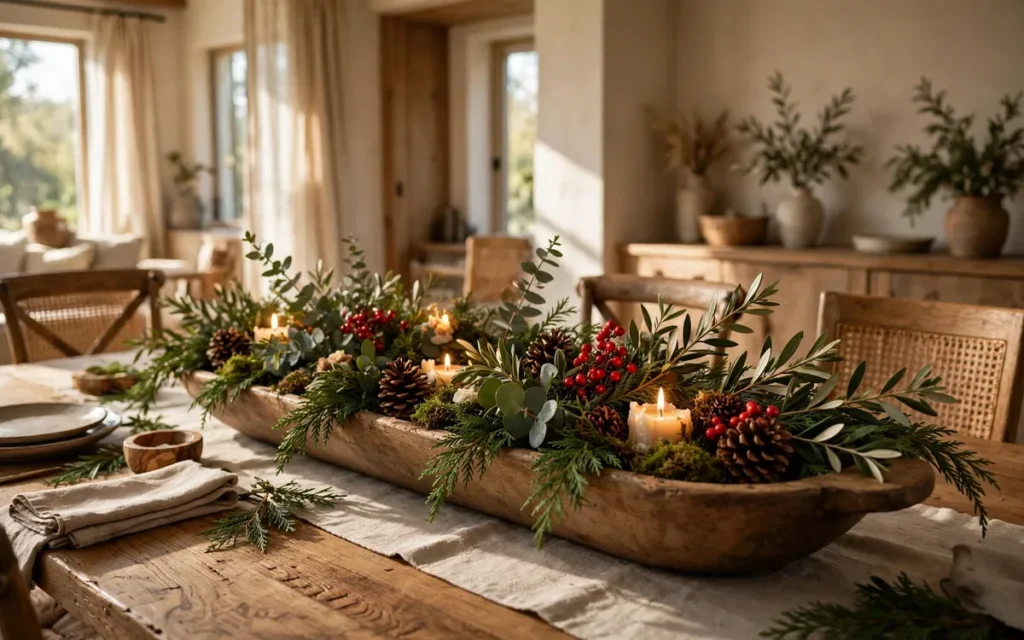
The long wooden dough bowl is a ready-made footprint: a natural line down the middle of the table with raised edges that keep everything — greenery, pinecones, berries, and candles nestled between them — contained in one tidy arrangement. It suits long tables and rustic rooms, and it stores as one object instead of a box of pieces.
Nestle flameless pillars between the cones if the bowl will sit through a long, busy dinner; real pillars in glass cups are the compromise for purists. Fill the bowl more generously than feels necessary — greenery settles and compresses, and a dough bowl looks best slightly overfull, spilling a sprig or two over the rim.
Budget Tips for a Centerpiece That Looks Expensive
The good news is that christmas centerpieces are one of the cheapest displays in the house to make well — most of these rules are about not buying things.
- Build from the ornament box first. Spare baubles, last year’s wreath, a cake stand and jars you already own make Ideas 2, 5, 14, 20 and 25 effectively free.
- Shop the food aisle and the garden. Clementines, cranberries, apples, pomegranates, cinnamon and star anise cost little and perfume the room; pinecones and clippings are free.
- Buy one good base, not twenty decorations. A tray, board or dough bowl is reused every Christmas and every other season of the year — it is the only prop truly worth spending on.
- Buy faux once, in the January sales. One good greenery base replaces a florist bill every year; add fresh sprigs only as the finishing layer, a day or two before.
- Let light do the luxury. Battery fairy lights and flameless candles are the cheapest glow there is — a lit table looks expensive even when the arrangement is simple.
Common Centerpiece Mistakes to Avoid
- Building into the 12–24 inch face band, so guests spend dinner talking around a wall of greenery. Low or slim — never tall and solid.
- Covering the whole table, leaving no landing zone for serving dishes, water jugs, glasses and elbows. The middle third is the limit.
- Scented candles next to food. Fragrance competes with the meal from the first course. Unscented at the table, always.
- Building the centerpiece in place, so it cannot move when the big dishes arrive. Build on a tray, board or stand instead.
- Flames resting against dried foliage, ribbon or paper — and candles left burning after everyone has left the table.
- Making a fully fresh arrangement a week early. It peaks before the day and sheds into the gravy. Build faux ahead; add fresh at the end.
- A top-heavy or water-filled piece on a wobbly table. Test stability empty, before the day — not during the toast.
Centerpiece Safety Notes
Flameless candles are the default recommendation in this article — the same glow with no risk — and the only sensible choice with children, pets, paper decorations or dried foliage at the table. If real candles are used, keep flames at least a hand’s width (about 15 cm) from greenery, dried leaves, ribbon and paper, never leave them burning unattended, and snuff them when the table empties.
Protect the table itself: a tray, plate or holder under every candle, dripless tapers where possible, and a runner or cloth as a second layer against wax drips and water rings. Keep the arrangement’s weight low and centred, with nothing dangling over the table’s edge where sleeves, serving dishes and small hands catch it. Finally, remember that faux berries and small decorations are not food — keep them out of toddlers’ reach, and wash display fruit before anyone eats it.
Frequently Asked Questions
How tall should a Christmas centerpiece be?
Keep the solid body under about 12 inches (30 cm) so seated guests can see and talk over it. The 12-to-24-inch band sits at face height and blocks conversation. Taller is fine only when the piece is slim or see-through — taper candles, branches, glass — and tall, lush arrangements belong on the sideboard instead.
How much of the table should a centerpiece cover?
Roughly the middle third of the table’s width and a quarter to a third of its length. Long tables take one long arrangement or repeated clusters down the spine; round tables take one contained focal point about a third of the diameter; small tables take one low, narrow piece. Always leave the sides clear for place settings and serving dishes.
How do I make a Christmas centerpiece myself — where do I start?
Start with the base, not the decorations: a tray, board, cake stand, flat wreath or bowl sets the footprint and makes the arrangement movable. Then build in layers — greenery, height (candles or trees), details (baubles, cones, fruit), and finally light (fairy lights woven deep, or the candles themselves). Most of the ideas in this article assemble in five to fifteen minutes.
What is the best centerpiece for a small dining table?
One contained, low arrangement that leaves room for plates: a small tray centerpiece (Idea 18), a single group of frosted jars (Idea 14), a cake-stand arrangement (Idea 25), or taper candles on a runner (Idea 3), whose footprint is barely wider than the runner itself. One piece, low and narrow, and nothing else on the table.
How do I keep fresh greenery in a centerpiece looking fresh until Christmas Day?
Build the structure with faux greenery ahead of time and add the fresh material last — sprigs, berries and fruit tucked in one or two days before the dinner. Fresh stems last longer with their ends in water-soaked floral foam, a light misting every day or two, and distance from radiators and heat vents. Made fully fresh a week early, an arrangement peaks before the day.
Are real candles safe in a Christmas centerpiece?
They can be, with rules: unscented near food, flames at least a hand’s width (about 15 cm) from greenery and anything dried or papery, a holder or tray under every candle, and never left burning unattended. Even so, flameless candles are the safer default — identical glow, no risk — and the only sensible choice with children, pets or dried foliage at the table.
A collected table layers tartan and collected dinnerware around the centrepiece — our vintage Christmas decor ideas show that table, era by era.
The patterned version of a statement centrepiece is porcelain — a ginger jar of cedar leads our chinoiserie christmas decor ideas for the table.
January asks the table for a calmer version of the same craft: a winter tablescape after christmas strips the red, keeps the bones and rebuilds the centrepieces under a sightline rule, so guests can still see each other across them.
Conclusion
The best christmas centerpieces are rarely the biggest ones. They are the ones that obey the height and footprint rules, are built in layers on something movable, and still look composed when the plates land and the candles are lit. If you are starting from zero, the pillar-candle runner, the flat wreath with a hurricane candle and the five-minute cake stand are the three safest first builds — each forgiving, quick and easy to adjust. Use unscented or flameless candles, build on a tray, and photograph the finished table before the first dinner of the season. Next year, you will be glad you did.



One Comment