
30 Inviting Winter Living Room Ideas for Long, Cold Evenings
The tree is down, the decorations are boxed away, and the coldest weeks of the year are still ahead. That is exactly when the living room matters most. It is where winter evenings actually happen, and it has to feel warm from the floor to the lamplight without a single Christmas symbol left in it. If the whole-home edit still needs doing first, these winter decor ideas for the home walk through the house room by room. This article stays in one room and goes deep instead: 30 winter living room ideas built on a simple layering system, with the sizes, counts and distances that make each one work. No new furniture is required. Almost everything here is covers, layers, light and layout.
Build It in Three Layers: The Winter Living Room Method
Every one of the winter living room ideas below hangs on one of three layers, and the layers go on in order. The method assumes the Christmas edit is already done — the red, the glitter and the worded pieces are packed away. What follows is narrower and deeper than a whole-home edit: one room, layered properly, so it stays comfortable for the three months of winter rather than the three days after you style it.
Layer 1 — The Base: Layout, Rug and Curtains
Warmth starts with where things stand. Pull the seating into one conversation zone, close enough that people can talk without raising their voices, and set the coffee table about 35–45 cm (roughly 14–18 in) from the sofa edge — near enough to reach a mug, far enough to stretch out legs. The rug anchors the zone: at least the front legs of every seat should sit on it. As a guide, 160 × 230 cm (about 5 × 8 ft) is the minimum for a standard sofa setup, and 200 × 300 cm (about 8 × 10 ft) suits a sectional. Curtains are the room’s third wall. Lined or heavy fabric, hung to just kiss the floor and drawn at dusk, holds the day’s heat in and shuts the cold glass away. The floor-up logic here is the same one behind this guide to cozy living room ideas for winter, which builds a room’s warmth from the rug upwards.
Layer 2 — The Warmth: Dress the Sofa in a Fixed Order
The order matters because each layer is placed once and then used nightly. First, one heavy throw folded lengthways over the sofa back. Second, one lighter throw per seat, draped over the arm nearest that seat. Third, cushions last, largest at the back. The cushion formula: 3–4 on a two-seater, 5 on a three-seater, and 6–7 on a sectional, including one lumbar. Squares of 45–50 cm (18–20 in) are the workable size, with one smaller lumbar at about 30 × 50 cm. Aim for three textures within arm’s reach of the main seat — knit with velvet and faux fur, or wool with boucle and brushed cotton — because in a neutral room, texture is what warmth looks like.
Layer 3 — The Glow: Light at Three Heights
Switch the overhead light off as the default. Three lower sources do the work instead: a floor lamp beside the main seat, with the shade centre roughly at seated eye level; a table lamp on a side table or console for the middle height; and low light at coffee-table or mantel height — candles, lanterns or fairy lights. Warm-white bulbs only, 2700–3000K, so cream and oatmeal textiles read golden rather than grey. Put the lamps on timers or smart plugs and the glow becomes a habit rather than a chore: the room lights itself at dusk.
The Half-Clear Rule That Keeps It Livable
Layers fail socially, not visually. A winter living room has to survive real evenings — feet up, mugs down, people sitting where the cushions are. So keep at least half of the coffee table empty, keep one seat cushion per person genuinely free at sitting time (spare cushions go to a basket, not the floor), and give every throw a home within reach of the sofa: a basket, a ladder, a lidded box. This single rule is the difference between a room that stays layered for three months and one that collapses into clutter by the second week.
1. Layer the Sofa in a Fixed Order

The sofa is the room’s biggest surface, so dress it the way the system says: heavy throw first, folded lengthways in thirds over the back; lighter throws second, one over each arm; cushions last, largest at the back, smallest in front. Styled in this order, the sofa looks deliberate instead of piled, and nothing has to be moved before someone can sit down.
Choose the back throw as the room’s textile anchor — the thickest knit or wool you own — and let the arm throws be lighter, so they drape instead of bulk. When every layer has an assigned place, the five-minute evening reset (Idea 30) takes care of itself, because everything simply goes back to where it belongs.
2. Use the Cushion Formula for Your Sofa Size

Too few cushions and a sofa looks bare; too many and nobody can sit. The formula that works: 3–4 cushions on a two-seater, 5 on a three-seater, 6–7 on a sectional. Work in odd numbers, which read calmer to the eye, and always include one lumbar cushion at about 30 × 50 cm among the 45–50 cm squares — the lumbar is the one people actually lean on.
Save money by changing covers, not cushions. The inserts you already own can be re-dressed in winter covers — knit, velvet, boucle, brushed cotton — and the summer covers fold away into the space the throws came out of. One deep accent colour among the neutrals is enough; Idea 28 shows how to repeat it.
3. Mix Three Textures Within Arm’s Reach

In a neutral winter palette, texture does the work that colour does in other seasons. Sit in the main seat and check what your hand can touch: you want at least three distinct textures within arm’s reach. A chunky knit throw, a velvet cushion and a faux fur cushion is one proven trio; wool, boucle and brushed cotton is another.
The touch test sorts fabrics quickly. If a textile feels cool and smooth — linen, thin cotton, anything summery — it will read cold all winter no matter its colour. Swap those pieces to a bedroom or store them, and bring the rough, napped, knitted and piled fabrics forward. Contrast is the point: smooth beside rough is what makes a cream room feel warm instead of flat.
4. Drape One Throw per Seat, Not per Sofa

One throw stretched across a whole sofa serves nobody — the first person to sit down drags it away from everyone else. Give each seat its own throw instead: folded over the arm nearest that seat, or rolled and rested against the arm on upright seats. On a sectional, the corner seat gets the heaviest throw, because corners collect the drafts.
Per-seat throws also settle the weight question. The person who runs cold takes the wool one; everyone else takes the lighter knits. Nothing is fought over, nothing ends up on the floor, and the sofa still reads as one styled piece because the throws share a palette even when their weights differ.
5. Add a Faux Fur Layer over the Chair Arm

Every living room has one chair that gets chosen first. Give that chair the luxury layer: a faux fur throw folded lengthways over one arm, spilling slightly onto the seat. It is the single richest texture a winter room can hold, and on a chair it is used constantly rather than admired from across the room.
Faux fur earns its keep twice on leather or vinyl chairs, whose seats feel cold for the first minutes of every sitting. Keep the fur on the arm and seat only — never draped where it can slide toward a heater or the fireplace — and shake it out outdoors once a week or so, because deep pile collects dust faster than any other textile in the room.
6. Pull the Seating into a Tighter Circle

Winter layout is closer layout. Float the sofa a few centimetres off the wall, angle the chairs in toward the coffee table, and shrink the gaps until conversation — and the pool of lamplight and firelight — tightens around the people in it. A seating circle of roughly 2.5–3 m across holds warmth and talk; the wide summer spread does neither.
The same principle works in long, awkward rooms: the layout guidance in these smart ways to make a narrow living room look bigger shows how pulling pieces off the walls makes a room work harder at any size. In winter you use that freedom in reverse — not to open the room up, but to gather it in.
7. Build a Reading Corner That Earns Its Space

One corner, furnished properly, outperforms thin effort spread across the whole room. A reading corner needs five things: the comfortable chair (Idea 5’s chair, ideally), a floor lamp close behind the shoulder, a small side table that holds a mug and a book, a throw within reach, and a short stack of books that are actually being read.
Put the corner in the room’s natural dead space — the angle beside the fireplace, the bay, the gap by the bookshelf — and near a socket, so the lamp needs no trailing cord. Because the corner is used every single day, it justifies its footprint in a way a styled-but-unused arrangement never does, and it gives the whole room a lived-in centre of gravity.
8. Layer a Second Rug over the Main Rug
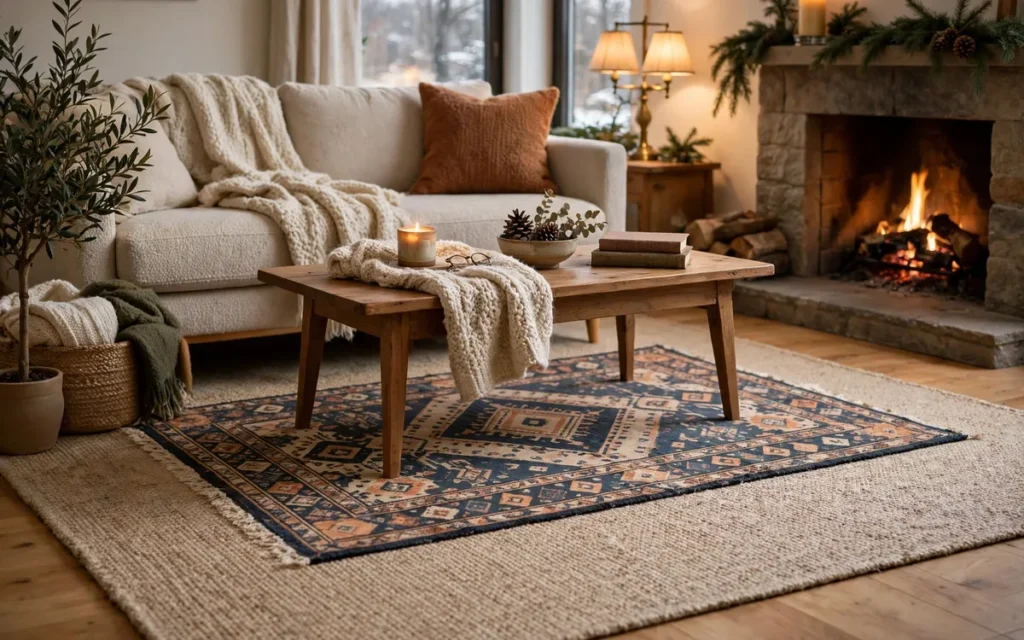
If the floor still feels cold through the main rug, add a second, smaller rug on top — a flatweave or a low patterned rug laid over the plain base, centred under the coffee table. The double layer insulates noticeably, defines the seating zone more sharply, and is the easiest way to bring pattern into a neutral room without committing to it on anything permanent.
Keep the top rug low-pile so table and chair legs sit steady, and leave a border of the base rug showing on all sides — roughly 20–30 cm — so the layering reads as intentional. Secure the corners if they curl; a curling rug corner beside a fireplace or in a walkway is a trip waiting to happen.
9. Swap to Heavier Curtains That Reach the Floor

Curtains are insulation you can see. Swap summer sheers and short panels for lined or heavyweight curtains that just kiss the floor, and draw them at dusk. The room loses its biggest cold surface — the glass — and gains a soft wall of fabric that also absorbs sound, which is part of why a curtained room feels calmer.
One caution decides where they hang: keep curtain fabric clear of radiators and heater vents, and never let panels pool over a heat source. Where a radiator sits under the window, hang the curtains to close beside it rather than over it, or choose a sill-length heavy panel for that one window and full length elsewhere.
10. Add Oversized Floor Cushions for Extra Seating

Winter evenings gather more people than the sofa holds. Two oversized floor cushions — squares of about 60–70 cm, or a long low bolster — give guests and teenagers somewhere real to sit near the fire and the coffee table, at the height where the warmth and the conversation are.
Choose firm fill that holds its shape, and removable covers you can wash, because floor cushions live where shoes and mugs pass. Stacked neatly in a corner or stood against the bookshelf, they store as part of the room’s look rather than as clutter waiting for a cupboard.
11. Build a Faux Fireplace Focal Point
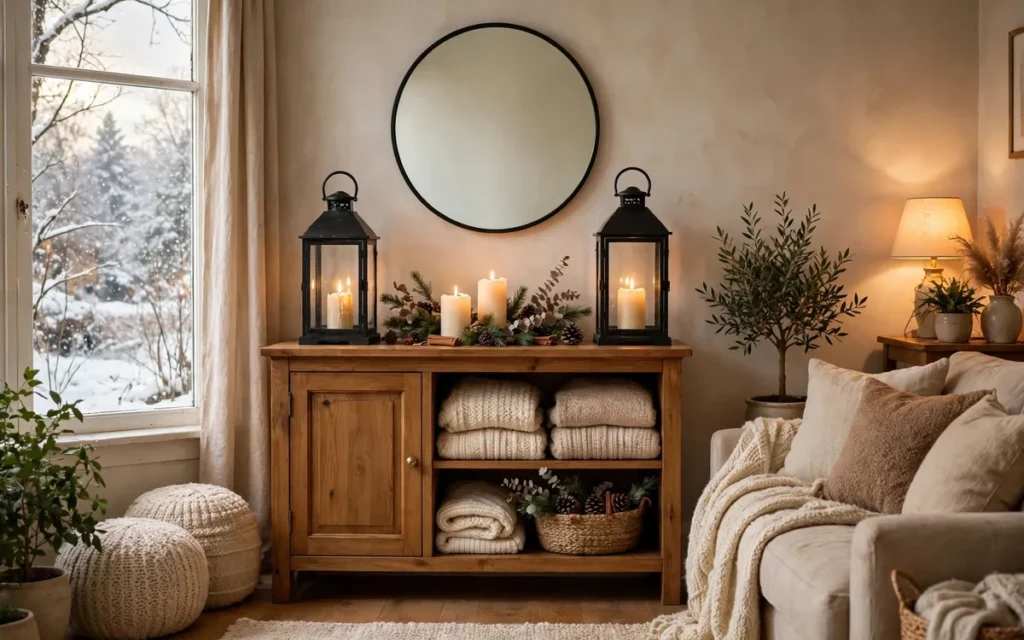
A room without a fireplace still needs an anchor — something the seating faces and the eye returns to. Build one on a console or low cabinet: a round or arched mirror centred above it, a lantern on each side or one tall lantern and a stack of books, and pillar candles (flameless is fine) where flames would be in a real hearth.
Aim the top of the arrangement at roughly mantel height, about 110–120 cm, and the grouping will read as a hearth substitute rather than a decorated sideboard. Face the seating toward it, exactly as you would a fire. The room gains the one thing winter asks of it: a warm centre.
12. Angle a Mirror to Bounce the Lamplight

A mirror is a light source you do not pay to run. Hung or leaned opposite or beside the lamps — above the mantel, over the console, on the wall next to the reading corner — it doubles the visible glow of every lamp and candle in the room and throws light into corners the lamps cannot reach.
Check the reflection from the main seat before fixing anything. The mirror should return lamplight, candles and the tops of the greenery — not the television screen or a bare ceiling. A large mirror leaned on the mantel or console does the same job with no drilling, which suits renters and anyone still deciding.
13. Re-dress the Mantel in Plain Greenery Only

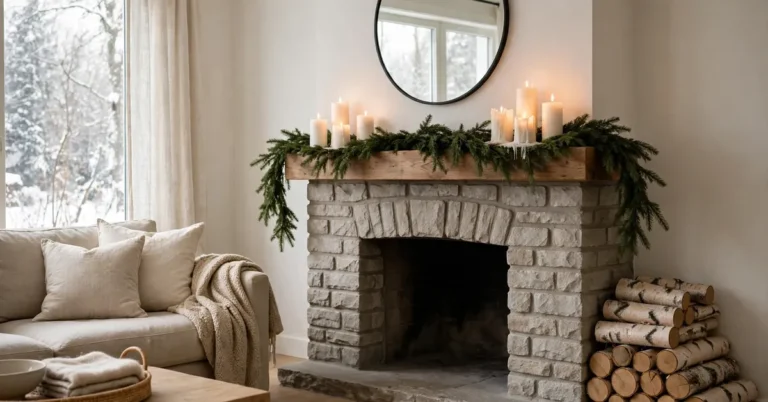
The January mantel keeps exactly one thing from December: the greenery. Take the garland down, strip every ornament, ribbon and berry from it, and put back the plain green alone — or lay loose stems and branches along the mantel shelf instead, looser and wilder than the dressed Christmas version.
The full festive method lives in these christmas fireplace decor ideas; winter is that same mantel with everything seasonal removed. On a working fireplace, keep every stem back from the heat line of the firebox opening, and expect real greenery to dry as the weeks pass — dried greenery near a fire is a hazard, not a decoration, which the safety notes below cover in full.
14. Cluster Mantel Candles at Three Heights
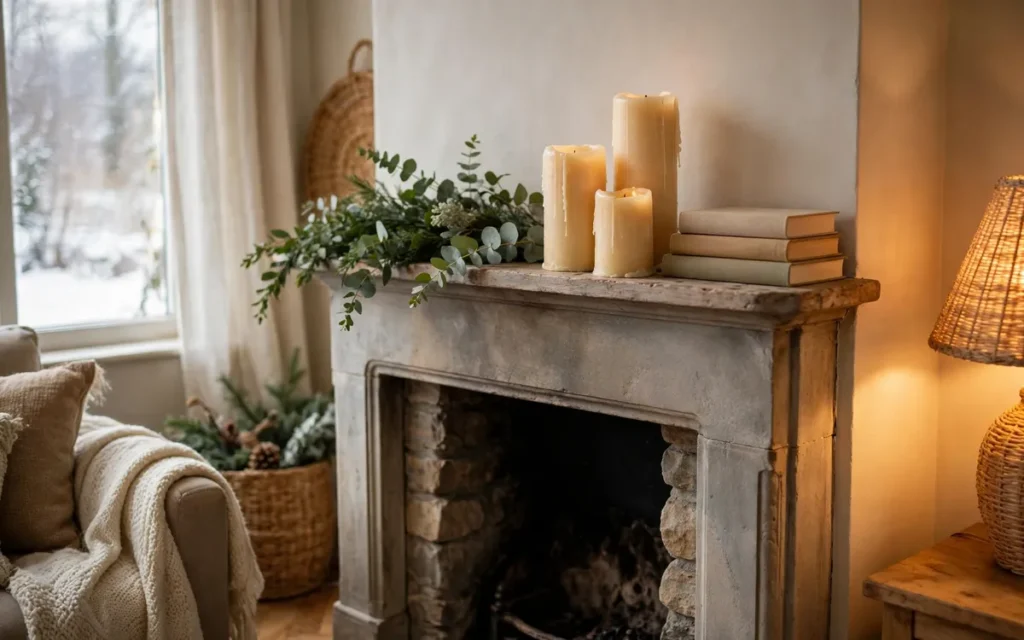
Candles on a mantel work as a cluster, not a row. Group pillars at three heights — tall, medium, short — in an uneven group of three or five, set on holders or a heat-safe plate, with the tallest at the back. The stepped heights echo the Layer 3 lighting plan and give the mantel its glow without a single ornament.
Raise shorter candles on small books, wooden blocks or inverted holders to reach the heights you need rather than buying new ones. Keep the cluster to one end of the mantel or centred with greenery at the sides; a full-length line of flames competes with the fire below and crowds the shelf.
15. Stack Birch Logs in the Firebox or a Basket

Pale birch bark is winter’s own colour, and a log stack is the most honest winter decoration there is. In an unused firebox, stack logs neatly to fill the opening, ends facing out in even rows. Beside a working fire, keep the stack in a basket or log holder on the hearth — seasoning within reach, stored off the floor.
Only burn properly seasoned wood, and keep the decorative stack and the burning supply as one tidy pile rather than two. Logs stored indoors dry further in the heated air, so a basket that looked rustic in January is also genuinely practical by February.
16. Hang Winter Art above the Mantel

The festive print or Christmas sign that hung over the mantel leaves a bare, slightly sad wall behind it. Fill the space with winter art instead: a snowy landscape, a bare-branch print, a moody charcoal sketch — anything in the room’s creams, greys and deep tones. A frame about two-thirds the width of the mantel shelf keeps the proportions right.
The cheapest source is your own house. A suitable frame already hanging in a hallway or bedroom can rotate to the mantel for the season, and the Christmas piece’s frame can hold a winter print in the same spot. Swapping art is a ten-minute change that alters the whole wall the room faces.
17. Pair a Lantern and a Log Basket on the Hearth

Finish the fireplace at floor level: a tall metal lantern on one side of the hearth, a woven log basket on the other. The mismatched pair balances the firebox visually — height against width, metal against weave — and the lantern extends the candlelight down to the low layer of the lighting plan.
Use a flameless candle in the hearth lantern when the fire is in regular use, so nothing on the hearth needs tending. Keep the floor directly in front of the firebox completely clear, as always: the pair stands to the sides, never in the working space where sparks land and feet step.
18. Build the Winter Coffee Table Tray

A wooden or woven tray turns the coffee table from a landing strip into a styled surface with rules. On the tray: one candle, one small bowl of pinecones or natural finds, one short stack of cream and clothbound books. Everything else on the table stays off the tray — that division is what keeps the half-clear rule (and the mugs) possible.
The tray method began with these christmas coffee table decor ideas; winter keeps the tray and simply changes what it carries — no red, no glitter, nothing worded. Lift the whole tray off in one move when the table is needed for a game, a puzzle or dinner on trays.
19. Anchor the Table with a Low, Wide Bowl

No tray? A single low, wide bowl anchors the table just as well. A wooden dough-bowl shape, roughly a third of the table’s length, filled with pinecones, nuts in their shells, or smooth stones, gives the surface one calm centre of weight and texture.
If a candle joins the bowl, it stands in a glass holder with clear space around the flame — or it is flameless. Dry pinecones and wood are fuel arranged decoratively, and the candle beside them needs that small discipline every single time, not just the first evening. The safety notes below set out the clearances in full.
20. Style the Sofa Table Behind the Seating

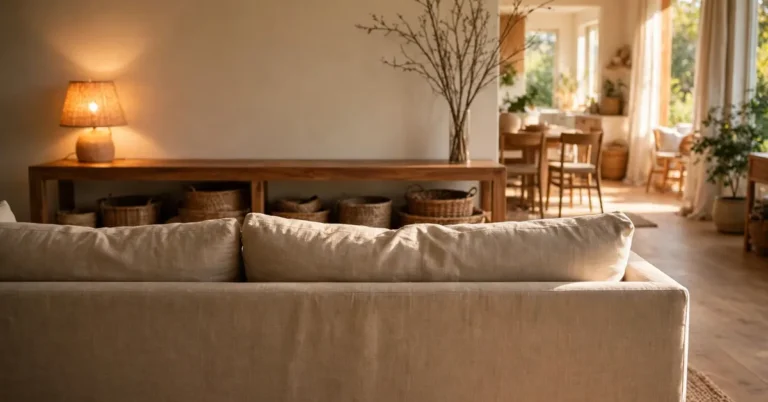
A narrow console behind a floated sofa is the winter room’s hardest-working surface. Style it with the middle-height lamp from the lighting plan, a short stack of books, and a tall jug or vase of bare branches for height. From the seats, it reads as the room’s finished back view; from behind, it hides the sofa’s plain rear.
Keep its top line below the sofa back so nothing looms over sitters’ heads, and keep the walkway behind it completely clear — a console is no use if everyone squeezes past a vase. Branches are the right tall element here: free, sculptural, and in no way festive.
21. Add One Warm Metal Accent to Each Surface

Low winter light needs something to catch it. One warm metal piece per surface — aged brass candlesticks on the mantel, a small copper bowl on the side table, a pewter dish on the bookshelf — throws back small points of light wherever the eye lands, and ties separate surfaces into one scheme.
One piece per surface is the discipline; two becomes a collection and three becomes clutter. Choose aged, brushed or hammered finishes rather than shiny gold, which tips the room back toward festive. The metal should glow in lamplight, not sparkle.
22. Restyle the Bookshelf for Winter

Bookshelves go stale because nothing on them ever moves. For winter, turn some vertical rows into horizontal stacks, clear roughly a third of the objects, and add three things: a small framed print leaned at the back of one shelf, one trailing or upright green plant, and one ceramic piece with some weight to it.
The emptier shelves are the point. Winter light is low and sideways, and a sparse shelf catches it in long shadows while a packed one reads as storage. Face a few book spines in the room’s palette outward on the stacks — creams, cloth bindings, one deep accent colour (Idea 28) — and the shelf becomes part of the room’s colour story.
23. Keep a Lidded Basket for Remotes and Clutter

Layered rooms collect small mess: remotes, chargers, coasters, reading glasses, the one cable nobody owns. Give it all one lidded basket beside the main seat. The lid is the whole idea — an open basket displays the tangle, a lidded one deletes it from view.
Size the basket to the real pile, not the hoped-for one, and keep it within arm’s reach of where people actually sit, or it will not be used. This basket, plus the throw basket from the half-clear rule, is the entire storage system the layered room needs.
24. Replace the Overhead Light with Three Low Lamps

Make the decision once and keep it all winter: the ceiling light is off. A floor lamp by the main seat, a table lamp on the side table or console, and low glow at mantel or coffee-table height replace it. Faces, books and textiles all look warmer at lamp height, and the room’s edges soften into the dark the way a winter room should.
Fit every lamp with warm-white bulbs at the same temperature — 2700–3000K throughout. Mixed temperatures are what make layered lighting look accidental: one golden lamp and one blue-white lamp undo each other. Keep the overhead light for cleaning and finding lost things, then switch it off again.
25. Put the Lamps on Timers
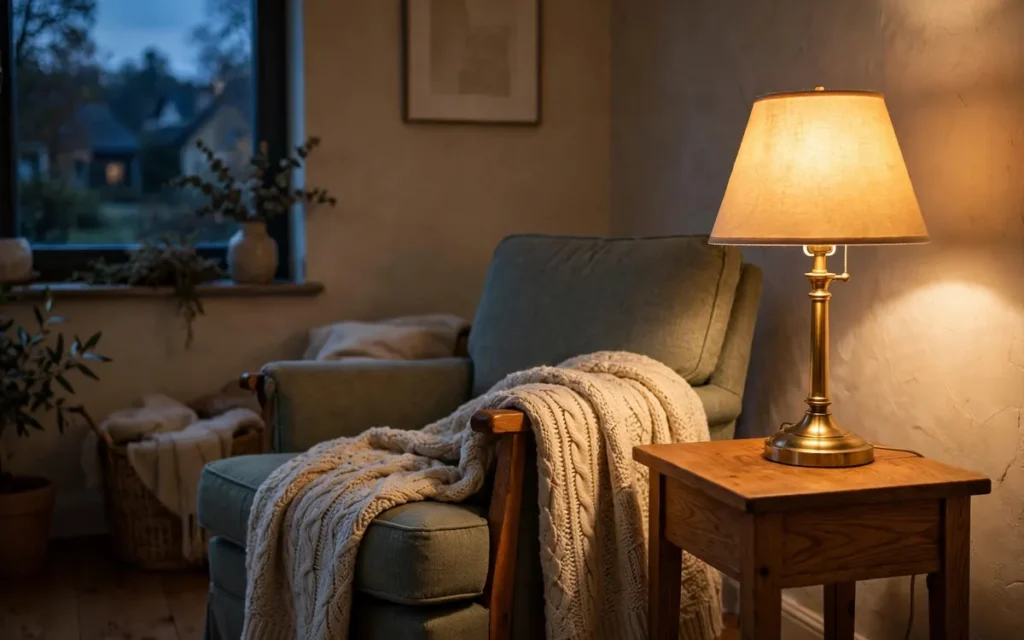
Timers turn the lighting plan into a routine that survives tired evenings. Set the floor and table lamps to come on shortly before dusk — or about fifteen minutes before the household usually gets home — and the room greets everyone already glowing, with nobody crawling behind the sofa to find switches.
Plug-in timers and smart plugs both work; the point is the habit, not the gadget. Timed flameless candles (Idea 27) join the same schedule, so the whole low layer lights itself. It is also the safer pattern: lights that are on because it is evening get switched off by the same routine, not forgotten until morning.
26. Drape Fairy Lights along a Shelf

The tree is gone but its softest light can stay. A warm-white fairy light strand draped along a bookshelf edge, a mantel shelf or the top of the console adds the lowest, gentlest layer of the lighting plan — pinpoints of light at the height where books and ceramics sit.
Weave the strand behind objects so the lights peek out between books and vases rather than drawing one visible wire line. Warm white only — coloured or twinkle modes belong to December. And inspect any strand relocated from the tree before it goes up: the safety notes below explain why that check matters.
27. Use Flameless Candles Where Flames Can’t Go

Real flames have no place beside folded throws, inside bookshelves, near curtain hems or within reach of children and pets. Flameless candles — the wax-look kind with a moving flame effect — take all of those posts: on the shelf, inside the hearth lantern, on the side table next to the chair’s faux fur.
Reserve real candles for the two spots that can be made genuinely safe — the mantel cluster and the coffee table’s glass-held candle — where they are lit deliberately and watched. Everything else glows without risk, most of it on timers, and the room loses nothing: at lamp height, across a room, the flameless versions pass completely.
28. Repeat One Deep Accent Colour Three Times

An all-neutral winter room needs one deep note or it drifts. Choose a single dark colour — charcoal, chocolate, deep forest or burgundy — and repeat it exactly three times: a cushion, a throw, and one quiet third appearance such as a book stack, a piece of art or the bowl on the table. Three repetitions read as a scheme; one reads as an accident.
Pick the colour from something already in the room — the border of the rug, a painting, the leather of a chair — and the accent will belong instead of arriving. Keep the doses small and the rest of the palette calm. It is also the colour the questions below point to for rooms that feel pale rather than serene.
29. Hang Wooden Snowflakes in the Window
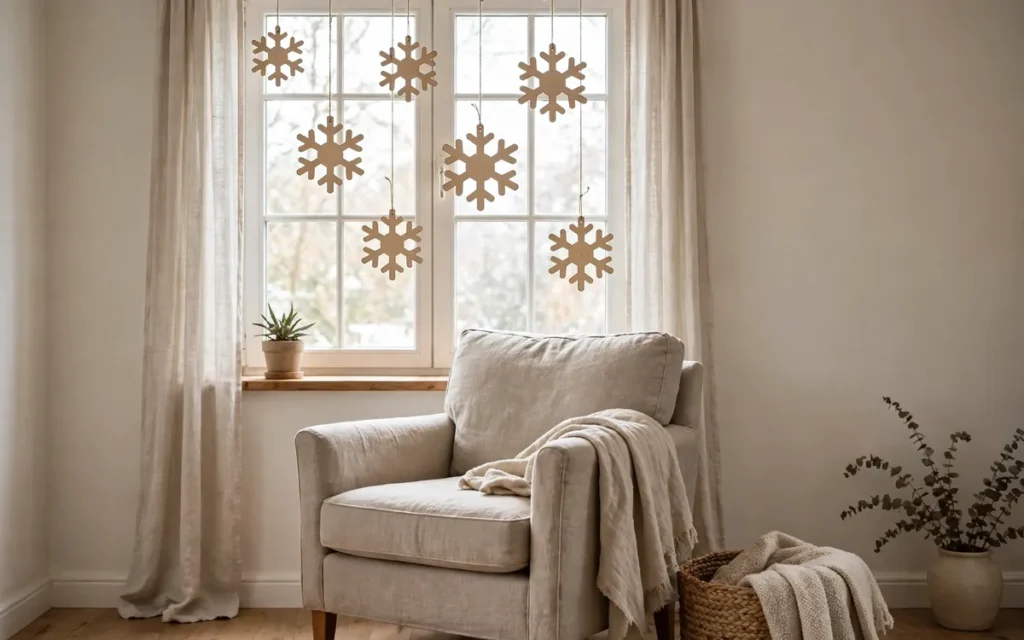
If one seasonal symbol survives January, let it be this one: plain wooden snowflakes, hung in the window at different heights on clear thread or fine ribbon. Snowflakes belong to winter, not to Christmas — no colour, no glitter, no wording — and against the early dark they are the room’s one moment of play.
Hang an odd number, three or five, at slightly different depths so lamplight throws soft shadows on the glass. Keep them above the sill and clear of curtain fabric when the curtains draw at dusk. When spring comes they store flat in a single envelope, which is more than can be said for most decorations.
30. Finish with the Five-Minute Evening Reset

This is the idea that makes the other twenty-nine survive the season. Once a night — while the kettle boils or the doors are locked — reset the room: throws folded back to their arms or the basket, cushions plumped and returned to their formula, the coffee table cleared back to half, remotes in the lidded basket, the low lamps and candles lit or lit-ready for the evening.
Five minutes, attached to a routine that already exists, is what separates a layered room in March from a layered room that collapsed in January. Winter coziness is not maintained by big tidy-ups. It is maintained by never letting one evening’s comfort become the next morning’s clutter.
Winter Living Room on a Budget
Spend in this order, because the cheapest layers do the most work. Free — shop your own home first: swap cushion covers and throws between rooms, move a lamp from a bedroom to the reading corner, restyle the mantel and shelves from pieces already owned, and pull the seating into its tighter circle. Half of this article costs nothing but an hour.
Small spends that change the room: cushion covers rather than new cushions, warm-white bulbs for every lamp, one genuinely good throw for the main seat, flameless candles for the spots flames cannot go, and secondhand baskets and bowls — woven and wooden pieces are plentiful and cheap used, and winter styling forgives wear.
Bigger spends, only if the base layer is missing: the correctly sized rug and lined curtains. These are the two purchases that change how the room actually feels — warmer floor, warmer glass — and both are bought once and used every winter for years. The rule for all of it: buy year-round pieces in winter colours, never winter-only novelties that will embarrass the room by February.
Mistakes That Make a Winter Living Room Feel Wrong
- Leaving Christmas in place because the colours are warm. Red cushions, glitter and worded pieces are festive signals, not warmth. The room reads “decorations still up” instead of “winter”, whatever the palette underneath.
- Lighting the whole room from one bright overhead fixture. A single ceiling light flattens every layer you built. Three low sources at warm-white temperature are the entire fix.
- Layering without homes. Throws and cushions with no basket, ladder or lidded box become clutter by the second week. The layers are not the problem; the missing storage is.
- A rug that floats. A small rug parked in front of the sofa anchors nothing and chills the seating zone. Front legs of every seat on the rug — that is the rule that makes it work.
- Candles beside fuel. Flames set next to throws, cushion fabric, trailing greenery or a wooden bowl of pinecones, in a room styled for a whole season of evenings.
- Blocking the heat. A sofa, blanket basket or curtain pushed against a radiator or heater vent keeps the warmth from the room and creates a hazard of its own.
- Every surface at the same height. With no high, middle and low rhythm, even good pieces read flat. Vary the heights and the room gains depth for free.
- Buying furniture for a textile problem. A cold, hard-looking room is almost never a furniture problem. Covers, layers, light and layout solve it at a tenth of the cost.
Winter Living Room Safety Notes
A layered living room is a room full of soft, dry, warm things arranged around heat and light, so the safety rules deserve the same care as the styling ones. Start with the fireplace: keep furniture, baskets, log stacks and throws well back from a working fire — about 90 cm (3 ft) is a sensible working clearance — store logs beside the hearth rather than on its hot edges, use a fireguard where children or pets share the room, and never leave a fire or stove burning unattended or overnight. Treat candles with the same respect, because a winter room gives them their longest season of the year: never leave one burning in an empty room, stand every candle on a stable, heat-safe holder, and keep flames away from greenery — which dries week by week all winter and becomes more flammable, not less — as well as from curtains and the edges of throws. A candle inside a wooden bowl or on a wood slice belongs in a glass holder with clear space around it, or it should be flameless.
Space heaters and heated throws need the same discipline as open flame. Give a space heater the same roughly 90 cm (3 ft) of clear space on all sides, stand it on hard floor rather than deep rug pile, never drape anything over or near it, switch it off when the room empties, and plug it directly into a wall socket rather than an extension lead. Use a heated throw flat, never folded or bunched while switched on, put it on a timer, and keep it from pets that chew. Cords are the quiet risk in a layered room: lamp and heater cords should never run under rugs, where heat builds up and wear goes unseen, and never where throws can smother them. Any fairy-light strand relocated from the tree gets inspected before its second life on a shelf — crushed or cracked sections are retired, not taped. Finally, in any home using real fires, stoves or gas heating, working smoke and carbon-monoxide alarms are part of the room’s equipment: check them at the start of the season rather than assuming they work.
Frequently Asked Questions
How do I make my living room cozy for winter without it looking like Christmas?
Build the coziness from texture, warmth and light instead of seasonal symbols. Keep the greenery but strip it of ornaments, ribbon and red; swap festive cushions for knit, velvet and faux fur in creams and deep neutrals; and light the room low and warm. If a piece would look out of place in a February photograph, it is a Christmas piece, whatever its colour.
What colours work best in a winter living room?
A warm neutral base — cream, oatmeal, soft white and natural wood — carries the room, deepened by one darker tone used sparingly: charcoal, chocolate, deep forest or burgundy, repeated three times (Idea 28) so it reads as a scheme. Cool greys and blue-whites fight the warm lighting and make textiles look tired; warm neutrals under 2700–3000K light do the opposite.
How can I make a small living room feel cozy for winter without clutter?
Layer up, not out. One rug large enough to anchor the seating, one throw per seat, the cushion formula kept to the small end, one warm lamp plus flameless candles, and a mirror to bounce the light you have. The layout discipline behind these small living room decorating ideas — pieces pulled in, surfaces kept half clear — carries straight into winter; what changes is only the palette and the symbols.
What can be the focal point of a winter living room if there is no fireplace?
Build one, as Idea 11 sets out: a console or low cabinet with a mirror above it and lanterns or pillar candles where flames would sit, the top of the arrangement at roughly mantel height. A styled coffee table or a proper reading corner can also anchor a small room. What matters is that the seating faces something warm and deliberate.
How do I stop throws and cushions from making the room look messy?
Give everything a home and a habit. Every throw has a basket, arm or ladder it returns to; spare cushions live in the basket, not on the floor; small clutter goes in one lidded basket; and the five-minute evening reset (Idea 30) puts it all back nightly. Layers only become mess when they have nowhere assigned to be.
How long can winter living room decor stay up?
From the Christmas takedown in January until the first spring signals — usually early March. The neutral, natural pieces are the ones that last the distance: greenery, wood, candles, knit and wool read as “late winter” long after anything glittered would have expired. When daylight starts arriving before the lamps switch on, the season is telling you it is over.
The living room’s glow starts at the fireplace — these winter mantel decor ideas compose the mantel as one calm picture, with the same anchor, rhythm and glow method this room uses.
The room’s focal wall has one more version worth planning properly: if the screen hangs over the fireplace, our tv above fireplace ideas test the wall’s heat, solve the viewing angle and style the mantel under the screen.
Winter is this room turned all the way up. Underneath the heavy throws and the candlelight sits a year-round system — warm 2700K light at three heights, one rug the seating actually stands on, and three textures within reach of every seat — and it works in every season, not just the cold ones. That system, with 24 ideas for rooms of every size, is our guide to cozy living room ideas.
Conclusion
Winter coziness in this room is a system, not a shopping list: a base that anchors the seating, warmth layered in a fixed order, glow at three heights, and one small nightly habit that keeps it all tidy. The 30 winter living room ideas above are that system opened out piece by piece, so you can start wherever your room is weakest. Pick one layer this week — most readers should start with the light — and let the room build from there. And when you are ready to carry the same calm through the rest of the house, the whole-home edit is waiting in the article linked at the top. Save this one for the January evenings; it will still be working in March.



5 Comments